Is big tech going all in on nuclear? Google and Microsoft have just pledged $45 billion on renewables
Sophie Vorrath, Dec 13, 2024, Renew Economy
https://reneweconomy.com.au/is-big-tech-going-all-in-on-nuclear-google-and-microsoft-have-pledged-45-billion-spend-on-renewables/
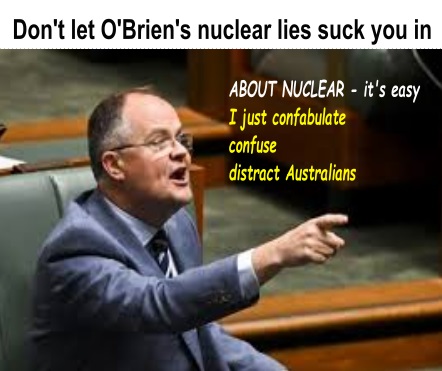
Did you hear the one about big tech going nuclear? One of the lines being trotted out in support of nuclear power by shadow energy minister Ted O’Brien – and faithfully reproduced by the Murdoch press – is that everyone’s doing it, including global tech giants Google and Microsoft.
“Not only does Labor claim to know the economics of nuclear better than companies like Microsoft who signed a massive nuclear deal, but they also think they can run the numbers better than (US banks and financiers) who have come out in favour of nuclear energy,” O’Brien said in September.
Microsoft did announce, in September, a 20 year power purchase agreement with Constellation Energy to reboot one unit at the mothballed Three Mile Island nuclear power plant in Pennsylvania and rebadge it as the Crane Clean Energy Centre.
Three Mile Island was, in 1979, the site of the worst commercial nuclear power accident in US history. It was shuttered in 2019 for economic reasons, with Constellation’s then parent company Exelon Corp, saying in 2017 that its closure was due to lack of financial rescue from the state.
This is not unusual. According to TechCrunch, in the last decade, seven nuclear reactors have been decommissioned in the US, while only two new ones have been switched on.
Notwithstanding the fact that restarting a nuclear plant that has been shut down for five years has never been done before (according to reports, Constellation Energy is reportedly seeking a taxpayer-subsidised loan it hopes will save it $122 million in borrowing costs) this somewhat baffling deal is expected to supply around 850 MW.
Google, meanwhile, in October announced plans to invest in small modular reactors to meet its own growing data centre needs and Amazon followed suit, with news of “three new agreements to support the development of nuclear energy projects,” again with a focus on the the as-yet commercially unproven SMR technology.
So, yes – all three of these companies have recently announced plans to invest in nuclear power – albeit in markets where it already exists (although not in the case of SMRs) and in technology and applications that are highly speculative.
Does this mean they have come over all Team Nuclear? Hardly.
Amazon, as it bragged in October, has been the largest corporate purchaser of renewable energy in the world for four years running, according to Bloomberg NEF, having invested billions of dollars in more than 500 solar and wind projects globally, which together are capable of generating enough energy to power the equivalent of 7.6 million US homes.
Amazon met its goal of sourcing 100% of the electricity its uses with renewable energy in 2023 – seven years ahead of the 2030 target.
Google announced just this week that it was funding $US20 billion ($A31 billion) worth of renewable power projects across the US, in a deal with Intersect Power and investment fund TPG Rise Climate to develop power to drive several gigawatt-scale data centers.
Microsoft, last week, joined a US investor Acadia Infrastructure Capital and other companies to launch the Climate and Communities Investment Coalition (CCIC) to develop a $US9 billion ($A14 billion) pipeline of renewable energy projects across the country, as reported in Reuters.
On its website, Microsoft says it invested in over 23.6 million megawatt-hours of renewable energy in 2023 financial year – “enough to power Paris with renewable electricity for about two years.”
Earlier this year, the company announced plans to procure some 9.5GW of solar panels from Qcells for PPAs through 2032 – adding about 1.5GW every year. In April Microsoft revealed in a job listing that it had more than 20GW of renewable energy under contract.
US Backs Israel’s Land Grab in Syria

The State Department framed Israel’s incursion into Syrian territory as ‘self-defense’
by Dave DeCamp December 9, 2024. https://news.antiwar.com/2024/12/09/us-backs-israels-land-grab-in-syria/
On Monday, the US State Department backed Israel’s seizure of territory in Syria that came after the collapse of the government of former Syrian President Bashar al-Assad, framing it as a defensive action.
Israel seized a buffer zone between the Israeli-occupied Golan Heights and the rest of Syria’s territory that was established in 1974 and also captured several areas beyond the zone. When asked about the land grab, State Department spokesman Matt Miller said it was important to put the situation in “context.”
“First of all, the Syrian army abandoned its positions in the area around the negotiated Israeli-Syrian buffer zone, which potentially creates a vacuum that could have been filled by terrorist organizations that would threaten the state of Israel and would threaten civilians inside Israel. Every country has the right to take action against terrorist organizations,” Miller said.
Miller also insisted the Israeli occupation of the land was temporary. “The second thing that is important is that Israel has said that these actions are temporary to defend its borders. These are not permanent actions,” he said.
Also on Monday, Israeli Prime Minister Benjamin Netanyahu declared the Golan Heights would be Israel’s “forever,” although it’s unclear if he was referring to the recently-captured territory.
Several Arab countries, including Iraq, Saudi Arabia, and Qatar, strongly condemned the Israeli seizure of Syria’s territory. The Qatari Foreign Ministry said it considered the move “a dangerous development and a blatant attack on Syria’s sovereignty and unity as well as a flagrant violation of international law.”
Saudi Arabia said the land grab confirmed “Israel’s continued violation of the rules of international law and its determination to sabotage Syria’s chances of restoring its security, stability and territorial integrity.”
The buffer zone Israel captured is patrolled by a UN peacekeeping force known as UNDOF, and there are signs Israel was looking to make a move in the area before Assad’s collapse.
The Associated Press reported that Israel began construction along the buffer zone in September, citing satellite images. After the report, UNDOF warned that Israel was committing “severe” violations of the deal with Syria that established the buffer zone.
Trump and Nuclear Energy: There Are Questions
By James Pethokoukis, October 29, 2024 https://www.aei.org/economics/trump-and-nuclear-energy-there-are-questions/?fbclid=IwY2xjawHFoTFleHRuA2FlbQIxMQABHQxPhKajCptbr5dJgCAd1ZhE0x5OIXLC1-lH_txOvx1zcexr7tF8oqHmYQ_aem_Nlh9f2T4vRa-IsURORqqrA
The 2024 GOP platform from the Republican National Convention promises that “Republicans will unleash Energy Production from all sources, including nuclear, to immediately slash Inflation and power American homes, cars, and factories with reliable, abundant, and affordable Energy.” And much the same message from the party’s presidential nominee:
Starting on day one, I will approve new drilling, new pipelines, new refineries, new power plants, new reactors and we will slash the red tape. We will get the job done. We will create more electricity, also for these new industries that can only function with massive electricity.
But what does that scenario look like, exactly? Trump addressed the issue during his recent podcast with Joe Rogan. As reported by E&E News:
Trump told Joe Rogan in an interview released Friday that he thought projects to build more of the large nuclear reactors currently on the grid, while “very clean,” have a tendency to be complex and to go over budget. He also expressed concern over the energy source’s safety implications. “They get too big, and too complex and too expensive,” Trump said of U.S. nuclear reactors. “I think there’s a little danger in nuclear.” … On Rogan’s show, Trump said two failed nuclear projects were evidence of why large reactors may not be the answer to meeting energy demand, likely referencing the Bellefonte Nuclear Station in Hollywood, Alabama, and the V.C. Summer nuclear plant near Jenkinsville, South Carolina. “They did one in Alabama. They did one in, I think, South Carolina. They do them wrong,” Trump said. “They build these massive things. Then the environmentalists get in.” Trump pointed to small modular reactors as a potential answer to long-running cost concerns surrounding the energy source. He believes that smaller reactors, which can be built in a factory, could avoid the complexities associated with large reactors.
As the piece correctly points out, none of the two dozen or so nuclear reactors that generate two-thirds of French energy are SMRs, a technology that optimists hope will be deployed by decade’s end. Those optimists include mega-retailer Amazon, which recently announced it was partnering with Dominion Energy to explore building a small modular reactor near Virginia’s North Anna nuclear plant. The project aims to support Amazon Web Service’s growing clean energy needs, particularly for AI operations. What’s more, Amazon is hardly the only tech company interested in nuclear to power its data centers, as the chart below [on original] outlines:
But Trump’s vote for nuclear energy abundance seems to conflict with his distaste for the Inflation Reduction Act (IRA)—despite the considerable IRA funding going to red states—which includes substantial nuclear power incentives, including a production tax credit for existing plants, investment tax credits for new nuclear projects, and support for advanced reactor development and nuclear-powered hydrogen production. That framework might change if Trump wins a second term, but it also seems likely that expanded nuclear power in the US “will require public-private collaboration, regardless of whether we decide to focus on building conventional reactors or next-gen designs,” as energy analyst Thomas Hochman told me back in July. For what it’s worth, some professional Washington observers think incentives for nuclear have enough GOP support to survive attacks on the IRA should Trump win.
Nuclear waste to be dumped into Cape Cod and turn ocean radioactive

by Lauren Acton-Taylor For Dailymail.Com, 11 Dec 24, https://www.msn.com/en-ca/news/world/nuclear-waste-to-be-dumped-into-cape-cod-and-turn-ocean-radioactive/ar-AA1vG9iC?ocid=msedgntp&pc=HCTS&cvid=8b954ae3ae4e46e9868246df57f356c5&ei=13
he pristine waters off Cape Cod could become radioactive for as long as a month after a new study found that nuclear waste being dumped from the tony peninsula has a ‘high probability’ of lingering.
The Woods Hole Oceanographic Institution conducted the study to find out how likely it would be that discharged wastewater from the Pilgrim Nuclear PowerStation in Plymouth, Massachusetts would spread into Cape Cod Bay, whose surrounding communities include multimillion-dollar mansions.
‘Our numerical simulations suggest it is unlikely that the bulk of plume waters will leave the Bay in less than a month,’ said the study’s leader Irina Rypina.
The dumping comes as part of the power station’s decommissioning, and the study found that its wastewaters could drift near the shores and coastal waters of Dennis, Wellfleet, and Provincetown.  Continue reading
‘If the release were to happen in the spring and summer, a small portion of a plume might leave the bay in less than a month, passing north of Provincetown and then flowing southward along the outer Cape,’ the study said.
‘We found virtually no out-of-the-Bay transport in winter and fall and slightly larger, but still low, probability of some of the plume exiting the Bay in spring and summer,’ Rypina said.
In response to the study, Massachusetts Sen. Ed Markey, who chairs the Senate‘s Environment and Public Works Subcommittee on Clean Air, Climate, and Nuclear Safety, said that the findings confirm concerns expressed by the residents of the Cape.
According to Markey, residents have been questioning the wisdom of dumping plant wastewater into the Bay ‘for years.’
Nuclear wastewater discharge is a normal occurrence during both the operation and decommissioning of power plants, according to the United States Nuclear Regulatory Commission.
‘The controlled release of liquid effluents at nuclear power plants, within specified regulatory limits, is an activity that occurs throughout the operation and decommissioning of a facility,’ said the NRC.
While the study did not explore the health risks that such a dump could pose to marine life or local fishing or recreation, a 2023 analysis by Florida-based Holtec International, the plant’s owner, and the Massachusetts Department of Public Health included alarming findings.
It determined that the roughly 900,000 gallons of wastewater stored at Pilgrim is contaminated with ‘four gamma emitters (Maganese-54, Cobalt-60, Zinc-65 and Cesium-137) and Tritium (H-3 a beta radiation emitter).’
A spokesperson for Holtec told the Boston Herald that Pilgrim had ‘safely’ discharged millions of gallons of water over the decades with little environmental impact.
‘Those discharges were done within the safe federal and state limits and reported to the NRC and publicly available on their website.
‘This includes studies to determine any potential impact to sea life and the Bay which showed that safety has always remained, and plant impact has been negligible,’ the spokesperson told the outlet.
The Pilgrim Nuclear Power Station shut down in May 2019 after 47 years of operation and was then owned by Louisiana-based Entergy Corporation. The plant was purchased by a subsidiary of Holtec in 2019 with an aim toward cleaning up the 1,700-acre site for industrial and commercial development, according to the Herald.
When the plant was bought, Holtec President and CEO Kris Singh assured residents that the project would ‘replicate the superb record of public health and safety and environmental protection that typified the plant’s 47 years of operations.’
In a statement, Markey said that Singh had promised both the senator and impacted communities that the process of decommissioning would be ‘open and transparent.’
‘In the years since, Holtec has fallen woefully short on this commitment. In light of these recent findings, I urge Holtec to develop a wastewater discharge plan that is informed and guided by scientific fact and community input,’ Markey said.
Local residents have continued to show concern for the wastewater dumping into Cape Cod Bay – identified as a’ protected ocean sanctuary’, according to the Massachusetts Government website.
The state Department of Environmental Protection determined on July 18 that Holtec was prohibited from ‘the dumping or discharge of industrial wastes into protected state waters’, the Cape Cod Times reported.
Holtec is reportedly hoping to discharge up to 1.1 million gallons of industrial wastewater and filed an appeal to the agency’s prohibition on August 16.
In a statement, the company said: ‘The appeal explains that the permits granting liquid discharge were issued prior to the Ocean Sanctuary Act legislation, which grandfathers these types of liquid discharges.’
Hitting Iran now could halt its nuclear plan
Tehran is exposed and may rush to get the bomb. The West should give it a short, sharp shock.
Rafael Grossi, director of the International Atomic Energy Agency (IAEA), said the
other day Iran was “dramatically” accelerating uranium enrichment to 60
per cent, a short hop away from the 90 per cent needed for weapons grade.
There was no civilian programme that could justify such a move.
Indeed, no other country has done so without in the end producing nuclear weapons. The
IAEA calculates that Iran already has enough 60 per cent purity stock to
upgrade into four nuclear weapons. The collapse of Iran’s proxies, the
flimsy nature of Russian support for the regime, the erosion of Iranian air
defence and the imminent arrival in the White House of Donald Trump point
to the possibility of a galloping nuclearisation by the regime and a
pre-emptive strike by Israel.
Times 10th Dec 2024 https://www.thetimes.com/comment/columnists/article/hitting-iran-nuclear-plan-tehran-exposed-78qhk5jzf
Atomic revival: A new age for nuclear?
This week, the Tony Blair Institute for Global Change released a report
declaring, “a new nuclear age is beginning,” arguing that nuclear power
is critical in meeting global climate goals. But how is this renaissance
different from earlier proclamations of an atomic revival?
In this episode, Richard talks with report co-author Tone Langengen about the case for a
nuclear revival and the hurdles still in its way. Joining the discussion is
nuclear expert Paul Dorfman, who questions whether nuclear can truly
compete with renewables. They cover the potential of small modular reactors
(SMRs), the challenges of cost overruns, and whether nuclear and renewables
can work together to create a resilient, low-carbon grid.
Montel 6th Dec 2024
https://montelnews.com/multimedia/montel-weekly
Drone strikes UN vehicle on way to inspect Ukrainian nuclear plant
An armored vehicle belonging to the UN’s atomic watchdog was hit by a
drone strike on its way to inspect a Ukrainian nuclear power plant on
Tuesday, in an attack President Volodymyr Zelensky has blamed on Russia.
The strike took place as the vehicle traveled in a convoy to the
Zaporizhzhia Nuclear Power Plant, as part of efforts by the International
Atomic Energy Agency (IAEA) to safeguard the facility amid fears it could
be caught in the crossfire of Russia’s war on Ukraine, sparking a nuclear
disaster. The IAEA said the strike destroyed the back of its armored
vehicle but the two people on board were not harmed.
CNN 10th Dec 2024 https://edition.cnn.com/2024/12/10/europe/drone-attack-iaea-ukraine-russia-intl-latam/index.html
‘Shambolic’ plans for Severn saltmarshes blasted
EDF’s “shambolic” attempt to “wriggle out of” installing a key
eco-saving measure at Hinkley Point C nuclear power plant has been blasted
by a wildlife charity amid fears it could lead to an ecological disaster in
the Severn Estuary. In a series of shambolic engagement events with local
communities, EDF has failed to make a clear case for the removal of the AFD
or provide evidence for why the proposals would adequately compensate for
the types of fish that will be killed, according to the Gloucestershire
Wildlife Trust.
The trust says the energy firm has effectively destroyed
community support for these alternative measures through a ham-fisted
approach to landowners that threatened compulsory purchase to acquire the
land to enable habitat restoration.
Gloucestershire Gazette 10th Dec 2024 https://www.gazetteseries.co.uk/news/24782581.shambolic-plans-severn-saltmarshes-blasted/
Fears nuclear power ‘may stop people moving to the bush’

Stephanie Gardiner, 12 Dec 24, https://www.afr.com/policy/energy-and-climate/fears-nuclear-power-may-stop-people-moving-to-the-bush-20241211-p5kxn2
Regional Australia is having its “phoenix moment” as more people move to the bush, according to a local councillor, but some residents fear the Coalition’s nuclear plan could hinder growth and prosperity.
The Coalition has earmarked seven sites for nuclear reactors at former and closing coal power plants across Australia, including at Lithgow’s Mount Piper power station in central west NSW.
Tom Evangelidis, who sits on Lithgow City Council, told a parliamentary inquiry his family moved to the town at the foot of the NSW Blue Mountains four years ago for its affordability and proximity to Sydney.
The presence of a nuclear reactor could dissuade others from settling in the region at a time when it is planning a bright future, Mr Evangelidis told the parliamentary committee sitting in Lithgow on Wednesday.
“This is our phoenix moment,” he said, referring to the mythical creature that rises from the ashes as a symbol of renewal and progress. “Nuclear in our region will stop that.”
Opposition Leader Peter Dutton has pledged to release the costings of his nuclear plan soon, having slammed an experts’ report that showed solar and wind remained the cheapest forms of energy.
Mount Piper operator EnergyAustralia has plans for a 500-megawatt battery energy storage system adjacent to the site, while also looking into pumped hydro at nearby Lake Lyell.
Further west near Dubbo, there is a proposed Renewable Energy Zone, with 4.5 gigawatts of potential capacity through solar, wind and new transmission infrastructure.
Peter Hennessy, who lives on a property at Bathurst, said communities have been left “high and dry” by planning laws and consultation on renewable projects.
“[Energy Minister Chris Bowen] would have solar everywhere, couldn’t care less about the countryside at all,” Mr Hennessy said.
“[It’s] just an absolute disgrace and total disregard to the welfare of the land or the people surrounding or indeed anywhere else.”
Jim Blackwood, a retired GP and vice president of the Bathurst Community Climate Action Network, said it was redundant to debate the pros and cons of nuclear because it would take too long to establish.
“The issue is we need to do something now, and we need to do it in a time frame that is going to make a difference,” Dr Blackwood told the hearing.
Lithgow is at the front line of climate change tensions, facing the end of its economic base in the fossil fuel industry while also recovering from the Black Summer bushfires.
“Four years ago, this whole town was surrounded by an inferno, a raging inferno,” Dr Blackwood said.
“All the hills were a fire, and so those two things are basically what’s confronting all of us.”
The inquiry is due to sit in Sydney on Thursday.
World War II airplanes to blame for radiation halting work on SSEN cable near Dounreay
The radioactive contamination that has suspended work on a
high voltage cable between Orkney and Caithness is being linked to wartime
aircraft. Work on part of the mainland link of SSEN Transmission’s new
cable was halted because of the presence of radioactive contamination.
John O’Groat Journal 9th Dec 2024
https://www.johnogroat-journal.co.uk/news/world-war-ii-airplanes-to-blame-for-radiation-halting-work-o-368483/
Why is Israel attacking Syria?
What does Israel gain by attacking Syria in the wake of al-Assad’s overthrow?
Aljazeera, By Justin Salhani and Simon Speakman Cordall, 11 Dec 2024
After the fall of Syria’s Bashar al-Assad, Israel has been encroaching on its neighbour’s territory.
Since al-Assad’s dramatic flight to Russia on Sunday, Israel has attacked Syria more than 400 times and, despite UN protests, launched a military incursion into the buffer zone that has separated the two countries since 1974.
…………………………….Israel has justified its attacks on Syria for years by claiming it is eliminating Iranian military targets. However, Iran has said none of its forces are currently in Syria.
Now, Israel says it is focused on destroying Syrian military infrastructure.
Israel claims that it is trying to stop weapons from landing in the hands of “extremists”, a definition it has applied to a rotating list of actors, most recently Hayat Tahrir al-Sham (HTS), the primary Syrian opposition group that led the operation to overthrow al-Assad.
srael has also deployed military units to the buffer zone along the Golan Heights separating Syria and Israel. The terrain has been an officially designated demilitarised zone as part of a 1974 UN-brokered ceasefire deal.
Israel occupies approximately two-thirds of the Golan Heights, with the UN-administered buffer zone spanning a narrow, 400-square-kilometre (154-sq-mile) area. The rest has been controlled by Syria.
Syrian security forces have also reported Israeli tanks advancing from the Golan Heights into Qatana, 10km (six miles) into Syrian territory and close to the capital.
Israeli military sources have denied any such incursion……………………………………….
What is Israel’s justification for this latest attack on a sovereign nation?
That it is acting in its defence.
Benjamin Netanyahu told reporters on Monday that the former Syrian territory along the Golan Heights, which has been classed as a demilitarised zone since 1974, would remain part of Israel “for eternity”.
Israeli Foreign Minister Gideon Sa’ar has defended the Israeli strikes since Sunday, saying Israel’s intention had been solely to target suspected chemical weapons sites and long-range rocket sites – to prevent their seizure by armed groups opposed to Israel’s ongoing offensives on its neighbours.
At a briefing for foreign media, Sa’ar said Israel was acting “in a precautionary manner”.
What does Israel want from Syria?
That’s not clear yet.
The government has not made any statements outside of “acting in the interest of Israel’s defence” that could indicate its intent.
However, some prominent Israeli figures have spoken about their views of what should happen next…………………..more https://www.aljazeera.com/features/2024/12/11/israel-attack-syria-explainer
Canada considers financing for Polish nuclear power plant

Tuesday, 10 December 2024 https://www.world-nuclear-news.org/articles/canada-considers-financing-for-polish-nuclear-power-plant
Polskie Elektrownie Jądrowe announced it has received a letter of intent from Export Development Canada, for up to CAD2.02 billion (USD1.45 billion) to potentially support Poland’s first nuclear power plant project.
The letter of intent with Export Development Canada (EDC) – a Canadian Crown corporation – is in support of the sale of goods and services by Canadian suppliers. EDC support is subject to the successful completion of its detailed due diligence process and credit approval.
Westinghouse – jointly owned by Canadian firms Brookfield and Cameco – welcomed the signing of the letter of intent, which it said it helped facilitate.
“Not only does this financing agreement underscore the important role Canada will play in helping Europe secure and diversify its energy future, but it will also help prepare the nation’s nuclear supply chain to support the next AP1000 plant in North America,” said Westinghouse Energy Systems President Dan Lipman. “We appreciate the close cooperation of the EDC in helping Westinghouse make AP1000 projects a reality for its customers while bringing home economic benefits to Canada.”
Westinghouse said the announcement demonstrates its “deep commitment to Canada’s economy by securing work for Canadian firms and trade unions supporting Westinghouse’s global fleet of advanced reactors”. For each AP1000 unit that is built outside of Canada, Westinghouse says it could generate almost CAD1 billion in gross domestic product through local suppliers.
Last month, the US International Development Finance Corporation – the USA’s development bank – signed a letter of interest with Polskie Elektrownie Jądrowe (PEJ) to provide more than USD980 million in financing for Poland’s first nuclear power plant. A similar declaration, for the equivalent of about PLN70 billion (USD17.3 billion), was made earlier by the US Export-Import Bank. Westinghouse and Bechtel jointly form a consortium that implements the PEJ investment project in Pomerania.
“We are pleased to see strong interest in our investment project from leading players in the global financial market, with whom we are in constant contact. The letter of intent from Export Development Canada is another confirmation of this fact, and at the same time our next step towards implementation of the strategy for obtaining financing for the entire project,” said PEJ Vice President Piotr Piela.
PEJ said: “Cooperation with export credit agencies is an important part of the strategy for securing financing for the nuclear power plant in Pomerania – it involves continuing discussions with, among others, entities from countries with extensive nuclear supply chains, in order to maximise and optimise financing opportunities for this key investment project for Poland.”
In November 2022, the then Polish government selected the Westinghouse AP1000 reactor technology for construction at the Lubiatowo-Kopalino site in the Choczewo municipality in Pomerania in northern Poland. An agreement setting a plan for the delivery of the plant was signed in May last year by Westinghouse, Bechtel and PEJ – a special-purpose vehicle 100% owned by Poland’s State Treasury. The Ministry of Climate and Environment in July issued a decision-in-principle for PEJ to construct the plant. The aim is for Poland’s first AP1000 reactor to enter commercial operation in 2033.
Under an engineering services signed in September last year, in cooperation with PEJ, Westinghouse and Bechtel will finalise a site-specific design for a plant featuring three AP1000 reactors. The design/engineering documentation includes the main components of the power plant: the nuclear island, the turbine island and the associated installations and auxiliary equipment, as well as administrative buildings and infrastructure related to the safety of the facility. The contract also involves supporting the investment process and bringing it in line with current legal regulations in cooperation with the National Atomic Energy Agency and the Office of Technical Inspection.
In September, the Polish government announced its intention to allocate PLN60 billion to fund the country’s first nuclear power plant.
1 This Month

of the week – Shut Down Drone Warfare!


Tell the Ukrainian Government to Drop Prosecution of Peace Activist Yurii Sheliazhenko

Petition to revoke the licensing of the Near Surface Nuclear Disposal Facility (NSDF) at Chalk River. https://www.ourcommons.ca/petitions/en/Petition/Details?Petition=e-7247
To see nuclear-related stories in greater depth and intensity – go to https://nuclearinformation.wordpress.com
-
Archives
- April 2026 (79)
- March 2026 (251)
- February 2026 (268)
- January 2026 (308)
- December 2025 (358)
- November 2025 (359)
- October 2025 (376)
- September 2025 (257)
- August 2025 (319)
- July 2025 (230)
- June 2025 (348)
- May 2025 (261)
-
Categories
- 1
- 1 NUCLEAR ISSUES
- business and costs
- climate change
- culture and arts
- ENERGY
- environment
- health
- history
- indigenous issues
- Legal
- marketing of nuclear
- media
- opposition to nuclear
- PERSONAL STORIES
- politics
- politics international
- Religion and ethics
- safety
- secrets,lies and civil liberties
- spinbuster
- technology
- Uranium
- wastes
- weapons and war
- Women
- 2 WORLD
- ACTION
- AFRICA
- Atrocities
- AUSTRALIA
- Christina's notes
- Christina's themes
- culture and arts
- Events
- Fuk 2022
- Fuk 2023
- Fukushima 2017
- Fukushima 2018
- fukushima 2019
- Fukushima 2020
- Fukushima 2021
- general
- global warming
- Humour (God we need it)
- Nuclear
- RARE EARTHS
- Reference
- resources – print
- Resources -audiovicual
- Weekly Newsletter
- World
- World Nuclear
- YouTube
-
RSS
Entries RSS
Comments RSS
 nuclear-news