Just Don’t Mention (or Measure) the Pu (Plutonium)
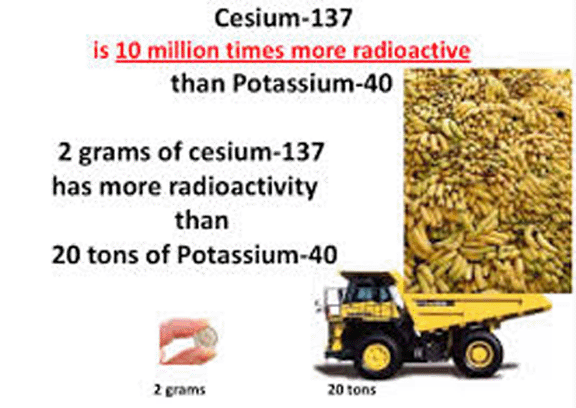
Cs-134 usually appears (at first) in similar amounts as Cs-137, as both are fission wastes………. With regard impact on human health cesium–134 (Cs-134) is extremely serious along with cesium-137 (Cs-137) the longer lived isotope which also present on Cumbrian beaches
By mariannewildart, Radiation Free Lakeland 30th Nov 2024, https://mariannewildart.wordpress.com/2024/11/30/just-dont-mention-or-measure-the-pu-plutonium/
Josh MacAlister MP for Sellafield (sorry Whitehaven and Workington) bigs up the “Good” status of Seascale and “Excellent” status of St Bees bathing water sites.
The bad news is that the criteria for bathing water quality in the UK does not include radioactive pollution – a bad case of the three wise monkeys “see no evil..”
Our own citizen science findings indicate radioactive wastes are a now an insidious and homogeneous part of West Cumbria’s beaches courtesy of the nuclear industry’s routine and accidental discharges to the Irish Sea.
Our own surveys and testing has shown that Caesium 134 is present along with Americium 241. Cs-134 has a short half life of only 2 years which is counter to the already disingenuous claims that the discharges (some very long lived) are “historic..” Cs-134 usually appears (at first) in similar amounts as Cs-137, as both are fission wastes. This implies that this Cs-134 was produced in a nuclear reactor about eight years ago. With regard impact on human health cesium–134 (Cs-134) is extremely serious along with cesium-137 (Cs-137) the longer lived isotope which also present on Cumbrian beaches. In nature, caesium exists only as a non-radioactive (or stable) isotope known as cesium-133. Americium 241 does not exist in nature and is a decay product of Plutonium.
The UK Health Security Agency have stated the risk of the public encountering a radioactive particle is “very low” but this is contested . In reality the ongoing risks are unacceptable and set to increase with new development plans such as proposed new nuclear and a Geological Disposal Facility for heat generating nuclear wastes both of which would cause likely disruption to the fragile Cumbrian Mud Patch through subsidence and induced earthquakes.
Campaigners point out that children and young women of childbearing age are most at risk of health impacts from encountering a radioactive particle. “Inadvertent ingestion of a particle will result in the absorption to blood of a small proportion of the radionuclide content of the particle. The subsequent retention of radionuclides in body organs and tissues presents a potential risk of the development of cancer.” Health risks from radioactive particles on Cumbrian beaches near the Sellafield nuclear site by John D Harrison et al 2023.
No comments yet.
1 This Month
Chernobyl: The Lost Tapes – A good documentary on Chernobyl on SBS available On Demand for the next 3 weeks– https://www.sbs.com.au/ondemand/tv-program/chernobyl-the-lost-tapes/2352741955560

of the week–London Campaign for Nuclear Disarmament

Tell the Ukrainian Government to Drop Prosecution of Peace Activist Yurii Sheliazhenko
To see nuclear-related stories in greater depth and intensity – go to https://nuclearinformation.wordpress.com
-
Archives
- April 2026 (139)
- March 2026 (251)
- February 2026 (268)
- January 2026 (308)
- December 2025 (358)
- November 2025 (359)
- October 2025 (376)
- September 2025 (257)
- August 2025 (319)
- July 2025 (230)
- June 2025 (348)
- May 2025 (261)
-
Categories
- 1
- 1 NUCLEAR ISSUES
- business and costs
- climate change
- culture and arts
- ENERGY
- environment
- health
- history
- indigenous issues
- Legal
- marketing of nuclear
- media
- opposition to nuclear
- PERSONAL STORIES
- politics
- politics international
- Religion and ethics
- safety
- secrets,lies and civil liberties
- spinbuster
- technology
- Uranium
- wastes
- weapons and war
- Women
- 2 WORLD
- ACTION
- AFRICA
- Atrocities
- AUSTRALIA
- Christina's notes
- Christina's themes
- culture and arts
- Events
- Fuk 2022
- Fuk 2023
- Fukushima 2017
- Fukushima 2018
- fukushima 2019
- Fukushima 2020
- Fukushima 2021
- general
- global warming
- Humour (God we need it)
- Nuclear
- RARE EARTHS
- Reference
- resources – print
- Resources -audiovicual
- Weekly Newsletter
- World
- World Nuclear
- YouTube
-
RSS
Entries RSS
Comments RSS
 nuclear-news
Leave a comment