US Congress wants to turn the nuclear regulator into the US industry’s cheerleader—again

the new act does not cite the Atomic Energy Act’s original safety standard of “adequate protection” (Section 182), but rather a watered-down version of “reasonable assurance of adequate protection.” In the law, words matter.
By Victor Gilinsky | November 21, 2024, Victor Gilinsky is a physicist and was a commissioner of the US Nuclear Regulatory Commission during the Ford, Carter, and Reagan administrations. https://thebulletin.org/2024/11/congress-wants-to-turn-the-nuclear-regulator-into-the-us-industrys-cheerleader-again/?utm_source=Newsletter&utm_medium=Email&utm_campaign=ThursdayNewsletter11212024&utm_content=NuclearRisk_NuclearRegulatorIndustryCheerleader_11212024
The US Congress overwhelmingly approved the ADVANCE Act in July to accelerate licensing of “advanced” reactors. These consist mainly of fast reactors, which radically differ from those operating today, and include “fusion machines.” There were no public hearings on the act, and it shows every sign of having been written by interested parties and with little vetting.
The Energy Department and the US nuclear industry are promoting fast reactor demonstration projects, the prime being TerraPower’s Natrium project in Wyoming. The project broke ground in June but still awaits a full construction permit. No commercial reactors of this type are operating today. TerraPower foresees selling hundreds of such reactors for domestic use and export. The new law is largely directed at clearing the way for the rapid licensing of such reactors by the Nuclear Regulatory Commission (NRC). It does so in part by providing additional resources but also—more ominously—by weakening the agency’s safety reviews and inspections in the name of efficiency.
Efficiency over safety. The act’s insidious approach is, first, to direct the NRC to modify its “mission statement” to add a provision that its licensing and safety reviews will “not unnecessarily limit the benefits of nuclear energy to society.” The addition sounds innocuous: No one is going to defend unnecessary work. But the message is clear. To make sure it works its way down to the daily decisions made by NRC’s safety engineers, the act then gives the commissioners one year to supply Congress with a report on what guidance they will provide to the professional engineering staff to “ensure effective performance” under the new mission.
In a bureaucracy, you get what you incentivize for: Congress wants the commissioners to make clear to safety reviewers that every hour they will take is an hour that society will be deprived of nuclear energy (and someone’s grandmother will sit in the dark). This sort of pressure spells trouble. The safety of complex systems with inherent dangers is a subtle trade and requires unbiased attention to avoid serious errors. That is especially true of newly commercialized technology. NRC safety reviews and inspections are especially critical in protecting the public because, with nuclear power, there is no customer feedback loop like there is with, say, commercial flying. If people get worried about flying, they can vote for more safety by not buying tickets. Once a nuclear plant is turned on, there is realistically not much the public can do.
The Energy Department’s web page said the new law would help to “build new reactors at a clip that we haven’t seen since the 1970s.” But the department seems to forget that the 1970s spurt of licensing—encouraged by the commissioners of the old Atomic Energy Commission—resulted in light-water power reactors with many safety problems. These problems were then left for the newly independent NRC to resolve, taking years and leading to considerable expense.
Weaker definition of safety. For Congress to address the mission statement of a federal agency is itself strange. Mission statements, like “vision” statements, are products of business schools and management consultants and are typically brief generalities that hardly anyone pays much attention to. The Energy Department says its mission is “to ensure the security and prosperity of the United States by addressing its energy, environmental, and nuclear challenges.” Congress could have told the department to speed up the reactor development process, but it didn’t. Instead, it acted on the assumption that the stumbling block to a nuclear future lies in the NRC licensing system.
The ADVANCE Act acknowledges the need for the NRC to continue to enforce the safety requirements of the Atomic Energy Act while pursuing the goal of “efficiency.” But in doing so, the new act does not cite the Atomic Energy Act’s original safety standard of “adequate protection” (Section 182), but rather a watered-down version of “reasonable assurance of adequate protection.” In the law, words matter.
The commission has been using that weaker standard of safety for some years—not legitimately, in my view. The new act now validates it. The NRC lamely claims that the additional three words are just explanatory—needed to avoid the implication that “adequate protection” would mean perfect safety—and do not affect the basic standard. But the commissioners don’t dare apply that logic to the security part of the NRC’s responsibilities, which, if they did, would read: “to promote reasonable assurance of the common defense and security.” There is no question that the addition changes the meaning.
Deja vu. For Congress to put the onus on NRC’s safety engineers to speed along the reactors of a yet-untested type is reminiscent of the situation before the 1974 Energy Reorganization Act separated the Atomic Energy Commission (AEC) regulators from the agency’s reactor developers. The 93rd Congress did not give the nuclear regulators independent status out of some concern for administrative neatness. It was done because the AEC commissioners neglected their safety responsibilities. The AEC kept the regulatory staff on a short leash, mainly so that they would not get in the way of the project the commissioners cared most about—as it turns out, also a demonstration fast reactor that was supposed to be followed by hundreds and even thousands of commercial orders. In the end, it all came to nothing. Glenn Seaborg, the then-chairman who was largely responsible for the debacle, would later admit: “[N]one of the [underlying] assumptions proved correct.”
We’ve gone through several iterations of nuclear power over-enthusiasm since the AEC thought fast reactors would soon power the world: The “nuclear renaissance” during the George W. Bush administration was to produce dozens of power reactor orders by 2010; then its Global Nuclear Energy Partnership was going to build fast reactors to burn spent fuel and obviate the need for additional geologic storage; and now fast power reactors are hyped again. None of the earlier expectations worked out. But each time, the certainty of the predictions was used to lean on the regulators to smooth the way. The ADVANCE legislation’s assumption that many orders for fast reactors will soon be coming and that the NRC must be disciplined to avoid a holdup has the makings of another such episode.
Congress’s main concern about the NRC should be that it is an effective protector of public safety.
Nuclear Industry Association members seek to expand into weapons sector
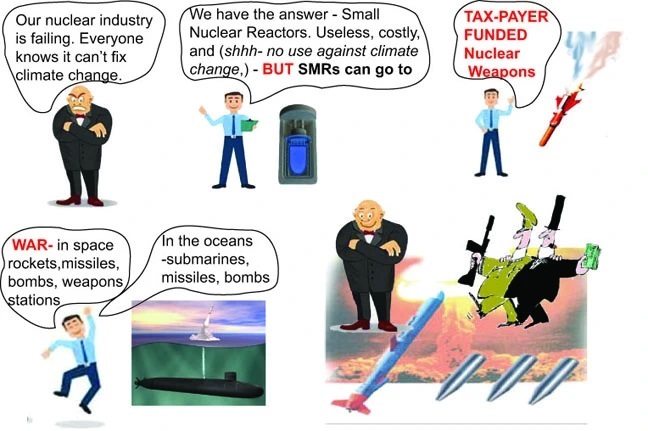
“defence is being seen as a major source of growth for the nuclear industry.”
“If the industry’s hopes for a new generation of civil reactors does not materialise, it could end up being the only source of growth.”
By Tom Pashby New Civil Engineer 22nd Nov 2024
The Nuclear Industry Association (NIA) is exploring ways to aid firms involved in civil nuclear projects to attain opportunities in nuclear weaponry, at the request of its members.
The NIA describes itself as the trade association “for the UK’s civil nuclear industry” and has more than 280 member companies from “across the supply chain to ensure more nuclear power is deployed”.
In a post from the trade association titled Update from NIA Chair Dr Tim Stone, CBE, Stone said he had commissioned an independent review of the scope, work and structure of the NIA “in the context of changes in the sector”.
He pointed in particular to “the advent of Great British Nuclear”, the new government and “the development of greater international and direct industrial interest in nuclear”.

In addition to the trends noted by Stone, construction of Hinkley Point C is well underway and Sizewell C is anticipating a final investment decision in 2025.
Meanwhile, the AUSUK submarine agreement has been , which will see the UK supporting with the building of new nuclear-powered submarines for Australia, has been launched.
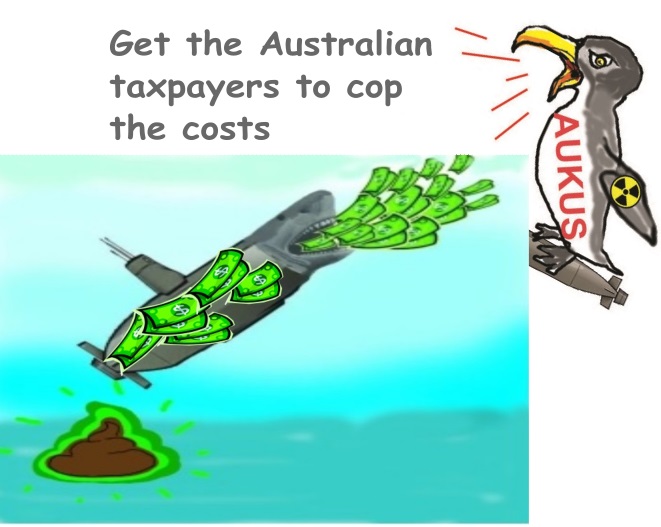
On the UK’s domestic military site, the UK Government is committed to expanding its stockpile of nuclear warheads from 225 to 260 under the Integrated Review 2021.
………………………..One of the areas of interest which NIA members requested more focus on was nuclear weapons and military applications of nuclear power.
…………………. the NIA has run events in partnership with nuclear security technology firm Atomic Weapons Establishment (AWE) “to help engage the wider supply chain in opportunities there”.
Additionally, the NIA is co-ordinating activity with both the aerospace, defence and security trade associations ADS and Make UK Defence “to broaden understanding”, with there being “some exciting initiatives under development aimed at simplifying work across the sector”.
…..AWE was recently renationalised and is responsible for renewing and building new warheads for the UK’s Trident nuclear weapon programme.
…………………..Concerns raised about links between nuclear power and weapons industries

Nuclear industry and weapons experts said the letter is evidence of increasingly close collaboration between the civil nuclear power and nuclear weapons sectors.
University of Sussex professor of science and technology policy Andy Stirling said it “provides yet more evidence of pressures to hide military costs behind supposedly civil nuclear activities”.
“In a recent study funded by the Foreign Office, research showed that resulting added burdens falling on taxpayers and electricity consumers, amount at least to £5bn per year,” Stirling Added.
The study referred to was titled Irreversible nuclear disarmament – Illuminating the ‘UK Nuclear Complex’: Implications of hidden links between military and civil nuclear activities for replacing negative with positive irreversibilities around nuclear technologies and was published by the University of York in March 2024.
Strling went on: “By concealing in this way the full costs of the UK military nuclear industrial base, democracy is undermined, energy strategies misdirected and climate action made slower, more expensive and less effective.”
The Nuclear Information Service (NIS) investigates the UK’s nuclear weapons programme and publishes “accurate and reliable information to stimulate informed debate on disarmament”.
NIS director David Cullen said: “In recent years we’ve seen an increased frankness in defence policy documents about the linkages between the civil and military nuclear sectors, both in terms of skills and supply chains.
“With the [UK’s] new Astrea warhead programme gathering steam, and working beginning on AUKUS, it’s unsurprising that defence is being seen as a major source of growth for the nuclear industry.”
The A21/Mk7 or Astraea is the next generation of nuclear warheads being manufactured by AWE in the UK. It will be installed on top of Trident missiles, which are manufactured by Lockheed Martin and carried by Vanguard-class submarines, built by BAE Systems Marine.
Cullen continued: “If the industry’s hopes for a new generation of civil reactors does not materialise, it could end up being the only source of growth.” https://www.newcivilengineer.com/latest/nuclear-industry-association-members-seek-to-expand-into-weapons-sector-22-11-2024/
In 14-1 UN Security Council Vote, Lone US Veto Kills Gaza Cease-Fire Resolution

“Today’s message is clear to the Israeli occupying power—you may continue your genocide… with complete impunity.”
“Today’s message is clear to the Israeli occupying power—you may continue your genocide… with complete impunity.”
The U.S. government, said one human rights lawyer, “proves once again to the world that it is fully committed to the continuation of the genocide in Palestine.”
Jessica Corbett, 22 Nov 24 https://www.commondreams.org/news/us-vetoes-un-security-council
The Biden administration faced fierce criticism on Wednesday after using its veto power at the United Nations Security Council to block a resolution demanding an immediate, unconditional, and permanent cease-fire in Israel’s assault on the Gaza Strip.
The vetoed measure also called for all parties to implement a U.N. Security Council (UNSC) resolution passed in June—which would lead to the release of all hostages—and to enable Gaza civilians’ immediate access to basic services and humanitarian assistance.
Jess Peake, who directs the International and Comparative Law Program at the University of California, Los Angeles, condemned the U.S. decision as “absolutely unforgivable” while Nina Turner, a senior fellow at the Institute on Race, Power, and Political Economy, declared that “this is absurd.”
Mai El-Sadany, executive director of the Tahrir Institute for Middle East Policy in Washington, D.C., called it “yet another shameful abuse of the UNSC veto by the U.S. to perpetuate a war that violates U.S. law and U.S. international legal commitment.
“Today’s message is clear to the Israeli occupying power—you may continue your genocide… with complete impunity.”
Human rights attorney Craig Mokhiber, who last year resigned as the New York director for the Office of the High Commissioner for Human Rights over the United Nations’ response to Gaza, said Wednesday that “the U.S. has just vetoed another cease-fire resolution in the U.N. Security Council, and, in doing so, proves once again to the world that it is fully committed to the continuation of the genocide in Palestine.”
Mokhiber also called for action at the United Nations General Assembly (UNGA), where there is no U.S. veto power.
“Even as we seek accountability for Israeli perpetrators, we must also seek accountability for complicit U.S. actors,” he said. “Israeli/U.S. impunity threatens the entire world. And the U.N. must now move to take concrete action in the UNGA.”
The 14-1 vote at the UNSC marked the fourth time the United States has blocked a Gaza resolution since Israel began its retaliation for the Hamas-led October 7, 2023 attack. All five permanent members of the Security Council—the U.S., the United Kingdom, Russia, France, and China—have veto power. The other seats are filled on a rotating basis and lack that authority.
The 10 nonpermanent members—Algeria, Ecuador, Guyana, Japan, Malta, Mozambique, Sierra Leone, Slovenia, South Korea, and Switzerland—were behind the push to pass this draft resolution. Those who supported it represent “the collective will” of the international community, Algerian Ambassador Amar Bendjama said after the vote, according toU.N. News.
“It is sad day for the Security Council, for the United Nations, and the international community as a whole,” Bendjama said, stressing that it has been “five months since the adoption of Resolution 2735, five months during which the Security Council remained idle—remained hand-tied.”
“Today’s message is clear to the Israeli occupying power—you may continue your genocide… with complete impunity. In this chamber—you enjoy immunity,” he added. “To the Palestinian people, another clear message—while the overwhelming majority of the world stands in solidarity with your plight, others remain indifferent to your suffering.”
Israel faces a South Africa-led genocide case at the International Court of Justice over its assault on Gaza, which as of Wednesday has killed at least 43,985 Palestinians, according to local officials. Another 104,092 people have been wounded, and most of the enclave’s 2.3 million residents have been repeatedly displaced as Israeli forces have devastated civilian infrastructure.
U.S. Ambassador Robert Wood said Wednesday that “we made clear throughout negotiations we could not support an unconditional cease-fire that failed to release the hostages.”
“This resolution abandoned that necessity,” he argued. “For that reason, the United States could not support it.”
The U.S. government has been widely accused of complicity in genocide for arming Israeli forces over the past 13 months—including by progressives in Congress. Sen. Bernie Sanders (I-Vt.) on Wednesday planned to force a vote on resolutions that would block American weapons sales to Israel on the grounds that they violate federal law.
Russia’s Revised Nuclear Doctrine and the NATO-Russia Ukrainian War
RUSSIAN and EURASIAN POLITICS, by Gordonhahn, November 21, 2024
In response to the escalating NATO-Ukrainian threat to Russia’s national security, embodied most recently and intensively by the U.S., British, and French use of their own missiles on pre-2022 Russian territory (outside Crimea, annexed in 2014), Moscow adopted and activated into law a revised Nuclear Doctrine (ND) on November 19th.
The original decision to revise Russia’s ND and, indeed, lower the threshold for use came in September when NATO countries first began discussing the use of ATACMs, Storm Shadows, Scalp, etc., which can only be fired with the participation of U.S., British, and/or French officers, making them and their countries direct combatants in a war against Russia, as Russian President Vladimir Putin stated at the time and quite logically so.
This and the timing in which the September discussion was revived in November at the same time completion of the ND revisions was expected gives evidence to the fact that this Western course and escalations in the NATO-Russia Ukrainian War is the driver of the ND revisions.
Similarly, NATO-Ukraine’s use on November 18-19 of ATACMs and Storm Shadows by NATO against targets on Russian territory proper (Bryansk and Kursk) internationally recognized demonstrate how several stipulations in the new doctrine are intended by the Kremlin to address the escalation by NATO to direct involvement by its officers’ control over the launch and attack process of such missiles. Moreover, there are indications that conditions are now such that, according to the new doctrine, Russia’s use of nuclear weapons against Ukrainian, American, British, and French targets is justifiable and thus, regretfully, feasible.
Much of the discussion around the ND revisions centers around Articles 9-12. They address the security problem posed to Russia by the NATO-Ukraine alliance and the war it sparked with Russia. Articles 9-10 note: “9. Nuclear deterrence is also carried out against States that provide their controlled territory, air and/or sea space and resources for the preparation and implementation of aggression against the Russian Federation. 10. Aggression of any state from the military coalition (bloc, union) against the Russian Federation and (or) its allies is considered as aggression of this coalition (bloc, union) as a whole” (http://kremlin.ru/events/president/news/75598, pp. 2-3).
These new articles are a result of, and a response to NATO countries various forms of support for Ukraine, particularly its invasion into Kursk as well as drome and missile attacks on numerous Russian regions, aside from Crimea and the four Ukrainian regions annexed by Russia.
Several subsequent Articles in Russia’s revised ND reduce the threshold for the use of nuclear weapons and demonstrate just how close we are approaching said threshold, as far as the Kremlin is concerned. In many ways, these specific Articles constitute the core of the warning that Putin’s decision to revise the ND is; the revision of the ND is an exercise of nuclear deterrence in and of itself.
Much attention has been focused on Article 11 and properly so. It stipulates: “Aggression against the Russian Federation and (or) its allies by any non-nuclear State with the participation or support of a nuclear State is considered as their joint attack” (http://kremlin.ru/events/president/news/75598, p. 3). This is indeed crucial because it attributes joint responsibility to NATO’s non-nuclear states and Ukraine along with NATO’s nuclear powers – the U.S., UK, and France.
Thus, Ukraine is tied to the potential nuclear threat to Russia or Belarus posed by the three leading NATO states. Kiev is placed on the nuclear escalatory ladder and targeted for nuclear deterrence, given the implied nuclear threat it poses by putting Russia into conflict and ever greater conflict with NATO and its nuclear powers.
The November 21st Russian attack on Dnipro, Kiev using a new intermediate range ballistic conventional not nuclear missile among others, was an exercise in deterrence if implied, if you will. This attack was in accordance with Article 11’s attribution of joint responsibility for Ukraine and NATO and its nuclear powers. Article 12 states: “Nuclear deterrence is aimed at ensuring that a potential adversary understands the inevitability of retaliation in the event of aggression against the Russian Federation and (or) its allies” (http://kremlin.ru/events/president/news/75598, p. 3). The invocation of inevitable retaliation is particularly chilling in light of the Russian ND’s Article 11 and the November 21st Russian attack on Dnipro—already a nuclear deterrence attack sans the nuclear warhead.
In response to the use of six ATACMs, the Russians deployed a new hypersonic, intermediate-range missile with a conventional but still unclear explosive charge, as noted above. In seeming proportion to the six ATACMs, the new Russian missile attacked in 6 waves each with 6 missiles, suggesting a multiple conventional warhead. There is speculation that there was no explosive, the attack having been a test, or detonation occurred deep underground (www.youtube.com/watch?v=hVrLEcxI7Wc&t=933s, at the 1:30 mark). Putin addressed the nation and the world after the Dnipro attack to explain Russia’s deterrence goal while again offering negotiations to end the war. He noted: ……………………………………………………………………………………………..
The upshot of all this, again, is that we are moving closer to scenarios in which Putin or a less cautious successor might choose to use a tactical nuclear weapon in order to end such threats as enumerated above or deter their further posing.
I do not think that Putin, who is an extremely rational and cautious actor, will opt to use even a single tactical nuclear weapon, unless a situation, say, like the one in Kursk should drastically deteriorate from the Russian point of view: for example, if by some miracle Ukraine’s forces in Kursk were somehow to regroup and be approaching the Kursk nuclear power plant and/or nuclear weapons storage facility.
But the actual situation on the ground is quite the reverse. Ukrainian forces are being or have been surrounded, depending on which one is talking about, and are likely to be fully destroyed or mostly destroyed during a hasty retreat. Thus, the ATACMs may be a way to ensure an open extraction corridor, and little more when it comes to Kursk.
But the attack on Bryansk suggests a more expansive NATO-Ukraine agenda for the missiles. Since NATO has consistently escalated its involvement in terms of weapons deployments to Kiev, we can expect a similar escalation regarding the use of the ATACMs and other missiles. Putin will match them every step up the way. He may be forced to rise up the escalatory ladder more rapidly, given mounting public and elite pressure to get tough and fight a war instead of his ‘special military operation.’ https://gordonhahn.com/2024/11/21/russias-revised-nuclear-doctrine-and-the-nato-russia-ukrainian-war/
UK Sees Privatization ‘Opportunities’ in Ukraine War
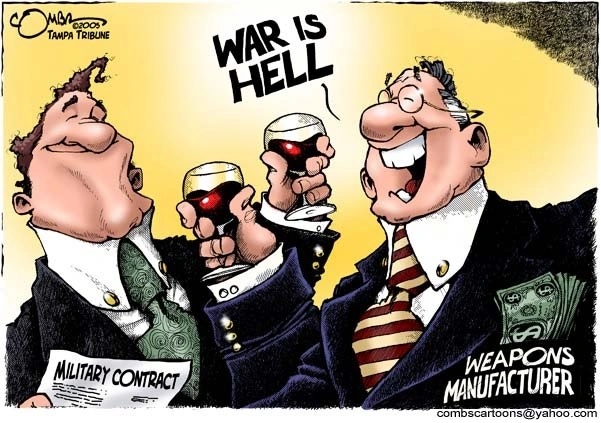
A recent project update from the Foreign Office is explicit about the goals. It states these should see “the invasion not only as a crisis, but also as an opportunity”
privatisation ……..can create private monopolies, reduce accountability to government and overcharge the public.
British aid is being used to open up Ukraine’s wrecked economy to foreign investors and enhance trade with the UK.
DECLASSIFIED UK, MARK CURTIS, November 21, 2024
Amid the devastating war in Ukraine, British economic aid to the country is focused on promoting pro-private sector reforms and on pressing the government to open up its economy to foreign investors.
Recently-published Foreign Office documents on its flagship aid project in Ukraine, which supports privatisation, note that the war provides “opportunities” for Ukraine delivering on “some hugely important reforms”.
The government in Kyiv has in recent months been responding positively to these calls. Last month, president Volodymyr Zelensky signed a new law expanding the privatisation of state-owned banks in the country.
It follows the Ukrainian government’s announcement in July of its ‘Large-Scale Privatisation 2024’ programme that is intended to drive foreign investment into the country and raise money for Ukraine’s struggling national budget, not least to fight Russia.
Large assets slated for privatisation currently include the country’s biggest producer of titanium ore, a leading producer of concrete products and a mining and processing plant.
Ukraine envisaged privatising the country’s roughly 3,500 state-owned enterprises in a law of 2018, which said foreign citizens and companies could become owners.
The process stalled as a result of coronavirus and then Russia’s invasion in February 2022. But hundreds of smaller-scale enterprises are now being privatised, bringing in revenues of UAH 9.6bn (£181m) in the past two years.
“The resumption of privatisation amid the full-scale war is an important step, which is already yielding results,” Ukraine’s economy minister Yulia Svyrydenko said last month.
Another law enacted in June 2023 allows large-scale assets to be sold to foreigners or Ukrainians during the current martial law regime.
‘Good governance’
Britain’s main economic aid project in Ukraine runs from 2022-25 and is called the Good Governance Fund. One of its aims is to ensure that “Ukraine adopts and implements economic reforms that create a more inclusive economy, enhancing trade opportunities with the UK”.
A recent project update from the Foreign Office is explicit about the goals. It states these should see “the invasion not only as a crisis, but also as an opportunity”…………………………………………………………………
Advancing privatisation
One key strand of the Good Governance Fund project is direct support to privatisation in Ukraine.
This involves a seven-year sub-programme called SOERA (State-owned enterprises reform activity in Ukraine), which is funded by USAID with the UK Foreign Office as a junior partner.
SOERA works to “advance privatization of selected SOEs [state-owned enterprises], and develop a strategic management model for SOEs remaining in state ownership.”
UK documents note the programme has already “prepared the groundwork” for privatisation, a key plank of which is to change Ukraine’s legislation. ………………………………………………………………
Declassified made a freedom of information request asking the Foreign Office to provide the briefing notes for then foreign secretary James Cleverly for the conference. It replied saying the request was “too broad”.
“The UK is hoping to reap benefits for UK firms from Ukraine’s reconstruction”, observes a report on British aid to Ukraine earlier this year by the aid watchdog, ICAI.
Conditionality
Britain’s privatisation agenda in Ukraine is part of a wider push by the World Bank and the International Monetary Fund (IMF), which routinely promote privatisation in low income countries, often as a condition of providing aid.
Zelensky’s recent announcement on state-owned banks is based on World Bank recommendations and gives international donors a role in selecting financial advisers for the sales.
……………………………………….Rustem Umyerov, the head of the State Property Fund, which presides over Ukraine’s privatisation strategy, said in July that “international partners support the start of large-scale privatization and are ready to facilitate pitches to the business communities in their countries.”
……Foreign investment in rebuilding Ukraine’s economy is being coordinated by the world’s largest asset manager, Blackrock.
…………………privatisation ……..can create private monopolies, reduce accountability to government and overcharge the public.
The key goal for Western states supposedly ‘aiding’ Ukraine’s privatisation process is to find access to new markets, and to bring Ukraine into their commercial orbit, fully detaching it from their rival, Russia.
A sign that the Ukrainian public needs persuading about this Western-backed privatisation is that the US/UK’s SOERA project includes a public relations dimension. One of its goals is to “assist the government in strategic communications to enhance reforms”. https://www.declassifieduk.org/uk-sees-privatisation-opportunities-in-ukraine-war/
USA. House Passes Chilling ‘Nonprofit Killer’ Bill With 15 Democrats Voting ‘Yes’
“A sixth grader would know this is unconstitutional,” said Rep. Jamie Raskin.
By Sharon Zhang , Truthout, November 21, 2024, https://truthout.org/articles/house-passes-chilling-nonprofit-killer-bill-with-15-democrats-voting-yes/
he House easily passed a bill that would give Donald Trump and future presidents a bludgeon to target and silence dissenting nonprofits on Thursday, in what opponents warned is a step toward allowing the executive branch to wield unchecked, authoritarian power.
H.R. 9495, nicknamed the “nonprofit killer” by critics, passed 219 to 184 with 15 Democrats voting “yes.” The legislation, which civil liberties groups have said could deliver a huge blow to the rights to free speech and dissent across the U.S., now goes to the Senate for consideration.
The bill would give the Treasury Secretary the ability to revoke the tax-exempt status of any nonprofit they deem to be a “terrorist supporting organization” withou
Opponents of the bill have warned that it is the most dangerous piece of supposed “anti-terror” legislation since the PATRIOT Act of 2001.
The bill’s backers have made it clear that the bill is targeted at groups advocating for Palestinian rights, giving presidents the power to even further target Muslim and Arab advocacy groups, which have already long faced repression. Lawmakers voting against it raised alarm that presidential administrations could also use it to crush any other nonprofits it deems fit — especially under Trump, whose avowed goal is to punish his political enemies.t due process or substantial evidence, effectively dealing most groups a killing blow.
“Authoritarianism is not born overnight. It creeps in,” said Rep. Lloyd Doggett (D-Texas) in a speech on the House floor before the vote. “A tyrant tightens his grip not just by seizing power, but when he demands new powers and those who can stop him willingly cede and bend to his will.”
Constitutional lawyer Rep. Jamie Raskin (D-Maryland) called the bill “a werewolf in sheep’s clothing,” and explained that the bill would give the Treasury Secretary the ability to label a group as terrorist supporting without “any standard of proof.”
Then, he explained, “once this scarlet letter and the infamy of being designated a terrorist-supporting group are firmly affixed on the organization, the stigmatized can finally go to a judge. But, incredibly, the legal burden is explicitly put on them to prove they are not a terrorist-supporting group — completely reversing the burden of due process which properly belongs to the government.”
“A sixth grader would know this is unconstitutional,” Raskin said.
Hundreds of advocacy groups have urged Congress to defeat the bill. On Wednesday, a coalition of over 55 Jewish organizations put out a statement opposing the legislation, while 150 civil society groups, led by the ACLU, signed a letter in September expressing “deep concerns” over the bill’s unconstitutionality and the danger it poses.
The bill had come to a vote last week, after Republicans tried to bypass House processes and pass the bill with a two-thirds majority vote. It failed 256 to 145, with 52 Democrats voting for it. In a renewed bid this week, Republicans rushed the bill through committee, allowing it to pass with a simple majority.
Reportedly, many Democrats voted against the bill last week because of their fears over how it would empower Trump specifically — not necessarily due to the chilling effect it could have on nonprofit newsrooms, civil rights groups, and, especially, Muslim and Arab advocacy groups. Fewer Democrats voted for the bill in this weeks’ vote, though the 15 Democrats who voted for it represent some of the most right-wing Democrats in the chamber.
Trump opposes Israel annexation of West Bank, Republican sources say
November 20, 2024, https://www.middleeastmonitor.com/20241120-trump-opposes-israel-annexation-of-west-bank-republican-sources-say/
Newly-elected United States’ President, Donald Trump, is in opposition to Israel’s reported plans to annex the Occupied West Bank, sources from his Republican Party have revealed.
According to Israeli outlet, Ynet News, a senior Republican Senator close to the President-elect has said that “Trump will not approve annexation” of the West Bank.
Such a move is reportedly seen by the new President as one that would be “a mistake for Israel” which would worsen its international standing – already severely damaged after over a year of the Occupation’s bombardment and invasion of the Gaza Strip.
Trump is also apparently primarily concerned that any official annexation could further disrupt and severely derail efforts to finally reach a normalisation between Israel and Saudi Arabia – a key priority for the incoming Trump administration, with Republican Senator, Lindsey Graham, particularly working on that goal.
The reported comments by the unnamed sources follow increased speculation in recent weeks over Trump’s appointments of controversial figures in his incoming administration, with many of the relevant roles being filled by radically pro-Israel figures who favour annexation of the West Bank.
UK Defence secretary to seek ‘missing’ nuclear test records
Dominic Casciani, BBC, 16 Nov 24
Defence Secretary John Healey has launched an investigation into whether there are long lost or hidden documents that reveal military chiefs secretly monitored the health of men who witnessed nuclear bomb tests in the 1950s.
John Healey told MPs that while “nothing is being withheld”, officials would carry out a “detailed dig” amid concerns from the surviving veterans.
The pledge comes after the BBC screened a special documentary on Wednesday into allegations that there has been a decades-long cover-up of how the nuclear testing programme harmed personnel.
Alan Owen, one of the leaders of the men’s campaign said the decision was a “brilliant” step forward after years of battles for answers.
Survivors in their 80s say many of them and their children have suffered cancers, genetic defects and other illnesses that must be linked to radioactive fall-out.
Similar claims have been made by indigenous communities in Australia where many of the tests were conducted.
For decades, successive governments have denied there was a secret monitoring programme – but the veterans say recently declassified files support their memories of medical staff taking blood and urine samples.
Speaking to Parliament’s Defence Committee, Mr Healey said the investigation would not be straight-forward and records may have been lost…………………………………………………………………………………… https://www.bbc.co.uk/news/articles/cg7g4z0jxneo
The enriched uranium market is all at sea, with USA the largest importer of Russian material

Five days after Russia imposed tit-for-tat restrictions on exports of
enriched uranium to the US, a 14-year old vessel remains anchored outside
the port of Saint Petersburg, its crew presumably unsure whether the
radioactive cargo they were due to collect for a US-based client can still
be shipped.
Moscow’s new measures, announced on Friday, come with
caveats. Just as US import restrictions introduced in May still allow
companies to seek waivers allowing uranium shipments when they can’t
obtain supplies elsewhere, so the Russians “didn’t say they’re
outright ending all deliveries to the US,” says Jonathan Hinze, president
of UxC, a consultancy specialising in the nuclear industry.
Russia’s cash requirements and control of almost half of global enrichment capacity,
coupled with the energy needs of the world’s biggest economy, mean “the
US stands out conspicuously as the largest importer of Russian material,
both prior to Moscow’s invasion of Ukraine and since,” writes Darya
Dolzikova, a research fellow at Royal United Services Institute.
FT 20th Nov 2024,
https://www.ft.com/content/ec09bcff-3771-4679-b0d0-4ec7062b7072
Germany’s national, federal highways could host 54 GW of PV

Germany’s national, federal highways could host 54 GW of PV. A new study
by Germany’s Federal Highway Research Institute (BASt) points to strong
potential for solar deployment across the nation’s roadways and highways.
PV Magazine 20th Nov 2024, https://www.pv-magazine.com/2024/11/20/germanys-national-federal-highways-could-host-54-gw-of-pv/
Norfolk MP criticised for ‘anti-nuclear’ stance for Bacton
Steff Aquarone, North Norfolk MP, has been criticised for his “negative”
stance on plans to create a nuclear reactor in Bacton. Norfolk MP
criticised for ‘anti-nuclear’ stance for Bacton. An MP has been attacked
for not being “more open-minded” over his staunch anti-nuclear stance after
plans emerged that could see a reactor built in a coastal village.
Eastern Daily Press 22nd Nov 2024, https://www.edp24.co.uk/news/24741752.norfolk-mp-criticised-anti-nuclear-stance-bacton/
1 This Month
Chernobyl: The Lost Tapes – A good documentary on Chernobyl on SBS available On Demand for the next 3 weeks– https://www.sbs.com.au/ondemand/tv-program/chernobyl-the-lost-tapes/2352741955560

of the week–London Campaign for Nuclear Disarmament

Tell the Ukrainian Government to Drop Prosecution of Peace Activist Yurii Sheliazhenko
To see nuclear-related stories in greater depth and intensity – go to https://nuclearinformation.wordpress.com
-
Archives
- April 2026 (139)
- March 2026 (251)
- February 2026 (268)
- January 2026 (308)
- December 2025 (358)
- November 2025 (359)
- October 2025 (376)
- September 2025 (257)
- August 2025 (319)
- July 2025 (230)
- June 2025 (348)
- May 2025 (261)
-
Categories
- 1
- 1 NUCLEAR ISSUES
- business and costs
- climate change
- culture and arts
- ENERGY
- environment
- health
- history
- indigenous issues
- Legal
- marketing of nuclear
- media
- opposition to nuclear
- PERSONAL STORIES
- politics
- politics international
- Religion and ethics
- safety
- secrets,lies and civil liberties
- spinbuster
- technology
- Uranium
- wastes
- weapons and war
- Women
- 2 WORLD
- ACTION
- AFRICA
- Atrocities
- AUSTRALIA
- Christina's notes
- Christina's themes
- culture and arts
- Events
- Fuk 2022
- Fuk 2023
- Fukushima 2017
- Fukushima 2018
- fukushima 2019
- Fukushima 2020
- Fukushima 2021
- general
- global warming
- Humour (God we need it)
- Nuclear
- RARE EARTHS
- Reference
- resources – print
- Resources -audiovicual
- Weekly Newsletter
- World
- World Nuclear
- YouTube
-
RSS
Entries RSS
Comments RSS
 nuclear-news