Nuclear ‘Renaissance’ Recalls Past Boondoggles, Legacy of Failures
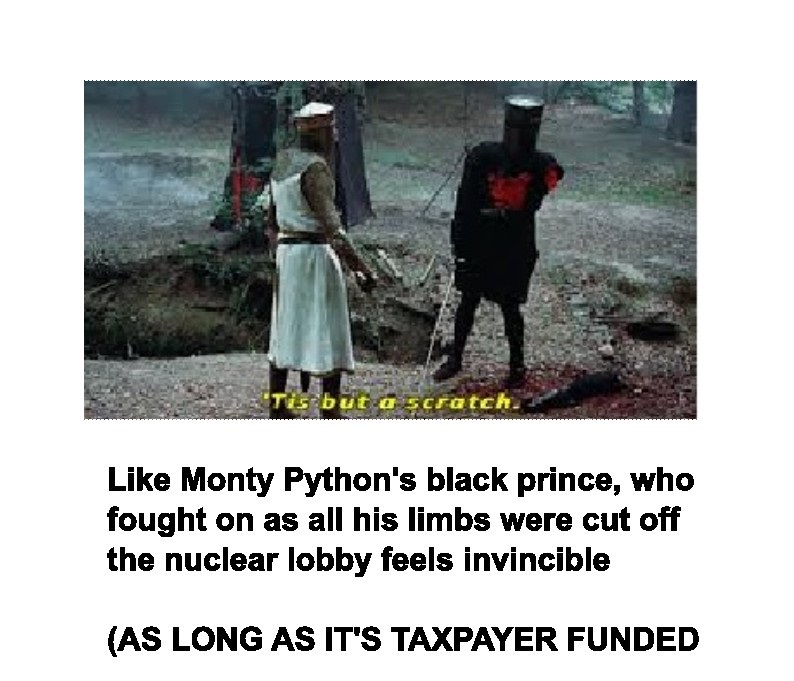
These federal subsidies were authorized by President Biden’s Inflation Reduction Act of 2022 (IRA). An analysis by NIRS has estimated the IRA includes more than a third of a trillion dollars in potential nuclear power subsidies. Although touted as a climate mitigation bill, the Nuclear Information and Resource Service analysis reported about the 2022 law: “The total amount of nuclear funding in these IRA measures alone ($383 billion) is potentially greater than the total reported amount of climate spending in the entire bill ($369 billion).
POWER, Nov 19, 2024, by Kevin Kamps
Yet another nuclear power “renaissance”? Again? The industry and its friends in high places would like us all to believe so. But, besides the fact that “relapse” would be a better word choice, we’ve also seen this bad horror flick before.
Anyone recall the George W. Bush administration’s attempted nuclear power relapse? Of some three-dozen gigantic new reactors proposed, only two—Vogtle 3 & 4—ever made it into operation. Albeit seven years behind schedule, and more than double the price tag Southern and Georgia Power predicted in 2012, more than $35 billion instead of “just” $15 billion. Of course, the Nuclear Energy Institute (NEI) had predicted, as cited in Dick Cheney’s Energy Task Force Report of May 2001, that such new reactors would “only” cost $2.5 billion each, not more than $17.5 billion each! Hence, $12 billion in federal loan guarantees, and “nuclear tax” surcharges on ratepayers’ bills, were required—private capital wouldn’t touch it.
The rest of those proposed reactors have simply been canceled at various stages of development. Many never broke ground, including Fermi 3 in Michigan, despite license approval from the U.S. Nuclear Regulatory Commission (NRC) to construct and operate. Others ended half-built or less, as at Summer 2 and 3, contributing to the bankruptcy of century-old Westinghouse, and near-bankruptcy of century-old Toshiba. Summer 2 and 3’s cancellation represented a $9 billion or more loss to the ratepayers of South Carolina, many of whom are low income and/or African American. They will be paying for this fiasco on their electric bills for decades—long after a small handful of corporate execs finish their short time behind bars for fraud—with no electricity in return.
Of course, that nuclear “renaissance” going belly up just echoed earlier booms gone bust. Recall the Forbes editorial of February 11, 1985, entitled “Nuclear Follies,” which stated: “The failure of the U.S. nuclear power program ranks as the largest managerial disaster in business history, a disaster on a monumental scale. The utility industry has already invested $125 billion in nuclear power … only the blind, or the biased, can now think that most of the money has been well spent.”
Scores, even hundreds, of reactors were abandoned at various stages of development in the past 50+ years. This included Midland Units 1 and 2, abandoned after being 85% and 50% built, due to safety-significant buildings sinking into the ground, a nuclear Leaning Tower of Pisa. By 1983, Consumers Energy had spent nearly $4.5 billion—$13.75 billion adjusted for inflation, expressed in 2023 dollar figures. It is the largest infrastructure fiasco in Michigan history. Whereas Richard Nixon had touted “Project Energy Independence,” envisioning a thousand reactors across the U.S. by the year 2000, “only” 135 were built. Of these, some never made it to full power operations, such as Shoreham. Most of the burden of the $6 billion wasted (in 1989 dollars, which would be $15 billion in 2023)—fell on Long Island ratepayers: a 3% surcharge was added onto electric bills for 30 years, to pay off the monumental price tag.
Along the same lines, the five-reactor Washington Public Power Supply System (WPPSS) defaulted on $2.25 billion in municipal bonds in 1983 ($7 billion in 2023 dollars), one of the largest such defaults in American history. Hence, WPPSS became known as “Whoops”!

But, despite the lessons that should have been learned, here we go again, with a propaganda-, lobbying-, and campaign contribution-driven nuclear industry joy ride, perhaps at a scale unlike any before. So-called “Small Modular Reactor” (SMR) schemes have proliferated, despite the sinking of the flagship “UAMPS” project, NuScale’s in Idaho, with the cancellation of eight SMRs, the first certified design. This happened despite massive subsidization. Most recently, NextEra has wisely dismissed SMRs as not “too cheap to meter,” but rather too expensive to matter.
Some have gone so far as to propose restarting closed reactors. Holtec’s zombie scheme at Palisades in Michigan is unprecedented, but others—as at the infamous Three Mile Island in Pennsylvania, and Duane Arnold in Iowa, which nearly had a derecho disaster in 2019—are seriously considering joining the zombie reactor parade. Holtec has also proposed SMRs at Palisades, as well as at the long closed and decommissioned Big Rock Point site in northern Michigan, making the eastern shoreline of Lake Michigan a leading-edge microcosm of the current attempted nuclear relapse across the country.
Holtec’s Magical Thinking in the Great Lakes State
In spring 2022, those of us who had watchdogged Palisades for decades—a proud tradition of resistance there, that even pre-dated its groundbreaking in 1967—breathed a huge sigh of relief, when then-owner Entergy pulled the plug, shutting the reactor for good. We had dodged so many radioactive bullets over the years. Although not everyone has—elevated rates of cancer, including childhood cancer, are reported in the area, for one thing.
Entergy had planned to close Palisades since 2016, although it took till 2022—the up to 57% above market rates power purchase agreement (PPA) it got then-governor (now Energy Secretary) Jennifer Granholm’s Michigan Public Service Commission (MPSC) to bless was just too lucrative to end early, safety risks be damned.
On May 20, 2022, Entergy finally called it a day, 11 days earlier than scheduled. Palisades’ latest in 50 years of ongoing Control Rod Drive Mechanism seal leaks took place, the worst such operating experience in industry. But by then, we already had plenty of evidence for trouble brewing……………………………………………………………………………………………………………..
Germany’s hard won shutdown of its last atomic reactors in early 2023 was a tremendous environmental victory, supported by not only the Greens and Social Democrats, but also the Conservatives. It embodies a political consensus, in response to nuclear power’s hazardous radioactive pollution, nuclear waste dilemma, and exorbitant expense, as well as to its severe dangers, as exemplified by the Chornobyl and Fukushima nuclear catastrophes.
But the nearly thousand-page FOIA response we obtained contained other revelations in addition to Holtec’s bailout application and re-nuclearization strategy for Palisades. MPSC staffer Kevin Krause, referring to “Beyond Nuclear et al,” in an email to MPSC Commissioner Peretick (who has enthusiastically supported Palisades’ restart from the very beginning), brushed off environmental watchdogs’ safety concerns, saying: “The unsafe claims are claims these organizations have been claiming for a long time and the NRC has looked at them before.”
The Upton Sinclair quote from 1935 comes to mind: “It is difficult to get a man to understand something when his salary depends on his not understanding it.” His or her.
…our coalition has warned repeatedly about Palisades’ grave risks for many decades now. But NRC is an infamously captured regulator, long the industry’s lapdog, not its watchdog. NRC oversight can more often be defined as “an unintentional failure to notice or do something,” rather than “the action of overseeing something.” “Unintentional” oversight gives NRC too much benefit of the doubt, assuming mere incompetence, rather than complicity with industry. The Japanese Parliament concluded in 2012 that collusion between the supposed, so-called safety regulatory agency, the industry, and government officials, was in fact the root cause of the Fukushima nuclear catastrophe. There has long been such collusion in spades at Palisades.
For one thing, NRC has repeatedly weakened pressurized thermal shock (PTS) regulations, over decades, in order to accommodate ever more risky continued operations at the worst neutron-embrittled reactor pressure vessel in the country, namely Palisades. For State of Michigan officials to incuriously accept NRC’s flippant assurances of safety is inviting disaster.
Investigative reporter Jeff Donn’s post-Fukushima nuclear catastrophe, four-part Associated Press series, “Aging Nukes,” cited PTS as a top example of NRC’s dangerous, ongoing, decades-long regulatory retreat.
Whitmer, the Michigan state legislature, MPSC, our Michigan U.S. congressional delegation, and even DOE, should not fall for the lie that NRC is somehow on top of safety at Palisades. NRC is the enabler of ever more alarming risk-taking, as by Holtec at Palisades.
But even MPSC’s Krause expressed skepticism that Palisades could actually be restarted, a sentiment shared by other MPSC staffers, as revealed a number of times in the FOIA response documents. Krause, in a Sept. 9, 2022 email he gave the subject line “Palisades – you won”t believe this…..,” wrote several other MPSC staffers that “I talked to a few people this afternoon, and we are in uncharted territory. It is not even clear that keeping the plant open is possible from a licensing perspective.” Krause’s email came in response to the “buzz,” news coverage about Holtec’s surprise announcement that day that it had abandoned its decommissioning plans at Palisades, instead was pursuing an unprecedented restart scheme, and had already secretively applied, more than two months earlier, for $2 billion in DOE CNC funding alone, all with Whitmer’s enthusiastic support.
Krause’s word choice is apt. But the uncharted territory is not limited to bureaucratic regulatory approvals. Holtec’s unprecedented Palisades restart scheme represents uncharted territory in terms of the unacceptable risks to health, safety, security, environment, and vast amounts of public funding.
Other watchdogs share this concern…………………………………………………
It’s astonishing that Holtec and NRC are betting the farm on the dangerously old Palisades reactor. It was a notorious, poorly performing nuclear lemon for most of the past half-century, with ever increasing age-related degradation risks, now made even worse by the apparent lack of active safety maintenace by Holtec for the past two and a half years, and counting.
And it’s dumbfounding that DOE, Whitmer, Michigan state legislators, and the PPA customers, the Wolverine/Hoosier rural electric co-ops, have fallen for NRC and Holtec’s assurances of reliability and safety, given their incompetence, complicity, collusion, and corruption………………………………
Money Grabs Galore

Thus far, Holtec has gotten $300 million in grants for the Palisades restart scheme approved by the State of Michigan, despite repeated protests by a broad Great Lakes State environmental coalition.
Holtec has also recently gotten final approval for $1.52 billion in loan guarantees approved by DOE, 52% more than Holtec had asked for two years earlier. Another $1.3 billion has been approved by the U.S. Department of Agriculture (USDA)—again, $330 million more than was reportedly initially applied for—to reimburse rural electric co-ops (Wolverine in Michigan, Hoosier in Indiana and Illinois) for 25% of a PPA for Palisades’ future antipcipated electricity supply, from 2025 to 2051, if not beyond that. Holtec hopes to gouge ratepayers even worse than the up to 57% above market rates PPA Entergy had previously enjoyed at Palisades for 15 years. Will the co-ops re-apply for yet additional USDA bailouts in the future?
These federal subsidies were authorized by President Biden’s Inflation Reduction Act of 2022 (IRA). An analysis by NIRS has estimated the IRA includes more than a third of a trillion dollars in potential nuclear power subsidies. Although touted as a climate mitigation bill, the Nuclear Information and Resource Service analysis reported about the 2022 law: “The total amount of nuclear funding in these IRA measures alone ($383 billion) is potentially greater than the total reported amount of climate spending in the entire bill ($369 billion).
…………………………………………………………….. It is unbelievable, in a shocking and horrifying way. But even this $3.12 billion in public bailouts approved thus far for the Palisades restart is but the tip of the iceberg. Holtec has requested more than $5 billion in additional taxpayer and ratepayer bailouts towards the zombie reactor restart scheme alone.
…………………………………………………… Opportunity Costs
Dr. Mark Z. Jacobson of Stanford University, citing his 2019 analysis he still stands by, serves as an expert witness for the environmental coalition opposing Palisades’ restart. Jacobson has testified that “a fixed amount of money spent on a new nuclear plant means much less power generation, a much longer wait for power, and a much greater emission rate than the same money spent on WWS [wind, water, and sunlight] technologies.” This dynamic also applies at zombie reactors like Palisades. Closed on May 20, 2022, the earliest date by which Holtec claims it can restart Palisades is August 2025. However, that optimistic goal seems to be slipping to October or even December 2025, even according to Holtec at various points in time recently………………………………………………………………………………………………………………………………………………
Restarted Reactor Risks to Health, Safety, Security, and the Environment
In spring 2006, Palisades’ intial owner/operator (from 1967-2007), Consumers Energy, admitted to the MPSC that the atomic reactor had a long list of severely degraded, safety-significant systems, structures, and components. Watchdogs had already known for a long time before that about its worst neutron-embrittled reactor pressure vessel in the country, something that NRC was finally dragged, kicking and screaming, to adknowledge more than a decade ago now. But the inclusion of the need for “[r]eactor vessel [closure] head replacement,” after the Davis-Besse, Ohio near-miss of 2002, and of the need for “[s]team generator replacement” for the second time at Palisades, added to our causes for concern.
…………………………………………………………………………………….. The problem is, Entergy did not fix any of those problems, despite owning and operating Palisades from 2007 to 2022. And despite the killing it made that entire time, charging up to 57% above market rates on its PPA. Why not? Because, as is typical, NRC did not require it………………………………………………………………
………………………………………All of those pathways to reactor core meltdown are still relevant at Palisades, and will grow worse, if and when Palisades is allowed to restart, and sail ever deeper into the uncharted waters of age-related degradation risk.
……………………………….This is a real world risk. On Christmas Day 1993, Fermi 2’s turbo-generator shaft mechanically exploded. This resulted in two million gallons of radioactively contaminated water being dumped into Lake Erie.
……………………………………………….Regarding the degraded steam generators, Gundersen pointed out in his October 7 declaration filed as part of the environmental coalition’s intervention petition/request for hearing that “at least 700 additional tubes…must be plugged due to metal corrosion. These were as many tubes as had been plugged during the previous 20 years of operating the aged Palisades reactor designed in 1965.”………………………………………..
Radioactive Waste Risks
In addition to averting meltdown, more good news about Palisades’ “permanent closure” by Entergy on May 20, 2022 was that no more highly radioactive waste would be generated there. Since 1971, nearly 900 metric tons of highly radioactive irradiated nuclear fuel has piled up at Palisades. Currently, about a third is in outdoor dry casks; two-thirds is still stored in Palisades’ indoor wet storage pool.
Palisades’ dry cask storage has been extremely controversial since 1993. ……………………………………………………………….. more https://www.powermag.com/blog/nuclear-renaissance-recalls-past-boondoggles-legacy-of-failures/
No comments yet.
1 This Month

of the week – Shut Down Drone Warfare!


Tell the Ukrainian Government to Drop Prosecution of Peace Activist Yurii Sheliazhenko

Petition to revoke the licensing of the Near Surface Nuclear Disposal Facility (NSDF) at Chalk River. https://www.ourcommons.ca/petitions/en/Petition/Details?Petition=e-7247
To see nuclear-related stories in greater depth and intensity – go to https://nuclearinformation.wordpress.com
-
Archives
- April 2026 (91)
- March 2026 (251)
- February 2026 (268)
- January 2026 (308)
- December 2025 (358)
- November 2025 (359)
- October 2025 (376)
- September 2025 (257)
- August 2025 (319)
- July 2025 (230)
- June 2025 (348)
- May 2025 (261)
-
Categories
- 1
- 1 NUCLEAR ISSUES
- business and costs
- climate change
- culture and arts
- ENERGY
- environment
- health
- history
- indigenous issues
- Legal
- marketing of nuclear
- media
- opposition to nuclear
- PERSONAL STORIES
- politics
- politics international
- Religion and ethics
- safety
- secrets,lies and civil liberties
- spinbuster
- technology
- Uranium
- wastes
- weapons and war
- Women
- 2 WORLD
- ACTION
- AFRICA
- Atrocities
- AUSTRALIA
- Christina's notes
- Christina's themes
- culture and arts
- Events
- Fuk 2022
- Fuk 2023
- Fukushima 2017
- Fukushima 2018
- fukushima 2019
- Fukushima 2020
- Fukushima 2021
- general
- global warming
- Humour (God we need it)
- Nuclear
- RARE EARTHS
- Reference
- resources – print
- Resources -audiovicual
- Weekly Newsletter
- World
- World Nuclear
- YouTube
-
RSS
Entries RSS
Comments RSS
 nuclear-news
Leave a comment