Nuclear Fusion, forever the energy of tomorrow?
Bulletin, By Dan Drollette Jr | November 12, 2024
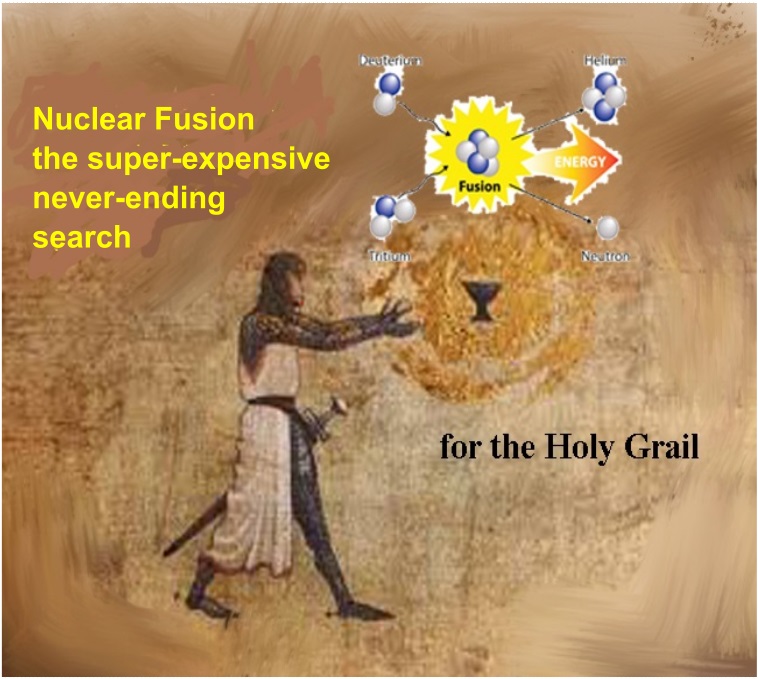
Nuclear fusion as a source of electricity always seems to be just around the corner. As the old joke goes, “Thirty years ago, fusion was 30 years away from becoming a viable commercial reality”—a comment borne out in the Bulletin’s own pages, if not precisely on a 30-year timescale.
In 1971, physicist Richard Post of what was then the Lawrence Radiation Laboratory published a Bulletin of the Atomic Scientists’ article featuring a chart that showed how fusion—that is, the fusing of hydrogen atoms to release energy, a process that powers all stars, including the Earth’s sun—would be widely available on a commercial scale, routinely pumping electrons to the electrical grid, by the year 1990 (although he hedged his bets by labeling it “An Optimist’s Fusion Power Timetable” [emphasis added]).
That optimism was widely shared, judging from the literature in the science and technology press of the time. But it proved to be misplaced; although militaries have thousands of nuclear warheads based on the fusion process, everything about commercial fusion as an energy has proven harder and taken longer than expected. For example, more than 60 years passed since the development of the first fusion “tokamak” reactor in the old Soviet Union to the first sustained fusion “burn,” or ignition, at the National Ignition Facility in the United States in 2022.
The difficulties involved in creating a commercial power plant are relatively simple to enumerate, as plasma physicist Bob Rosner—himself the former director of a national laboratory (and former chair of the Bulletin’s Science and Security Board)—explains in his interview, “Ferreting out the truth about fusion.” In a nutshell, the fusion process releases neutrons that are 10 times more energetic than what a commercial plant powered by the splitting of atoms, or nuclear fission, ordinarily emits. These high-powered neutrons are difficult to contain and rapidly degrade the containers proposed for controlling the extremely hot plasma required for a fusion reaction. At the same time, plasmas are just plain difficult to keep stable while producing that all-important steady (or quasi-steady) fusion “burn.”
In fact, Rosner notes, it’s likely that if a disruptive instability ever happens at ITER—the giant international research and engineering effort, based in France, that seeks to demonstrate how fusion could be produced in a magnetic fusion device—the multibillion-dollar experimental facility likely would not recover. For these reasons and more, Rosner asserts that commercial-scale, tokamak-style fusion will not be a reality in his lifetime—“and I think not in my children’s lifetime, or my grandchildren’s lifetime.” In addition, he warns about the hype and public relations fluff surrounding overly rosy projections for fusion, or what Rosner terms “a complex mixture of fact, half-truths and outright misinformation.”
It turns out that getting a reliable, steady source of tritium fuel for a fusion reactor would be an extremely difficult problem to crack, as physicist Daniel K. Jassby—formerly of the Princeton Plasma Physics Laboratory—points out. In his article, “The fuel supply quandary of fusion power reactors,” Jassby argues that the fusion reactors now envisioned would not be able to “breed” enough tritium to supply the reactor’s continued operation, and that even a few such reactors (if they ever became reality) would shortly exhaust the world’s supply of that hydrogen isotope, which is not naturally occurring.
So, why would anyone or any institution even go near fusion research? The same reasons keep popping up, in various forms, among the various experts in this issue of the magazine: There’s the desire to know and understand the basic mechanisms of our universe, and the likelihood that fundamental research and development in fusion could lead to big results in other scientific and technological arenas (“self-healing metals” being one of them). And then there’s what fusion research could do for nuclear weapons research in the immediate near-term. As Arjun Makhijani, president of the Institute for Energy and Environmental Research, writes:
“Fusion research for peaceful use and military use are highly intertwined, despite attempts to cloak nuclear weapons with the aura of the so-called ‘peaceful atom.’ ”
Given these considerations, it’s understandable that governments continue to back fusion research, despite the small likelihood that a commercial fusion power plant will come on-line soon. After all, funding basic research and providing for national defense are core goals for any state.
It is harder to understand why prominent players in the private marketplace—including the founders of Microsoft, OpenAI, Paypal, and Amazon—would invest vast sums on an infant field like commercial fusion. More than $1.8 billion was raised to fund just one startup, Commonwealth Fusion Systems, whose website indicates that it seeks to commercialize fusion energy in some form in just 10 years—decades ahead of government-funded efforts. To help explain their thinking, Silicon Valley venture capitalist and University of California Berkeley professor Mark Coopersmith delves into the world of high-finance. In his interview, “Fusion is not a typical bet,” Coopersmith explains the psychology behind putting down large sums despite long odds—assuming one has the money burning a hole in one’s pocket. The prospect of a “super return” of 1,000 or even 10,000 percent makes “deep-tech” research and development attractive, he says, even if the potential payoff could be decades away………………………………………………………. https://thebulletin.org/premium/2024-11/introduction-fusion-the-next-big-thing-again/?utm_source=Newsletter&utm_medium=Email&utm_campaign=ThursdayNewsletter11142024&utm_content=NuclearRisk_FusionNextBigThingAgain_11122024
No comments yet.
1 This Month

of the week – Shut Down Drone Warfare!


Tell the Ukrainian Government to Drop Prosecution of Peace Activist Yurii Sheliazhenko

Petition to revoke the licensing of the Near Surface Nuclear Disposal Facility (NSDF) at Chalk River. https://www.ourcommons.ca/petitions/en/Petition/Details?Petition=e-7247
To see nuclear-related stories in greater depth and intensity – go to https://nuclearinformation.wordpress.com
-
Archives
- April 2026 (34)
- March 2026 (251)
- February 2026 (268)
- January 2026 (308)
- December 2025 (358)
- November 2025 (359)
- October 2025 (376)
- September 2025 (257)
- August 2025 (319)
- July 2025 (230)
- June 2025 (348)
- May 2025 (261)
-
Categories
- 1
- 1 NUCLEAR ISSUES
- business and costs
- climate change
- culture and arts
- ENERGY
- environment
- health
- history
- indigenous issues
- Legal
- marketing of nuclear
- media
- opposition to nuclear
- PERSONAL STORIES
- politics
- politics international
- Religion and ethics
- safety
- secrets,lies and civil liberties
- spinbuster
- technology
- Uranium
- wastes
- weapons and war
- Women
- 2 WORLD
- ACTION
- AFRICA
- Atrocities
- AUSTRALIA
- Christina's notes
- Christina's themes
- culture and arts
- Events
- Fuk 2022
- Fuk 2023
- Fukushima 2017
- Fukushima 2018
- fukushima 2019
- Fukushima 2020
- Fukushima 2021
- general
- global warming
- Humour (God we need it)
- Nuclear
- RARE EARTHS
- Reference
- resources – print
- Resources -audiovicual
- Weekly Newsletter
- World
- World Nuclear
- YouTube
-
RSS
Entries RSS
Comments RSS
 nuclear-news
Leave a comment