The Future of Nuclear Power is Wrought with Challenges
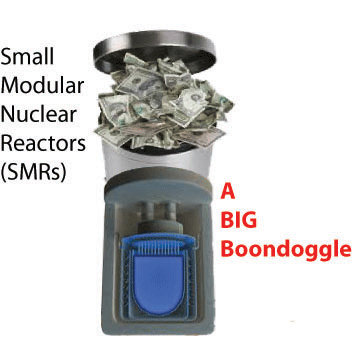
My analysis indicates that while advanced modular nuclear reactors might theoretically be helpful for the very long term, they cannot fix the problems of the US, and other countries in the West, nearly quickly enough. I expect that the Trump administration, which will start in January 2025, will see this program as a boondoggle.
Strangely enough, the US has no working model of a small-scale nuclear reactor, even one operating on conventional fuel.
Oil Price, By Gail Tverberg – Nov 12, 2024
The world is facing a growing shortage of uranium, the essential fuel for nuclear power plants.
The US is heavily reliant on Russia and its allies for enriched uranium, creating geopolitical risks.
Recycling spent nuclear fuel is expensive, complex, and faces significant environmental and security challenges.
It is easy to get the impression that proposed new modular nuclear generating units will solve the problems of nuclear generation. Perhaps they will allow more nuclear electricity to be generated at a low cost and with much less of a problem with spent fuel.
As I analyze the situation, however, the problems associated with nuclear electricity generation are more complex and immediate than most people perceive. My analysis shows that the world is already dealing with “not enough uranium from mines to go around.” In particular, US production of uranium “peaked”about 1980 (Figure 1 on original).
For many years, the US was able to down-blend nuclear warheads (both purchased from Russia and from its own supply) to get around its uranium supply deficit.
Today, the inventory of nuclear warheads has dropped quite low. There are few warheads available for down-blending. This is creating a limit on uranium supply that is only now starting to hit.
Nuclear warheads, besides providing uranium in general, are important for the fact that they provide a concentrated source of uranium-235, which is the isotope of uranium that can sustain a nuclear reaction. With the warhead supply depleting, the US has a second huge problem: developing a way to produce nuclear fuel, probably mostly from spent fuel, with the desired high concentration of uranium-235. Today, Russia is the primary supplier of enriched uranium.
The plan of the US is to use government research grants to kickstart work on new small modular nuclear reactors that will be more efficient than current nuclear plants. These reactors will use a new fuel with a higher concentration of uranium-235 than is available today, except through purchase from Russia. Grants are also being given to start work on US production of the more highly enriched uranium fuel within the US. It is hoped that most of this highly enriched uranium can come from recycling spent nuclear fuel, thus helping to solve the problem of what to do with the supply of spent fuel.
My analysis indicates that while advanced modular nuclear reactors might theoretically be helpful for the very long term, they cannot fix the problems of the US, and other countries in the West, nearly quickly enough. I expect that the Trump administration, which will start in January 2025, will see this program as a boondoggle.
Current problems with nuclear electricity generation are surprisingly hidden. World electricity generation from nuclear has been close to flat since 2004.
Although there was a dip in world generation of nuclear electricity after the tsunami that affected nuclear reactors in Fukushima, Japan, in 2011, otherwise world production of nuclear electricity has been nearly flat since 2004 (Figure 3 on original)……………………………………………………………………………………………………
Recycling of spent fuel to recover usable uranium and plutonium has been accomplished only to a limited extent. Experience to date suggests that recycling has many issues……………………………………………..
There seem to be several issues with building units to recover uranium from spent fuel:
- Higher cost than simply mining more uranium
- Pollution problems from the recycling plants
- Potential for use of the output to make nuclear warheads
- Potential for nuclear accidents within the plants
- Remaining radioactivity at the site at the end of the reprocessing plant’s life, and thus the need to decommission such plants
- Potential for many protestors disrupting construction and operation because of issues (2), (3), (4), and (5)
The US outlawed recycling of spent fuel in 1977, after a few not-very-successful attempts. Once the purchase of Russian warheads was arranged, down-blending of warheads was a much less expensive approach than reprocessing spent fuel. Physics Today recently reported the following regarding US reprocessing:
“A plant in West Valley, New York, reprocessed spent fuel for six years before closing in 1972. Looking to expand the plant, the owners balked at the costs required for upgrades needed to meet new regulatory standards. Construction of a reprocessing plant in Barnwell, South Carolina, was halted in 1977 following the Carter administration’s ban.”
Japan has been trying to build a commercial spent fuel reprocessing plant at Rokkasho since 1993, but it has had huge problems with cost overruns and protests by many groups. The latest estimate of when the plant will actually be completed is fiscal year 2026 or 2027.
The largest commercial spent fuel reprocessing plant in operation is in La Hague, France. It has been in place long enough (since 1966) that it has run into the issue of decommissioning an old unit, which was started as a French military project. The first processing unit was shut down in 2003. The International Atomic Energy Administration says, “The UP2-400 decommissioning project began some 20 years ago and may be expected to continue for several more years.” It talks about the huge cost and number of people involved. It says, “Decommissioning activities represent roughly 20 per cent of the overall activity and socio-economic impact of the La Hague site, which also hosts two operating spent fuel recycling plants.”
The cost of the La Hague reprocessing units is probably not fully known. They were built by government agencies. They have gone through various owners including AREVA. AREVA has had huge financial problems. The successor company is Orano. The currently operating units have the capacity to process about 1,700 metric tons of fuel per year. The 1700 metric tons of reprocessing of spent fuel from La Hague is reported to be nearly half of the world’s operating capacity for recycling spent fuel.The plant would process 800 metric tons of fuel per year.
I understand that Russia is working on approaches that quite possibly are not included in my figures. If so, this may add to world uranium supply, but Russia is not likely to want to share the benefits with the West if there is not enough to go around……………………………………………………………………………………….
The US is trying to implement many new ideas at one time with virtually no successful working models to smooth the transition.
Strangely enough, the US has no working model of a small-scale nuclear reactor, even one operating on conventional fuel. A CNBC article from September 2024 says, Small nuclear reactors could power the world, the challenge is building the first one in the US…………………………………………………………………………………….
Starting at this level, it is difficult to see how reactors with the new technology and the HALEU fuel to feed them can possibly be available in quantity before 2050.
It is difficult to see how the cost of electricity generated using the new advanced modular nuclear reactors and the new HALEU fuel, created by reprocessing spent fuel, could be low.
As far as I can see, the main argument that these new modular electricity generation plants will be affordable is that they will only generate a relatively small amount of electricity at once —about 300 megawatts or less, or about one third of the average of conventional nuclear reactors in the US. Because of the smaller electricity output, the hope is that they will be affordable by more buyers, such as utility companies.
The issue that is often overlooked by economists is that electricity generated using these new techniques needs to be low cost, per kilowatt-hour, to be helpful. High-cost electricity is not affordable. Keeping costs down when many new approaches are being tried for the first time is likely to be a huge hurdle. I look through the long list of problems encountered in recycling spent fuel mentioned in Section [6] and wonder whether these issues can be inexpensively worked around. There are also issues with adopting and installing the proposed new advanced modular reactors, such as security, that I have not even tried to address.https://oilprice.com/Alternative-Energy/Nuclear-Power/The-Future-of-Nuclear-Power-is-Wrought-with-Challenges.html
No comments yet.
1 This Month

of the week – Shut Down Drone Warfare!


Tell the Ukrainian Government to Drop Prosecution of Peace Activist Yurii Sheliazhenko

Petition to revoke the licensing of the Near Surface Nuclear Disposal Facility (NSDF) at Chalk River. https://www.ourcommons.ca/petitions/en/Petition/Details?Petition=e-7247
To see nuclear-related stories in greater depth and intensity – go to https://nuclearinformation.wordpress.com
-
Archives
- April 2026 (103)
- March 2026 (251)
- February 2026 (268)
- January 2026 (308)
- December 2025 (358)
- November 2025 (359)
- October 2025 (376)
- September 2025 (257)
- August 2025 (319)
- July 2025 (230)
- June 2025 (348)
- May 2025 (261)
-
Categories
- 1
- 1 NUCLEAR ISSUES
- business and costs
- climate change
- culture and arts
- ENERGY
- environment
- health
- history
- indigenous issues
- Legal
- marketing of nuclear
- media
- opposition to nuclear
- PERSONAL STORIES
- politics
- politics international
- Religion and ethics
- safety
- secrets,lies and civil liberties
- spinbuster
- technology
- Uranium
- wastes
- weapons and war
- Women
- 2 WORLD
- ACTION
- AFRICA
- Atrocities
- AUSTRALIA
- Christina's notes
- Christina's themes
- culture and arts
- Events
- Fuk 2022
- Fuk 2023
- Fukushima 2017
- Fukushima 2018
- fukushima 2019
- Fukushima 2020
- Fukushima 2021
- general
- global warming
- Humour (God we need it)
- Nuclear
- RARE EARTHS
- Reference
- resources – print
- Resources -audiovicual
- Weekly Newsletter
- World
- World Nuclear
- YouTube
-
RSS
Entries RSS
Comments RSS
 nuclear-news
Leave a comment