TODAY. Cop 30 Climate Summit probable change of venue – CorporateHub, Hades.

by Nicholas Beelzebub Lucifer, 14 November 2024 https://theaimn.com/cop-30-climate-summit-probable-change-of-venue-corporatehub-hades/
I was a bit disappointed not to be invited to Cop 29, the 2024 United Nations Climate Change Conference. But cheered up by the fact that anybody who’s really anybody is boycotting this fossil fuel financial talkfest is boycotting it anyway – Chinese President Xi Jinping, US President Joe Biden and Indian Prime Minister Narendra. Heck, even little U.S. hanger-on Australia’s not sending their little man,
And, I can assure you, that even though uninvited, I have had an influence on these gatherings right from the start. International climate action began with the United Nations Framework Convention on Climate Change (UNFCCC) in 1992, but , really, nothing substantial happened until the Kyoto Protocol in December 1997, when nations sort of agreed to cut their greenhouse gas emissions. I happily predicted that this was doomed to failure, with the USA refusing to sign up, with China not included, and emissions target reductions woefully inadequate. Meanwhile the many Conferences of the Parties (COPs) held since 1995, have had the aim of reducing global warming, but with little effect .
My minions have worked on behalf of the polluting industries, and little Australia has been especially ingenious in appearing to support climate action, right from its original reluctance to sign and ratify Kyoto, through to its later ingenious use of carbon credits, to weaken climate action, despite its Kyoto and later Paris 2015 climate commitments.
Look, I’m acknowleging those tireless operators from many countries, who forwarded my interests – people like Mike Pompeo, (Who’s gone on to my greater causes – weapons and war), and Charles and David Koch, and the many thousands of well-paid lobbyists for fossil fuel companies. I do have a soft spot for Australia’s Scott Morrison, (who has now joined Mike Pompeo in the “defence” area)
It’s been so encouraging – in 2023 -the work of SULTAN AHMED AL JABER, and now Azerbaijan’s President Ilham Aliyev at Cop 29 – “Oil and gas are a ‘gift of God'”
But now it is time to take things into my own hands. So, while Brazil planned for COP 30 is OK (I’m happy that President Lula da Silva is boycotting COP 29) – well, it’s not adequate. COP 30 should be held in my capital, CorporateHub, Hades.
I’ve waited a long time, since I was so unjustly expelled from my top position in that smug boring country above, that tries to suck souls up. Indeed, since then, my goal has been to “go up and down, to and fro in the earth, seeking to destroy the souls of men”. I’ve had moderate success, with quite a few men. Women have been more difficult, but they shouldn’t count anyway. Indeed, if we can eliminate abortion, contraception, family planning etc, they’ll soon be put back in their place.
Mightily powerful and great as am, I could use a bit of help from the human species. And now, comes the time of opportunity. Not only is the USA President boycotting the current climate conference, but the President-elect, Donald Trump is strongly on my side on this climate matter(and on quite a few others!).
Under Trump the USA will:
- again withdraw from the Paris agreement,
- end climate reporting and regulation, politicising Environmental, Social, and Governance (ESG) criteria and related climate policies,
- hinder the renewable energy transition by gutting Biden’s Inflation Reduction Act (IRA)
His appointments to his coming administration bring joy to my heart: they mostly focus on my other favourite causes – like hatred of China, and support for Israel’s genocide of Gazans. But I’m sure that Trump will bring thorough attention to the climate issue. He’s starting by choosing Lee Zeldin to lead the Environment Protection Agency. I am disappointed that he’s excluded my old friend Mike Pompeo. But there’s plenty of time to remedy that, when Donald moves on from those primary causes. Happily the great Elon Musk used to be on the side of the climate activists – but now, dedicated to colonising Mars, Elon is back in my camp.
In the meantime, COP 29 is making a good start. Papua New Guinea’s pulled out of the climate summit due to frustration over “empty promises and inaction”. Squabbles over finance are the big thing now, in notoriously corrupt Azerbaijan. Already, Argentina has withdrawn due to dissatisfaction over climate finance negotiations.
UN Secretary-General António Guterres warns of “a stampede of greed that crushes the poor.”
There are so many COP goals that interfere with mine, and with corporate interests – the main goal – cutting back to net zero greenhouse gas emissions – ridiculous and intolerable! Fortunately the big new thing, AI, just has to have boundless energy, boundless fossil fuel emissions, the and then radioactive emissions from nuclear power. Then there’s the absurdity of cutting back on water use, and deforestation. Oh it’s a good new era for me, and all my fellow fallen cherabim, and for our all our devout corporate, political and media followers.
So, I look forward to a robust discussion on the way forward for future COP climate summits. We will ban that disgraced Antonio Guterres and his ilk. We will have a truly glorious international, intergalactic meeting in our capital city CorporateHub, in Hades.
‘No sign’ of promised fossil fuel transition as emissions hit new high

There is “no sign” of the transition away from burning fossil fuels
that was pledged by the world’s nations a year ago, with 2024 on track to
set another new record for global carbon emissions.
The new data, released
at the UN’s Cop29 climate conference in Azerbaijan, indicates that the
planet-heating emissions from coal, oil and gas will rise by 0.8% in 2024.
In stark contrast, emissions have to fall by 43% by 2030 for the world to
have any chance of keeping to the 1.5C temperature target and limiting
“increasingly dramatic” climate impacts on people around the globe.
The world’s nations agreed at Cop28 in Dubai in 2023 to “transition away”
from fossil fuels, a decision hailed as a landmark given that none of the
previous 27 summits had called for restrictions on the primary cause of
global heating. On Monday, the Cop28 president, Sultan Al Jaber, told the
summit in Baku: “History will judge us by our actions, not by our
words.”
Guardian 13th Nov 2024, https://www.theguardian.com/environment/2024/nov/12/cancel-drilling-north-sea-oilfields-court-greenpeace-uplift-rosebank-jackdaw
The Future of Nuclear Power is Wrought with Challenges
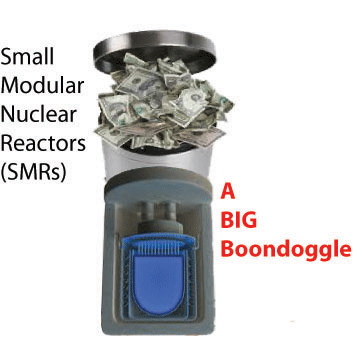
My analysis indicates that while advanced modular nuclear reactors might theoretically be helpful for the very long term, they cannot fix the problems of the US, and other countries in the West, nearly quickly enough. I expect that the Trump administration, which will start in January 2025, will see this program as a boondoggle.
Strangely enough, the US has no working model of a small-scale nuclear reactor, even one operating on conventional fuel.
Oil Price, By Gail Tverberg – Nov 12, 2024
The world is facing a growing shortage of uranium, the essential fuel for nuclear power plants.
The US is heavily reliant on Russia and its allies for enriched uranium, creating geopolitical risks.
Recycling spent nuclear fuel is expensive, complex, and faces significant environmental and security challenges.
It is easy to get the impression that proposed new modular nuclear generating units will solve the problems of nuclear generation. Perhaps they will allow more nuclear electricity to be generated at a low cost and with much less of a problem with spent fuel.
As I analyze the situation, however, the problems associated with nuclear electricity generation are more complex and immediate than most people perceive. My analysis shows that the world is already dealing with “not enough uranium from mines to go around.” In particular, US production of uranium “peaked”about 1980 (Figure 1 on original).
For many years, the US was able to down-blend nuclear warheads (both purchased from Russia and from its own supply) to get around its uranium supply deficit.
Today, the inventory of nuclear warheads has dropped quite low. There are few warheads available for down-blending. This is creating a limit on uranium supply that is only now starting to hit.
Nuclear warheads, besides providing uranium in general, are important for the fact that they provide a concentrated source of uranium-235, which is the isotope of uranium that can sustain a nuclear reaction. With the warhead supply depleting, the US has a second huge problem: developing a way to produce nuclear fuel, probably mostly from spent fuel, with the desired high concentration of uranium-235. Today, Russia is the primary supplier of enriched uranium.
The plan of the US is to use government research grants to kickstart work on new small modular nuclear reactors that will be more efficient than current nuclear plants. These reactors will use a new fuel with a higher concentration of uranium-235 than is available today, except through purchase from Russia. Grants are also being given to start work on US production of the more highly enriched uranium fuel within the US. It is hoped that most of this highly enriched uranium can come from recycling spent nuclear fuel, thus helping to solve the problem of what to do with the supply of spent fuel.
My analysis indicates that while advanced modular nuclear reactors might theoretically be helpful for the very long term, they cannot fix the problems of the US, and other countries in the West, nearly quickly enough. I expect that the Trump administration, which will start in January 2025, will see this program as a boondoggle.
Current problems with nuclear electricity generation are surprisingly hidden. World electricity generation from nuclear has been close to flat since 2004.
Although there was a dip in world generation of nuclear electricity after the tsunami that affected nuclear reactors in Fukushima, Japan, in 2011, otherwise world production of nuclear electricity has been nearly flat since 2004 (Figure 3 on original)……………………………………………………………………………………………………
Recycling of spent fuel to recover usable uranium and plutonium has been accomplished only to a limited extent. Experience to date suggests that recycling has many issues……………………………………………..
There seem to be several issues with building units to recover uranium from spent fuel:
- Higher cost than simply mining more uranium
- Pollution problems from the recycling plants
- Potential for use of the output to make nuclear warheads
- Potential for nuclear accidents within the plants
- Remaining radioactivity at the site at the end of the reprocessing plant’s life, and thus the need to decommission such plants
- Potential for many protestors disrupting construction and operation because of issues (2), (3), (4), and (5)
The US outlawed recycling of spent fuel in 1977, after a few not-very-successful attempts. Once the purchase of Russian warheads was arranged, down-blending of warheads was a much less expensive approach than reprocessing spent fuel. Physics Today recently reported the following regarding US reprocessing:
“A plant in West Valley, New York, reprocessed spent fuel for six years before closing in 1972. Looking to expand the plant, the owners balked at the costs required for upgrades needed to meet new regulatory standards. Construction of a reprocessing plant in Barnwell, South Carolina, was halted in 1977 following the Carter administration’s ban.”
Japan has been trying to build a commercial spent fuel reprocessing plant at Rokkasho since 1993, but it has had huge problems with cost overruns and protests by many groups. The latest estimate of when the plant will actually be completed is fiscal year 2026 or 2027.
The largest commercial spent fuel reprocessing plant in operation is in La Hague, France. It has been in place long enough (since 1966) that it has run into the issue of decommissioning an old unit, which was started as a French military project. The first processing unit was shut down in 2003. The International Atomic Energy Administration says, “The UP2-400 decommissioning project began some 20 years ago and may be expected to continue for several more years.” It talks about the huge cost and number of people involved. It says, “Decommissioning activities represent roughly 20 per cent of the overall activity and socio-economic impact of the La Hague site, which also hosts two operating spent fuel recycling plants.”
The cost of the La Hague reprocessing units is probably not fully known. They were built by government agencies. They have gone through various owners including AREVA. AREVA has had huge financial problems. The successor company is Orano. The currently operating units have the capacity to process about 1,700 metric tons of fuel per year. The 1700 metric tons of reprocessing of spent fuel from La Hague is reported to be nearly half of the world’s operating capacity for recycling spent fuel.The plant would process 800 metric tons of fuel per year.
I understand that Russia is working on approaches that quite possibly are not included in my figures. If so, this may add to world uranium supply, but Russia is not likely to want to share the benefits with the West if there is not enough to go around……………………………………………………………………………………….
The US is trying to implement many new ideas at one time with virtually no successful working models to smooth the transition.
Strangely enough, the US has no working model of a small-scale nuclear reactor, even one operating on conventional fuel. A CNBC article from September 2024 says, Small nuclear reactors could power the world, the challenge is building the first one in the US…………………………………………………………………………………….
Starting at this level, it is difficult to see how reactors with the new technology and the HALEU fuel to feed them can possibly be available in quantity before 2050.
It is difficult to see how the cost of electricity generated using the new advanced modular nuclear reactors and the new HALEU fuel, created by reprocessing spent fuel, could be low.
As far as I can see, the main argument that these new modular electricity generation plants will be affordable is that they will only generate a relatively small amount of electricity at once —about 300 megawatts or less, or about one third of the average of conventional nuclear reactors in the US. Because of the smaller electricity output, the hope is that they will be affordable by more buyers, such as utility companies.
The issue that is often overlooked by economists is that electricity generated using these new techniques needs to be low cost, per kilowatt-hour, to be helpful. High-cost electricity is not affordable. Keeping costs down when many new approaches are being tried for the first time is likely to be a huge hurdle. I look through the long list of problems encountered in recycling spent fuel mentioned in Section [6] and wonder whether these issues can be inexpensively worked around. There are also issues with adopting and installing the proposed new advanced modular reactors, such as security, that I have not even tried to address.https://oilprice.com/Alternative-Energy/Nuclear-Power/The-Future-of-Nuclear-Power-is-Wrought-with-Challenges.html
Head of UN nuclear watchdog: ‘Dire straits dynamic’ with Iran’s nuclear program amid Mideast wars
Daily Mail, By ASSOCIATED PRESS, 13 November 2024
BAKU, Azerbaijan (AP) – The head of the United Nations´ nuclear watchdog said Tuesday he’s hopeful that meetings this week with Iranian officials, including the country’s new president, can lead to a breakthrough in monitoring the country’s nuclear program, a longstanding issue that has gained new urgency as Israel has twice struck Iran amid rising tensions in the Middle East.
Rafael Mariano Grossi, director general of the International Atomic Energy Agency, will travel to Iran on Wednesday to meet for the first time with President Masoud Pezeshkian, who was elected in July. Grossi said he hopes to build on positive discussions he had with Iranian Foreign Minister Abbas Araghchi during the U.N. General Assembly in September.
“We have a problem that we need to solve,” Grossi said in an interview at the U.N. climate conference in Azerbaijan. “That is this gap, this lack of confidence, which we should not allow to grow into a self-fulfilling prophecy of using nuclear facilities as targets.”
He added: “There has been a bit of a dire straits dynamic with Iran that we want to go beyond.”
Iran is rapidly advancing its atomic program while increasing stockpiles of uranium enriched to near weapons-grade levels, all in defiance of international demands, according to the IAEA. Iran says its program is for energy purposes, not to build weapons.
Grossi’s visit comes as Israel and Iran have traded missile attacks in recent months after more than a year of war in Gaza, which is governed by Hamas, a group supported by Iran……………………………………………………………………………….. https://www.dailymail.co.uk/wires/ap/article-14073759/Head-UN-nuclear-watchdog-Dire-straits-dynamic-Irans-nuclear-program-amid-Mideast-wars.html
Nuclear Decommissioning Services Market Expected to Reach $11.79 Billion by 2034 – BIS Research
Industry Today 12th Nov 2024
As nuclear facilities worldwide reach the end of their operational lives, the nuclear decommissioning services market is witnessing substantial growth. The Nuclear Decommissioning Services Market is projected to grow from $6.70 billion in 2024 to $11.79 billion by 2034, fueled by the rising number of decommissioned nuclear facilities and the increasing emphasis on sustainable practices.
Published 12 November 2024
Market Overview
Market Size and Growth Rate
The Nuclear Decommissioning Services Market is projected to grow from $6.70 billion in 2024 to $11.79 billion by 2034, at a CAGR of 5.81% during the forecast period. This growth is driven by the escalating number of decommissioned reactors and a shift toward stringent regulatory frameworks prioritizing safe and sustainable decommissioning processes. …………………………………………………..
Demand Drivers
The market is significantly driven by the retirement of aging nuclear facilities, increased regulatory scrutiny, and advancements in decommissioning technology. Environmental sustainability mandates are pushing the demand for efficient and compliant decommissioning solutions.
Challenges
Complex regulatory requirements and high costs remain key challenges. Additionally, the intricate nature of nuclear waste disposal raises concerns over potential delays and budget overruns in large-scale decommissioning projects. …………………………………………………………………………………………………….
The successful [whaaa-aa-aat!] decommissioning of Japan’s Fukushima Daiichi nuclear power plant highlights the potential for advanced decommissioning technology to manage complex sites safely and efficiently. ……………………………………………..https://industrytoday.co.uk/energy_and_environment/nuclear-decommissioning-services-market-expected-to-reach-1179-billion-by-2034-bis-research
Other sites considered for UK’s nuclear waste disposal
A government agency says it is “considering other options” for the location
of a nuclear waste disposal site on the Lincolnshire coast. Nuclear Waste
Services’ (NWS) plans for a geological disposal facility (GDF) includes a
land-based facility which would accept waste and send it through tunnels to
a disposal area under the sea.
The search has been focussed on a former gas
terminal in Theddlethorpe but, in an update issued on Tuesday, NWS said
“competing interests” in the site had “matured” over the past year. It
added a “range of studies” was being carried out in the search area which
includes the electoral wards of Mablethorpe and Withern and Theddlethorpe.
In the update, external, NWS’ communities director Simon Hughes said: “No
decisions on these options have been made at this stage, we will publish an
update early next year and our teams will be out in communities to explain
our findings, hear feedback and consider next steps.”
For more than three years, Nuclear Waste Services has been eyeing up the former Theddlethorpe gas terminal as a suitable location for the land-based part of its
geological storage facility or GDF. This facility would receive the nuclear
waste before transporting it through tunnels to rocks deep beneath the sea.
But, since NWS announced its plans in 2021, the gas terminal site has
attracted other interest from other energy industries. There are proposals
for a carbon capture and storage facility there, the possibility of a
gas-fired power station and the site is also being considered as a location
to bring electricity cables ashore from North Sea windfarms. In other words
– it’s getting crowded.
The proposed location for the under-sea disposal
site remains unchanged. But NWS is now widening its search for the
land-based facility. Crucially, this search will be confined to two
electoral wards – Mablethorpe and Withern and Theddlethorpe. But NWS will
not identify a specific location until next year.
BBC 12th Nov 2024 https://www.bbc.co.uk/news/articles/c3e8pex248yo
1 This Month

of the week – Shut Down Drone Warfare!


Tell the Ukrainian Government to Drop Prosecution of Peace Activist Yurii Sheliazhenko

Petition to revoke the licensing of the Near Surface Nuclear Disposal Facility (NSDF) at Chalk River. https://www.ourcommons.ca/petitions/en/Petition/Details?Petition=e-7247
To see nuclear-related stories in greater depth and intensity – go to https://nuclearinformation.wordpress.com
-
Archives
- April 2026 (103)
- March 2026 (251)
- February 2026 (268)
- January 2026 (308)
- December 2025 (358)
- November 2025 (359)
- October 2025 (376)
- September 2025 (257)
- August 2025 (319)
- July 2025 (230)
- June 2025 (348)
- May 2025 (261)
-
Categories
- 1
- 1 NUCLEAR ISSUES
- business and costs
- climate change
- culture and arts
- ENERGY
- environment
- health
- history
- indigenous issues
- Legal
- marketing of nuclear
- media
- opposition to nuclear
- PERSONAL STORIES
- politics
- politics international
- Religion and ethics
- safety
- secrets,lies and civil liberties
- spinbuster
- technology
- Uranium
- wastes
- weapons and war
- Women
- 2 WORLD
- ACTION
- AFRICA
- Atrocities
- AUSTRALIA
- Christina's notes
- Christina's themes
- culture and arts
- Events
- Fuk 2022
- Fuk 2023
- Fukushima 2017
- Fukushima 2018
- fukushima 2019
- Fukushima 2020
- Fukushima 2021
- general
- global warming
- Humour (God we need it)
- Nuclear
- RARE EARTHS
- Reference
- resources – print
- Resources -audiovicual
- Weekly Newsletter
- World
- World Nuclear
- YouTube
-
RSS
Entries RSS
Comments RSS
 nuclear-news