The Great American Nuclear Weapons Upgrade
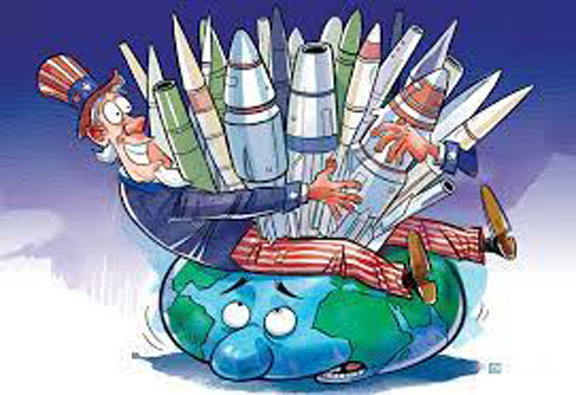
New nuclear-capable planes will soon be distributed to U.S. bases. Will they deter warfare or lead to an arms race?
In the plains of western South Dakota, about 25 miles northeast of Mount Rushmore, the Ellsworth Air Force Base is preparing to receive the first fleet of B-21 nuclear bombers, replacing Cold War-era planes. Two other bases, Dyess in Texas and Whiteman in Missouri, will soon follow. By the 2030s, a total of five bases throughout the United States will host nuke-carrying bombers for the first time since the 1990s.
The planes are part of an estimated $1.7 trillion military program advancing the nuclear arsenal of the United States, as tensions continue to rise with nuclear-armed rivals Russia and China. In addition to the B-21s, the Pentagon is upgrading larger aging bombers and may also restore nukes to the ones that had their nuclear capabilities removed. Leaders within the U.S. Department of Defense, such as Air Force General Anthony Cotton, argue that the nuclear modernization program, as it is called, is a “national imperative.” While some nuclear and foreign policy analysts argue that the program is crucial to building — or rebuilding — a formidable arsenal that deters other nuclear powers, others say it raises questions for both nuclear deterrence and arms control.
Still, the costly and massive nuclear modernization program enjoys bipartisan support, said Geoff Wilson, a defense policy researcher at the Stimson Center, a Washington, D.C.-based think tank. “The United States has committed itself to one of the largest arms races in history. We’re spending about $75 billion a year on new nuclear weapons,” he said, citing figures from the Congressional Budget Office. In comparison, the entire Manhattan Project cost about $30 billion in today’s dollars, spread over multiple years.
In addition to new bombers and nukes returning to bases that haven’t seen them since around the end of the Cold War, the U.S. and some of its rivals are building new missiles and nuke-launching subs. At the same time, the U.S. and Russia have announced their withdrawal from pacts or have suspended their participation in them, including the Comprehensive Nuclear-Test-Ban Treaty, the Intermediate-Range Nuclear Forces Treaty, and New START.
With the international arms control regime eroding, experts say, there is little incentive for nuclear powers to reduce their arsenals. Instead, the U.S. and other military powers are advancing or expanding their nuclear weaponry, with few international rules remaining in place.
Though the Cold War ended more than 30 years ago, the U.S. and Russia maintain the biggest bomber fleets in the world………………………………………………………………………………………………………
Each of these new nuclear bombers and storage sites comes with safety and security concerns. After all, numerous military nuclear accidents occurred during the Cold War. For example, in 1958 at Dyess Air Force Base, a fire erupted on a nuke-carrying B-47. The aircraft crashed, causing an explosion that created a crater on the ground. The nuke didn’t detonate, and while three crew members were able to eject safely, one was killed. In 1959 at Barksdale, a transport aircraft nicknamed “Old Shakey” crashed. According to reporting from the Shreveport Times, three thermonuclear devices were destroyed. Then in 1964 at Ellsworth, a small explosion popped off a missile’s cone, which contained a nuclear warhead, and it fell to the bottom of a silo. Fortunately, it did not detonate.
More recently, a non-nuclear B-1 bomber crashed in January 2024 at Ellsworth, and following an investigation, the Air Force fired a commander there. ………………….
The new and upgraded nukes come with arms control and geopolitical concerns as well. During the Cold War, negotiators from the U.S. and USSR hammered out at least five major nuclear treaties, but most of those have since fallen by the wayside. Last year, Putin suspended Russia’s participation in the New START treaty — the final remaining nuclear treaty between the U.S. and Russia — which is now set to expire in February 2026. The accord limits each country to 1,550 deployed nuclear warheads, but there’s a loophole: Each bomber counts as one weapon even though it can carry multiple nukes.
…………………………………………..The U.S. has deployed nuclear-capable bombers in Australia near China, near Russia-occupied Ukraine, near North Korea, and near Iran, which suspended its nuclear program, according to U.S. intelligence reports. The U.S. has been more frequently doing these deployments than before, though such bombers haven’t carried nukes abroad in decades, Kristensen said. The Pentagon also recently deployed nuclear-capable B-2 bombers to strike Houthi targets in Yemen, their first use in combat in years, perhaps intended to threaten Iran as well. The Air Force declined to comment on nuclear-capable bombers overseas.
As tensions worsen, especially between the U.S. and Russia over Ukraine and between the U.S. and China over Taiwan, analysts fear conventional conflicts could escalate into nuclear ones, such as if Putin feels his government is threatened or if a direct war between Russia and NATO erupts.
These conflicts and geopolitical tensions have been a boon for defense contractors, including Northrop Grumman, which is building the B-21 and B-2 bombers for the Air Force. The company has seen its stock rise during Israel’s expanding bombing campaigns and the Russia-Ukraine war, and it has been one of the U.S.’s main contractors for military aid packages to both Israel and Ukraine, along with Boeing, Lockheed Martin, RTX Corporation (formerly Raytheon), and others. (Northrop Grumman did not respond to Undark’s requests for comment.)
Since the Cold War, the U.S. and Russia have operated with the goal of nuclear deterrence, each maintaining a sufficient arsenal to deter its rival from using a nuke. But there’s a risk that such notions could give way to a new arms race, especially when one country cites its rival’s nuclear modernization in order to expand its arsenal, Wilson argues. Deterrence, he said, “has become an excuse to ramp up defense spending and pay more money towards defense contractors who are woefully behind schedule and over-budget on all these things already.”
“I think that people have forgotten what deterrence means,” he added. “It’s based on stability — it’s not based on dominance.” https://undark.org/2024/11/04/the-great-american-nuclear-weapons-upgrade/?utm_source=Undark%3A+News+%26+Updates&utm_campaign=77b2fac5ab-RSS_EMAIL_CAMPAIGN&utm_medium=email&utm_term=0_5cee408d66-185e4e09de-%5BLIST_EMAIL_ID%5D
No comments yet.
1 This Month


18 March Webinar @ 1 PM EST: An Assessment of SMR Projects: The Case of Canada
register for the zoom:
https://us02web.zoom.us/webinar/register/WN_o8BIIOUvQ2ONJR1nta65DQ#/registration


of the week – STOP SMALL MODULAR REACTORS IN CANADA
To see nuclear-related stories in greater depth and intensity – go to https://nuclearinformation.wordpress.com
-
Archives
- March 2026 (138)
- February 2026 (268)
- January 2026 (308)
- December 2025 (358)
- November 2025 (359)
- October 2025 (376)
- September 2025 (258)
- August 2025 (319)
- July 2025 (230)
- June 2025 (348)
- May 2025 (261)
- April 2025 (305)
-
Categories
- 1
- 1 NUCLEAR ISSUES
- business and costs
- climate change
- culture and arts
- ENERGY
- environment
- health
- history
- indigenous issues
- Legal
- marketing of nuclear
- media
- opposition to nuclear
- PERSONAL STORIES
- politics
- politics international
- Religion and ethics
- safety
- secrets,lies and civil liberties
- spinbuster
- technology
- Uranium
- wastes
- weapons and war
- Women
- 2 WORLD
- ACTION
- AFRICA
- Atrocities
- AUSTRALIA
- Christina's notes
- Christina's themes
- culture and arts
- Events
- Fuk 2022
- Fuk 2023
- Fukushima 2017
- Fukushima 2018
- fukushima 2019
- Fukushima 2020
- Fukushima 2021
- general
- global warming
- Humour (God we need it)
- Nuclear
- RARE EARTHS
- Reference
- resources – print
- Resources -audiovicual
- Weekly Newsletter
- World
- World Nuclear
- YouTube
-
RSS
Entries RSS
Comments RSS
 nuclear-news
Leave a comment