TODAY . COP 29 global climate summit – already a dead duck.
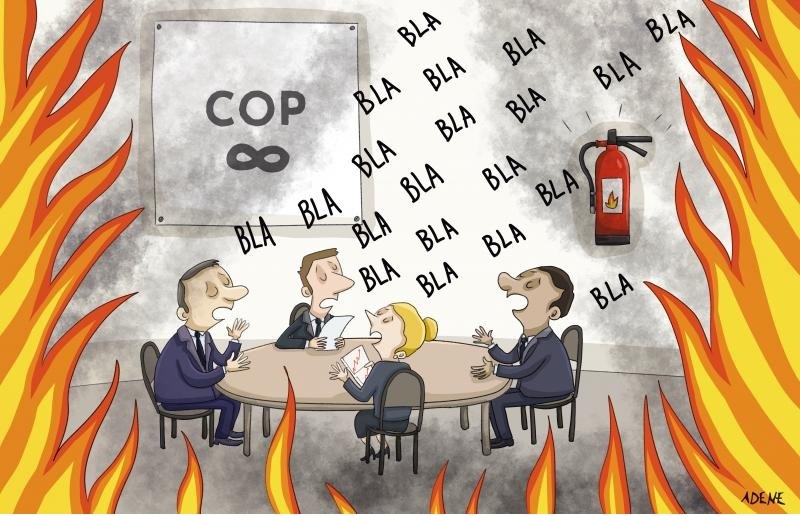
In the midst of all the brouhaha about the election of a deranged narcissist to be in charge of America, we must remember what is really the biggest danger to our Earth – climate change – global heating
The 29th Conference of the Parties to the UN Framework Convention on Climate Change (COP29), will take place from November 11 to 22 in 2024 at Baku Stadium, Azerbaijan, from 11 to 22 November 2024.
There will be good people there, and I’m not rubbishing their work.
Still, at the top level, corporate greed will be running the show.
FIRST. to start with, the host, Azerbaijan- is a massive exporter of oil and gas, – global fossil fuel lobbyists will be welcome there and money will be splurged on an attractive greenwash of the dirtiest industries

SECOND. As if having the fossil fuel industries in control was not bad enough, we have their close mate, the nuclear industry, jumping on the bandwagon, with its lucrative claims about “solving” the climate crisis .
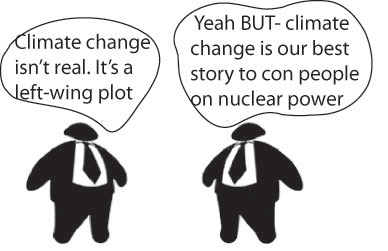
THIRD. Politics international. Ursula von der Leyen, the big cheese of the European Commission, will not be attending. Nor will France’s Emmanuel Macron, the current US president, Joe Biden, and the Brazilian president, Luiz Inácio Lula da Silva, . The leaders of China, South Africa, Japan and Australia are expected to miss the talks as well. This sends a clear message that climate change is not a concern for top world leaders

THIRD. American politics now. I’m not a fan of Joe Biden, but the Biden administration deserves credit . The U.S. Inflation Reduction Act has been successful in promoting truly clean energy (even though it does contain sops to the nuclear industry). Many Americans have now become painfully aware of the extreme effects of global heating, and the USA’s clean energy success will be hard for the climate deniers to unravel. But still, in January, Trump’s climate denial administration will take over, and this fact does cast a damper on COP29.

We know that there are millions of people who are dedicated to the cause of a clean world, and of stopping global heating. We are up against the globally amoral corporateaucracy .
Trump Puts An Appropriately Ugly Face On A Very Ugly Empire
Caitlin Johnstone, Nov 09, 2024, https://www.caitlinjohnst.one/p/trump-puts-an-appropriately-ugly?utm_source=post-email-title&publication_id=82124&post_id=151402607&utm_campaign=email-post-title&isFreemail=true&r=1ise1&triedRedirect=true&utm_medium=email
The only thing I like about Trump is exactly what so many empire managers hate about him: he gives the game away. He says the quiet parts out loud. He’s the only president who’ll openly boast that US troops are in Syria to keep the oil or lament that they failed to take the oil from Venezuela, or just come right out and tell everyone he’s bought and owned by Zionist oligarchs.
Trump is the opposite of Obama, who was very skillful at putting a pretty face on the evil empire. Trump puts a very ugly face on a very ugly thing. He is a much more honest face to have on the empire. A crude, stupid plutocrat who is owned by other plutocrats is the perfect representative of that tyrannical power structure.
The propaganda machine has been spinning its head off trying to frame soccer brawls in Amsterdam as a horrifying “pogrom” against Jewish people because the side instigating the violence were supporters of team Maccabi Tel Aviv who flew in from Israel.
Video evidence shows far right Israeli hooligans terrorizing the streets of Amsterdam, chanting “Fuck the Arabs”, starting fights, beating people, tearing down Palestinian flags, attacking a cab driver, and singing “Let the IDF win and fuck the Arabs! Why is school out in Gaza? There are no children left there!”
In the face of all this evidence of atrocious behavior by Israeli soccer fans, The New York Times ran a story with the headline “Antisemitic Attacks Prompt Emergency Flights for Israeli Soccer Fans”. The Wall Street Journal ran with “Antisemitic Attacks in Amsterdam Prompt Tight Security at Jewish Sites”. “Pogroms have returned to Europe, and the ‘anti-racist’ Left are silent,” says The Telegraph.
Meanwhile the Daily Mail sports section ran with a headline more in line with what people actually saw: “Israeli football hooligans tear down Palestine flags in Amsterdam as taxi drivers ‘fight back’ in night of chaos ahead of Maccabi Tel Aviv’s visit to Ajax”
Leaders of western nations like the US, UK, Canada and France joined the Dutch king in framing these soccer brawls and hooliganism as a historic mass-scale hate crime against Jews, while Israeli officials have been melodramatically shrieking like their hair is on fire.
These exhausting victim-LARPing freaks. Stop playing sports with Israel. Stop holding sporting events which could lead to the deranged members of a genocidal apartheid state showing up in your community stirring up violence and hate so they can cry victim and say you holocausted them.
Another thing that sucks about the fake “antisemitism” crisis that the western political-media class are pretending to believe in is that it will probably become a kind of self-fulfilling prophecy which creates real hatred of Jewish people.
You can’t keep telling everyone over and over and over again that Jews and Israel are one and the same and that any criticism of one is always necessarily an attack on the other while the state of Israel is murdering children by the tens of thousands without contributing to unfair prejudice against Jewish people everywhere. Israel is exacerbating this effect by insisting its actions represent all Jews and are done in defense of Judaism while committing genocidal atrocities under a Star of David flag.
If you understand the truth that modern Israel is a settler-colonialist project of the western empire which uses the Jewish religion as an excuse to inflict violence and tyranny in a crucial geostrategic region, then you understand that there’s no real connection between modern Israel and the Jews you encounter in your community. Sure a majority of western Jews buy into the empire’s lies and support Israel, but a majority of the westerners of all faiths buy into the empire’s lies about its wars and official enemies and all its other propaganda too. This is just what it looks like when you live in a highly propagandized society which is structured to psychologically manipulate people into consenting to nonstop military violence.
Once you understand this, you see that blaming ordinary Jews in your society for the actions of the state of Israel makes about as much sense as blaming ordinary Muslims for the actions of the Saudi royals — but most people don’t understand this. It takes a lot of learning and close examination, and most people haven’t reached that level of lucidity in our confusing information landscape which is distorted by lies and propaganda.
So when they see a self-evidently evil thing being done and hear their leaders and pundits telling them over and over again that if you hate what you’re seeing then you necessarily hate Jewish people, what understanding do you think they’re going to form in their minds?
Greater hatred and prejudice looks like a fairly inevitable consequence of this messaging from where I’m sitting. And it will all be the fault of the western pundits and politicians who are aggressively promulgating this message throughout our society right now in an effort to stomp out criticism of an active genocide.
The garment-rending emotional reaction to the US election results compared to the apathy on Gaza over the last year tells you that liberals don’t see Palestinians as human beings. They’ll deny it, but it’s true. Their emotions show you much more than their words ever will. This is who they are.
Ignore their words and watch their actions. It works with politicians, it works with entire governments, and it works with individuals too. If you see someone flailing around on the ground because their genocidal candidate lost after spending a year walking around functioning perfectly fine throughout a year of genocide, that tells you something about them that their words would never tell you.
People are always much more honest with their actions than their words, because words can spin narratives and actions cannot. If you’re ever unsure of someone’s true motivations and where they really stand, don’t ask them, just watch them. They’ll tell you eventually, with their actions and not their words.
Von der Leyen’s Cop29 absence sends ‘fatal signal’, say watchers
MEPs express concern for EU climate leadership as commission head confirms she will miss Baku summit
Jennifer Rankin in Brussels, Guardian 6th Nov 2024 https://www.theguardian.com/environment/2024/nov/06/von-der-leyens-cop29-absence-sends-fatal-signal-say-watchers
Ursula von der Leyen’s decision to miss the Cop29 climate summit is “a fatal signal” and raises questions about Europe’s commitment to the climate crisis, observers have said.
The European Commission confirmed on Tuesday that its president would not attend the UN climate talks in Baku, which start on Monday. “The commission is in a transition phase and the president will therefore focus on her institutional duties,” a spokesperson said.
Also skipping the “world leaders’ climate action summit” on Tuesday and Wednesday are France’s Emmanuel Macron and the outgoing US president, Joe Biden. The Brazilian president, Luiz Inácio Lula da Silva, cancelled his participation due to a head injury, Reuters reported. The leaders of China, South Africa, Japan and Australia are expected to miss the talks as well.
Mohammed Chahim, a Dutch socialist and the vice-chair of the European parliament’s delegation to the Baku talks, described von der Leyen’s absence as “regrettable”, but said it did not imply a lack of EU commitment.
He said: “The climate crisis does not wait for ideal conditions to act, and neither can we. After the re-election of [Donald] Trump, the EU must now take a stronger leadership role, both to sustain momentum and to counterbalance the US stance.”
Michael Bloss, a German Green MEP, also in the delegation, said it was “a fatal signal” that Europe’s most powerful woman, along with other leaders, had chosen not to attend.
Referring to Azerbaijan’s strongman president, Ilham Aliyev, Bloss said: “By leaving the stage to autocrats like Aliyev, we risk turning the conference more and more into a greenwashing spectacle for self-promotion rather than genuine climate action.”
Von der Leyen is preparing for her second term in office, expected to begin on 1 December after European parliament hearings with her top team conclude.
The commission will be represented at Cop29 by its climate commissioner, Wopke Hoekstra, and the energy commissioner, Kadri Simson, and a team of negotiators.
WWF said von der Leyen’s non-attendance was disappointing. Shirley Matheson, a climate specialist at the charity, said her absence, along with other world leaders, raised “serious questions” about European and international commitment to fighting the climate crisis. “We cannot afford for climate action to move down on Europe’s agenda,” she added.
Von der Leyen has attended every high-level Cop meeting since she became commission president in 2019. In her successful pitch for re-election by MEPs, she highlighted the importance of Europe’s role in international climate talks: “I want Europe to remain a leader in international climate negotiations.”
The head of the UN environment programme said last month that “huge cuts” in carbon emissions were needed to steer the world off a path of catastrophic temperature rise, in a report urging countries to act at the climate summit in Baku.
Sven Harmeling, head of climate at the Climate Action Network Europe, said he did not see von der Leyen’s non-attendance as “not showing interest”, but added it was important she ensured the EU “is able to speak up and convey its ambition for climate leadership”.
“Stronger EU participation is always important to signal leadership, but for me it really comes down to how they use diplomatic channels,” he said, highlighting the bloc’s role at the G20 summit in Brazil on 18-19 November, where leaders of the world’s largest economies will discuss financing the climate transition.
On Wednesday, the commission said: “Our leadership is demonstrated by our consistent actions domestically and internationally. We are always a leading voice for ambition at Cops and that will not change this year.”
‘A wrecking ball’: experts warn Trump’s win sets back global climate action
Election of a ‘climate denier’ to US presidency poses ‘major threat to the planet’, environmentalists say. Donald Trump has called climate change ‘a big hoax’ and vowed to gut environmental rules ahead of his election victory
Guardian 6th Nov 2024 Oliver Milman and Ajit Niranjan,
https://www.theguardian.com/us-news/2024/nov/06/trump-climate-change-environment-threat
Donald Trump’s new term as US president poses a grave threat to the planet if it blows up the international effort to curb dangerous global heating, stunned climate experts have warned in the wake of his decisive election victory.
Trump’s return to the White House is widely expected to result in the US, yet again, exiting the Paris climate agreement and may even remove American involvement in the underpinning United Nations framework to deal with the climate crisis.
While campaigning for president, Trump has called climate change “a big hoax”, scorned wind energy and electric cars and vowed to gut environmental rules and the “green new scam” of the Inflation Reduction Act, a major bill passed by Democrats to support clean energy projects.
Trump’s agenda, analysts have found, risks adding several billion tonnes of extra heat-trapping gases to the atmosphere, further imperiling goals to stave off disastrous global heating that governments are already failing to meet. Michael Mann, a climate scientist at the University of Pennsylvania, said that the US is now a “failed democracy” and that “we now pose a major threat to the planet.”
The election result will send shockwaves through annual UN climate talks that start in Azerbaijan on Monday. “The election of a climate denier to the US presidency is extremely dangerous for the world,” said Bill Hare, a senior scientist at Climate Analytics, who warned a Trump administration would likely “damage efforts” to keep the world from heating by more than 1.5C above pre-industrial levels, a Paris target that now appears even further out of reach.
While Joe Biden’s administration will send a delegation to the Cop29 summit next week, this will be overshadowed by an incoming Trump government that threatens to disengage with other major carbon emitters, such as China, to address the climate crisis. “The nation and world can expect the incoming Trump administration to take a wrecking ball to global climate diplomacy,” said Rachel Cleetus, policy director at the Union of Concerned Scientists.
Across Europe, climate activists and politicians who support stronger action to cut pollution reacted with despair to the news of Trump’s win. “This is a dark day in the US and globally,” said Thomas Waitz, an Austrian MEP and co-chair of the European Green party.
Luisa Neubauer, a German climate activist from the Fridays for Future movement, who went door-knocking for Harris, compared the feeling to a bad breakup. “A decision over parts of the near future has been made and most of us didn’t have a say in it,” she said. “And for a moment it feels like the world is going to end. It’s not. But the heartbreak is real.”
But they also urged supporters of climate action to not give up.
Areeba Hamid, joint executive director of Greenpeace UK, said it was “an election won with corporate cash, big polluter backers and disinformation” but that a global movement was already fighting to rein in the damage.
“We simply don’t have any more time to waste,” she added. “Whatever a Trump presidency chooses to do on global climate action, we know that damage can be contained if the grown-ups in the room speak up.”
When he was last president, Trump took several months to decide to remove the US from the Paris deal, raising fears the agreement would collapse. Countries did manage to avoid such a fate prior to Biden re-entering the pact and there is some optimism that the transition to cleaner energy isn’t something that Trump, despite his demands that the US “drill, baby drill” for oil and gas, can reverse.
“The US election result is a setback for global climate action, but the Paris agreement has proven resilient and is stronger than any single country’s policies,” said Laurence Tubiana, chief executive of the European Climate Foundation and a key architect of the Paris deal.
“The context today is very different to 2016,” she said. “There is powerful economic momentum behind the global transition, which the US has led and gained from, but now risks forfeiting. The devastating toll of recent hurricanes was a grim reminder that all Americans are affected by worsening climate change.”
Much like after the previous withdrawal, cities and state within the US committed to climate action will try to fill the void of federal indifference, acting as de facto representatives at global summits and even engaging with other countries on how to cut emissions.
“No matter what Trump may say, the shift to clean energy is unstoppable and our country is not turning back,” said Gina McCarthy, former climate adviser to Biden and co-chair of the America Is All In coalition of climate-concerned states and cities.
“Our coalition is bigger, more bipartisan, better organized, and fully prepared to deliver climate solutions, boost local economies and drive climate ambition,” she said. “We cannot and will not let Trump stand in the way of giving our kids and grandkids the freedom to grow up in safer and healthier communities.”
Domestically, environmental groups have said they will attempt to rally Democrats, as well as some Republicans, to oppose Trump’s tearing down of climate policies, which is anticipated to include major cuts to the Environmental Protection Agency and weakened pollution rules for coal plants, cars and fossil fuel drilling. “President Trump will face a bipartisan wall of opposition if he attempts to rip away clean energy incentives now,” said Dan Lashof, director of the World Resources Institute.
“No matter what Trump may say, the shift to clean energy is unstoppable and our country is not turning back,” said Gina McCarthy, former climate adviser to Biden and co-chair of the America Is All In coalition of climate-concerned states and cities.
“Our coalition is bigger, more bipartisan, better organized, and fully prepared to deliver climate solutions, boost local economies and drive climate ambition,” she said. “We cannot and will not let Trump stand in the way of giving our kids and grandkids the freedom to grow up in safer and healthier communities.”
Domestically, environmental groups have said they will attempt to rally Democrats, as well as some Republicans, to oppose Trump’s tearing down of climate policies, which is anticipated to include major cuts to the Environmental Protection Agency and weakened pollution rules for coal plants, cars and fossil fuel drilling. “President Trump will face a bipartisan wall of opposition if he attempts to rip away clean energy incentives now,” said Dan Lashof, director of the World Resources Institute.
The Great American Nuclear Weapons Upgrade

New nuclear-capable planes will soon be distributed to U.S. bases. Will they deter warfare or lead to an arms race?
In the plains of western South Dakota, about 25 miles northeast of Mount Rushmore, the Ellsworth Air Force Base is preparing to receive the first fleet of B-21 nuclear bombers, replacing Cold War-era planes. Two other bases, Dyess in Texas and Whiteman in Missouri, will soon follow. By the 2030s, a total of five bases throughout the United States will host nuke-carrying bombers for the first time since the 1990s.
The planes are part of an estimated $1.7 trillion military program advancing the nuclear arsenal of the United States, as tensions continue to rise with nuclear-armed rivals Russia and China. In addition to the B-21s, the Pentagon is upgrading larger aging bombers and may also restore nukes to the ones that had their nuclear capabilities removed. Leaders within the U.S. Department of Defense, such as Air Force General Anthony Cotton, argue that the nuclear modernization program, as it is called, is a “national imperative.” While some nuclear and foreign policy analysts argue that the program is crucial to building — or rebuilding — a formidable arsenal that deters other nuclear powers, others say it raises questions for both nuclear deterrence and arms control.
Still, the costly and massive nuclear modernization program enjoys bipartisan support, said Geoff Wilson, a defense policy researcher at the Stimson Center, a Washington, D.C.-based think tank. “The United States has committed itself to one of the largest arms races in history. We’re spending about $75 billion a year on new nuclear weapons,” he said, citing figures from the Congressional Budget Office. In comparison, the entire Manhattan Project cost about $30 billion in today’s dollars, spread over multiple years.
In addition to new bombers and nukes returning to bases that haven’t seen them since around the end of the Cold War, the U.S. and some of its rivals are building new missiles and nuke-launching subs. At the same time, the U.S. and Russia have announced their withdrawal from pacts or have suspended their participation in them, including the Comprehensive Nuclear-Test-Ban Treaty, the Intermediate-Range Nuclear Forces Treaty, and New START.
With the international arms control regime eroding, experts say, there is little incentive for nuclear powers to reduce their arsenals. Instead, the U.S. and other military powers are advancing or expanding their nuclear weaponry, with few international rules remaining in place.
Though the Cold War ended more than 30 years ago, the U.S. and Russia maintain the biggest bomber fleets in the world………………………………………………………………………………………………………
Each of these new nuclear bombers and storage sites comes with safety and security concerns. After all, numerous military nuclear accidents occurred during the Cold War. For example, in 1958 at Dyess Air Force Base, a fire erupted on a nuke-carrying B-47. The aircraft crashed, causing an explosion that created a crater on the ground. The nuke didn’t detonate, and while three crew members were able to eject safely, one was killed. In 1959 at Barksdale, a transport aircraft nicknamed “Old Shakey” crashed. According to reporting from the Shreveport Times, three thermonuclear devices were destroyed. Then in 1964 at Ellsworth, a small explosion popped off a missile’s cone, which contained a nuclear warhead, and it fell to the bottom of a silo. Fortunately, it did not detonate.
More recently, a non-nuclear B-1 bomber crashed in January 2024 at Ellsworth, and following an investigation, the Air Force fired a commander there. ………………….
The new and upgraded nukes come with arms control and geopolitical concerns as well. During the Cold War, negotiators from the U.S. and USSR hammered out at least five major nuclear treaties, but most of those have since fallen by the wayside. Last year, Putin suspended Russia’s participation in the New START treaty — the final remaining nuclear treaty between the U.S. and Russia — which is now set to expire in February 2026. The accord limits each country to 1,550 deployed nuclear warheads, but there’s a loophole: Each bomber counts as one weapon even though it can carry multiple nukes.
…………………………………………..The U.S. has deployed nuclear-capable bombers in Australia near China, near Russia-occupied Ukraine, near North Korea, and near Iran, which suspended its nuclear program, according to U.S. intelligence reports. The U.S. has been more frequently doing these deployments than before, though such bombers haven’t carried nukes abroad in decades, Kristensen said. The Pentagon also recently deployed nuclear-capable B-2 bombers to strike Houthi targets in Yemen, their first use in combat in years, perhaps intended to threaten Iran as well. The Air Force declined to comment on nuclear-capable bombers overseas.
As tensions worsen, especially between the U.S. and Russia over Ukraine and between the U.S. and China over Taiwan, analysts fear conventional conflicts could escalate into nuclear ones, such as if Putin feels his government is threatened or if a direct war between Russia and NATO erupts.
These conflicts and geopolitical tensions have been a boon for defense contractors, including Northrop Grumman, which is building the B-21 and B-2 bombers for the Air Force. The company has seen its stock rise during Israel’s expanding bombing campaigns and the Russia-Ukraine war, and it has been one of the U.S.’s main contractors for military aid packages to both Israel and Ukraine, along with Boeing, Lockheed Martin, RTX Corporation (formerly Raytheon), and others. (Northrop Grumman did not respond to Undark’s requests for comment.)
Since the Cold War, the U.S. and Russia have operated with the goal of nuclear deterrence, each maintaining a sufficient arsenal to deter its rival from using a nuke. But there’s a risk that such notions could give way to a new arms race, especially when one country cites its rival’s nuclear modernization in order to expand its arsenal, Wilson argues. Deterrence, he said, “has become an excuse to ramp up defense spending and pay more money towards defense contractors who are woefully behind schedule and over-budget on all these things already.”
“I think that people have forgotten what deterrence means,” he added. “It’s based on stability — it’s not based on dominance.” https://undark.org/2024/11/04/the-great-american-nuclear-weapons-upgrade/?utm_source=Undark%3A+News+%26+Updates&utm_campaign=77b2fac5ab-RSS_EMAIL_CAMPAIGN&utm_medium=email&utm_term=0_5cee408d66-185e4e09de-%5BLIST_EMAIL_ID%5D
COP 29 chief exec filmed promoting fossil fuel deals

BBC 8th Nov 2024, Justin Rowlatt, BBC climate editor, https://www.bbc.co.uk/news/articles/crmzvdn9e18o
A senior official at COP29 climate change conference in Azerbaijan appears to have used his role to arrange a meeting to discuss potential fossil fuel deals, the BBC can report.
A secret recording shows the chief executive of Azerbaijan’s COP29 team, Elnur Soltanov, discussing “investment opportunities” in the state oil and gas company with a man posing as a potential investor.
“We have a lot of gas fields that are to be developed,” he says.
A former head of the UN body responsible for the climate talks told the BBC that Soltanov’s actions were “completely unacceptable” and a “betrayal” of the COP process.
As well as being the chief executive of COP29, Soltanov is also the deputy energy minister of Azerbaijan and is on the board of Socar.
Azerbaijan’s COP29 team has not responded to a request for comment.
Oil and gas accounts for about half of Azerbaijan’s total economy and more than 90% of its exports, according to US figures.
COP29 will open in Baku on Monday and is the 29th annual UN climate summit, where governments discuss how to limit and prepare for climate change, and raise global ambition to tackle the issue.
However, this is the second year in a row the BBC has revealed alleged wrongdoing by the host government.
The BBC has been shown documents and secret video recordings made by the human rights organisation, Global Witness.
It is understood that one of its representatives approached the COP29 team posing as the head of a fictitious Hong Kong investment firm specialising in energy.
He said this company was interested in sponsoring the COP29 summit but wanted to discuss investment opportunities in Azerbaijan’s state energy firm, Socar, in return. An online meeting with Soltanov was arranged.
During the meeting, Soltanov told the potential sponsor that the aim of the conference was “solving the climate crisis” and “transitioning away from hydrocarbons in a just, orderly and equitable manner”.
Anyone, he said, including oil and gas companies, “could come with solutions” because Azerbaijan’s “doors are open”.
However, he said he was open to discussions about deals too – including on oil and gas……………
“There are a lot of joint ventures that could be established,” Soltanov says on the recording. “Socar is trading oil and gas all over the world, including in Asia.
….. The UN climate science body, the Intergovernmental Panel on Climate Change, acknowledges there will be a role for some oil and gas up to 2050 and beyond. However, it has been very clear that “developing… new oil and gas fields is incompatible with limiting warming to 1.5C”.
It also goes against the agreement the world made at the last global climate summit to transition away from fossil fuels.
Soltanov appeared eager to help get discussions going, telling the potential sponsor: “I would be happy to create a contact between your team and their team [Socar] so that they can start discussions.”
A couple of weeks later the fake Hong Kong investment company received an email – Socar wanted to follow up on the lead.
Attempting to do business deals as part of the COP process appears to be a serious breach of the standards of conduct expected of a COP official.
These events are supposed to be about reducing the world’s use of fossil fuels – the main driver of climate change – not selling more.
…………………………………… Christiana Figueres, who oversaw the signing of the 2015 Paris agreement to limit global temperature rises to well below 2C, told the BBC that she was shocked anyone in the COP process would use their position to strike oil and gas deals.
She said such behaviour was “contrary and egregious” to the the purpose of COP and “a treason” to the process.
The BBC has also seen emails between the COP29 team and the fake investors.
In one chain, the team discusses a $600,000 (£462,000) sponsorship deal with a fake company in return for the Socar introduction and involvement in an event about “sustainable oil and gas investing” during COP29.
………………… The findings come a year after the BBC obtained leaked documents that revealed plans by the UAE to use its role as host of COP28 to strike oil and gas deals.
COP28 was the first time agreement was reached on the need to transition away from fossil fuels.
Compelling Economics of Renewables Unmask Fossil Fuels and Nuclear
Posted to Energy November 07, 2024, by Francesco La Camera, Paul Dorfman,
https://dcjournal.com/compelling-economics-of-renewables-unmask-fossil-fuels-and-nuclear/
The renewable energy revolution is happening, but it is running too slow.
Renewables set a record in 2023 with 473 gigawatts added. Yet, we need to triple capacity by 2030 to stay aligned with the Paris Agreement.
While renewables are overtaking fossil fuels and nuclear as the primary choice for new power, the transition isn’t fast enough to limit global warming. In fact, renewable power capacity must triple by 2030, as recommended by International Renewable Energy Agency and agreed on by world leaders in the UAE Consensus at the last U.N. Climate Conference in Dubai.
Peaking fossil fuels is not enough; we need deep and rapid carbon dioxide cuts in the limited time we have to keep within our vanishingly small carbon budget.
The choices we make about the use of technologies will largely determine the success of our climate actions. We need low-carbon, or even no-carbon technologies. The concept of technology neutrality, understood as the capacity to cut carbon dioxide emissions, should also include the dimensions of costs and the time needed to reach the desired outcome.
Recently, nuclear energy has attracted attention as a technology to cut emissions and diversify energy supplies.
We are not challenging the choice of technology as a matter of national sovereignty. Instead, energy technologies (nuclear, renewables, fossil fuels) are compared in the context of the fight against climate change, where time is the most relevant variable.
According to the Intergovernmental Panel on Climate Change, accelerating renewables coupled with energy efficiency measures are the most realistic means to reduce global emissions by 43 percent by 2030 and at least 60 percent by 2035.
Due to lower cost and higher efficiency, the IPCC has stated that renewables, particularly solar and wind, are ten times more effective at cutting carbon dioxide emissions than nuclear.
Nuclear’s share of global electricity production has almost halved from 1996 to 2023, largely due to the high costs of, and delays to, building and operating nuclear reactors. Far from improving, the latest nuclear reactor designs offer the worst-ever record of delays and cost escalation.
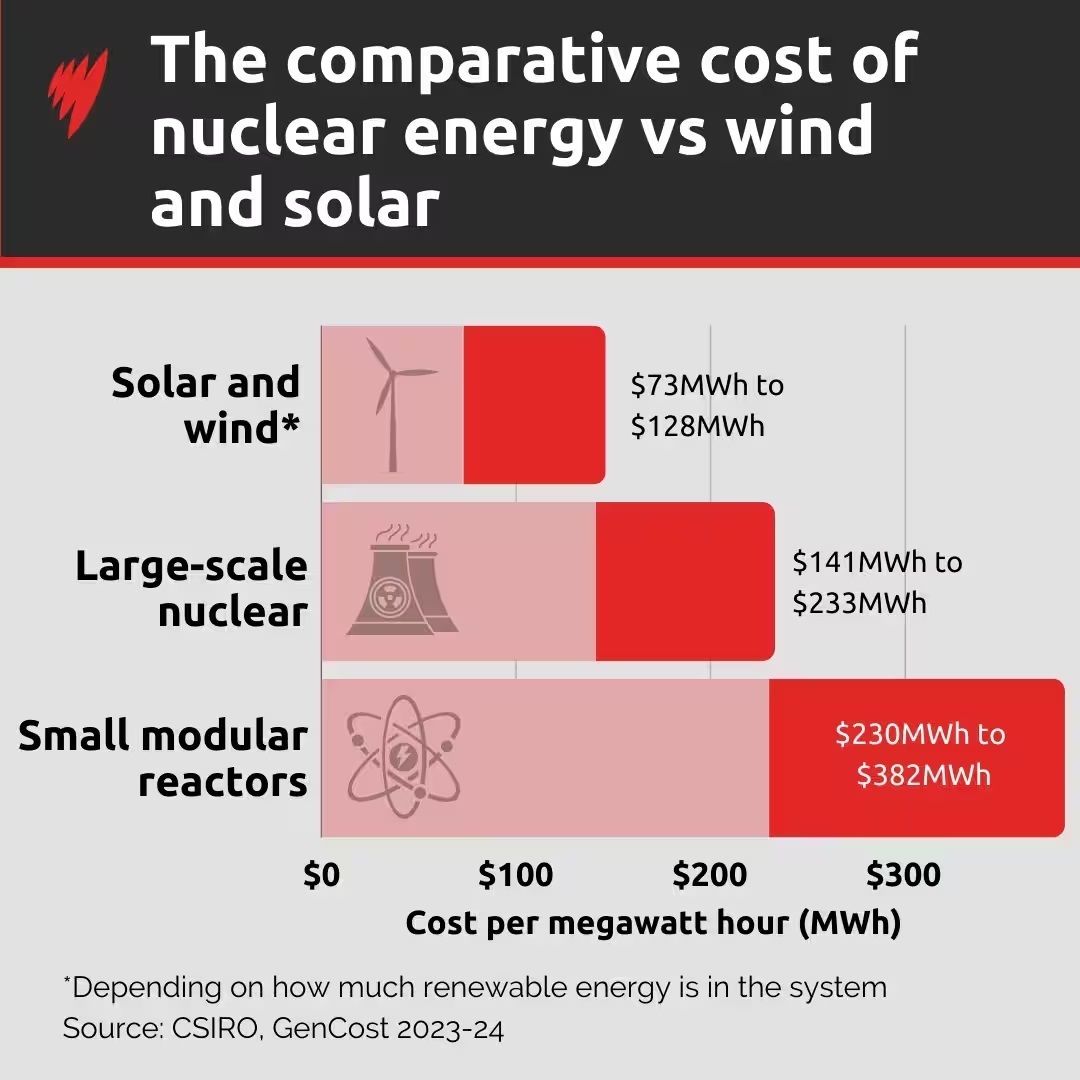
According to studies from Stanford University, new nuclear power plants cost 2.3 to 7.4 times those of onshore wind or solar per kilowatt-hour of electricity, take five to 17 years to deploy, and produce nine to 37 times the emissions per kilowatt-hour as wind.
New nuclear adds only as much electricity in a year as renewables add every few days. For example, China is now installing wind and solar capacity equivalent to five new nuclear reactors weekly.
Nuclear delivers far less power per dollar.
Because of significant costs and delays, the emphasis has moved to small modular reactors (SMRs). Their economics are costly and share the same significant security and waste problems. To date, several key SMR projects have fallen by the wayside.
Instead of wasting money on expensive non-renewable technologies, limited financial resources should be channeled into realistic solutions to climate change, including electrification; the expansion of renewables across all sectors; expansion and modernization of grids; storage, efficiency solutions and smart demand-side management.
The last decade represents a seismic shift in the balance of competitiveness between renewable technologies and incumbent fossil options.
The notion that renewables are expensive is outdated. According to IRENA data, 81 percent of the record renewable additions in 2023 were cheaper than fossil fuel and nuclear alternatives.
The total renewable power capacity deployed globally since 2000 has saved $409 billion in fuel costs in the power sector.
Factoring in the wider economic and environmental benefits of renewable power in reducing fossil fuel imports, improving a country’s balance of payments and enhancing security of affordable energy supply by reducing exposure to volatile fossil fuel prices in global markets makes it even more compelling.
The world is increasingly rallying behind renewables to do the heavy lifting for the net-zero energy transition. We have the knowledge, the technology and the means. We are fully equipped to adjust the trajectory of the transition and reduce the carbon footprint of the global energy system.
We must move faster.
Biden Team Wants To Rush Weapons Shipments to Ukraine Before Trump Inauguration
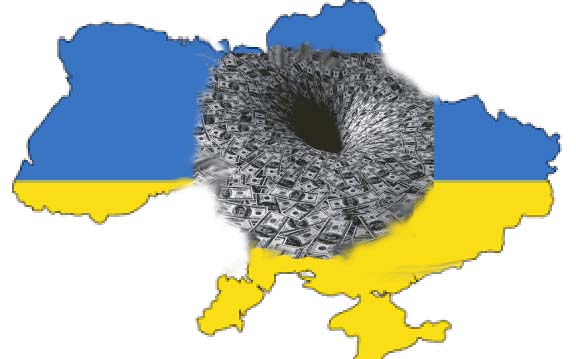
The administration wants to exhaust $6 billion in remaining military aid
by Dave DeCamp November 6, 2024. https://news.antiwar.com/2024/11/06/biden-team-wants-to-rush-weapons-shipments-to-ukraine-before-trump-inaguration/
—
The Biden administration is preparing to rush over $6 billion in military aid to Ukraine before Inauguration Day, POLITICO reported on Wednesday.
The report said the Biden team expects the incoming administration to end the weapons flow, as President-elect Donald Trump campaigned on ending the proxy war.
The Biden administration has $4.3 billion in military aid that can be pulled from existing US stockpiles, known as the Presidential Drawdown Authority. There is also $2.1 billion available in the Ukraine Security Assistance Initiative, which provides money to put weapons under contract, meaning it takes longer to deliver.
Biden officials are unsure if they’ll be able to rush all the aid to Ukraine before January 20 since any military equipment they send must be replaced, and it’s unclear if production levels are high enough to ship so many weapons in such a short period of time.
“We have been sending whatever industry can produce each month, but the problem is you can only send these things as they are produced,” Mark Cancian, a former Pentagon budget official, told POLITICO. “The administration could dip into the stockpiles and send equipment more quickly, but it’s unclear the Pentagon would want to do that since it would affect its own readiness.”
Even if the weapons are sent from US military stockpiles, the actual delivery time could still take months, and Biden officials are worried the next administration could cancel them before they arrive in Ukraine.
Can Trump 2.0 defuse the nuclear threat? These Washington heavyweights fear not

The concern about Trump rests on his chaotic and erratic method of decision-making and his personal preference for dictators over democrats – for America’s traditional enemies over its allies.
Peter Hartcher, November 9, 2024
Political and international editor
Bob Woodward is doing his best to remain optimistic in the face of an impending second Donald Trump presidency. “Don’t give up on America’s democracy!”
But when the topic turns to the president’s unique responsibility for US nuclear strategy, his sunny outlook grows dim.
“It’s frightening,” says the noted American journalist and close student of the last 10 US presidents. “We are all walking on eggshells,” Woodward tells me. “Trump is totally unpredictable, he never plans, he operates on instinct.”
Not necessarily because he fears that Trump will recklessly fire off atomic weapons but because he worries about Trump’s ability to deter other powers from doing so.
Woodward, whose initial fame was in breaking the Watergate stories with co-author Carl Bernstein, has interviewed Trump dozens of times over 35 years, and chronicled his political career in four books ripe with insider anecdotes.
Woodward was most impressed with Joe Biden’s management of the nuclear threat from Russia two years ago when Vladimir Putin was threatening to attack Ukraine with a tactical, or battlefield, nuclear weapon. He sets out in detail in his new book, War, how Biden’s administration confronted Moscow, including a phone call from the US Defence Secretary, Lloyd Austin, to his Russian counterpart, Sergei Shoigu:
“It wouldn’t matter how small the nuclear weapon is,” Austin told Shoigu, according to the transcript of the call that Woodward obtained. “If you do this, it would be the first use of nuclear weapons anywhere in the world in three-quarters of a century and it could set in motion events that you cannot control and we cannot control.”
The US would review all the self-imposed restraints it had imposed in supporting Ukraine’s war effort, Austin told him.
Separately, Biden called Xi Jinping to enlist his help. China’s economic support keeps Russia solvent through its war. So Xi’s opinion matters in the Kremlin.
“If Putin were to break the seal on nuclear use, that would be an enormous event for the world,” Biden told Xi, according to the book. China’s president agreed and undertook to warn Putin off. He did so publicly when he said: “Nuclear wars must not be fought.”
America’s Cold War-era plans for nuclear and conventional escalation with the Soviet Union were reworked and refitted for war with Putin’s Russia.
Woodward says he was shocked to learn that, during this episode, the US intelligence assessment of the risk that Putin would actually use a battlefield nuke had started at a 10 per cent chance but peaked at 50 per cent. Putin, of course, ultimately did not act on his threat.
The Biden administration showed “unique, steady, purposeful, informed leadership” in handling the risk from Russia, says Woodward. “It’s a road map for how you avoid a nuclear catastrophe.”
He adds: “There is nothing steady and there is nothing purposeful in Donald Trump’s leadership. He’s focused on himself and his own instinct.”
…………………………………………………………………………..The concern about Trump rests on his chaotic and erratic method of decision-making and his personal preference for dictators over democrats – for America’s traditional enemies over its allies.
But there is a new factor that Trump will have to confront. “All of US Cold War nuclear strategy was bipolar – it was the US and the USSR,” Woodward says. “With China’s rapid nuclear build-up, strategy will have to be tripolar.”
So a president given to simplistic plans and impulses must deal with a whole new level of nuclear complexity for which neither he nor the US system is yet equipped. Woodward need not fear contradiction on this point: “This is such a dangerous time.” https://www.theage.com.au/world/north-america/can-trump-2-0-defuse-the-nuclear-threat-these-washington-heavyweights-fear-not-20241108-p5kp0n.html
Robot Removes First Bit Of Fukushima’s Nuclear Fuel Debris – Just 880 Tons More To Go

The radioactive ruins are still far too dangerous for humans.
Tom Hale, IFL Science 6th Nov 2024, https://www.iflscience.com/robot-removes-first-bit-of-fukushimas-nuclear-fuel-debris-just-880-tons-more-to-go-76669
robot has delved into the radioactive ruins of Fukushima to retrieve a tiny chunk of spent nuclear fuel. It’s the first time solid fuel debris has been removed from the plant – but they’ve still got a hell of a long way to go: 880 tons of the stuff to be precise.
The remotely operated robotic arm, equipped with a telescopic camera, was able to grasp and retrieve a “small amount of fuel debris” from the floor of Unit 2’s reactor on October 30, according to the plant’s operator Tokyo Electric Power Company Holdings (TEPCO).
“From the results of primary containment vessel internal investigations, we have deduced that the accumulated debris on the surface of the floor inside the pedestal is solidified molten material that consists of fuel elements and also may contain a lot of metal,” TEPCO said in a statement.
The fuel debris will now be taken away from the Fukushima site where scientists will analyze it to gain further insight into how to remove the rest of the debris.
“By analyzing the attributes of the sampled fuel debris we will directly ascertain information such as the composition of debris at the sampling location and radioactivity density,” added TEPCO……………………………………………………………..
It’s estimated that the three impacted reactors contain an estimated total of 880 tons of melted fuel debris, all of which TEPCO hopes to remove during their decommissioning effort by the year 2031. The latest retrieval of a small chunk of radioactive debris is just the beginning of the mammoth feat ahead.
Along with solid debris, the decommissioning project has also had to deal with the colossal quantities of radioactive water that accumulated after being used to cool the damaged reactor cores. In August 2023, Japan began releasing some of the treated wastewater into the Pacific Ocean, much to the annoyance of their neighbors.
TEPCO has expressed hope the entire clean-up operation will be completed in 30 to 40 years, although some speculate the target is overly optimistic.
Senior Journalist
1
UK budget outlines nuclear power plans (new nuclear not a high priority)
Nuclear Engineering International 5th Nov 2024
The first budget of the UK Labour Government included decisions related to both the Sizewell C NPP and to plans for small modular reactors (SMRs). However, this was clearly not a high priority in the 170-page budget. The small eight paragraph section on the Department for Energy Security & Net Zero (DESNZ) included just two short paragraphs on nuclear.
DESNZ was allocated total funding of £14.1bn ($18.2bn) in 2025-26 up 22.0% from 2023-24. The main paragraph (4.75) notes that “Making Britain a clean energy superpower is one of the five missions of this government. Great British Energy (GBE) will be at the heart of the mission.” GBE is allocated £100m million capital funding in 2025-26 “for clean energy project development” and £25m to establish GBE as a company, headquartered in Aberdeen. Investment activity will be undertaken by the National Wealth Fund, “helping it to make initial investments as quickly as possible”.
The budget says “new nuclear will play an important role in helping the UK achieve energy security and clean power while securing thousands of good, skilled jobs” (para 4.80). It provides £2.7bn to continue development of Sizewell C through 2025-26. “The process to raise equity and debt for the project will shortly move to its final stages and will conclude in the Spring. As with other major multiyear commitments, a Final Investment Decision (FID) on whether to proceed with the project will be taken in Phase 2 of the Spending Review.” Phase 2 is expected in the Spring.
However, on 30 August DESNZ announced a Sizewell C Development Expenditure (Devex) Scheme that would benefit from up to £5.5bn in subsidies to get to a FID with support mainly comprising equity injections by the UK government. The £2.7bn announced in the budget is not new funding and would be taken either from £5.5bn already made available or through a separate subsidy scheme that would be established at the point of the FID.
Sizewell C, in Suffolk, is expected to host two EPR reactor units producing 3.2 GWe similar to the Hinkley Point C plant, under construction in Somerset. EDF Energy submitted a development consent order (planning application) for the plant in May 2020, which was granted in July 2022. In March 2023, the Environment Agency granted environmental permits for the plant.
The UK government in August 2023 made available a further £341m of previously allocated funding to help prepare the site for construction on top of the government’s existing £870m investment made available from the DESNZ Capital Budgets. EDF said in November 2022 that construction of Sizewell C remained subject to a FID that depended on the achievement of certain key stages, in particular the ability to raise the necessary financing. DESNZ said that, subject to receiving the relevant approvals, the government said then it was aiming to reach FID before the end of 2024. However, the FID will now be taken in Phase 2 of the Spending Review.
The decision was criticised by opponents of the Sizewell C project. Alison Downes from Stop Sizewell C noted: “For a government that criticised the opposition for playing fast and loose with the nation’s finances, the Chancellor is surprisingly happy to do the same, allocating another £2.7bn of taxpayers’ money on risky, expensive Sizewell C, without making any guarantee of a Final Investment Decision being taken.
Jenny Kirtley, Chair of Together Against Sizewell C described the decision as appalling. “It’s staggering that Labour, even though they cast doubt about the future of the project by stating, “a Final Investment Decision on whether to proceed with the project will be taken in Phase 2 of the Spending Review”, have increased the outlay of UK taxpayer funds on EDF’s Sizewell C white elephant by a further £2.7bn.”
On SMRs, the Budget said: “Great British Nuclear’s (GBN’s) Small Modular Reactor competition is ongoing and has entered the negotiation phase with shortlisted vendors.” (para 4.81). In September, GBN concluded the initial tender phase of the competition and down-selected four companies – GE-Hitachi Nuclear Energy International, Holtec Britain, Rolls-Royce SMR, and Westinghouse Electric Company UK. GBN then said it expected the final decision on the technologies to be supported would be taken by the end of the year. It had previously been set for summer 2024. The Budget has now deferred that decision until the Spring 2025………………
https://www.neimagazine.com/news/uk-budget-decision-on-sizewell-c-and-smrs/
Hinkley workers ‘unfair’ pay claim leads to action
Workers involved in the construction of the Hinkley Point nuclear power
plant have started industrial action after claiming they are being paid
unfairly. Employed by the firm Alten – a supplier for EDF’s Hinkley Point C
– the workers say they have not had a cost of living pay rise in four
years. They walked out of their Bristol office for 24 hours on Tuesday and
have now begun action which Prospect Union described as “short of a
strike”.
BBC 7th Nov 2024,
https://www.bbc.co.uk/news/articles/ckgdlg1ql5no
Radioactivity in Food and the Environment (RIFE) report UK published
RIFE 29 published. The Radioactivity in Food and the Environment (RIFE)
report is published each year by environmental regulators and food
standards agencies. This report brings together all the results of
monitoring of radioactivity in food and the environment by the RIFE
partners (Environment Agency, Food Standards Agency, Food Standards
Scotland, Natural Resources Wales, Northern Ireland Environment Agency and
the Scottish Environment Protection Agency).
Environment Agency etc 7th Nov 2024 https://www.gov.uk/government/publications/radioactivity-in-food-and-the-environment-rife-reports/rife-29-radioactivity-in-food-and-the-environment-2023
1 This Month

of the week – Shut Down Drone Warfare!


Tell the Ukrainian Government to Drop Prosecution of Peace Activist Yurii Sheliazhenko

Petition to revoke the licensing of the Near Surface Nuclear Disposal Facility (NSDF) at Chalk River. https://www.ourcommons.ca/petitions/en/Petition/Details?Petition=e-7247
To see nuclear-related stories in greater depth and intensity – go to https://nuclearinformation.wordpress.com
-
Archives
- April 2026 (34)
- March 2026 (251)
- February 2026 (268)
- January 2026 (308)
- December 2025 (358)
- November 2025 (359)
- October 2025 (376)
- September 2025 (257)
- August 2025 (319)
- July 2025 (230)
- June 2025 (348)
- May 2025 (261)
-
Categories
- 1
- 1 NUCLEAR ISSUES
- business and costs
- climate change
- culture and arts
- ENERGY
- environment
- health
- history
- indigenous issues
- Legal
- marketing of nuclear
- media
- opposition to nuclear
- PERSONAL STORIES
- politics
- politics international
- Religion and ethics
- safety
- secrets,lies and civil liberties
- spinbuster
- technology
- Uranium
- wastes
- weapons and war
- Women
- 2 WORLD
- ACTION
- AFRICA
- Atrocities
- AUSTRALIA
- Christina's notes
- Christina's themes
- culture and arts
- Events
- Fuk 2022
- Fuk 2023
- Fukushima 2017
- Fukushima 2018
- fukushima 2019
- Fukushima 2020
- Fukushima 2021
- general
- global warming
- Humour (God we need it)
- Nuclear
- RARE EARTHS
- Reference
- resources – print
- Resources -audiovicual
- Weekly Newsletter
- World
- World Nuclear
- YouTube
-
RSS
Entries RSS
Comments RSS
 nuclear-news