France wrestles with the idea that nuclear wastes might be useful, “retrievable” for future generations

“measures likely to cause serious and lasting harm to the environment”
CIGEO: REVERSIBILITY AND RECOVERABILITY In the request for creation authorization (DAC)
Saturday, November 2, 2024, by Bernard Laponche
During the first decades of nuclear electricity production in France, the management of radioactive waste produced by this industry, from uranium mines to reprocessing products of irradiated fuel, was not a major concern of the governments and industrialists concerned.
The acceleration of the nuclear program in the early 1970s, particularly the “Messmer Plan” of 1974, made it necessary to take things seriously.
Since the work of the Castaing Commission in the early 1980s, the choice has been oriented towards deep geological storage, with the condition of reversibility, that is to say the possibility for future generations to reverse such a choice and therefore to easily recover any waste that may have already been buried.
This condition of reversibility was subsequently maintained by government decisions and legislative acts leading to the creation of a research laboratory on the Bure site, then to the Cigéo project for deep storage of the most dangerous waste on a site close to that of the laboratory.
Following the declaration of public utility (DUP) of the Cigéo project, the application for authorisation to create (DAC), filed by the organisation responsible for the management of radioactive materials and waste, ANDRA, is currently being examined by the nuclear safety organisations, IRSN and ASN, and should result in an authorisation for commissioning by 2026-27, after a series of consultations.
In 2023, the Constitutional Council, asked by the Council of State to rule on a
priority question of constitutionality (QPC) brought by a group of organizations and private individuals, concluded that “… the legislator, when adopting measures likely to cause serious and lasting harm to the environment, must ensure that choices intended for the needs of the present do not compromise the ability of future generations and other peoples to meet their own needs, while preserving their freedom of choice in this regard”. This decision of historic importance highlights the question of the reversibility of the Cigéo project, which, in its analysis, the Constitutional Council considered to be acquired.
In order to judge this, this report analyses the way in which the reversibility of storage is treated in the various parts of the DAC file to which the reader can refer.
This analysis leads to the following conclusion:
Reversibility, the possibility of removing all packages from storage due to a political decision, would be ensured for the duration of operation, therefore before final closure, if the cells and galleries were not “sealed” and therefore accessible. This situation may therefore arise for generations up to the date of closure of the site, planned by ANDRA towards the end of the 22nd century.
This condition must therefore be imposed as soon as the creation of Cigéo is authorized.
On the other hand, once the galleries, cells and all accesses to the storage are sealed at the end of the storage operation and at final closure, there is no longer any possible reversibility for future generations beyond this date.
No comments yet.
1 This Month
To see nuclear-related stories in greater depth and intensity – go to https://nuclearinformation.wordpress.com/
12 February – Webinar The Big Push: New Nuclear Projects in Canada
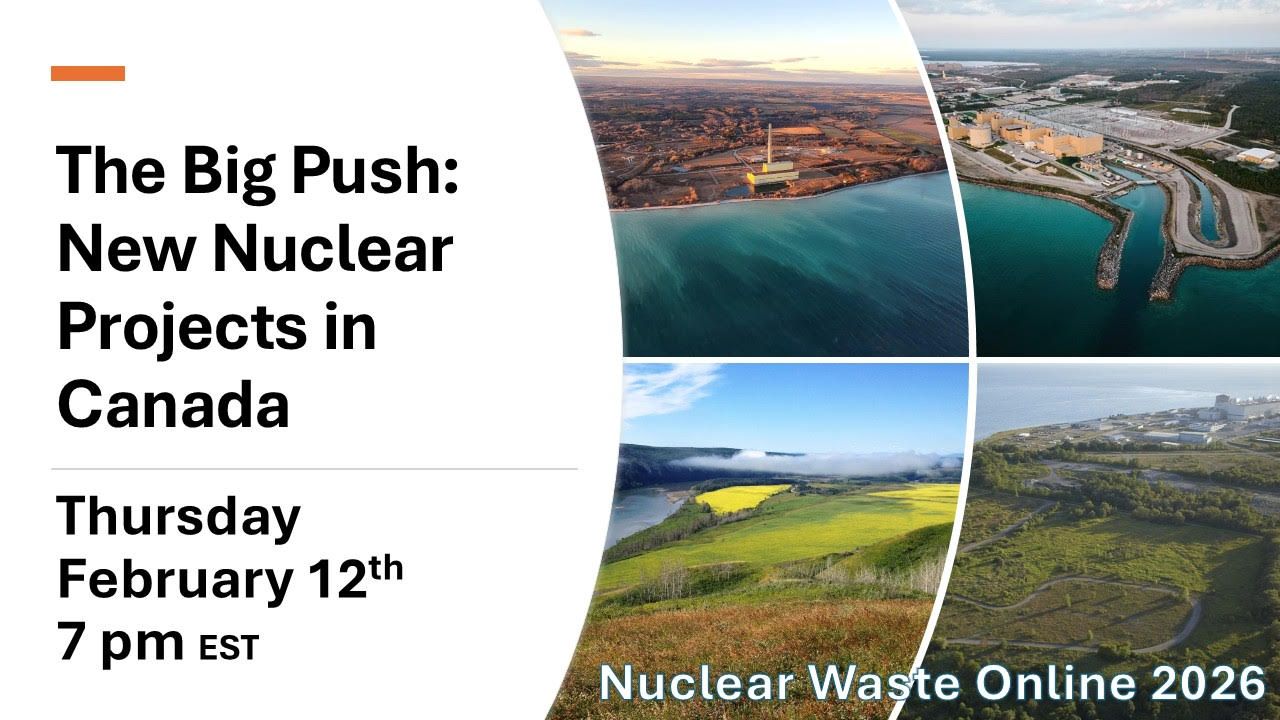
Thursday, February 12, 7 pm Eastern | 2nd of 4 sessions in the 2026 Nuclear Waste Online webinar series
Join a webinar on the push for new nuclear generation in Canada. Go to Northwatch.org to register or use the registration link https://us02web.zoom.us/webinar/register/WN_ZfWOf1GITqSRIZX8CB-A9w
-
Archives
- February 2026 (115)
- January 2026 (308)
- December 2025 (358)
- November 2025 (359)
- October 2025 (376)
- September 2025 (258)
- August 2025 (319)
- July 2025 (230)
- June 2025 (348)
- May 2025 (261)
- April 2025 (305)
- March 2025 (319)
-
Categories
- 1
- 1 NUCLEAR ISSUES
- business and costs
- climate change
- culture and arts
- ENERGY
- environment
- health
- history
- indigenous issues
- Legal
- marketing of nuclear
- media
- opposition to nuclear
- PERSONAL STORIES
- politics
- politics international
- Religion and ethics
- safety
- secrets,lies and civil liberties
- spinbuster
- technology
- Uranium
- wastes
- weapons and war
- Women
- 2 WORLD
- ACTION
- AFRICA
- Atrocities
- AUSTRALIA
- Christina's notes
- Christina's themes
- culture and arts
- Events
- Fuk 2022
- Fuk 2023
- Fukushima 2017
- Fukushima 2018
- fukushima 2019
- Fukushima 2020
- Fukushima 2021
- general
- global warming
- Humour (God we need it)
- Nuclear
- RARE EARTHS
- Reference
- resources – print
- Resources -audiovicual
- Weekly Newsletter
- World
- World Nuclear
- YouTube
-
RSS
Entries RSS
Comments RSS
 nuclear-news
Leave a comment