Inside the radioactive island with mutant sharks that was used to test nuclear bombs

The water….remains undrinkable and sealife and plants cannot be eaten due to the radioactive water and soil.
The Defence Department concluded in the ’70s that the soil was so contained with cesium-137 and strontium-90 – both taking about three decades to decay, called a half-life – that the best course of action was to just let it rot.
Plutonium-239, however, takes a little longer; 24,000 years..…………………
Josh Milton, Oct 26, 2024,
https://metro.co.uk/2024/10/26/inside-radioactive-island-mutant-sharks-caused-nuclear-bombs-21376332/
Mutant sharks. White sand laced with plutonium. Water tainted with strontium. Hub cap-sized hermit crabs eating coconuts containing caesium. A dome ‘coffin’ crammed with radioactive material in plastic bags.
The Marshall Islands, a ring of coral reefs in the middle of the Pacific Ocean, looks like the perfect place to throw on a floppy sun hat and read a book below swaying palm trees.
But in the 1940s and ’50s, the US used two of the far-flung atolls, Bikini and Enewetak, to test out 67 nuclear bombs.
One was 1,000 times more powerful than the Hiroshima bomb, according to Hibakusha Worldwide, which tracks nuclear incidents.
This was part of Operation Crossroad, an atomic testing programme that came out of the anxiety of the Cold War.
With 52,000 Marshallese people calling the islands home at the time, the 20 islands are the remnants of ancient volcanoes halfway between Hawaii and Australia.
Yet entire islands were vaporized and craters gouged into its shallow lagoons, forcing hundreds of people out of their homes, never to return.
Bikini Atoll now has such a reputation for groovy wildlife it inspired the setting of Spongebob Squarepants.
While the islands are unlikely home to talking sponges, the radiation that lingers in its waters is impacting the wildlife.
Nurse sharks with just one dorsal fin swim around the Bikini Atoll and car-sized coral grows along the seafloor.
‘Popular belief is that radiation causes mutations, and you know what, it’s true,’ Steve Palumbi, a professor of marine sciences also at Stanford, told The Sun.
Even low levels of radiation can cause genetic mutations. Caesium, strontium and other radioactive isotopes break apart DNA, compressing thousands of years of evolution into a few decades in what one paper once described as ‘unnatural selection‘.
Marine life is on the rebound in Bikini. ‘The fact there is life there and the life there is trying to come back from the most violent thing we’ve ever done to it is pretty hopeful,’ said Steve Palumbi, a professor in marine sciences at Stanford University.
The water, though, remains undrinkable and sealife and plants cannot be eaten due to the radioactive water and soil.
People living on nearby islands, now part of the Republic of the Marshall Islands, during and after the testing show a higher risk of developing cancer – not one of the top two causes of death – and birth defects.
The list of woes for the Marshallese does not end there, with rising sea levels fuelled by climate change slowly swallowing up the habitable atolls.
The largest nuclear detonation was the hydrogen bomb Castle Bravo, fired on March 1, 1954, in Bikini. As the mushroom-shaped clast cast a shadow over the island, the radioactive fallout and debris spewed well beyond the shorelines.
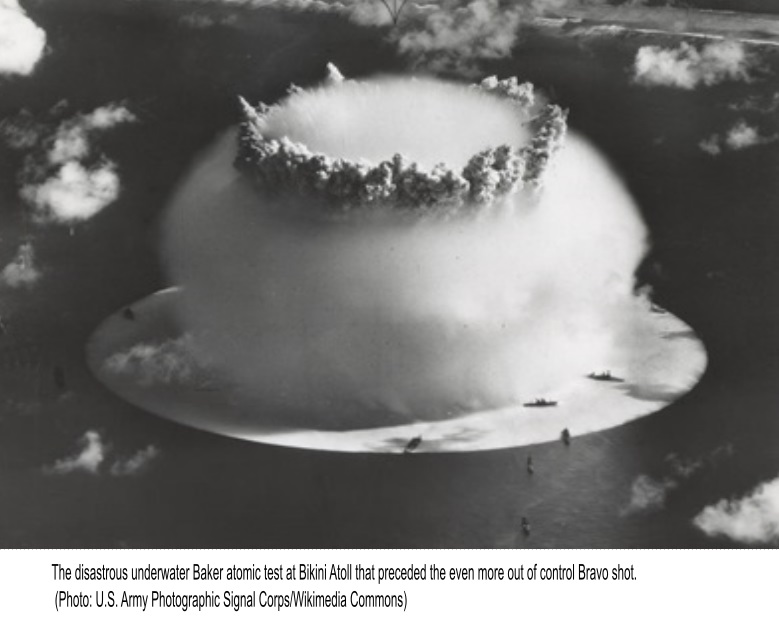
‘Traces of radioactive material were later found in parts of Japan, India, Australia, Europe, and the US,’ says the Atomic Heritage Foundation.
‘This was the worst radiological disaster in US history and caused worldwide backlash against atmospheric nuclear testing.’
Bikini, the colonial spelling of Pikinni, became so radioactive there’s little hope it’ll ever be habitable.
After the Limited Test Ban Treaty of 1963 put an end to atmospheric nuclear testing, this left American officials – and the islands’ displaced citizens – with one option: wait.
The Defence Department concluded in the ’70s that the soil was so contained with cesium-137 and strontium-90 – both taking about three decades to decay, called a half-life – that the best course of action was to just let it rot.
Plutonium-239, however, takes a little longer; 24,000 years. The US dumped 437 plastic bags filled with lumps of plutonium that had spewed after a bomb misfired into a 33-foot crater left behind in 1958 by a nuke on Runit Island.
That, and about 35 Olympic-sized swimming pools’ worth of radioactive soil and nuclear waste.
The crater was plugged up by a 350-foot-wide slab of concrete called the Runit Dome, which locals call ‘The Tomb’, in the ’70s. The dome almost looks like something from a science fiction movie, surrounded by a tropical paradise.
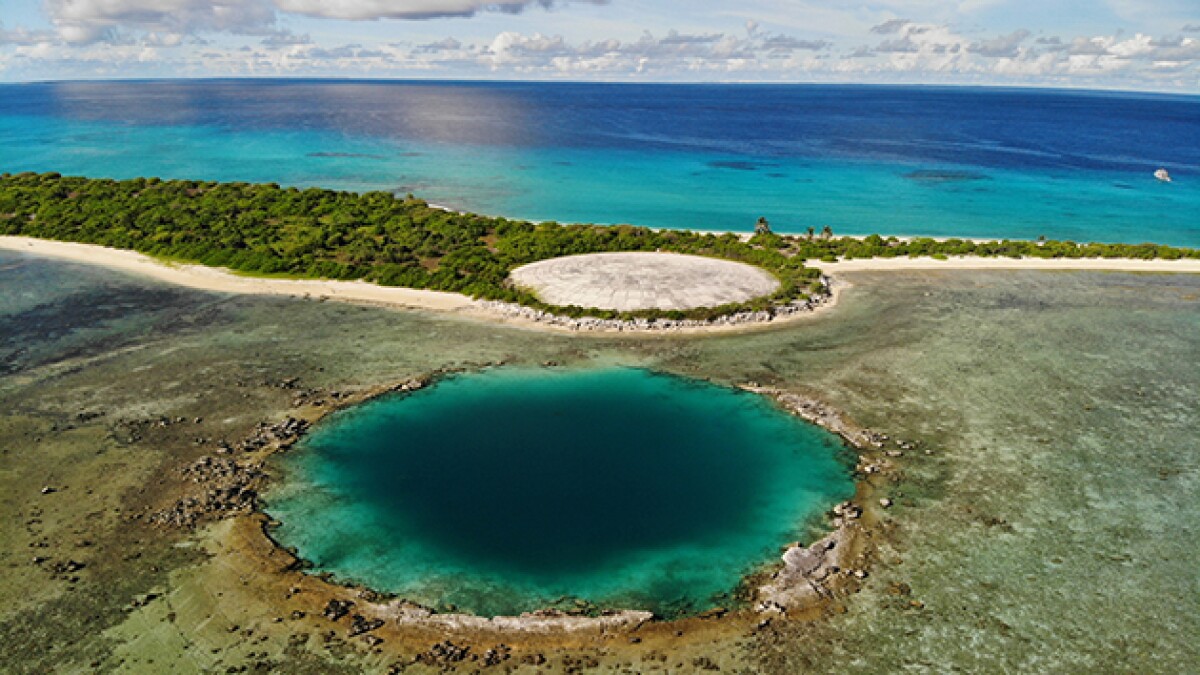
And the dome is leaking. ‘The dome is a significant visible scar on the landscape,’ Ken Buesseler, a marine radioactivity expert at the Woods Hole Oceanographic Institution (WHOI), told Oceans magazine in 2020.
But it’s a relatively small source of radioactivity.’
Overall, more than half of the 167 original inhabitants of Bikini Atoll have died. Some started showing cancers related to radiation exposure in the 1960s, while people living downwind of the explosions suffered burns and low blood counts.
Several generations later, about 5,400 Bikinians are still living in exile. Some live on a lone Pacific island called Kili, roughly 400 miles from Bikini, and others from Honolulu to the ‘Wheat Capital’ of Oklahoma, Enid.
Bikini Atoll largely remains uninhabited, with a tiny caretaker team taking care of the island infrastructure and divers pop in from time to time.
Bikinians continue to fight, however. Lobbying the US Congress for money to redevelop and clean up the place they once called home.
Scientists are hopeful. Remediation efforts include sprinkling affected areas with potassium fertilizer which reduces how much cesium-137 seeps into locally grown crops. How radioactive the soil is has also been decreasing.
The Marshall Islands Program advises that, once resettlement finally begins, a radiation monitoring programme be set up.
‘In this way, the Kili-Bikini-Ejit Local Government and the people of Bikini can be assured that radiological conditions on the islands remain at or below applicable safety standards, and the United States Government can avoid mistakes of the past,’ the programme says.
Ha ha. – Facebook removed my post AGAIN!

Hardly surprising ! –
“We removed your post” – We removed your post – Noel Christina Wauchope Oct 14, 2024
This was the post: FACEBOOK hits a new low – removing a post that congratulated the Nobel Peace Prize winners !
I didn’t read their “reasons”. But I guess, as usual, I have “offended community standards” by saying something negative about nuclear. https://www.nuclearpolicy.info/news/uk-and-ireland-partners-congratulate-2024-nobel-peace-prize-winner/
Oct 14, 2024 We removed your post Noel Christina Wauchope Oct 14, 2024 https://www.nuclearpolicy.info/news/uk-and-ireland-partners-congratulate-2024-nobel-peace-prize-winner/ You shared this on your profile
Literary Institutions Are Pressuring Authors to Remain Silent About Gaza

Requiring authors remain silent about war at the risk of losing their livelihoods is not only ironic but also sinister.
By Lisa Ko , Truthout, October 25, 2024
When writer and disability justice activist Alice Wong received a MacArthur Fellowship earlier this month, she shared a statement about accepting it “amidst the genocide happening in Gaza.” The backlash was swift, with a deluge of posts on X attacking Wong’s character and accusing her of antisemitism.
This conflation of opposition to Israel’s military action with hatred of Jewish people is only one part of a broader wave of political and social repression that is attempting to silence writers speaking out against the war. In the past month alone, authors who have criticized Israel’s ongoing bombardment of Gaza — which is funded largely by the U.S. — have been labeled extremists, been suspended and fired from faculty jobs, and targets of defamation and harassment.
I had my own recent experience with the latter following an incident with the New York State Writers Institute’s Albany Book Festival. ………………………………………………………………………………………………………………………………….. more https://truthout.org/articles/literary-institutions-are-pressuring-authors-to-remain-silent-about-gaza/
Google and Amazon Are Betting Big on Nuclear. No One Has a Plan for the Radioactive Waste

By Jacob Adelman, Oct 24, 2024
Deals announced by Google and Amazon last week to power their
artificial-intelligence businesses with mini nuclear plants mark a new
frontier for so-called small-module reactors. The planned new generation of
compact power units are faster and less expensive to manufacture than
conventional ones, and are simpler to operate, their advocates say.
But the announcements may complicate an already vexing question that has bedevilled
the industry since the dawn of the atomic age: what to do with the unending
stream of spent fuel and other radioactive waste that are the byproduct of
nuclear power.
The U.S. has so far failed in its decadeslong effort to
build an underground repository for reactor waste to be stored in
perpetuity, leaving it instead to collect on the grounds of reactor
complexes.
Some experts who have studied designs for the small-module
reactors, or SMRs, say they will produce more potent waste than their
larger-scale older siblings—and more of it. They question whether SMRs’
spent fuel can be safely stored at the aboveground reactor sites.
Barron’s 24th Oct 2024,
https://www.barrons.com/articles/google-amazon-ai-nuclear-waste-16fb39ab
‘We have emotions too’: Climate scientists respond to attacks on objectivity

Climate scientists who were mocked and gaslighted after speaking up about
their fears for the future have said acknowledging strong emotions is vital
to their work. The researchers said these feelings should not be suppressed
in an attempt to reach supposed objectivity. Seeing climate experts’
fears and opinions about the climate crisis as irrelevant suggests science
is separate from society and ultimately weakens it, they said. The
researchers said they had been subject to ridicule by some scientists after
taking part in a large Guardian survey of experts in May, during which they
and many others expressed their feelings of extreme fear about future
temperature rises and the world’s failure to take sufficient action. They
said they had been told they were not qualified to take part in this broad
discussion of the climate crisis, were spreading doom and were not
impartial.
Guardian 25th Oct 2024,
https://www.theguardian.com/environment/2024/oct/25/we-have-emotions-too-climate-scientists-respond-to-attacks-on-objectivity
UNEP: New climate pledges need ‘quantum leap’ in ambition to deliver Paris goals
There is a “massive gap between rhetoric and reality” that must be
closed by new climate pledges being drafted under the Paris Agreement, the
UN Environment Programme (UNEP) says.
In the 15th edition of its annual
“emissions gap” report, the UNEP calls for “no more hot air” as
countries approach the February 2025 deadline to submit their next
nationally determined contributions (NDCs) setting mitigation targets for
2035.
These NDCs “must deliver a quantum leap in ambition in tandem with
accelerated mitigation action in this decade”, the report says. The
report charts the “gap” between where emissions are headed under
current policies and commitments over the coming decade, compared to what
is needed to meet the Paris goal of limiting global warming to “well
below” 2C and pursuing efforts to stay under 1.5C.
It highlights that
greenhouse gas emissions reached record levels in 2023, up 1.3% from 2022,
and rising notably faster than the average over the past decade.
Carbon Brief 24th Oct 2024,
https://www.carbonbrief.org/unep-new-climate-pledges-need-quantum-leap-in-ambition-to-deliver-paris-goals/
Slovenia’s referendum on new nuclear cancelled
WNN, Friday, 25 October 2024
The nationwide referendum due to be held in Slovenia on 24 November about proposed new nuclear power units has been called off and may now be staged later in the project process, in 2028, instead.
The decision by Slovenia’s parliament to cancel the vote – just days after the elected members had voted for it to happen – followed challenges to the wording and allegations that it was not being properly conducted………………..
Prime Minister Robert Golob has committed to hold a referendum on the project before it goes ahead, with a number of key studies and documents to be published beforehand to “enable citizens to make an informed decision”. The current timetable for the project is for a final investment decision to be taken in 2028, with construction beginning in 2032.
Among a raft of reviews and documents published over the past few months, was an economic review of the estimated cost of the project which put the cost, depending on the power-generating capacity selected, at EUR9.5 billion to EUR15.4 billion (USD10.3 billion to USD16.7 billion).
The opposition Slovenian Democratic Party (SDS) -… – said it now opposed the referendum because, they say, Energy Minister Bojan Kumer had requested, and not published, an analysis of the costs if there was no nuclear energy and up to 100% renewable energy instead.
SDS MP Zvone Černač said if media reports were
true “and Minister Kumer hid the study from the public for two months, he should resign”. Černač
accused the minister of using the “rhetoric of renewable energy activists” and said that in the current circumstances carrying out a referendum “would be irresponsible”……………………… https://www.world-nuclear-news.org/articles/slovenias-referendum-on-new-nuclear-cancelled
Nuclear Energy Firm Orano Halts Niger Uranium Production
By Boureima HAMA avec Nathalie ALONSO à Paris, October 24, 2024, https://www.barrons.com/news/nuclear-energy-firm-orano-halts-niger-uranium-production-ed2fd6b6
French nuclear fuel firm Orano said on Wednesday it was halting its uranium production in junta-ruled Niger from October 31, citing a “highly deteriorated” situation and its inability to operate.
The Nigerien government, whose leader Abdourahamane Tiani seized power in a July 2023 coup, has previously made clear it would overhaul rules regulating the mining of raw materials by foreign companies.
Orano-owned mining subsidiary “Somair’s worsening financial difficulties have compelled the company to suspend its operations,” in the Artlit region of north Niger where Orano has operated since 1971, the French group’s Paris spokeswoman told AFP on Wednesday.
The Sahel nation’s military rulers have turned their backs on Paris, ordering French troops deployed there to leave and instead forging ties with fellow juntas in Burkina Faso and Mali — as well as Iran and Russia.
Niger’s position as the world’s seventh-largest uranium producer plays an important role in the shifting relations.
Iran has significantly increased its stock of enriched uranium in recent months, while strengthening ties with Niger, according to the International Atomic Energy Agency.
The production of uranium concentrate will cease from October 31 as Orano was unable to export the commodity, in part due to landlocked Niger’s closed border with coastal Benin, the firm said.
“Despite all the efforts deployed” with the military regime “to try and resolve the situation” and obtain export licenses, “all of our proposals were left unanswered”, said the spokeswoman of the group, which specialises in nuclear fuel.
Nigerien authorities did not follow up on an Orano proposal to export uranium by air via Namibia.
“Maintenance will continue but there will be no more production,” she added.
Nigerien authorities did not comment on the matter.
Niamey in June rescinded Orano’s licence to operate in one of the largest deposits in the world, Imouraren, with estimated reserves of 200,000 metric tonnes (220,000 US tons).
Niger’s Council of Ministers on September 19 passed a draft decree proposing to create a state company named “Timersoi National Uranium Company”, without detailing the move.
Japan to resume trial removal of Fukushima nuclear debris, reports say
https://www.japantimes.co.jp/news/2024/10/25/japan/fukushima-debris-removal/
The operator of the tsunami-stricken Fukushima No. 1 nuclear plant will resume an operation to remove a sample of highly radioactive material next week, reports said Friday, after having suspended the effort over a technical snag.
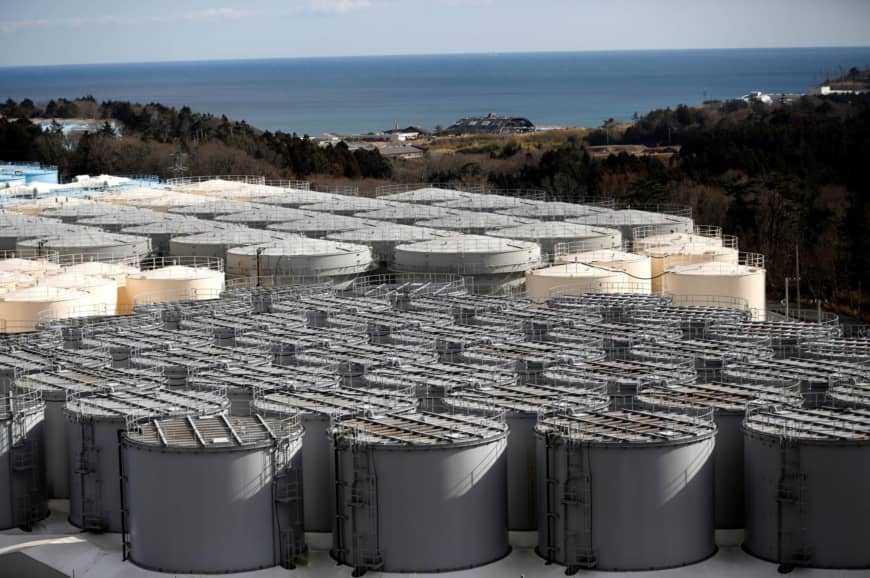
Extracting the estimated 880 tons of highly radioactive fuel and debris inside the former power station remains the most challenging part of decommissioning the facility, which was hit by a catastrophic tsunami in 2011.
Radioactivity levels inside are far too high for humans to enter, and last month engineers began inserting an extendable device to try and remove a small sample.
However, operator Tokyo Electric Power Company Holdings had to halt the procedure after noticing that remote cameras on the apparatus were not beaming back images to the control center.
Tepco on Friday said it would resume the removal on Monday after replacing the cameras with new ones, the Asahi Shimbun daily and other local media reported.
Tepco officials could not immediately be reached to confirm the reports.
Three of Fukushima’s six reactors went into meltdown after a tsunami triggered by the nation’s biggest earthquake on record swamped the facility in one of the world’s worst nuclear accidents.
Japan last year began releasing into the Pacific Ocean some of the 540 Olympic swimming pools’ worth of reactor cooling water amassed since the catastrophe.
China and Russia banned Japanese seafood imports as a result, although Tokyo insists the discharge is safe, a view backed by the U.N. atomic agency.
Beijing last month said it would “gradually resume” importing seafood from Japan after imposing the blanket ban.
In a Tepco initiative to promote food from the Fukushima area, swanky London department store Harrods began selling peaches grown in the region last month.
US nuclear regulator kicks off review on Three Mile Island restart
By Laila Kearney, October 26, 2024
- Summary
- Companies
- NRC holds first public meeting on Three Mile Island restart
- Constellation wants to restore Unit 1’s operating license
- NRC requests more emergency, environmental restart plan details
- Watchdog group questions plans, including simulator
NEW YORK, Oct 25 (Reuters) – U.S. nuclear regulators kicked off a long-winding process to consider Constellation Energy’s (CEG.O), opens new tab unprecedented plans to restart its retired Three Mile Island nuclear power plant in an initial public meeting held on Friday.
Constellation, which announced last month that it had signed a 20-year power purchase agreement with Microsoft that would enable reopening the Unit 1 reactor at Three Mile Island, made its case before the Nuclear Regulatory Commission to restore its operating license for the plant.
The company also sought to extend the life of the plant and change its name to the Crane Clean Energy Center.
Three Mile Island, which is located in Pennsylvania on an island in the Susquehanna River, is widely known for the 1979 partial meltdown of its Unit 2 reactor. That unit has been permanently shut and is being decommissioned.
Members of the NRC requested details about the emergency evacuation plans for the restarted plant and information about the commercial deal with Microsoft, while imploring Constellation to quickly work on permitting related to its water use for the plant.
The NRC also raised questions about how the restart of Unit 1 would intersect with the decommissioning of Unit 2, which began last year, nearly 45 years after the partial meltdown.
Utah-based nuclear services company EnergySolutions owns Unit 2 and related infrastructure, while Constellation owns Unit 1 and the site’s land.
Unit 1 shut down due to economic reasons in 2019, some 15 years before the operating license was set to expire. At the time, Constellation said it did not anticipate a restart.
Constellation now expects to restart the 835-megawatt Unit 1 in 2028, delivering power to the grid to offset electricity use by Microsoft’s data center in the region.
A recent jump in U.S. electricity demand, driven in part by Big Tech’s energy-intensive AI data center expansion has led to a revival of the country’s struggling nuclear industry.
No retired reactor has been restarted before. The Palisades nuclear plant in Michigan, owned by Holtec, is also in the process of being resurrected.
…………………..The physical work to restore Three Mile Island, which is expected to start in the first quarter of 2025, cost at least $1.6 billion, and could require thousands of workers, still needs licensing modifications and permitting.
Local activists have also vowed to fight the project over safety and environmental concerns, including the storage of nuclear waste on the site.
Scott Portzline, who is with nuclear watchdog group Three Mile Island Alert in Harrisburg, questioned the site’s backup power and criticized the proposed nuclear control room simulator used for training.
“I have a constitutional right to know how my nuclear plants are operating and the utility ought to be able to answer that,” Portzline said during the meeting……….
Under the National Environmental Policy Act, the NRC will be required to complete an environmental assessment within the final year of any restart. The plant will require other environmental permits, including ones for air emissions and water pollutants. https://www.reuters.com/business/energy/us-nuclear-regulator-hears-three-mile-island-power-plant-restart-plan-2024-10-25/
CND condemns ‘outrageous railroading’ of US-UK nuclear agreement renewal through Parliament.
Anti-arms campaigners today condemned the
“outrageous railroading” of the US-UK Mutual Defence Agreement (MDA)
renewal through Parliament. The MDA, active since 1958, enables vital
nuclear material and technology transfers between the US and Britain,
reviewed every 10 years. But the Campaign for Nuclear Disarmament (CND)
condemned the government’s intention to make the treaty permanent by
removing the clause that requires the treaty to be extended and enables
debate and amendment, including rejection.
Morning Star 25th Oct 2024 https://morningstaronline.co.uk/article/cnd-condemns-outrageous-railroading-us-uk-nuclear-agreement-renewal-through-parliament
Crew members on Royal Navy nuclear submarine left with ‘low supplies’ and suffering fatigue
Medics reportedly feared for a ‘serious loss of life’ after plans to resupply the vessel failed to materialise
Holly Evans, 25 Oct 24,
https://www.independent.co.uk/news/uk/home-news/nuclear-submarine-royal-navy-uk-b2635513.html
Medics on a Royal Navy nuclear submarine were reportedly left fearing a “serious loss of life” after crew members were forced to share food when supplies ran low.
During a six-month patrol, crew began to suffer from fatigue with mistakes caused by concentration lapses, while the vessel closed its honesty shop over fears of hoarding.
Navy chiefs reportedly asked the crew to hand in any supplies of chocolate or sweets and off-duty sailors were instructed to sleep to conserve calories and limit their movements.
A source told The Sun: “It was miserable. If you weren’t on watch your movements were limited to conserve energy and encouraged to sleep to burn less calories.”
They added: “Medical staff raised concerns about a serious loss of life due to fatigue and people either not concentrating or falling asleep on critical duties.”
The Vanguard-class vessel, which has not been named for security reasons, had been due to resupply at sea but had been unable to do so.
A former submarine captain said the conditions onboard the vessel were “horrific”.
Due to the shortage of available submarines, patrols have been extended for six-months rather than the usual customary 80 days.
One submarine, which forms part of the UK’s nuclear deterrent force, is always on patrol with their location remaining top secret, with sailors only allowed to receive one 40-word message each week that is censored for bad news.
The Royal Navy has emphasised that robust practices and procedures are always in place to ensure the safety of its crew on operations.
It comes three weeks after the head of the Royal Navy apologised after an investigation found “misogyny, bullying and other unacceptable behaviours” in the submarine service.
There was at least one report of rape, and women suffered lewd comments and sexual gestures, an official report has revealed.
Will AI’s huge energy demands spur a nuclear renaissance?
Contracts with Google and Amazon could help, but bringing new types of reactor online will take larger investments — and time.
Davide Castelvecchi, Nature , 25vOct 24
Last week, technology giants Google and Amazon both unveiled deals supporting ‘advanced’ nuclear energy, as part of their efforts to become carbon-neutral.
Google announced that it will buy electricity made with reactors developed by Kairos Power, based in Alameda, California. Meanwhile, Amazon is investing approximately US$500 million in the X-Energy Reactor Company, based in Rockville, Maryland, and has agreed to buy power produced by X-energy-designed reactors due to be built in Washington State.
Both moves are part of a larger [??] green trend that has arisen as tech companies deal with the escalating energy requirements of the data centres and number-crunching farms that support artificial intelligence (AI). Last month, Microsoft said it would buy power from a utility company that is planning to restart a decommissioned 835-megawatt reactor in Pennsylvania.
The partnerships agreed by Google and Amazon involve start-up companies that are pioneering the design of ‘small modular reactors’, which are intended to be assembled from prefabricated pieces………….they still have a way to go before they become a reality.
Nature talked to nuclear-energy researchers to explore the significance and possible implications of these big-tech investments.
Could these deals spur innovation in the nuclear industry?
Building nuclear power stations — a process often plagued by complex permit procedures, construction delays and cost overruns — is financially risky, and betting on unproven technologies is riskier still…………..
the details of the deals are murky, and the level of support provided by Amazon and Google is likely to be “a drop in the bucket” compared with the billions these start-ups will ultimately need, says physicist Edwin Lyman, director of nuclear power safety at the Union of Concerned Scientists in Washington DC. “The PR machine is just going into overdrive,” says Lyman, but “private capital just doesn’t seem ready yet to take that risk”.
Allison Macfarlane, director of the School of Public Policy and Global Affairs at the University of British Columbia in Vancouver, Canada, and former chair of the US Nuclear Regulatory Commission (NRC), says that the speed of progress in computer science raises another question. “If we’re talking 15 years from now, will AI need that much power?”
Are there safety advantages to the small modular designs?
“The smallest reactors, in theory, could have a high degree of passive safety,” says Lyman. When shut down, the core of a small reactor would contain less residual heat and radioactivity than does a core of the type that melted down in the Fukushima Daiichi disaster that followed the cataclysmic 2011 tsunami in Japan.
The companies also say that the proposed pebble-bed reactors are inherently safer because they are not pressurized, and because they are designed to circulate cooling fluids without the help of pumps (it was the loss of power to water pumps that caused three of the Fukushima plant’s reactors to fail).
But Lyman thinks it is risky to rely on potentially unpredictable passive cooling without the backup of an active cooling option. And as reactors become get smaller, they become less efficient. Another start-up company, NuScale Power, based in Portland, Oregon, originally designed its small modular reactor — which was certified by the NRC — to produce 50 MW of electricity, but later switched to a larger, 77-MW design. The need to make the economics work “makes passive safety less credible”, Lyman says.
Do small modular reactors carry extra risks?
In some cases, small modular reactors “could actually push nuclear power in a more dangerous direction”, says Lyman. “Advanced isn’t always better.”
In particular, Lyman points out that the pebble-bed designs drawn up by X-energy and Kairos would rely on high-assay low-enriched uranium (HALEU), which comprises 10–20% uranium-235 — compared with the 5% enrichment level required by most existing reactors (and by NuScale’s reactor). HALEU is still classified as low-enrichment fuel (as opposed to the highly enriched uranium used to make nuclear bombs), but that distinction is misleading, Lyman says. In June, he and his collaborators — including physicist Richard Garwin, who led the design of the first hydrogen bomb — warned in a Science article that a bomb could be built with a few hundred kilograms of HALEU, with no need for further enrichment1.
Smaller reactors are also likely to produce more nuclear waste and to use fuel less efficiently, according to work reported in 2022 by Macfarlane and her collaborators2. In a full-size reactor, most of the neutrons produced by the splitting of uranium travel through a large volume of fuel, meaning that they have a high probability of hitting another nucleus, rather than colliding with the walls of the reactor vessel or escaping into the surrounding building. “When you shrink the reactor, there’s less material in there, so you will have more neutron leakage,” Macfarlane says. These rogue neutrons can be absorbed by other atomic nuclei — which would then themselves become radioactive.
Will small reactors be cheaper to build?
The capacity to build components in an assembly line could drastically cut reactors’ construction costs. But there are also intrinsic economies of scale in building larger reactors, says Buongiorno. “Don’t believe people blindly” when they say smaller reactors will produce cheaper energy, he says: nuclear energy has a lot going for it, but “it ain’t cheap” — and that is unlikely to change significantly.
Will all of these efforts help to combat climate change?
…………….. whether building new reactors is the best way to rapidly cut emissions is debated. Macfarlane points out that solar panels and wind turbines can be deployed at a much faster rate.
https://www.nature.com/articles/d41586-024-03490-3
MP Steffan Aquarone says scrap Norfolk nuclear power plans
25th October By Adam Barker, Business Reporter
A nuclear power station in Norfolk is not the answer to the region’s push for renewable energy and green electricity, a Norfolk MP has said.
Eastern Daily Press 25th Oct 2024 https://www.edp24.co.uk/news/24675730.mp-steffan-aquarone-says-scrap-norfolk-nuclear-power-plans/
Scrutinise Sizewell C

Petition to the Independent Chair of the Treasury’s new ‘Office of Value for Money’ https://action.stopsizewellc.org/valueformoney
We, the undersigned, urge you, as the new Office of Value for Money’s independent Chair*, to call in the Sizewell C project for urgent scrutiny, as it is currently proceeding by stealth. Vast sums of public money have been spent on the project, and there is the potential for billions more to be spent without any guarantee of a Final Investment Decision being made:
- Sizewell C has already received £2.5 billion, and the government now holds at least a 76% share in the project.
- In August 2024 the government created a further subsidy scheme that could allow up to a further £5.5 billion of public money to be given to Sizewell C in advance of any Final Investment Decision .
- Therefore up to £8 billion of public money is being used to progress work on site without any guarantees that private investors will take a stake in the project, or indeed that a Final Investment Decision will be made.
- There is no transparency at all about the overall cost of the project.
- In addition to the drain on taxpayers’ funds, there are serious implications for consumers; the intended use of the Regulated Asset Base (RAB) funding model means households will pay a Sizewell tax on their electricity bills throughout construction, for many years before any electricity is generated.
- There is still uncertainty regarding major issues that affect Sizewell C’s viability and costs. For example Sizewell C still hasn’t secured a guaranteed sustainable potable water supply for its planned 60 years of operation, nor is there a final design of the sea defences needed to keep the site safe for its full 150 year lifetime.
* The Labour government announced soon after the election that an ‘Office of Value for Money’ would be created within His Majesty’s Treasury, to scrutinise areas of public spending. Initial feedback from the Treasury indicated that Sizewell C would definitely be examined, but more recent correspondence with officials has rowed back from such a firm position. It is anticipated that the independent Chair of the Office of Value for Money will be announced shortly.
-
Archives
- February 2026 (220)
- January 2026 (308)
- December 2025 (358)
- November 2025 (359)
- October 2025 (376)
- September 2025 (258)
- August 2025 (319)
- July 2025 (230)
- June 2025 (348)
- May 2025 (261)
- April 2025 (305)
- March 2025 (319)
-
Categories
- 1
- 1 NUCLEAR ISSUES
- business and costs
- climate change
- culture and arts
- ENERGY
- environment
- health
- history
- indigenous issues
- Legal
- marketing of nuclear
- media
- opposition to nuclear
- PERSONAL STORIES
- politics
- politics international
- Religion and ethics
- safety
- secrets,lies and civil liberties
- spinbuster
- technology
- Uranium
- wastes
- weapons and war
- Women
- 2 WORLD
- ACTION
- AFRICA
- Atrocities
- AUSTRALIA
- Christina's notes
- Christina's themes
- culture and arts
- Events
- Fuk 2022
- Fuk 2023
- Fukushima 2017
- Fukushima 2018
- fukushima 2019
- Fukushima 2020
- Fukushima 2021
- general
- global warming
- Humour (God we need it)
- Nuclear
- RARE EARTHS
- Reference
- resources – print
- Resources -audiovicual
- Weekly Newsletter
- World
- World Nuclear
- YouTube
-
RSS
Entries RSS
Comments RSS
 nuclear-news