Japan struggles to find nuclear waste disposal site

Japan is facing difficulties selecting a final disposal site for high-level radioactive waste left from spent fuel at nuclear power plants across the nation.
https://www.japantimes.co.jp/news/2024/10/27/japan/nuclear-waste-site-struggles/
First-stage surveys to find locations suited to host an underground storage facility have been conducted in three municipalities — two in Hokkaido and one in Saga Prefecture — despite continuing anxieties among local residents.
With nuclear power plants in Japan gradually going back online, there remains no clear timeline for reprocessing spent nuclear fuel, keeping the government’s goal of a nuclear fuel cycle out of reach.
High-level radioactive waste, which is vitrified after uranium and plutonium are extracted from spent fuel for reuse, presents a significant challenge. Japan’s plan for final disposal involves burying the waste more than 300 meters underground for tens of thousands of years, allowing its radioactivity to diminish over time.
Nuclear power plants in Japan, operating without a designated final dump site for waste, are often criticized for being like “a condominium building without a toilet.”
The Nuclear Waste Management Organization of Japan, or NUMO, responsible for managing final disposal, began inviting municipalities to host surveys for potential dump sites in 2002. To date, however, no location has been selected.
The research process for selecting a final repository site consists of three stages: a literature survey, a drilling survey, and a detailed investigation using an underground facility. Local governments that host such surveys receive subsidies from the central government.
Literature surveys, which involve reviewing geological maps and historical earthquake records, began in the town of Suttsu and the village of Kamoenai in Hokkaido in 2020, and in the town of Genkai, Saga Prefecture, in 2024. No other municipality has agreed to participate in site selection research, however.
The first-stage surveys concluded that all of Suttsu and most of Kamoenai are suitable for moving forward to the drilling survey phase. NUMO plans to release a report as early as this fall and hold briefing sessions for local residents.
Still, Hokkaido Gov. Naomichi Suzuki has expressed opposition to the drilling surveys, and Saga Gov. Yoshinori Yamaguchi has also voiced objections to conducting such a survey in Genkai. The consent of the prefectural governor is required to proceed with second-stage surveys.
The central government has emphasized its responsibility in its basic policies on the final disposal of nuclear waste and aims to conduct surveys in about 10 additional locations, following international precedents.
In the past, the town of Toyo in Kochi Prefecture and the city of Tsushima in Nagasaki Prefecture considered hosting surveys but ultimately declined. Central government representatives now plan to visit over 100 local governments, increasing opportunities to explain the process to residents.
Japan, which has relied on nuclear power for over half a century, currently holds around 19,000 tons of spent fuel at its nuclear power plants and other facilities, using about 80% of its total storage capacity.
As a resource-scarce nation, Japan has been promoting a nuclear fuel cycle, by which spent fuel is reprocessed and recycled for continued use in power generation. The reprocessing plant that is key to this cycle has yet to be completed, however.
Japan Nuclear Fuel started construction of the country’s first commercial reprocessing facility in Rokkasho, Aomori Prefecture, in 1993, but its completion has been delayed 27 times.
In September, an interim storage facility in the city of Mutsu, Aomori Prefecture, took delivery of the first batch of spent fuel from Tokyo Electric Power Company Holdings’ Kashiwazaki-Kariwa nuclear plant in Niigata Prefecture. This facility, not on the premises of any nuclear power plant site, will store the fuel for up to 50 years before it undergoes reprocessing.
Many local residents see the receipt of spent fuel as premature, given the unfinished reprocessing plant and the lack of a final disposal solution. They worry that storage at the facility may become permanent rather than temporary.
The central government has decided to rebuild nuclear power plants and extend their operational periods. This marks a reversal of the previous policy, which aimed to reduce reliance on nuclear energy following the March 2011 accident at TEPCO’s Fukushima No. 1 plant, caused by severe damage from the earthquake and tsunami the same month.
An official from the Ministry of Economy, Trade and Industry said that “as we have used nuclear power plants, we cannot avoid” the issue of final nuclear waste disposal.
Hideki Masui, president of Japan Atomic Industry Forum, emphasized the need for “a national debate” as Japan struggles to conduct surveys in additional areas for potential disposal sites, placing disproportionate burdens on certain regions.
Nuclear Free Local Authorities (NFLAs) believe budget is opportunity to lobby Ministers to ditch Sizewell C
Chancellor Rachel Reeves will be unveiling the contents of her red box when making her Autumn Statement on Wednesday and the UK/Ireland Nuclear Free Local Authorities believes this offers an opportunity to lobby Labour to ditch Sizewell C – if opponents act now.
Though intended to be constructed by French owned nuclear operator EDF Energy, the outgoing Conservative Government squandered £2.5 billion of taxpayers money on preparatory work, and in August 2024, Labour compounded the calumny by announcing a new subsidy scheme that could make up to a further £5.5 billion in public money available to support this unwanted white elephant. Consequently, the project is now 76%-owned by the British Government at a time when Ministers and their advisors still desperately chase private sector investors to back this Suffolk turkey.
There are still many unknowns about the eventual overall cost of Sizewell C. In contrast to the amazing reductions achieved in recent years in the cost of generating electricity through renewables, the delivery cost of nuclear continues to rise. Given that Sizewell C’s predecessor, the identical Hinkley Point C, is being delivered hugely over budget with some estimates that the cost in real terms will be up to £46 billion, it is wholly incredible that this project can be delivered for the £20 billion that Ministers claim.
And Sizewell C presents additional costly challenges. As a consequence of climate change, the coastal location will be increasingly threatened by inundation from an encroaching sea, requiring significant expenditure on coastal defences. Further Suffolk is ‘water stressed’ meaning that there will be increasing competition for fresh water from inhabitants or commercial operators, and Sizewell C has still to secure a guaranteed sustainable potable water supply for its planned 60 years of operation.
Given the circumstances it is unsurprising that few players amongst the financial markets have expressed any interest in taking a stake in the Sizewell doonboggle, and there is still considerable uncertainty when, or even if, the Financial Investment Decision will be made.
Sizewell C also represents a double whammy for electricity consumers. As taxpayers, we are expected to front up to £8 billion in funding, incidentally almost the same in total that Labour has dedicated to Great Britain Energy over the entirely of its five year term in office, but as electricity consumers we will also be expected to reimburse the construction costs through the imposition of an additional levy on bills, derisking the project for the profit-focussed operator. Unsurprisingly, the NFLA Secretary has described this Regulated Asset Base (RAB) model as the ROB for it represents daylight robbery.
The Labour Government has announced that they will establish a new ‘Office of Value for Money’ within the Treasury and the appointment of a Chair is expected imminently. Stop Sizewell C has launched a petition calling for that office holder to prioritise an examination of the financial liability that is Sizewell C.
Although initial feedback from the Treasury to campaigners had indicated that Sizewell C would definitely be examined by the new office holder, officials in recent correspondence have been more ambivalent and a recent written answer by Nuclear Minister Lord Hunt to a House of Lords parliamentary question was opaque and non-committal.
Stop Sizewell C are also asking supporters of their campaign to join them in writing to the Chancellor, Prime Minister and Secretary of State for Energy to cancel Sizewell C.
The NFLAs would urge opponents of Sizewell C to sign the petition:
Reeves urged not to cut Sellafield funds amid concern at rise in ‘near misses’

GMB raises safety concerns amid rumours of budget cuts across sites and Nuclear Decommissioning Authority
Guardian, Alex Lawson and Anna Isaac, 28 Oct 24
Rachel Reeves has been urged not to carry out mooted funding cuts for nuclear sites including Sellafield amid safety concerns, as it emerged that the number of incidents where workers narrowly avoided harm had increased at the Cumbrian site.
The GMB union has written to Reeves, the chancellor, before Wednesday’s budget to raise safety concerns after rumours emerged that the budget for the taxpayer-owned Nuclear Decommissioning Authority (NDA) could be reduced, which could result in cuts at nuclear sites including Sellafield and Dounreay in Scotland.
In the letter to Reeves, seen by the Guardian, union leaders warned that a safety incident at Sellafield, Europe’s most hazardous industrial site, would “have devastating consequences far beyond the immediate community”. The NDA had a budget of £4bn in the last financial year.
The warning came as recently released annual accounts for the NDA showed “near misses” at Sellafield had risen in the last financial year, and an “international nuclear event-scale” incident had occurred at the site, which is a vast dump for nuclear waste and also the world’s largest store of plutonium.
The NDA said there was an “inadequate response” during an incident in 2023 as some staff did not follow procedures when an emergency alarm unexpectedly sounded inside the site’s hazardous chemical separation area.
The report also said Sellafield, which employs 12,000 people, had received six enforcement letters from its regulator, the Office for Nuclear Regulation, and that in studying its safety record the “rate of significant near misses is higher across 2023-24”.
It found that the impact on employees from work injuries had “often been significant” even if many of the incidents had appeared innocuous.
In the letter, Denise Walker and Roger Denwood, of the GMB, wrote: “While operators and regulators work tirelessly to ensure safety, the inherent risks of the site mean that any lapse in safety standards could result in serious and far-reaching economic and ecological consequences.”
They said radioactive “materials must be safely managed to prevent leaks or accidental releases of radiation. The health risks of radiation exposure, including cancer and other serious illnesses, are well documented.”
They added: “Any reduction in funding would inevitably result in fewer resources for maintenance, monitoring, and emergency preparedness-heightening the risk of a serious incident.”
The Guardian’s Nuclear Leaks investigation in late 2023 revealed a string of cybersecurity problems at Sellafield, as well as issues with its safety and workplace culture. Last week the National Audit Office said the cost of decommissioning the site had risen to £136bn, with major projects running years behind schedule……………………………. https://www.theguardian.com/business/2024/oct/28/sellafield-work-accidents-reeves-budget
Meltdown nightmares: silent spring for climate change

“Dirty Secrets of Nuclear Power in an Era of Climate Change,” strips away the myth that nuclear energy solves climate change
By Choi Hee-jin, October. 29. 2024, Korea Times: https://m-koreatimes-co-kr.cdn.ampproject.org/c/s/m.koreatimes.co.kr/pages/article.amp.asp?newsIdx=384891—
Asia is buzzing with the 2024 Nobel Prize announcements. The Nobel Prize in literature was awarded to a Korean author, Han Kang, and the Peace Prize to the Japanese organization Nihon Hidankyo, formed by Hibakusha in 1956 to improve support for victims and lobby governments to abolish nuclear weapons. Today, I would like to introduce a timely book that came out this summer on the topic of the Nobel Peace Prize.
In 1962, Rachel Carson published “Silent Spring,” a landmark book that ignited the modern environmental movement by exposing the hidden and devastating effects of widespread pesticide use. Her message raised public awareness about the harmful effects of DDT and led to the establishment of the Environmental Protection Agency in 1970. Consequently, it contributed to banning DDT in the United States in 1972 and internationally in 2004.
Like Carlson’s book, the recently released “Dirty Secrets of Nuclear Power in an Era of Climate Change,” strips away the myth that nuclear energy solves climate change and calls our attention to nuclear power. Its authors are Doug Brugge, professor and chair of the Department of Public Health Sciences at the University of Connecticut, and Aaron Datesman, visiting professor at the University of Virginia and engineer at NASA’s Goddard Space Flight Center.
Before delving into the book, some fundamental questions about climate change should be addressed. Is climate change real? Yes, it is happening. As temperatures continue to rise swiftly, the melting of glaciers and polar ice is becoming more pronounced, serving as a visible and reliable sign of climate change. What is the cause? There is much debate on this topic, but human activity — particularly our reliance on fossil fuels in built environments, cities, and infrastructure — is the main culprit. What is crucial in addressing climate change? Time. It depends on how quickly we switch from fossil fuels to other energy sources. Nuclear power, even in “highly developed” countries, takes a significant amount of time to implement as a solution.
Hidden Costs
Brugge and Datesman conclude that the effects of nuclear power may be more severe and longer lasting because some radioactive materials have such long half-lives, and nuclear accidents are so catastrophic. It exposes the hidden problems of the nuclear industry by looking at its impacts on people and the environment, with a focus on uranium mining, waste management and the dangers of nuclear proliferation.
Uranium mining disproportionately impacts Indigenous communities, leaving a legacy of pollution and health problems. The waste dilemma poses another challenge, with no permanent storage solution for high-level nuclear waste, potentially poisoning water, food chains and ecosystems for thousands of years.
The history of Fukushima and Chernobyl still haunts us and reminds us of the danger of nuclear accidents. The authors say even well-designed reactors are prone to failure due to human error, natural disaster or terrorism. These types of accidents would be a national security issue and would require massive long-term clean-up, and the communities affected would continue to live with the effects.
Economic realities of nuclear power
The economics of nuclear are also covered. Supporters point to the financial benefits of nuclear. But the book shows that the actual costs still need to be added in. Recent numbers bear this out: between 2010 and 2020, the cost of utility-scale solar and onshore wind fell 85 percent and 56 percent, respectively, while nuclear costs increased. The economics are shifting and making nuclear look less and less like a solution to climate change. The authors argue that renewable energy technologies offer a safer and more viable path to a decarbonized future.
A call for responsible energy choices
Nuclear power is being promoted as a solution in many countries and regions. Still, its inherent risks and unsolved problems mean there are better options for achieving net zero emissions and a carbon-free world. “Dirty Secrets of Nuclear Power in the Age of Climate Change” calls for global action to transition to more sustainable and equitable energy solutions. No one knowingly leaves a ticking time bomb in their house when there are safer alternatives.
In industrial history, miners would take small canaries deep into the earth, their delicate respiratory systems acting as an early warning system for toxic gases. A canary’s song, or its silence, could mean the difference between life and death for miners. While we continue to grapple with the ever-present dangers of invisible nuclear radiation and the consequences of its hazardous waste, we seem to treat future generations as unwitting canaries.
Perhaps the debate over nuclear power is outdated. It is essential to envision a completely new society with a carbon-free economy that ensures sustainable prosperity. We need to invest boldly in new alternatives and develop innovative technologies that harness nature’s limitless energy before it’s too late.
Choi Hee-jin is the author of “Future Cities” in The Routledge Handbook for Sustainable Cities and Landscapes in the Pacific Rim (2022), Salzburg Global Seminar Fellow (2023), and founder and CEO of RestFullness(restfullness.net), a platform for rest. She leads vocational formation and leadership sessions and coaches young leaders at METES Institute(metes.io).
South Bruce Municipality narrowly votes to host underground nuclear waste disposal site
Matthew McClearn, October 28, 2024, Globe and Mail,
Residents in Ontario’s Municipality of South Bruce narrowly voted in favor of hosting a nuclear waste disposal site in a referendum completed on Monday.
Unofficial results published Monday evening by Simply Voting, an online voting platform, reported that of the 3,130 votes case, 51.2% voted in favor, while 48.8% were opposed.
The Nuclear Waste Management Organization (NWMO), a non-profit organization representing major nuclear power generation utilities, has been hunting since 2010 for a site to store spent fuel from nuclear power reactors. Known as a deep geological repository, or DGR, the facility would be built more than half a kilometer underground, at an estimated cost of $26 billion.
South Bruce, located more than 120 kilometres north of London and home to about 6,200 residents, is a rural, largely agricultural area of less than 500 square kilometers. It includes a few small communities including Mildmay, Formosa, Culross and Teeswater. The NWMO has secured more than 1,500 acres of land north of Teeswater for the project.
From the outset, the NWMO said it would build the facility only “in an area with informed and willing hosts,” which meant one municipality and one Indigenous group. South Bruce is one of two finalists to host the DGR, down from an original list of 22 communities that expressed interest. The NWMO said it will announce its final selection by Dec. 31st.
Under a hosting agreement the municipality signed earlier this year, South Bruce stands to receive $418-million over nearly a century and a half if selected. The municipality agreed not to do anything to oppose or halt the project, and at the NWMO’s request will communicate its support. The NWMO can modify the project in several respects, including changing the sorts of waste it will store there. The facility would be constructed between 2036 and 2042, ns would then receive, process and store nuclear waste for another half-century.
South Bruce’s byelection, which began last week, asked residents to vote by phone or Internet on whether they were in favor of hosting the DGR. Simply Voting reported turnout of 69.3%, substantially above the 50% minimum required to make the outcome binding under Ontario’s Municipal Elections Act.
The other community in the running is Ignace, Ont., a town of 1,200 more than 200 kilometres northwest of Thunder Bay. Its council voted to accept the DGR in July, and would receive $170-million under its own hosting agreement. (The move was supported by 77% of registered voters who participated in a non-binding online poll.) That location, known as the Revell site, is about 40 km west of the town.
The NWMO also seeks approval from two Indigenous communities: The Saugeen Ojibway Nation for the South Bruce site, and the Wabigoon Lake Ojibway Nation for the Revell site. Neither First Nation has yet signaled consent, but the NWMO spokesperson Craig MacBride said the organization is “in active discussions” with both.
“The NWMO still anticipates selecting a site by the end of this year,” he wrote in an e-mailed response to questions.
As of June 2023, Canada had accumulated 3.3 million spent fuel bundles, each the size of a fire log. They’re currently stored at nuclear power plants in Ontario, Quebec and New Brunswick, and roughly 90,000 new ones are added each year. Upon removal from a reactor, they’re highly radioactive and must be stored in pools of water for about a decade; afterward, they’re moved to storage containers made from reinforced concrete and lined with half-inch steel plate.
The South Bruce referendum follows a campaign that lasted a dozen years and produced rifts within the community.
Protect Our Waterways, a local group opposed to the DGR from the outset, had demanded a referendum. Some DGR supporters opposed putting the matter to a public vote, preferring to leave the decision to elected officials. Municipal officials pointed to the area’s declining economy and population, and emphasized the benefits brought by the NWMO’s spending. Supporters and opponents often accused each other of producing misinformation………………………………………………………….. https://www.theglobeandmail.com/canada/article-south-bruce-municipality-narrowly-votes-to-host-underground-nuclear/#:~:text=Its%20council%20voted%20to%20accept,km%20west%20of%20the%20town.
Lepreau nuclear headaches could add up to an extra $150M
NB Power says it won’t know the true costs until plant comes back online in December after an eight-month shutdown
John Chilibeck • Local Journalism Initiative reporter, Oct 28, 2024 Journal: https://tj.news/new-brunswick/lepreau-headaches-could-add-up-to-an-extra-150m
NB Power expects the troubled Point Lepreau nuclear plant to be back up and running in December, about 140 days after serious problems were first discovered.
The repairs and replacing the lost electricity could cost New Brunswick ratepayers $150 million, based on testimony provided earlier this year by senior executives at the public utility.
In a news release Monday, NB Power said the total costs won’t be known until the plant near Saint John is back in operation. The utility is also considering making an insurance claim to protect the public and businesses from punishing costs.
“Our team has been working diligently, with the support of national and international experts, to assess and address the situation,” stated spokesperson Dominique Couture in the release. “This has been a very complex task, and NB Power left no stone unturned in understanding the problem and the repair options.”
During a summer rate hearing before the New Brunswick Energy and Utilities Board, Craig Church, a chief modeler for the public utility, told the quasi-judicial body that replacing the 660 megawatts of energy lost at the Candu reactor, one of the most important plants in its generating system, costs on average $900,000 a day.
The repair work and replacement power did not figure into rate hearings in which NB Power asked for the highest hikes to electrical rates in generations – close to 20 per cent over two years. A decision is still pending with the board.
During those summer hearings, NB Power estimated the repair work would cost $20 million and replacing energy $51 million, for a total of $71 million.
But that was an estimate only up to Sept. 1, roughly 48 days of the unplanned outage. Extending that timeline to Dec. 1 would add another 91 days, just when temperatures plunge and electrical costs go up.
The $900,000 a day estimate was an average only, suggesting the costs could escalate to at least $150 million.
The Point Lepreau Nuclear Generating Station has been offline since April 6, when NB Power undertook a planned, 100-day maintenance outage.
But when getting ready for starting the plant back up in July, workers identified a critical issue within the main generator, located on the non-nuclear side of the plant.
It turns out it wasn’t even in an area that was part of the maintenance work.
The culprit was a damaged stator bar in the generator, one of the long devices inside the big round machine and a stationary part of the rotor.
The experts began probing further and after testing all 144 bars, found five others showing signs of serious deterioration.
“An independent investigation has determined that the cause of this issue is a manufacturer’s defect that occurred during the maintenance of the generator in 2010,” NB Power stated. “We made the decision to repair all six bars while the station is offline to ensure continued safe operations and prevent potential issues in the future.”
It wasn’t a simple job. To access the stator bars, workers had to meticulously disassemble part of the generator assembly, including the removal of the machine’s rotor.
“The stator bars and other internal components are delicate and strict manufacturer’s precautionary measures must be followed,” Couture wrote. “We are pleased to report that repairs have been completed on all six stator bars and that the generator reassembly is underway. This involves several verification steps and thorough testing to ensure that all components are precisely aligned and secured.”
NB Power said once the components are ready, in the coming weeks, it will begin start-up activities at the massive plant, including equipment checks and testing protocol. The utility anticipates a full return to service in December. That would mean the unplanned outaged lasted about 140 days, with Lepreau offline for a total of about eight months.
The true costs won’t be released until the plant is back in service, NB Power stated. Couture said the utility is examining every option to reduce costs for its customers, including looking at an insurance claim.
“We are pleased that the station will be back online for the winter heating season to ensure New Brunswickers have the energy they need when they need it,” Couture wrote. “We are committed to safety and operational excellence and will continue to keep the public informed.”
New Brunswick’s nuclear plant’s ongoing troubles an early threat to Holt government finances
N.B. Power’s Point Lepreau generating station has been offline since April with no definite return date
Robert Jones · CBC News · Oct 28, 2024
More than 200 days after going offline for what was supposed to be a 98-day maintenance shutdown the Point Lepreau nuclear generating station remains idle with no definite word on when it will be able to generate electricity again.
In an email last week the utility declined to commit to a previously estimated mid-November restart date and will say only that it has a “goal” of completing repairs on the station’s troubled generator sometime in November.
However, reconnecting to New Brunswick’s electrical grid following repairs will take an uncertain amount of additional time, according to N.B. Power spokesperson Dominique Couture.
“The next steps will be to proceed with start-up activities including Station equipment checks and testing protocol,” Couture said in an email to CBC News about what happens when repairs are complete.
“The timeline for full return to service will be determined by how these activities progress.”
That is a potential problem for the incoming government of Susan Holt, whose Liberal Party won the New Brunswick election a week ago.
Cost climbing daily
Bills for the latest troubles afflicting the nuclear plant passed $100 million in late September and are climbing at a rate of $1 million a day or more with some uncertainty over who will pay.
An upcoming decision of the New Brunswick Energy and Utilities Board will rule on a number of matters concerning N.B. Power and the rates it charges, including whether Lepreau breakdown costs should continue to be paid by N.B. Power customers or be shifted to the utility and its owner — the provincial government.
Hearings conducted by the EUB into those matters ended nine weeks ago, but no decision has been released to date.
“There are many, many issues and the board will do its very best to endeavour to have a decision as quickly as we can, but that obviously will take some time,” the EUB’s Christopher Stewart noted at the conclusion of final arguments in the rate hearing on Aug. 26.
More complex than expected
The latest problems at Lepreau began after it was taken offline April 6 for what was supposed to be a 98-day maintenance shutdown.
After sitting idle for three months during that period, the plant’s 700-megawatt generator, which had not been among the components worked on during the outage, showed a problem during routine testing done on all plant equipment prior to being restarted………………………………………………………………………….
N.B. Power now says it is not sure when the plant will be operational.
Colder weather will increase energy replacement costs
In the summer, the utility told the EUB that delaying Lepreau’s return to service by seven weeks, from mid-July to Sept. 1, would add an estimated $71 million in unbudgeted costs to the original 98-day maintenance outage.
That included an expected $20 million in unbudgeted repairs to the generator and $51 million in costs to pay for replacement energy while Lepreau remained offline. Adding another 11 weeks or more to that downtime, some of that during colder fall weather when replacement energy costs begin to rise, will more than double those amounts.
It is a serious financial setback for N.B. Power.
Ratepayer frustrations
Major customers of N.B. Power have been expressing increasing levels of alarm about the nuclear plant’s poor performance and frustration that they are having to pay for its shortcomings…………………………………………………..
unlike storm damage, or rising fuel prices that are outside N.B. Power’s control, failings at the nuclear plant can mostly be traced to poor maintenance, poor management and poor decision-making.
They argued N.B. Power and the provincial government should be forced to absorb the financial costs of Lepreau’s troubles on their own and asked the EUB to make that happen in its ruling…………………………………. https://www.cbc.ca/news/canada/new-brunswick/lepeau-nuclear-offline-generator-repairs-maintenance-cost-rates-holt-government-1.7363968
Oxfam reaction to Knesset decision
October 29, 2024, by: The AIM Network, https://theaimn.com/oxfam-reaction-to-knesset-decision/—
Oxfam Australia
In reaction to the Knesset passing bills banning UNRWA from operating in areas under Israel’s control, Sally Abi Khalil, Oxfam Regional Director in the Middle East and North Africa said:
“Israel has bombed Palestinians to death, maimed them, starved them, and is now ridding them of their biggest lifeline of aid. Piece by piece, Israel is systemically dismantling Gaza as a land that is autonomous and liveable for Palestinians. Its banning of UNRWA today is condemnable and another step in this crime.
“The decision will further undermine the ability of the international community to provide sufficient humanitarian aid and to save lives in any safe, independent and impartial way.
“UNRWA was not only the biggest and most established agency that has been delivering aid and sustenance to the people of Gaza for years, it was also a thread that connected them in some hope of solidarity and security to the United Nations.
“We are in no doubt that Israel and its allies are fully aware of the terrible consequences that this decision will have on Palestinians living in Gaza, many of whom are already starving. We join others in warning again that this will result in more death, more suffering, and more forced displacement of people from their besieged homeland. It is impossible not to believe that this is their aim.”
1 This Month
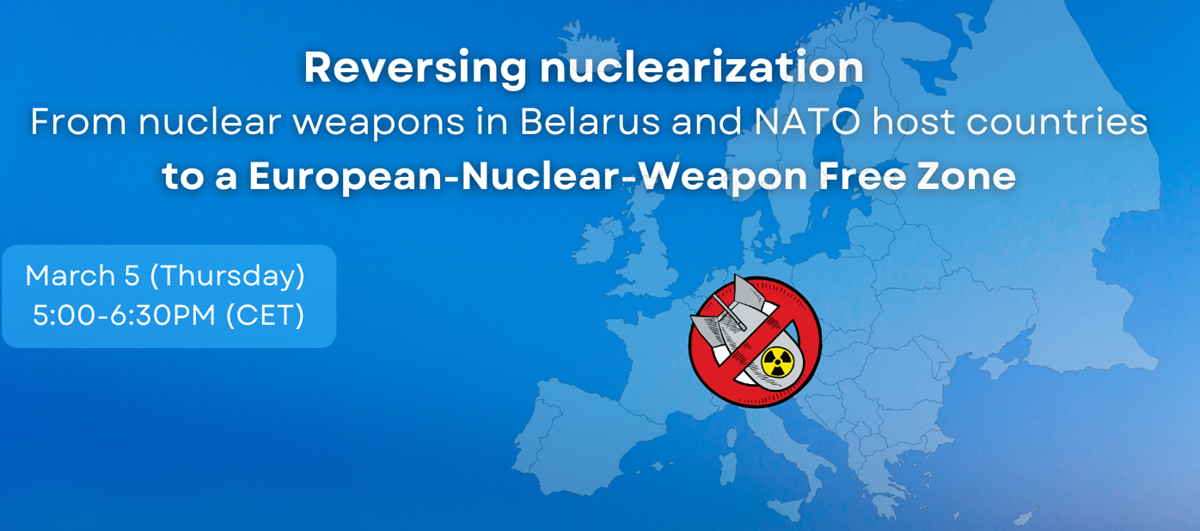
5 March -Online – Reversing nuclearization:
From nuclear weapons in Belarus and NATO host countries to a European-Nuclear-Weapon Free Zone
11am-12:30pm Eastern Time USA / 5pm-6:30pm CET

of the week – Advocating for a
nuclear free beach – https://www.samuellawrencefoundation.org/
The Samuel Lawrence Foundation advocates for a Nuclear Waste Free Beach at San Onofre, join us and take action!

10 March A LIVE WEBINAR THE REAL EFFECTS OF NUCLEAR POWER
What the Industry Isn’t Telling Us
1:00 PM Mountain, 2 pm Central, 3 pm Eastern. Live on the Keepers of the Water Facebook page

18 March Webinar @ 1 PM EST: An Assessment of SMR Projects: The Case of Canada
register for the zoom:
https://us02web.zoom.us/webinar/register/WN_o8BIIOUvQ2ONJR1nta65DQ#/registration

of the week – STOP SMALL MODULAR REACTORS IN CANADA
To see nuclear-related stories in greater depth and intensity – go to https://nuclearinformation.wordpress.com
-
Archives
- March 2026 (51)
- February 2026 (268)
- January 2026 (308)
- December 2025 (358)
- November 2025 (359)
- October 2025 (376)
- September 2025 (258)
- August 2025 (319)
- July 2025 (230)
- June 2025 (348)
- May 2025 (261)
- April 2025 (305)
-
Categories
- 1
- 1 NUCLEAR ISSUES
- business and costs
- climate change
- culture and arts
- ENERGY
- environment
- health
- history
- indigenous issues
- Legal
- marketing of nuclear
- media
- opposition to nuclear
- PERSONAL STORIES
- politics
- politics international
- Religion and ethics
- safety
- secrets,lies and civil liberties
- spinbuster
- technology
- Uranium
- wastes
- weapons and war
- Women
- 2 WORLD
- ACTION
- AFRICA
- Atrocities
- AUSTRALIA
- Christina's notes
- Christina's themes
- culture and arts
- Events
- Fuk 2022
- Fuk 2023
- Fukushima 2017
- Fukushima 2018
- fukushima 2019
- Fukushima 2020
- Fukushima 2021
- general
- global warming
- Humour (God we need it)
- Nuclear
- RARE EARTHS
- Reference
- resources – print
- Resources -audiovicual
- Weekly Newsletter
- World
- World Nuclear
- YouTube
-
RSS
Entries RSS
Comments RSS
 nuclear-news