Taiwan is only months away from shutting off all nuclear power.
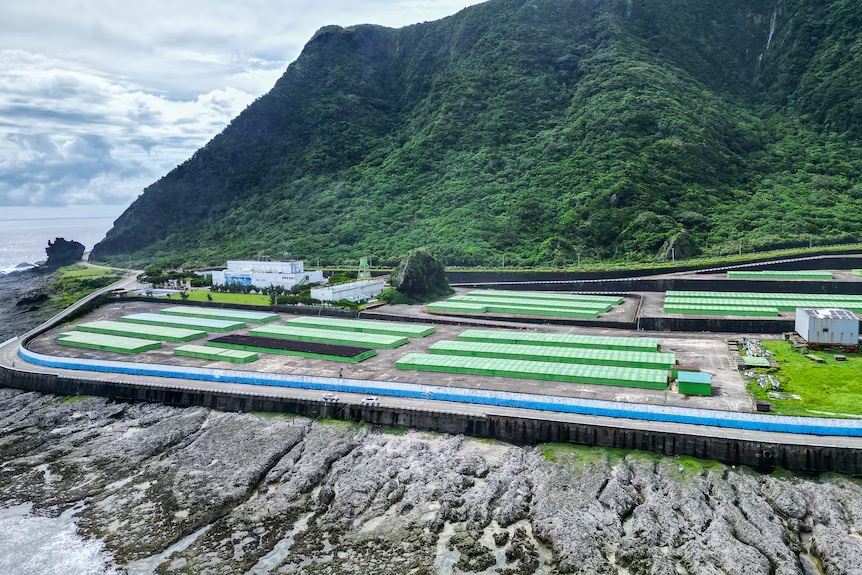
nuclear waste on Lanyu in Taiwan
ABC News, By East Asia correspondent Kathleen Calderwood, Xin-yun Wu and Fletcher Yeung in Lanyu and Hsinchu, Taiwan, 26 Oct 24
As Syamen Womzas harvests taro in a water-logged field on Lanyu, pebbles of sweat trace the lines on his face.
The early autumn sun still beats hard on the island and, about as far south-west as you can go and still be in Taiwan, the humidity is oppressive.
“This is the field I inherited from my parents,” he says.
“These fields have been here for generations.”
The tiny island he calls home is at the heart of Taiwan’s nuclear power debate.
For decades, Lanyu has been saddled with a nuclear waste facility, which Syamen Womzas and others have protested over and campaigned to have removed, fearing environmental impacts.
He wants to see Taiwan completely free of nuclear power.
That transition is happening, but as Taiwan works to phase out its nuclear plants, questions are being asked about how it will continue to power itself……..
Nuclear power and democracy in Taiwan
Syamen Womzas is a member of the Taiwanese aboriginal Tao people, who have lived on Lanyu for thousands of years.
Fringed by emerald cliffs and other-worldly rock formations, today the island is a haven for divers and tourists wanting to explore its stunning coral reefs and enjoy its laid-back lifestyle.
But the nuclear waste facility is one enduring scar on the otherwise pristine island.
“When the nuclear waste entered Lanyu, we people in Lanyu were completely uninformed,” Syamen Womzas tells the students at the Lanyu Elementary School, where he is the principal.
“They said they were building a military harbour and a canning factory.
“No one knew that the so-called cans would turn out to be barrels of nuclear waste.
“For almost 40 years we’ve kept asking the government to remove the storage site, but the officials keep delaying.”
In the 1970s and 80s, when Taiwan was still under martial law and the authoritarian rule of the exiled Kuomintang government, three nuclear power plants were built.
But as Taiwan moved towards democratisation and the Chernobyl disaster occurred in Ukraine, an anti-nuclear movement began to emerge.
“The ruling Democratic Progressive Party really came together only in 1986 — the year of Chernobyl,” says clean energy advocate Angelica Oung, founder of the Clean Energy Transition Alliance.
“The fact that that was such big news back then caused people to draw an equal sign between authoritarianism, contamination and nuclear energy as a symbol of the lack of democracy that Taiwan was under.
“They made it a goal to get rid of nuclear energy in Taiwan, and so the fight against nuclear energy and the fight for democracy in Taiwan have become entwined.”
Fear of disaster puts nuclear out
In 2011, after the Fukushima disaster in Japan, the nuclear debate really entered the mainstream.
It stirred fear in the community that a similar accident could happen in Taiwan where, like Japan, it’s prone to frequent earthquakes.
In the years following, the Democratic Progressive Party installed a nuclear-free homeland policy under which it committed not to renew the licences of the three existing plants.
Meanwhile, the construction of a fourth plant had been beset by problems and delays over a 15-year period.
Then in 2021, a referendum was held that saw the Taiwanese public vote against finally firing it up.
………………………Taiwan’s government now seems to be hedging on its no-nuclear policy and testing the water on how the public might react to the possibility of extending the licence of the nuclear plants…………………………
two power plants have been shut down, with the final one due to be completely decommissioned by May next year.
…………………………Construction of offshore wind is stalling because of delays, high costs due to a local component requirement and the geopolitical risks of investing in Taiwan, while there is limited land space for solar.
………………………………………..The Taiwan Semiconductor Manufacturing Company (TSMC), arguably the world’s most important chip firm, is headquartered in Hsinchu.
“The semiconductor industry is an absolute monster when it comes to consuming electricity,” Ms Oung says.
………………………….Differing views on the future
Meanwhile, Taiwan’s electricity company Taipower is still deciding on what to do with the rest of Taiwan’s nuclear waste.
It says it will decide on a permanent storage location by 2038. If a new site is approved, Taipower says it will also relocate the waste from Lanyu there.
…………………….recently, the government found that Taipower has failed to properly monitor and manage the waste.
The report was initiated in response to a complaint filed by the family of a man who was diagnosed with leukaemia three years after working at the storage site.
It found that “workers performing inspection and re-packaging work back then were likely exposed to quite high doses of radiation.”
“Over the past 30 to 40 years, managing and storing each of these 100,000-plus barrels has cost at least $NT1 million ($47,000) per barrel, with expenses expected to continue indefinitely.”
………………………..Syamen Womzas, the school principal, still worries about how it will impact the environment.
“If the nuclear waste stays in Lanyu, it will continue to impact the environment,” he says.
“It will also impact the roots of the plants, and the habits of the animals.
“I think we are constantly thinking (about) progress and development, so we need more electricity — if everyone can think about more rational use of energy, I think it will be better for the earth.”
No comments yet.
1 This Month


18 March Webinar @ 1 PM EST: An Assessment of SMR Projects: The Case of Canada
register for the zoom:
https://us02web.zoom.us/webinar/register/WN_o8BIIOUvQ2ONJR1nta65DQ#/registration


of the week – STOP SMALL MODULAR REACTORS IN CANADA
To see nuclear-related stories in greater depth and intensity – go to https://nuclearinformation.wordpress.com
-
Archives
- March 2026 (141)
- February 2026 (268)
- January 2026 (308)
- December 2025 (358)
- November 2025 (359)
- October 2025 (376)
- September 2025 (258)
- August 2025 (319)
- July 2025 (230)
- June 2025 (348)
- May 2025 (261)
- April 2025 (305)
-
Categories
- 1
- 1 NUCLEAR ISSUES
- business and costs
- climate change
- culture and arts
- ENERGY
- environment
- health
- history
- indigenous issues
- Legal
- marketing of nuclear
- media
- opposition to nuclear
- PERSONAL STORIES
- politics
- politics international
- Religion and ethics
- safety
- secrets,lies and civil liberties
- spinbuster
- technology
- Uranium
- wastes
- weapons and war
- Women
- 2 WORLD
- ACTION
- AFRICA
- Atrocities
- AUSTRALIA
- Christina's notes
- Christina's themes
- culture and arts
- Events
- Fuk 2022
- Fuk 2023
- Fukushima 2017
- Fukushima 2018
- fukushima 2019
- Fukushima 2020
- Fukushima 2021
- general
- global warming
- Humour (God we need it)
- Nuclear
- RARE EARTHS
- Reference
- resources – print
- Resources -audiovicual
- Weekly Newsletter
- World
- World Nuclear
- YouTube
-
RSS
Entries RSS
Comments RSS
 nuclear-news
Leave a comment