Secrets and Lies: This is how the West doomed Ukraine

Glenn Diesen, By Glenn Diesen, professor at the University of South-Eastern Norway Wed, 16 Oct 2024, https://www.sott.net/article/495541-Secrets-and-Lies-This-is-how-the-West-doomed-Ukraine
The desire of the US and UK to conduct a proxy war destroyed the Istanbul+ process.
In February 2022, Russia started its military operation against Ukraine to impose a settlement after a group of NATO countries had undermined the Minsk II peace agreement for seven years. On the first day after the start of hostilities, Vladimir Zelenskyconfirmedthat Moscow had contacted him to discuss negotiations based on restoring Ukrainian neutrality.On the third day, Russia and Ukraineagreedto start peace negotiations based on a Russian military withdrawal in return for this. Zelensky responded favorably to this condition, and he even called for a “collective security agreement” to include Russia to mitigate the security competition that had sparked the war.
The talks that followed are referred to as the Istanbul negotiations, in which Russia and Ukraine were close to an agreement before the US and UK sabotaged it, according to numerous claims by people close to the process.
Washington rejects negotiations without preconditions
For Washington, there were great incentives to use the large proxy army it had built in Ukraine to weaken Russia as a strategic rival, rather than accepting a neutral Kiev. On the first day after the start of the military operation, when Zelensky responded favorably to starting negotiations without preconditions,US State Department spokesperson Ned Pricerejectedthis stance – saying Russia would first have to withdraw all its forces.
This was a demand for capitulation as the Russian military presence in Ukraine was Moscow’s bargaining chip to achieve the objective of restoring Kiev’s neutrality. Less than a month later, Price was asked if Washington would support peace talks, to which he replied negatively as the conflict was part of a larger struggle:
“This is a war that is in many ways bigger than Russia, it’s bigger than Ukraine… The key point is that there are principles that are at stake here that have universal applicability everywhere, whether in Europe, whether in the Indo-Pacific, anywhere in between.”
The US and UK demand a long war: Fighting Russia with Ukrainians
In late March 2022, Zelensky revealed in an interview with The Economist:
“There are those in the West who don’t mind a long war because it would mean exhausting Russia, even if this means the demise of Ukraine and comes at the cost of Ukrainian lives.”
Israeli and Turkish mediators have since confirmed that Ukraine and Russia were both eager to make a compromise to end the war before the US and UK intervened to prevent peace from breaking out.
Zelensky had contacted former Israeli Prime Minister Naftali Bennett to help with the talks. Bennett noted that Putin was willing to make “huge concessions” if Ukraine would restore its neutrality to end NATO expansion. Zelensky accepted this condition and “both sides very much wanted a ceasefire.”
However, Bennett argued that the US and UK intervened and blocked the peace agreement as they favored a long war. With a powerful Ukrainian military at its disposal, the West rejected the Istanbul peace agreement and there was a “decision by the West to keep striking Putin” instead of pursuing peace.
The Turkish negotiators reached the same conclusion: Russia and Ukraine agreed to resolve the conflict by restoring Ukraine’s neutrality, but NATO decided to fight Russia with Ukrainians as a proxy. Turkish Foreign Minister Mevlut Cavusogluarguedthat some NATO states wanted to extend the war to bleed Russia:
“After the talks in Istanbul, we did not think that the war would take this long… But following the NATO foreign ministers’ meeting, I had the impression that there are those within the NATO member states that want the war to continue – let the war continue and Russia gets weaker. They don’t care much about the situation in Ukraine.”
Numan Kurtulmus, the deputy chairman of Turkish President Recep Tayyip Erdogan’s political party, confirmed that Zelensky was ready to sign the peace agreement before the US intervened:
“This war is not between Russia and Ukraine, it is a war between Russia and the West. By supporting Ukraine, the United States and some countries in Europe are beginning a process of prolonging this war. What we want is an end to this war. Someone is trying not to end the war. The US sees the prolongation of the war as its interest.”
Ukrainian Ambassador Aleksandr Chalyi, who participated in peace talks with Russia, confirms that Putin “tried everything” to reach a peace agreement and they were able “to find a very real compromise”. David Arakhamia, a Ukrainian parliamentary representative and head of Zelensky’s political party, said Russia’s key demand was Ukrainian neutrality.
“They were ready to end the war if we, like Finland once did, would accept neutrality and pledge not to join NATO. In fact, that was the main point. All the rest are cosmetic and political ‘additions.'”
Aleksey Arestovich, the former adviser of Zelensky, also confirmed that Russia was mainly preoccupied with restoring Ukraine’s neutrality.
The main obstacle to peace was thus overcome as Zelenskyofferedneutrality in the negotiations. The tentative peace agreement was confirmed by Fiona Hill, a former official at the US National Security Council, and Angela Stent, a former National Intelligence Officer for Russia and Eurasia. Hill and Stent penned an article inForeign Affairsin which theyoutlinedthe main terms of the agreement:
“Russian and Ukrainian negotiators appeared to have tentatively agreed on the outlines of a negotiated interim settlement: Russia would withdraw to its position on February 23, when it controlled part of the Donbas region and all of Crimea, and in exchange, Ukraine would promise not to seek NATO membership and instead receive security guarantees from a number of countries.”
Boris Johnson goes to Kiev
What happened to the Istanbul peace agreement? On April 9, 2022, UK Prime Minister Boris Johnson went to Kiev in a rush to sabotage the agreement and cited the killings in Bucha as the excuse. Ukrainian media reported that Johnson went to Kiev with two messages:
“The first is that Putin is a war criminal, he should be pressured, not negotiated with. And the second is that even if Ukraine is ready to sign some agreements on guarantees with Putin, they [the UK and US] are not.”
In June 2022, Johnson told the G7 and NATO:
“The solution to the war was ‘strategic endurance’ and now is not the time to settle and encourage the Ukrainians to settle for a bad peace.”
Johnson also published an op-ed in the Wall Street Journalarguing against any negotiations:
“The war in Ukraine can end only with Vladimir Putin’s defeat.”
Before Johnson’s trip to Kiev, historian Niall Ferguson interviewed several American and British leaders who confirmed:
“A decision had been made for the conflict to be extended and thereby bleed Putin,” as “the only end game now is the end of Putin regime.“
Retired German General Harald Kujat, the former head of the German Bundeswehr and former chairman of the NATO Military Committee, confirmed that Johnson had sabotaged the peace negotiations. Kujat said:
“Ukraine had pledged to renounce NATO membership and not to allow any foreign troops or military installations to be stationed,” while “Russia had apparently agreed to withdraw its forces to the level of February 23.” However, “Boris Johnson intervened in Kiev on the 9th of April and prevented a signing. His reasoning was that the West was not ready for an end to the war.”
According to Kujat, the West demanded a Russian capitulation. He explained that this position was due to the US war plans against Russia:
“Now the complete withdrawal is repeatedly demanded as a prerequisite for negotiations. Perhaps one day the question will be asked who did not want to prevent this war… Their declared goal is to weaken Russia politically, economically, and militarily to such a degree that they can then turn to their geopolitical rival, the only one capable of endangering their supremacy as a world power: China… No, this war is not about our freedom… Russia wants to prevent its geopolitical rival USA from gaining a strategic superiority that threatens Russia’s security.”
What was Ukraine told by the US and UK?Why did Zelensky make a deal given that he was aware some Western states wanted to use Ukraine to exhaust Russia in a long war – even if it would destroy Ukraine? Zelensky likely received an offer he could not refuse:
If Zelensky would pursue peace with Russia, then he would not receive any support from the West and he would predictably face an uprising by the far-right/fascist groups that the US had armed and trained. In contrast, if Zelensky would choose war, then NATO would send all the weapons needed to defeat Russia, NATO would impose crippling sanctions on Russia, and NATO would pressure the international community to isolate Russia.
Zelensky could thus achieve what both Napoleon and Hitler had failed to achieve – to defeat Russia.
Arestovich explained in 2019 that a major war with Russia was the price of joining NATO. He predicted that the threat of Ukraine’s accession to NATO would “provoke Russia to launch a large-scale military operation against Ukraine,” and Ukraine could join NATO after defeating Russia.
Victory over Russia was assumed to be a certainty as Ukraine would merely be the spearhead of a wider NATO proxy war.
“In this conflict, we will be very actively supported by the West – with weapons, equipment, assistance, new sanctions against Russia and the quite possible introduction of a NATO contingent, a no-fly zone etc. We won’t lose, and that’s good.”
NATO turned on the propaganda machine to convince the public that a war against Russia was the only path to peace.
The Russian ‘invasion’ was “unprovoked”; Moscow’s objective was to conquer all of Ukraine to restore the Soviet Union; Russia’s withdrawal from Kiev was not a sign of good will to be reciprocated but a sign of weakness; it was impossible to negotiate with Putin; and NATO Secretary-General Jens Stoltenberg subsequently asserted that “weapons are the way to peace.”
The Western public, indoctrinated with anti-Russian propaganda over decades, believed that NATO was merely a passive third party seeking to protect Ukraine from the most recent reincarnation of Hitler. Zelensky was assigned the role as new Churchill – bravely fighting to the last Ukrainian rather than accepting a bad peace.
The inevitable Istanbul+ agreement to end the war
The war did not go as expected. Russia built a powerful army and defeated the NATO-built Ukrainian army. Sanctions were overcome by reorienting the economy to the East, and instead of being isolated, Russia took a leading role in constructing a multipolar world order.
How can the war be brought to an end? The suggestions of a land-for-NATO membership agreement ignores that Russia’s leading objective is not territory but ending NATO expansion, as it is deemed to be an existential threat. NATO expansion is the source of the conflict and territorial dispute is the consequence, thus Ukrainian territorial concessions in return for NATO membership is a non-starter.
The foundation for any peace agreement must be the Istanbul+ formula. An agreement to restore Ukraine’s neutrality, plus territorial concessions as a consequence of almost three years of war. Threatening to expand NATO after the end of the war will merely incentivize Russia to capture strategic territory from Kharkov to Odessa, and to ensure that only a dysfunctional Ukrainian rump state will remain that is not capable of being used against Russia.
This is a cruel fate for the Ukrainian nation and the millions of Ukrainians who have suffered so greatly. It was also a predictable outcome, as Zelensky cautioned in March 2022.
“There are those in the West who don’t mind a long war because it would mean exhausting Russia, even if this means the demise of Ukraine and comes at the cost of Ukrainian lives.”
Iran complains to UN nuclear watchdog about Israeli threats against its nuclear sites
Iran has written to the UN nuclear watchdog to complain about Israel’s threats against its nuclear sites, foreign ministry spokesperson Esmaeil Baghaei said on Monday at a weekly news conference.
Israel has vowed to attack Iran in retaliation for a volley of Iranian missiles launched on Oct. 1, leading to widespread speculation that Iran’s nuclear sites could be among Israel’s targets.
“Threats to attack nuclear sites are against UN resolutions…. and are condemned… we have sent a letter about it to… the UN nuclear watchdog,” Baghaei said in the televised news conference.
Separately, Baghaei said Iranian Foreign Minister Abbas Araghchi would travel to Bahrain and Kuwait on Monday as part of Iran’s efforts to curb regional tensions.
Iran launched its Oct. 1 missile attack to retaliate against Israeli strikes targeting its allies Hezbollah in Lebanon and Hamas in Gaza. It was the second Iranian attack on Israel this year; Israel responded to the first missile volley in April with an air strike on an air defense site in central Iran.
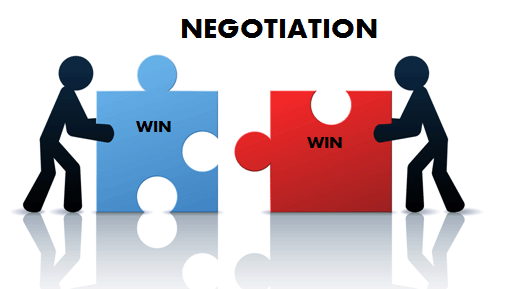
Path to peace in Ukraine is thru negotiated settlement, not escalatory war that could go nuclear.
Walt Zlotow, West Suburban Peace Coalition, Glen Ellyn IL 21 Oct 24
Ethan Finegold’s October 20 letter ‘The US has the power to end the war in Ukraine’ offers just one simplistic remedy to achieve a Ukrainian victory over Russia. Finegold argues the US must approve long range missile strikes by Ukraine with the missiles we’ve already provided but restrict their long range use.
There are 2 problems with this solution. First, long range missile strikes will have no effect on achieving a Ukrainian victory. This is not just the opinion of we in the community including esteemed University of Chicago political science expert John Mearsheimer. It’s the opinion of his polar opposite, Defense Secretary Lloyd Austin, who argues such strikes will have no effect because Russia has already moved over 90% of its strategic targets beyond the range of these long range missiles.
The second reason is decidedly more ominous. Russia has made clear both publicly at the UN and privately in backchannel talks with the Biden administration, that such attacks using US/UK missiles, fired using US technology and logistics, will put Russia at war with NATO. These communications so unnerved Biden that he rebuffed UK Prime Minister Keir Starmer and Ukraine President Volodymyr Zelensky last month who both sought US approval for such strikes. Russia upped the ante against such strikes by publicly revising its nuclear strategy to allow for use of nuclear weapons if a non-nuclear state strikes deep into Russia supported by weaponry from a nuclear state. So far, President Biden has wisely gotten the message.
Finegold is correct in stating “Every day that this war is allowed to continue is another day that risks Russia’s use of nuclear weapons on the battlefield.” That is precisely why the US must pivot from endless weaponizing this 32 month long unwinnable war to a sensible negotiated peace.
Humanity is on the verge of ‘shattering Earth’s natural limits’, say experts in biodiversity warning

Humanity is “on the precipice” of shattering Earth’s limits, and will
suffer huge costs if we fail to act on biodiversity loss, experts warn.
This week, world leaders meet in Cali, Colombia, for the Cop16 UN
biodiversity conference to discuss action on the global crisis. As they
prepare for negotiations, scientists and experts around the world have
warned that the stakes are high, and there is “no time to waste”. “We
are already locked in for significant damage, and we’re heading in a
direction that will see more,” says Tom Oliver, professor of applied
ecology at the University of Reading. “I really worry that negative
changes could be very rapid.”
Guardian 21st Oct 2024 https://www.theguardian.com/environment/2024/oct/21/humanity-earth-natural-limits-biodiversity-warning-cop16-conference-scientists-academics
‘Nuclear waste would be disaster for our seaside’
BBC News, Paul Murphy, Environment Correspondent, 21 Oct 24
Campaigners opposed to plans for a nuclear waste disposal site on the Lincolnshire coast say it could be “disastrous” for the seaside economy.
The former Theddlethorpe gas terminal on the Lincolnshire coast is one of three sites being considered for an underground facility.
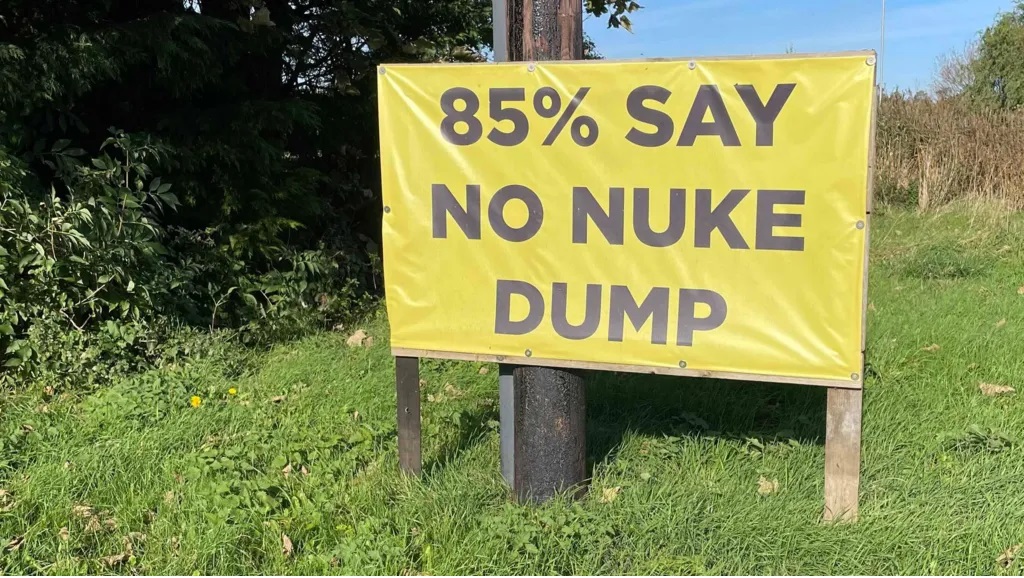
Guardians of the East Coast (GOTEC) said a survey of more than 1,000 visitors to the resorts of Mablethorpe and Skegness found the “great majority” would be put off coming to the area.
GOTEC said it had carried out “extensive research” into the potential impact of the facility.
The group has produced a 60-page booklet called The Nuclear Option.
According to chairman Mike Crookes, the facility would “blight this area” and the economic impact on tourism could be “profound” and “catastrophic”.
“The tourism industry in this area brings £600m of economic benefit and 8,000 jobs,” he said. “We need to protect this at all costs.”
A survey of 1,100 people along the coastline from Mablethorpe to Skegness, carried out by GOTEC, found “83% of them would not visit this area if that facility was built”, Mr Crookes added.
NWS is considering the site for what is known in the waste industry as a geological disposal facility (GDF).
Other possible sites have been mooted in Hartlepool and Cumbria………………………………………………………………………..
Most of the radioactive waste generated by the UK’s nuclear power stations is being temporarily stored at Sellafield in Cumbria, but longer term storage is needed for substances that remain hazardous for many thousands of years.
The idea of a nuclear waste site, or GDF, was first proposed for Theddlethorpe more than three years ago.
Local councillors have called for a referendum on the development.
According to the Theddlethorpe GDF Community Partnership, a facility would only be built in an area where the community “demonstrates if it is willing to host one”, following a “test of public support“, such as a referendum or consultation.
…………………………………… “The government has committed to providing multi-million-pound investment to the community that hosts a GDF. This investment could support better transport links which could help to enhance tourism in a local area.”
https://www.bbc.co.uk/news/articles/cy4d3y33y3go
Nuclear lobby continues to infiltrate education

Pupils from Alde Valley Academy have joined the Sizewell C Youth Council.
This initiative aims to provide the nuclear power project with insights
into the needs of local young people. The students, from Years 7 to 11,
will have regular meetings with joint managing director, Julia Pyke, and
other project leaders. They will discuss local needs, aspirations, and the
project’s progress. Julia Pyke, Sizewell C joint managing director, said:
“Consultation for big infrastructure projects can sometimes be skewed
towards older people.
East Anglian Daily Times 21st Oct 2024
https://www.eadt.co.uk/news/24658473.alde-valley-academy-pupils-join-sizewell-c-youth-council/
Somerset village would be devastated by salt marsh plans.
One young farmer warned her home and all of her land was in the area that could become a
salt marsh. A North Somerset village is urging bosses at the Hinkley Point
C nuclear power station to drop plans to turn huge swathes of local
farmland into a salt marsh.
EDF, who are building Somerset’s new nuclear
power station, are proposing creating new salt marsh habitats along the
Severn to compensate for the number of fish that will die by being sucked
into the power station’s cooling systems. But the sudden announcement of
plans has shocked communities where the salt marshes are planned — such
as Kingston Seymour in North Somerset.
Somerset Live 21st Oct 2024,
https://www.somersetlive.co.uk/news/somerset-news/somerset-village-would-devastated-salt-9645474
1 This Month

of the week – Shut Down Drone Warfare!


Tell the Ukrainian Government to Drop Prosecution of Peace Activist Yurii Sheliazhenko

Petition to revoke the licensing of the Near Surface Nuclear Disposal Facility (NSDF) at Chalk River. https://www.ourcommons.ca/petitions/en/Petition/Details?Petition=e-7247
To see nuclear-related stories in greater depth and intensity – go to https://nuclearinformation.wordpress.com
-
Archives
- March 2026 (237)
- February 2026 (268)
- January 2026 (308)
- December 2025 (358)
- November 2025 (359)
- October 2025 (376)
- September 2025 (257)
- August 2025 (319)
- July 2025 (230)
- June 2025 (348)
- May 2025 (261)
- April 2025 (305)
-
Categories
- 1
- 1 NUCLEAR ISSUES
- business and costs
- climate change
- culture and arts
- ENERGY
- environment
- health
- history
- indigenous issues
- Legal
- marketing of nuclear
- media
- opposition to nuclear
- PERSONAL STORIES
- politics
- politics international
- Religion and ethics
- safety
- secrets,lies and civil liberties
- spinbuster
- technology
- Uranium
- wastes
- weapons and war
- Women
- 2 WORLD
- ACTION
- AFRICA
- Atrocities
- AUSTRALIA
- Christina's notes
- Christina's themes
- culture and arts
- Events
- Fuk 2022
- Fuk 2023
- Fukushima 2017
- Fukushima 2018
- fukushima 2019
- Fukushima 2020
- Fukushima 2021
- general
- global warming
- Humour (God we need it)
- Nuclear
- RARE EARTHS
- Reference
- resources – print
- Resources -audiovicual
- Weekly Newsletter
- World
- World Nuclear
- YouTube
-
RSS
Entries RSS
Comments RSS
 nuclear-news