TODAY. All the way with AI – up, up, then -into the abyss?

In Australia – way back – we used to say “All the way with USA!”. (We still do – can’t help it – it’s our “cultural cringe” – we think we’re a bit stupid).s
But sorry – all the way with AI doesn’t rhyme – which makes the whole thing even gratingly worse.
I’ve been alerted to this global problem by the wonderful article “ Is it worse to have no climate solutions – or to have them but refuse to use them?“, by the heretical Rebecca Solnit. In a previous era, she would have been burnt at the stake. Probably still will be, the way things are going.
At least she’ll have company- there are bound to be many deaths as wildfires become more prevalent and more severe. Yes, I’m talking about climate change – that boring old subject, which shouldn’t get a mention in the media, while we obsess over important stuff, Trump’s caps, and childless cat ladies.
It’s not as if Rebecca Solnit is telling us anything new, really. We all know that big leaps in technology are led by ambitious, technically brilliant, highly competitive men. Somehow or other, we revere these men, even though some of them clearly have a strangely lop-sided cognitive state -with a deficit in integrity and ethics.
That’s why “progress” from way back, then through the industrial revolution, and now the digital revolution has been accompanied by shocking exploitation of millions of people . It’s been the ill-treatment of “the working class”, of indigenous peoples – to develop mines, and progress in transport and modern industries, and of course, in warfare. But still we admired and followed the “captains of industry” who led us all into the mixed bag of “progress”
Today’s captains of industry – Musk, Gates, Bezos, Zuckerberg – and about 7 more digital champions are headed towards becoming trillionaires – with many other clever technical billionaires in the running, too. Along with their obscene wealth goes their power and influence over governments , education, and media.
Rebecca Solnit brings something different to this discussion. She simply points out, using the example of former Google CEO Eric Schmidt – the mindset that we should not worry about climate change – we should go ahead with AI because somehow Artificial Intelligence will solve the problem.
As Solnit says “decoy is the new denial” , meaning that “we ignore workable present-day solutions in favor of unworkable and nonexistent ones while continuing to burn fossil fuel.”
We know that the solutions are there – thousands of scientists are telling us. But these thousands of men, and women, too – have more normal brains, including qualities of integrity and ethics, and the ability to look at the total picture, and imagine the future.

Sorry, but to me, the tech squillionaires are looking increasingly like the Christian religious figures of the past – who frightened the public with fears of burning in hell, and then sold the public “indulgences” that were supposed to save them from hell.
Plutonium just had a bad day in court

In a major decision whose consequences are still being assessed, a federal judge declared that plutonium pit production — one ingredient in the U.S. government’s $1.5 trillion nuclear weapons expansion — has to be performed in accordance with the nation’s strongest environmental law
SEARCHLIGHT NEW MEXICO, by Alicia Inez Guzmán, October 17, 2024
Most Americans don’t seem aware of it, but the United States is plunging into a new nuclear arms race. At the same time that China is ramping up its arsenal of nuclear weapons, Russia has become increasingly bellicose. After a long period of relative dormancy, the U.S. has embarked on its own monumental project to modernize everything in its arsenal — from bomb triggers to warheads to missile systems — at a cost, altogether, of at least $1.5 trillion.
Los Alamos National Laboratory plays a vital role as one of two sites set to manufacture plutonium “pits,” the main explosive element in every thermonuclear warhead. But as a recent court ruling makes clear, the rush to revive weapons production has pushed environmental considerations — from nuclear waste and increases in vehicular traffic to contamination of local waterways, air and vegetation — to the wayside.
That just changed dramatically. On Sept. 30, United States District Judge Mary Geiger Lewis of South Carolina ruled that the federal government violated the National Environmental Policy Act — the “Magna Carta” of federal environmental law — when it formulated and began to proceed with plans to produce plutonium pits at LANL and the Savannah River Site, in Aiken, South Carolina.
“[T]he Court is unconvinced Defendants took a hard look at the combined effects of environmental impacts of their two-site strategy,” Lewis wrote of the Department of Energy (DOE) and the National Nuclear Security Administration (NNSA), which together oversee America’s nuclear weapons stockpile.
The ruling was momentous for the anti-nuclear community. But it was also mystifying, because Judge Lewis didn’t provide a roadmap for how to move forward with this extraordinarily complicated policy dispute. Rather than bringing pit production to a halt — which plaintiffs argued for in their original complaint, filed in 2021 — the judge instead ordered the parties to reach some sort of “middle ground” among themselves and submit a joint proposal by Oct. 25. What that will consist of is anybody’s guess. The judge was clear on one point, though — she’ll be keeping a close eye on the matter by maintaining jurisdiction over the case. Injunctive relief, she added, could still be in the cards.
NEPA’s rules require that agencies take a “hard look” at potential environmental impacts. NEPA does not, however, dictate what decision should be made once those impacts are identified.
Previous impact statements have spelled out a vast array of potential hazards for nuclear facilities. These have included an “inadvertent criticality event,” which happens when nuclear material produces a chain reaction and a pulse of potentially fatal radioactivity. Another risk is fire igniting inside a glovebox — the sealed enclosure where radioactive materials like plutonium are handled — and then resisting suppression, leading to widespread contamination. Other possibilities: a natural gas explosion at vulnerable nuclear sites or a wildfire on LANL’s sprawling campus, which is bounded on all sides by the towns of Los Alamos and White Rock, the Pueblo of San Ildefonso, the Santa Fe National Forest and Bandelier National Monument.
“Perhaps more significantly,” Judge Lewis stated, those impact statements “provide a springboard for public comment,” a kind of mechanism for citizens to express criticism and concern and, in some cases, identify a project’s blindspots — risks to people and places that have not been properly taken into account.
An announcement from the DOE the following day was telling, if not defiant: The first plutonium pit manufactured as part of this modernization program was ready to be deployed into the stockpile. That pit — made at LANL but the product of multiple facilities across the nation’s nuclear weapons complex — is intended for a new warhead, which will be strapped into a new intercontinental ballistic missile called the Sentinel. The Sentinel program, at $140 billion, is one of the costliest in the history of the U.S. Air Force……………………………………………………………………….
Now, almost 40 years later, the court found that the agencies charged with reviving the nuclear weapons complex have not properly evaluated the perils that could come with turning out plutonium pits at two different sites, thousands of miles apart. For the plaintiffs in this case — which include Nuclear Watch New Mexico, Savannah River Site Watch, Tri-Valley Communities Against a Radioactive Environment and the Gullah/Geechee Sea Island Coalition — Lewis’s decision to intervene is a milestone.
“We’ve had a pretty significant victory here on the environmental front,” said Tom Clements, the director of Savannah River Site Watch. “Nonprofit public interest groups are able to hold the U.S. Department of Energy accountable.”
………………………………………………………………………………………………….. For LANL, which sits on the kind of forested land typical of the Pajarito Plateau, wildfire is a major risk. …………………………………………………..
A “parade of horribles”
The array of sites that play some role in this latest phase of pit production goes well beyond LANL and SRS, and includes existing facilities in Amarillo, Texas; Kansas City, Missouri; and Livermore, California. Hypothetically, if the feds ever produce the kind of environmental impact statement plaintiffs demand, it could potentially cover this entire constellation, requiring public hearings at each location and in Washington, D.C………………………………………… more https://searchlightnm.org/federal-judge-ruling-plutonium-pits-environmental-impact/?utm_source=Searchlight+New+Mexico&utm_campaign=ae33d0dc0a-10%2F15%2F2024+%E2%80%93+Plutonium&utm_medium=email&utm_term=0_8e05fb0467-ae33d0dc0a-395610620&mc_cid=ae33d0dc0a&mc_eid=a70296a261
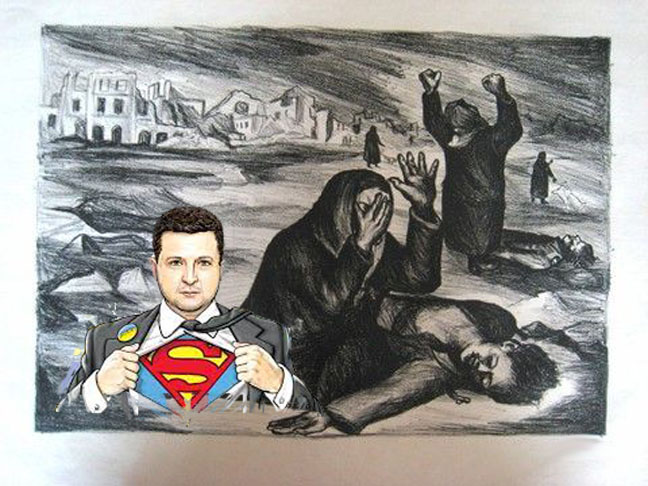
Volodomyr’s World: A Delusional ‘Victory Plan’
RUSSIAN and UERASIAN POLITICS, by Gordonhahn, October 17, 2024,
Ukraine’s Volodomyr Zelenskiy lives in a world of productions, PR, simulacra and, therefore, delusion. Hence, the bizarre content of his so-called Victory Plan as presented to Ukraine’s parliament, the Verkhovna Rada, on October 16th. It contained five points, each out of touch with the real world in its own way……
The first point is Ukraine’s immediate admittance to NATO. This is none other than an extension to the level of the absurdity of his policy of trying to bring the alliance into the NATO-Russia Ukrainian War as an open and direct combatant party. Despite repeated escalations, the reluctance or hesitation to grant Ukraine the right to use Western-supplied long-range missiles against targets deep inside Russia demonstrates the limits of Western commitment.
So does the reduction of Western weapons and financial assistance to Ukraine, and repeated claims by Western leaders that their countries weapons reserves are depleted, and the lack of a war time production plan demonstrate that the West will not fight Russia directly any time soon, no less immediately, as granting Ukraine NATO membership would soon lead to.
Moreover, Western leaders have repeatedly rejected this idea. Saying that Ukraine’s membership in NATO was only “in the future” and that even another country might be admitted prior to Ukraine, new NATO Gen Sec Rutte Mark Rutte poured cold water on any “immediate” NATO membership for Ukraine the day after Zelenskiy outlined his Victory Plan to the Rada…..
The second point includes many of the faults of the first in that it calls for the West to build up Ukraine’s defensive and, crucially, offensive military capacity as a deterrent to Russian aggression and, more importantly, to allow Kiev to turn the war back onto Russian territory. This point includes Western approval so that Kiev can use long-range missiles provided by the West to attack targets deep inside Russia…. To this point is attached a secret protocol, the contents of which are known to the leaders of the US, UK, and Italy
Thus, Zelenskiy is proposing that NATO engage in attacks on Russia directly as an alliance or by one of its members, Ukraine. In short he is proposing that NATO with Ukraine as a member wage war against Russia.
To be sure, building up Ukraine’s defense to such a level that it could spearhead a NATO attack on Russia with any hope of success would take at least several years, by which time Ukraine is unlikely to exist. Pushing the war onto Russian territory has just been tried in Kursk to disastrous effect, with Ukrainian troops on the verge of encirclement and destruction.
Assuming an existing Ukraine, such a plan would require the West virtually to transition to a war economy if to have any prospect of success, with all the catastrophic effects for the parties which adopted such a decision and likely for domestic stability that would have as well.
Most dangerous is Zelenskiy’s reiteration of his plea to be allowed to hit deep inside Russia with long-range missiles, which can only be undertaken by using Western targeting and other technical means data and Western military officer-operators. Putin has said this would establish the countries in the armed forces of which these operators serve as combatants in the war and legal targets for Russian retaliation.
The third point is the ‘containment’ of Russia by way of the deployment of non-nuclear, long-range ballistic missiles in Ukraine. This point has the look of a post-war military strategic initiative and also has a secret protocol attached. The prospect of such a move by the West was one of the causes of Putin’s decision to begin the present ‘special military operation.’ Thus, as with the first three points the ‘Victory Plan’ is a road map to escalation and a direct NATO-Russian war; again, a long-standing goal of Zelenskiy since February 2022.
The fourth point is for the West to help rebuild Ukraine’s military-industrial base, as another means of protecting Ukraine and containing Russia. This point also has a secret protocol and likely pertains more to any post-war period, since Russia will have no trouble destroying any new military-industrial plants during the war.
The fifth point is also post-war oriented, stipulating that the forces of what should become Europe’s leading military power – Ukraine – as a surrogate for American power on the continent. It is proposed that Ukrainian forces would replace American forces across Europe. Thus, NATO would become Ukrainian-oriented and Ukraine a veritable European superpower. This point has the scent of many ultranationalist and neofascist visions of a Great Ukraine, master of an eastern European “Intermarium” stretching from the Baltic Sea to the Black Sea. This smacks of a certain megalomania in Zelenskiy’s thinking that supplements his Victory Plan’s delusions. This may be fine for a sitcom or even a film manuscript — a geopolitical feel-good’ story — but not the real world of cut throat self-interest and lessons learned and hardened by the crooked, cruel path of human history.
The absurdities and extravagant demands and expectations in Zelenskiy’s Victory Plan may explain in part – along with the domestic political needs of the impending U.S. presidential election — the delaying tactics being used by Washington to put off strategic decisions such as whether or not to pressure Zelenskiy to negotiate with Russia, to negotiate behind Ukraine’s back, or to change the political configuration (remove Zelenskiy) in Kiev.
The U.S. Biden administration has been doing everything in order to delay until after the elections any decisions or announcements of decisions already made in relation to the future of its support for the NATO-Russia Ukrainian War and the Zelenskiy Maidan regime’s strategies.
First, in September the administration began postponing and still is any decision on whether or not to grant permission to Kiev to use Western-supplied long-range missiles in order to target deep inside Russia…………………………………………………………………………………….
The administration can now put off any strategic decisions, including rejection of Zelenskiy’s absurd ‚Victory Plan‘ until next month—that is until November at the earliest. One can be sure they will not be announced before the results of the U.S. presidential election are known and perhaps significantly later. …………………………………………………………………………………….
In the meantime, Ramstein will approve a new package of assistance, military and financial, to Ukraine to ensure there is no full collapse of the front and/or regime until after Biden’s departure from office.
Nevetheless, difficult strategic decisions await decisionmakers in the West in order to soften the appearance of defeat at Russia’s hands. Otherwise, they confront a perhaps decade-long war supporting a Ukrainian underground, terrorist attacks, and a disappearing indigenous Ukrainian economy and society reduced to a shrinking western Ukraine as Russian forces cross the Dneiper River and grind through the land to Ukraine’s western, southwestern and northwestern borders, to Odessa in the south, Lvov and Uzhgorod in the west, and Lutsk and Kovel in the north.
And all along the threat of direct war with Russia and nuclear escalation will hang over their heads and those of their electorates. To a significant degree, Zelenskiy and his delusions stand in the way of the West’s only reasonable exit path: de-escalation and peace, sans defeat and loss of face for NATO. Indeed, difficult decisions and bad options are the path ahead. https://gordonhahn.com/2024/10/17/volodomyrs-world-a-delusional-victory-plan/—
Israel Is Routinely Shooting Children in the Head in Gaza: US Surgeon & Palestinian Nurse
SCHEERPOST, October 17, 2024
As the official death toll in Gaza passes more than 42,400, the true number may be impossible to know until Israel’s war is over. But medical workers who witnessed the carnage in Gaza’s hospitals are speaking out. We speak with Dr. Feroze Sidhwa about his op-ed in The New York Times that features harrowing stories from dozens of healthcare workers and CT scans of children shot in the head or the left side of the chest. The Times called the corresponding images of the patients too graphic to publish. “I personally wish that Americans could see more of what it looks like when a child is shot in the head, when a child is flayed open by bombs,” says Sidhwa. “I think it would make us think a little bit more about what we do in the world.” We also speak with Palestinian nurse Rajaa Musleh, who worked at Al-Shifa Hospital in Gaza City. “I will never forget the dogs were eating the dead body inside Shifa Hospital at the front of the emergency department. This will be stuck on my mind for my whole life,” says Musleh. “My message for the whole world: We are human beings. We are not numbers. We have the right to receive healthcare inside Gaza.”
Transcript
This is a rush transcript. Copy may not be in its final form.
AMY GOODMAN: As the official death toll in Gaza passes more than 42,400, the true number may be impossible to know until Israel’s war is over. But medical workers who witnessed the carnage in Gaza’s hospitals are speaking out.
We begin today’s show with a surgeon who volunteered at the European Hospital in Khan Younis and wrote a devastating opinion piece in The New York Times headlined “65 Doctors, Nurses and Paramedics: What We Saw in Gaza.”
In a minute, we’ll be joined by Dr. Feroze Sidhwa, who begins the piece writing, quote, “I worked as a trauma surgeon in Gaza from March 25 to April 8. I’ve volunteered in Ukraine and Haiti, and I grew up in Flint, Mich. I’ve seen violence and worked in conflict zones. But of the many things that stood out about working in a hospital in Gaza, one got to me: Nearly every day I was there, I saw a new young child who had been shot in the head or the chest, virtually all of whom went on to die. Thirteen in total.
“At the time, I assumed this had to be the work of a particularly sadistic soldier located nearby. But after returning home, I met an emergency medicine physician who had worked in a different hospital in Gaza two months before me. ‘I couldn’t believe the number of kids I saw shot in the head,’ I told him. To my surprise, he responded: ‘Yeah, me, too. Every single day,’” he said.
The piece quotes dozens of healthcare workers and includes three X-rays or CT scans of pediatric patients who were shot in the head or the left side of the chest. The person who provided the scans was Dr. Mimi Syed, who worked in Khan Younis from August 8th to September 5th and said the children usually arrived at the hospital either dead or in critical condition after suffering a single shot.
On Tuesday, The New York Times opinion section editor issued a statement refuting claims circulating online that the images were altered, saying the editors had, quote, “photographs to corroborate the CT scan images,” but, quote, “because of their graphic nature, we decided these photos — of children with gunshot wounds to the head or neck — were too horrific for publication.”
For more, we’re joined by Dr. Feroze Sidhwa, the trauma and general surgeon who wrote this piece. He also spearheaded an open letter to President Biden and Vice President Harris signed by 99 U.S. medical professionals who served in Gaza, testifying to the unprecedented scale of the healthcare catastrophe and calling for an immediate ceasefire and the end to all U.S. support for Israel.
We are also joined in Chicago by Rajaa Musleh, the country representative in Gaza of MedGlobal, a medical humanitarian aid group. She previously worked as a nurse at Al-Shifa Hospital in Gaza City…………………………………………………………………………………………………………………………………………………………………………………………………………………………………… more https://scheerpost.com/2024/10/17/israel-is-routinely-shooting-children-in-the-head-in-gaza-us-surgeon-palestinian-nurse/
Refuting myths about nuclear and renewable energy

15 Oct 2024, Mark Diesendorf, https://renew.org.au/renew-magazine/renew/refuting-myths-about-nuclear-and-renewable-energy/
There’s a lot of talk at present about nuclear energy being a strong contender in Australia’s energy market. But how much is political spin getting in the way of fact? Dr Mark Diesendorf unpacks some of the myths that are out there.
The AUKUS agreement has given renewed stimulus to the nuclear energy lobby. With campaign support from the Murdoch press, they have increased their efforts to denigrate renewable energy and to promote nuclear energy and fossil gas in its place.
Because of the sheer volume of their campaign and the difficulty of publishing fact checks and refutations in the mass media, public opinion polls indicate that some people seem to be taking the misleading claims of the nuclear lobby seriously. In this article, I seek to refute the principal myths the lobby is disseminating.
Myth: Renewables cannot supply 100% electricity
Denmark, South Australia and Scotland already obtain 88%, 74% and 62% of their respective annual electricity generations from renewables, mostly wind. Scotland actually supplies the equivalent of 113% of its electricity consumption from renewables; the difference between its generation and consumption is exported by transmission line.
All three jurisdictions have achieved this with relatively small amounts of hydroelectricity, zero in South Australia. Given the political will, South Australia and Denmark could reach 100% net renewables generation by 2030, as indeed two northern states of Germany have already done. The ‘net’ means they trade some electricity with neighbours but on average will be at 100% renewables.
Computer simulations by several research groups, including ours at UNSW, using real hourly wind, solar and demand data spanning several years, show that the Australian electricity system could be run entirely on renewable energy, with the main contributions coming from solar and wind. System reliability can be maintained by a combination of storage, building excess generating capacity for wind and solar (which is cheap), key transmission links, and demand management encouraged by transparent pricing.
Storage to fill infrequent troughs in generation from the variable renewable sources will comprise existing hydro, pumped hydro (mostly small-scale and off-river), and batteries. Geographic dispersion of renewables will also assist.
For the rare extended periods of Dunkelflaute (literally ‘dark doldrums’), gas turbines with stores of biofuels or green hydrogen could be kept in reserve as insurance.
Coal and nuclear power stations are too inflexible in operation to be useful as backup—they require a whole day to start up from cold and, when operating, have difficulty and increased costs in attempting to vary their output to follow the peaks and troughs in demand.
Myth: We need baseload power stations
This is an old, discredited claim that refers to the past when variable renewables (wind and solar) were absent and the fossil fuelled electricity supply system consisted mainly of two types of power station: baseload and peak load.
Baseload power stations, such as coal and nuclear, operate 24/7 at maximum power output, except then they break down or undergo planned maintenance. Because of their inflexibility in operation, the former system also needed to supplement baseload with peak load power stations, hydro-electric and gas turbines. Peak load stations can vary their output rapidly in response to rapid changes in demand or breakdowns in baseload supply.
When a nuclear power reactor breaks down, it can be useless for weeks or months. For a conventional large reactor rated at 1000 to 1600 megawatts, the impact of breakdown on electricity supply can be disastrous. Big nuclear needs big back-up, which is expensive. Small modular reactors are not commercially available nor likely to be in the foreseeable future.
A renewable electricity system, including storage, delivers the same reliability, and hence the same economic value, as the traditional fossil fuelled system based on a mix of baseload and peak-load power stations.
Myth: Gas can fill the gap until nuclear is constructed
As a fuel for electricity generation, fossil gas in eastern Australia is many times more expensive per kilowatt-hour than coal, so it’s not generally used for baseload power. Instead, it’s used for fuelling gas turbines for meeting the peaks in demand and helping to fill troughs in supply. For this purpose, it contributes about 5% of Australia’s annual electricity generation. But, as storage expands, fossil gas will become redundant in the electricity system.
The fact that baseload gas-fired electricity generation continues temporarily in Western Australia results from a unique history. Unlike the eastern states, WA has a Domestic Gas Reservation Policy that insulates domestic customers from the high export prices of gas. However, most new gas supplies would have to come from high-cost unconventional sources.
South Australia has an ancient, struggling, gas-fired power station, Torrens Island, that was originally regarded as baseload, but can no longer perform as baseload. It will be closed in 2026 and replaced with renewables and batteries. South Australia will soon have 100% renewable electricity without a single baseload power station.
Myth: Nuclear energy is cheaper than renewables
Assuming that Australia would not buy nuclear reactors from China or Russia, the only choices are the European Nuclear Reactor and the Westinghouse AP-1000 (or variants thereof). The former type is under construction in Finland, France and the UK. In each case, construction times have greatly increased and original cost estimates have tripled or more.
In South Carolina USA, two AP-1000 reactors were abandoned while under construction due to delays and cost escalation—under state law the electricity customers had to pay for the failed project. In Georgia USA, two AP-1000 reactors have just been completed at double the original cost. They are the only new nuclear power reactors commenced in the USA since the 1970s and completed. Nuclear power projects bankrupted Westinghouse in 2017.
South Korea is exporting its modification of the Westinghouse reactor, the APR-1400, subsidised by an unknown amount by its government. Its only export project so far, the Barakah project in UAE, is three years behind schedule—the extent of its cost overrun is unknown.
The state-owned Korean Electric Power Company (KEPCO) has a debt equivalent to US$149 billion resulting mainly from its nuclear investments.
All expert studies—e.g. by CSIRO, AEMO, and the multinational investment advisor Lazard—find that nuclear is the most expensive electricity generating technology, while solar PV and wind are the cheapest. This is true after including the cost of ‘firming’ renewables with storage.
Contrary to the claims of some nuclear proponents, the levelised cost method used in these studies takes account of the different lifetimes of the technologies. It also includes the cost of connecting the power stations to the main grid. While renewables will need a few additional major high-voltage transmission links, so would nuclear.
Myth: Nuclear energy can co-exist with large contributions from renewables
This myth has two refutations:
- Nuclear is too inflexible in operation to be a good partner for variable wind and solar. Its very high capital cost necessitates running it constantly at full power, not just during periods of low sun or wind. This would mean offloading renewables, although they are much cheaper to operate.
- On current growth trends of renewables, there will be no room for nuclear energy in South Australia, Victoria or NSW. The 2022 shares of renewables in total electricity generation in each of these states were 74%, 37% and 33% respectively. Rapid growth from these levels is likely. It’s already too late for nuclear in SA. Provided the growth of renewables is not deliberately suppressed in NSW and Victoria, these states too will reach 100% renewables long before the first nuclear power station could go online
Myth: There is insufficient land for wind and solar
Although a wind farm may span a large area, its turbines, access road and substation together occupy a tiny fraction of that area, typically about 2%. Most wind farms are built on land that was previously cleared for agriculture and are compatible with all forms of agriculture. Off-shore wind occupies no land.
Solar farms are increasingly being built sufficiently high off the ground to allow sheep to graze beneath them, providing welcome shade. This practice, known as agrivoltaics, provides additional farm revenue that’s especially valuable during droughts. Rooftop solar occupies no land.
Myth: Nuclear energy is safe
Nuclear energy is dangerous for three reasons: its contribution to the proliferation of nuclear weapons, the impacts of nuclear accidents and the task of managing high-level nuclear wastes for 100,000 years or more.
The two principal nuclear explosives are Uranium-235 and Plutonium-239. Both can be obtained from the nuclear energy supply chain.
Under the cloak of nuclear energy, several countries—the UK, France, India, Pakistan, North Korea and South Africa—have produced nuclear weapons either by further enrichment of uranium to increase the concentration of Uranium-235 beyond the level (3-4%) required for nuclear energy or by extracting Plutonium-239 from the spent fuel of their nuclear power reactors.
In addition, the following countries have attempted to use nuclear power to produce nuclear explosives while cloaking their development of nuclear weapons: Algeria, Argentina, Australia, Brazil, Libya, South Korea and Taiwan.
Fortunately, they did not complete their programs for various reasons. Nuclear power and nuclear weapons are intimately linked.
The most serious nuclear accidents were the Kyshtym disaster in the former USSR in 1957, the partial meltdown at Three Mile Island in the USA in 1979, Chernobyl in Ukraine in 1986, and Fukushima in Japan in 2011. Except for Three Mile Island, which took the US to the brink of a major disaster, each of these accidents have likely caused many thousands of cancer deaths from exposure to ionising radiation.
There are no operating permanent repositories for high-level nuclear wastes. Finland is the only country that’s close to completing a deep underground repository. The USA spent billions developing one at an unsuitable site in Nevada and then had to abandon it.
At present, high-level wastes are in temporary storage above ground at nuclear reactor sites, either in steel and concrete casks or in pools of water.
The contrast between nuclear and renewable energy technologies is demonstrated by their respective responses to the earthquake and tsunami that struck the Pacific coast of Japan in 2011.
At the Fukushima Daichi nuclear power station, three of the six nuclear reactors melted down, accompanied by hydrogen explosions that expelled vast amounts of radioactive materials into the environment.
Further down the coast at Kamisu, the tsunami passed through a near-shore wind farm located in the surf (see picture) without stopping it. It was only shut down when the grid went down and recommenced operating when the grid was restored three days later.
In summary
Renewables—solar, wind and existing hydro—together with storage and energy efficiency, can supply all Australia’s electricity and ultimately all energy, including transportation and heating.
Nuclear energy is too dangerous, too expensive, too slow to build, and too inflexible in operation to be a good partner for wind and solar. A nuclear scenario would inevitably involve the suppression of clean, inexpensive, safe renewables.
Amazon bets on nuclear power to fuel AI ambitions

The technology is still in its infancy and lacks regulatory approval, however, raising doubts about implementation timelines.
Daily Mail By Afp, 17 October 2024
Amazon announced significant investments in nuclear energy on Wednesday, joining other tech giants in aiming to meet the high electric power demands of artificial intelligence using atomic energy.
As companies including Microsoft, Amazon, and Google rapidly expand their global data center capabilities, they are actively seeking new electricity sources.
Amazon has signed three agreements to support the development of Small Modular Reactors (SMRs), which are more compact and potentially easier to deploy than traditional reactors.
The technology is still in its infancy and lacks regulatory approval, however, raising doubts about implementation timelines……………………
According to an Amazon spokeswoman, the contracts signed are worth over half a billion dollars.
Amazon’s new partnerships include collaborating with Energy Northwest to develop four advanced SMRs in Washington state, potentially generating up to 960 megawatts of power by the early 2030s.
The company is also taking part in a $500 million funding round in X-energy, a leading SMR developer, to support more than five gigawatts of new nuclear-energy projects.
Additionally, Amazon is teaming up with Dominion Energy to explore an SMR project near Virginia’s North Anna nuclear power station, aiming to add at least 300 MW of power to meet projected demand increases…………………
Google recently signed a deal with Kairos Power for SMR-generated electricity, while Microsoft plans to use power from the restarted Three Mile Island facility.
Amazon has also announced plans to locate a major data center next to a 40-year-old nuclear facility in Pennsylvania.
According to Goldman Sachs, data center power demand is estimated to grow 160 percent by 2030, with AI representing about 19 percent of data center power demand by 2028.
https://www.dailymail.co.uk/wires/afp/article-13967077/Amazon-bets-nuclear-power-fuel-AI-ambitions.html
Environmental groups challenge the nuclear industry’s portrayal of its energy as “clean” and “non-emitting,” citing health risks and long-term radioactive waste

By James Murray, October 16, 2024,
https://www.netnewsledger.com/2024/10/16/environmental-groups-challenge-the-nuclear-industrys-portrayal-of-its-energy-as-clean-and-non-emitting-citing-health-risks-and-long-term-radioactive-waste/
Competition Bureau Asked to Investigate Misleading Nuclear Energy Claims in Canada
Ottawa, 16 October 2024 – Seven Canadian environmental advocates have filed a formal complaint with the Competition Bureau, urging it to investigate the Canadian Nuclear Association (CNA) and its members for promoting nuclear energy as “clean” and “non-emitting.”
This latest action, under Section 9 of the Competition Act, calls for the Bureau to address what the complainants argue are false and misleading claims about nuclear energy.
“Legislation against greenwashing should spur the Bureau to act on the misuse of terms like ‘clean’ and ‘non-emitting.’ These claims are misleading and repeated by uninformed officials,” said Dr. Ole Hendrickson.
“Nuclear reactors emit carcinogenic substances and produce dangerous radioactive waste—hardly ‘clean’ by any reasonable definition,” added J.P. Unger, a science writer and policy analyst. “The industry’s survival depends on misleading the public and securing subsidies.”
The complaint highlights the continuous emission of carcinogenic gases and the production of long-lived radioactive waste by nuclear reactors, which pose significant health risks to current and future generations. According to the applicants, the CNA’s portrayal of nuclear energy as clean misleads the public, especially given the severe environmental impact of its waste.
The group points out that these claims have unfairly bolstered nuclear energy’s image, positioning it to secure public funding intended for genuinely clean energy projects. They also criticize nuclear industry campaigns, such as educational initiatives targeted at schools, for perpetuating these misconceptions.
This action follows an earlier complaint filed in February, which was dismissed by the Competition Bureau. At the time, the Bureau deemed CNA’s statements to be political rather than promotional. However, the new complaint emphasizes that the CNA’s messaging aims to sway public opinion and secure financial benefits by falsely categorizing nuclear energy as environmentally friendly.
China’s openness about its latest nuclear missile test shows growing confidence vis-à-vis the United States

The rare public ICBM test seems to have been specifically aimed at dissuading Washington from using nuclear weapons in a potential conflict across the Taiwan Strait
Bulletin, By Hui Zhang | October 16, 2024
China’s Ministry of National Defense announced last month that the People’s Liberation Army Rocket Force (PLARF) had successfully launched an intercontinental ballistic missile (ICBM) carrying a simulated warhead into the Pacific Ocean and that the missile accurately fell into the designated area. This was the first time since 1980 that China had test-fired an ICBM into international waters.
But the test launch was part of routine annual training, the ministry added, in line with international law and international practice, and not directed against any country or target.
Just as observers were vigorously speculating about the type of missile used in the test, China Junhao (China’s military media wing) cut short the discussions, releasing pictures of the launch site—a very rare step given that the Chinese army has not made public a photo of the launch of a new ICBM for decades.
China’s Ministry of National Defense announced last month that the People’s Liberation Army Rocket Force (PLARF) had successfully launched an intercontinental ballistic missile (ICBM) carrying a simulated warhead into the Pacific Ocean and that the missile accurately fell into the designated area. This was the first time since 1980 that China had test-fired an ICBM into international waters.
But the test launch was part of routine annual training, the ministry added, in line with international law and international practice, and not directed against any country or target.
Just as observers were vigorously speculating about the type of missile used in the test, China Junhao (China’s military media wing) cut short the discussions, releasing pictures of the launch site—a very rare step given that the Chinese army has not made public a photo of the launch of a new ICBM for decades…………………
With this new launch test, China certainly wants to show a forceful response to suspicion about its nuclear deterrence capabilities in the wake of recent corruption scandals and command instability in its rocket force. The test shows that the rocket force has an operational and credible nuclear force that can help ensure China’s ability to maintain a strong nuclear deterrent—a key element of President Xi Jinping’s long-held military objectives and emphasis on strengthening China’s nuclear forces, an emphasis initiated in 2015.
The rare public ICBM test seems to have been specifically aimed at dissuading Washington from using nuclear weapons in a potential conflict across the Taiwan Strait. The unusual transparency surrounding the test shows how China is becoming increasingly confident vis-à-vis the United States. It also could offer a rare opportunity for engaging in risk reduction talks.
A new missile type. Unlike the United States, which usually tests its ICBMs in international waters, China has usually fired its ICBMs over its homeland, using a lofted or depressed trajectory to keep the missile inside Chinese territory. China’s last full-trajectory flight test of an ICBM (the DF-5) was conducted in May 1980………………………………….
Where the 1980 test was meant to be a trump card for deterring Moscow, today’s DF-31AG test is aimed at deterring Washington………………………………………………………………………………………………………………….
Changing target. China now perceives the United States as being its main threat, and the question of whether China has a credible and reliable deterrent against a US first nuclear strike has become more important in Chinese government circles. At least, this appears to be the strategic calculation that Xi currently pursues………………………………………….
Since 2012 and Xi’s presidential tenure, however, China has been substantially modernizing, expanding, and diversifying its nuclear forces to address perceived threats from the United States. …………………………..
China has expanded its nuclear arsenal at unprecedented speed and scale. It has increased its total warhead count from about 260 in 2016 to about 500 in 2024. Most of the increase has come in the shape of ICBMs capable of reaching the continental United States—from about 65 in 2016 to about 240 in 2024. The US Defense Department projected that China would possess over 1,000 warheads by 2030.
The observable transformation of China’s nuclear posture and the projections for its expansion over the next decade raise the question of whether China has changed its nuclear strategy.[8] Until recently, Chinese officials and government documents reaffirmed China’s commitment to a no-first-use policy and a self-defense nuclear strategy.[9] Under this nuclear policy and strategy, China has always confirmed that it “keeps its nuclear capabilities at the minimum level required for national security.” The major question is how to interpret the “minimum” needs of a nuclear force for a secured second-strike capability.
Searching for a minimum and “effective” deterrent. China’s officials have never declared a specific number of weapons required for its minimum level. Such a level is never static. It depends on several factors, including estimates of survivability during a nuclear attack and a projected enemy’s missile defense systems. …………………….
………….. since 2000, the US missile defense plan has been a major driver of China’s nuclear modernization and buildup…………………………….
At this stage, it is not clear whether Xi Jinping has decided to empower the country’s nuclear force beyond assuring such a reliable second-strike capability. However, while there is little evidence to show that China has changed its long-standing nuclear strategy and no-first-use policy, recent qualitative and quantitative improvements in the nuclear forces demonstrate that Chinese leaders may now pursue a more ambitious nuclear strategy.
A more confident China—and the need to reduce risk. Without a clear understanding of China’s goals and motivations, a new arms race could be triggered with the United States, which would reverse China’s long-standing policy against such engagements. It is now the time for both countries to conduct dialogues to avoid a nuclear arms race and reduce the risk of nuclear conflict. Both sides should undertake risk-reduction and military confidence-building measures to address security concerns, clarify strategic intentions, and increase transparency. They should also engage in “strategic stability” talks.
As a first step, China and the United States could negotiate a bilateral agreement on mutual notification for ballistic missile and space launches, which would significantly reduce the risk of misperception and miscalculation……………………..https://thebulletin.org/2024/10/chinas-openness-about-its-latest-nuclear-missile-test-shows-growing-confidence-vis-a-vis-the-united-states/?utm_source=Newsletter&utm_medium=Email&utm_campaign=ThursdayNewsletter10172024&utm_content=NuclearRisk_ChinaNuclearMissileTest_10162024
.
Apollo Global Management Inc in Talks to Partly Finance EDF’s Hinkley UK Nuclear Power Plant
By Aaron Kirchfeld, Silas Brown, and Francois de BeaupuyOctober 15, 2024
(Bloomberg) — Apollo Global Management Inc. is in talks with Electricite de France SA to provide financing for a nuclear power plant under construction in the UK, people with knowledge of the matter said.
The alternative asset manager has held early discussions about providing a complex mix of equity and debt that may total billions of pounds, the people said, asking not to be identified because deliberations are private.
EDF has been holding meetings with a series of investors including investment firms, sovereign wealth funds and infrastructure specialists to raise as much as £4 billion ($5.2 billion) through a deal that would give investors a stake in the Hinkley Point C project, Bloomberg News reported last week. Centrica Plc. is one of the companies considering investing.
The estimated cost of building Hinkley has risen to as much as £47.9 billion in current terms, due in part to lingering labor shortages and supply chain issues. The first of the two reactors at the site is scheduled to become operational in 2030 — five years later than initially planned — under EDF’s base-case scenario.
Talks about financing Hinkley are at an early stage and may not result in a deal, the people said. Representatives for Apollo and EDF declined to comment………………… https://www.bnnbloomberg.ca/investing/2024/10/15/apollo-in-talks-to-partly-finance-edfs-hinkley-uk-nuclear-power-plant/
North Somerset MP objects to salt marsh at Kingston Seymour
North Somerset Times 16th Oct 2024
NORTH Somerset’s MP, Sadik Al-Hassan, objects to the creation of a salt marsh in the corner of his constituency, claiming his constituents are being “shut out of the conversation.”
The proposed salt marsh at Kingston Seymour, which sits on the boundary with the neighbouring Wells and Mendip Hills constituency, is one of four sites earmarked on the Severn Estuary by EDF as environmental mitigation measures for its construction of Hinkley Point C. The other sites include Littleton, Arlingham and Rodley………………………………………….. https://www.northsomersettimes.co.uk/news/24657962.north-somerset-mp-objects-salt-marsh-kingston-seymour/
How carbon capture and storage and nuclear are adding little to decarbonisation compared to solar and wind
CCS, like nuclear is going not very far in terms of future increases in decarbonisation capacity, but it will be at very great cost to taxpayers.
David Toke, Oct 16, 2024
We’ve heard a lot in the news recently about how carbon capture and storage of carbon dioxide (CO2) is a major solution to decarbonisation. But the global figures suggest otherwise. The results so far are that this is having an almost insignificant effect on global decarbonisation. Rather it is looking like CCS funding from Governments is a good way of funneling money into the fossil fuel and chemicals industry with very little to show for combatting climate change. Indeed this CCS sector is eerily technologically redundant in many of the same ways as nuclear power.
You can see this in the chart below [on original]. This shows the respective global contributions to carbon dioxide abatement from three sources a) solar plus wind power, b) nuclear power and c) carbon capture and storage (CCS).
I have taken global capacity figures for CCS from the Global CCS Institute (HERE). They have data available for the period since 2010 showing how the global capacity for CO2 removal has changed. I have used data on carbon intensity of global electricity production drawn from Ember (See HERE) to determine how much CO2 is saved by each unit of nuclear, solar and wind generation. Then I combine this with data on nuclear, solar and wind electricity generation from the Energy Institute (See HERE).
The result is a calculation of the annual carbon dioxide saved by global solar plus wind generation, nuclear generation and CCS (since 2010). There is a notable caveat with regard to the CCS figures. Whilst I have confidence in the reported production figures from solar, wind and nuclear power, I have no information that the ‘capacity’ of CCS reported is actually being completely filled each year. Therefore the CCS annual capacity figures must each be regarded as a ‘maximum’.
It is apparent that whilst solar and wind are increasing rapidly, and nuclear production has stagnated, CCS contributes a very small amount to world carbon removal capacity by comparison. …………………………………………………………………………………………………………………..
Meanwhile, technologies, which do stand a chance of being optimised and do not involve fossil fuels or nuclear power are ignored. Recent UK Government announcements talk of around £20 billion being made available for CCS activities over the coming years. Yet there is no direct budget to develop deep underground or closed loop geothermal energy, new technologies, which have seen considerable technical interest in recent years (see HERE and HERE)………………………………………………This trend of low output compared to public money spent seems likely to continue for many years to come!
CCS – eerily like nuclear?
What is striking about CCS processes is that they are seriously dogged by environmental problems…………………………………….The technology starts off as an inferior commercial proposition to conventional fossil fuel commercial activities, and the pressures for improvements are going to increase costs, not reduce them. Have we heard this before? Well, yes.
This is actually much the same general problem that nuclear power has faced. Nuclear power is a mature technology relying on a low-productivity construction industry. On top of this its costs have increased since its inception because of the need to build-in safety requirements. New designs have tended to be made with safety in mind (eg ‘passive’ safety designs) rather than improvements in economic productivity. This, in general, is the same sort of problem that fossil fuel CCS faces. See my earlier blog post on nuclear’s productivity problems HERE. Like nuclear CCS is forced to pursue non-market objectives rather than improve productivity to reduce costs of production.
The contrast with solar and wind is staggering. These technologies can devote their efforts into reducing costs and improving productivity. Solar panels today are made with a small fraction of the polysilicon used in the past. The production lines are much longer and efficiently organised and the machines to make the panels are much better and cheaper etc etc. In the case of wind power the wind capture rates have been improved through computer-aided design of the turbine blades, making the machines of lighter material and also making them a great deal bigger etc etc.
CCS, like nuclear is going not very far in terms of future increases in decarbonisation capacity, but it will be at very great cost to taxpayers. No commercial operation is going to contract for the CCS ‘product’. There is a very limited market for CO2 itself and no commercial market for storing carbon dioxide outside of direct Government support. For how long can this drain on our public spending resources carry on?
https://davidtoke.substack.com/p/how-carbon-capture-and-storage-and
To make nuclear fusion a reliable energy source one day, scientists will first need to design heat- and radiation-resilient materials
Fusion energy has the potential to be an effective clean energy source, as its reactions
generate incredibly large amounts of energy. Fusion reactors aim to
reproduce on Earth what happens in the core of the Sun, where very light
elements merge and release energy in the process. Engineers can harness
this energy to heat water and generate electricity through a steam turbine,
but the path to fusion isn’t completely straightforward.
Controlled nuclear fusion has several advantages over other power sources for
generating electricity. For one, the fusion reaction itself doesn’t
produce any carbon dioxide. There is no risk of meltdown, and the reaction
doesn’t generate any long-lived radioactive waste. I’m a nuclear
engineer who studies materials that scientists could use in fusion
reactors.
Fusion takes place at incredibly high temperatures. So to one day
make fusion a feasible energy source, reactors will need to be built with
materials that can survive the heat and irradiation generated by fusion
reactions.
The Conversation 18th Oct 2024 https://theconversation.com/to-make-nuclear-fusion-a-reliable-energy-source-one-day-scientists-will-first-need-to-design-heat-and-radiation-resilient-materials-238489
1 This Month

of the week – Shut Down Drone Warfare!


Tell the Ukrainian Government to Drop Prosecution of Peace Activist Yurii Sheliazhenko

Petition to revoke the licensing of the Near Surface Nuclear Disposal Facility (NSDF) at Chalk River. https://www.ourcommons.ca/petitions/en/Petition/Details?Petition=e-7247
To see nuclear-related stories in greater depth and intensity – go to https://nuclearinformation.wordpress.com
-
Archives
- April 2026 (34)
- March 2026 (251)
- February 2026 (268)
- January 2026 (308)
- December 2025 (358)
- November 2025 (359)
- October 2025 (376)
- September 2025 (257)
- August 2025 (319)
- July 2025 (230)
- June 2025 (348)
- May 2025 (261)
-
Categories
- 1
- 1 NUCLEAR ISSUES
- business and costs
- climate change
- culture and arts
- ENERGY
- environment
- health
- history
- indigenous issues
- Legal
- marketing of nuclear
- media
- opposition to nuclear
- PERSONAL STORIES
- politics
- politics international
- Religion and ethics
- safety
- secrets,lies and civil liberties
- spinbuster
- technology
- Uranium
- wastes
- weapons and war
- Women
- 2 WORLD
- ACTION
- AFRICA
- Atrocities
- AUSTRALIA
- Christina's notes
- Christina's themes
- culture and arts
- Events
- Fuk 2022
- Fuk 2023
- Fukushima 2017
- Fukushima 2018
- fukushima 2019
- Fukushima 2020
- Fukushima 2021
- general
- global warming
- Humour (God we need it)
- Nuclear
- RARE EARTHS
- Reference
- resources – print
- Resources -audiovicual
- Weekly Newsletter
- World
- World Nuclear
- YouTube
-
RSS
Entries RSS
Comments RSS
 nuclear-news