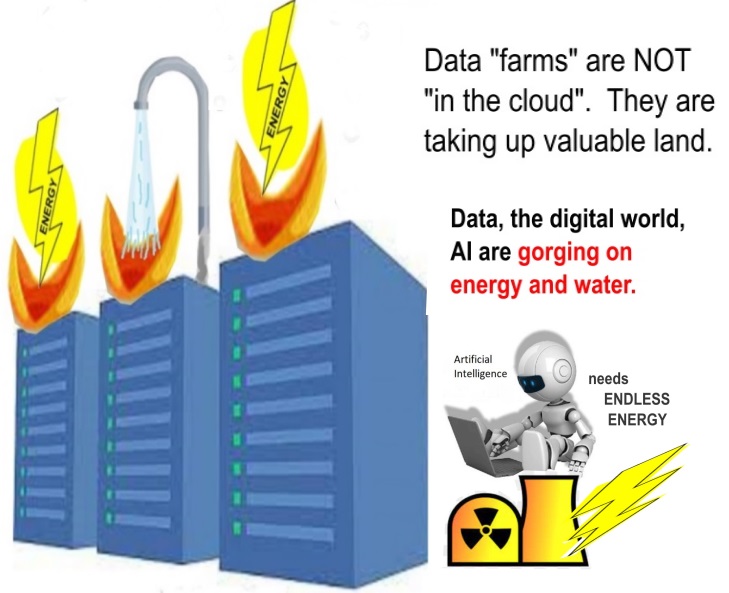
Small nuclear reactors won’t be ready in time for the needs of energy-guzzling needs of Artificial Intelligence.
As of last month, when [data centres] were classed as critical national
infrastructure, data centres are on a par with utilities, meaning the
government would step in were there a risk to connectivity. Nonetheless, as
Rohan Kelkar, the executive vice-president of power products at Schneider
Electric, puts it, the “lack of grid capacity puts UK’s AI and data
centre ambitions and energy transition goals at risk”.
So much so that we have seen the boroughs of Hillingdon, Ealing and Hounslow all rejecting
data centre projects in order to retain supply for housing. This is far
from a UK-specific issue. In Ireland, the pressure on the national grid
from computing needs is so acute they have had to pause some data centre
approvals over concerns that excessive demand from data centres could lead
to blackouts.
On the other side of the Atlantic, Big Tech companies are
also grappling with the energy conundrum: how to find low-carbon, reliable
sources of power for their power-hungry warehouses without jeopardising
customer needs or their net zero goals. Along with renewable energy and
improving battery storage, right now they all seem to be turning in one
direction: towards nuclear power. Microsoft signed a deal last month to
help resurrect a unit of the Three Mile Island plant in Pennsylvania.
Amazon bought a nuclear-powered data centre earlier in the year. On Monday,
Google became the latest to announce a nuclear energy deal to meet the
needs of its data centres, looking at mini reactors developed by a
Californian company.
A cocktail of technological innovation means this
could happen in the UK, too. Rolls-Royce, the engineer, is at the forefront
of developing mini reactors and is already having conversations with
operators in the UK about their use. While mini nukes would not have been
commercially viable in the past, now that demand for data centres has
jumped exponentially, their potential use has become more feasible. Another
key component in the future marriage of computing and nuclear power is that
data centres are becoming less location driven because of improvements in
latency, the time it takes for data to travel from one point to another.
The immediate problem with the introduction of small nuclear reactors?
Rolls-Royce estimates that they remain a decade or more away, with none
currently operating and generating electricity in the UK. In the meantime,
connection to the “constrained” grid, remains all-important headache
for those looking to build data centres.
Times 16th Oct 2024
No comments yet.
1 This Month

of the week – Shut Down Drone Warfare!


Tell the Ukrainian Government to Drop Prosecution of Peace Activist Yurii Sheliazhenko

Petition to revoke the licensing of the Near Surface Nuclear Disposal Facility (NSDF) at Chalk River. https://www.ourcommons.ca/petitions/en/Petition/Details?Petition=e-7247
To see nuclear-related stories in greater depth and intensity – go to https://nuclearinformation.wordpress.com
-
Archives
- April 2026 (34)
- March 2026 (251)
- February 2026 (268)
- January 2026 (308)
- December 2025 (358)
- November 2025 (359)
- October 2025 (376)
- September 2025 (257)
- August 2025 (319)
- July 2025 (230)
- June 2025 (348)
- May 2025 (261)
-
Categories
- 1
- 1 NUCLEAR ISSUES
- business and costs
- climate change
- culture and arts
- ENERGY
- environment
- health
- history
- indigenous issues
- Legal
- marketing of nuclear
- media
- opposition to nuclear
- PERSONAL STORIES
- politics
- politics international
- Religion and ethics
- safety
- secrets,lies and civil liberties
- spinbuster
- technology
- Uranium
- wastes
- weapons and war
- Women
- 2 WORLD
- ACTION
- AFRICA
- Atrocities
- AUSTRALIA
- Christina's notes
- Christina's themes
- culture and arts
- Events
- Fuk 2022
- Fuk 2023
- Fukushima 2017
- Fukushima 2018
- fukushima 2019
- Fukushima 2020
- Fukushima 2021
- general
- global warming
- Humour (God we need it)
- Nuclear
- RARE EARTHS
- Reference
- resources – print
- Resources -audiovicual
- Weekly Newsletter
- World
- World Nuclear
- YouTube
-
RSS
Entries RSS
Comments RSS
 nuclear-news
Leave a comment