Nuclear weapons and children
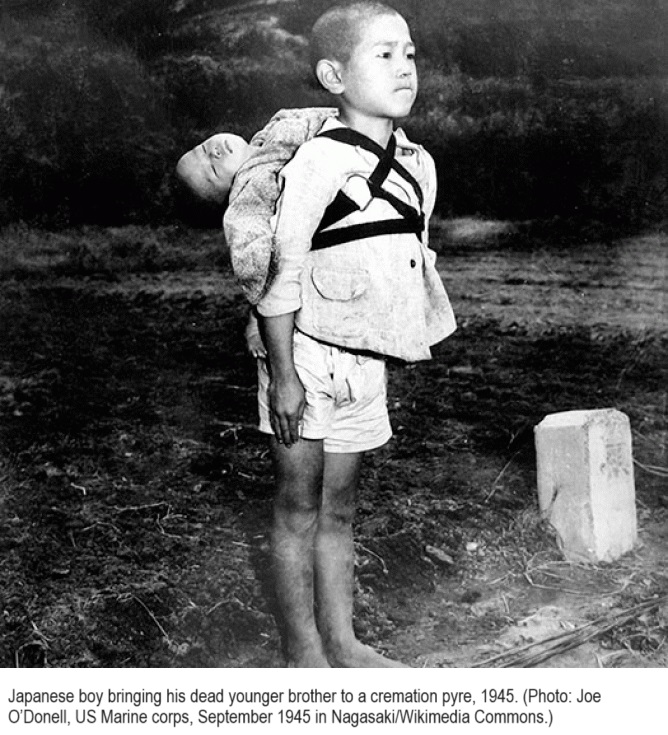
The main perpetrators of violence against children are states armed with nuclear weapons, writes Tim Wright.
Nuclear weapons are designed to destroy cities; to kill and maim whole populations, children among them.
In a nuclear attack, children are more likely than adults to die or suffer severe injuries, given their greater vulnerability to the effects of nuclear weapons: heat, blast and radiation. The fact that children depend on adults for their survival also places them at higher risk of death and hardship in the aftermath of a nuclear attack, with support systems destroyed.
Tens of thousands of children were killed when the United States detonated two relatively small nuclear weapons (by today’s standard) over the Japanese cities of Hiroshima and Nagasaki in 1945.
Many were instantly reduced to ash and vapour. Others died in agony minutes, hours, days or weeks after the attacks from burn and blast injuries or acute radiation sickness. Countless more died years or even decades later from radiation-related cancers and other illnesses. Leukaemia – cancer of the blood – was especially prevalent among the young.
In Hiroshima and Nagasaki, the scenes of devastation were apocalyptic: Playgrounds scattered with the dead bodies of young girls and boys. Mothers cradling their lifeless babies. Children with their intestines hanging out of their bellies and strips of skin dangling from their limbs.
At some of the schools close to ground zero, the entire student population of several hundred perished in an instant. At others, there were but a few survivors. In Hiroshima, thousands of school students were working outside to create firebreaks on the morning of the attack. Approximately 6,300 of them were killed.
Those children who, by chance, escaped death carried with them severe physical and psychological scars throughout their lifetimes. What they witnessed and experienced on 6 August and 9 August 1945 and in the days that followed was permanently seared into their memories.
Thousands of children lost one or both parents, as well as siblings. Some “A-bomb orphans” were left to roam the streets, with orphanages exceeding capacity.
Many of the babies who were in their mothers’ wombs at the time of the atomic bombings were also harmed as a result of their exposure to ionising radiation. They had a greater risk of dying soon after birth or suffering from congenital abnormalities such as brain damage and microcephaly, as well as cancers and other illnesses later in life.
Pregnant women in Hiroshima and Nagasaki also experienced higher rates of spontaneous abortions and stillbirths.
In communities around the world exposed to fallout from nuclear testing, children have experienced similar harm from radiation.
Since 1945, nuclear-armed states have conducted more than two thousand nuclear test explosions at dozens of locations, dispersing radioactive material far and wide
Among the general population, children and infants have been the most severely affected, due to their higher vulnerability to the effects of ionising radiation. Young children are three to five times more susceptible to cancer in the long term than adults from a given dose of radiation, and girls are particularly vulnerable.
In the Marshall Islands, where the United States conducted 67 nuclear tests, children played in the radioactive ash that fell from the sky, unaware of the danger. They called it “Bikini snow” – a reference to the atoll where many of the explosions took place. It burned their skin and eyes, and they quickly developed symptoms of acute radiation sickness.
For decades after the tests, women in the Marshall Islands gave birth to severely deformed babies at unusually high rates. Those born alive rarely survived more than a few days. Some had translucent skin and no discernible bones. They would refer to them as “jellyfish babies”, for they could scarcely be recognised as human beings.
Similar stories have been told by people living downwind or downstream of nuclear test sites in the United States, Kazakhstan, Ma’ohi Nui, Algeria, Kiribati, China, Australia and elsewhere.
We have a collective moral duty to honour the memories of the thousands of children killed in Hiroshima and Nagasaki, as well as those harmed by the development and testing of nuclear weapons globally. And we must pursue the goal of a nuclear-weapon-free world with determination and urgency, lest there be any more victims, young or old.
Under international humanitarian law and the Convention on the Rights of the Child, governments have a legal obligation to protect children against harm in armed conflict. To fulfil this obligation, it is imperative that they work together now to eliminate the scourge of nuclear weapons from the world.
In this report, we describe how nuclear weapons are uniquely harmful to children, based on the experiences of children in Hiroshima and Nagasaki and those living near nuclear test sites. We share their first-hand testimonies and depictions of the toll of nuclear weapons on their lives. And we explain how the ever-present fear of nuclear war – the possibility that entire cities might be destroyed at any given moment – causes psychological harm to children everywhere.
Finally, we make an urgent appeal to all governments to protect current and future generations of children by eliminating nuclear weapons, via the landmark UN Treaty on the Prohibition of Nuclear Weapons, which entered into force in 2021.
Key Findings
So long as nuclear weapons exist in the world, there is a very real risk that they will be used again, and that risk at present appears to be increasing.
In the event of their use, it is all but certain that many thousands of children – perhaps hundreds of thousands or more – would be counted among the dead and injured, and they would suffer in unique ways and out of proportion to the rest of the population.
In a nuclear attack, children would be more likely than adults:
To die from burn injuries, as their skin is thinner and more delicate and burns deeper, more quickly and at a lower temperature;- To die from blast injuries, given the relative frailty of their smaller bodies;
- To die from acute radiation sickness, as they have more cells that are growing and dividing rapidly and are significantly more vulnerable to radiation effects;
- To be unable to free themselves from collapsed and burning buildings or take other steps in the aftermath that would increase their chances of survival;
- To suffer from leukaemia, solid cancers, strokes, heart attacks and other illnesses years later as a result of the delayed effects of radiation damage to their cells; and
- To suffer privation in the aftermath of the attacks, as well as psychological trauma leading to mental disorders and suicide.
Furthermore, babies who were in their mothers’ wombs at the time of the attack would be at greater risk of:
Death soon after birth or in early childhood;- Microcephaly, accompanied by intellectual disability, given the higher vulnerability of the developing brain to radiation damage;
- Other developmental abnormalities;
- Growth impairment due to the reduced functioning of the thyroid; and
- Cancers and other radiation-related illnesses during childhood or later in life.
These horrifying realities should have profound implications for policy-making in countries that currently possess nuclear weapons or those that support their retention as part of military alliances.
They should also prompt organisations dedicated to the protection of children and the promotion of their rights to work to address the grave global threat posed by nuclear weapons.
While children played no part in developing these doomsday devices, it is children who would suffer the most in the event of their future use – one of the myriad reasons why such weapons must be urgently eliminated.
Tim Wright is Treaty Coordinator of the International Campaign to Abolish Nuclear Weapons.
This is the Executive Summary from the longer report, The Impact of Nuclear Weapons on Children, by Tim Wright and published by ICAN, which can be found in full on the ICAN website. It is republished with permission of the author.
No comments yet.
1 This Month

of the week – Shut Down Drone Warfare!


Tell the Ukrainian Government to Drop Prosecution of Peace Activist Yurii Sheliazhenko

Petition to revoke the licensing of the Near Surface Nuclear Disposal Facility (NSDF) at Chalk River. https://www.ourcommons.ca/petitions/en/Petition/Details?Petition=e-7247
To see nuclear-related stories in greater depth and intensity – go to https://nuclearinformation.wordpress.com
-
Archives
- April 2026 (103)
- March 2026 (251)
- February 2026 (268)
- January 2026 (308)
- December 2025 (358)
- November 2025 (359)
- October 2025 (376)
- September 2025 (257)
- August 2025 (319)
- July 2025 (230)
- June 2025 (348)
- May 2025 (261)
-
Categories
- 1
- 1 NUCLEAR ISSUES
- business and costs
- climate change
- culture and arts
- ENERGY
- environment
- health
- history
- indigenous issues
- Legal
- marketing of nuclear
- media
- opposition to nuclear
- PERSONAL STORIES
- politics
- politics international
- Religion and ethics
- safety
- secrets,lies and civil liberties
- spinbuster
- technology
- Uranium
- wastes
- weapons and war
- Women
- 2 WORLD
- ACTION
- AFRICA
- Atrocities
- AUSTRALIA
- Christina's notes
- Christina's themes
- culture and arts
- Events
- Fuk 2022
- Fuk 2023
- Fukushima 2017
- Fukushima 2018
- fukushima 2019
- Fukushima 2020
- Fukushima 2021
- general
- global warming
- Humour (God we need it)
- Nuclear
- RARE EARTHS
- Reference
- resources – print
- Resources -audiovicual
- Weekly Newsletter
- World
- World Nuclear
- YouTube
-
RSS
Entries RSS
Comments RSS
 nuclear-news
Leave a comment