Nuclear weapons and children
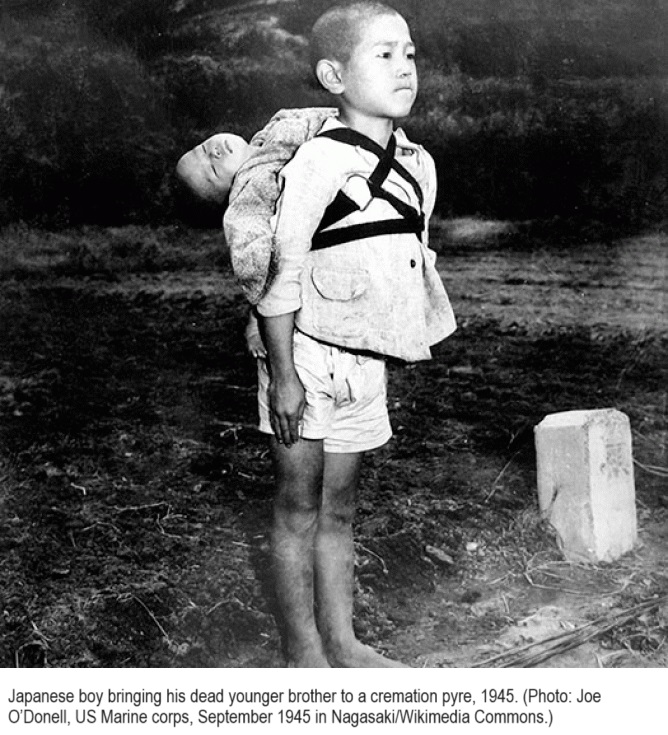
The main perpetrators of violence against children are states armed with nuclear weapons, writes Tim Wright.
Nuclear weapons are designed to destroy cities; to kill and maim whole populations, children among them.
In a nuclear attack, children are more likely than adults to die or suffer severe injuries, given their greater vulnerability to the effects of nuclear weapons: heat, blast and radiation. The fact that children depend on adults for their survival also places them at higher risk of death and hardship in the aftermath of a nuclear attack, with support systems destroyed.
Tens of thousands of children were killed when the United States detonated two relatively small nuclear weapons (by today’s standard) over the Japanese cities of Hiroshima and Nagasaki in 1945.
Many were instantly reduced to ash and vapour. Others died in agony minutes, hours, days or weeks after the attacks from burn and blast injuries or acute radiation sickness. Countless more died years or even decades later from radiation-related cancers and other illnesses. Leukaemia – cancer of the blood – was especially prevalent among the young.
In Hiroshima and Nagasaki, the scenes of devastation were apocalyptic: Playgrounds scattered with the dead bodies of young girls and boys. Mothers cradling their lifeless babies. Children with their intestines hanging out of their bellies and strips of skin dangling from their limbs.
At some of the schools close to ground zero, the entire student population of several hundred perished in an instant. At others, there were but a few survivors. In Hiroshima, thousands of school students were working outside to create firebreaks on the morning of the attack. Approximately 6,300 of them were killed.
Those children who, by chance, escaped death carried with them severe physical and psychological scars throughout their lifetimes. What they witnessed and experienced on 6 August and 9 August 1945 and in the days that followed was permanently seared into their memories.
Thousands of children lost one or both parents, as well as siblings. Some “A-bomb orphans” were left to roam the streets, with orphanages exceeding capacity.
Many of the babies who were in their mothers’ wombs at the time of the atomic bombings were also harmed as a result of their exposure to ionising radiation. They had a greater risk of dying soon after birth or suffering from congenital abnormalities such as brain damage and microcephaly, as well as cancers and other illnesses later in life.
Pregnant women in Hiroshima and Nagasaki also experienced higher rates of spontaneous abortions and stillbirths.
In communities around the world exposed to fallout from nuclear testing, children have experienced similar harm from radiation.
Since 1945, nuclear-armed states have conducted more than two thousand nuclear test explosions at dozens of locations, dispersing radioactive material far and wide
Among the general population, children and infants have been the most severely affected, due to their higher vulnerability to the effects of ionising radiation. Young children are three to five times more susceptible to cancer in the long term than adults from a given dose of radiation, and girls are particularly vulnerable.
In the Marshall Islands, where the United States conducted 67 nuclear tests, children played in the radioactive ash that fell from the sky, unaware of the danger. They called it “Bikini snow” – a reference to the atoll where many of the explosions took place. It burned their skin and eyes, and they quickly developed symptoms of acute radiation sickness.
For decades after the tests, women in the Marshall Islands gave birth to severely deformed babies at unusually high rates. Those born alive rarely survived more than a few days. Some had translucent skin and no discernible bones. They would refer to them as “jellyfish babies”, for they could scarcely be recognised as human beings.
Similar stories have been told by people living downwind or downstream of nuclear test sites in the United States, Kazakhstan, Ma’ohi Nui, Algeria, Kiribati, China, Australia and elsewhere.
We have a collective moral duty to honour the memories of the thousands of children killed in Hiroshima and Nagasaki, as well as those harmed by the development and testing of nuclear weapons globally. And we must pursue the goal of a nuclear-weapon-free world with determination and urgency, lest there be any more victims, young or old.
Under international humanitarian law and the Convention on the Rights of the Child, governments have a legal obligation to protect children against harm in armed conflict. To fulfil this obligation, it is imperative that they work together now to eliminate the scourge of nuclear weapons from the world.
In this report, we describe how nuclear weapons are uniquely harmful to children, based on the experiences of children in Hiroshima and Nagasaki and those living near nuclear test sites. We share their first-hand testimonies and depictions of the toll of nuclear weapons on their lives. And we explain how the ever-present fear of nuclear war – the possibility that entire cities might be destroyed at any given moment – causes psychological harm to children everywhere.
Finally, we make an urgent appeal to all governments to protect current and future generations of children by eliminating nuclear weapons, via the landmark UN Treaty on the Prohibition of Nuclear Weapons, which entered into force in 2021.
Key Findings
So long as nuclear weapons exist in the world, there is a very real risk that they will be used again, and that risk at present appears to be increasing.
In the event of their use, it is all but certain that many thousands of children – perhaps hundreds of thousands or more – would be counted among the dead and injured, and they would suffer in unique ways and out of proportion to the rest of the population.
In a nuclear attack, children would be more likely than adults:
To die from burn injuries, as their skin is thinner and more delicate and burns deeper, more quickly and at a lower temperature;- To die from blast injuries, given the relative frailty of their smaller bodies;
- To die from acute radiation sickness, as they have more cells that are growing and dividing rapidly and are significantly more vulnerable to radiation effects;
- To be unable to free themselves from collapsed and burning buildings or take other steps in the aftermath that would increase their chances of survival;
- To suffer from leukaemia, solid cancers, strokes, heart attacks and other illnesses years later as a result of the delayed effects of radiation damage to their cells; and
- To suffer privation in the aftermath of the attacks, as well as psychological trauma leading to mental disorders and suicide.
Furthermore, babies who were in their mothers’ wombs at the time of the attack would be at greater risk of:
Death soon after birth or in early childhood;- Microcephaly, accompanied by intellectual disability, given the higher vulnerability of the developing brain to radiation damage;
- Other developmental abnormalities;
- Growth impairment due to the reduced functioning of the thyroid; and
- Cancers and other radiation-related illnesses during childhood or later in life.
These horrifying realities should have profound implications for policy-making in countries that currently possess nuclear weapons or those that support their retention as part of military alliances.
They should also prompt organisations dedicated to the protection of children and the promotion of their rights to work to address the grave global threat posed by nuclear weapons.
While children played no part in developing these doomsday devices, it is children who would suffer the most in the event of their future use – one of the myriad reasons why such weapons must be urgently eliminated.
Tim Wright is Treaty Coordinator of the International Campaign to Abolish Nuclear Weapons.
This is the Executive Summary from the longer report, The Impact of Nuclear Weapons on Children, by Tim Wright and published by ICAN, which can be found in full on the ICAN website. It is republished with permission of the author.
Nuclear disarmament is an urgent cause in a world on the brink

13 Oct 24,
https://morningstaronline.co.uk/article/editorial-nuclear-disarmament-urgent-cause-world-brink
TOMORROW Nato begins nuclear war drills over western Europe. Exercise Steadfast Noon tests the nuclear capability of non-nuclear weapons states under the US’s “nuclear umbrella,” with Dutch F-35A jets declared “ready to perform nuclear roles” for the first time.
Nato’s aggressive posturing is sparking a new arms race. The US is spending a staggering $1.5 trillion (£1.14tn) on upgrading its nuclear arsenal. Britain too is increasing its stockpile of nuclear weapons.
Russia has revised its protocol on nuclear strikes, announcing it reserves the right to use nuclear weapons in retaliation for a non-nuclear attack.
But it is above all the US which has dismantled barriers to nuclear conflict.
It was the US which tore up the Intermediate Nuclear Forces Treaty, a landmark achievement of which saw US and Soviet missiles removed from Europe. Now they are coming back: Russia has deployed them to Belarus, while the US is redeploying them across Europe, including in Germany and Britain.
Europe is already the battlefield for a proxy war between Nato and Russia: these deployments will make it the battleground should that war escalate to direct conflict between nuclear powers.
Nuclear war is also brought closer by the development of lower-yield “tactical” nuclear weapons, again led by the US, which equipped its submarine fleet with such weapons under Donald Trump.
These reduce the threshold for use, leading US and Russian strategists to talk of fighting a limited nuclear war with a supposedly lower risk of mutually assured destruction. Yet they carry all the same costs in terms of radioactive fallout that have poisoned generations.
The consequence of their use would be to end the taboo on using nuclear weapons that has held since their only ever use in war — by the United States against Japan in 1945.
We need to relearn the fear of nuclear conflict that inspired a mass peace movement during the original cold war. Complacency over the continued existence of nuclear weapons rests on the idea that nobody would ever use them: yet the world came alarmingly close to nuclear annihilation at least twice during the original cold war.
Two current conflicts could plausibly spiral into nuclear war: the Nato-Russia proxy war over Ukraine, and Israel’s ever-expanding war against Palestine, Lebanon and increasingly Iran.
Cold war politicians were aware of mass public opposition to use of nuclear weapons. They had also lived through world war, and seen the impact of enemy bombing on cities in their own countries.
Today’s political leaders lack this life experience. The 1980s comedy Blackadder Goes Forth includes a scene where Britain’s naive rush into World War I is explained by its complacency after decades of easy colonial conflicts against vastly inferior opponents.
Since the collapse of the Soviet Union, the US and its allies have fought multiple wars against countries which cannot strike back: Yugoslavia, Afghanistan, Iraq, Libya. This surely explains the blasé attitude to war prevalent among most Western politicians. Yet we are in an age of great power conflict in which world war against countries capable of devastating retaliation is no longer unthinkable.
It must be prevented. The Campaign for Nuclear Disarmament’s The World We Want conference on Saturday was a valuable reminder of that.
Building on the record of retiring CND general secretary Kate Hudson in forging alliances across the peace movement, it brought together campaigners from peace, social justice and environmental causes to debate the drive towards global conflict and what ordinary people can do to stop it.
It is only through such alliances that the vital cause of nuclear disarmament can be placed at the heart of the struggle for a safer world, just as it is only through unity with the left and labour movements that the essential campaigns against environmental degradation, racism and misogyny can develop from single-issue causes into a force that can change the planet.
Senior U.S. Diplomats, Journalists, Academics and Secretaries of Defense Say: the U.S. Provoked Russia in Ukraine
by Donald A. Smith, PhD, The Ukraine Papers, 14 Oct 24
It took some years for Americans to realize they’d been lied to about the war in Vietnam. Thanks to the publication of the Pentagon Papers, and thanks to the antiwar movement, Americans eventually learned about the injustices and failures of that war.
Likewise, it took several years after the starts of the wars in Iraq and Afghanistan for Americans to realize they’d been lied to about those wars as well.
Americans are just now starting to realize that they’ve been lied to about the war in Ukraine. (The propaganda effort has been quite effective, with the New York Times, in particular, acting as a mouthpiece for the government’s position.) More and more mainstream publications are exposing the lies, and a majority of Americans now oppose further arming of Ukraine.
This essay is a summary of what the U.S. government has been hiding about the war in Ukraine, with links to sources for further information
According to Brown University’s Costs of War project, U.S. military actions since 9/11 directly killed over 900,000 people, with an additional 3.5 million people dying from indirect effects. The wars cost Americans at least $8 trillion and displaced over 38 million people from their homes. The U.S. spends over a trillion dollars a year on its military, if you count all expenditures.
If we go back to the 1960s, the number killed by U.S. wars includes the several million killed in the Vietnam war, the approximately 1 million killed by U.S. support for Indonesian military’s attacks on left wing groups, and the hundreds of thousands, at least, killed in proxy wars and government overthrows in Latin America.
The wars, overthrows, and associated sanctions caused mass migrations worldwide — particularly in Europe and at the southern U.S. border — and destabilized politics. Yet almost nobody (except for whistleblowers) was held accountable for these disasters; indeed, many of the same people are in Congress or work for the government or the weapons industry.
Moreover, the U.S. government lied about almost all the wars — in particular, about the wars in Vietnam, Iraq, and Afghanistan, but also about the war in Yugoslovia, as documented in Harper’s Magazine, here (Chapter 3), and here. (In short, the Kosovo Liberation Army that the U.S. supported was, basically, a terrorist organization funded by the CIA, and U.S. propaganda greatly overstated the nobility of the U.S. intervention.)
So, it should come as no surprise that our government is lying now about the war in Ukraine. Specifically, claims by President Biden and others that the Russian invasion was “unprovoked” are greatly exaggerated.
Read what these diplomats, secretaries of Defense, journalists, academics, politicians, and others have to say:………………………………………………………………………………………………………………………………………………………………………………………………more https://theukrainepapers.org/senior-US-diplomats-academics-journalists-and-secretaries-of-defense-say-the-US-provoked-Russia-in-Ukraine.html
Nuclear – not the way ahead

12 Oct 24 https://renewextraweekly.blogspot.com/2024/10/nuclear-not-way-ahead.html
Renewable energies consistently outperform nuclear power in terms of cost and deployment speed and are therefore chosen over nuclear power in most countries’ – so says this years independent World Nuclear Industry status report (WNISR). It notes that in 2023, 5 new nuclear reactors (5 GW) started up and 5 were closed (6 GW), capacity thus declining by 1 GW. So overall it says that nuclear energy’s share of global commercial gross electricity generation declined from 9.2 % to 9.1%, little more than half of its peak of 17.5 % in 1996. In 2023, total investment in non-hydro renewable electricity capacity reached a record US$623 billion, 27 times the reported global investment decisions for the construction of nuclear power plants, with solar and wind power capacities growing by 73% and 51%, respectively.
Nevertheless, some countries are still pushing on with new nuclear, despite its poor economics, including the UK and Sweden. Sweden has mooted a new financing model but its critics say support for nuclear ‘is like throwing money down the drain’ since ‘the expansion of solar energy will make nuclear power obsolete and push it out of the electricity market by the 2030s’. In the UK, and also in France, it has been argued that part of the reason for the political commitment to new nuclear is link between civil and military nuclear, with cross-funding and technical collaboration seen as beneficial.
However, be that as it may, Emeritus Profs. Stephen Thomas (University of Greenwich) and Andrew Blowers (OU) do not see nuclear civil power prospering in the UK, indeed they say that ‘it is time to expose the Great British nuclear fantasy once and for all.’ They claim that ‘no amount of political commitment can overcome the lack of investors, the absence of credible builders and operators or available technologies let alone secure regulatory assessment and approval. Moreover, in an era of climate change there will be few potentially suitable sites to host new nuclear power stations for indefinite, indeed unknowable, operating, decommissioning and waste management lifetimes. And there are the anxieties and fears that nuclear foments, the danger of accidents and proliferation and the environmental and public health issues arising from the legacy of radioactive waste scattered on sites around the country’.
They go on to suggest backing off new nuclear projects. They do recognise that ‘abandoning Sizewell C and the SMR competition will lead to howls of anguish from interest groups such as the nuclear industry and trade unions with a strong presence in the sector. It will also require compensation payments to be made to organisations affected. However, the scale of these payments will be tiny in comparison with the cost of not abandoning them’.
Certainly the cost of construction is vast- and expanding. The EPR being built by EDF at Hinkley Point may in the event cost £35bn, with there’s still being a way to go- 2030 for unit 1 start up, maybe 2031 for Unit 2. And as industry commentators have noted ‘as the cost of Hinkley Point has increased, the backers have had to provide more funding. The souring of relations between Britain & China saw CGN stop providing any more money, leaving EDF to fund the shortfall. EDF has called upon the UK government to help out with the escalating cost but it has refused. EDF was fully nationalised in 2023, leaving the French taxpayer to pick up the tab for the cost overruns’.
UK consumers will of course pay the high cost of the power when it comes on the grid. They will also be expected to shell out for the next EPR that is planned in the UK, at Sizewell, but this time in advanced of completion, under the RAB financing system. However, although the government has provided £5.5bn to move things along, the final (private) investment decision on Sizewell C keeps being delayed. EDF aimed to secure funding by the end 2024, but that may now be extended to 2025 – and EDF is still looking for £4bn to finish Hinkley Point!
All in all, with EDF’s finances in a mess, and few other companies keen to take risks with this technology, it looks a bit uncertain. Even the UK government seems to be having doubts, with plans for a new large project on Wylfa in Wales may be subject to a review. Proposals are currently being considered for small modular reactors under a UK SMR competition, but the US NuScale PWR has just been eliminated from the race. It was once seen as the leader, but it had lost a US order. EDF had earlier dropped out. So that leaves Rolls-Royce, GE-Hitachi, Westinghouse, and Holtec Britain, with the newly formed agency, Great British Nuclear, expected to announce 2 winners later this year or early next year. Up to £20bn is at stake. However few see any power being available anywhere from SMRs until the early or mid 2030s. Despite a lot of hype, in reality it has been slow going. And there are risks.
Overall then, the prospects for new nuclear in the UK, or indeed elsewhere, do not look too good. Even in China, renewables are expanding very much faster, with according to the WNISR/IRENA, at the end of 2023, there being over 1000GW of wind and solar and around 421GW of hydro in place, compared to just 53GW of nuclear. Given the scale and rate of deployment, and the costs, it’s pretty clear which should be the way forward in terms of energy supply there and everywhere else.
Nuclear fission may have a small role to play in some isolated locations and in some applications, and fusion may be viable at commercial scale at some stage, but we have to be aware of hype and overselling in this area, and also in the wider nuclear debate, with nuclear sometimes being sold as the answer to climate change. It’s not. As I have indicated in earlier posts, there is no shortage of studies from around the world confirming the view that nuclear is a costly and risky distraction from renewables, which are the main energy supply solutions to climate change. And Germany has shown how the exit from nuclear can be done, led by renewables. Although they do have some issues in terms of balancing, renewables, along with energy efficiency, demand management and storage, are the way ahead to an economically viable and sustainable energy future.
BBC viewers urge everyone to watch ‘bleak’ war film that has only ever been shown four times
Threads was the first film to ever show what devastation a nuclear winter would cause
Greg Evans, Friday 11 October 2024 ,
https://www.independent.co.uk/arts-entertainment/tv/news/threads-bbc-iplayer-1984-movie-b2627786.html
BBC iPlayer viewers are encouraging others to watch the nuclear war film Threads, often described as one of the most harrowing movies ever made.
The 1984 film was made for BBC TV by The Bodyguard director Mick Jackson and Kes writer Barry Hines, with Jackson wanting to focus on the scientific ramifications of a nuclear attack and its fallout.
Threads was first aired on BBC Two on 23 September 1984 at the height of the Cold War, when nuclear tensions were as prevalent a talking point as they are today.
Although the film revolves around the conflict between the United States and the Soviet Union, after the latter invades Iran, it predominantly focuses on the lives of a couple in Sheffield, England and how the war impacts their lives.
The South Yorkshire city was chosen due to the belief that the Soviets would opt to strike an industrial city in the UK and that the local council, at the time, had a “nuclear-free zone” policy.
Despite having a budget of just £400,000, Threads was the first film to ever depict what a nuclear winter would actually look like, giving an uncompromising and brutally bleak outlook on the implications of nuclear war and the devastation it would create. It has been widely praised by critics and audiences alike ever since and holds a 100 per cent rating on Rotten Tomatoes.
It has only been repeated on BBC TV three times since its original broadcast, with the most recent being on 9 October, to celebrate its 40th anniversary.
The film is now available to watch on iPlayer, with many encouraging those who haven’t seen it to watch it despite the heavy subject matter.
On X/Twitter, one person wrote: “Watching Threads as a youngster (too young really) was a massively transformative experience for me. If you haven’t watched it, you owe it to yourself to do so.”
Another said: “One of the earliest films to not treat nuclear bombs as the end point. But instead focus on the horrors and hauntings that accompany surviving their impact. Rarely shown on TV, a must watch.”
A third added: “I beseech you, if you’ve never watched Threads before, make sure you do now. It’s only been shown 4 times on telly in 40 years and it’s a bleak, harrowing, but essential watch. Something you’ll never forget.”
Watching it for the first time, one viewer said: “Waking up the morning after seeing Threads for the first time… … Like all great art, shakes you to the core and makes you see the world in a new way. While the kitchen sink (antithesis of Hollywood) context makes it all the more terrifying.
Under the shadow of a NATO-Russia nuclear war, Hibakusha awarded Nobel Peace Prize
By John Hallam, Oct 15, 2024, https://johnmenadue.com/under-the-shadow-of-a-nato-russia-nuclear-war-hibakusha-awarded-nobel-peace-prize
As Vladimir Putin deploys mobile missile launchers throughout the Siberian Taiga armed with Yars heavy duty ICBMs, while making nuclear threats and claiming that these forces have been placed on a higher level of alert (though this isn’t necessarily so), NATO seems intent on compounding what seems already threatening and dangerous enough with the performance of the annual Steadfast Noon nuclear exercises, in which NATO literally rehearses for the apocalypse. It seems that this year the exercise is more ‘real’ than previously.
Meanwhile – and highly appropriately given the level of the threat and the danger the world faces – the Hibakusha (Bomb Victims) group Nihon Hidankyo has been awarded this years Nobel Peace Prize for its work in spreading the word on the effects of nuclear weapons and in working for their abolition. A more appropriate and timely award is hard to imagine.
Newsweek reported on 7 Oct that Putin had ordered Russian missiles placed on higher alert. Video of mobile missile launchers rumbling out into the Siberian Taiga over remote roads from their garages was posted on Telegram.
An item in Pearls and Irritations Oct 11, by this author noted that placing Russian nuclear missiles on high alert (if indeed their alert status really has changed) is ‘a dangerous game’.
If the deployment of Yars missiles on mobile launchers in the Siberian Taiga (threatening enough if we also take account of the accompanying rhetoric) inches us toward an event sequence that would, if it should take place, end what we call ‘civilisation’ in its first milliseconds of EMP, kill up to 50% of all humans in about 90 minutes, and leave most of those who somehow survive to starve and freeze in the twilight of a nuclear winter – then the pursuit of a NATO nuclear exercise in which the dropping and the targeting of nuclear weapons is actively practiced, surely compounds the risk.
Russia’s deployment of its mobile YARS ICBMs was bad enough. 2 weeks worth of NATO nuclear exercises, in which NATO actively practices for the apocalypse, surely compounds that risk.
Colonel Daniel Bunch, director of NATO nuclear weapons operations, adds point to the potential risk, saying in a Finnish publication that this year’s exercise also has another clear difference from last years’ nuclear weapons exercises.
“- This year, the planes will deliver the weapon to the target”. “We’re looking at how to integrate that and what we can learn about maximising the performance of a very powerful aircraft,”
One can imagine how this reads in the Kremlin. About as cheerfully as the deployment of YARS mobile missiles reputedly on ‘high alert’ reads to NATO.
Back in 1983, NATO also practiced for the apocalypse, in an exercise known as ‘Able Archer’, in which commanders went through the procedures they would have had to go through to order the release of nuclear weapons. There was one slight glitch – The KGB was convinced it wasn’t an exercise but the real thing. Only the leakage of NATOs real battle plans to the Kremlin (showing it was indeed an exercise) and a last minute substitution of heads of state for underlings saved the world from nuclear war.
Russia’s deployment of an important segment of its nuclear forces, (assuming a real change of status has taken place which it may not have) combined with NATO’s nuclear exercises which will go on for a week starting Monday put the world closer to the brink.
The need for nuclear risk reduction measures such as No First Use, de-alerting and enhanced or resumed military to military communication has never been clearer, and the need for abolition never clearer.
Australia could do much both by vigorous advocacy of risk reduction and by joining the TPNW (Ban Treaty). Much has been promised and little or nothing achieved in this department.
Meanwhile, the well-deserved award of the Nobel Peace prize to the Hibakusha both puts the spotlight on nuclear weapons and their abolition, and on the suffering of nuclear victims, where it needs to be.

J
Israel’s War on the United Nations

October 15, 2024, by: Dr Binoy Kampmark, https://theaimn.com/israels-war-on-the-united-nations/
The United Nations is an easy body to hate. At times, it seems to be effusion without substance, body with no backbone. It was conceived in a fit of post-war idealism, when egos were humbled and hatred briefly stemmed. Over the ruins of the Second World War, the builders were favoured over the destroyers and mischief makers – at least for a time.
On its establishment, the UN became a hostage to the political intrigues and power blocs that have continued to plague it for its duration. Of particular concern was the body’s pursuit of international law protocols – formulation, drafting and implementation. A central feature of this: resolutions passed by various bodies, the most significant being by the UN Security Council. Such measures are followed by nation states when convenient, ignored when not.
One such nation state in the mischief making class is Israel. Its relationship with the UN has often been tetchy. The Anti-Defamation League, for instance, admits that the body “played a pivotal role in the establishment of the Jewish State by passing UN Resolution 181 in 1947.” The resolution, with its hefty consequences, called for “the partition of British Mandate Palestine into two states, one Jewish and one Arab.” The same organisation, however, goes on to note with satisfaction the remarks in April 2007 by then UN Secretary-General Ban Ki-Moon: “Unfortunately, because of the [Israeli-Palestinian] conflict, Israel’s been weighed down by criticism and suffered from bias – and sometimes even discrimination.”
For various periods of its history, Israel has felt hard done by in the international forum. The folder of resolutions against it has burgeoned. Notable ones include UNSC Resolution 242 (1967) which asserts, in accordance with the UN Charter principles, that a “just and lasting peace in the Middle East” includes the withdrawal of Israel’s armed forces from territories occupied during the Six Day War and the termination of territorial claims and affirmation of sovereignty of all States in the area. UNSC Resolution 338 (1973), passed in response to the Yom Kippur War between Israel, Egypt and Syria, called on the parties to cease hostilities within 12 hours and implement Resolution 242 “in all its parts.”
UN Resolution 2334, passed in December 2016, particularly hurt, striking at the expansionist, displacing drive of the Jewish state through settlements in occupied territory that amount to de facto colonisation. It particularly condemned “all measures aimed at altering the demographic composition, character and status of the Palestinian Territory occupied since 1967, including East Jerusalem.” This included, among other matters, the expansion of the settlements, the transfer of Israeli settlers, the confiscation of land and the displacement of Palestinian civilians.
Instead of seeing such a measure as a clear assessment of predation in breach of international law and the principles of the UN Charter, Israel’s Ambassador to the UN, Danny Danon, called it an unnecessary reward to the Palestinians “to continue down a dangerous path they have chosen” in avoiding direct negotiations with Israel. That Israel cared not a jot on that score hardly mattered.
A number of recent incidents reveals the poor regard the United Nations is held in, notably within Israel’s warring circles. Its agency aiding Palestinians, UNRWA, is threatened by two bills before the Israeli parliament that will significantly hamper its operations by evicting the body from its premise in territories within Israel’s control. The proposed laws will also abolish any associated privileges and immunities. Having failed to convince all major donors to the organisation that it should be defunded for being packed with Hamas apologists and operatives (the evidence has always been paltry on that score), the Israeli government is using a legal sledgehammer fashioned by the Knesset.
The passage of the bills, warns UN Secretary-General António Guterres, “would effectively end coordination to protect UN convoys, offices and shelters serving hundreds of thousands of people.” The provision of shelter, food and healthcare “would grind to a halt” without the agency. Some 600,000 children “would lose the only entity that is able to re-start education, risking the fate of an entire generation.”
With Israel’s broadening campaign against Hezbollah to the north, the UN Interim Force in Lebanon (UNIFIL) is facing continuous harassment by the Israel Defense Forces (IDF). Established in 1978 by the Security Council to confirm the withdrawal of Israel from Lebanon and aid Lebanese authorities restore peace and security in the area, UNIFIL has been a source of endless irritation to the IDF’s operations.
In an October 13 statement, UNIFIL revealed that two IDF Merkava tanks at 4.30 that morning had gone about the business of destroying the main gate of their post in Ramyah, near the Israeli border. The tanks forcibly entered, after which Israeli personnel demanded that the base turn out its lights. “The tanks left about 45 minutes later after UNIFIL protested through our liaison mechanism, saying that IDF presence was putting peacekeepers in danger.”
At 6.40 am, peacekeepers at the same post reported the firing of several smoke emitting rounds 100 metres to the north. “Despite putting on protective masks, fifteen peacekeepers suffered effects, including skin irritation and gastrointestinal reactions, after the smoke entered the camp.”
On October 14, persisting in its approach of impeding and harrying the peacekeeping force, the IDF halted “a critical UNIFIL logistical movement near Meiss ej Jebel, denying it passage. The critical movement could not be completed.”
The statement goes on to remind the IDF about its obligations to ensure the safety and security of the UN peacekeepers and property. Breaching a UN position violated UN Security Council Resolution 1701 (2006), while any deliberate attack on peacekeepers was aserious violation of international humanitarian law, in addition to breaching resolution 1701.
In an almost disdainful manner, the IDF suggested in a statement that the peacekeepers had entirely misunderstood the brutal encroachment. The actions had been motivated by goodwill to evacuate soldiers wounded by an anti-tank missile. “For the sake of evacuating the wounded, two tanks drove backwards, in a place where they could not advance otherwise in light of the threat of shooting, a few metres towards the UNIFIL position.” The smokescreen had been created to aid the evacuation, while the entire operation was conducted throughout with continuous contact with the UN peacekeepers. After a time, the dressing of lies becomes tatty and banal.
Typically, it fell to the Israeli Prime Minister, Benjamin Netanyahu, to shed some light on the mendacious fog. UNIFIL, he suggested, had to immediately withdraw its forces from southern Lebanon. “It is time for you,” stated the PM in a pointed message to Guterres, “to withdraw UNIFIL from Hezbollah strongholds and from the areas of combat.” Yet again, international law which, in this case, provides legitimacy to the UN peacekeeping operations in the area, could be treated as a tissue easily torn.
Exposed: How Israeli spies control your VPN (Virtual Private Network)
the high tech industry is inextricably linked to the Israeli military apparatus
Mint Press News, September 11th, 2024, Alan Macleod
An estimated 1.6 billion people rely on VPNs to carry out the most sensitive tasks online, from watching illegal videos to engaging in sexual or political activities. But few people know that a considerable chunk of that market—including three of the six most popular VPNs—is quietly operated by an Israeli-owned company with close connections to that country’s national security state, including the elite Unit 8200 and Duvdevan Units of the Israeli Defense Forces (IDF).
Previous MintPress News investigations into Israel’s growing control over the tech industry have outlined how those units have been involved in many of Israel’s most outrageous hacking, surveillance and assassination programs, acting as spies and death squads. Unit 8200, for example, has been the source of much of the world’s most infamous spying software, including Cellebrite and Pegasus, the program used to snoop on tens of thousands of the world’s top politicians and journalists, including by Saudi Arabia, who used it to help track down and kill Washington Post columnist Jamal Khashoggi.
Given this context, justifiable fears arise that control over a vast VPN empire could add to Israel’s influence over the online information and security world, creating backdoors for Israeli intelligence to carry out a vast kompromat operation on users around the globe.
This investigation is part of a series highlighting and detailing the power of Israel’s growing tech industry to access and control people’s data.
A Company Like No Other
Kape Technologies is a major player in the online privacy world, one of the three giants that collectively control the market. It owns many of the world’s top VPNs, including ExpressVPN, CyberGhost, Private Internet Access, ZenMate, Intego Antivirus, and a host of tech websites that promote its products. Kape brands can be seen sponsoring a wide array of public figures, such as Tucker Carlson, Angry Video Game Nerd, Drew Gooden, Lex Fridman, Cody Ko, Uncle Roger, and Ben Shapiro.
“We are living in an era of tyranny,” Shapiro says in one video endorsing the company, adding:
“The Internet is at the frontier of a battle for control. When powerful interests want to push their agenda, they get big government and big tech to silence any voice that doesn’t fit the narrative. Americans are being forced to give up the very thing that makes Americans great: our freedom of speech. Well, I don’t like my voice being censored, I also don’t like being monitored by big Tech and big government, that’s why I use ExpressVPN [and] you should do the same.”
VPN stands for virtual private network and is a service that claims to protect your anonymity online. Instead of giving your information to an internet service provider, you provide it to the VPN company, who will scramble it, allowing users to get around government censorship and carry out activities online that they do not wish to be connected to themselves, such as purchasing banned products, partaking in certain activities, and communicating with others. Therefore, individuals trust VPNs to conceal their most sensitive activities.
Although it is headquartered in London and employs more than 1,000 people worldwide, Kape Technologies maintains a distinctly Israeli flavor. This begins with its owner, Teddy Sagi. Born in Tel Aviv, the tycoon, who previously spent time in prison for financial crimes,isestimatedto be worth $6.4 billion, making him among the top ten richest Israelis.
Sagi has a long history of working closely with the IDF and is rumored to be extremely close to Israeli intelligence. In 2019, he donated $3 million to fund hundreds of academic scholarships for discharged Israeli soldiers.
Sagi, at the Friends of the IDF Gala, said:
“It is a debt of honor for us and for me personally to express gratitude and appreciation that all of Israel’s citizens owe to you.”
………………………………Kape Technology’s connections to the Israeli security services do not end there. Indeed, the company is teeming with Israeli intelligence officials.………………………..
…………………………………………………………………………………………………………………………. Express VPN Executive, a Former Spy
When using a VPN service, users place a large amount of trust in the VPN company itself. They must trust that it is effectively encrypting users’ traffic, securing their data and the server network infrastructure, and not doing anything else with the vast amount of sensitive information they are given. As noted previously, individuals and organizations use VPNs to carry out all manner of highly compromising activities online.
Unfortunately, Daniel Gericke, ExpressVPN’s chief technology officer (CTO) from 2019-2023, was deeply involved in such questionable practices. A Reuters investigation series revealed that Gericke was a key member of a team of spies that hacked the devices of human rights activists, journalists and government officials, stealing their data and passing it on to the government of the United Arab Emirates. The UAE used this data to track down dissidents and torture them, according to the investigation.
ExpressVPN hired Gericke (a former manager for weapons firm Lockheed Martin) after the Reuters exposé and continued to back him, even after the U.S. Department of Justice fined him $335,000 for his role in the clandestine operation. “Our trust in Daniel remains strong,” the company said in a statement. Gericke left ExpressVPN last summer after nearly four years with the company.
A Unit Like No Other
With his background as a former spy, Gericke likely fits well with many of the other top Kape Technologies leaders. Ido Erlichman, Kape CEO between 2016 and 2023, is a veteran of the Duvdevan, an elite Israeli commando unit. Described by Middle East news outlet Electronic Intifada as Israel’s “death squad,” members are given special training to disguise themselves as Palestinians in order to infiltrate enemy groups and carry out extrajudicial killings. Both the selection process and the training are exceptionally rigorous, and Duvdevan commandos often spend months or even years undercover before being assigned a mission.
The life and work of Duvdevan agents were explored and promoted in the Netflix series Fauda.
Unit 8200, meanwhile, is no less prestigious.Described as Israel’s Harvard, parents spend fortunes on extra classes for their children, who know that selection into the unit will unlock a wealth of doors in Israel’s burgeoning hi-tech industry.
But Unit 8200 is also the centerpiece of the country’s repressive state apparatus. It has created a gigantic digital dragnet that is used to constantly monitor, surveil and harass the Palestinian population,whose calls, emails and every move are clocked by the group.
Unit 8200 uses this data to compile gigantic dossiers of information on Palestinians under their control, including their medical history, sex lives, and search histories, so that it could be used later for extortion. If a particular individual needs to travel across checkpoints for crucial medical treatment, permission can be suspended until they comply with Israeli requests for dirt on their peers. Information, such as if a person was cheating on their spouse or was homosexual, is also used as bait for blackmail. One former Unit 8200 soldier said that as part of his training, he was assigned to memorize different Arabic words for “gay” so that he could listen out for them in conversations.
In 2014, 43 Unit 8200 reservists went public,revealing that the unit makes no distinction between ordinary Palestinians and those engaged in violence and that Palestinians as a whole are considered enemies of the state. They also claimed that their intelligence was passed on to powerful local politicians, who used it as they saw fit.
More recently, Unit 8200’s new project, Lavender, uses artificial intelligence to select targets for the Israeli military’s bombing campaign in Gaza. A “conservative estimate” published by the medical journal The Lancet suggested that 186,000 people have died since October 7 due to Israeli bombing. Some two millionmore people have been displaced.
Unit 8200 agents have gone on to produce many of the world’s most downloaded apps, including the maps service Waze and the communications platform Viber.Perhaps the most consequential, however, is the spying software Pegasus.
Pegasus was used to spy on more than 50,000 prominent individuals around the world, including politicians such as President Emmanuel Macron of France, Prime Minister Imran Khan of Pakistan, and President Barham Salih of Iraq. Journalists, human rights defenders and members of royal families were also targeted for surveillance. The Unit 8200 veterans sold Pegasus to some of the world’s most authoritarian governments. Indian prime minister Narendra Modi, for example, used the software to dig up dirt on his political opponents, while other members of his government hacked the phone of a woman who accused the Chief Justice of India of raping her.
Known purchasers of the software include the U.S. Central Intelligence Agency, as well as the governments of the UAE, Panama, and Saudi Arabia, who used the software to surveil Washington Post journalist Jamal Khashoggi before he was assassinated by Saudi agents in Türkiye. All sales of Pegasus had to be approved by the Israeli government, who ostensibly had access to the data Pegasus’ foreign customers were accruing.
Unit 8200 veterans have even created spyware VPNs before. In 2013, Facebook purchased Onavo Protect and later heavily promoted its product to its billions of users. However, Those who downloaded it were unaware that, far from being a privacy app,Onavo was being used to surveil them to help Facebook understand the market and crush its competitors. After the scandal was made public, Facebook removed Onavo from the app store, and, as of 2019, the product is defunct.
The Spies Controlling Your Social Media
Facebook’s collaboration with Unit 8200 goes far deeper, however. This author’s 2022 MintPress News investigation found that a vast number of Unit 8200 veterans had gone on to work in senior positions at Meta, Facebook’s parent company.
Chief among these is Emi Palmor, a longtime IDF veteran and former Director General of the Israeli Ministry of Justice.Palmor is one of 21 individuals sitting on Meta’s Oversight Board, the panel that ultimately controls the political direction of Facebook, Instagram and Threads, deciding what content is appropriate and what is unacceptable and should be suppressed. As such, a Unit 8200 veteran is influencing what content billions of users see – and don’t see – online, including, presumably, on Israel’s assault on Gaza, an issue on which Facebook has consistently favored Israel and silenced Palestinian voices.
The same investigation found at least 99 former Unit 8200 agents working at Google. These included Google’s head of strategy and operations, Gavriel Goidel; its head of insights, data and management, Jonathan Cohen; and Google Waze’s head of global self-service, Ori Daniel.
Microsoft, meanwhile, hired at least 166 Unit 8200 veterans to fill its ranks, including many that went straight from the military into the company, suggesting that it is actively recruiting from the regiment.
These numbers are certainly a serious underestimate, as, under Israeli law, revealing one’s current or previous affiliation to Unit 8200 is an offense. Therefore, those found were the ones brazen enough to defy Israeli law.
Is Your Identity Safe?
Internet secrecy is a serious business. Over a billion individuals trust VPNs to hide their identities online. However, the background of Kape Technologies, from its beginnings as an adware company spamming users with advertisements to its key figures’ close connections to Israeli intelligence, raises serious concerns about its clients’ privacy.
At best, a worrying set of conflicts of interest arises when giving your data to a company with such an ethical background. But given that many of the key figures highlighted here have close connections to groups such as the Duvdevan and Unit 8200, both of which carry out wide-scale spying operations, and ExpressVPN’s former CTO reportedly working to spy on users and pass that information on to foreign governments, one cannot rule out the possibility that this is a gigantic sting operation to gather data on vast amounts of individuals,akin to what Unit 8200 is already known to do.
While ExpressVPN, CyberGhost, Private Internet Access, ZenMate and other Kape Technologies products may well be safe to use, activists and revolutionaries — particularly those who work on issues such as Palestine — should at least know the company’s history before reflexively trusting it. https://www.mintpressnews.com/exposed-how-israeli-spies-control-your-vpn/288259/
Hibakusha group receives Nobel Peace Prize for “demonstrating through witness testimony that nuclear weapons must never be used again”
Bulletin, By François Diaz-Maurin, Thomas Gaulkin | October 11, 2024
The Norwegian Nobel Committee has awarded this year’s Nobel Peace Prize to the Japanese organization Nihon Hidankyo, a grassroots movement formed by survivors of the Hiroshima and Nagasaki atomic bombings and nuclear weapons testing (or Hibakusha), “for its efforts to achieve a world free of nuclear weapons and for demonstrating through witness testimony that nuclear weapons must never be used again.”
“The extraordinary efforts of Nihon Hidankyo and other representatives of the Hibakusha have contributed greatly to the establishment of the nuclear taboo,” the Norwegian Nobel Committee said in a statement presented by its chair, Jergen Watne Frydnes. “It is therefore alarming that today this taboo against the use of nuclear weapons is under pressure. The nuclear powers are modernizing and upgrading their arsenals; new countries appear to be preparing to acquire nuclear weapons; and threats are being made to use nuclear weapons in ongoing warfare. At this moment in human history, it is worth reminding ourselves what nuclear weapons are: the most destructive weapons the world has ever seen.”
“One day, the Hibakusha will no longer be among us as witnesses to history. But with a strong culture of remembrance and continued commitment, new generations in Japan are carrying forward the experience and the message of the witnesses. They are inspiring and educating people around the world. In this way they are helping to maintain the nuclear taboo—a precondition of a peaceful future for humanity.”
In an interview with the Nobel Prize organization, Masako Wada, a representative of Nihon Hidankyo and survivor of the Nagasaki bombing, said, “The world is currently moving backward on nuclear disarmament. ……………………………………………………………………………………………………………………………………………… more https://thebulletin.org/2024/10/hibakusha-group-receives-nobel-peace-prize-for-demonstrating-through-witness-testimony-that-nuclear-weapons-must-never-be-used-again/?utm_source=Newsletter&utm_medium=Email&utm_campaign=MondayNewsletter10142024&utm_content=NuclearRisk_NobelPeacePrizeNihonHidankyo_10112024
Biden should channel Trump and talk to Putin.
Walt Zlotow, West Suburban Peace Coalition, Glen Ellyn IL 14 Oct 24
Democrats are using revelations of candidate Trump’s talks with Russian President Putin to bash him as a ‘Putin Puppet.’ Bob Woodward’s new book ‘War’ claims there have been at least 7 such talks since Trump left the White House, including this year.
President Biden, unlike Trump, has spoken not a word with Putin for all 45 months of his presidency. That willful silence by Biden puts us all at greater risk of the US stumbling into nuclear war with Russia over the conventional war in Ukraine.
Had Biden picked up the phone to discuss Putin’s concerns over US sponsored NATO membership in 2021, war in Ukraine could have been easily avoided. Over half a million Ukrainian soldiers would be alive. Millions would not have been forced to flee to other countries or locales within Ukraine. The 20% of eastern Ukraine now forever lost to Russia would still be under Ukrainian sovereignty. Ukraine’s economy would not be on life support kept alive by NATO’s endless billions.
Biden was simply following US policy going back to the George W. Bush administration to keep Russia out of the Western European political economy by phantacizing Russia as a threat, not an economic partner. The linchpin for such isolation was NATO membership for Ukraine allowing a NATO military buildup on their Ukrainian border.
Isolating Russia was so important to the US that they supported a 2014 coup against the Russian leaning Ukrainian president because he was about to cooperate economically with Russia. That coup demonstrated America’s total hypocrisy championing democracy. It led the Russian leaning Ukrainians in Donbas to seek separation from the Kiev ultranationalists seeking to snuff out their Russian culture.
America’s response was not to support an end to Kyiv’s oppression but to fund it with hundreds of millions in US weapons. Putin’s Russia spent 7 years using diplomacy to stop Kyiv’s repression and keep Ukraine out of NATO. In November 2021, Putin made his last overture to Biden to negotiate Russia’s NATO and Eastern Ukrainian separatists’ concerns. Instead of doing the sensible, diplomatic step of free and open negotiation, Biden, thru his emissaries, essentially told Putin to ‘Go to Hell.’
Instead, Putin went to war, which has now largely destroyed Ukraine as a functioning country, spelling the end of US political dominance in Europe. Senseless US action provoking this unfolding catastrophe is possibly the worst diplomatic blunder in US history.
NATO stands for North Atlantic Treaty Organization. What it should stand for is No Action Talk Only.
Iran’s nuclear sites – a red line Israel won’t cross?
EVEN just a few weeks ago, the idea of crossing such a red line in the Middle East
conflict would have been considered unlikely. But as the war in the region
this past year has repeatedly shown, such boundaries and limits have become
increasingly meaningless. Talk of a potential Israeli attack on Iran’s
nuclear facilities is a case in point. Certainly there’s no shortage
right now of hawkish analysts and commentators who think that this is the
ideal moment for Israel to destroy the Islamic Republic’s nuclear
programme.
The National 13th Oct 2024,
https://www.thenational.scot/politics/24648576.irans-nuclear-sites—red-line-israel-wont-cross/
1 This Month

of the week – Shut Down Drone Warfare!


Tell the Ukrainian Government to Drop Prosecution of Peace Activist Yurii Sheliazhenko

Petition to revoke the licensing of the Near Surface Nuclear Disposal Facility (NSDF) at Chalk River. https://www.ourcommons.ca/petitions/en/Petition/Details?Petition=e-7247
To see nuclear-related stories in greater depth and intensity – go to https://nuclearinformation.wordpress.com
-
Archives
- April 2026 (103)
- March 2026 (251)
- February 2026 (268)
- January 2026 (308)
- December 2025 (358)
- November 2025 (359)
- October 2025 (376)
- September 2025 (257)
- August 2025 (319)
- July 2025 (230)
- June 2025 (348)
- May 2025 (261)
-
Categories
- 1
- 1 NUCLEAR ISSUES
- business and costs
- climate change
- culture and arts
- ENERGY
- environment
- health
- history
- indigenous issues
- Legal
- marketing of nuclear
- media
- opposition to nuclear
- PERSONAL STORIES
- politics
- politics international
- Religion and ethics
- safety
- secrets,lies and civil liberties
- spinbuster
- technology
- Uranium
- wastes
- weapons and war
- Women
- 2 WORLD
- ACTION
- AFRICA
- Atrocities
- AUSTRALIA
- Christina's notes
- Christina's themes
- culture and arts
- Events
- Fuk 2022
- Fuk 2023
- Fukushima 2017
- Fukushima 2018
- fukushima 2019
- Fukushima 2020
- Fukushima 2021
- general
- global warming
- Humour (God we need it)
- Nuclear
- RARE EARTHS
- Reference
- resources – print
- Resources -audiovicual
- Weekly Newsletter
- World
- World Nuclear
- YouTube
-
RSS
Entries RSS
Comments RSS
 nuclear-news