Biden Allowing Israel to March US Into War With Iran
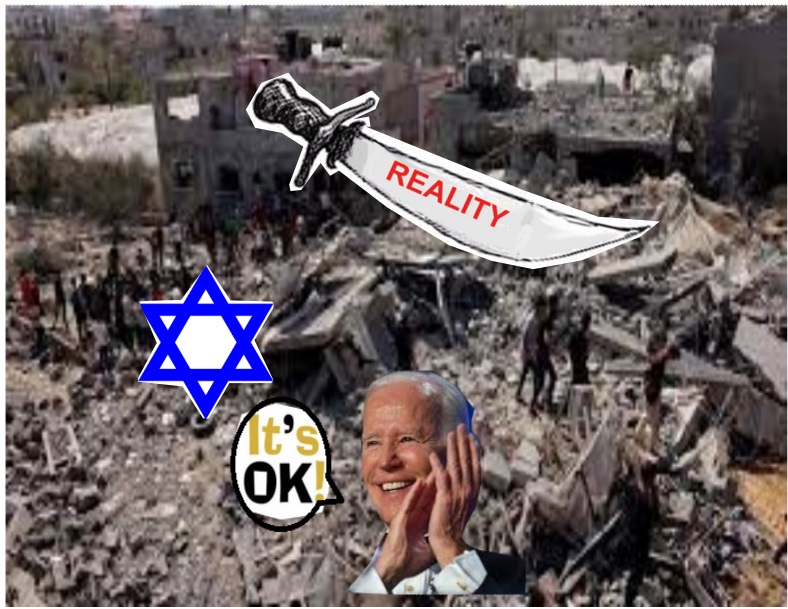
By cooperating with Israel in a new attack, the United States is assisting a state that has been responsible for most of the escalation and the vast majority of death and destruction in the Middle East for at least the past year.
Common Dreams, Paul Pillar. Oct 07, 2024, Responsible Statecraft
The Biden administration is not only endorsing but also on the verge of actively assisting a new Israeli armed attack on Iran. National security adviser Jake Sullivan says that the United States is working directly with Israel regarding such an attack. “The United States is fully, fully, fully supportive of Israel,” declares President Joe Biden.
The projected attack serves no U.S. interests. The attack perpetuates a broader pattern of escalating violence in the Middle East that also serves no U.S. interests. The Iranian missile salvo to which the coming Israeli attack is ostensible retaliation was itself retaliation for previous Israeli attacks. Retaliation for retaliation is a prescription for an unending cycle of violence.
The United States is facilitating an attack on a nation that does not want war and has been remarkably restrained in trying to avoid it, in the face of repeated Israeli provocations. A sustained Israeli bombing campaign against Iranian-related targets within Syria elicited a response only when it escalated to an attack on a diplomatic compound in Damascus, killing senior Iranian officials. Even then, the Iranian response, in the form of an earlier salvo of missiles and drones in April, was designed and telegraphed in a way to make a show of defiance but — with most of the projectiles certain to be shot down — to cause minimal damage and almost no casualties.
When Israel assassinated visiting Hamas political leader Ismail Haniyeh in a government guest house in Tehran in July — the sort of attack that would elicit a quick and forceful response by the U.S. or Israel if it happened in one of their capitals — Iran did nothing until last week. It finally acted only after yet another Israeli attack — this time an assault on residential buildings in a suburb of Beirut that killed a senior Iranian Revolutionary Guard officer along with Hezbollah secretary-general Hassan Nasrallah. Far from being motivated by any grandiose ambitions of regional dominance or desire to destabilize the region, Iranian leaders believed that they were getting killed by a thousand cuts from Israel and that they had to respond to the repeated Israeli attacks lest they lose the confidence not only of their own people but of regional allies. The missile firings that constituted Iran’s retaliation, like the ones in April, again caused minimal damage or casualties.
By cooperating with Israel in a new attack, the United States is assisting a state that has been responsible for most of the escalation and the vast majority of death and destruction in the Middle East for at least the past year. Although Hamas’ attack on southern Israel last October is commonly seen as the starting point of the subsequent mayhem in the Middle East, the question of who is responding to whom could go back farther than that. For example, the 1,200 deaths from that Hamas attack, horrible to be sure, were fewer than the number of Palestinians that Israel had killed in the occupied West Bank and the Gaza Strip just from the day-to-day operations of the occupying Israeli army, supplemented by settler violence in the West Bank, during the previous eight years.
Since the Hamas attack, the devastating Israeli operation in the Gaza Strip has gone far beyond anything that can be construed as defense, or even as a response to Hamas, and has brought suffering to innocent civilians that is orders of magnitude greater than anything Hamas or any other Palestinian group has ever done. The still-rising official death toll exceeds 41,000, with the actual number of Palestinian deaths probably much higher and likely into six figures. Much of the Strip has been reduced to rubble and rendered unlivable.
After Hezbollah fired rounds into Israel last October in a show of support for the Palestinians in Gaza, the story of conflict along the Israeli-Lebanese frontier has mainly been one of repeated Israeli escalations. Israeli attacks in Lebanon have far exceeded Hezbollah attacks on Israel, in number but especially in physical effects, with almost no casualties within Israel apart from a few military personnel at the border. The rapidly rising toll of deaths in Lebanon from Israeli attacks has now passed 2,000, with about 10,000 injured and about 1.2 million people displaced from their homes. As in the Gaza Strip, civilians constitute much and perhaps most of that toll, including as a result of Israeli airstrikes that have demolished residential buildings in densely populated neighborhoods.
As a growing Israeli ground assault in Lebanon accompanies the aerial bombardment, Israel has told people in almost the entire southern third of Lebanon to move north, even though Israel already has been conducting lethal aerial attacks throughout Lebanon, including as far north as Tripoli. This also is reminiscent of the pattern in Gaza, in which residents are told to move, only to be bombed again in their new location……………………………………………………………………………………………………………………………………..
Israel has already entrapped the United States to a large degree in its lethal ways in the Middle East, and the entrapment threatens to become deeper with the anticipated new attack on Iran. The entrapment would not have been possible without mismanagement of the U.S.-Israeli relationship on the Washington end. President Biden’s approach of holding Netanyahu close in the hope of influencing his policies has failed. It also has been counterproductive. In the absence of any willingness to employ the leverage that U.S. material aid to Israel represents, all the bear-hugging and expressions of support have only reassured Netanyahu that he can continue to prosecute his wars and ignore American calls for restraint without losing that aid.
It is refreshing to see reports that at least within the Department of Defense there is some recognition that the policy has been counterproductive by emboldening Israel to escalate. It is perhaps unsurprising that the department whose personnel would be on the front line of any expanded warfare involving the United States is more willing than others to recognize the nature and sources of the violence plaguing the Middle East and the need to deter or restrain Israel rather than embolden it. One can only hope that this willingness will spread more widely in policymaking circles. https://www.commondreams.org/opinion/biden-israel-war-with-iran?fbclid=IwY2xjawFyg3dleHRuA2FlbQIxMAABHRouKaR2ZR-gz5KkJIrj7Lz4yB_yy0cppu3rr4KzPnZL0PIvnbHrmshjLg_aem_SGLFnpWmqgyty62qiA5Trg
No comments yet.
1 This Month

of the week – Shut Down Drone Warfare!


Tell the Ukrainian Government to Drop Prosecution of Peace Activist Yurii Sheliazhenko

Petition to revoke the licensing of the Near Surface Nuclear Disposal Facility (NSDF) at Chalk River. https://www.ourcommons.ca/petitions/en/Petition/Details?Petition=e-7247
To see nuclear-related stories in greater depth and intensity – go to https://nuclearinformation.wordpress.com
-
Archives
- March 2026 (237)
- February 2026 (268)
- January 2026 (308)
- December 2025 (358)
- November 2025 (359)
- October 2025 (376)
- September 2025 (257)
- August 2025 (319)
- July 2025 (230)
- June 2025 (348)
- May 2025 (261)
- April 2025 (305)
-
Categories
- 1
- 1 NUCLEAR ISSUES
- business and costs
- climate change
- culture and arts
- ENERGY
- environment
- health
- history
- indigenous issues
- Legal
- marketing of nuclear
- media
- opposition to nuclear
- PERSONAL STORIES
- politics
- politics international
- Religion and ethics
- safety
- secrets,lies and civil liberties
- spinbuster
- technology
- Uranium
- wastes
- weapons and war
- Women
- 2 WORLD
- ACTION
- AFRICA
- Atrocities
- AUSTRALIA
- Christina's notes
- Christina's themes
- culture and arts
- Events
- Fuk 2022
- Fuk 2023
- Fukushima 2017
- Fukushima 2018
- fukushima 2019
- Fukushima 2020
- Fukushima 2021
- general
- global warming
- Humour (God we need it)
- Nuclear
- RARE EARTHS
- Reference
- resources – print
- Resources -audiovicual
- Weekly Newsletter
- World
- World Nuclear
- YouTube
-
RSS
Entries RSS
Comments RSS
 nuclear-news
Leave a comment