Unrealisable Justice: Julian Assange in Strasbourg
October 2, 2024, by: Dr Binoy Kampmark, https://theaimn.com/unrealisable-justice-julian-assange-in-strasbourg/
It was good to hear that voice again. A voice of provoking interest that pitter patters, feline across a parquet, followed by the usual devastating conclusion. Julian Assange’s last public address was made in the Ecuadorian Embassy in London. There, he was a guest vulnerable to the capricious wishes of changing governments. At Belmarsh Prison in London, he was rendered silent, his views conveyed through visitors, legal emissaries and his family.
The hearing in Strasbourg on October 1, organised by the Committee on Legal Affairs and Human Rights of the Parliamentary Assembly of the Council of Europe (PACE), arose from concerns raised in a report by Iceland’s Thórhildur Sunna Ævarsdóttir, in which she expressed the view that Assange’s case was “a classic example of ‘shooting the messenger’.” She found it “appalling that Mr Assange’s prosecution was portrayed as if it was supposed to bring justice to some unnamed victims the existence of whom has never been proven, whereas perpetrators of torture or arbitrary detention enjoy absolute impunity.”
His prosecution, Ævarsdóttir went onto explain, had been designed to obscure and deflect the revelations found in WikiLeaks’ disclosures, among them abundant evidence of war crimes committed by US and coalition forces in Iraq and Afghanistan, instances of torture and arbitrary detention in the infamous Guantánamo Bay camp facility, illegal rendition programs implicating member states of the Council of Europe and unlawful mass surveillance, among others.
A draft resolution was accordingly formulated, expressing, among other things, alarm at Assange’s treatment and disproportionate punishment “for engaging in activities that journalists perform on a daily basis” which made him, effectively, a political prisoner; the importance of holding state security and intelligence services accountable; the need to “urgently reform the 1917 Espionage Act” to include conditional maliciousness to cause harm to the security of the US or aid a foreign power and exclude its application to publishers, journalists and whistleblowers.
Assange’s full testimony began with reflection and foreboding: the stripping away of his self in incarceration, the search, as yet, for words to convey that experience, and the fate of various prisoners who died through hanging, murder and medical neglect. While filled with gratitude by the efforts made by PACE and the Legal Affairs and Human Rights Committee, not to mention innumerable parliamentarians, presidents, prime ministers, even the Pope, none of their interventions “should have been necessary.” But they proved invaluable, as “the legal protections that did exist, many existed only on paper or were not effective in any remotely reasonable time frame.”
The legal system facing Assange was described as encouraging an “unrealisable justice”. Choosing freedom instead of purgatorial process, he could not seek it, the plea deal with the US government effectively barring his filing of a case at the European Court of Human Rights or a freedom of information request. “I am not free today because the system worked,” he insisted. “I am free today because after years of incarceration because I plead guilty to journalism. I plead guilty to seeking information from a source. I plead guilty to informing the public what that information was. I did not plead guilty to anything else.”
When founded, WikiLeaks was intended to enlighten people about the workings of the world. “Having a map of where we are lets us understand where we might go.” Power can be held to account by those informed, justice sought where there is none. The organisation did not just expose assassinations, torture, rendition and mass surveillance, but “the policies, the agreements and the structures behind them.”
Since leaving Belmarsh prison, Assange rued the abstracting of truth. It seemed “less discernible”. Much ground had been “lost” in the interim; truth had been battered, “undermined, attacked, weakened and diminished. I see more impunity, more secrecy, more retaliation for telling the truth and more self–censorship
Much of the critique offered by Assange focused on the source of power behind any legal actions. Laws, in themselves, “are just pieces of paper and they can be reinterpreted for political expedience.” The ruling class dictates them and reinterprets or changes them depending on circumstances.
In his case, the security state “was powerful enough to push for a reinterpretation of the US constitution,” thereby denuding the expansive, “black and white” effect of the First Amendment. Mike Pompeo, when director of the Central Intelligence Agency, simply lent on Attorney General William Barr, himself a former CIA officer, to seek the publisher’s extradition and re-arrest of Chelsea Manning. Along the way, Pompeo directed the agency to draw up plans of abduction and assassination while targeting Assange’s European colleagues and his family.
The US Department of Justice, Assange could only reflect, cared little for moderating tonic of legalities – that was something to be postponed to a later date. “In the meantime, the deterrent effect that it seeks, the retributive actions that it seeks, have had their effect.” A “dangerous new global legal position” had been established as a result: “Only US citizens have free speech rights. Europeans and other nationalities do not have free speech rights.”
PACE had, before it, an opportunity to set norms, that “the freedom to speak and the freedom to publish the truth are not privileges enjoyed by a few but rights guaranteed to all”. “The criminalisation of newsgathering activities is a threat to investigative journalism everywhere. I was formally convicted, by a foreign power, for asking for, receiving, and publishing truthful information about that power while I was in Europe.”
A spectator, reader or listener might leave such an address deflated. But it is fitting that a man subjected to the labyrinthine, life-draining nature of several legal systems should be the one to exhort to a commitment: that all do their part to keep the light bright, “that the pursuit of truth will live on, and the voices of the many are not silenced by the interests of the few.”
Sorry, AI won’t “fix” climate change.
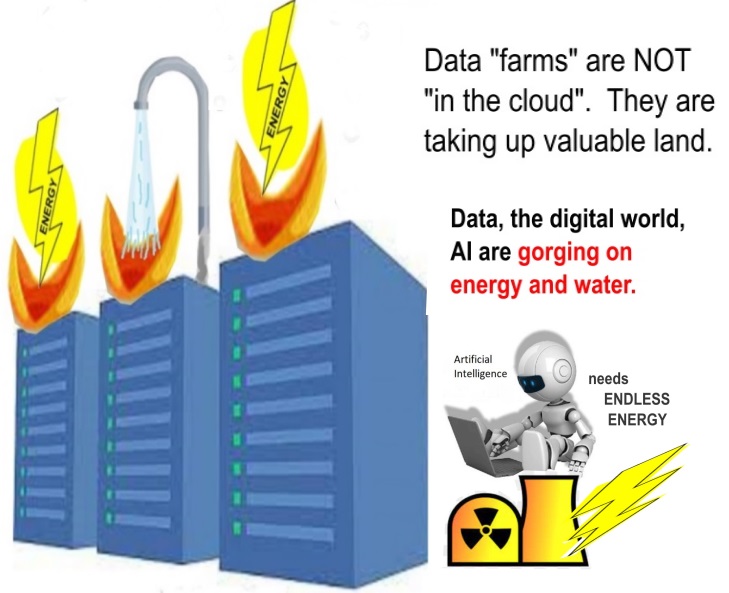
OpenAI’s Sam Altman claims AI will deliver an “Intelligence Age,” but tech breakthroughs alone can’t solve global warming.
James Temple, September 28, 2024,
https://www.technologyreview.com/2024/09/28/1104588/sorry-ai-wont-fix-climate-change/
In an essay last week, Sam Altman, the CEO of OpenAI, argued that the accelerating capabilities of AI will usher in an idyllic “Intelligence Age,” unleashing “unimaginable” prosperity and “astounding triumphs” like “fixing the climate.”
It’s a promise that no one is in a position to make—and one that, when it comes to the topic of climate change, fundamentally misunderstands the nature of the problem.
More maddening, the argument suggests that the technology’s massive consumption of electricity today doesn’t much matter, since it will allow us to generate abundant clean power in the future. That casually waves away growing concerns about a technology that’s already accelerating proposals for natural-gas plants and diverting major tech companies from their corporate climate targets.
By all accounts, AI’s energy demands will only continue to increase, even as the world scrambles to build larger, cleaner power systems to meet the increasing needs of EV charging, green hydrogen production, heat pumps, and other low-carbon technologies. Altman himself reportedly just met with White House officials to make the case for building absolutely massive AI data centers, which could require the equivalent of five dedicated nuclear reactors to run.
It’s a bedrock perspective of MIT Technology Review that technological advances can deliver real benefits and accelerate societal progress in meaningful ways. But for decades researchers and companies have oversold the potential of AI to deliver blockbuster medicines, achieve super intelligence, and free humanity from the need to work. To be fair, there have been significant advances, but nothing on the order of what’s been hyped.
Given that track record, I’d argue you need to develop a tool that does more than plagiarize journalism and help students cheat on homework before you can credibly assert that it will solve humanity’s thorniest problems, whether the target is rampant poverty or global warming.
To be sure, AI may help the world address the rising dangers of climate change. We have begun to see research groups and startups harness the technology to try to manage power grids more effectively, put out wildfires faster, and discover materials that could create cheaper, better batteries or solar panels.
All those advances are still relatively incremental. But let’s say AI does bring about an energy miracle. Perhaps its pattern-recognition prowess will deliver the key insight that finally cracks fusion—a technology that Altman is betting on heavily as an investor.
That would be fantastic. But technological advances are just the start—necessary but far from sufficient to eliminate the world’s climate emissions.
How do I know?
Because between nuclear fission plants, solar farms, wind turbines, and batteries, we already have every technology we need to clean up the power sector. This should be the low-hanging fruit of the energy transition. Yet in the largest economy on Earth, fossil fuels still generate 60% of the electricity. The fact that so much of our power still comes from coal, petroleum, and natural gas is a regulatory failure as much as a technological one.
“As long as we effectively subsidize fossil fuels by allowing them to use the atmosphere as a waste dump, we are not allowing clean energy to compete on a level playing field,” Zeke Hausfather, a climate scientist at the independent research organization Berkeley Earth, wrote on X in a response to Altman’s post. “We need policy changes, not just tech breakthroughs, to meet our climate goals.”
That’s not to say there aren’t big technical problems we still need to solve. Just look at the continuing struggles to develop clean, cost-competitive ways of fertilizing crops or flying planes. But the fundamental challenges of climate change are sunk costs, development obstacles, and inertia.
We’ve built and paid for a global economy that spews out planet-warming gases, investing trillions of dollars in power plants, steel mills, factories, jets, boilers, water heaters, stoves, and SUVs that run on fossil fuels. And few people or companies will happily write off those investments so long as those products and plants still work. AI can’t remedy all that just by generating better ideas.
To raze and replace the machinery of every industry around the world at the speed now required, we will need increasingly aggressive climate policies that incentivize or force everyone to switch to cleaner plants, products, and practices.
But with every proposal for a stricter law or some big new wind or solar farm, forces will push back, because the plan will hit someone’s wallet, block someone’s views, or threaten the areas or traditions someone cherishes. Climate change is an infrastructure problem, and building infrastructure is a messy human endeavor.
Tech advances can ease some of these issues. Cheaper, better alternatives to legacy industries make hard choices more politically palatable. But there are no improvements to AI algorithms or underlying data sets that solve the challenge of NIMBYism, the conflict between human interests, or the desire to breathe the fresh air in an unsullied wilderness.
To assert that a single technology—that just happens to be the one your company develops—can miraculously untangle these intractable conflicts of human society is at best self-serving, if not a little naïve. And it’s a troubling idea to proclaim at a point when the growth of that very technology is threatening to undermine the meager progress the world has begun to make on climate change.
As it is, the one thing we can state confidently about generative AI is that it’s making the hardest problem we’ve ever had to solve that much harder to solve.
‘Western Press Obscured the Sheer Terror of What Israel Had Carried Out’: CounterSpin interview with Mohamad Bazzi on Lebanon pager attacks

So this was an entirely indiscriminate attack, and it puts the Western media fascination with Israel’s technological prowess into even sharper focus. We had the Western press marveling at—I’ll just quote a few of the terms—“Israel’s prowess,” “precision,” “James Bond“–type operation. And quite a few other terms that obscured the sheer terror of what Israel had carried out over those two days in Lebanon.
Janine Jackson interviewed NYU’s Mohamad Bazzi about Israel’s terror attacks in Lebanon for the September 27, 2024, episode of CounterSpin. This is a lightly edited transcript.
Janine Jackson: Speaking of Israel’s remote detonation of thousands of pagers and walkie-talkies of suspected Hezbollah members in Lebanon, former CIA director and defense secretary Leon Panetta told CBS, ”I don’t think there is any question that it’s a form of terrorism.”
Panetta’s remarks were widely reported, mostly straight, but for Fox, where Sean Hannity said Panetta “had the gall to say Israel is engaging in terrorism against the terror group Hezbollah.”
It seems worth noting: Just before Panetta, CBS viewers heard from a former FBI analyst who said of the explosions in stores, cars and homes that killed some 39 people and injured more than 3,000, including children:
Tactically, what Israel has done has been brilliant. They have severely degraded Hezbollah’s capabilities. They’ve severely degraded Hezbollah’s ability to respond to Israeli things. They’re really hoping that, strategically, Hezbollah gets the message: Stop firing rockets into our country.
That “tactic” has led to more death, more destruction and, some say, more chance of a still wider, more devastating war.
Joining us now to talk about unfolding events and US media’s depictions is Mohamad Bazzi. He’s director of the Hagop Kevorkian Center for Near Eastern Studies and journalism professor at New York University, as well as former Middle East bureau chief at Newsday. He joins us now by phone from here in town. Welcome to CounterSpin, Mohamad Bazzi.
Mohamad Bazzi: Thank you for having me.
JJ: CBS segued from the “brilliant tactic” guy to Leon Panetta by saying that some saw Israel’s action as a “deception one step too far. The United Nations labeled the operation a violation of international law, and it’s raised some eyebrows here at home too.” It’s equally hard to imagine that this wasn’t a violation as that it wouldn’t immediately be condemned as such, had anyone else carried it out, would you say?
MB: That’s an excellent point. It would certainly have been condemned, let’s say, if Russia had carried out a similar operation, or even something a fraction of this kind of attack, in Ukraine.
I think one of the things that struck me, and I suspect it struck you and others who watch the Western media, is the sense of marvel over the ingenuity of Israel’s technological prowess. So what we had is a lot of the coverage framed as, “Oh, this is taking a page out of a spy thriller, or a dystopian movie.”
And in some ways, what unfolded in Lebanon last week was something dystopian, but it wasn’t a movie. It affected real people’s lives. And so many in the Western media were fixating on the novelty of Israel’s attack, and sometimes celebrating it, but they neglected to acknowledge or even consider the sheer terror experienced by tens of thousands of Lebanese civilians. And this is a society that suffered through years and years of trauma, and this was the latest attack that unfolded in this incredibly pernicious way.
A lot of the coverage also didn’t get into the question of whether this constituted a war crime. And, on the face of it, it seems to meet the definition of a war crime: Human Rights Watch, a few other rights organizations, issued statements noting that international humanitarian law forbids the use of booby traps, especially with objects that have such important use for civilians. I think it would fit the definition of a war crime, beyond just being an act of terrorism that’s meant to instill terror in a civilian population.
JJ: Hezbollah, like Hamas, is for many US media consumers almost like a sports team, or like a kaiju, a monster like Godzilla. And I think it might sound strange to some to think that they aren’t solely a military force in Lebanon, but in fact have a much broader role.
MB: Yeah, a lot of media consumers and listeners in the US don’t get the context. They don’t get the background that Hezbollah is not only a militia, it is not only the militia that’s labeled a terrorist group by the US and by many countries in the EU, but it’s also the most dominant military force in Lebanon, and it’s also the most powerful political party and political movement in the country.
So Hezbollah runs an extensive social service network. It operates schools and hospitals and supermarkets and credit unions.
…………………………..It’s the act of terror. It’s the imprecise nature, this deliberate setting off of detonations of thousands of small bombs that went off at the same time on a Tuesday afternoon, as people were going about their daily lives. And so the bombs went off in grocery stores and hospitals and sidewalk cafes and barbershops. The next day, on Wednesday, some of the walkie-talkie explosions went off during the funerals of people who had been killed the day before during the pager explosions.
So this was an entirely indiscriminate attack, and it puts the Western media fascination with Israel’s technological prowess into even sharper focus. We had the Western press marveling at—I’ll just quote a few of the terms—“Israel’s prowess,” “precision,” “James Bond“–type operation. And quite a few other terms that obscured the sheer terror of what Israel had carried out over those two days in Lebanon……………………………………………………………………………………………………………………………………….

JJ: There are calls now for Secretary of State Anthony Blinken, to resign after it’s been reported, I believe by ProPublica, that he was in receipt of assessments, from both USAID and the State Department’s Refugees Bureau, that Israel had blocked deliveries of humanitarian aid to Gaza. He had that information, Blinken did, when he went before Congress, and said there was no evidence of that.
Short even of his resignation, though, how many times do US officials need to lie or hide or dissimulate before journalists stop quoting them credulously? Isn’t it just insulting to readers and to the public at some point?
MB: We certainly have many decades of this, going back to Vietnam, of course, US officials lying about war and lying about US support for allies who commit atrocities.
The report from ProPublica has been an exception. It’s an excellent report. It just came out in the last couple of days, based on internal leaks, because there are officials in the State Department, and elsewhere in the Biden administration, that find all of this unconscionable, and don’t want to see this continued support.
And it’s a very important leak, not just because of what it tells us about Blinken and others in the administration, and their ability and willingness to lie to the US public and to lie to the US media, but it also shows us that there’s actually a fairly straightforward path for the Biden administration to stop its weapons transfers to Israel, because those weapons transfers violate US laws. And if they were honest, and they had admitted it, they would’ve had to stop sending weapons, because that’s what US law requires. It’s what the Biden administration’s own guidelines require.
So that was a tremendously important leak by ProPublica. And, unfortunately, I’ve seen some references to it in the past few days, but it’s not getting the widespread attention in the corporate media and in the legacy media that it should be getting.
It’s certainly getting a lot of attention on social media. People are sharing it, and sharing the documents, and it’s creating these calls for Blinken to resign, or for Biden to do something. But it’s certainly troubling to see the legacy media ignore this as well.
And it all raises the question, what more do you want? What more can be presented to the media for it to change its approach to covering this war?
…………………MB: I would certainly like to see more humane coverage. It’s a basic ask, and it’s unfortunate that we have to make this ask, but I would like to see more humane coverage of Palestinians, of Lebanese, of other Arabs and Muslims.
I think one of the things we’ve seen, just in this past week, in the way that the pager explosions and the walkie-talkie explosions were covered—this marveling over Israel’s ingenuity, it ignores the reality on the ground, but it also contributes to the dehumanization of Palestinians and Lebanese and Arabs, this widespread dehumanization that we’ve seen, certainly for decades, but we’ve seen it ramp up to an extreme since Israel launched its war on Gaza. …..more https://fair.org/home/western-press-obscured-the-sheer-terror-of-what-israel-had-carried-out/
Nuclear Annihilation Threatened by Revival of 20th Century McCarthy Era Cold War & Red Scare
Alice Slater, Wednesday, October 02, 2024, Inter Press Service, https://www.globalissues.org/news/2024/10/02/37850
– The world may have dodged an immediate bullet when the US intelligence agencies warned, this week, that by giving in to Ukraine’s pleading for long range missiles that could attack targets deep into Russia, we would be poking the Russian bear beyond its patience without even influencing the outcome of the war in Ukraine’s favor.
There had been a sense of waiting with bated breath in the wake of Russia’s President Vladimir Putin recent announcement that he would lower the threshold for Russia’s use of nuclear weapons, as the US and its NATO allies broadcasted their plans to ignore a repeated “red line” articulated by US President Biden not to provide arms to Ukraine which could be launched deep inside Russia.
Britain is playing its usual provocative role by sending clear messages that it would welcome US approval to let Ukraine use its “Storm Shadow” long-range missiles. We just got a short breather, in light of this recently issued public US intelligence evaluation.
Despite repeated requests to the US from Russian President Vladmir Putin to honor US promises made to Gorbachev and Yeltsin that the US would not expand NATO east of a unified Germany, when the wall came down and Gorbachev ended the Warsaw Pact and Soviet occupation of Eastern Europe without a shot, the US, driven by visions of Empire, steadily expanded NATO eastward.
It began with Clinton’s annexation of Poland, Hungary and the Czech Republic in 1999, followed by Bulgaria, Estonia, Latvia, Lithuania, Romania, Slovakia and Slovenia in 2004, and Albania, Croatia, Montenegro and North Macedonia between 2009 and 2017. At one point Putin was so dismayed at this expansion, he asked the Clinton administration if Russia could join NATO, but he was denied membership.
Putin made it very clear to the US and NATO that Russia, which shares a long border with Ukraine, would not tolerate Ukraine becoming a member of NATO. After the US supported a 2014 coup d’état replacing the pro-Russian president of Ukraine, Viktor Yanukovych, with Petro Poroshenko who immediately announced that only the Ukrainian language would be recognized in Ukraine, a civil war broke out in the Eastern part of the country where the majority of the people were Russian and Russian speaking. More than 14,000 people were killed in that war before Russia invaded Ukraine.
Putin provided a draft agreement in 2021 to the US proposing that Ukraine remain neutral and that the Donbass region, undergoing the civil war, remain in Ukraine as a federation and have the right to speak Russian. The US completely ignored the proposal and Putin invaded Ukraine in February 2022.
Putin was negotiating for a ceasefire with Yeltsin six months after the invasion, but Boris Johnson, the British Prime Minister came to Ukraine and told Zelensky not to make the deal! And the slaughter continues, with more than 20,000 civilians and 100,000 soldiers killed.
Thanks to the brief respite we just received from imminent nuclear annihilation, thanks to the sensible US intelligence services who took Putin’s recent warnings as a reason for caution in pursuing a headlong and heedless expansion of military aid to Ukraine, it is time to change the conversation with bold new proposals.
Proposals that are guaranteed to bring us a respite from the growing terror. Proposals that will bring a shift in planetary consciousness allowing us to respond cooperatively to the impending cataclysmic climate disaster down the road! Mother Earth grows impatient with the folly of humankind.
Here are a series of steps that are guaranteed to bring us peace on earth if the US is ready to mobilize against the MICIMATT (Military Industrial, Congressional Intelligence, Media, Academic, Think Tank complex) and work for peace!
- Take up repeated Russian and Chinese proposals in the UN and in frequent speeches for a treaty to ban weapons in space
- Take up repeated Russian and Chinese proposals in the UN to negotiate a cyberwar ban treaty
- Reinstate the 1972 Anti-Ballistic Missile Treaty with Russia and get US missiles placed by Obama and Trump out of Poland and Romania
- Remove US nuclear weapons stationed in five NATO states: Turkey, Germany, Italy, the Netherlands, Belgium as a deal for Russia removing its recently placed weapons from Belarus
- Take all nuclear weapons off high alert and separate the warheads from their delivery system as China does–the wisdom of the East
- Dismantle NATO and pull it back from Russia’s border immediately
The ball, as they say, is in the US court. Or as Pogo Possum, a character in Walt Kelly’s 1950s comic strip was known to say, “We met the enemy and he is us!”
There is no doubt that Russia and China would be willing partners in these new initiatives. They have been proposing them to the United States for more than ten years!!
Alice Slater serves on the Boards of World BEYOND War and the Global Network Against Weapons and Nuclear Power in Space, and as an UN NGO representative for the Nuclear Age Peace Foundation.
IPS UN Bureau
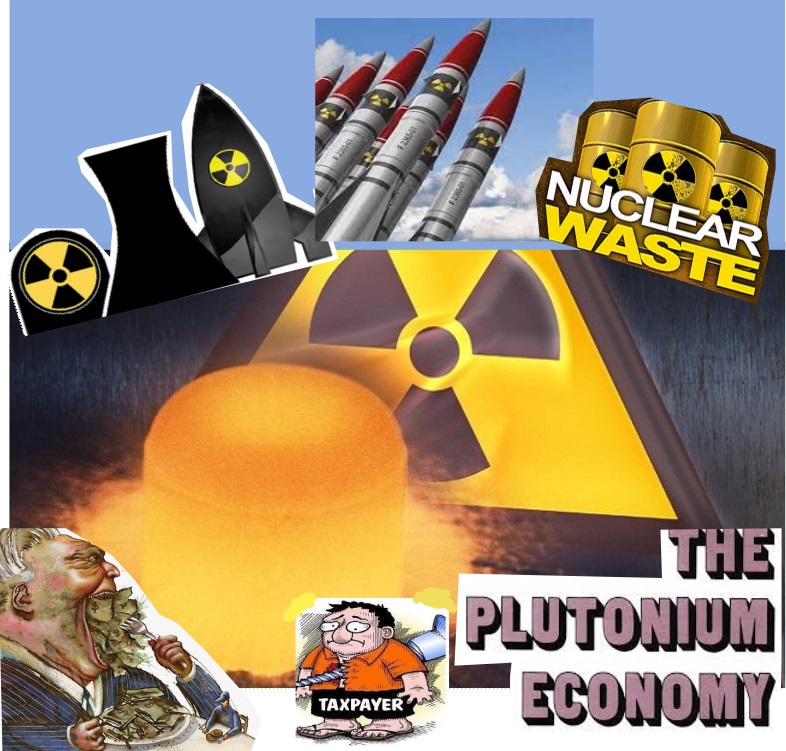
Plutonium vs Democracy: A Necessary Debate
by Gordon Edwards and Susan O’Donnell submitted to the CNSC on September 30 2024
www.ccnr.org/CCNR_CNSC_Plutonium_Paper_Sept_30_2024.pdf
The following appeal was inserted into the document:
An Appeal for Public Consultation
There is a growing pressure on the government of Canada to allow the civilian use of plutonium as a commercial reactor fuel. Such a move requires extracting plutonium from used nuclear fuel, thereby making it accessible. Once accessible, plutonium can be used as a nuclear fuel or as a nuclear explosive. Even a crude explosive device using plutonium is capable of causing enormous destruction and killing thousands.
The security measures needed to safeguard society from the threat of nuclear terrorism when plutonium becomes an article of commerce are so severe that our democratic way of life will be seriously threatened. Enforced secrecy, intrusive surveillance, and privately maintained security forces equipped with military-style weapons, are not what Canadians have come to expect from their energy suppliers.
In the last two decades, Canada has seen the wisdom of eliminating weapons-usable uranium entirely from civilian use, thereby obviating the need for extreme security measures otherwise needed to keep that material out of the hands of criminals and terrorists. In the same way, keeping plutonium out of circulation is the best way to prevent the further growth of a powerful nuclear security regime that is becoming increasingly militarized, with access to prohibited weapons under Bill C-21.
We urge CNSC to advise Parliament that there is a need in Canada for a broad public consultation or debate on the social desirability of moving toward the civilian use of plutonium in Canada or choosing to avoid that option altogether. As in the case with highly enriched uranium, we believe that there is no demonstrable need for plutonium with or without an expanded nuclear industry. Given the stakes, it is up to the people of Canada to decide the issue by democratic means. That requires a mechanism of consultation that goes far beyond public hearings.
Rumina Velshi, a past president of CNSC, has said ““Reprocessing is going to be a huge, huge deal for this country. We need to be clear: If this is not an area that this country is interested in pursuing, put a stop to it. And if there is a possibility, then let’s at least start that conversation”
As an Agency whose legal mandate is to serve the public interest rather than the interests of the industry, we urge the CNSC to speak out publicly on this important matter so that Canadians are not blindly led into a future that they may live to regret.
Gordon Edwards and Susan O’Donnell, September 30 2024.
The Israeli Government Must Be Stopped

By David Swanson, World BEYOND War, October 1, 2024, https://worldbeyondwar.org/the-israeli-government-must-be-stopped/
David Swanson is Executive Director of World BEYOND War.
The Israeli government has been dragging Western weapons and militaries into wars for far too long, putting all of the world — and its global institutions — at risk. The move into Lebanon, creating more dead, injured, traumatized, and homeless already in huge numbers ought to snap some war supporters out of their trance.
The danger of a catastrophic war on Iran that is joined by the United States and NATO on one side, and additional nations on the other, looms horrifically on the horizon.
It is high time for the world’s governments, including that of Israel’s top supplier, the United States, to begin complying with the International Court of Justice, the United Nations General Assembly, and each of the treaties and domestic laws violated by each arms shipment.
While the UK and Canada have stopped some weapons, that is far from sufficient. While a handful of U.S. Senators anti-democratically plan a vote weeks from now after a U.S. election, on halting illegal arms shipments to Israel, that is far from sufficient, and yet more than we see in the U.S. House of so-called representatives.
Western governments have emboldened the Israeli government with weapons supplies for so long that Israel understands there are no limits. There is nothing it can do that anyone could reasonably expect the U.S. and allied governments not to support, not to protect with propaganda assistance, Security Council vetoes, and yet more instruments of mass killing. That has to change.
Public pressure in the West has prevented western governments from going to war with Iran for decades. But Israel is now expanding an existing war in an effort to create a wider war without any debate or decision. Western media is already using the passive language of “being dragged into” a war — as if no decision need be made at all. This could not be more dangerous, more dishonest, more opposed to the supposed ideal of democracy.
The good people who have raised their voices and taken nonviolent action against the genocide in Gaza for a year and more, and those who have been silent, must all rise up together now and declare that nothing permits wider war, nothing justifies these outrages, no election season puts a pause on our moral duty to protect all life.
Ukrainian energy minister censured over response to power grid attacks
Ahead of Ukraine’s third and most testing winter of the war, criticism
is mounting over the government’s slow response to Russia’s attacks on
the energy grid and its priorities when rebuilding.
Energy minister German
Galushchenko has come under fire for delaying by two years efforts to
decentralise power generation so it is less vulnerable to Russian attacks.
The energy ministry started taking steps towards building smaller power
stations only this summer, with the government announcing cheap loans to
attract investors in these projects. But critics say those efforts should
have started in 2022 soon after Russia’s full-scale invasion when Moscow
homed in on Ukraine’s energy grid and that hundreds of smaller
gas-powered stations or renewable energy projects could have been built in
this period.
“The energy ministry is not interested in decentralisation.
Rather, they are interested in centralisation, they want as much of energy
sector, particularly generation, under their state companies,” said an
energy official.
Galushchenko, say experts and officials, has instead
lobbied for the construction of large and costly nuclear reactors, which
take between seven to 10 years to build. Before becoming minister in 2021,
Galushchenko was vice-president of the state nuclear company, Energoatom.
FT 30th Sept 2024. https://www.ft.com/content/69b56215-c373-45a6-b52e-c1ab403565d5
“Drop Out of Nuclear Dump Plan” Message to Nuclear Waste Services “Drop In”
By mariannewildart, https://mariannewildart.wordpress.com/2024/09/30/drop-out-of-nuclear-dump-plan-message-to-nuclear-waste-services-drop-in/—
“Drop Out of Nuclear Dump Plan” was the message from campaigners at the Nuclear Waste Services “Drop In” at the Beacon Portal, Whitehaven on Saturday 28th September.
The Plan
Should Nuclear Waste Services plan in Cumbria be taken to conclusion a giant mine as deep as Scafell is high at 1000m and larger than the City of Westminster at 25km square would be excavated under the Irish Sea in order to bury the UK’s high level nuclear wastes in the hope that it would stay buried. The above ground area of a Geological Disposal Faciity (GDF) at 1km square, would be nearly as big as Hyde Park in London and would sit alongside the National Park boundary on the Lake DIstrict coast. Lakes Against Nuclear Dump (LAND) a Radiation Free Lakeland campaign chatted with members of the public on Saturday outside Nuclear Waste Services event. LAND were thanked by members of the public for showing resistance to the plan for a deep nuclear dump or Geologicial Disposal Facility under the Lake District’s coast.
Irish Sea Geology a Giant Heat Sink?
Lakes Against Nuclear Dump LAND campaigner Marianne Birkby said “no other industry would have the sheer brass neck to plan to use the geology of the supposedly protected Irish Sea as a gigantic heat sink for their ever increasing wastes. No other industry produces heat generating nuclear wastes . The reason the infamous leaks at the once state of the art Magnox silos at Sellafield are impossible to find and stop is precisely because the silos are buried 6 metres underground.” Campaigners asked how long it would take the heat from buried high level nuclear wastes to reach the Irish Sea bed. Nuclear Waste Services staff replied that they would “find out” It is clear that alongside the radiological impacts the industry cannot point to any research on the short or long term impacts of thermal heating of the deep geology and ocean specifically of the Irish Sea from a Geological Disposal Facility.
Earthquakes and Plutonium
Campaigners asked about the earthquake risks of deep mining so close to the plutonium stockpiles at Sellafield and were told that “the government is working on a plan for the plutonium so it won’t be a problem at the time mining begins”. LAND Campaigners say that the Nuclear Decommissioning Authority’s “preferred” option is to use plutonium as MOX fuel . MOX (mixed oxide) fuel contains a tiny amount of plutonium blended with uranium.
The net result is the production of ever more plutonium for “reuse as fuel in reactors followed by disposal (of unusable plutonium) in a GDF.” Much more land would be required for MOX fabrication facilities. The NDA say “The policy position recognises that not all the inventory could be reused; therefore, any strategy will also require the development of approaches to immobilise plutonium for storage pending disposal.” Nuclear Waste Services assurance to the public at the “drop in” that the plutonium problem “will not exist when mining begins” is clearly at odds with reality. LAND say “burning MOX fuel would increase the nuclear sprawl at Sellafield and would increase, not decrease the plutonium stockpiles. Instead of reducing the “exceptional circumstances” of a severe accident at Sellafield the nuclear industry and government seem hell bent on increasing the likelihood of severe accident with proposing earthquake inducing mining to bury high level nuclear wastes while at the same time proposing increasing the plutonium mess at Sellafield.”
Orange Harbour a Visual Reminder of Fragile Area
The continuing acid mine pollution pouring into Whitehaven Harbour for two years with no end in sight is a terrible visual reminder that deep mining in this fragile area of West Cumbria should be banned and that is say campaigners without the area containing the world’s largest stockpiles of plutonium.
Most Dangerous Experiment Since Splitting the Atom
Lakes Against Nuclear Dump say The potential disastrous impacts of the plan could be on planetary scale but a future “test of public support” is limited to those who are now benefitting from £millions for every year the manufactured “Community Partnership” with Nuclear Waste Services continues along the “Journey to GDF” aka Nuclear Dump Under the Lake District Coast
References:…………………………………………….
Sullivan: US Will Ensure Iran Faces ‘Severe Consequences’ for Attacking Israel

October 2, 2024 , By Dave DeCamp / Antiwar.com
US National Security Advisor Jake Sullivan said on Tuesday that the US would work with Israel to ensure Iran faces “severe consequences” for launching a missile attack on Israel, which came in response to recent Israeli escalations.
“There will be severe consequences for this attack, and we will work with Israel to make that the case,” Sullivan told reporters at the White House.
President Biden said the US was in “active discussions” with Israel on what the response would be. “The United States is fully, fully, fully supportive of Israel,” he said.
Media reports say Iran fired at least 180 missiles at Israel. Iran’s Islamic Revolutionary Guard Corps (IRGC) said the attack was launched in retaliation for the Israeli assassination of Hamas political chief Ismail Haniyeh in Tehran, the killing of Hezbollah Secretary-General Hassan Nasrallah, and Abbas Nilforoushan, an IRGC commander who was killed alongside Nasrallah.
The IRCG has claimed that 90% of the missiles hit their targets, while Israel claimed most were intercepted. Videos have surfaced that show Iranian missiles making an impact on Israeli military sites. So far, there’s been no word on Israeli deaths, but a Palestinian in the Israeli-occupied West Bank was killed when shrapnel from an intercepted missile fell on Jericho.
The US said that it helped Israel intercept some of the Iranian missiles and portrayed the defense as a success. Sullivan said the Iranian attack “appears to have been defeated and ineffective.”
…………………………………………Iran has signaled that it’s done attacking Israel but warned there would be a “crushing response” if Israel hits back. Israeli officials have made clear that they plan to respond.
“There will be consequences,” said Israeli military spokesman Daniel Hagari. “Our defensive and offensive capabilities are at the highest levels of readiness. Our operational plans are ready. We will respond wherever, whenever, and however we choose, in accordance with the directive of the government of Israel.”
Israeli Prime Minister Benjamin Netanyahu said Iran will “pay” for the attack. “This evening, Iran made a big mistake — and it will pay for it,” he said at a security cabinet meeting. “The regime in Tehran does not understand our determination to defend ourselves and to exact a price from our enemies.” https://scheerpost.com/2024/10/02/sullivan-us-will-ensure-iran-faces-severe-consequences-for-attacking-israel/
1 This Month


18 March Webinar @ 1 PM EST: An Assessment of SMR Projects: The Case of Canada
register for the zoom:
https://us02web.zoom.us/webinar/register/WN_o8BIIOUvQ2ONJR1nta65DQ#/registration


of the week – STOP SMALL MODULAR REACTORS IN CANADA
To see nuclear-related stories in greater depth and intensity – go to https://nuclearinformation.wordpress.com
-
Archives
- March 2026 (138)
- February 2026 (268)
- January 2026 (308)
- December 2025 (358)
- November 2025 (359)
- October 2025 (376)
- September 2025 (258)
- August 2025 (319)
- July 2025 (230)
- June 2025 (348)
- May 2025 (261)
- April 2025 (305)
-
Categories
- 1
- 1 NUCLEAR ISSUES
- business and costs
- climate change
- culture and arts
- ENERGY
- environment
- health
- history
- indigenous issues
- Legal
- marketing of nuclear
- media
- opposition to nuclear
- PERSONAL STORIES
- politics
- politics international
- Religion and ethics
- safety
- secrets,lies and civil liberties
- spinbuster
- technology
- Uranium
- wastes
- weapons and war
- Women
- 2 WORLD
- ACTION
- AFRICA
- Atrocities
- AUSTRALIA
- Christina's notes
- Christina's themes
- culture and arts
- Events
- Fuk 2022
- Fuk 2023
- Fukushima 2017
- Fukushima 2018
- fukushima 2019
- Fukushima 2020
- Fukushima 2021
- general
- global warming
- Humour (God we need it)
- Nuclear
- RARE EARTHS
- Reference
- resources – print
- Resources -audiovicual
- Weekly Newsletter
- World
- World Nuclear
- YouTube
-
RSS
Entries RSS
Comments RSS
 nuclear-news