Russia’s Nuclear Doctrine Change Is More Cautious Than It May Appear
What’s new in the proposed update is the suggestion that a non-nuclear state could be the primary aggressor without being formally allied with a nuclear-armed state. ……………….
This shift in the doctrine seems to be crafted with the current geopolitical situation in mind, particularly Russia’s framing of the Ukraine conflict and its relationship with the United States and its allies.….
Long-Range Strikes May Not Be a Silver Bullet…………
By Maxim Trudolyubov on September 27, 2024, https://www.wilsoncenter.org/blog-post/russias-nuclear-doctrine-change-more-cautious-it-may-appear
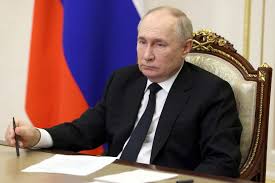
In a recent discussion on Russia’s nuclear doctrine, President Vladimir Putin announced an expansion of the categories of states and military alliances that would fall under Russia’s nuclear deterrence policy. “Aggression against Russia by any non-nuclear state, with the participation or support of a nuclear state, will be treated as a joint attack on the Russian Federation,” Putin stated during the public segment of a recent meeting of Russia’s Security Council.
While the official document, titled “Basic Principles of State Policy of the Russian Federation on Nuclear Deterrence,” has yet to be updated, experts suggest that the timing of this announcement serves as a clear warning to Ukraine. Currently, Ukraine is seeking approval from the United States to use Western long-range missiles against targets deeper within Russian territory.
Putin’s wording is explicit: the “non-nuclear state” in question is Ukraine, while the “nuclear state” providing support or participating in an attack is primarily the United States, though this could also extend to the United Kingdom and France.
U.S. officials believe such strikes could lead to a significant escalation, potentially drawing NATO into direct confrontation with Russia. Moscow has consistently warned Western countries that any attacks on its territory would be seen as acts of war. This cautious stance by the United States has led to public frustration among some American allies in Europe.
Both France and Britain have indicated a willingness to approve such strikes for Ukraine, but they are waiting for Washington’s decision as a benchmark. The UK and France produce and supply their own missiles, but they use guiding technology developed by the United States. “It would be really good to stop the delays. And I think that the restrictions on the use of weapons should be lifted,” said Mette Frederiksen, prime minister of Denmark, in an interview with Bloomberg.
What the New Language Actually Means
Pavel Podvig, a senior researcher on weapons of mass destruction at the United Nations Institute for Disarmament Research, notes that Russia’s current nuclear doctrine does not clearly distinguish between aggression from nuclear-armed and non-nuclear states. Instead, any aggression that “threatens the existence of the state” could potentially provoke a nuclear response.
At first glance, the proposed change does not sound like a tectonic shift. Since 1995, Russia has pledged not to use nuclear weapons against non-nuclear-armed states unless they act “in association or alliance with a nuclear-weapon state.” The Russian authorities at the time operated on an assumption that any such situation would involve a nuclear-armed state as the primary aggressor, with non-nuclear states in a supporting role.
What’s new in the proposed update is the suggestion that a non-nuclear state could be the primary aggressor without being formally allied with a nuclear-armed state. The language implies that a non-nuclear state’s aggression could be seen as part of a broader campaign involving a nuclear-armed state, thereby justifying a nuclear response. This shift in the doctrine seems to be crafted with the current geopolitical situation in mind, particularly Russia’s framing of the Ukraine conflict and its relationship with the United States and its allies.
“The new language suggests that a non-nuclear weapon state might be an aggressor,” Podvig says. “Apparently, the idea behind the change is to say that this ‘association’ would make the nuclear weapons state that provides this support an aggressor too. It’s the ‘joint attack’ language.”
During the Security Council meeting Putin also said that Russia could resort to nuclear weapons on receiving “reliable information” indicating a large-scale aerial attack involving aircraft, missiles, and drones. Additionally, Moscow would treat an attack on its ally Belarus as an attack on Russia itself, potentially responding with nuclear force to defend Belarus.
On closer examination, Putin’s remarks reflect a more cautious approach than may initially seem. While the rhetoric implies a potential broadening of scenarios in which Russia might consider nuclear deterrence, it does not represent a fundamental departure from the country’s long-standing policies. However, the language remains vague: it fails to define what constitutes an “association” or clarify precisely against whom a nuclear strike might be directed.
Long-Range Strikes May Not Be a Silver Bullet
There are doubts within the policy and expert communities about whether long-range strikes on Russian territory would be a decisive factor in the war. To achieve a significant breakthrough, Ukraine would need to coordinate large-scale ground maneuvers in tandem with these strikes—something its forces have yet to demonstrate. “In its summer 2023 offensive, the Ukrainian military showed no ability to coordinate forces on anything like the scale needed for a decisive breakthrough. Longer-range weapons would make this coordination even more complicated,” writes Stephen Biddle, professor of international and public affairs at Columbia University, in a piece for Foreign Affairs.
Biddle highlights the limitations and challenges of deep strikes in the current context. Such strikes are costly and require precision guidance, which can quickly lose effectiveness as the opposing side adapts.
The historical record on longer-range strikes is not encouraging, notes Biddle. Historically, even large-scale strategic bombing campaigns, including strikes aimed at German and Japanese cities during World War II and North-Korean cities during the Korean War, have not succeeded in breaking the resolve of the targeted country. Additionally, the military benefits of diverting Russian efforts into air defense or disrupting weapons production would require an extensive, sustained campaign that Ukraine is not currently equipped to carry out.
All Eyes on U.S. Voters
The wait for a decision on allowing Ukraine to carry out long-range strikes on Russian territory is closely tied to the outcome of the U.S. presidential election. The two candidates have contrasting views on the Russo-Ukrainian war, which makes the future U.S. stance uncertain. One candidate may push for greater support for Ukraine, potentially approving the use of advanced Western missiles for strikes deeper into Russia, while the other could advocate a more cautious approach, prioritizing de-escalation or negotiations.
This political uncertainty leaves European allies, Ukrainian policymakers, and even Moscow in a holding pattern. For now, decision-makers are watching the United States closely, understanding that the future of support for Ukraine’s military capabilities—and the overall direction of the war—will largely hinge on the results of the upcoming election.
No comments yet.
1 This Month


18 March Webinar @ 1 PM EST: An Assessment of SMR Projects: The Case of Canada
register for the zoom:
https://us02web.zoom.us/webinar/register/WN_o8BIIOUvQ2ONJR1nta65DQ#/registration


of the week – STOP SMALL MODULAR REACTORS IN CANADA
To see nuclear-related stories in greater depth and intensity – go to https://nuclearinformation.wordpress.com
-
Archives
- March 2026 (141)
- February 2026 (268)
- January 2026 (308)
- December 2025 (358)
- November 2025 (359)
- October 2025 (376)
- September 2025 (258)
- August 2025 (319)
- July 2025 (230)
- June 2025 (348)
- May 2025 (261)
- April 2025 (305)
-
Categories
- 1
- 1 NUCLEAR ISSUES
- business and costs
- climate change
- culture and arts
- ENERGY
- environment
- health
- history
- indigenous issues
- Legal
- marketing of nuclear
- media
- opposition to nuclear
- PERSONAL STORIES
- politics
- politics international
- Religion and ethics
- safety
- secrets,lies and civil liberties
- spinbuster
- technology
- Uranium
- wastes
- weapons and war
- Women
- 2 WORLD
- ACTION
- AFRICA
- Atrocities
- AUSTRALIA
- Christina's notes
- Christina's themes
- culture and arts
- Events
- Fuk 2022
- Fuk 2023
- Fukushima 2017
- Fukushima 2018
- fukushima 2019
- Fukushima 2020
- Fukushima 2021
- general
- global warming
- Humour (God we need it)
- Nuclear
- RARE EARTHS
- Reference
- resources – print
- Resources -audiovicual
- Weekly Newsletter
- World
- World Nuclear
- YouTube
-
RSS
Entries RSS
Comments RSS
 nuclear-news
Leave a comment