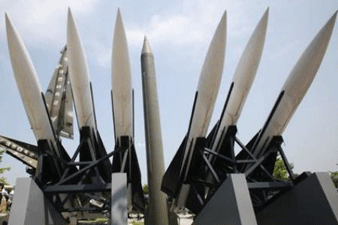
Russia revisits nuclear doctrine to allow attacks on non-nuclear states in response to Western weapons in Ukraine.
By Heloise Vyas, https://www.abc.net.au/news/2024-09-26/russia-revises-nuclear-weapons-laws-warning-united-states/104398414
In short:
Vladimir Putin has unveiled changes to conditions surrounding Russia’s use of nuclear weapons which he says will be put into effect if there was “reliable information” about a large-scale enemy attack.
The updated doctrine includes a widening of the threats under which Russia would consider a nuclear strike, including retaliating against conventional weapons.
What’s next?
Russia’s warning to the West comes amid deliberations on Ukraine’s use of Western long-range missiles. The US has not directly responded to the threat.
Russian President Vladimir Putin has broadened the remit of his nuclear doctrine to fend off Western-supported attacks in the Ukraine war, threatening to use nuclear weapons against non-nuclear-armed nations even if not attacked by them.
During a meeting with Russia’s Security Council on Wednesday, local time, he outlined three key changes to the Kremlin’s official nuclear doctrine — signed in 2020 — as a response to ongoing deliberations in the United States and Britain about permitting Ukraine to fire long-range missiles into Russian territory.
Mr Putin said under the lowered threshold, Russia could deploy nuclear bombs even if it was struck with conventional weapons, and that Moscow would consider any assault on it supported by a nuclear power to be a “joint attack”.
Russia reserved the right to also use nuclear weapons if it or ally Belarus were the subject of aggression, including by conventional weapons, he added.
The 71-year-old, who is the primary decision-maker on Russia’s vast nuclear arsenal, said he wanted to underscore one key change in particular.
“It is proposed that aggression against Russia by any non-nuclear state, but with the participation or support of a nuclear state, be considered as their joint attack on the Russian Federation,” Mr Putin said in his opening remarks to the council.
He said the new rules would be effectuated if Russia detected a large-scale launch of enemy missiles, aircraft or drones was coming its way: “The conditions for Russia’s transition to the use of nuclear weapons are also clearly fixed.”
Mr Putin said the clarifications were carefully calibrated and commensurate with the modern military threats facing Russia — confirmation that the nuclear doctrine was changing.
The implications
Russia’s warning to the West comes amid Ukrainian pleas to fire long-range weapons (many already in its possession) into Russia, including British Storm Shadows and American ATACMS ballistic missiles.
Ukrainian President Volodymyr Zelenskyy argues these will help hit vital military depots with precision, but the US has trodden carefully, fearing such a move would escalate the war and pit NATO in direct conflict with Russia.
Russia has previously provoked war with NATO, accusing the US and European nations of de facto participation in the conflict, but has not come as far as spelling out changes to the use of its nuclear arsenal. Earlier this month it said it was considering updating the doctrine.
With Ukraine losing key towns to gradually advancing Russian forces in the country’s east, the war is entering what Russian officials say is the most dangerous phase to date.
Western aid for Kyiv has remained steady, with the US pledging a further $375 million in aid on Thursday, although it is unclear what bearing Mr Putin’s nuclear threat will have on considerations of long-range weapon restrictions.
Many view Russia brandishing its nuclear sabre as little more than a bluff, but some analysts say it is “because of and not in spite of” the fact that Moscow has repeatedly held its nuclear arsenals over Western heads that leaders should take these threats seriously.
Russia’s current published nuclear doctrine, set out in a 2020 decree by Mr Putin, says it may use nuclear weapons in case of a nuclear attack by an enemy or a conventional attack that threatens the existence of the state.
The innovations outlined include a widening of the threats under which Russia would consider a nuclear strike, the inclusion of ally Belarus under the nuclear umbrella, and the idea that a rival nuclear power supporting a conventional strike on Russia would also be considered to be attacking it.
Nuclear-armed states that could be drawn into this include France, the United Kingdom, Israel and most crucially the US, which along with Russia controls 90 per cent of the world’s nuclear warheads.
China, Pakistan, India, and North Korea possess the remainder, but neither has actively been involved in the Ukraine war. A further 32 states also either host nuclear weapons or endorse their use.
Ukraine is neither a nuclear state, nor a part of NATO, but is backed by the alliance.
How has Russia’s threat been received?
Mr Zelenskyy has urged the West to disregard Russia’s so-called “red lines”, and some Western allies have also urged the US to do just that.
“Russia no longer has any instruments to intimidate the world apart from nuclear blackmail,” Andrey Yermak, Mr Zelenskyy’s chief of staff, said in response to the Russian president’s Wednesday remarks.
“These instruments will not work.”
Mr Putin, who casts the West as a decadent aggressor, and US President Joe Biden, who casts Russia as a corrupt autocracy and Mr Putin as a killer, have both warned that a direct Russia-NATO confrontation could escalate into World War III. Republican presidential candidate Donald Trump has also warned of the risk of nuclear war.
In his comments to Russia’s Security Council, a type of modern-day politburo of Mr Putin’s most powerful officials including influential hawks, he said work on amendments to changing the doctrine had been going on for the past year.
“The nuclear triad remains the most important guarantee of ensuring the security of our state and citizens, an instrument for maintaining strategic parity and balance of power in the world,” he said.
Russia, he said, would consider using nuclear weapons “upon receiving reliable information about the massive launch of aerospace attack vehicles and their crossing of our state border, meaning strategic or tactical aircraft, cruise missiles, drones, hypersonic and other aircraft”.
No explicit laws restraining nuclear weapons use
Casualties from a nuclear war between Russia and the US could reach tens of millions, with even a single bomb having the capacity to wipe out about 580,000 people, according to estimates from the International Campaign to Abolish Nuclear Weapons.
US-Russian arms control agreements also classify “tactical” nuclear weapons, which are presented as having smaller yield, and are intended for battlefield use as opposed to strategic weapons fired across vast distances.
But even these smaller warheads are hugely destructive and comparable in strength with the two atomic bombs dropped by the US in Japan during World War Two which killed about 210,000 people.
In 2022, Washington was so concerned about the possible use of tactical nuclear weapons by Russia that it warned Mr Putin about the consequences of using them, according to Central Intelligence Agency director Bill Burns.
The two-and-a-half-year Ukraine war has triggered the gravest confrontation between Russia and the West since the 1962 Cuban Missile Crisis — considered to be the closest the two Cold War superpowers came to intentional nuclear war.
Internationally, little power exists to prevent nuclear powers invoking the use of their arsenals.
The UN’s Treaty on the Prohibition of Nuclear Weapons does formally push for nuclear disarmament and outlaws the development, testing, production, acquisition, possession and stockpiling of nuclear weapons but neither Russia nor the US is a part of it.
The Netherlands is also the only NATO member participating in the treaty.
DOE Plutonium Pit Plan Found To Violate Environmental Law

By Daniel Wilson (September 30, 2024,) — A South Carolina federal judge on Monday backed antinuclear groups’ challenge to a U. S. Department of Energy plan to boost production of plutonium cores used in nuclear weapons, saying the DOE hadn’t properly considered the potential environmental impact of the plan. . . …….. (Subscribers only) more https://www.law360.com/articles/1884130/doe-plutonium-pit-plan-found-to-violate-environmental-law
US government provides $1.52 billion loan to resurrect Michigan nuclear plant

US closes $1.52 billion loan to resurrect Michigan nuclear plant, By Timothy Gardner October 1, 2024
WASHINGTON, Sept 30 (Reuters) – The U.S. on Monday said it closed a $1.52 billion loan to resurrect Holtec’s Palisades nuclear plant in Michigan, and a senior Biden administration official said it could take two years to reopen the plant, which is longer than the company predicted.
President Joe Biden’s administration has called for a tripling of U.S. nuclear power capacity as U.S. power demand surges and worries about climate change mount.
The push could include the potential reopening of some commercial reactors that have been shut for decommissioning, including one at Three Mile Island, site of the worst nuclear accident in U.S. history. Restarting shut nuclear plants is a complicated and expensive process never before accomplished in the country.
“Palisades is a climate comeback story,” Ali Zaidi, the White House climate adviser, told reporters in a call, adding that nuclear power supports high-paying union jobs
The $1.52 billion in financing from the Department of Energy’s Loan Programs Office, was accompanied by funding for nonprofit electric cooperatives to purchase power from Palisades. Deputy U.S. Energy Secretary Xochitl Torres Small announced more than $1.3 billion in public funding to power cooperatives Wolverine and Hoosier Energy.
Nuclear reactors generate virtually emissions-free power, which is valued as electricity demand soars for the first time in decades on growth in artificial intelligence, electric vehicles and cryptocurrencies. Nuclear critics, however, point out that the U.S. has not agreed on a permanent place to bury radioactive nuclear waste.
Palisades still needs licensing from regulators and the senior U.S. official said that means it could take “a couple of years to turn back on”. Holtec has estimated a comeback in the fourth quarter next year…………….
O’Brien has said Holtec does not expect delays or additional costs. https://www.reuters.com/business/energy/us-closes-152-billion-loan-resurrect-michigan-nuclear-plant-2024-09-30/
Russia’s Nuclear Doctrine Change Is More Cautious Than It May Appear
What’s new in the proposed update is the suggestion that a non-nuclear state could be the primary aggressor without being formally allied with a nuclear-armed state. ……………….
This shift in the doctrine seems to be crafted with the current geopolitical situation in mind, particularly Russia’s framing of the Ukraine conflict and its relationship with the United States and its allies.….
Long-Range Strikes May Not Be a Silver Bullet…………
By Maxim Trudolyubov on September 27, 2024, https://www.wilsoncenter.org/blog-post/russias-nuclear-doctrine-change-more-cautious-it-may-appear
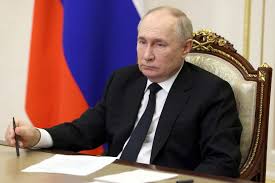
In a recent discussion on Russia’s nuclear doctrine, President Vladimir Putin announced an expansion of the categories of states and military alliances that would fall under Russia’s nuclear deterrence policy. “Aggression against Russia by any non-nuclear state, with the participation or support of a nuclear state, will be treated as a joint attack on the Russian Federation,” Putin stated during the public segment of a recent meeting of Russia’s Security Council.
While the official document, titled “Basic Principles of State Policy of the Russian Federation on Nuclear Deterrence,” has yet to be updated, experts suggest that the timing of this announcement serves as a clear warning to Ukraine. Currently, Ukraine is seeking approval from the United States to use Western long-range missiles against targets deeper within Russian territory.
Putin’s wording is explicit: the “non-nuclear state” in question is Ukraine, while the “nuclear state” providing support or participating in an attack is primarily the United States, though this could also extend to the United Kingdom and France.
U.S. officials believe such strikes could lead to a significant escalation, potentially drawing NATO into direct confrontation with Russia. Moscow has consistently warned Western countries that any attacks on its territory would be seen as acts of war. This cautious stance by the United States has led to public frustration among some American allies in Europe.
Both France and Britain have indicated a willingness to approve such strikes for Ukraine, but they are waiting for Washington’s decision as a benchmark. The UK and France produce and supply their own missiles, but they use guiding technology developed by the United States. “It would be really good to stop the delays. And I think that the restrictions on the use of weapons should be lifted,” said Mette Frederiksen, prime minister of Denmark, in an interview with Bloomberg.
What the New Language Actually Means
Pavel Podvig, a senior researcher on weapons of mass destruction at the United Nations Institute for Disarmament Research, notes that Russia’s current nuclear doctrine does not clearly distinguish between aggression from nuclear-armed and non-nuclear states. Instead, any aggression that “threatens the existence of the state” could potentially provoke a nuclear response.
At first glance, the proposed change does not sound like a tectonic shift. Since 1995, Russia has pledged not to use nuclear weapons against non-nuclear-armed states unless they act “in association or alliance with a nuclear-weapon state.” The Russian authorities at the time operated on an assumption that any such situation would involve a nuclear-armed state as the primary aggressor, with non-nuclear states in a supporting role.
What’s new in the proposed update is the suggestion that a non-nuclear state could be the primary aggressor without being formally allied with a nuclear-armed state. The language implies that a non-nuclear state’s aggression could be seen as part of a broader campaign involving a nuclear-armed state, thereby justifying a nuclear response. This shift in the doctrine seems to be crafted with the current geopolitical situation in mind, particularly Russia’s framing of the Ukraine conflict and its relationship with the United States and its allies.
“The new language suggests that a non-nuclear weapon state might be an aggressor,” Podvig says. “Apparently, the idea behind the change is to say that this ‘association’ would make the nuclear weapons state that provides this support an aggressor too. It’s the ‘joint attack’ language.”
During the Security Council meeting Putin also said that Russia could resort to nuclear weapons on receiving “reliable information” indicating a large-scale aerial attack involving aircraft, missiles, and drones. Additionally, Moscow would treat an attack on its ally Belarus as an attack on Russia itself, potentially responding with nuclear force to defend Belarus.
On closer examination, Putin’s remarks reflect a more cautious approach than may initially seem. While the rhetoric implies a potential broadening of scenarios in which Russia might consider nuclear deterrence, it does not represent a fundamental departure from the country’s long-standing policies. However, the language remains vague: it fails to define what constitutes an “association” or clarify precisely against whom a nuclear strike might be directed.
Long-Range Strikes May Not Be a Silver Bullet
There are doubts within the policy and expert communities about whether long-range strikes on Russian territory would be a decisive factor in the war. To achieve a significant breakthrough, Ukraine would need to coordinate large-scale ground maneuvers in tandem with these strikes—something its forces have yet to demonstrate. “In its summer 2023 offensive, the Ukrainian military showed no ability to coordinate forces on anything like the scale needed for a decisive breakthrough. Longer-range weapons would make this coordination even more complicated,” writes Stephen Biddle, professor of international and public affairs at Columbia University, in a piece for Foreign Affairs.
Biddle highlights the limitations and challenges of deep strikes in the current context. Such strikes are costly and require precision guidance, which can quickly lose effectiveness as the opposing side adapts.
The historical record on longer-range strikes is not encouraging, notes Biddle. Historically, even large-scale strategic bombing campaigns, including strikes aimed at German and Japanese cities during World War II and North-Korean cities during the Korean War, have not succeeded in breaking the resolve of the targeted country. Additionally, the military benefits of diverting Russian efforts into air defense or disrupting weapons production would require an extensive, sustained campaign that Ukraine is not currently equipped to carry out.
All Eyes on U.S. Voters
The wait for a decision on allowing Ukraine to carry out long-range strikes on Russian territory is closely tied to the outcome of the U.S. presidential election. The two candidates have contrasting views on the Russo-Ukrainian war, which makes the future U.S. stance uncertain. One candidate may push for greater support for Ukraine, potentially approving the use of advanced Western missiles for strikes deeper into Russia, while the other could advocate a more cautious approach, prioritizing de-escalation or negotiations.
This political uncertainty leaves European allies, Ukrainian policymakers, and even Moscow in a holding pattern. For now, decision-makers are watching the United States closely, understanding that the future of support for Ukraine’s military capabilities—and the overall direction of the war—will largely hinge on the results of the upcoming election.
Netanyahu: Israel Is Fighting a War on Seven Fronts
The Israeli leader called the UN General Assembly a ‘Swamp of Antisemitic Bile’
by Kyle Anzalone September 27, 2024, https://news.antiwar.com/2024/09/27/netanyahu-israel-is-fighting-a-war-on-seven-fronts/#gsc.tab=0
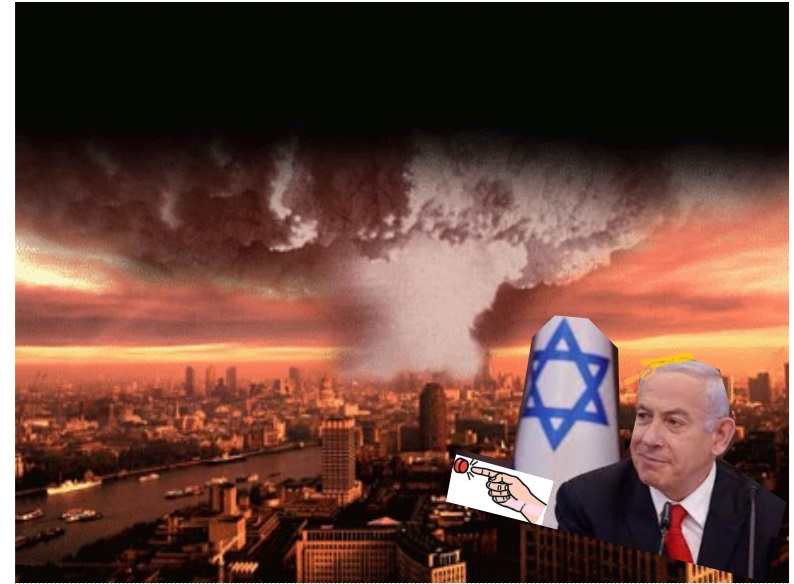
Israeli Prime Minister Benjamin Netanyahu slammed the UN during his remarks at the 79th General Assembly summit on Friday. He called the body a swamp of antisemitism while saying Israel needed to defend itself on seven fronts.
The Israeli leader’s speech was contentious. Before Netanyahu took to the podium, Pakistani Prime Minister Muhammad Shehbaz Sharif blasted Israel for waging a genocide in Gaza and creating a war with Lebanon. As Netanyahu began his address, a large portion of the UN General Assembly body walked out.
During his remarks, Netanyahu referred to the UN General Assembly as a “swamp of antisemitic bile.” He went on to slam the International Criminal Court (ICC) for considering charging him with war crimes, adding the true war criminals are in Iran and its allied nations.
During his address, Netanyahu presented two maps, one titled “the blessing” and the other “the curse.” The Israeli leader said Tel Aviv is still seeking a normalization agreement with Saudi Arabia. He claimed that if Riyadh established official ties with Israel, the world would receive a “blessing,” but Iran represented a “curse” to the region.
The Israeli leader explained “the blessing” was establishing a “landbridge” from India to Israel. The blessing requires Saudi Arabia to enter the Abraham Accords and normalize ties with Israel. Netanyahu claimed that would have happened, but the October 7 Hamas attack prevented the deal.
In the map titled “the curse,” five countries were represented in black: Iran, Iraq, Syria, Yemen and Lebanon. The Israeli leader claimed that Tehran was working to eliminate Tel Aviv using its allies in the region. Netanyahu presented the conflict as a battle between forces of civilization against barbarism.
When discussing Gaza, Netanyahu said “Hamas must go.” He added that any end to the war that would see Hamas remain in power in Gaza is equivalent to allowing the Nazis to rebuild Germany after World War II.
As with Hamas, Netanyahu also said Israel would continue to wage war against Hezbollah until all its objectives were met. Over the past week, Tel Aviv has significantly ramped up its military operations in southern Lebanon, killing over 700 in the past week.
Kyle Anzalone is the opinion editor of Antiwar.com, news editor of the Libertarian Institute, and co-host of Conflicts of Interest.
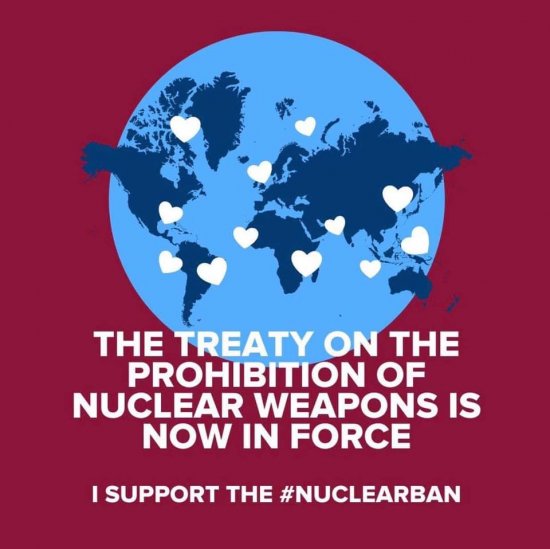
Question for the candidates: Will the United States sign and ratify the Treaty on the Prohibition of Nuclear Weapons?
By Alicia Sanders-Zakre | September 20, 2024 Alicia Sanders-Zakre is the Policy and Research Coordinator at the International Campaign to Abolish Nuclear Weapons. https://thebulletin.org/2024/09/will-the-united-states-sign-and-ratify-the-treaty-on-the-prohibition-of-nuclear-weapons/?fbclid=IwY2xjawFoiE5leHRuA2FlbQIxMQABHXWHz4dPKx6qA6gXNV_3JCT1LqSA4SpW4InKnv6GP0M0A5RzBvtaJMfokw_aem_nT8dnPTOYgkrNFm4kOHKTA
Before the 2016 US presidential election, Princeton physicist Zia Mian wrote an essay asking then-candidates Hillary Clinton and Donald Trump in the Bulletin whether they would be ready to start talks to ban nuclear weapons. Eight years and two presidents later, both the Trump and Biden administrations have rebuffed the 2017 UN Treaty on the Prohibition of Nuclear Weapons (TPNW) and chosen instead to persist with current US policies to maintain and upgrade nuclear weapons—despite a legal obligation to disarm, public support for the TPNW, and the existential threat to humanity of adherence to the debated theory of nuclear deterrence.
The TPNW is the first international treaty banning all nuclear weapons activities, including nuclear use and threat of use, testing, stationing, and development. The treaty’s Article 4 provides a verifiable pathway for nuclear-armed states to join and disarm. And Articles 6 and 7 create the first international regime to provide assistance and remediation to people and environments harmed by nuclear weapons use and testing; an effort led by countries that have been bombarded by Soviet and British nuclear detonations. This treaty currently has 93 signatory states and 70 states parties from every region of the world.
The United States—like other nuclear-armed countries—has chosen to undermine and dismiss this good faith effort by nearly half the world’s governments, including US allies, to rid the world of nuclear weapons. In 2020, the Trump administration even urged states to withdraw their instruments of ratification. Meanwhile, the United States has failed to implement the obligation it undertook more than half a century ago under Article VI of the Treaty on the Non-Proliferation of Nuclear Weapons (NPT) to pursue nuclear disarmament and instead spent $51.5 billion in 2023 alone to upgrade its nuclear arsenal. The continued investment of nuclear powers in maintaining and rebuilding their nuclear arsenals, while paying mere lip service to disarmament, is a source of contention within the NPT and undermines the nuclear non-proliferation regime.
Foreign policy goals aside, US presidential candidates should adhere to democratic principles and align their policies with public opinion and support for the treaty among local governments to join the TPNW: According to a 2022 study, 65 percent of the US population supports joining the TPNW. Cities and towns across the country—from Washington, D.C. to Los Angeles to Yellow Springs, Ohio—have adopted local resolutions calling on their government to join, alongside five US states. Members of the US Congress, as well as local and state politicians, have also called on the United States to join the ban treaty.
Support for the TPNW is based on a clear-eyed assessment of the risks that nuclear weapons pose as long as they exist—and an understanding of the naiveté of relying on the rationality of statemen like Russian President Vladimir Putin, Israeli Prime Minister Benjamin Netanyahu, North Korean leader Kim Jong-un, or former US president Donald Trump to decide the fate of humanity.
Scholars have shown that the reason humanity has escaped nuclear annihilation since the dawn of the nuclear age may have more to do with sheer luck than with any successful strategy.
No one will want to be around when luck runs out.
We know all too well what that would look like and the incapacity of humanitarian organizations to respond. A new report by the International Campaign to Abolish Nuclear Weapons documents in gut-wrenching detail the harm that nuclear weapons have done to children and the threat they continue to pose to them, including those bombed by the United States in Hiroshima and Nagasaki. Some of those children survived and now give testimony to—and remind leaders of—the urgent need to abolish these weapons. This report adds to the robust body of literature on the devastating humanitarian and environmental consequences of nuclear weapons.
Under both Republican and Democratic administrations, the United States and the world have continued to face the threat of accidental or intentional nuclear annihilation, a threat that has continued to grow in recent years. It is time to chart a new course and to eliminate nuclear weapons, which is the only fail-safe way to eliminate the threat of their use.
Presidential candidates Kamala Harris and Donald Trump should be asked: If elected President, will you sign and submit to the Senate for ratification the Treaty on the Prohibition of Nuclear Weapons?
Governments urged to ‘stop gambling with humanity’s future’ and eliminate nuclear weapons
26 September 2024
World leaders, senior government officials and civil society representatives joined forces at UN Headquarters on Thursday to reaffirm commitment to nuclear disarmament as a global priority.
The High-Level Meeting was held to commemorate the International Day for the Total Elimination of Nuclear Weapons, observed annually on 26 September.
“There should be no place for these devices of death in our world,” said UN Secretary-General António Guterres.
Nuclear ‘spectre’ looming
He warned, however, that “not since the worst days of the Cold War has the spectre of nuclear weapons cast such a dark shadow.”
He said that “nuclear sabre-rattling has reached a fever pitch” and there have been threats to use a nuclear weapon, highlighting fears of a new arms race.
Meanwhile, decades-old norms established against the use, spread and testing of nuclear weapons are being eroded.
Learn from the past
Mr. Guterres said the first-hand experience of the hibakusha – the survivors of the atomic bombing of the Japanese cities of Hiroshima and Nagasaki in 1945 – “stand as clear reminders of where the nuclear path ends”.
“And yet, nearly 80 years later, nuclear-weapon States continue to roll the dice, resisting disarmament measures and believing that, somehow, our luck will never run out,” he said.
Stop gambling with our future
He appealed for these countries to “stop gambling with humanity’s future”, starting with honouring their commitments and meeting their disarmament obligations.
“Until nuclear weapons are eliminated, these States should commit to never use them under any circumstances. And they must demonstrate the utmost transparency in all matters related to nuclear weapons,” he said.
Appeal to Russia and USA
The Secretary-General also called on Russia and the United States “to return to the process of nuclear arms reductions, with other nuclear-weapon States following in due course.”
As “disarmament and non-proliferation are two sides of the same coin,” countries must pursue both as a matter of urgency, he added.
He recalled that the recently concluded Summit of the Future resulted in new international commitment to revitalize the global disarmament regime and to bring the world closer to the goal of total elimination of nuclear weapons, which the vast majority of UN Member States support.
“The time has come to take steps to ensure that a nuclear weapon is never used again,” he said.
‘Nuclear catastrophe’ risk mounting: General Assembly President
UN General Assembly President Philémon Yang lamented the current era of heightened nuclear risks.
“We are also observing a growing nexus between nuclear weapons and domains such as outer and cyber space, and technologies such as artificial intelligence, which are multiplying the danger of a nuclear catastrophe,” he said. ……………………………………………………………………..
Warnings going unheard: Marshall Islands President
The President of the Marshall Islands, Heidi Heine, spoke about her country’s experience, history and current challenges with nuclear exposure. ………………………………………………………………
Non-Aligned Movement demands urgent action
Ugandan Foreign Minister Jeje Odongo Abubakhar spoke on behalf of the Non-Aligned Movement (NAM), which has its roots in the Cold War era.
NAM’s 121 members remain deeply concerned over the slow progress towards nuclear disarmament and the failure of nuclear weapons holders to eliminate their arsenals.
“We reaffirm the need for the nuclear-weapon States, which bear the primary responsibility for nuclear disarmament, to take urgent and concrete actions aimed at achieving this goal,” he said.
Nuclear weapons have ‘no constructive value’: Libya
The Acting Foreign Minister of Libya, Eltaher Salem Elbaour, reminded participants that his country decided to relinquish its nuclear weapons programme in 2003.
Implement existing commitments: US official ………………………………………….more https://news.un.org/en/story/2024/09/1154951
Hurricane Helene Floods Closed Duke Nuclear Plant in Florida
Ari Natter, Bloomberg News, 30 Sept 24
- Plant closed since 2013 soaked by 12-foot storm surge
- Wastewater overflowing, but major leakage seen as unlikely
Floodwaters from Hurricane Helene have swamped a retired Duke Energy Corp. nuclear power plant, according to a filing with the Florida Department of Environmental Protection, though an escape of contaminated fuel appears unlikely.
The Crystal River plant, which has been shuttered since 2013, experienced a storm surge of as much as 12 feet, according to the filing, which was posted online.
“The whole site was flooded, including buildings, sumps, and lift stations. Industrial Wastewater Pond #5 was observed overflowing to the ground due to the surge,” according to the report, which was filed Friday, the day after Helene roared … ………. (Subscribers only)
Lawmakers to Investigate Faulty Sub, Carrier Welding at Newport News Shipbuilding

USNI News, Sam LaGrone, September 27, 2024
THE PENTAGON – The House Armed Services Committee is investigating substandard welding on submarines and aircraft carriers at Newport News Shipbuilding, the committee announced on Friday.
Following a Thursday report in USNI News, lawmakers are now looking into how shipbuilders at the Virginia yard had violated proper welding procedures on work that made it into current in-service submarines. The flawed work was found by quality assurance teams at Newport News Shipbuilding, which has led to a wider investigation into welding quality that’s prompted a notification to the Department of Justice, USNI News reported.
“It is deeply concerning to learn that faulty welds may have been knowingly made to U.S. Navy submarines and aircraft carriers. The House Armed Services Committee is investigating how this occurred. The safety of our sailors is our top concern, and we need to immediately understand any risks associated with the faulty work,” reads the statement from HASC chair Rep Mike Rogers (R-Ala.), ranking member Rep Adam Smith (D-Wash.) and House Armed Services seapower and projection forces subcommittee leaders Rep. Trent Kelly (R-Miss.) and Rep. Joe Courtney (D-Conn.).
“The Department of Defense needs to immediately provide our committee with answers and a plan for how they will protect U.S. Navy vessels against tampering. Absolute transparency with Congress is essential.”
The Congressional query comes as the Navy and shipbuilder HII are gauging the scope of the ships that were affected overall. The number of in-service Virginia-class submarines that have been affected are in the “low single digits” and an ongoing analysis of under-construction Virginia, Columbia-class submarines and Ford-class aircraft carriers could stretch into October, a defense official told USNI News on Friday.
Earlier this year, quality assurance teams at Newport News discovered the sub-standard welds and reported the violations in procedure to both the Navy and the Department of Justice, according to a Friday statement on LinkedIn by Newport News president Jennifer Boykin.
“We recently discovered that the quality of certain welds on submarines and aircraft carriers under construction here at NNS do not meet our high-quality standards. Most concerning is that some of the welds in question were made by welders who knowingly violated weld procedures.” she wrote.
“We immediately put together a team made up of both internal and independent engineering and quality subject matter experts to determine the root causes, bound the issue and put in place immediate short-term corrective actions as we work through longer-term solutions.”
Boykin went on to say HII notified both the Navy and the Department of Justice on the sub-standard work………………………………………………………………………………………….
Neither HII nor the Navy have said when the initial faulty work was discovered.
While the assessment of the overall welds on the ships under construction could extend into next month, the Navy and HII now have the tedious task of reinspecting the welds and determining solutions.
Twice in the 2000s, the Navy mounted separate investigations into suspicious welds into then Northrop Grumman-managed Newport News Shipbuilding. In 2007, the Navy found welders used the wrong filler material in non-nuclear pipping on Virginia submarines. In 2009, the Navy had to reinspect the welds on nine submarines and four aircraft carriers after a shipyard inspector admitted to falsifying inspection reports, according to The Virginian Pilot.
The inspections can involve analyzing welds that are difficult to reach throughout a submarine or aircraft carrier. The subsequent weld checks after the 2009 investigation took years, USNI News understands. https://news.usni.org/2024/09/27/lawmakers-announce-investigation-into-faulty-submarine-carrier-welding-at-newport-news-shipbuilding-ships-affected-in-low-single-digits-officials-say
New NATO member Finland to place command center near Russian border
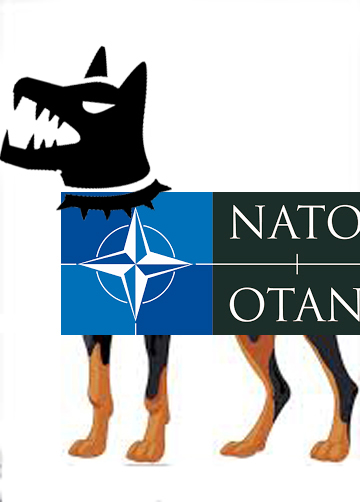
https://www.rt.com/news/604782-finland-new-nato-command/ 30 Sept 24
Finland will host the bloc’s HQ for Northern Europe in Mikkeli, less than 200km from the frontier.
Finland will host a new NATO command base responsible for operations in Northern Europe in the city of Mikkeli, less than 200km from the Russian border, Helsinki announced on Friday.
Finland formally joined the US-led military bloc along with Sweden following the escalation of the Ukraine conflict in 2022. Moscow has argued that the two nations compromised their own security by becoming part of what it perceives as a hostile organization that serves US geopolitical interests, while sacrificing their credibility as possible neutral mediators.
The new Multi Corps Land Component Command (MCLCC) will be under the authority of NATO’s Joint Force Command (JFC) in Norfolk, Virginia. Initially, it will comprise only a few dozen service members, Defense Minister Antti Hakkanen told journalists.
“NATO recognizes Finland’s expertise and trusts our ability to contribute to the defense of the northern region,” he said.
The bloc approved the creation of the new command center during its leaders’ summit in July. Helsinki allocated some €8.5 million ($9.5 million) in 2024 for the creation of the MCLCC.
The commander of the Finnish Defense Forces, General Janne Jaakkola, has said that placing the new NATO structure in close proximity to the headquarters of the Finnish Army “fosters cooperation between the national and the Allies’ forces, creating obvious synergy benefits.”
Hakkanen, also said he would soon announce where a new multinational force that Finland intends to host will be based. According to the state broadcaster Yle, Helsinki will choose between Rovaniemi and Sodankyla. The former is the capital of the northern region of Finnish Lapland, while the latter is a municipality located in the same province but closer to the Russian border.
NATO intensified its military buildup in Europe in 2014, following the US-backed armed coup in Kiev, claiming that it was preparing to respond to possible Russian aggression. The military bloc has significantly expanded its presence in Europe, breaking assurances given to Moscow to secure Russia’s support for the reunification of Germany in 1990.
China’s Newest Nuclear Submarine Sank, Setting Back Its Military Modernization
Pierside accident came as Beijing attempts to expand its navy
WSJ, By Michael R. Gordon, Sept. 26, 2024
WASHINGTON—China’s newest nuclear-powered attack submarine sank in the spring, a major setback for one of the country’s priority weapons programs, U.S. officials said.
The episode, which Chinese authorities scrambled to cover up and hasn’t previously been disclosed, occurred at a shipyard near Wuhan in late May or early June.
It comes as China has been pushing to expand its navy, including its fleet of nuclear-powered submarines.
The Pentagon has cast China as its principal long-term “pacing challenge,” and U.S. officials say that Beijing has been using political and military pressure to try to coerce Taiwan, a separately governed island that Beijing claims as part of its territory.
China says its goal in building a world-class military is to deter aggression and safeguard its overseas interests. A spokesman for the Chinese embassy didn’t immediately respond to a request for comment…………………………………………………………….. more https://www.wsj.com/world/china/chinas-newest-nuclear-submarine-sank-setting-back-its-military-modernization-785b4d37?st=pMigx5&reflink=desktopwebshare_permalink
1 This Month

of the week – Shut Down Drone Warfare!


Tell the Ukrainian Government to Drop Prosecution of Peace Activist Yurii Sheliazhenko

Petition to revoke the licensing of the Near Surface Nuclear Disposal Facility (NSDF) at Chalk River. https://www.ourcommons.ca/petitions/en/Petition/Details?Petition=e-7247
To see nuclear-related stories in greater depth and intensity – go to https://nuclearinformation.wordpress.com
-
Archives
- April 2026 (57)
- March 2026 (251)
- February 2026 (268)
- January 2026 (308)
- December 2025 (358)
- November 2025 (359)
- October 2025 (376)
- September 2025 (257)
- August 2025 (319)
- July 2025 (230)
- June 2025 (348)
- May 2025 (261)
-
Categories
- 1
- 1 NUCLEAR ISSUES
- business and costs
- climate change
- culture and arts
- ENERGY
- environment
- health
- history
- indigenous issues
- Legal
- marketing of nuclear
- media
- opposition to nuclear
- PERSONAL STORIES
- politics
- politics international
- Religion and ethics
- safety
- secrets,lies and civil liberties
- spinbuster
- technology
- Uranium
- wastes
- weapons and war
- Women
- 2 WORLD
- ACTION
- AFRICA
- Atrocities
- AUSTRALIA
- Christina's notes
- Christina's themes
- culture and arts
- Events
- Fuk 2022
- Fuk 2023
- Fukushima 2017
- Fukushima 2018
- fukushima 2019
- Fukushima 2020
- Fukushima 2021
- general
- global warming
- Humour (God we need it)
- Nuclear
- RARE EARTHS
- Reference
- resources – print
- Resources -audiovicual
- Weekly Newsletter
- World
- World Nuclear
- YouTube
-
RSS
Entries RSS
Comments RSS
 nuclear-news