Pentagon “goes to school” -William Hartung, The Battle for the Soul of American Science
“……………………………………………. Hartung, a Pentagon expert, has focused on this strange reality of ours: no matter how many wars the United States loses, it only pours yet more taxpayer dollars into the Pentagon budget and into the coffers of those giant weapons-making companies of the military-industrial-congressional complex.
September 29, 2024, Tomgram
………………………………………………… Yet, after all these years, what couldn’t be more striking today is that, in the same spirit as those older pieces, Hartung focuses (as he so often has) on a different aspect entirely of the Pentagon’s distinctly over-funded world, one that, amid all the news coverage in this country, gets little or no attention: how the Pentagon, as he puts it, “goes to school” to enlist American science in the battle to create yet more horrific weaponry.
Pentagon expert William Hartung first wandered into TomDispatch in March 2008, less than seven years after this country’s Global War(s) on Terror were launched, full-scale disasters that were already costing the American taxpayer a fortune and a half — or perhaps, given the subject, all too literally an arm and a leg. As he wrote then, “How much, for instance, does one week of George Bush’s wars cost? Glad you asked. If we consider the wars in Iraq and Afghanistan together — which we might as well do, since we and our children and grandchildren will be paying for them together into the distant future — a conservative, single-week estimate comes to $3.5 billion. Remember, that’s per week! By contrast, the whole international community spends less than $400 million per year on the International Atomic Energy Agency, the primary institution for monitoring and preventing the spread of nuclear weapons; that’s less than one day’s worth of war costs.”
Only $650 million or so of that weekly sum, he estimated, was “spent on people.” So, he wondered, “where does the other nearly $3 billion go?” The answer he offered then: “It goes for goods and services, from tanks and fighter planes to fuel and food. Most of this money ends up in the hands of private companies like Boeing, Lockheed Martin, and the former Halliburton subsidiary, Kellogg, Brown and Root.” And knowing about that expense of $3.5 billion a week “and counting” on America’s wars, he added sarcastically, “Doesn’t that make you feel safer?”
Ever since then, Hartung, a Pentagon expert, has focused on this strange reality of ours: no matter how many wars the United States loses, it only pours yet more taxpayer dollars into the Pentagon budget and into the coffers of those giant weapons-making companies of the military-industrial-congressional complex. Even the titles of a few of his pieces over the years catch the grim spirit of his all-too-striking analysis: “There’s No Business Like the Arms Business, Weapons ‘R’ Us (But You’d Never Know It)” (July 2016); “The Urge to Splurge, Why Is It So Hard to Reduce the Pentagon Budget?” (October 2016); “The American Way of War Is a Budget-Breaker, Never Has a Society Spent More for Less” (May 2017); “Merger Mania, The Military-Industrial Complex on Steroids” (July 2019); “America Dominant Again (in Arms Sales), And Again… and Again… And Again” (May 2021); “Fueling the Warfare State, America’s $1.4 Trillion ‘National Security’ Budget Makes Us Ever Less Safe” (July 2022); “Spending Unlimited, The Pentagon’s Budget Follies Come at a High Price” (March 2024).
And of course, that’s just a small dip into the pieces he’s written for TomDispatch. Yet, after all these years, what couldn’t be more striking today is that, in the same spirit as those older pieces, Hartung focuses (as he so often has) on a different aspect entirely of the Pentagon’s distinctly over-funded world, one that, amid all the news coverage in this country, gets little or no attention: how the Pentagon, as he puts it, “goes to school” to enlist American science in the battle to create yet more horrific weaponry. And so it goes, again and again and again. Tom
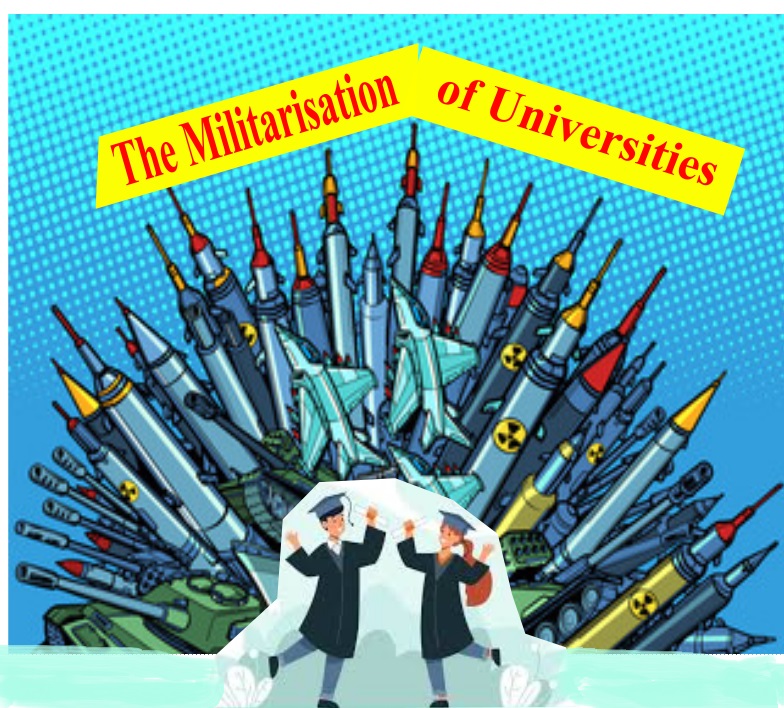
The Pentagon Goes to School. The Battle for the Soul of American Science. Bringing the Militarization of University Research Back to Earth
The divestment campaigns launched last spring by students protesting Israel’s mass slaughter in Gaza brought the issue of the militarization of American higher education back into the spotlight.
Of course, financial ties between the Pentagon and American universities are nothing new. As Stuart Leslie has pointed out in his seminal book on the topic, The Cold War and American Science, “In the decade following World War II, the Department of Defense (DOD) became the biggest patron of American science.” Admittedly, as civilian institutions like the National Institutes of Health grew larger, the Pentagon’s share of federal research and development did decline, but it still remained a source of billions of dollars in funding for university research.

And now, Pentagon-funded research is once again on the rise, driven by the DOD’s recent focus on developing new technologies like weapons driven by artificial intelligence (AI). Combine that with an intensifying drive to recruit engineering graduates and the forging of partnerships between professors and weapons firms and you have a situation in which many talented technical types could spend their entire careers serving the needs of the warfare state. The only way to head off such a Brave New World would be greater public pushback against the military conquest (so to speak) of America’s research and security agendas, in part through resistance by scientists and engineers whose skills are so essential to building the next generation of high-tech weaponry.
The Pentagon Goes to School
Yes, the Pentagon’s funding of universities is indeed rising once again and it goes well beyond the usual suspects like MIT or Johns Hopkins University. In 2022, the most recent year for which full data is available, 14 universities received at least — and brace yourself for this — $100 million in Pentagon funding, from Johns Hopkins’s astonishing $1.4 billion (no, that is not a typo!) to Colorado State’s impressive $100 million. And here’s a surprise: two of the universities with the most extensive connections to our weaponry of the future are in Texas: the University of Texas at Austin (UT-Austin) and Texas A&M.
In 2020, Texas Governor Greg Abbott and former Army Secretary Ryan McCarthy appeared onstage at a UT-Austin ceremony to commemorate the creation of a robotics lab there, part of a new partnership between the Army Futures Command and the school. “This is ground zero for us in our research for the weapons systems we’re going to develop for decades to come,” said McCarthy.
Not to be outdone, Texas A&M is quietly becoming the Pentagon’s base for research on hypersonics — weapons expected to travel five times the speed of sound. Equipped with a kilometer-long tunnel for testing hypersonic missiles, that school’s University Consortium for Applied Hypersonics is explicitly dedicated to outpacing America’s global rivals in the development of that next generation military technology. Texas A&M is also part of the team that runs the Los Alamos National Laboratory, the (in)famous New Mexico facility where the first nuclear weapons were developed and tested as part of the Manhattan Project under the direction of Robert Oppenheimer.
Other major players include Carnegie Mellon University, a center for Army research on the applications of AI, and Stanford University, which serves as a feeder to California’s Silicon Valley firms of all types. That school also runs the Technology Transfer for Defense (TT4D) Program aimed at transitioning academic technologies from the lab to the marketplace and exploring the potential military applications of emerging technology products.
In addition, the Pentagon is working aggressively to bring new universities into the fold. In January 2023, Secretary of Defense Lloyd Austin announced the creation of a defense-funded research center at Howard University, the first of its kind at a historically black college.
Given the campus Gaza demonstrations of last spring, perhaps you also won’t be surprised to learn that the recent surge in Pentagon spending faces increasing criticism from students and faculty alike. Targets of protest include the Lavender program, which has used AI to multiply the number of targets the Israeli armed forces can hit in a given time frame. But beyond focusing on companies enabling Israel’s war effort, current activists are also looking at the broader role of their universities in the all-American war system.
For example, at Indiana University research on ties to companies fueling the killings in Gaza grew into a study of the larger role of universities in supporting the military system as a whole. Student activists found that the most important connection involved that university’s ties to the Naval Surface Warfare Center, Crane Division, whose mission is “to provide acquisition, engineering… and technical support for sensors, electronics, electronic warfare, and special warfare weapons.” In response, student activists have launched a “Keep Crane Off Campus” campaign.
A Science of Death or for Life?
Graduating science and engineering students increasingly face a moral dilemma about whether they want to put their skills to work developing instruments of death. Journalist Indigo Olivier captured that conflict in a series of interviews with graduating engineering students. She quotes one at the University of West Florida who strongly opposes doing weapons work this way: “When it comes to engineering, we do have a responsibility… Every tool can be a weapon… I don’t really feel like I need to be putting my gifts to make more bombs.”
By contrast, Cameron Davis, a 2021 computer engineering graduate from Georgia Tech, told Olivier about the dilemma faced by so many graduating engineers: “A lot of people that I talk to aren’t 100% comfortable working on defense contracts, working on things that are basically going to kill people.” But he went on to say that the high pay at weapons firms “drives a lot of your moral disagreements with defense away.”
The choice faced by today’s science and engineering graduates is nothing new. The use of science for military ends has a long history in the United States. But there have also been numerous examples of scientists who resisted dangerous or seemingly unworkable military schemes……………………………………………………………………………………………
Scientists have also played a leading role in pressing for nuclear arms control and disarmament, founding organizations like the Bulletin of the Atomic Scientists (1945), the Federation of American Scientists (1945), the global Pugwash movement (1957), the Council for a Livable World (1962), and the Union of Concerned Scientists (1969). To this day, all of them continue to work to curb the threat of a nuclear war that could destroy this planet as a livable place for humanity.

A central figure in this movement was Joseph Rotblat, the only scientist to resign from the Manhattan Project over moral qualms about the potential impact of the atomic bomb. In 1957, he helped organize the founding meeting of the Pugwash Conference, an international organization devoted to the control and ultimate elimination of nuclear weapons. In some respects Pugwash was a forerunner of the International Campaign to Abolish Nuclear Weapons (ICAN), which successfully pressed for the U.N. Treaty on the Prohibition of Nuclear Weapons, which entered into force in January 2021.
Enabling Endless War and Widespread Torture
The social sciences also have a long, conflicted history of ties to the Pentagon and the military services. Two prominent examples from earlier in this century were the Pentagon’s Human Terrain Program (HTS) and the role of psychologists in crafting torture programs associated with the Global War on Terror, launched after the 9/11 attacks with the invasion of Afghanistan.
………………………………………………An even more controversial use of social scientists in the service of the war machine was the role of psychologists as advisors to the CIA’s torture programs at Abu Ghraib in Iraq, the Guantánamo Bay detention center in Cuba, and other of that agency’s “black sites.” ……………………………………………………………
today, resistance to the militarization of science has extended to the growing use of artificial intelligence and other emerging military technologies. For example, in 2018, there was a huge protest movement at Google when employees learned that the company was working on Project Maven, a communications network designed to enable more accurate drone strikes. More than 4,000 Google scientists and engineers signed a letter to company leadership calling for them to steer clear of military work, dozens resigned over the issue, and the protests had a distinct effect on the company. That year, Google announced that it would not renew its Project Maven contract, and pledged that it “will not design or deploy AI” for weapons.
Unfortunately, the lure of military funding was simply too strong. Just a few years after those Project Maven protests, Google again began doing work for the Pentagon,…………………………………….
The Future of American Science
……………………………………………………………………The stakes are particularly high now, given the ongoing rush to develop AI-driven weaponry and other emerging technologies that pose the risk of everything from unintended slaughter due to system malfunctions to making war more likely, given the (at least theoretical) ability to limit casualties for the attacking side. In short, turning back the flood of funding for military research and weaponry from the Pentagon and key venture capital firms will be a difficult undertaking. After all, AI is already performing a wide range of military and civilian tasks. Banning it altogether may no longer be a realistic goal, but putting guardrails around its military use might still be.
Such efforts are, in fact, already underway. The International Committee for Robot Arms Control (ICRAC) has called for an international dialogue on “the pressing dangers that these systems pose to peace and international security and to civilians.”………………………………….
The Future of Life Institute has underscored the severity of the risk, noting that “more than half of AI experts believe there is a one in ten chance this technology will cause our extinction.”
Instead of listening almost exclusively to happy talk about the military value of AI by individuals and organizations that stand to profit from its adoption, isn’t it time to begin paying attention to the skeptics, while holding back on the deployment of emerging military technologies until there is a national conversation about what they can and can’t accomplish, with scientists playing a central role in bringing the debate back to earth?
https://tomdispatch.com/the-pentagon-goes-to-school/
No comments yet.
1 This Month

of the week – Shut Down Drone Warfare!


Tell the Ukrainian Government to Drop Prosecution of Peace Activist Yurii Sheliazhenko

Petition to revoke the licensing of the Near Surface Nuclear Disposal Facility (NSDF) at Chalk River. https://www.ourcommons.ca/petitions/en/Petition/Details?Petition=e-7247
To see nuclear-related stories in greater depth and intensity – go to https://nuclearinformation.wordpress.com
-
Archives
- April 2026 (68)
- March 2026 (251)
- February 2026 (268)
- January 2026 (308)
- December 2025 (358)
- November 2025 (359)
- October 2025 (376)
- September 2025 (257)
- August 2025 (319)
- July 2025 (230)
- June 2025 (348)
- May 2025 (261)
-
Categories
- 1
- 1 NUCLEAR ISSUES
- business and costs
- climate change
- culture and arts
- ENERGY
- environment
- health
- history
- indigenous issues
- Legal
- marketing of nuclear
- media
- opposition to nuclear
- PERSONAL STORIES
- politics
- politics international
- Religion and ethics
- safety
- secrets,lies and civil liberties
- spinbuster
- technology
- Uranium
- wastes
- weapons and war
- Women
- 2 WORLD
- ACTION
- AFRICA
- Atrocities
- AUSTRALIA
- Christina's notes
- Christina's themes
- culture and arts
- Events
- Fuk 2022
- Fuk 2023
- Fukushima 2017
- Fukushima 2018
- fukushima 2019
- Fukushima 2020
- Fukushima 2021
- general
- global warming
- Humour (God we need it)
- Nuclear
- RARE EARTHS
- Reference
- resources – print
- Resources -audiovicual
- Weekly Newsletter
- World
- World Nuclear
- YouTube
-
RSS
Entries RSS
Comments RSS
 nuclear-news
Leave a comment