The Rise and Fall of NuScale: a nuclear cautionary tale

Kelly Campbell, October 29, 2024 ,
https://oregoncapitalchronicle.com/2024/10/29/the-rise-and-fall-of-nuscale-a-nuclear-cautionary-tale/
A decade ago, NuScale, the Oregon-based small modular nuclear company born at Oregon State University, was on a roll. Promising a new era of nuclear reactors that were cheaper, easier to build and safer, their Star Wars-inspired artist renditions of a yet to be built reactor gleamed like a magic bullet.

As of last year, NuScale was the furthest along of any reactor design in obtaining Nuclear Regulatory Commission licensing and was planning to build the first small modular nuclear reactor in the United States. Its plan was to build it in Idaho to serve energy to a consortium of small public utility districts in Utah and elsewhere, known as UAMPS.
This home-grown Oregon company was lauded in local and national media. According to project backers, a high-tech solution to climate change was on the horizon, and an Oregon company was leading the way. It seemed almost too good to be true.
And it was.
image

Turns out, NuScale was a house of cards. The UAMPS project’s price tag more than doubled and the timeline was pushed back repeatedly until it was seven years behind schedule. Finally, UAMPS saw the writing on the wall and wisely backed out in November, 2023.
After losing their customer, NuScale’s stock plunged, it laid off nearly a third of its workforce, and it was sued by its investors and investigated for investor fraud. Then its CEO sold off most of his stock shares.
NuScale’s project is the latest in a long line of failed nuclear fantasies.

Why should you care? A different nuclear company, X-Energy, now in partnership with Amazon, wants to build and operate small modular nuclear reactors near the Columbia River, 250 miles upriver from Portland.
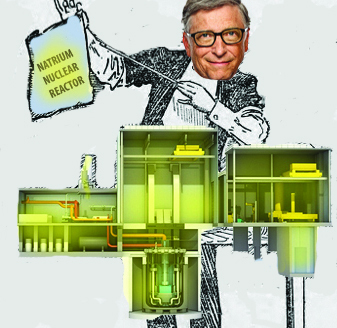
Bill Gates’s darling, the Natrium reactor in Wyoming is also plowing ahead. Both proposals are raking in the Inflation Reduction Act and other taxpayer funded subsidies. The danger: Money and time wasted on these false solutions to the climate crisis divert public resources from renewables, energy efficiency and other faster, more cost-efficient and safer ways to address the climate crisis.
A recent study from the Institute for Energy Economics and Financial Analysis concluded that small modular nuclear reactors are still too expensive, too slow to build and too risky to respond to the climate crisis.
While the nuclear industry tries to pass itself off as “clean,” it is an extremely dirty technology, beginning with uranium mining and milling which decimates Indigenous lands. Small modular nuclear reactors produce two to thirty times the radioactive waste of older nuclear designs, waste for which we have no safe, long-term disposal site. Any community that hosts a nuclear reactor will likely be saddled with its radioactive waste – forever. This harm falls disproportionately on Indigenous and low-income communities.

For those of us downriver, X-Energy’s plans to build at the Hanford Nuclear Site on the Columbia flies in the face of reason, as it would add more nuclear waste to the country’s largest nuclear cleanup site.
In Oregon, we have a state moratorium on building nuclear reactors until there is a vote of the people and a national waste repository. Every few years, the nuclear industry attempts to overturn this law at the Oregon Legislature, but so far it has been unsuccessful. This August, Umatilla County Commissioners announced they’ll attempt another legislative effort to overturn the moratorium. Keeping this moratorium is wise, given the dangerous distraction posed by the false solution of small modular nuclear reactors. Let’s learn from the NuScale debacle and keep our focus on a just transition to a clean energy future–one in which nuclear power clearly has no place.
Labour just railroaded a secretive US-UK nuclear treaty renewal deal
by The Canary, 30 October 2024
The Campaign for Nuclear Disarmament (CND) said it condemns the government’s outrageous railroading through parliament of the renewal of the US-UK Mutual Defence Agreement (MDA), the secretive treaty that underpins the nuclear ‘special relationship’ between London and Washington.
The MDA: under a cloak of secrecy
In force since 1958, the MDA allows for the transfer of key technologies, information, and nuclear materials to and from the US. Since its inception, the treaty has been amendable every ten years, also requiring parliamentary agreement on its extension.
But the government intends to make this treaty permanent by removing the clause that requires the treaty to be extended, and enables debate and amendment, including rejection. CND said:
n an open and democratic society, a major change like this should be given due consideration and debate in parliament. However, the government has disgracefully obstructed this by announcing its planned changes to the MDA just before parliament’s summer recess – guaranteeing six weeks of inaction.
Upon their return, MPs spent much of September and October engaged with party conferences. This shamefully left little time for parliament to debate the proposed changes before the deadline of 23 October.
Labour’s railroading of US nuclear co-operation: CND reacts
CND general secretary Kate Hudson said:
Thousands of CND supporters have contacted their MPs to raise the MDA as an issue for debate in Parliament before the 23 October deadline. Despite this outpouring of public concern, the limited time MPs have spent in Parliament since the election has left very little space for the open discussion this significant but little-known treaty deserves.
The railroading of the MDA by the government is typical of the policy that successive governments have been pursuing when it comes to Britain’s military policies and its possession of nuclear weapons.
This ‘special relationship’ tethers British military and foreign policy to Washington – and makes redundant the claim that Britain has an independent nuclear weapons system. Without US support, Britain would be unable to sustain its nuclear arsenal. Efforts to scrutinise this relationship are regularly deflected by the government under the guise of national security.
SO, CND will protest not only the MDA, but also the return of US nuclear weapons to Britain – ahead of the US presidential election.
CND protesting at Lakenheath on 2 November
The group and its supporters will mobilise at RAF Lakenheath on Saturday 2 November, to oppose plans to station US nuclear weapons in Britain for the first time since 2008.
This will be CND’s fourth national mobilisation at RAF Lakenheath since 2022, after US government budget documents revealed plans for upgrade works at the US-run air base for the storage of the new B61-12 guided nuclear bomb.
With the US presidential election to take place just days later, the protest aims to highlight the significant impact of US foreign and military policy on the British public, and the increased nuclear dangers brought by deploying its nuclear weapons in Britain – by whoever wins the White House.
Attendees will also witness an unofficial declaration of Lakenheath as a nuclear-free zone, and calls for both the UK and other nuclear weapons states to engage with the UN Treaty on the Prohibition of Nuclear Weapons.
CND will be joined by Melissa Parke ,executive director of the International Campaign to Abolish Nuclear Weapons (ICAN), the organisation that won the 2017 Nobel Peace Prize. Melissa will speak about nuclear dangers in Europe.
No US nuclear weapons on UK soil
Details of the protest are as follows:
- Saturday 2 November.
- 12 noon to 3pm.
- RAF Lakenheath Main Gate, Brandon Road, Lakenheath, Suffolk. More details on parking can be found on the CND website here.
…………………………………………………..
https://www.thecanary.co/uk/news/2024/10/30/cnd-nuclear-weapons-treaty/
“Ultra Safe” Nuclear Corp. 1 Major Microreactor Developer Enters Bankruptcy

Ultra Safe” Nuclear Corp. filed Chapter 11 bankruptcy yesterday . Beneath the finance jargon in the article, it appears the company will be divvied up and the various parts sold off. The one part of USNC that seems to have value is its TRISO fuel manufacturing subsidiary, which is building a pilot plant for making TRISO at Oak Ridge National Lab. A company named Standard Nuclear has put in a standing offer to purchase that division for $28 million, if USNC doesn’t receive any other offers.
The article also implies USNC’s other subsidiaries will continue pursuing the microreactor demonstration projects in Canada (at Chalk River) and the US (at Univ. of Illinois, Urbana-Champaign). But it also says the company’s debts are greater than its assets, so it’s not clear how that would happen. Probably, USNC is holding out for a large company to swoop in and buy them out. But one piece the article doesn’t mention is that USNC has been threatening to sue the Dept. of Defense for the last 14 months to upset a procurement deal DOD reached with Oklo to supply a reactor to power the Eielson Air Force Base in Alaska. DoD rescinded the deal with Oklo last year and has been slow to reissue the bid for the project. It’s possible that USNC’s bankruptcy will clear the way for DoD to reaffirm the deal with Oklo.
Not that Oklo is in much better condition to succeed. It’s stock shot up in the last month like most companies in the nuclear industry, but it has not announced any big investment deals or sales contracts, not even with ChatGPT, whose CEO is an angel investor in Oklo and chairs the company’s board.
Major Microreactor Developer Enters Bankruptcy Amid Nuclear Industry Surge Power, Oct 29, 2024,
Ultra Safe Nuclear Corp. (USNC), a developer of much-watched microreactor technology and advanced nuclear fuel, has filed for Chapter 11 bankruptcy. The move signals a critical restructuring phase through which the company will seek to secure new ownership while ensuring uninterrupted operations.
The company’s Oct. 29 filings at the U.S. Bankruptcy Court for the District of Delaware include its key subsidiaries: USNC-Power Ltd., which develops the company’s flagship 15-MWe (45 MWth) Micro Modular Reactor (MMR) technology; Global First Power Limited (GFP), focused on nuclear project development within Canadian markets; and USNC-Technologies, which leads USNC’s nuclear technology research and development initiatives. Each subsidiary plays a distinct role in USNC’s vertically integrated approach to advancing its Gen IV nuclear technology.
Process Designed to Keep USNC Operating
USNC’s petition is intended to facilitate a streamlined sale process under Section 363 of the Bankruptcy Code, which would allow the Oak Ridge, Tennessee–headquartered USNC to offload assets while continuing to operate its existing projects under a court-supervised process………………………..
USNC is currently invested in two separate MMR high-temperature gas-cooled reactor (HTGR) projects. In Canada, GFP is spearheading a 15-MWe MMR demonstration at Canadian Nuclear Laboratories’ (CNL) Chalk River site in partnership with Ontario Power Generation. The project, which kicked off in 2019, is currently pursuing licensing, engineering and system development, and environmental assessment. Site work is slated to begin in 2026, with operations scheduled in 2028 or 2029. USNC is also developing an MMR that will be built and operated at the University of Illinois at Urbana-Champaign’s Grainger College of Engineering as a Class 104(c) utilization facility for research and development purposes………………………………………………………………………………………………….
https://www.powermag.com/major-microreactor-developer-enters-bankruptcy-amid-nuclear-industry-surge/
Settlers prepare for ’resettlement in Gaza’

Voltaire Network | 25 October 2024, https://www.voltairenet.org/article221426.html
Israeli Minister of National Security Itamar Ben-Gvir took part in a two-day meeting on Israel’s southern border entitled “Preparing for our resettlement in Gaza” on the occasion of the Jewish holiday of Sukkot. He said: “What we have learned this year is that everything depends on us. We are the owners of this land. Yes, we have experienced a terrible catastrophe. But we must understand that a year later, so many Israelis have changed their mentality. They have changed their mindset. They understand that acting as the rightful owners of this land brings results.
Referring to the Palestinian prisoners, he went on: “We took their jelly sandwiches. We took their chocolate. We took their televisions. We took their ping-pong tables and practice time. You should see them crying and weeping in their cells. This is our proof: when we decide we can, we do succeed.”
“We will encourage the voluntary transfer of all citizens of Gaza. We will offer them the opportunity to move to other countries because this land belongs to us,” he concluded.
• Spokesperson for the “Mothers’ Parade” Sima Hasson said “I’m going to say something that not everyone here is ready to say, but I am, and I know many of you are, ready to say it: “Conquer, expel and resettle”. I’m not just talking about an area of Gaza. I’m not just talking about northern Gaza. I mean every area of land. This is the only way to prevent our boys from constantly going to war. To all those in Europe who have an opinion about what is going on here, I say: do not meddle. Your entire continent is invaded by radical Islam!”
Pasionaria of the settler movement Daniella Weiss said: “We came here with a clear objective: to occupy the entire Gaza Strip… Every inch from north to south. We are thousands of people and we are ready to go to Gaza. October 7 changed history. As a result of the brutal massacre, the Arabs of Gaza have lost their rights to be here forever, they will not stay here.
• Minister of the Negev, Galilee and National Resilience Yitzhak Wasserlauf said: “For 2,000 years, we dreamed of returning to our Jewish homeland. I know that those who disagree with us call it messianism. I call it Zionism. We are true Zionists. We love our land, we love our people, and we value life. And we have a responsibility to create a safe, Jewish nation on the land God has given us.
• Minister of Social Equality and the Advancement of Women May Golan said: “We will hit them where it hurts: their land. Whoever uses his plot of land to plan another holocaust will receive from us, with God’s help, another Nakba [catastrophe].
In February 2024, the settler movement had already organized a “Conference for Israel’s victory – settlements bring security: return to the Gaza Strip and northern Samaria” in Jerusalem in which they threatened the United States and the United Kingdom with resurrecting the Stern terrorist group [1].
This is the editorial from our paywalled “Voltaire, international newsletter”, n°105. For more information, do not hesitate to subscribe: 500€ per year.
Translation
Gregor Fröhlich
South Africa Files 750 Pages of ‘Overwhelming’ Evidence in ICJ Genocide Case Against Israel

“The glaring genocide in Gaza is there for all who are not blinded by prejudice to see.”
By Brett Wilkins / Common Dreams, 30 Oct 24
South Africa filed 750 pages of “overwhelming” proof that Israel is committing genocide in Gaza to the International Court of Justice in The Hague, Netherlands on Monday, the deadline for submitting final evidence in the ongoing trial.
South African Ambassador to the Netherlands Vusi Madonsela delivered the legal document—known as a memorial—to the ICJ headquarters in the Dutch city. Under the court’s rules, the contents of the memorial cannot be made public at this time.
According to a statement from the office of South African President Cyril Ramaphosa, the memorial is a “comprehensive presentation of the overwhelming evidence of genocide in Gaza.”
The office said the document “contains evidence which shows how the government of Israel has violated the Genocide Convention by promoting the destruction of Palestinians living in Gaza, physically killing them with an assortment of destructive weapons, depriving them access to humanitarian assistance, causing conditions of life which are aimed at their physical destruction, and ignoring and defying several provisional measures of the International Court of Justice, and using starvation as a weapon of war and to further Israel’s aims to depopulate Gaza through mass death and forced displacement of Palestinians.”
South Africa filed 750 pages of “overwhelming” proof that Israel is committing genocide in Gaza to the International Court of Justice in The Hague, Netherlands on Monday, the deadline for submitting final evidence in the ongoing trial.
South African Ambassador to the Netherlands Vusi Madonsela delivered the legal document—known as a memorial—to the ICJ headquarters in the Dutch city. Under the court’s rules, the contents of the memorial cannot be made public at this time.
According to a statement from the office of South African President Cyril Ramaphosa, the memorial is a “comprehensive presentation of the overwhelming evidence of genocide in Gaza.”
The office said the document “contains evidence which shows how the government of Israel has violated the Genocide Convention by promoting the destruction of Palestinians living in Gaza, physically killing them with an assortment of destructive weapons, depriving them access to humanitarian assistance, causing conditions of life which are aimed at their physical destruction, and ignoring and defying several provisional measures of the International Court of Justice, and using starvation as a weapon of war and to further Israel’s aims to depopulate Gaza through mass death and forced displacement of Palestinians.”
“The evidence will show that undergirding Israel’s genocidal acts is the special intent to commit genocide, a failure by Israel to prevent incitement to genocide, to prevent genocide itself, and its failure to punish those inciting and committing acts of genocide,” Ramaphosa’s office added.
South Africa’s filing comes amid Israel’s ongoing 387-day assault on Gaza, which according to Palestinian and international agencies has killed at least 43,020 people—most of them women and children. At least 101,110 others have been wounded and over 10,000 Gazans are missing and believed dead and buried beneath the rubble of hundreds of thousands of bombed homes and other structures. Millions more Palestinians have been forcibly displaced, starved, or sickened by Israel’s invasion and “complete siege” of Gaza.
The filing also comes one week after senior members of Israeli Prime Minister Benjamin Netanyahu’s far-right Cabinet and national lawmakers spoke at a conference advocating the ethnic cleansing and recolonization of Gaza.
Ramaphosa’s office lamented that “Israel has been granted unprecedented impunity to breach international law and norms for as long as the United Nations Charter has been in existence.”………………………………………………………………https://www.commondreams.org/news/south-africa-icj-genocide-israel
Sizewell C nuclear project proceeds by stealth – vast sums of public money spent, with no public disclosure about its true cost
1 The Autumn Budget includes a £14.1bn settlement for DESNZ in 2025/26,
which includes £2.7 bn for Sizewell C. This amounts to half the £5.5bn,
two year subsidy scheme published in August. The Chancellor chose not to
mention Sizewell C or nuclear energy in her speech to the House of Commons.
Stop Sizewell C said: “For a government that criticised the opposition
for playing fast and loose with the nation’s finances, the Chancellor is
surprisingly happy to do the same, allocating another £2.7 billion of
taxpayers’ money on risky, expensive Sizewell C, without making any
guarantee of a Final Investment Decision being taken.
Including £2.5 billion already spent, this means £5.2 billion of our money will be spent
on a project that cannot even help Labour achieve its energy mission, and
is looking increasingly toxic to private investors.”
The Chancellor also announced that David Goldstone has been appointed as the independent Chair of the “Office of Value for Money” within the Treasury. “Stop
Sizewell C urges David Goldstone to call in Sizewell C for immediate
scrutiny, as the project is currently proceeding by stealth. Despite almost
no public disclosure about its true cost or transparency about value for
money, vast sums of public money have already been spent on Sizewell C,
with the potential for billions more to be poured down the drain.”
Stop Sizewell C 30th Oct 2024
Ontario’s huge nuclear debt and other things Dutton doesn’t understand about cost of electricity

Unfortunately for us, Dutton and O’Brien are also in a hurry. They think they can deliver nuclear power plants far faster than what many experts believe is sensible and what many countries with far more nuclear experience than ourselves have been able to achieve.
Dutton and O’Brien also want to do this via a government-owned utility, instead of via a competitive market.
ReNewEconomy, Tristan Edis, Oct 30, 2024
All of this has left taxpayers with a massive budget and timeframe blow-out. This is what happens when we leave it to politicians in a hurry to hand pick power projects.
It seems our alternative Prime Minister Peter Dutton’s favourite topic is your electricity bill. Given how much he talks about electricity prices, you’d think he might know a fair bit about what makes up your electricity bill, wouldn’t you?
According to Dutton and his Shadow Energy Minister Ted O’Brien, the problem is all about too much renewable energy in the mix. And their answer to the problem is nuclear power, as well as more gas.
According to Peter Dutton, “We can’t continue a situation that Labor has us on of a renewables only policy because, as we know, your power prices are just going to keep going up under this Prime Minister.”
Instead, according to Dutton, “we could be like Ontario, where they’ve got 60 or 70 per cent nuclear in the mix, and they’re paying about a quarter of the price for electricity that we are here in Australia.”
O’Brien, elaborated on this point by saying:
“We will have plenty of time in due course to talk about the costings [for their nuclear plan] once we release them here in the Australian context. But I point to Ontario in Canada, there you have up to 60 per cent of their energy mix in the grid, coming from zero emissions, nuclear energy. Their households pay around about 14 cents kilowatt hour. There are parts in Australia that will be paying up to 56 cents a kilowatt hour from July 1 this year.”
Once you actually delve into these numbers it becomes apparent that O’Brien and Dutton don’t seem know much about electricity costs and pricing.
But even worse, they don’t know how badly Ontario’s taxpayers and electricity consumers were burnt by their utility racking up huge debt building nuclear power plants equal to $70 billion in current day Australian dollars.
Do Dutton and O’Brien understand your electricity bill?
You can actually look up what Ontario households pay for electricity via the Ontario Energy Board’s bill calculator website.
This provides you with a break down on the charges a typical household faces depending on the utility you choose…………………………………………………
But notice there’s also other very significant items in this bill separate to the kilowatt-hour charge? There’s a “delivery” charge which is the cost of paying for the distribution and transmission poles and wires. There’s also regulatory charges and also their sales tax is known as “HST” rather than GST for us.
So the Ontario 14 cents per kilowatt-hour charge that O’Brien and Dutton are referring to covers only the wholesale energy portion of their bill.
In Australia, we pay a majority of the costs of distribution and transmission in our cents per kilowatt-hour charge, in addition to wholesale energy costs, and then we get GST added on top. O’Brien and Dutton don’t seem to have appreciated this important aspect of electricity pricing in this country, which is different to Ontario.
But it actually gets worse.
I went digging on the official government energy retailer comparison sites- www.energymadeeasy.gov.au and www.energycompare.vic.gov.au and I initially couldn’t find a single Australian retailer selling electricity at 56 cents per kilowatt-hour.
This was based on looking at offers based on a single rate tariff. Then I had a brainwave and looked at time-of-use rates. In Queensland and Victoria I still couldn’t find anyone wanting to charge me 56 cents for the peak period.
But eventually I succeeded. Right at the bottom of the EnergyMadeEasy list of retailer offers – which were ordered from best to worst – sat EnergyAustralia as the worst offer, charging 57 cents for the peak period in South Australia (although with a compensating high solar feed-in tariff of 8.5 cents)…………………………………
To help out O’Brien and Dutton, I’ve prepared the table below which provides a proper apples versus apples comparison (as opposed to apples vs peak rate bananas) –[on original ]
…………………………………………….. Ontario’s nuclear debt debacle
Yet this comparison between Ontario and Australia misses a far more important part of the story that O’Brien and Dutton seem to be blissfully ignorant of.
That is the history of the Ontario’s state owned utility – Ontario Hydro – and the unsustainable level of debt that it racked up over the 1980’s and 1990’s as a result of an ambitious nuclear plant construction program that went wrong.
While this cost is no longer apparent in current electricity prices, Ontario businesses and households were stuck with paying back CAD$38.1 billion in debt (over $70 billion in Australian current day dollars) for more than 35 years after their public utility committed its last nuclear reactor to construction in 1981.
So what went wrong?
In anticipation of large growth in electricity demand, over the 1970’s and 1980’s Ontario Hydro committed to construction 12 nuclear reactors with 9,000 MW of generating capacity. To fund the projects the public utility accessed commercial debt markets anticipating that it could comfortably repay this debt from the increased electricity demand it forecast. However, several things went wrong.
The nuclear power stations took far longer to build and were around twice as expensive to build than had been planned
– Interest rates on debt rose to very high levels by historical standards over the 1980’s in order to contain the high levels of inflation that unfolded over the 1970’s and early 1980’s. With the nuclear power stations taking longer than expected to build, interest was accumulating on this debt with far less output from the plants to offset it.
– Lastly, Ontario Hydro’s estimate of large growth in electricity demand didn’t eventuate. A 1977 forecast projected a system peak of 57,000 MW by 1997. Actual peak demand in 1997 was 22,000 MW. This meant that the very large cost and associated debt of the large nuclear expansion had to be recovered from a much smaller volume of electricity sales than it had anticipated, making it much harder to pay off the debt without substantial increases in electricity prices.
……………………………………………………………………………………………………………… “On April 1, 1999, the Ministry of Finance determined that Ontario Hydro’s total debt and other liabilities stood at $38.1 billion, which greatly exceeded the estimated $17.2-billion market value of the assets being transferred to the new entities. The resulting shortfall of $20.9 billion was determined to be “stranded debt,” representing the total debt and other liabilities of Ontario Hydro that could not be serviced in a competitive environment.”
So the CAD$38.1 billion in debt was transferred out of the electricity companies and into a special purpose government entity called the Ontario Electricity Financial Corporation (OEFC). This debt management corporation was given the following revenues to service the debt:
– Both residential and business consumers were required to pay a special “Debt Retirement Charge”. This charge was introduced in 2002 and lasted until 2016 for residential consumers and 2018 for business customers.
– The Ontario government would forgo any corporate income and other taxes owed by the offshoot electricity companies from Ontario Hydro so they could be diverted to the OEFC to pay down debt.
– If the cumulative profits of two of the new state power companies exceeded the $520m annual interest cost on their debts, then this would go towards paying stranded debt rather than dividends to the Ontario government.
None of this is apparent on current bills, but the burden of repaying the nuclear debt left the Ontario government and its taxpayers far poorer than Dutton and O’Brien seem to appreciate.
More things O’Brien doesn’t want to understand about Ontario’s nuclear power program
Dutton and O’Brien like to claim that nuclear power plants last a very long time and so therefore the large upfront cost of these plants isn’t something we should be too worried about………………………..
It’s not as simple as this. Nuclear power plants involve a range of components which are exposed to severe heat and mechanical stress. These all need to be replaced well before you get to 60 years, and such refurbishment comes at a cost.
Ontario’s experience is that refurbishment comes at a very significant cost. Less than 25 years after the Darlington Nuclear Power Plant construction was completed, it needed to commence refurbishment. The total cost? $12.8 billion in Canadian dollars or $14 billion Australian dollars.
This is partly why, even though the original nuclear construction cost debt had been largely paid down and nuclear operating costs are lower than coal or gas plant, Ontario still pays more for its electricity than we do.
This is because the current owner of the nuclear power plants – Ontario Power Generation – operates under regulated return model where the regulator grants them the right to recover these refurbishment costs from electricity consumers.
Are O’Brien and Dutton about to commit to another Snowy 2.0 budget blow-out, but on steroids?
………………………………The problem here is that when you don’t know very much and you’re spending other people’s money, ego can easily cloud your judgement. Don’t get me wrong, ego will often cloud business leaders’ judgement too. But their ability to spend money to feed their ego can only so far before either competitors or shareholders intervene.
Ontario taxpayers on the other hand realised far too late that their public utility, in cahoots with their politicians, were pursuing a nuclear vanity project built upon a poor understanding of the future, and without any competitor to discipline their ego.
Australian taxpayers have seen a similar mistake unfold with the Snowy 2.0 pumped hydro plant whose cost now stands at five times greater than the original expectation, and double what was meant to be a fixed price construction contract.
Snowy 2.0 is a parable of what goes wrong when:
– Politicians rush things leading to inadequate planning and preparation;
– Politicians fail to objectively and thoroughly evaluate alternatives; and
– Politicians fail to employ open and competitive markets to deliver end consumer outcomes.
All of this has left taxpayers with a massive budget and timeframe blow-out. This is what happens when we leave it to politicians in a hurry to hand pick power projects.
Unfortunately for us, Dutton and O’Brien are also in a hurry. They think they can deliver nuclear power plants far faster than what many experts believe is sensible and what many countries with far more nuclear experience than ourselves have been able to achieve. Dutton and O’Brien also want to do this via a government-owned utility, instead of via a competitive market.
While the budget blowout of Snowy 2.0 is bad enough, it pales into comparison with the kind of cost blow-outs that can unfold with nuclear power projects. As an example, the budget for completion of UK’s Hinkley Point C nuclear project now stands at $89.7 billion which is three times higher than what was originally budgeted.
We’ve all seen this movie before, including in Ontario, and it doesn’t end well……………………………………………………………………………………………………………….. more https://reneweconomy.com.au/ontarios-huge-nuclear-debt-and-other-things-dutton-doesnt-understand-about-cost-of-electricity/
Ukraine and Russia in talks about halting strikes on energy plants
Ukraine and Russia are in preliminary discussions about halting strikes on
each other’s energy infrastructure, according to people familiar with the
matter. Kyiv was seeking to resume Qatar-mediated negotiations that came
close to agreement in August before being derailed by Ukraine’s invasion
of Kursk, said the people, who included senior Ukrainian officials.
FT 29th Oct 2024, https://www.ft.com/content/69a57022-aeed-4bfe-8ada-b2ccd38f162a
Israeli Knesset Passes Bill To Ban UN Palestinian Relief Agency
The collapse of UNRWA’s aid efforts in Gaza would ensure the starvation of more Palestinian civilians
by Dave DeCamp October 28, 2024 , https://news.antiwar.com/2024/10/28/israeli-knesset-passes-bill-to-ban-un-palestinian-relief-agency/#gsc.tab=0
The Israeli Knesset on Monday passed a bill banning the UN’s Palestinian relief agency, UNWRA, from operating inside Israel and another that will severely limit its ability to operate in Gaza and the West Bank. The legislation is expected to take effect in 90 days.
The first bill banning UNWRA in Israel passed in a vote of 92-10. The second bill aimed at ending UNWRA’s operations in the Israeli-occupied territories passed in a vote of 97-9.
The second bill prohibits Israeli authorities from having any contact with UNRWA, making it impossible for the relief agency to coordinate with the Israeli military on aid deliveries. The legislation does not outline any plan to replace UNRWA’s relief efforts in Gaza, which millions of Palestinian civilians rely on to survive.
Israel has waged war against UNWRA over the past year, killing over 200 of its staff members in Gaza. Israel has claimed a significant number of UNWRA’s staff are members of Hamas but has offered no evidence for the allegations, which have been strongly rejected by the UN agency.
The US took Israel’s claims at face value and cut off funding to UNWRA at the beginning of the year. Now, the US is warning Israel against implementing the bills banning UNRWA since it would starve Palestinian civilians.
“If UNRWA goes away, you will see civilians — including children, including babies — not be able to get access to food and water and medicine that they need to live. We find that unacceptable,” State Department spokesman Matt Miller said ahead of the Knesset vote.
“We continue to urge the government of Israel to pause the implementation of this legislation. We urge them not to pass it at all, and we will consider next steps based on what happens in the days ahead,” Miller added.
UNWRA was formed in 1949 to provide aid to about 750,000 Palestinians who were displaced when the state of Israel was founded in 1948, an ethnic cleansing known to the Palestinians as the “Nakba.” Today, Israeli ministers are calling for a new Nakba in Gaza to pave the way for Jewish settlements, and the Israeli military is currently imposing a starvation siege on northern Gaza to forcibly displace hundreds of thousands of civilians.
South Bruce Deep Geological Repositary (DGR) opposition promises to keep fighting
Scott Dunn, Oct 29, 2024 Owen Sounds Sun Times
A group opposed to burying high-level nuclear waste in South Bruce says it will keep fighting because having just 78 more votes in favour than against the project in Monday’s referendum isn’t a “compelling” demonstration of community support.
Bill Noll, the co-chair of Protect Our Waterways – No Nuclear Waste, said in an interview that that’s part of what will be argued at regulatory hearings if Nuclear Waste Management Organization selects South Bruce as its preferred site.
Council for Ignace Township in Northern Ontario, the other site remaining in the running, has already voted in favour of being a willing host, after residents voted in favour of the proposal. First Nations in both locations must still decide if they’re in favour too.
“People are still concerned, a large group of people in South Bruce who are saying no to this project,” said Noll, a retired electrical engineer who lived in South Bruce for 15 years before moving to near Ottawa to be near family.
There were 51.2 per cent, or 1,604 voters saying yes, and 48.8 per cent, or 1,526, who voted no, according to unofficial results posted by the municipality Monday night. Eight electors declined their ballot.
The vote result “doesn’t really give the council a mandate to say we won this,” Noll said.
But council is expected to ratify the result which Mayor Mark Goetz said is binding on council, even as he acknowledged it was a close vote, at a special council meeting Nov. 12. ………………………….
Now it will be up to Saugeen Ojibway Nation to decide if it would be a willing host, he said.
…………………………………………Both Ignace and South Bruce have signed agreements with NWMO that would see them receive millions of dollars over the lifespan of the project — $418 million over 138 years in South Bruce and $170 million over 80 years in Ignace.
………………………………………………………..Noll credited Protect Our Waterways for obtaining a referendum vote by insisting on a study of the community’s willingness because otherwise, it was going to be done by council vote.
“NWMO said in their early stages that the community needed to have two things: one, they needed to demonstrate a compelling willingness and the other thing was they needed to be informed,” Noll said.
“Well, I don’t think either of those conditions have been met at this stage. So that will be our agenda when we get into the regulatory process.” https://www.owensoundsuntimes.com/news/local-news/south-bruce-dgr-opposition-promises-to-keep-fighting
South Bruce voters narrowly approve being host to nuclear waste
Scott Dunn Oct 29, 2024 , Horeline Beacon
Teeswater is near one of the two proposed sites for an underground storage facility for the country’s highly radioactive nuclear fuel.
By a thin majority, the answer in South Bruce was yes. Bruce declaring South Bruce to be a willing host for the Nuclear Waste Management Organization’s proposed Deep Geological Repository (DGR)? resulted in 51.2 per cent, or 1,604, of voters saying yes, and 48.8 per cent, or 1,526, saying no, according to unofficial results posted by the municipality Monday night. Eight electors declined their ballot.
Voter turnout was 3,138 of 4,525 electors, or 69.3 per cent. Since turnout was above 50 per cent, the results are binding on municipal council…………………
Teeswater’s residents were divided by the prospect of burying spent nuclear fuel in a deep, underground vault, people said in interviews outside the community’s post office earlier Monday.
Nuclear Waste Management Organization has secured land for a possible DGR site northwest of Teeswater, part of South Bruce. If the area is selected, the NWMO would build and manage the bunker to be some 650 metres underground.
But first NWMO needed to confirm if the community was a willing host. A referendum was chosen as the way to do that, and voting is to end at 8 p.m. today. It would take 50 per cent plus one of eligible voters to signal willingness, as long as at least 50 per cent of South Bruce voters cast ballots. Otherwise the decision was council’s to make.
……………………………….. there’s the risk of a leak, and the implicit requirement to trust officials who say the job can be done safely. Still others said they think government has already decided it will build the nuclear storage facility in South Bruce……………………………………………………………………………… more https://www.shorelinebeacon.com/news/local-news/update-south-bruce-voters-narrowly-approve-being-host-to-nuclear-waste
Japan struggles to find nuclear waste disposal site

Japan is facing difficulties selecting a final disposal site for high-level radioactive waste left from spent fuel at nuclear power plants across the nation.
https://www.japantimes.co.jp/news/2024/10/27/japan/nuclear-waste-site-struggles/
First-stage surveys to find locations suited to host an underground storage facility have been conducted in three municipalities — two in Hokkaido and one in Saga Prefecture — despite continuing anxieties among local residents.
With nuclear power plants in Japan gradually going back online, there remains no clear timeline for reprocessing spent nuclear fuel, keeping the government’s goal of a nuclear fuel cycle out of reach.
High-level radioactive waste, which is vitrified after uranium and plutonium are extracted from spent fuel for reuse, presents a significant challenge. Japan’s plan for final disposal involves burying the waste more than 300 meters underground for tens of thousands of years, allowing its radioactivity to diminish over time.
Nuclear power plants in Japan, operating without a designated final dump site for waste, are often criticized for being like “a condominium building without a toilet.”
The Nuclear Waste Management Organization of Japan, or NUMO, responsible for managing final disposal, began inviting municipalities to host surveys for potential dump sites in 2002. To date, however, no location has been selected.
The research process for selecting a final repository site consists of three stages: a literature survey, a drilling survey, and a detailed investigation using an underground facility. Local governments that host such surveys receive subsidies from the central government.
Literature surveys, which involve reviewing geological maps and historical earthquake records, began in the town of Suttsu and the village of Kamoenai in Hokkaido in 2020, and in the town of Genkai, Saga Prefecture, in 2024. No other municipality has agreed to participate in site selection research, however.
The first-stage surveys concluded that all of Suttsu and most of Kamoenai are suitable for moving forward to the drilling survey phase. NUMO plans to release a report as early as this fall and hold briefing sessions for local residents.
Still, Hokkaido Gov. Naomichi Suzuki has expressed opposition to the drilling surveys, and Saga Gov. Yoshinori Yamaguchi has also voiced objections to conducting such a survey in Genkai. The consent of the prefectural governor is required to proceed with second-stage surveys.
The central government has emphasized its responsibility in its basic policies on the final disposal of nuclear waste and aims to conduct surveys in about 10 additional locations, following international precedents.
In the past, the town of Toyo in Kochi Prefecture and the city of Tsushima in Nagasaki Prefecture considered hosting surveys but ultimately declined. Central government representatives now plan to visit over 100 local governments, increasing opportunities to explain the process to residents.
Japan, which has relied on nuclear power for over half a century, currently holds around 19,000 tons of spent fuel at its nuclear power plants and other facilities, using about 80% of its total storage capacity.
As a resource-scarce nation, Japan has been promoting a nuclear fuel cycle, by which spent fuel is reprocessed and recycled for continued use in power generation. The reprocessing plant that is key to this cycle has yet to be completed, however.
Japan Nuclear Fuel started construction of the country’s first commercial reprocessing facility in Rokkasho, Aomori Prefecture, in 1993, but its completion has been delayed 27 times.
In September, an interim storage facility in the city of Mutsu, Aomori Prefecture, took delivery of the first batch of spent fuel from Tokyo Electric Power Company Holdings’ Kashiwazaki-Kariwa nuclear plant in Niigata Prefecture. This facility, not on the premises of any nuclear power plant site, will store the fuel for up to 50 years before it undergoes reprocessing.
Many local residents see the receipt of spent fuel as premature, given the unfinished reprocessing plant and the lack of a final disposal solution. They worry that storage at the facility may become permanent rather than temporary.
The central government has decided to rebuild nuclear power plants and extend their operational periods. This marks a reversal of the previous policy, which aimed to reduce reliance on nuclear energy following the March 2011 accident at TEPCO’s Fukushima No. 1 plant, caused by severe damage from the earthquake and tsunami the same month.
An official from the Ministry of Economy, Trade and Industry said that “as we have used nuclear power plants, we cannot avoid” the issue of final nuclear waste disposal.
Hideki Masui, president of Japan Atomic Industry Forum, emphasized the need for “a national debate” as Japan struggles to conduct surveys in additional areas for potential disposal sites, placing disproportionate burdens on certain regions.
Nuclear Free Local Authorities (NFLAs) believe budget is opportunity to lobby Ministers to ditch Sizewell C
Chancellor Rachel Reeves will be unveiling the contents of her red box when making her Autumn Statement on Wednesday and the UK/Ireland Nuclear Free Local Authorities believes this offers an opportunity to lobby Labour to ditch Sizewell C – if opponents act now.
Though intended to be constructed by French owned nuclear operator EDF Energy, the outgoing Conservative Government squandered £2.5 billion of taxpayers money on preparatory work, and in August 2024, Labour compounded the calumny by announcing a new subsidy scheme that could make up to a further £5.5 billion in public money available to support this unwanted white elephant. Consequently, the project is now 76%-owned by the British Government at a time when Ministers and their advisors still desperately chase private sector investors to back this Suffolk turkey.
There are still many unknowns about the eventual overall cost of Sizewell C. In contrast to the amazing reductions achieved in recent years in the cost of generating electricity through renewables, the delivery cost of nuclear continues to rise. Given that Sizewell C’s predecessor, the identical Hinkley Point C, is being delivered hugely over budget with some estimates that the cost in real terms will be up to £46 billion, it is wholly incredible that this project can be delivered for the £20 billion that Ministers claim.
And Sizewell C presents additional costly challenges. As a consequence of climate change, the coastal location will be increasingly threatened by inundation from an encroaching sea, requiring significant expenditure on coastal defences. Further Suffolk is ‘water stressed’ meaning that there will be increasing competition for fresh water from inhabitants or commercial operators, and Sizewell C has still to secure a guaranteed sustainable potable water supply for its planned 60 years of operation.
Given the circumstances it is unsurprising that few players amongst the financial markets have expressed any interest in taking a stake in the Sizewell doonboggle, and there is still considerable uncertainty when, or even if, the Financial Investment Decision will be made.
Sizewell C also represents a double whammy for electricity consumers. As taxpayers, we are expected to front up to £8 billion in funding, incidentally almost the same in total that Labour has dedicated to Great Britain Energy over the entirely of its five year term in office, but as electricity consumers we will also be expected to reimburse the construction costs through the imposition of an additional levy on bills, derisking the project for the profit-focussed operator. Unsurprisingly, the NFLA Secretary has described this Regulated Asset Base (RAB) model as the ROB for it represents daylight robbery.
The Labour Government has announced that they will establish a new ‘Office of Value for Money’ within the Treasury and the appointment of a Chair is expected imminently. Stop Sizewell C has launched a petition calling for that office holder to prioritise an examination of the financial liability that is Sizewell C.
Although initial feedback from the Treasury to campaigners had indicated that Sizewell C would definitely be examined by the new office holder, officials in recent correspondence have been more ambivalent and a recent written answer by Nuclear Minister Lord Hunt to a House of Lords parliamentary question was opaque and non-committal.
Stop Sizewell C are also asking supporters of their campaign to join them in writing to the Chancellor, Prime Minister and Secretary of State for Energy to cancel Sizewell C.
The NFLAs would urge opponents of Sizewell C to sign the petition:
Reeves urged not to cut Sellafield funds amid concern at rise in ‘near misses’

GMB raises safety concerns amid rumours of budget cuts across sites and Nuclear Decommissioning Authority
Guardian, Alex Lawson and Anna Isaac, 28 Oct 24
Rachel Reeves has been urged not to carry out mooted funding cuts for nuclear sites including Sellafield amid safety concerns, as it emerged that the number of incidents where workers narrowly avoided harm had increased at the Cumbrian site.
The GMB union has written to Reeves, the chancellor, before Wednesday’s budget to raise safety concerns after rumours emerged that the budget for the taxpayer-owned Nuclear Decommissioning Authority (NDA) could be reduced, which could result in cuts at nuclear sites including Sellafield and Dounreay in Scotland.
In the letter to Reeves, seen by the Guardian, union leaders warned that a safety incident at Sellafield, Europe’s most hazardous industrial site, would “have devastating consequences far beyond the immediate community”. The NDA had a budget of £4bn in the last financial year.
The warning came as recently released annual accounts for the NDA showed “near misses” at Sellafield had risen in the last financial year, and an “international nuclear event-scale” incident had occurred at the site, which is a vast dump for nuclear waste and also the world’s largest store of plutonium.
The NDA said there was an “inadequate response” during an incident in 2023 as some staff did not follow procedures when an emergency alarm unexpectedly sounded inside the site’s hazardous chemical separation area.
The report also said Sellafield, which employs 12,000 people, had received six enforcement letters from its regulator, the Office for Nuclear Regulation, and that in studying its safety record the “rate of significant near misses is higher across 2023-24”.
It found that the impact on employees from work injuries had “often been significant” even if many of the incidents had appeared innocuous.
In the letter, Denise Walker and Roger Denwood, of the GMB, wrote: “While operators and regulators work tirelessly to ensure safety, the inherent risks of the site mean that any lapse in safety standards could result in serious and far-reaching economic and ecological consequences.”
They said radioactive “materials must be safely managed to prevent leaks or accidental releases of radiation. The health risks of radiation exposure, including cancer and other serious illnesses, are well documented.”
They added: “Any reduction in funding would inevitably result in fewer resources for maintenance, monitoring, and emergency preparedness-heightening the risk of a serious incident.”
The Guardian’s Nuclear Leaks investigation in late 2023 revealed a string of cybersecurity problems at Sellafield, as well as issues with its safety and workplace culture. Last week the National Audit Office said the cost of decommissioning the site had risen to £136bn, with major projects running years behind schedule……………………………. https://www.theguardian.com/business/2024/oct/28/sellafield-work-accidents-reeves-budget
Meltdown nightmares: silent spring for climate change

“Dirty Secrets of Nuclear Power in an Era of Climate Change,” strips away the myth that nuclear energy solves climate change
By Choi Hee-jin, October. 29. 2024, Korea Times: https://m-koreatimes-co-kr.cdn.ampproject.org/c/s/m.koreatimes.co.kr/pages/article.amp.asp?newsIdx=384891—
Asia is buzzing with the 2024 Nobel Prize announcements. The Nobel Prize in literature was awarded to a Korean author, Han Kang, and the Peace Prize to the Japanese organization Nihon Hidankyo, formed by Hibakusha in 1956 to improve support for victims and lobby governments to abolish nuclear weapons. Today, I would like to introduce a timely book that came out this summer on the topic of the Nobel Peace Prize.
In 1962, Rachel Carson published “Silent Spring,” a landmark book that ignited the modern environmental movement by exposing the hidden and devastating effects of widespread pesticide use. Her message raised public awareness about the harmful effects of DDT and led to the establishment of the Environmental Protection Agency in 1970. Consequently, it contributed to banning DDT in the United States in 1972 and internationally in 2004.
Like Carlson’s book, the recently released “Dirty Secrets of Nuclear Power in an Era of Climate Change,” strips away the myth that nuclear energy solves climate change and calls our attention to nuclear power. Its authors are Doug Brugge, professor and chair of the Department of Public Health Sciences at the University of Connecticut, and Aaron Datesman, visiting professor at the University of Virginia and engineer at NASA’s Goddard Space Flight Center.
Before delving into the book, some fundamental questions about climate change should be addressed. Is climate change real? Yes, it is happening. As temperatures continue to rise swiftly, the melting of glaciers and polar ice is becoming more pronounced, serving as a visible and reliable sign of climate change. What is the cause? There is much debate on this topic, but human activity — particularly our reliance on fossil fuels in built environments, cities, and infrastructure — is the main culprit. What is crucial in addressing climate change? Time. It depends on how quickly we switch from fossil fuels to other energy sources. Nuclear power, even in “highly developed” countries, takes a significant amount of time to implement as a solution.
Hidden Costs
Brugge and Datesman conclude that the effects of nuclear power may be more severe and longer lasting because some radioactive materials have such long half-lives, and nuclear accidents are so catastrophic. It exposes the hidden problems of the nuclear industry by looking at its impacts on people and the environment, with a focus on uranium mining, waste management and the dangers of nuclear proliferation.
Uranium mining disproportionately impacts Indigenous communities, leaving a legacy of pollution and health problems. The waste dilemma poses another challenge, with no permanent storage solution for high-level nuclear waste, potentially poisoning water, food chains and ecosystems for thousands of years.
The history of Fukushima and Chernobyl still haunts us and reminds us of the danger of nuclear accidents. The authors say even well-designed reactors are prone to failure due to human error, natural disaster or terrorism. These types of accidents would be a national security issue and would require massive long-term clean-up, and the communities affected would continue to live with the effects.
Economic realities of nuclear power
The economics of nuclear are also covered. Supporters point to the financial benefits of nuclear. But the book shows that the actual costs still need to be added in. Recent numbers bear this out: between 2010 and 2020, the cost of utility-scale solar and onshore wind fell 85 percent and 56 percent, respectively, while nuclear costs increased. The economics are shifting and making nuclear look less and less like a solution to climate change. The authors argue that renewable energy technologies offer a safer and more viable path to a decarbonized future.
A call for responsible energy choices
Nuclear power is being promoted as a solution in many countries and regions. Still, its inherent risks and unsolved problems mean there are better options for achieving net zero emissions and a carbon-free world. “Dirty Secrets of Nuclear Power in the Age of Climate Change” calls for global action to transition to more sustainable and equitable energy solutions. No one knowingly leaves a ticking time bomb in their house when there are safer alternatives.
In industrial history, miners would take small canaries deep into the earth, their delicate respiratory systems acting as an early warning system for toxic gases. A canary’s song, or its silence, could mean the difference between life and death for miners. While we continue to grapple with the ever-present dangers of invisible nuclear radiation and the consequences of its hazardous waste, we seem to treat future generations as unwitting canaries.
Perhaps the debate over nuclear power is outdated. It is essential to envision a completely new society with a carbon-free economy that ensures sustainable prosperity. We need to invest boldly in new alternatives and develop innovative technologies that harness nature’s limitless energy before it’s too late.
Choi Hee-jin is the author of “Future Cities” in The Routledge Handbook for Sustainable Cities and Landscapes in the Pacific Rim (2022), Salzburg Global Seminar Fellow (2023), and founder and CEO of RestFullness(restfullness.net), a platform for rest. She leads vocational formation and leadership sessions and coaches young leaders at METES Institute(metes.io).
1 This Month

Website of the Week

New book – https://www.amazon.com/dp/1923372157?utm_source=substack&utm_medium=email
Now until to February 10, 2026 Radioactive waste storage in France: the debate is finally open! How to participate?
-
Archives
- January 2026 (74)
- December 2025 (358)
- November 2025 (359)
- October 2025 (377)
- September 2025 (258)
- August 2025 (319)
- July 2025 (230)
- June 2025 (348)
- May 2025 (261)
- April 2025 (305)
- March 2025 (319)
- February 2025 (234)
-
Categories
- 1
- 1 NUCLEAR ISSUES
- business and costs
- climate change
- culture and arts
- ENERGY
- environment
- health
- history
- indigenous issues
- Legal
- marketing of nuclear
- media
- opposition to nuclear
- PERSONAL STORIES
- politics
- politics international
- Religion and ethics
- safety
- secrets,lies and civil liberties
- spinbuster
- technology
- Uranium
- wastes
- weapons and war
- Women
- 2 WORLD
- ACTION
- AFRICA
- Atrocities
- AUSTRALIA
- Christina's notes
- Christina's themes
- culture and arts
- Events
- Fuk 2022
- Fuk 2023
- Fukushima 2017
- Fukushima 2018
- fukushima 2019
- Fukushima 2020
- Fukushima 2021
- general
- global warming
- Humour (God we need it)
- Nuclear
- RARE EARTHS
- Reference
- resources – print
- Resources -audiovicual
- Weekly Newsletter
- World
- World Nuclear
- YouTube
-
RSS
Entries RSS
Comments RSS
 nuclear-news