The Israeli nuclear risk no one is talking about

Israel’s ability to build and deploy nuclear weapons, while never officially acknowledged, remains at the heart of its security doctrine
September 27, 2024 https://inews.co.uk/news/world/what-happens-us-stops-supporting-israel-3296914
A tenuous and inherently unstable military stand-off between Israel and Hezbollah – has finally shattered.
The latest outbreak in fighting is certain to result in increasing civilian casualties as Israel and Hezbollah exchange fire across the border.
As Israel faces numerous threats its possession of nuclear bombs lurk behind the growing debate over arms supplies to the nation.
Israel’s use of US-supplied weapons in Gaza in the past year has already forced the Biden administration to address the option of limiting the supply of US arms if US officials determine that Israel has committed gross human rights violations or blocked the movement of humanitarian assistance.
In addition, Senator Bernie Sanders is preparing several resolutions that would affect more than $20bn (£15bn) in US arms sales to Israel.
There is no chance that such measures will pass, but that is not the point. As an AP report noted, “the move is designed to send a message to the Netanyahu regime that its war effort is eroding the US’s long-time bipartisan support for Israel.”
Indeed, Washington and Jerusalem must face the unwelcome fact that such actions by Congress or the White House, however symbolic, may well undermine the longstanding bargain that not only keeps Israel’s conventional arsenals full … but also ensures that its nuclear bombs stay in the basement – undeclared and shrouded in a veil of ambiguity.
The Jewish state has long enjoyed a nuclear weapons monopoly in the region, and its ability to build and deploy nuclear weapons, while never officially acknowledged, remains at the heart of its security doctrine.
In the first days of the October 1973 “Yom Kippur” War, for example, Israel is believed to have placed a small number of nuclear warheads on alert and may have considered their deployment to stop a Syrian tank advance into Israel’s heartland.
It is no accident that Israel has never acknowledged having nuclear weapons. US policies developed in the aftermath of the June 1967 Six Day War have played a critical role in shaping Israel’s conventional and nuclear superiority.
Washington did oppose Israel’s nuclear weapons activities in the 50s and 60s. In the wake of the June 1967 war, however, a quid pro quo with Israel was established.
In return for Israel maintaining a policy of nuclear weapons ambiguity, Washington would guarantee what was termed Israel’s “qualitative military edge” – QME. That is, Washington will ensure that as long as Israel keeps its “bombs in the basement” – undeclared, unacknowledged, and unused – Washington will guarantee Israel the conventional weapons arsenal necessary to defeat any combination of regional enemies.
In the decades since, every change in US political or defence policy, every diplomatic or military engagement with Israel, has featured a ritualistic reaffirmation of Washington’s commitment to maintain Israel’s QME. See for example, the Democrats’ election platform, which declares that “our commitment to Israel’s security, its qualitative military edge, its right to defend itself … is ironclad.”
Indeed, the State Department recently reaffirmed that “the US is by statute mandated … to guarantee that … Israel has a qualitative military edge over rivals in the region. It’s not a discretionary question. It is a statutory requirement, and it is one that we are committed to.,, There is also an important deterrent effect to the United States continuing to send a message to Israel’s adversaries that if they attack Israel, we will defend it. And that’s a message that we will continue to send loud and clear.”
Since Israel’s peace treaty with Egypt in 1979, Iran under the rule of the ayatollahs has been deemed the biggest challenge to Israel’s regional hegemony in both the conventional and nuclear realms. and the biggest test of “ironclad” US support for QME.
Notwithstanding an officially declared intention to refrain from creating a nuclear weapons option, Iran’s production of highly enriched uranium continues.
Iran’s stock of uranium in the form of uranium hexafluoride enriched to up to 60 per cent purity, close to the roughly 90 per cent of weapons grade, grew an estimated 22.6kg to 164.7kg, according to a confidential quarterly International Atomic Energy Agency report recently sent to member states. According to an IAEA yardstick, that is 2kg short of being enough, in theory, if enriched further, for four nuclear bombs.
US Secretary of State Antony Blinken observed in July that “instead of being at least a year away from having the breakout capacity of producing fissile material for a nuclear weapon, (Iran) is now probably one or two weeks away from doing that… what we’ve seen in the last weeks and months is an Iran that’s actually moving forward” with its nuclear programme.
One might think that the prospect of a nuclear stand-off in the Middle East might arouse an international chorus of concern, especially since Blinken’s plaintive warning about a nuclear Iran is part and parcel of the metastasizing failure of US led effort to stabilise the cascading crises already consuming the heart of the Middle East.
Iran has declared its opposition to the development of a nuclear weapons capability and has shown no progress in integrating such a capability as part of its strategic doctrine.
Nevertheless, as Blinken’s remarks illustrate, Iran is proceeding with developing critical constituent parts necessary to achieve a weapons capability while retaining a veil of ambiguity about its intentions.
In the wake of the demise of the JCPOA, Iran’s cultivation of nuclear ambiguity has established a new policy framework for its continuing nuclear programme and tested the continuing relevance of Washington’s commitment to QME.
The blowback from the Gaza war, has had an unexpected and unwelcome impact on this long-held policy.
National Security Memorandum, NSM-20 requires US military aid recipients to provide “credible and reliable assurances” that they will abide by international law when using the weapons or risk losing access to US arms. Israel, it is argued, has violated laws prohibiting the transfer of American military aid to governments that have committed gross human rights violations or blocked the movement of humanitarian assistance.
Prime Minister Benjamin Netanyahu wants Washington to swing the pendulum in the opposite direction. “Give us the tools faster,” he advised Congress, “and we’ll finish the job faster.”
A US decision to withhold arms for Gaza won’t affect the course of the war and it is in any scenario unlikely.
But any US action along such lines, however symbolic, will no doubt test Israel’s confidence in the continuing US commitment to the broader security assurances at the heart of QME, which, like it or not, has succeeded over the decades in restraining the nuclear weaponisation of the entire region and preserved Israel’s nuclear weapons monopoly.
Indeed, the current crisis creates an opportunity for Israel to exploit the relative freedom enabled by Washington’s ineffectual Gaza diplomacy and to test its support for QME to destroy two threats at the heart of Israel’s security doctrine – to destroy Iran’s nuclear and missile infrastructure and to defeat the Iran-led axis now active along Israel’s frontiers.
Should Washington fail the QME test in Israel’s eyes, it might well precipitate a dramatic change in Israel’s nuclear doctrine – ending the thin veil of ambiguity about Israel’s nuclear weapons arsenal and sparking a regional nuclear arms race.
Policies that make sense in Jerusalem, however, may not survive scrutiny in Washington. The Biden administration continues to give its “partner” Israel an unprecedented free hand in Gaza, the West Bank and now Lebanon.
And it is taking extraordinary pains to demonstrate its “ironclad” commitment to QME, and thus keep the lid on a potential slide towards the nuclearisation of the crisis and an explicit change in Israel’s nuclear deployment and war fighting doctrine.
President Biden strives to contain rather than confront. He has no interest in prompting a crisis of confidence between Washington and Jerusalem that raises questions about Washington’s commitment to QME and its unwritten support for Israel’s nuclear monopoly. So he is deploying unprecedented military and diplomatic resources, so far without success, to prevent a hot war that has the potential to define the region and perhaps beyond for generations.
Geoffrey Aronson writes about Middle East affairs. He consults with a variety of public and private institutions dealing with regional political, security, and development issues. He has advised the World Bank on Israel’s disengagement and has worked for the European Union Coordinating Office for the Palestinian Police Support mission to the West Bank and Gaza
Despite vastly different social and political contexts, Finland, Germany and France are all grappling with the question of safe nuclear waste disposal.
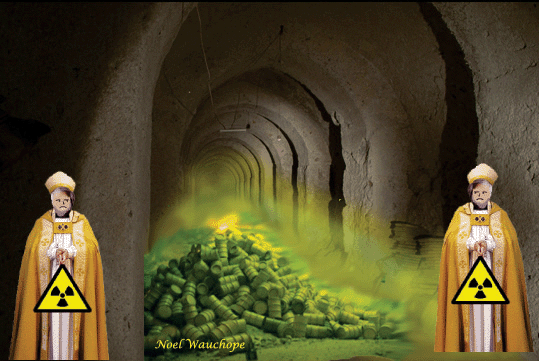
“At first, there was strong opposition to the reactors, but it eventually disappeared”,……… One explanation lies in the massive financial support provided by the nuclear power plant operator, TVO, to the municipality of Eurajoki. ……………………………..[Opponents] all share a common trait: they feel that they have been silenced, either by unspoken ostracisation or by more explicit confrontations.
The waste to be stored in Cigéo amounts to only 3 per cent of France’s waste, but 99 per cent of its radioactivity.
in a leaked document produced by a Land Operations Engineer of Andra, consulted by Equal Times, farmers of the region are listed and labelled according to whether they have been or can be “managed”.
By Guillaume Amouret, Michalina Kowol, Maxime Riché, 24 September 2024 https://www.equaltimes.org/despite-vastly-different-social?lang=en
“It looks just like wallpaper,” Jean-Pierre Simon says, pointing at the dark green line of trees that separate the fields, now glimmering in the setting sun. It is a landscape that he has admired for decades. “But soon, there will be a railway, and a train carrying nuclear waste on the horizon,” laments the farmer, his voice becoming bitter. His family has been living here, near Bure in the Meuse department of north-eastern France, for three generations. The question is, how many more generations will stay here to cultivate these fields in the future.
“Our goal is to reconcile the economy with our planet,” promised Ursula von der Leyen when she presented the adoption of the European Green Deal in 2019, shortly after she first assumed the presidency of the European Commission. Two years later, the European Parliament adopted the European Climate Law, which promised to turn the European Union climate-neutral by 2050. Another year later, in 2022, the European Parliament agreed to label both natural gas and nuclear power investments as climate-friendly sources of energy. In the latest European elections, held in June 2024, the centre-right European People’s Party, led by von der Leyen, again secured the majority of the seats.
But EU member states remain divided when it comes to investing in – and relying on – nuclear energy. On one hand, there’s France, which currently produces around 70 per cent of its electricity using nuclear power, and which recently passed a law to facilitate the construction of six (and up to 14) new reactors. In 2023, Finland’s first European Pressurised Water Reactor (EPR) in the country’s second nuclear power plant, Olkiluoto, started regular production; the country’s first nuclear power plant, Loviisa, began operating in 1977. And while some EU countries, like Poland, are planning to start building their first nuclear power plants in the coming years, others – like Germany – have opted out of nuclear energy production. The country’s last remaining nuclear power plants were closed in April 2023.
But it is not only the process of producing nuclear energy that sparks controversy, especially after the devastation caused by the accidents in Chernobyl (in Ukraine in 1986) and Fukushima (in Japan in 2011). Countries that have produced and relied on nuclear energy, like France, Germany and Finland, all face the same question: how to safely dispose of nuclear waste?
Finland: silenced detractors amid widespread support
Finland is considered one of the forerunners when it comes to nuclear energy. Roughly 20 years ago, the municipality of Eurajoki in western Finland not only accepted the erection of an EPR nuclear power generator but also the digging of Onkalo. Finnish for ‘cave’, it is a repository for spent nuclear fuel. It will become the first of its kind in the world at its opening, planned for 2025, after €900 million of construction costs. The overall cost is expected to reach €5 billion.
Finland: silenced detractors amid widespread support
Finland is considered one of the forerunners when it comes to nuclear energy. Roughly 20 years ago, the municipality of Eurajoki in western Finland not only accepted the erection of an EPR nuclear power generator but also the digging of Onkalo. Finnish for ‘cave’, it is a repository for spent nuclear fuel. It will become the first of its kind in the world at its opening, planned for 2025, after €900 million of construction costs. The overall cost is expected to reach €5 billion.
Run by the Finnish energy company Posiva Oy about 240 kilometres from Helsinki and situated 400 metres under the surface of the Earth, dug into the Finnish granite bedrock, Onkalo will become the final resting place for used nuclear fuel rods originating from the country’s five reactors: three on the island of Olkiluoto, right next door, and two in Loviisa in the south-east of the country.
The Onkalo project works according to the KBS-3 model, first developed in Sweden: spent fuel rods are inserted in copper cylinders, which offer the first barrier against the propagation of radioactive materials. The cylinders are then put in slots dug into granite. Finally, bentonite clay seals the copper capsules in their slots and fills in the deposition tunnels, and acts as a buffer between the copper and the granite.
One explanation lies in the massive financial support provided by the nuclear power plant operator, TVO, to the municipality of Eurajoki. In 2022, over a total of €57 million in tax revenues for the town, TVO would have paid €20 million in property taxes, according to Eurajoki’s mayor.
Sirkka supports the presence of TVO and the Onkalo, like most of the inhabitants of Eurajoki that Equal Times spoke to. Their trust could be considered as representative of the Finnish population nowadays. If acceptance of nuclear power was under 25 per cent back in 1983, it jumped to 61 per cent in 2024, according to a recent poll. And negative views decreased from 40 per cent to 9 per cent during the same time period.
But this does not mean that everyone agrees to the project.
We spoke to several residents – either historical opposition figures involved for decades in the protests against the construction of Onkalo or younger people, active until recently – who asked to remain anonymous. They all share a common trait: they feel that they have been silenced, either by unspoken ostracisation or by more explicit confrontations.
Some went as far as intimidating those against the plan, “sometimes walking under their windows with rifle guns”, as one person recalls. Another person we met had the feeling that because her opposition to the project was publicly known, she slowly lost her friends and had to search for work in other cities, further and further away from her hometown. She felt local employers would not want to hire her because of her opinions – although none explicitly gave this reason. Another opponent, after being involved in one of the marches organised against nuclear energy a few years ago, suffered from violent police repression and also decided to drop the fight, seeking refuge in a secluded property, far away from those painful memories.
On the other side of the Bothnia Gulf, work by researchers at the KTH Royal Institute of Technology in Stockholm, Sweden, questions the durability of copper containers in the long term. To offer protection from any radiation, the capsules would have to hold the nuclear waste safely for 100,000 years. But in a study published in January 2023, the corrosion scientist Jinshan Pan and his team point out the risks regarding embrittlements, cracks and corrosion due to sulphides in groundwater and called for “a comprehensive understanding of the corrosion mechanism […] to provide a solid scientific basis for the risk assessment of copper canisters in the final disposal of nuclear waste”. In a nutshell, he called for more studies on copper corrosion. The operator of Onkalo, Posiva, opposed these findings, arguing that sulphide levels are low enough to ignore this particular type of corrosion. It has not conducted any new research on the topic so far.
Germany’s nuclear phase-out
While Finland races ahead to be the first country to have a fully functioning spent nuclear fuel deposit, other countries like Germany seem to be far from even designing a location.
It all started on shaky ground in 1977, as a salt dome near Gorleben, right between Hamburg and Berlin, was designated to be the last resting place for spent nuclear fuel.
This decision sparked a massive opposition movement, which contributed to forming the ‘Anti-Atom-Bewegung’, the anti-nuclear-movement in Germany. Wolfgang Ehmke, spokesperson of the Bürgerinitiative Lüchow-Dannenberg, the anti-nuclear movement near Gorleben, is an activist of the first hour. To him, the nuclear phase-out in Germany is “not only due to our action, but also a series of lucky and unlucky events”.
The first phase of the new search terminated in 2020 and stated de facto that Gorleben is not suited for such an infrastructure. Its geological characteristics did not meet the conditions which the future disposal site should respond to.
The location analysis is currently making slow but steady progress. In a recent interview with the local newspaper Braunschweiger Zeitung, the president of the federal agency for nuclear wastes disposal (BGE), Iris Graffunder, explained that ten potential locations should be set for 2027. However, a final decision on the location will not be announced before 2046.
As for Gorleben, the federal agency for nuclear waste disposal announced its dismantlement last year. The salt that was dug out from the site for the construction and stored in a heap ever since, should be returned to the dome later this year. Observing every action and gesture of the agency, Bürgerinitiative Lüchow-Dannenberg remains critical concerning the date: “We are still waiting for the announced test run, before the final dismantlement,” explains Ehmke. Until then, its maintenance will have cost €20 million per year.
High tension over new waste repositories in France
Swallows fly in and out of Jean-Pierre’s barn, which provides shelter and shade on a hot June evening. JP, as everybody in Bure knows him, now armed with a rake, has been working since the early morning – like he does every day. A row of white and brown cows chew lazily on their hay. Only every now and then a low-pitched moo breaks the silence.
But Bure, in north-eastern France, about 300 km east of Paris, is far from quiet. The village, home to about 80 people, is the main stage of a political fight between the French state and anti-nuclear activists. Here, demonstrators have clashed with police on numerous occasions. In 2018, about 500 policemen were mobilised to evacuate protesters occupying a nearby forest. Even today, tensions are still palpable in Bure and the neighbouring villages. Police cars patrol the streets frequently, inhabitants denounce house searches and living under constant police supervision.
The reason? Bure’s underground is a construction site. France’s nuclear waste repository – named Cigéo for “industrial centre for geological deposit” – is supposed to store a total of 83,000m³ of high-level, long-life and medium-level nuclear waste. France produces around 70 per cent of its electricity from nuclear power.
Some of the demonstrators who came to Bure to support the local protest decided to stay and revive the countryside with sustainable farming. Like Mila and Jan, who hoped to start a new chapter in their lives here, far from the clamour of the city. Their dream is to raise goats: “We would like to produce our own goat cheese, to have just enough for ourselves and perhaps sell or exchange with others,” says the young couple who until recently, lived in an old house in a village next to Bure. However, this summer, they were forced out by the prefecture. While local authorities invoked the apparently ‘unsanitary conditions’ of the habitation, Jan and Mila’s landlord is convinced that the mayor of the village simply doesn’t want anyone who opposes Andra, the French national agency for nuclear waste management, to settle in the municipality. Since last year, Andra embarked on an unprecedented large-scale appropriation programme to acquire the land needed to construct the deposit.
Despite the nuclear waste’s high radioactivity levels, Andra has offered assurances that the location in Bure is safe: Cigéo is being constructed within a layer of Callovo-Oxfordian clay, deposited on-site about 160 million years ago. The conditioning of the waste and the protective layer of clay rock will help to avoid radioactive dispersion, the agency says. The storage is designed to remain safe during its operation for 100 years, as well as after its closure, for another 100,000 years. The deep storage project should enter its pilot phase in 2035.
But whether generations-old farmers like JP, or newcomers like Jan and Mila, will be able to continue their lives here is a different question. Andra plans to acquire an additional 550 plots to continue with the construction of its mega-project. Cigéo was declared of public interest in 2022, so the company now has the right to expropriate landowners. “I am 64, it is time for me to retire,” says JP. “My son applied to take over the farm, but Cigéo also covets some of my land parcels,” he laments. The agency recently asked for an extra strip of land alongside the former railway that will become the transportation channel for incoming spent nuclear fuel, and this further threatens the viability of JP’s plots, which would become much harder to work – or sell – if Andra’s request is granted.
In January 2023, Andra submitted an application to the national nuclear security agency, IRSN (Institute for Radiation Protection and Nuclear Safety), to authorise the construction of the final disposal in place of the current underground laboratory. After a reform of the nuclear security agency last year, and the termination of its previous president’s mandate, its new head was nominated in May 2024. And it is no less than the current president of Andra, Pierre-Marie Abadie, designated by President Emmanuel Macron. This choice raised doubts regarding the integrity of the entire project’s authorisation process, as critics pointed out conflict of interests.
“For now, we don’t see the bulldozers smashing the ground,” says JP. But he still remains sceptical: “I have doubts about my ability to stay here, should my farm be taken over. But I don’t have much time to reflect and think,” he says.
For now, JP must go back to work.
This article was developed with the support of Journalismfund.eu.
Scottish National Party blasts Labour for ‘frittering away’ money on nuclear plant instead of winter fuel payment
The party’s energy spokesperson Dave Doogan said Labour “is more concerned with funding needless nuclear projects… than it is with supporting hard-pressed pension
Andrew Quinn, Westminster Reporter, 28 SEP 2024.
https://www.dailyrecord.co.uk/news/politics/snp-blasts-labour-frittering-away-33767683
The SNP has claimed the Labour Government is “frittering away” £5 billion on a nuclear power plant while cutting the Winter Fuel Payment.
The party’s energy spokesperson Dave Doogan said the party is “more concerned with funding needless nuclear projects… than it is with supporting hard-pressed pensioners.”
The UK Government announced earlier this month that an extra £5.5bn is being made available to the Sizewell C nuclear power plant.
The plant is being built in Suffolk and the UK Government has said it will help secure the country’s energy independence. It will supply up to seven per cent of the UK’s energy needs but won’t start generating electricity until the 2030s.
t comes after the Labour Government decided to make the Winter Fuel Payment means-tested. Nearly 900,000 Scots pensioners will now miss out on the benefit.
Doogan said: “When Labour frittered away more than £5bn to the blackhole that is Sizewell C nuclear plant, what they did was fund a French owned company that will have no benefit to Scotland all the while picking the pockets of Scottish pensioners by robbing them of their Winter Fuel Payment.
“England’s Sizewell C will cost the tax payer some £30bn, yet just £1.4bn was deemed too high a price to keep 880,000 pensioners Scottish warm this winter – Sir Keir Starmer’s priorities are all wrong.
“The British Government is more concerned with funding needless nuclear projects and defending indefensible designer clothing funds than it is with supporting hard-pressed pensioners as the frost bites this winter and heating bills rise.
“Scotland is energy rich and our future is in renewables, but instead the Labour Government is choosing to pump money into English nuclear power plants and letting Scottish pensioners go cold – the SNP will always put Scotland’s interests first and that includes our pensioners in the face of swingeing Labour cuts.”
“Given the dire state of the public finances we have inherited, it’s right we target support to those who need it most. Over a million pensioners will still receive the Winter Fuel Payment, while many others will also benefit from the £150 Warm Home Discount to help with their energy bills over winter.
“We are also committed to helping the UK achieve energy security and net zero and new nuclear power stations such as Sizewell C will help us achieve that, while securing thousands of good, skilled jobs.”
Weatherwatch: Labour’s stance on nuclear power is worryingly familiar
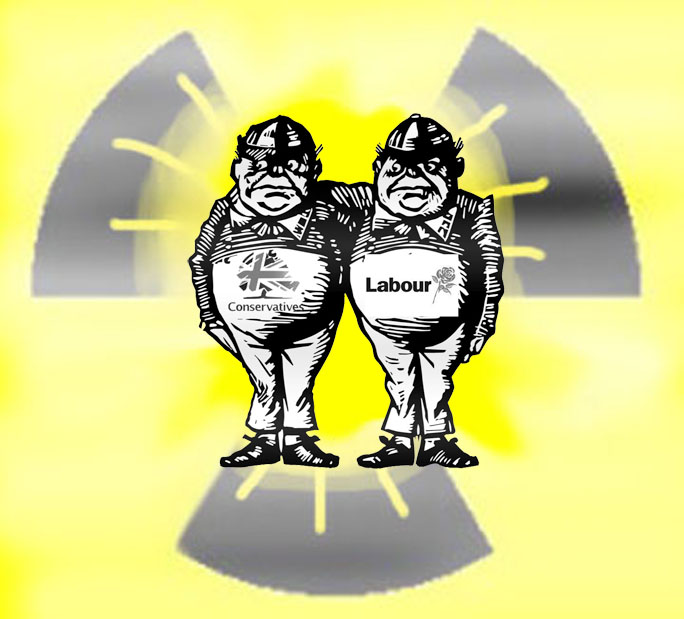
There is little difference between this government’s and its Conservative predecessor’s policies on expansion
Paul Brown, Fri 27 Sep 2024, https://www.theguardian.com/news/2024/sep/27/weatherwatch-labour-nuclear-power-conservative-policies
There seems to be no difference between Conservative and Labour policies on nuclear power. Both support the current building of Hinkley Point C in Somerset, the planned Sizewell C station in Suffolk, an unspecified number of small modular reactors all over Britain as well as the far-off dream of nuclear fusion.
However, few scientists serious about the threat of the climate crisis believe new nuclear power stations are part of the solution in reducing carbon output. Building them is too slow and costly, while solar and wind are quicker and cheaper in making a dent in fossil fuel consumption and eliminating it.
While supporting nuclear expansion seems to be politically expedient, the reality on the ground appears to be different. As the 2024 World Nuclear Status report published this month points out, if Britain gets anywhere near its plan to double onshore wind, triple solar power and quadruple offshore wind by 2030, it will be producing more electricity from these sources than the country consumes.
The experts also say if Rolls-Royce’s “heroic assumption” of the cost of electricity from small modular reactors was correct, any planned construction of large stations would immediately be abandoned.
Why NuScale Power Stock Dropped Today

Motley Fool, By Rich Smith – Sep 26, 2024
NuScale’s potential growth just got smaller by exactly one country.
Shares of NuScale Power (SMR 5.55%) slipped 3.2% through 11 a.m. ET Thursday on some disconcerting news out of Great Britain. According to World Nuclear News (WNN), the British government just narrowed the list of companies competing to begin building small modular nuclear reactors (SMRs) in the U.K. to four names.
NuScale isn’t one of them.
SMRs in the U.K.
According to WNN, the list of companies competing for this program initially numbered six, but two companies have been cut: NuScale and France’s EDF. General Electric subsidiary GE Hitachi Nuclear Energy, Rolls-Royce-owned Rolls-Royce SMR, and privately owned Holtec and Westinghouse all made the cut with reactor designs based on existing technology married to “modular production techniques.”
Britain plans to narrow its list further to two or perhaps three companies that will win co-funding contracts to complete their designs and obtain permits. Then the government will make a final decision to proceed with power plant construction in 2029.
………………….The bad news is that the closest company to a pure play in this new technology, NuScale Power, is now no longer an option in the U.K. Furthermore, Britain’s decision to pass on NuScale’s technology may give U.S. regulators second thoughts about it as well. All things considered, I’d say this is bad news for NuScale stock.
The other bad news is that the options that remain, Rolls-Royce and GE, are valued at $60 billion and $200 billion, respectively. While nuclear power may one day become a bigger part of their businesses, it’s going to be a long time before either company gets big enough in nuclear to move the needle on their revenue or earnings, or for investors to see them primarily as nuclear power stocks.
Investors seeking pure plays on nuclear power should probably look elsewhere. https://www.fool.com/investing/2024/09/26/why-nuscale-power-stock-dropped-today/
The Looming Catastrophe in the Middle East (w/ Gideon Levy) | The Chris Hedges Report
September 28, 2024
It has become quite rare to hear any meaningful accountability for Israel’s actions from Israeli citizens themselves. Israeli journalist Gideon Levy is an anomaly in Israel by today’s standards, as for his entire career he has challenged the apartheid and occupation of the Israeli state. On today’s episode of The Chris Hedges Report, Levy joins host Chris Hedges to discuss his book, The Killing of Gaza: Reports on a Catastrophe, and explain the spiritual destruction, both of Israel and Palestine, that the current genocide in Gaza is causing as well as the implications of new military operations in Lebanon.
The worst change, according to Levy, is that Israel has lost its humanity. “Everything is acceptable,” Levy tells Hedges as he describes the ongoing slaughter of Palestinian civilians in Gaza, the brutal killing of prisoners, the censorship at the hands of the state and the overall indifference to it all.
“There is practically only one camp in Israel, the camp which supports apartheid and occupation,” Levy says.
There isn’t even any room left for empathy of the innocent victims in Gaza, according to Levy. Teachers have been subject to interrogation and termination because they “express[ed] empathy with the children of Gaza, with the victims of Gaza. Even this is not legitimate anymore in Israeli society 2024,” Levy contends.
Although the horrors following October 7 are devastatingly unprecedented, Levy asserts that this entire catastrophe was years in the making and the meaningless gestures of advocating for a two-state solution, for example, will perpetuate it further.
In the first years following the war in 1967, the occupation of Palestinians as a way of life quickly became normalized, according to Levy. “[Palestinians] clean our streets, they build our buildings, they pave our roads and they will never have citizenship. The only people in the world without any citizenship of any state,” Levy says.
As Israeli society attempts to continue this way of living, only disruptive movements and moments, such as the First Intifada, the Yom Kippur war and now October 7, will bring meaningful attention to the Palestinian struggle most of the world is okay with ignoring.
As Levi writes in his book,
“The way of terror is the only way open to the Palestinians to fight for their future. The way of terror is the only way for them to remind Israel, the Arab states and the world, of their existence. They have no other way. Israel has taught them this. If they don’t use violence, everyone will forget about them, and then a little later, only through terrorism will they be remembered. Only through terrorism will they possibly attain something. One thing is certain, if they put down their weapons, they are doomed.”
Levy says that history has told the Palestinians and the world something crucial about Israel: “the message is, if you want to achieve anything from us, only by force. And the message for the world is the same, if you want the world to care about you, raising your voice is not enough. You have to take measures. You have to take actions, and unfortunately, many times violent ones, aggressive ones, and many times even barbarian ones, like on the seventh of October.”……………………………………………more https://scheerpost.com/2024/09/28/the-looming-catastrophe-in-the-middle-east-w-gideon-levy-the-chris-hedges-report/
US company eliminated from race to build Britain’s first mini-nuclear plant.

NuScale Power will not proceed to the final round of the competition’s selection process
Executives at NuScale Power were told on
Wednesday afternoon that they had been eliminated from the small modular
reactor (SMR) design competition.
The decision by officials at Great
British Nuclear (GBN), a government agency, leaves four companies battling
to secure support for their proposed technologies: Rolls-Royce,
Westinghouse, GE-Hitachi and Holtec Britain. Those businesses will now
progress to the final stage of the process, which will see them submit
“final best offers” to the Government.
GBN is then expected to announce
two winners either late this year or early in 2025, with the companies then
awarded sites and funding.
Earlier this year, a sixth company, the French
state-owned energy giant EDF, effectively dropped out of the contest when
it decided not to submit a bid by the required deadline. A spokesman for
NuScale also confirmed the decision. He said the company had been told it
did not meet the criteria for the SMR competition as it had already begun
production of its reactors and did not need support getting to market.
The decision is a fresh blow to NuScale, which suffered another setback last
November when its $1.4bn (£1bn) project to build a plant for a Utah power
provider was cancelled amid spiralling costs. The Government has not yet
confirmed where the first SMRs will be built. However, GBN purchased sites
in Wylfa, on the Welsh island of Anglesey; and Oldbury, Gloucestershire,
earlier this year.
Telegraph 25th Sept 2024
New developments at Sellafield for endless storage of ever-increasing amounts of highly radioactive spent nuclear fuel.
Sellafield to store all fuel from UK’s operational nuclear power stations, by Business Crack, September 25, 2024

I would have thought that it might be a good idea to plan for not making any more of this poisonous stuff.
But I guess that’s not in the official, expert, thinking.
A new space-saving rack at Sellafield will enable the site to store all the fuel expected from the UK’s operational nuclear sites.
The first fuel has been placed into a storage rack and the firm said it was set to save billions of pounds.
Known as the 63-can rack, the container allows the Thorp pond to store 50% more spent nuclear fuel.
Without the rack, a new storage pond would have to be built, potentially costing billions of pounds.
The rethink was required because Thorp needs to store more fuel than previously thought because the UK no longer reprocesses spent fuel, but instead stores it underwater prior to disposal.
The rack has been 16 years in the making and represents a success story for UK manufacturing.
Weighing 7 tonnes and standing 5.5 metres high, the stainless steel containers are being built by a consortium of Cumbrian manufacturers and Stoke-based Goodwin International.
Between them, they will manufacture 160 racks. Another 340 racks will be needed in the future…………………………………………………………………….
“These racks will increase fuel capacity from 4,000 tonnes to 6,000 tonnes, meaning we can accommodate all current and future arising, negating the need for a new storage facility……………………………………………………………………..
Because fuel will be stored for longer than was originally intended, the pond has required other alterations including raising the pH level to avoid corrosion and installing new cooling capacity, Sellafield Ltd said. https://businesscrack.co.uk/2024/09/25/sellafield-to-store-all-fuel-from-uks-operational-nuclear-power-stations/
Ambassadors called upon to refrain from military action involving nuclear plants
NFLA 26th Sept 2024
Following a recent safety visit by Director General Grossi of the International Atomic Energy Agency (IAEA) to the Kursk nuclear reactor in Southwest Russia, the Nuclear Free Local Authorities have written to the Russian and Ukrainian Ambassadors to the UK urging their armed forces not to take military action against nuclear power plants in the conflict zone.
Letters have also been sent to Mr Grossi and to the UN Secretary General Guterres urging them to take action to ensure that both the Russian Federation and Ukraine comply.
All nations already have existing international obligations under the 1949 Geneva Convention, Protocol 1, Article 56, not to target nuclear installations or to use military equipment based at such installations to launch offensive actions………………………………….
https://www.nuclearpolicy.info/news/ambassadors-called-upon-to-refrain-from-military-action-involving-nuclear-plants/
TODAY. I would rather have tough-guy macho men, than slimy sweet-talk hypocrites


Well, I’m thinking about the big military leaders, like Austin Lloyd, the USA’s Defense Secretary. He’s no wimp . For one thing – he looks the part – he’s a big tough guy in an imposing uniform. He got lotsa medals for bravery in the invasion of Iraq . A four-star general, he was the commander of U.S. forces in Afghanistan. Then he left the military to join the weapons-making firm Raytheon. Lloyd is a strong supporter of Israel, and of Saudi Arabia. He ordered air strikes against Syria. He’s ready to wage war against Iran, when that time is “needed”. Lloyd has declared “America’s commitment to Israel’s security is ironclad. It is not negotiable. And it never will be.”
So – nobody can accuse Lloyd of weakness, of cowardice. We know where he stands – ready to lead the USA into its next war.
And as for the war in Ukraine – Austin has been an allout supporter of Ukraine, and devout American hater of Russia. BUT, he is opposed to the plan to supply Ukraine with long range attack missiles to send deep into Russia. He doesn’t see any military reason for this drastic step that would really provoke Putin. Previously, Austin rejected a plan for a no-fly zone over Ukraine. He saw it as not militarily useful and “to enforce that no-fly zone, you’ll have to engage Russian aircraft. And again, that would put us at war with Russia.”
There’s the clue – a “military reason”. Austin doesn’t mind war. It’s his business. But he’s not keen on unnecessary actions that are not useful militarily, but could bring chaos upon us. We know to be wary of belligerents like Austin, but at least there’s a certain logic in his actions.
Then we come to The case of the good-looking slim and silver-haired Antony Blinken in his lovely suits, (and he even plays the guitar). Here we have the ultimate in what a diplomat should be – well-spoken, charming, calming – just what you need for peaceful communication between nations?
Blinken struts the world stage, making motherhood statements about protecting civilians, promoting peace, human rights, and harmony – and sounding so good! All this lovely talk is a cover-up for what he is really supporting – American military hawkishness and Zionist genocide.
Blinken has consistently promoted US military interventions. During the Obama administration, Blinken pushed strongly for the overthrow of Libyan president Muammar al-Gaddafi. In the years before he became Secretary of State, Blinken co-founded and worked for the secretive WestExec Advisors firm, which lobbied the Pentagon on behalf of weapons-making companies.
In Blinken’s Senate confirmation hearing, he affirmed that he would be belligerent towards China and Venezuela. Even while he publicly supported U.S. policy for reviving a deal with Iran, he made belligerent statements against Iran.
And that is the typical Blinken way – say one thing, while promoting the opposite in action.
Blinken supports the plan for long-range missiles to be supplied to Ukraine – according to reports in the Guardian and the New York Times.
Not that I’m a fan of Lloyd Austin. Indeed, just like Blinken, Austin has made $millions from his work for weapons industries. As of October 2020, his Raytheon stock holdings were worth roughly $500,000 and his compensation, including stock, totaled $2.7 million. He was a partner in another weapons investment company Pine Island Capital, in which Antony Blinken is, or was, also involved.
Finally – my point is – I worry about the smarmy types like Antony Blinken. He is the epitome of the liars and hypocrites who cover up for governments. Ever in the media, Blinken lulls the world, including Americans, into the belief that America wants peace, that zealots like Zelensky and Netanyahu are right, that somehow – don’t worry – all will be well.
But ,worse than Lloyd Austin, Blinken doesn’t even grasp the military realities. At least Lloyd Austin doesn’t want to plunge us into World War 3 for the sake of a pointless military exercise like letting Ukraine send long range missiles to Moscow.
Ukraine’s Zelensky arriving in US….to pitch WWIII.

Walt Zlotow, West Suburban Peace Coalition, Glen Ellyn IL, 26 September 24
Ukrainian President Volodymyr Zelensky has long been the most dangerous man in the world.
Since the US provoked Russian invasion of Ukraine 31 months ago, he’s been begging, cajoling, indeed demanding the US and UK allow him to attack deep into Russia with US and UK long range missiles. He’s got both in his weapons arsenal to which the US and UK still have strings attached tying them to Russian targets in Ukraine. Russian President Putin has made it abundantly clear that strikes deep into Russia signal the West is at war with Russia, requiring swift, military response.
But Zelensky remains unconcerned that his war strategy may get him incinerated along with the rest of us if a single nuke goes off from his deranged escalation plan.
Astonishingly, Zelensky has already got newbie UK PM Keir Starmer on board in. Starmer traveled to the US recently to pitch Zelensky’s plan to use the UK Storm Shadow missiles. Starmer needs US approval since his Storm Shadows contain US components and require US guidance data to hit choice Russian targets.
To his credit, Biden publicly rebuffed Starmer’s pitch even before their September 13 talks were concluded. Starmer scurried back to Downing Street disappointed.
But undaunted, Ukraine’s Mr. ‘Let’s Provoke WWIII’ is traveling 4,668 miles from Kyiv to New York to continue lobbying Biden for their use at the UN’s 79th General Assembly meeting this week.
In a bizarre twist, Biden’s State Department is ready to sign off, possibly on their own demise, while Defense has demurred. Defense Secretary Lloyd Austin has publicly advised that long range missile strikes will not achieve any strategic benefit, especially since Russia has already moved over 90% of prime targets beyond range of even the long range UK Storm Shadows and US ATACMS.
Austin knows the US proxy war against Russia in Ukraine is lost so why risk WWIII. Somehow, top diplomat Tony Blinken remains in denial.
Let’s hope President Biden doesn’t weaver in his sensible pushback to all out war with Russia. A dwindling number of we Americans still recall hoping to survive the angst of living thru the Missiles of October during the Cuban Missile Crisis. Sixty-two years later, we inexplicably must deal with the angst of surviving the Missiles of September.
US Gives Israel $8.7 Billion in Military Aid for Operations in Gaza and Lebanon

The new aid comes as the US claims it’s pushing for a ceasefire in Lebanon
by Dave DeCamp September 26, 2024. https://news.antiwar.com/2024/09/26/us-gives-israel-8-7-billion-in-military-aid-for-operations-in-gaza-and-lebanon/#gsc.tab=0
On Thursday, the Israeli Defense Ministry announced that it secured $8.7 billion in military aid from the US to support its “ongoing military efforts,” meaning the genocidal slaughter in Gaza and Israel’s dramatic escalation in Lebanon.
The ministry said in a statement that its director-general, Maj. Gen. Eyal Zamir, concluded negotiations in Washington to secure the military aid. It said the package includes $3.5 billion for “essential wartime procurement” that has already been sent to Israel and a $5.2 billion grant for air defenses.
The ministry said the $5.2 billion for air defenses “will significantly strengthen critical systems such as Iron Dome and David’s Sling while supporting the continued development of an advanced high-powered laser defense system currently in its later stages of development.”
Secretary of Defense Lloyd Austin vowed Thursday that the US would continue arming Israel and brushed off the idea of the US setting red lines. “We’ve been committed from the very beginning to help Israel, provide the things that are necessary for them to be able to protect their sovereign territory and that hasn’t changed and won’t change in the future,” he said.
So far, the US has not announced the details of the $8.7 billion weapons package, but the funds are likely being pulled from the $17 billion in new military aid for Israel that was included in the $95 billion foreign military aid bill President Biden signed into law back in April. Israel also receives $3.8 billion from the US in annual military aid.
News of the new US support for Israel comes as the Biden administration claims it’s pushing for a ceasefire in Lebanon. But the US has not altered its support of full-throated support for Israel, and the military aid and pledges to defend Israel if the situation escalates have only emboldened Prime Minister Benjamin Netanyahu, who rejected the US calls for a truce on Thursday.
Wars, Propaganda Wars and Funding Them
CoounterPunch, Eve Ottenberg, September 27, 2024
By now it’s clear even to the thick-skulled nabobs running our government, that the U.S. can’t win actual wars. It puts up a more respectable performance with propaganda campaigns, probably because those are things the mighty intellects in the CIA truly enjoy, but even those, with their ferocious philippics against malevolent Moscow in The New York Times and Washington Post, even those go down eventually to ignominious defeat. Truth will out.
Like it did in Afghanistan where, for 20 years our military men assured us victory was just around the corner and the established press harrumphed at any peacenik outraged by the slaughter. Then, practically overnight, the whole house of cards collapsed. Even those of us who had predicted a Taliban victory were stunned at the speed with which the U.S. puppet regime folded. It was a disgrace for the Empire. Not unlike the imperial misadventure in Iraq, but somehow worse. It brought all too forcibly to mind those U.S. military helicopters fleeing from Saigon rooftops so many decades ago…
For the past two and a half years, we Americans have been deafened by the clang of a stupendous propaganda war waged against Moscow and on behalf of Kiev and supposedly the west in our mainstream news outlets. We read early on that Russia would soon run out of missiles. It didn’t. Embarrassed silence greeted this uncomfortable fact. Even worse for our press and elite political fabricators, it turned out Russia BRISTLES with missiles. Little said about that in our corporate media. We also read that the desperate Russian military cannibalized washing machines and dishwashers to produce weapons, a lie that I’ve never seen retracted.
Also, those fiendish northern Slavs were accused of every conceivable atrocity against the Ukrainian population, and when later it emerged that the Russian military actually avoids targeting civilians with a care utterly absent in, say, the U.S. assault on Iraq or the Israeli one on Gaza, there were no apologies, no retractions, no expressions of contrition. Nope. The press just moved on to the next tall tale. My guess is that when this whole sorry proxy war ends with Ukraine’s defeat, the propaganda chickens will NOT come home to roost, no, they’ll flap their wings to the next nest of lies. Located where? Farther over the horizon. In China, of course.
For those who dread these frenzies of press prevarication, the news that Washington may allocate $1.6 billion for anti-Chinese propaganda cannot be good. According to a Responsible Statecraft article September 11 by Marcus Stanley, the House passed the “Countering the PRC Malign Influence Fund” on September 9. This money is “about twice, for example, the annual expenditure of CNN,” and it goes to the state department and the infamously, covertly CIA-associated USAID over the next five years. The Global Engagement Center and USAID will lead on spending these monies, making “grants to foreign media and civil society organizations.” The bill, “HR 1157 would supercharge these programs.”
Because the bill doesn’t require transparency to foreign citizens for this U.S. financing, “it’s possible that the program could in some cases be used to subsidize covert anti-Chinese messaging…Such anti-Chinese messaging could cover a wide range of bread-and-butter political issues in foreign countries.” In other words, the U.S. government is poised to launch a MASSIVE black propaganda campaign. Foreigners exposed to its efforts can expect epics of Chinese depravity that make J.D. “One Whopper After Another” Vance’s phony cat-eating Haitian fantasy in Ohio look like child’s play. Who knows what the state department and CIA chefs of hogwash will serve up, but you can be sure it will explode your tastebuds. And for the constipated American legacy purveyors of CIA poppycock, like The New York Times and The Washington Post, it’ll doubtless barrel through them like magnesium citrate…………………………………………………………. more https://www.counterpunch.org/2024/09/27/wars-propaganda-wars-and-funding-them/
Karen Silkwood and Kerr-McGee: A Reinvestigation

Silkwood was an outspoken advocate of both maintaining union representation and taking precautions to protect the workers from plutonium contamination caused by the company’s poor handling practices.
Van De Steeg’s analysis is definitive proof that Silkwood never spiked her samples. Kerr-McGee argued that she did it to embarrass the company……… Van De Steeg testified that after Bill Silkwood filed his lawsuit, his lab notebook containing his notes on Silkwood’s samples was removed from his lab and was never seen again.
[The film] Silkwood poorly portrays the real Silkwood…………………. she cared about the lives of her friends and co-workers at the plant and channeled that care about others into activism.
the real Karen Silkwood “died defending her trade union and coworkers against a powerful employer—one whose lax practices threatened not only its employees, but also the community and possibly the entire nation.
By Steven H. Wodka, September 25, 2024, https://www.wodkalaw.com/karen-silkwood-and-kerr-mcgee?fbclid=IwY2xjawFi1zBleHRuA2FlbQIxMAABHbdJGAfN8QXm-MRvButaJeYwt7KZrRu3b1OHQNkIkSlxxJ8rmbk2rRMLvQ_aem_Laom06PdDllnHMWJxw7Wsg
In 1974, Karen Silkwood and her union, the Oil, Chemical and Atomic Workers, were engaged in a confrontation with her employer, the Kerr-McGee Corporation, and its regulator, the Atomic Energy Commission. On November 5th, Silkwood became contaminated with plutonium and died in a car crash a few days later. Fifty years later, even after repeated investigations, the basic questions on how these events occurred have gone unanswered.
On November 7, 1974, the Atomic Energy Commission (AEC) took responsibility for determining “the cause and extent of the contamination.” But by December 16, 1974, the AEC had given up and stated that its “investigation did not reveal exactly how the contamination occurred.”
After Silkwood’s death on November 13, 1974, the US Department of Justice (DOJ) ordered the Federal Bureau of Investigation (FBI) to commence an investigation of her car crash. On February 21, 1975, the DOJ further ordered the FBI, after a request from the newly formed Nuclear Regulatory Commission (the NRC, a successor to the AEC), to expand its investigation to include the circumstances of Silkwood’s contamination with plutonium. The unauthorized possession and use of plutonium is prohibited by the Atomic Energy Act of 1954.
Silkwood’s union, the OCAW, had high hopes for a thorough investigation. The FBI was known for its massive response to the 1964 murders of three civil rights workers in Philadelphia, Mississippi. Within six months, even though it was operating in hostile territory, the FBI had their suspects, which included the county sheriff and his deputy. We expected no less for Silkwood.
However, neither the DOJ nor the FBI effectively supervised the FBI agent placed in charge of the Silkwood investigation, Lawrence J. Olson, Sr. There was no dispute that plutonium from Kerr-McGee’s nuclear fuel manufacturing plant at Crescent, Oklahoma had escaped and contaminated Silkwood’s apartment. Yet Olson failed to treat anyone associated with the plant with suspicion, except for Silkwood.
Olson joined forces with Kerr-McGee’s internal security to defend the corporation and destroy Silkwood’s credibility. In the course of his investigation, Olson uncovered critical evidence that indicated that someone other than Silkwood had placed plutonium in her urine and fecal sample kits. Olson also obtained information that it was likely that an anti-union worker had spiked her kits. But Olson never pursued any investigation into a potential perpetrator.
Read more: Karen Silkwood and Kerr-McGee: A ReinvestigationUltimately, the DOJ conceded that the FBI’s investigation “did not determine” how the plutonium was taken out of the plant. The FBI’s failure allowed for rampant speculation. On March 9, 1976, The Washington Star reported, without any supporting facts, that Silkwood “managed to carry a small quantity of plutonium oxide out of the plant without being detected.”
The failures of the AEC and the FBI led to Congressional investigations. In the Senate, the Government Operations Committee led by Sen. Lee Metcalf (D-MT), started to look into the matter, but Kerr-McGee intervened and Metcalf backed off. In the House, Rep. John Dingell (D-MI) led a two day hearing by his Subcommittee on Energy and the Environment. But Jacque Srouji, who claimed to have a “special relationship” with the FBI, successfully sidetracked the Subcommittee’s investigation before it could make any meaningful progress.
In November 1976, Silkwood’s father, Bill Silkwood, as administrator of his daughter’s estate and on behalf of her children, filed a civil action against Kerr-McGee in Federal court in Oklahoma City. This action presented Bill Silkwood with the opportunity to use the court’s discovery process to pick up the leads that Olson had dropped.
Instead, Silkwood’s attorney, Danny Sheehan, used the discovery process to pursue nonsensical conspiracy theories concerning the Oklahoma City police, wiretapping, physical surveillance, and anti-nuclear dissidents. Sheehan took eight depositions of members of the Oklahoma City Police Department that went nowhere. As a result, most of the available time and money, as well as the patience of the court, was wasted by Sheehan, who never pursued the evidence before him on Silkwood’s contamination.
At the trial of the lawsuit, from March 7 to May 18, 1979, Silkwood’s personal injury claim was saved by brilliant lawyering conducted by another attorney, Gerry Spence. The circumstances of Silkwood’s contamination pervaded the trial. Kerr-McGee contended that Silkwood contaminated herself while spiking her urine and fecal samples in order to embarrass the company. Bill Silkwood, the plaintiff, didn’t offer any proof on how the samples were spiked. Rather, the plaintiff followed a tort rule of strict liability that applied to ultra-hazardous activity, such as the handling of plutonium. Under strict liability, if such dangerous activity gets out of control and hurts someone, the owner or operator of the dangerous activity is liable, regardless of how much care was taken.
But before reaching that issue, the jury had to determine whether “Karen Silkwood intentionally, that is knowingly and consciously, carried from work to her apartment the plutonium that caused her contamination.”
The jury answered that question in the negative and went on to award Silkwood $10,505,000 in damages, a sum that included $10 million for punitive damages that was ultimately affirmed by the US Supreme Court. But the last word on that award was issued by the US Court of Appeals for the Tenth Circuit, which ordered a new trial and took away $10.5 million of the award. The Tenth Circuit held that Silkwood’s contamination arose in the course of her employment. Accordingly, the exclusivity of workers’ compensation barred any tort recovery against Kerr-McGee for personal injuries suffered by Karen Silkwood. As a result, the case settled for $1.38 million.
The question of how Silkwood got contaminated was never answered during the trial.
My Reinvestigation
Since 1974, I have attempted to follow every twist and turn of this case. At the time, I was a staff representative for the Oil, Chemical, and Atomic Workers International Union (OCAW) at its legislative office in Washington, DC. In 1981, I left the union, went to law school, and then practiced law for 37 years representing workers who had developed cancer as a result of exposure to toxic chemicals.
I retired in 2023. I finally had unlimited time to explore the obscure edges of this case and double and triple check the claims that others had made. I still had my notes and files from 1974. I also had multiple responses from Freedom of Information Act requests that I had made to the AEC and the FBI. I also obtained the entire discovery record and trial transcript of Silkwood v. Kerr-McGee that had been held in the National Archives repository in Kansas City.
In 1974, Kerr-McGee was known by the OCAW as a brutal and ruthless employer. From May through November 1973, the OCAW members who worked at Kerr-McGee’s uranium mine in Grants, New Mexico went on strike for more than six months in order to obtain a new contract. At Grants, Kerr-McGee followed the same tactic that it had successfully used in the prior year against Silkwood’s local at the Crescent plant.
Instead of negotiating with its union for a new contract, Kerr-McGee would impose a new contract on the union. If the union didn’t like the terms of the contract that Kerr-McGee sought to impose, the local could go on strike. In fact, Kerr-McGee took a nine week strike at Crescent from late 1972 to early 1973, but Kerr-McGee got its way. Silkwood and her co-workers went back to work in February 1973 under a contract that was worse than the one they had before the strike. This defeat for the union set the stage for a vote on whether to decertify the OCAW as the bargaining agent for the workers in October 1974.
Kerr-McGee was also vindictive. The Grants local believed that Kerr-McGee’s uncompromising stance was directly connected with the union’s successful efforts in 1971 to get the State of New Mexico to reduce the allowable radiation exposure in the mines, which was a proven cause of lung cancer in the miners. At Crescent, the exposures were far worse than in the mines because plutonium was much more radioactive than the radon gas found in the uranium mines. Thus, if Silkwood’s local union managed to win the decertification election in October 1974, it would still need all the leverage imaginable in order to obtain a decent new contract in November 1974 without going on a lengthy strike.
I had known Silkwood during this tumultuous period of her life. We first met on September 27, 1974, when she came to Washington, DC to meet in person with the AEC with her fellow local union leaders Jack Tice and Gerald Brewer. We saw each other again on October 10, 1974, when the OCAW arranged for an educational session for the members of her local union on the health effects of exposure to plutonium. The last time I saw her was on November 8 and 9, 1974, in Oklahoma City, when she was being interviewed by the AEC after her plutonium contamination and I was arranging for her medical care.
In March 2023, I set to work to see if I could answer the still unanswered questions about what had happened to Karen Silkwood in 1974. Here is what I found.
The Events Leading up to November 9th
When we met in Washington, DC on September 27, 1974, Silkwood and Brewer, who worked in the plant’s laboratory where quality checks were run, described a multi-faceted effort by Kerr-McGee to speed up production by shipping plutonium fuel rods which should have been rejected. According to Silkwood and Brewer, the results of quality control checks were being manipulated. Anthony Mazzocchi, the OCAW’s legislative director, and I had never encountered such an effort by any manufacturer. Our first instinct was that if the OCAW was going to make an accusation against Kerr-McGee on its manipulation of such quality control checks, such a charge needed to be documented, or no one would believe our claim.
Even though Brewer had brought his personal notes that identified specific welding samples, rods and pellet lots that had passed quality control checks when they should have been failed, it was Silkwood who volunteered to assemble the documentation upon her return to Oklahoma. Brewer didn’t have any company documents that contained any incriminating data or statements. This is what Silkwood offered to find.
Within ten days of her arriving back in Oklahoma, Silkwood called me on October 7th and described the information that she had amassed to date. On October 10th we met at an educational session sponsored by the local union to inform the members about the hazards of plutonium. She told me that she was still collecting records. The contract negotiations were set to begin on November 6th. The contract expiration date was December 1, 1974. On October 30th, we made arrangements for her to meet with reporter David Burnham of The New York Times on November 13th in Dallas.
It is well documented that Silkwood was found to be contaminated at work with plutonium on Tuesday, November 5, 1974, and again at work the next day. However, there were no leaks or exposures at work that could have accounted for the contamination on either day. After being decontaminated on November 6th, she was instructed to report directly to the Health Physics (HP) office upon her arrival at work the next day, and not go into any work areas where there was any potential for exposure. Health physics is the science and practice of radiation protection.
On Thursday, November 7, 1974, Silkwood did as she was instructed and came directly to the HP office after parking her car and walking in the door. She was very hot (heavily contaminated with plutonium) and the urine and fecal samples that she was carrying with her were very hot as well. It was evident to the HPs that the source of her contamination was off-site. Her car was first checked but it was clean of any contamination.
Silkwood and the HPs then went to her apartment and discovered that it was contaminated. Kerr-McGee started the process of decontaminating it and discarding her possessions. The AEC was notified.
Karen called me and asked me to come down from Washington. She was quite upset and told me that she had no idea whether she was going to live another day. She called her mother and told her that she thought that she was dying from radiation. Her boyfriend, Drew Stephens, reported that Silkwood arrived at his home that night “crying and shaking.”
As for the meeting with Burnham, I assumed that all bets were off. First, if Silkwood lived, I thought that she would be bedridden or at least far too ill to travel or engage in meetings. I also assumed that whatever Kerr-McGee documents that she had collected were now back in Kerr-McGee’s hands. As of November 7th, Kerr-McGee had complete control over her apartment and everything in it. She couldn’t store such documents at the plant. They must have been in her home. She could have easily called off the meeting and no one would have questioned her decision.
I arrived in Oklahoma City the next day, November 8th. Silkwood’s short life was dissected in back to back interviews of her by the AEC investigators, by the AEC’s medical consultant, and by Kerr-McGee’s medical consultant, Charles Sternhagen, MD. She cried often. Her skin was so raw from the decontamination treatments that she told us that her tears were burning the skin on her face.
Plans were made for Silkwood to be examined by Sternhagen the next day, November 9th, at Oklahoma City’s Baptist Hospital. Additional arrangements were made for Silkwood, her roommate Sherri Ellis, and Drew Stephens to fly to New Mexico on November 10th for two days of testing at the AEC facility in Los Alamos.
On November 8th, I was surprised when Silkwood made it clear that she still had her documentation against Kerr-McGee and that she still wanted to go forward with the planned meeting with Burnham on November 13th. To accommodate her upcoming trip to New Mexico, we moved the site of the meeting to Oklahoma City. Burnham agreed.
Throughout this time period, beginning on the evening of November 5th, and lasting for the next five days, Silkwood was required to collect all of her urine and fecal voidings into sample jars that were part of a kit prepared by the HPs. The kit was placed on a shelf in a hallway approximately 30 steps from the HP office, a location that all employees passed on entry to and exit from the plutonium plant. It was labeled with her name and badge number. It consisted of four one-liter plastic bottles in a cardboard carrying box. Silkwood was instructed to pick it up on her way out of the plant.
The urine and fecal samples that Silkwood brought with her to the plant on the morning of November 7th were heavily contaminated with plutonium that was not the result of Silkwood’s exposure to, inhalation of, or excretion of this highly radioactive substance. Rather, the plutonium had been intentionally placed into the sample containers. They had been “spiked.” Moreover, on November 7th, the spiked plutonium had evidently gotten out of the sample container and contaminated Silkwood’s apartment.
Plutonium is a special nuclear material under the Atomic Energy Act of 1954. It is an intense emitter of alpha radiation and can be made into a nuclear weapon. As described at the trial by Dr. John Gofman, sixteen billionths of a gram of plutonium will release two thousand alpha particles per minute. The half-life of plutonium-239, one of the isotopes that Silkwood was handling, is 24,300 years. Plutonium is poorly excreted from the body. It can be readily taken into the lung and absorbed during inhalation. According to Gofman, when these plutonium particles get into the lung, they are “hitting right through the cells of the lung with two and a half million times the energy that you would get from a carbon burning.”
The Atomic Energy Commission had the responsibility for making certain that plutonium could not leave Kerr-McGee’s nuclear fuel fabrication plant in any unauthorized manner. It was evident that the AEC safeguards had failed. Yet, the AEC never attempted to determine the identity of the perpetrator, nor did it ever penalize Kerr-McGee for its failure to protect this weapons-grade material.
On December 16, 1974, the AEC investigators signed off on their report of Silkwood’s contamination. They admitted that their “investigation did not reveal exactly how the contamination occurred.” The agency’s report did indicate that the spiking of Silkwood’s samples had begun earlier than first believed and also continued after November 7th.
At some point between October 15 and 22, 1974, and again on October 31, 1974, Silkwood used urine sample kits that had been spiked. In addition, the fecal sample kit that Silkwood used on Saturday, November 9, 1974, at the Baptist Hospital when she was undergoing an examination by Dr. Sternhagen, contained an extraordinary amount of insoluble plutonium. The fact that the spiking of the samples began in October and continued through November 9th is significant.
On October 16, 1974, Silkwood and her union achieved an upset victory. On that day, the National Labor Relations Board (NLRB) conducted the decertification election. In September 1974, more than 80 hourly workers had signed a petition to the NLRB to have the OCAW decertified as their collective bargaining agent. On October 16th, the union only had 30 dues paying members. But the union won the “decert” by a vote of 80 votes for the union and 61 votes for no union.
Silkwood was an outspoken advocate of both maintaining union representation and taking precautions to protect the workers from plutonium contamination caused by the company’s poor handling practices. In the laboratory section where Silkwood worked, 19 out of the 21 hourly workers opposed the union. Even after the decert vote, the lab workers circulated a petition that was submitted to the company and the union on November 6th. The petition demanded that the lab workers be excised from the union’s jurisdiction and be placed on salaried status. But the petition was too little and too late. Under the NLRB rules, the decert election was the only opportunity for the workers to vote the union out.
In this plant handling radioactive materials, there was another way to silence a union activist. If a worker’s urine or fecal samples indicated potential contamination, the worker is deemed “hot” and is restricted from working in areas where there is potential exposure. At Kerr-McGee, a sample result greater than 10 disintegrations per minute is cause to “[i]mpose work restrictions that prevents [the] individual from entering any radiation area.”
Kerr-McGee’s normal handling of such samples allowed for a delay between the collection of the sample and receipt of the results. Normal, routine samples, where no contamination was expected, were analyzed for Kerr-McGee by an outside testing company. The collection, mailing, and routine analytical process typically consumed a month or more between the collection date and the date when the results were received. Thus, on November 5th, the results of the samples provided by Silkwood in mid and late October were not known. Negotiations between the OCAW and Kerr-McGee on a new contract were set to begin on November 6th.
When Silkwood was found to be contaminated while working in the lab on the evening of Tuesday, November 5th, the investigators could not find any source for the exposure. The deposition and trial testimony of Kerr-McGee’s HPs convinced me that they had properly tested both the gloves and the glovebox at which Silkwood was found contaminated and could not find any leaks.
On November 5th, Silkwood had arrived at the plant at 1:20 PM. She was carrying with her a routine urine sample that she had voided earlier that day at home. She handed in the sample at the HP office before proceeding to her work area. Because it was routine, this sample was not checked when it arrived at the plant. Weeks later this sample was reported as hot, containing 27,000 disintegrations per minute per 100 milliliters of urine. The AEC designated this sample as “spiked,” the same label that was applied to the two prior urine samples that were provided in October.
During the AEC’s interrogation in my presence on November 8th, Silkwood stated that she checked herself twice on November 5th, at 3:15 PM and again at 5:30 PM, and did not find any contamination. Only after working in a glovebox and testing herself at 6:30 PM did Silkwood discover the contamination.
During this late afternoon period, after the day shift workers had left, very few people remained in the lab. It would have taken only seconds for another lab worker to walk by the glovebox and, by using a syringe (which were plentiful in the lab), eject a tiny dab of plutonium into the recesses of the glove, where Silkwood would soon place her hands and forearms. Kerr-McGee estimated that the entire amount of plutonium involved in all of Silkwood’s contamination from October through November 1974 was “about the amount of a No. 8 shot, which is smaller than the head of a pin.”
The identity of the workers present in the lab during the late afternoon of November 5th could have been easily determined by Olson. Yet he never subjected any of them to an interview as to their animus to Silkwood and the union, or as to their activities on November 5th
The Sample at Baptist Hospital
Olson also failed to investigate the spiked fecal sample that Silkwood provided at the Baptist Hospital on Saturday, November 9th. This sample provides the most compelling evidence that Silkwood could not have been spiking her samples.
By November 9th, Silkwood’s life was in tatters. She had been exposed to plutonium and inhaled it. She didn’t know how much was in her. She didn’t know whether she would soon become ill from the effects of acute radiation exposure. Even though she had been decontaminated at the plant for the third time on the morning of November 7th, and checked again on November 8th by the AEC investigators with Geiger counters, Silkwood felt that she was radioactive and that she was exhaling plutonium particles. She was placing all of her tissues from blowing her nose into a plastic bag.
The process of being decontaminated was horrifying. Wayne Norwood, Kerr-McGee’s Health and Safety Manager, was present in the HP office on November 6th and described at trial what Silkwood underwent in order to remove the “fixed” contamination from her skin:
Her and Mr. Fine went into the first aid room area there at the wash basin and proceeded to decontaminate the fixed area. They used a de-con solution of clorox and water, which is 25 percent clorox with a little Tide thrown in for sudsing to remove it. That removed part of the contamination.
There was still some left that was even more stubborn. So, we applied potassium permanganate to that, and normally applied several applications and wait for each application to dry. So, it takes some time to wait between applications, and then we used sodium bisulfite to remove the potassium permanganate, which removed the fixed contamination.
Not mentioned by Norwood is that the mixture of Tide and Clorox was applied to Silkwood’s skin with a vegetable brush.
She had no place to live. Kerr-McGee’s HPs dressed in moon suits and breathing through respirators were in her apartment, going through all of her possessions, testing them for plutonium contamination, and if they were contaminated, tossing them into 55 gallon drums for disposal as radioactive trash. She was under intense scrutiny from Kerr-McGee and the AEC. Even the local news media was camped outside her motel room at the Holiday Inn. Yet, Kerr-McGee argued at the trial that throughout this time period she continued with her “scheme” to spike her samples.
At around 6:00 PM on November 9th, Silkwood met with Dr. Sternhagen at the emergency department of the Baptist Hospital in Oklahoma City. She had complained of constipation and Sternhagen had advised her to take a laxative. It had the desired effect. Silkwood assumed that the hospital would have a kit for the collection. But none was available.
She had been driven to the hospital by Drew Stephens. Since she knew that she was on a total collection, they had brought a sample kit with them in the trunk of his car. Drew went out to his car in the parking lot, retrieved the sample kit, brought it into the hospital, and handed it to Silkwood. Silkwood used the kit in the examining room at the emergency department.
Gerald Sinke was Kerr-McGee’s Coordinator for Radiation Health and Safety. He told Olson that he had responsibility for auditing the health physics program at the plant and writing health physics procedures. He had accompanied Sternhagen to the hospital. Sinke took possession of the kit from Silkwood. Sinke locked the kit in the trunk of his car. But before he left the hospital, he checked Room 8 of the emergency department for contamination with a survey meter. He found none.
On November 10th, Sinke took the fecal samples to the plant and examined them through the exterior of the containers using a wound counter which measures gamma radiation. He told Olson that he was “surprised that they were highly contaminated.” He even returned to the emergency department at the Baptist Hospital to check again with survey meter to make sure that it wasn’t contaminated. These surveys were again negative. But no effort was made by Sinke or by anyone else with Kerr-McGee to track down Silkwood or Stephens, determine the origin of this fecal kit, and confiscate the remaining kits that they had.
On Monday, November 11th, Sinke drove Silkwood’s sample directly to Kerr-McGee’s Technical Center at 3301 NW 150th Street in Oklahoma City. There, the sample was analyzed by Garet Van De Steeg, a PhD radiochemist who had been heading up Kerr-McGee’s radiochemistry program since 1972. Van De Steeg’s function, in the event of a release of plutonium, was “to analyze the urine and fecal samples from the employees on a rush basis to provide the company with as rapid information as possible regarding any potential contamination of the individual.”
Van De Steeg was interviewed by Olson on April 2, 1975. Olson recorded the interview on a FBI form FD-302, which is used by FBI agents to memorialize their interviews and report their results. The contents of a FD-302 are meant to be used for potential court testimony and are supposed to be truthful. Olson dictated the FD-302 the following day, April 3, 1975.
Van De Steeg told Olson that there was “an extremely high amount of radioactive material” in the fecal sample. Olson wrote, “[t]here was a total of twenty micrograms in the sample he saw.” Van De Steeg concluded, with respect to the fecal samples provided by Silkwood earlier on November 7th and then on November 9th at the Baptist Hospital, that “it does not appear to him that the plutonium seen in these two samples was ingested.”
Van De Steeg’s analysis is definitive proof that Silkwood never spiked her samples. Kerr-McGee argued that she did it to embarrass the company, but after November 7th Kerr-McGee was already embarrassed and under intense investigation by the AEC. Kerr-McGee had violated its license with the government. If Silkwood had thought that she could spike her samples without hurting herself, the events of November 7th demonstrated that she had miscalculated. By November 7th, Silkwood knew that her life, as well as the lives of her friends and lovers, were now in danger from the plutonium contamination spread throughout her apartment.
Van De Steeg made his observations on Monday, November 11th. Silkwood had already left for New Mexico the previous day, but was scheduled to return on Tuesday, November 12th. Based on Van De Steeg’s findings, Kerr-McGee should have moved immediately to confiscate and analyze any unused sample kits in Silkwood’s possession. Such action was never taken.
But Kerr-McGee did confiscate Van De Steeg’s handwritten record of his observations. In his deposition, Van De Steeg testified that after Bill Silkwood filed his lawsuit, his lab notebook containing his notes on Silkwood’s samples was removed from his lab and was never seen again.
Norwood, Kerr-McGee’s Health and Safety Manager, also drew similar conclusions about Silkwood’s November 9th fecal sample. On March 26, 1975, Olson recorded an interview with Norwood in a FD-302. Norwood told Olson that the evidence suggested that “one of the containers furnished by STEPHENS to SILKWOOD was contaminated prior to her voiding therein.” Norwood further advised Olson “that the containers utilized by SILKWOOD had been furnished to her by DREW STEPHENS who got the containers from his car.”
On June 5, 1975, Olson interviewed Drew Stephens for the third time. By this time, Olson knew that Silkwood had not used a bathroom at the hospital, but rather she had provided the fecal sample in an examining room of the emergency department. It would have been highly unlikely that Silkwood could have spiked a sample there, assuming that she was engaging in such conduct, as a hospital staff member could have walked into the room at any time. The sample container that Stephens took out of his car must have been already spiked.
There is no record of Olson asking Stephens about the origin of this kit. The interview is totally silent on the subject. Rather, Stephens repeated his earlier statement to Olson, that he “still does not feel that KAREN would have knowingly contaminated herself nor does he feel that KAREN would have spiked her urine and fecal samples.”
Another Lab Employee Likely Caused Silkwood’s Contamination
I submit that another employee of Kerr-McGee, with access to plutonium at the plant, must have intentionally contaminated Silkwood’s urine and fecal sample kits beginning in October 1974. Such criminal conduct violated the Atomic Energy Act of 1954. There has never been an arrest.
One month after interviewing Van De Steeg, Olson interviewed Gerald Brewer, Silkwood’s closest confidant at the plant and the only other lab worker who supported the union. Brewer was one of the three members of the local union leadership committee, along with Silkwood and Jack Tice, who met with Mazzocchi and I, in Washington, DC on September 27, 1974.
While both Silkwood and Brewer had witnessed the quality control procedures in the lab being compromised, Brewer brought notes to the meeting that identified specific welding samples, rods and pellet lots that had passed quality control checks when they should have been failed. Brewer also described the improper practice of another lab analyst who used a felt-tipped pen to touch up photographic negatives taken of weld samples. Both Kerr-McGee and the US Energy Research and Development Administration ultimately confirmed Brewer’s allegation that this lab analyst had improperly touched up the negatives. In real life, Brewer was far removed from the country bumpkin as he was portrayed in Mike Nichols’ and Nora Ephron’s movie, Silkwood.
On May 5, 1975, Olson interviewed Brewer. As recorded by Olson in a FD-302, Brewer stated that “it would be very possible that some unknown employee who disliked SILKWOOD and her union activities, may have acted on his own without the knowledge of the company and in so doing, spiked SILKWOOD’s urine samples and contaminated SILKWOOD’s apartment.” On June 18, 1975, Olson sent this FD-302 to FBI headquarters in Washington where it was reviewed. There is no record that the Bureau directed Olson to follow up on Brewer’s suggestion, nor is there any indication that Olson attempted to determine which employees disliked Silkwood and her union activity.
In 1975, Olson was a FBI Special Agent, assigned to the Oklahoma City Field Office, having served as a Special Agent of the FBI since September 1961. The contamination investigation was deemed a “Special” by the FBI. Due to this designation, Olson was required to prepare daily and weekly summaries of his investigative efforts which were forwarded to FBI Headquarters. According to Olson, the results of his investigation were set forth on internal FBI reports which were reviewed by his supervisor, George C. Robb. These reports were then forwarded to Andrew J. Duffin, supervisor of Atomic Energy Desk, Intelligence Division, at FBI Headquarters in Washington, DC. Olson has further asserted that his reports “were forwarded by the FBI to the Internal Security Section, Criminal Division, Department of Justice for review to determine whether there had been violations of the federal laws.”
On April 26, 1976, Jacque Srouji testified before Congressman John Dingell’s Subcommittee on Energy and Environment of the House Committee on Small Business. Srouji enraged Dingell and his staff with her testimony implying that she, as a journalist from Tennessee, due to a “special relationship” that she had with the FBI and specifically with Olson, was able to obtain access to Olson’s entire file. That file, of course, was being sought by Dingell’s committee and the FBI had denied them access to it. Srouji’s testimony was highly successful in derailing Dingell’s investigation into Silkwood’s contamination. Two years later, Srouji was equally successful in diverting Sheehan and causing him to spend scarce time and funds on depositions, hearings and motions that went nowhere.
Srouji did focus Dingell’s attention onto Olson. The FBI resisted providing Olson for public testimony. Ultimately, Attorney General Edward Levi intervened and arranged for Olson to be interviewed privately by the Subcommittee counsel, but on the record and under oath. The interview occurred on May 7, 1976, but the transcript was not published by the Subcommittee until 1977.
Olson testified that he had “thoroughly studied and understood how one would obtain the kits.” According to Olson, the workers obtained the urine and fecal sample kits on a “random” basis from a storage area on the “clean” side of the men’s and women’s locker rooms. Thus, Olson testified, the “likelihood of people being able to predict a particular kit to Silkwood was very remote” and that Silkwood’s name would only be “applied to the kit after–by the employee after donation.”
Olson lied to the Subcommittee while under oath. Olson never interviewed Kerr-McGee’s HPs who reported that they had issued specific urine and fecal sampling kits to Silkwood. Even the AEC report did not support Olson’s testimony. In its December 16, 1974 report on Silkwood’s contamination, the AEC stated that on November 5th:
[a] urine kit and a fecal kit were prepared for her use by a health physics technician and she was requested to begin a total collection program which was to last for the next five days. Between 9 and 10 p.m. these kits, which bore a label with her name and badge number, were placed on a shelf situated for this purpose in the hallway leading to the air lock through which all personnel must pass.
The Subcommittee counsel had this AEC report as well. Their failure to stop Olson at this point and use the AEC report to cross-examine him is inexplicable.
At trial, under direct examination by Bill Paul, counsel for Kerr-McGee, Norwood further confirmed that Olson’s testimony was erroneous:
Q. Now, who writes in the name, the badge number, the location, and so on?
A. The health physics technician.
Q. And on November 5th that was Mr. Fine who did that, who testified here earlier, isn’t that so?
A. That is correct.
Q. Okay. Then the kit is issued to the employee?
A. Yes, sir.
After 1974, Kerr-McGee moved the shelf with the marked sample kits to an area within the view of the plant guards.
Ten days after Olson’s testimony, on May 17, 1976, the FBI Intelligence Division issued the following report in order to close out their investigation into Silkwood’s contamination:
Intensive investigation into the contamination incidents resulted in no evidence being found that would definitely prove that Silkwood was contaminated accidentally, purposefully by her own hand or purposefully by someone else without her knowledge. Indications are however that she purposefully contaminated herself in an attempt to discredit KMC [Kerr-McGee Corporation]. These indications are a result of the fact that Silkwood was uncooperative in the submission of body samples for analysis and the fact that many of her samples indicated that they had been “salted” and were not the result of normal bodily functions. A thorough review of this case fails to locate any possible loop holes.
That was it. No explanation was provided for how “the fact that many of her samples indicated that they had been ‘salted’” supports the Bureau’s conclusion that she did it. By the time that the FBI got involved, it was already established that the samples had been spiked. Rather, the Nuclear Regulatory Commission had asked the FBI to determine the who, how, and why of the spiking.
On January 12, 1977, the majority and minority counsels to Dingell’s Subcommittee issued a joint statement “that the FBI did not conduct an encompassing investigation, and this has resulted in continuing problems.” Remarkably, the Subcommittee counsels acknowledged that the “Silkwood investigation of this Subcommittee ends not with a bang, but a whimper.”
The Missing Documents
I am convinced that Silkwood had some form of documentation on quality control when she left the Hub Café in Crescent about 7:00 PM on the night of November 13th. Co-worker Jean Jung was the last person to see Silkwood alive and talk to her. For several months, Silkwood had confided in Jung that she was gathering information on the poor safety conditions and the falsification of the quality control checks.
Jung stated in a subsequent affidavit that she noticed Silkwood carrying a “brown manila folder filled with papers, about an inch thick.” Silkwood also had a “reddish-brown spiral notebook about 8 by 10 in size.” Jung noticed that some of the papers in the folder “were quite heavy — almost like cardboard — and smaller than typewriter paper.” According to Jung, they “looked to me like they might be photographs.” Jung further described some of the papers as “yellow, apparently from a yellow tablet.”
Silkwood then told Jung that there was one thing she was glad about, that she had all of the proof concerning the health and safety conditions in the plant, and concerning falsification of records. As she said this, she clenched her hand more firmly on the folder and the notebook she was holding. She told me she was on her way to meet Steven Wodka and a New York Times reporter at the Holiday Inn Northwest to give them this material.
None of the material described by Jung ever got to me. Silkwood left the Hub Café shortly after 7:00 PM. By 7:30 PM she was dead.
Seven miles south of Crescent, Silkwood, in her 52 horsepower, 1600 pound, 1973 Honda Civic, went off the left hand side of the two-lane highway, traveled approximately 255 feet on the grass adjacent to the road’s shoulder, flew through the air over a culvert carrying a small stream, and then hit a concrete wingwall head on. The Oklahoma Highway Patrol (OHP) estimated that her car was traveling about 40 to 45 miles per hour at the moment of impact. The collision crumpled the front-end of her car. The impact pushed the firewall, dashboard, and steering wheel of the car into the driver’s compartment. The windshield flew out. The car landed on its driver’s side into the red mud of the stream. The steering wheel pinned Silkwood to the ceiling of the car. She died instantly.
The first three people who arrived at the scene of the accident were John Trindle, James Mullins, and Dalton Ervin. Trindle was interviewed on January 29, 1975 by Kerr-McGee’s security department. When Trindle saw the wreck, he drove to a gas station and called the Oklahoma Highway Patrol. He returned to the wreck site. According to Kerr-McGee’s report of this interview,
TRINDLE stated while he was in the creek near the wrecked car assisting, he noticed some scattered papers and the victim’s purse on the ground in front of the wreck. He said he did not bother thesearticles and they were gathered up by the patrolman and placed in the wrecked car.
Mullins and Ervin confirmed Trindle’s observation to Kerr-McGee’s investigators.
Rick Fagan was the officer for the Oklahoma Highway Patrol who responded to Trindle’s call. On November 19, 1974, Fagan told Jim Reading, the head of Kerr-McGee’s security, that his original inspection of the interior of the vehicle revealed a red notebook and two bundles of paper, 8-½ x 11, in the vehicle. His second inspection of the vehicle was with the AEC inspectors in Crescent, Oklahoma, where the vehicle had been stored after the accident. At this time, these papers and notebook was checked for contamination and proved to be negative. During this inspection, he noted the contents referred to the Kerr-McGee operations and labor negotiations at the Cimmaron facility.
Eight days later, on November 27, 1974, Fagan was interviewed by Olson. According to Olson’s FD-302, Fagan said that he observed on the “rear seat there were two stacks of paper approximately one-half inch thick each which contained papers relative to Kerr-McGee – Union Bargaining Session.” Fagan also said that he saw “a thin spiral notebook, red in color, approximately nine inches by eleven inches in size.”
More than four years later on February 20, 1979, Fagan was deposed by Sheehan. Fagan testified that when he arrived at the crash site at 8:15 PM on November 13th, he didn’t recall seeing any documents scattered around the crash nor did he recall ever picking up documents around the car and putting them back in the car. Fagan did recall that he saw a “red notebook” in the car.
It is difficult to reconcile the recollections of Jung, Trindle, Mullins, and Ervin with Fagan. Fagan claims that two stacks of paper remained resting on the rear seat of the car when he arrived at the crash site. Such an observation would defy the law of physics. Fagan had estimated that Silkwood’s Honda was traveling at 40 to 45 miles per hour when it hit a concrete wall head on. Anything unrestrained that was sitting on the rear seat would have continued moving forward at 40 to 45 miles per hour until it hit something else. Even the windshield of the car flew out. In addition, according to Fagan and confirmed by other eyewitnesses, the car came to rest on its left hand, driver’s side, in the mud created by the stream flowing through the culvert. It would have been difficult for papers resting on the back seat to have remained in two stacks.
During the afternoon of November 14th, the day after the accident, Bill Silkwood authorized the garage, to which the Honda had been towed, to release all of Silkwood’s possessions in the car to Stephens and me. In these materials, there was no “reddish-brown spiral notebook about 8 by 10 in size” as described by Jung, nor “a thin spiral notebook, red in color, approximately nine inches by eleven inches in size” as described by Fagan. None of the documents concerned quality control. Rather, they were all connected with the company-union bargaining sessions for a new contract. In addition, all of the documents released to us were clean. None of them were dirtied by any mud from the crash site.
In his deposition, Fagan testified that earlier that day, at about 1:00 AM on November 14th, he met a Crescent police officer and three men who said that they were with the AEC at Sebring’s garage in Crescent where the car had been towed. The AEC also confirmed that it sent two representatives to Sebring’s garage that night, but that the third person was with Kerr-McGee, not the AEC. Olson ultimately determined that this third person was Kerr-McGee’s Gerald Sinke. All three surveyed Silkwood’s automobile for contamination, but none was found.
According to Fagan, it took about 15 to 20 minutes for them to check the car for “radiation.” Fagan testified that “they handled the documents in her car” and checked them with Geiger counters. Such checking for plutonium contamination, if done properly, would have required every piece of paper to be individually surveyed. To the extent that there were Kerr-McGee quality control documents in the wreck, as well as the red or reddish-brown notebook that was seen by both Jung and Fagan, Sinke had the opportunity to remove them during the wee hours of the morning of November 14th.
Silkwood poorly portrays the real Silkwood
Dr. Karl Z. Morgan, the renowned “father” of the science of health physics, has characterized Silkwood as one of the worst cases of plutonium contamination. At the trial, he testified that the Kerr-McGee plant “was one of the worst operations” that he had ever studied because of the “wanton disregard for the health and safety of the employees” and “a burning desire and motivation to put production first.” Morgan found that Silkwood “had a terrific insight and realized that plutonium was extremely hazardous material, and it was very much to her credit that she did all she could to bring this to the attention of the authorities, not only for her own protection but for her fellow-employees.”
There is much speculation as to what drove Karen Silkwood to speak up at the plant and talk back to the Kerr-McGee management. In the movie, Silkwood, she was wrongly portrayed by Meryl Streep as a careless, chain-smoking, and apolitical woman, who was living in squalor and who was consumed by a lonely fight against the world. At age 28, Silkwood was already the mother of three children. At bottom, she cared about the lives of her friends and co-workers at the plant and channeled that care about others into activism. In a phone conversation with me on October 7, 1974, these instincts were apparent. She told me that
in the laboratory we’ve got 18 and 19 year old boys, you know, 20 and 21. I mean and they didn’t have the schooling so they don’t understand what radiation is. They don’t understand, Steve, they don’t understand.
Her union, however, did understand what she was trying to do, but we should have done more. We should not have allowed her to leave the Hub Café alone that night for the drive to Oklahoma City. We should have met her there.
Suzanne Gordon wrote in Ms. Magazine that the real Karen Silkwood “died defending her trade union and coworkers against a powerful employer—one whose lax practices threatened not only its employees, but also the community and possibly the entire nation.” It was a privilege to have known her.
Outgoing French nuclear safety chief warns of 25% budget cut

(Montel) France’s ASN nuclear safety authority faces a 25% cut to its budget next year which would leave the body “unable to operate”, its outgoing head, Bernard Doroszczuk, has told parliamentarians.
by: Muriel Boselli, 25 Sep 2024
The same would apply when ASN plans to merge with its technical arm, the Institute for Radiation Protection and Nuclear Safety (IRSN), to create a new body ASNR from 2025, he told a French lower house committee on Tuesday.
“Whether it’s the ASNR or the separate ASN and IRSN, we don’t have the means to operate with these figures,” he said.
The planned cuts, due to be tabled in the government’s finance bill next month, would leave a EUR 37m hole in ASN’s EUR 150m budget, Doroszczuk said, adding this was “very alarming”.
Merger on 1 January?
President Emmanuel Macron proposed the head of the nation’s nuclear waste agency Pierre-Marie Abadie to succeed Doroszczuk when his term ends on 12 November.
One of Abadie’s first tasks will be to oversee the controversial merging of the ASN and the IRSN from 1 January 2025 as approved by parliament and officially stipulated as law on 22 May.
Despite legislative delays following France’s snap election, the launch of ASNR could go ahead on 1 January as planned even if “it won’t be perfect”, Doroszczuk said.
It would be a “transitional” entity at first, with only 30 reconfigured positions out of more than 2,000. The general management will be unified, but the entities responsible for nuclear safety and radiation protection within ASN and IRSN will remain unchanged.
1 This Month

petition to oppose the rapid increase of space-military industry threatening Jeju Island and the region.
[Petition by April 19th (KST)] Stop the joint military-Hanwha Systems-Jeju Provincial Government Sea Launch!

Chernobyl: The Lost Tapes – A good documentary on Chernobyl on SBS available On Demand for the next 3 weeks– https://www.sbs.com.au/ondemand/tv-program/chernobyl-the-lost-tapes/2352741955560

of the week–London Campaign for Nuclear Disarmament

Tell the Ukrainian Government to Drop Prosecution of Peace Activist Yurii Sheliazhenko
To see nuclear-related stories in greater depth and intensity – go to https://nuclearinformation.wordpress.com
-
Archives
- April 2026 (194)
- March 2026 (251)
- February 2026 (268)
- January 2026 (308)
- December 2025 (358)
- November 2025 (359)
- October 2025 (376)
- September 2025 (257)
- August 2025 (319)
- July 2025 (230)
- June 2025 (348)
- May 2025 (261)
-
Categories
- 1
- 1 NUCLEAR ISSUES
- business and costs
- climate change
- culture and arts
- ENERGY
- environment
- health
- history
- indigenous issues
- Legal
- marketing of nuclear
- media
- opposition to nuclear
- PERSONAL STORIES
- politics
- politics international
- Religion and ethics
- safety
- secrets,lies and civil liberties
- spinbuster
- technology
- Uranium
- wastes
- weapons and war
- Women
- 2 WORLD
- ACTION
- AFRICA
- Atrocities
- AUSTRALIA
- Christina's notes
- Christina's themes
- culture and arts
- Events
- Fuk 2022
- Fuk 2023
- Fukushima 2017
- Fukushima 2018
- fukushima 2019
- Fukushima 2020
- Fukushima 2021
- general
- global warming
- Humour (God we need it)
- Nuclear
- RARE EARTHS
- Reference
- resources – print
- Resources -audiovicual
- Weekly Newsletter
- World
- World Nuclear
- YouTube
-
RSS
Entries RSS
Comments RSS
 nuclear-news