The Israeli nuclear risk no one is talking about

Israel’s ability to build and deploy nuclear weapons, while never officially acknowledged, remains at the heart of its security doctrine
September 27, 2024 https://inews.co.uk/news/world/what-happens-us-stops-supporting-israel-3296914
A tenuous and inherently unstable military stand-off between Israel and Hezbollah – has finally shattered.
The latest outbreak in fighting is certain to result in increasing civilian casualties as Israel and Hezbollah exchange fire across the border.
As Israel faces numerous threats its possession of nuclear bombs lurk behind the growing debate over arms supplies to the nation.
Israel’s use of US-supplied weapons in Gaza in the past year has already forced the Biden administration to address the option of limiting the supply of US arms if US officials determine that Israel has committed gross human rights violations or blocked the movement of humanitarian assistance.
In addition, Senator Bernie Sanders is preparing several resolutions that would affect more than $20bn (£15bn) in US arms sales to Israel.
There is no chance that such measures will pass, but that is not the point. As an AP report noted, “the move is designed to send a message to the Netanyahu regime that its war effort is eroding the US’s long-time bipartisan support for Israel.”
Indeed, Washington and Jerusalem must face the unwelcome fact that such actions by Congress or the White House, however symbolic, may well undermine the longstanding bargain that not only keeps Israel’s conventional arsenals full … but also ensures that its nuclear bombs stay in the basement – undeclared and shrouded in a veil of ambiguity.
The Jewish state has long enjoyed a nuclear weapons monopoly in the region, and its ability to build and deploy nuclear weapons, while never officially acknowledged, remains at the heart of its security doctrine.
In the first days of the October 1973 “Yom Kippur” War, for example, Israel is believed to have placed a small number of nuclear warheads on alert and may have considered their deployment to stop a Syrian tank advance into Israel’s heartland.
It is no accident that Israel has never acknowledged having nuclear weapons. US policies developed in the aftermath of the June 1967 Six Day War have played a critical role in shaping Israel’s conventional and nuclear superiority.
Washington did oppose Israel’s nuclear weapons activities in the 50s and 60s. In the wake of the June 1967 war, however, a quid pro quo with Israel was established.
In return for Israel maintaining a policy of nuclear weapons ambiguity, Washington would guarantee what was termed Israel’s “qualitative military edge” – QME. That is, Washington will ensure that as long as Israel keeps its “bombs in the basement” – undeclared, unacknowledged, and unused – Washington will guarantee Israel the conventional weapons arsenal necessary to defeat any combination of regional enemies.
In the decades since, every change in US political or defence policy, every diplomatic or military engagement with Israel, has featured a ritualistic reaffirmation of Washington’s commitment to maintain Israel’s QME. See for example, the Democrats’ election platform, which declares that “our commitment to Israel’s security, its qualitative military edge, its right to defend itself … is ironclad.”
Indeed, the State Department recently reaffirmed that “the US is by statute mandated … to guarantee that … Israel has a qualitative military edge over rivals in the region. It’s not a discretionary question. It is a statutory requirement, and it is one that we are committed to.,, There is also an important deterrent effect to the United States continuing to send a message to Israel’s adversaries that if they attack Israel, we will defend it. And that’s a message that we will continue to send loud and clear.”
Since Israel’s peace treaty with Egypt in 1979, Iran under the rule of the ayatollahs has been deemed the biggest challenge to Israel’s regional hegemony in both the conventional and nuclear realms. and the biggest test of “ironclad” US support for QME.
Notwithstanding an officially declared intention to refrain from creating a nuclear weapons option, Iran’s production of highly enriched uranium continues.
Iran’s stock of uranium in the form of uranium hexafluoride enriched to up to 60 per cent purity, close to the roughly 90 per cent of weapons grade, grew an estimated 22.6kg to 164.7kg, according to a confidential quarterly International Atomic Energy Agency report recently sent to member states. According to an IAEA yardstick, that is 2kg short of being enough, in theory, if enriched further, for four nuclear bombs.
US Secretary of State Antony Blinken observed in July that “instead of being at least a year away from having the breakout capacity of producing fissile material for a nuclear weapon, (Iran) is now probably one or two weeks away from doing that… what we’ve seen in the last weeks and months is an Iran that’s actually moving forward” with its nuclear programme.
One might think that the prospect of a nuclear stand-off in the Middle East might arouse an international chorus of concern, especially since Blinken’s plaintive warning about a nuclear Iran is part and parcel of the metastasizing failure of US led effort to stabilise the cascading crises already consuming the heart of the Middle East.
Iran has declared its opposition to the development of a nuclear weapons capability and has shown no progress in integrating such a capability as part of its strategic doctrine.
Nevertheless, as Blinken’s remarks illustrate, Iran is proceeding with developing critical constituent parts necessary to achieve a weapons capability while retaining a veil of ambiguity about its intentions.
In the wake of the demise of the JCPOA, Iran’s cultivation of nuclear ambiguity has established a new policy framework for its continuing nuclear programme and tested the continuing relevance of Washington’s commitment to QME.
The blowback from the Gaza war, has had an unexpected and unwelcome impact on this long-held policy.
National Security Memorandum, NSM-20 requires US military aid recipients to provide “credible and reliable assurances” that they will abide by international law when using the weapons or risk losing access to US arms. Israel, it is argued, has violated laws prohibiting the transfer of American military aid to governments that have committed gross human rights violations or blocked the movement of humanitarian assistance.
Prime Minister Benjamin Netanyahu wants Washington to swing the pendulum in the opposite direction. “Give us the tools faster,” he advised Congress, “and we’ll finish the job faster.”
A US decision to withhold arms for Gaza won’t affect the course of the war and it is in any scenario unlikely.
But any US action along such lines, however symbolic, will no doubt test Israel’s confidence in the continuing US commitment to the broader security assurances at the heart of QME, which, like it or not, has succeeded over the decades in restraining the nuclear weaponisation of the entire region and preserved Israel’s nuclear weapons monopoly.
Indeed, the current crisis creates an opportunity for Israel to exploit the relative freedom enabled by Washington’s ineffectual Gaza diplomacy and to test its support for QME to destroy two threats at the heart of Israel’s security doctrine – to destroy Iran’s nuclear and missile infrastructure and to defeat the Iran-led axis now active along Israel’s frontiers.
Should Washington fail the QME test in Israel’s eyes, it might well precipitate a dramatic change in Israel’s nuclear doctrine – ending the thin veil of ambiguity about Israel’s nuclear weapons arsenal and sparking a regional nuclear arms race.
Policies that make sense in Jerusalem, however, may not survive scrutiny in Washington. The Biden administration continues to give its “partner” Israel an unprecedented free hand in Gaza, the West Bank and now Lebanon.
And it is taking extraordinary pains to demonstrate its “ironclad” commitment to QME, and thus keep the lid on a potential slide towards the nuclearisation of the crisis and an explicit change in Israel’s nuclear deployment and war fighting doctrine.
President Biden strives to contain rather than confront. He has no interest in prompting a crisis of confidence between Washington and Jerusalem that raises questions about Washington’s commitment to QME and its unwritten support for Israel’s nuclear monopoly. So he is deploying unprecedented military and diplomatic resources, so far without success, to prevent a hot war that has the potential to define the region and perhaps beyond for generations.
Geoffrey Aronson writes about Middle East affairs. He consults with a variety of public and private institutions dealing with regional political, security, and development issues. He has advised the World Bank on Israel’s disengagement and has worked for the European Union Coordinating Office for the Palestinian Police Support mission to the West Bank and Gaza
Despite vastly different social and political contexts, Finland, Germany and France are all grappling with the question of safe nuclear waste disposal.
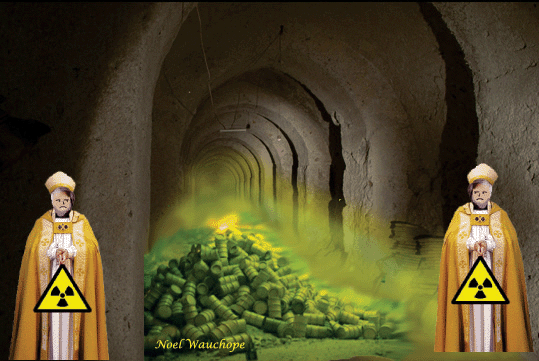
“At first, there was strong opposition to the reactors, but it eventually disappeared”,……… One explanation lies in the massive financial support provided by the nuclear power plant operator, TVO, to the municipality of Eurajoki. ……………………………..[Opponents] all share a common trait: they feel that they have been silenced, either by unspoken ostracisation or by more explicit confrontations.
The waste to be stored in Cigéo amounts to only 3 per cent of France’s waste, but 99 per cent of its radioactivity.
in a leaked document produced by a Land Operations Engineer of Andra, consulted by Equal Times, farmers of the region are listed and labelled according to whether they have been or can be “managed”.
By Guillaume Amouret, Michalina Kowol, Maxime Riché, 24 September 2024 https://www.equaltimes.org/despite-vastly-different-social?lang=en
“It looks just like wallpaper,” Jean-Pierre Simon says, pointing at the dark green line of trees that separate the fields, now glimmering in the setting sun. It is a landscape that he has admired for decades. “But soon, there will be a railway, and a train carrying nuclear waste on the horizon,” laments the farmer, his voice becoming bitter. His family has been living here, near Bure in the Meuse department of north-eastern France, for three generations. The question is, how many more generations will stay here to cultivate these fields in the future.
“Our goal is to reconcile the economy with our planet,” promised Ursula von der Leyen when she presented the adoption of the European Green Deal in 2019, shortly after she first assumed the presidency of the European Commission. Two years later, the European Parliament adopted the European Climate Law, which promised to turn the European Union climate-neutral by 2050. Another year later, in 2022, the European Parliament agreed to label both natural gas and nuclear power investments as climate-friendly sources of energy. In the latest European elections, held in June 2024, the centre-right European People’s Party, led by von der Leyen, again secured the majority of the seats.
But EU member states remain divided when it comes to investing in – and relying on – nuclear energy. On one hand, there’s France, which currently produces around 70 per cent of its electricity using nuclear power, and which recently passed a law to facilitate the construction of six (and up to 14) new reactors. In 2023, Finland’s first European Pressurised Water Reactor (EPR) in the country’s second nuclear power plant, Olkiluoto, started regular production; the country’s first nuclear power plant, Loviisa, began operating in 1977. And while some EU countries, like Poland, are planning to start building their first nuclear power plants in the coming years, others – like Germany – have opted out of nuclear energy production. The country’s last remaining nuclear power plants were closed in April 2023.
But it is not only the process of producing nuclear energy that sparks controversy, especially after the devastation caused by the accidents in Chernobyl (in Ukraine in 1986) and Fukushima (in Japan in 2011). Countries that have produced and relied on nuclear energy, like France, Germany and Finland, all face the same question: how to safely dispose of nuclear waste?
Finland: silenced detractors amid widespread support
Finland is considered one of the forerunners when it comes to nuclear energy. Roughly 20 years ago, the municipality of Eurajoki in western Finland not only accepted the erection of an EPR nuclear power generator but also the digging of Onkalo. Finnish for ‘cave’, it is a repository for spent nuclear fuel. It will become the first of its kind in the world at its opening, planned for 2025, after €900 million of construction costs. The overall cost is expected to reach €5 billion.
Finland: silenced detractors amid widespread support
Finland is considered one of the forerunners when it comes to nuclear energy. Roughly 20 years ago, the municipality of Eurajoki in western Finland not only accepted the erection of an EPR nuclear power generator but also the digging of Onkalo. Finnish for ‘cave’, it is a repository for spent nuclear fuel. It will become the first of its kind in the world at its opening, planned for 2025, after €900 million of construction costs. The overall cost is expected to reach €5 billion.
Run by the Finnish energy company Posiva Oy about 240 kilometres from Helsinki and situated 400 metres under the surface of the Earth, dug into the Finnish granite bedrock, Onkalo will become the final resting place for used nuclear fuel rods originating from the country’s five reactors: three on the island of Olkiluoto, right next door, and two in Loviisa in the south-east of the country.
The Onkalo project works according to the KBS-3 model, first developed in Sweden: spent fuel rods are inserted in copper cylinders, which offer the first barrier against the propagation of radioactive materials. The cylinders are then put in slots dug into granite. Finally, bentonite clay seals the copper capsules in their slots and fills in the deposition tunnels, and acts as a buffer between the copper and the granite.
One explanation lies in the massive financial support provided by the nuclear power plant operator, TVO, to the municipality of Eurajoki. In 2022, over a total of €57 million in tax revenues for the town, TVO would have paid €20 million in property taxes, according to Eurajoki’s mayor.
Sirkka supports the presence of TVO and the Onkalo, like most of the inhabitants of Eurajoki that Equal Times spoke to. Their trust could be considered as representative of the Finnish population nowadays. If acceptance of nuclear power was under 25 per cent back in 1983, it jumped to 61 per cent in 2024, according to a recent poll. And negative views decreased from 40 per cent to 9 per cent during the same time period.
But this does not mean that everyone agrees to the project.
We spoke to several residents – either historical opposition figures involved for decades in the protests against the construction of Onkalo or younger people, active until recently – who asked to remain anonymous. They all share a common trait: they feel that they have been silenced, either by unspoken ostracisation or by more explicit confrontations.
Some went as far as intimidating those against the plan, “sometimes walking under their windows with rifle guns”, as one person recalls. Another person we met had the feeling that because her opposition to the project was publicly known, she slowly lost her friends and had to search for work in other cities, further and further away from her hometown. She felt local employers would not want to hire her because of her opinions – although none explicitly gave this reason. Another opponent, after being involved in one of the marches organised against nuclear energy a few years ago, suffered from violent police repression and also decided to drop the fight, seeking refuge in a secluded property, far away from those painful memories.
On the other side of the Bothnia Gulf, work by researchers at the KTH Royal Institute of Technology in Stockholm, Sweden, questions the durability of copper containers in the long term. To offer protection from any radiation, the capsules would have to hold the nuclear waste safely for 100,000 years. But in a study published in January 2023, the corrosion scientist Jinshan Pan and his team point out the risks regarding embrittlements, cracks and corrosion due to sulphides in groundwater and called for “a comprehensive understanding of the corrosion mechanism […] to provide a solid scientific basis for the risk assessment of copper canisters in the final disposal of nuclear waste”. In a nutshell, he called for more studies on copper corrosion. The operator of Onkalo, Posiva, opposed these findings, arguing that sulphide levels are low enough to ignore this particular type of corrosion. It has not conducted any new research on the topic so far.
Germany’s nuclear phase-out
While Finland races ahead to be the first country to have a fully functioning spent nuclear fuel deposit, other countries like Germany seem to be far from even designing a location.
It all started on shaky ground in 1977, as a salt dome near Gorleben, right between Hamburg and Berlin, was designated to be the last resting place for spent nuclear fuel.
This decision sparked a massive opposition movement, which contributed to forming the ‘Anti-Atom-Bewegung’, the anti-nuclear-movement in Germany. Wolfgang Ehmke, spokesperson of the Bürgerinitiative Lüchow-Dannenberg, the anti-nuclear movement near Gorleben, is an activist of the first hour. To him, the nuclear phase-out in Germany is “not only due to our action, but also a series of lucky and unlucky events”.
The first phase of the new search terminated in 2020 and stated de facto that Gorleben is not suited for such an infrastructure. Its geological characteristics did not meet the conditions which the future disposal site should respond to.
The location analysis is currently making slow but steady progress. In a recent interview with the local newspaper Braunschweiger Zeitung, the president of the federal agency for nuclear wastes disposal (BGE), Iris Graffunder, explained that ten potential locations should be set for 2027. However, a final decision on the location will not be announced before 2046.
As for Gorleben, the federal agency for nuclear waste disposal announced its dismantlement last year. The salt that was dug out from the site for the construction and stored in a heap ever since, should be returned to the dome later this year. Observing every action and gesture of the agency, Bürgerinitiative Lüchow-Dannenberg remains critical concerning the date: “We are still waiting for the announced test run, before the final dismantlement,” explains Ehmke. Until then, its maintenance will have cost €20 million per year.
High tension over new waste repositories in France
Swallows fly in and out of Jean-Pierre’s barn, which provides shelter and shade on a hot June evening. JP, as everybody in Bure knows him, now armed with a rake, has been working since the early morning – like he does every day. A row of white and brown cows chew lazily on their hay. Only every now and then a low-pitched moo breaks the silence.
But Bure, in north-eastern France, about 300 km east of Paris, is far from quiet. The village, home to about 80 people, is the main stage of a political fight between the French state and anti-nuclear activists. Here, demonstrators have clashed with police on numerous occasions. In 2018, about 500 policemen were mobilised to evacuate protesters occupying a nearby forest. Even today, tensions are still palpable in Bure and the neighbouring villages. Police cars patrol the streets frequently, inhabitants denounce house searches and living under constant police supervision.
The reason? Bure’s underground is a construction site. France’s nuclear waste repository – named Cigéo for “industrial centre for geological deposit” – is supposed to store a total of 83,000m³ of high-level, long-life and medium-level nuclear waste. France produces around 70 per cent of its electricity from nuclear power.
Some of the demonstrators who came to Bure to support the local protest decided to stay and revive the countryside with sustainable farming. Like Mila and Jan, who hoped to start a new chapter in their lives here, far from the clamour of the city. Their dream is to raise goats: “We would like to produce our own goat cheese, to have just enough for ourselves and perhaps sell or exchange with others,” says the young couple who until recently, lived in an old house in a village next to Bure. However, this summer, they were forced out by the prefecture. While local authorities invoked the apparently ‘unsanitary conditions’ of the habitation, Jan and Mila’s landlord is convinced that the mayor of the village simply doesn’t want anyone who opposes Andra, the French national agency for nuclear waste management, to settle in the municipality. Since last year, Andra embarked on an unprecedented large-scale appropriation programme to acquire the land needed to construct the deposit.
Despite the nuclear waste’s high radioactivity levels, Andra has offered assurances that the location in Bure is safe: Cigéo is being constructed within a layer of Callovo-Oxfordian clay, deposited on-site about 160 million years ago. The conditioning of the waste and the protective layer of clay rock will help to avoid radioactive dispersion, the agency says. The storage is designed to remain safe during its operation for 100 years, as well as after its closure, for another 100,000 years. The deep storage project should enter its pilot phase in 2035.
But whether generations-old farmers like JP, or newcomers like Jan and Mila, will be able to continue their lives here is a different question. Andra plans to acquire an additional 550 plots to continue with the construction of its mega-project. Cigéo was declared of public interest in 2022, so the company now has the right to expropriate landowners. “I am 64, it is time for me to retire,” says JP. “My son applied to take over the farm, but Cigéo also covets some of my land parcels,” he laments. The agency recently asked for an extra strip of land alongside the former railway that will become the transportation channel for incoming spent nuclear fuel, and this further threatens the viability of JP’s plots, which would become much harder to work – or sell – if Andra’s request is granted.
In January 2023, Andra submitted an application to the national nuclear security agency, IRSN (Institute for Radiation Protection and Nuclear Safety), to authorise the construction of the final disposal in place of the current underground laboratory. After a reform of the nuclear security agency last year, and the termination of its previous president’s mandate, its new head was nominated in May 2024. And it is no less than the current president of Andra, Pierre-Marie Abadie, designated by President Emmanuel Macron. This choice raised doubts regarding the integrity of the entire project’s authorisation process, as critics pointed out conflict of interests.
“For now, we don’t see the bulldozers smashing the ground,” says JP. But he still remains sceptical: “I have doubts about my ability to stay here, should my farm be taken over. But I don’t have much time to reflect and think,” he says.
For now, JP must go back to work.
This article was developed with the support of Journalismfund.eu.
Scottish National Party blasts Labour for ‘frittering away’ money on nuclear plant instead of winter fuel payment
The party’s energy spokesperson Dave Doogan said Labour “is more concerned with funding needless nuclear projects… than it is with supporting hard-pressed pension
Andrew Quinn, Westminster Reporter, 28 SEP 2024.
https://www.dailyrecord.co.uk/news/politics/snp-blasts-labour-frittering-away-33767683
The SNP has claimed the Labour Government is “frittering away” £5 billion on a nuclear power plant while cutting the Winter Fuel Payment.
The party’s energy spokesperson Dave Doogan said the party is “more concerned with funding needless nuclear projects… than it is with supporting hard-pressed pensioners.”
The UK Government announced earlier this month that an extra £5.5bn is being made available to the Sizewell C nuclear power plant.
The plant is being built in Suffolk and the UK Government has said it will help secure the country’s energy independence. It will supply up to seven per cent of the UK’s energy needs but won’t start generating electricity until the 2030s.
t comes after the Labour Government decided to make the Winter Fuel Payment means-tested. Nearly 900,000 Scots pensioners will now miss out on the benefit.
Doogan said: “When Labour frittered away more than £5bn to the blackhole that is Sizewell C nuclear plant, what they did was fund a French owned company that will have no benefit to Scotland all the while picking the pockets of Scottish pensioners by robbing them of their Winter Fuel Payment.
“England’s Sizewell C will cost the tax payer some £30bn, yet just £1.4bn was deemed too high a price to keep 880,000 pensioners Scottish warm this winter – Sir Keir Starmer’s priorities are all wrong.
“The British Government is more concerned with funding needless nuclear projects and defending indefensible designer clothing funds than it is with supporting hard-pressed pensioners as the frost bites this winter and heating bills rise.
“Scotland is energy rich and our future is in renewables, but instead the Labour Government is choosing to pump money into English nuclear power plants and letting Scottish pensioners go cold – the SNP will always put Scotland’s interests first and that includes our pensioners in the face of swingeing Labour cuts.”
“Given the dire state of the public finances we have inherited, it’s right we target support to those who need it most. Over a million pensioners will still receive the Winter Fuel Payment, while many others will also benefit from the £150 Warm Home Discount to help with their energy bills over winter.
“We are also committed to helping the UK achieve energy security and net zero and new nuclear power stations such as Sizewell C will help us achieve that, while securing thousands of good, skilled jobs.”
Weatherwatch: Labour’s stance on nuclear power is worryingly familiar
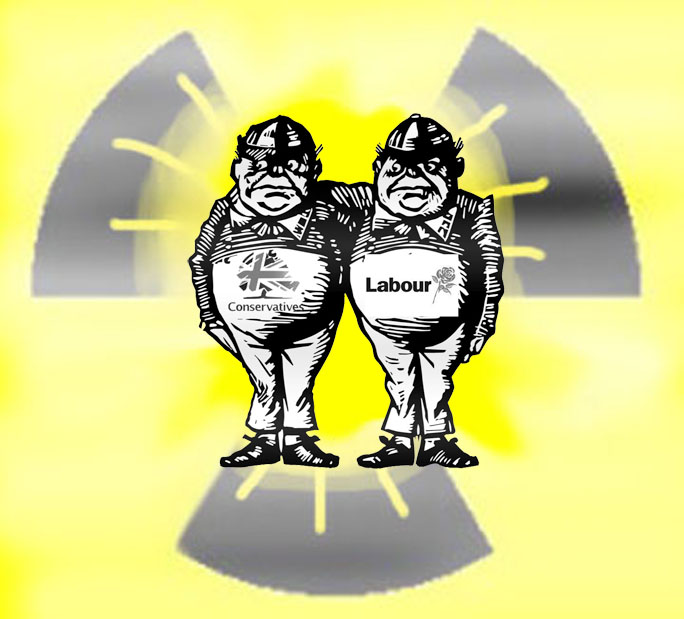
There is little difference between this government’s and its Conservative predecessor’s policies on expansion
Paul Brown, Fri 27 Sep 2024, https://www.theguardian.com/news/2024/sep/27/weatherwatch-labour-nuclear-power-conservative-policies
There seems to be no difference between Conservative and Labour policies on nuclear power. Both support the current building of Hinkley Point C in Somerset, the planned Sizewell C station in Suffolk, an unspecified number of small modular reactors all over Britain as well as the far-off dream of nuclear fusion.
However, few scientists serious about the threat of the climate crisis believe new nuclear power stations are part of the solution in reducing carbon output. Building them is too slow and costly, while solar and wind are quicker and cheaper in making a dent in fossil fuel consumption and eliminating it.
While supporting nuclear expansion seems to be politically expedient, the reality on the ground appears to be different. As the 2024 World Nuclear Status report published this month points out, if Britain gets anywhere near its plan to double onshore wind, triple solar power and quadruple offshore wind by 2030, it will be producing more electricity from these sources than the country consumes.
The experts also say if Rolls-Royce’s “heroic assumption” of the cost of electricity from small modular reactors was correct, any planned construction of large stations would immediately be abandoned.
Why NuScale Power Stock Dropped Today

Motley Fool, By Rich Smith – Sep 26, 2024
NuScale’s potential growth just got smaller by exactly one country.
Shares of NuScale Power (SMR 5.55%) slipped 3.2% through 11 a.m. ET Thursday on some disconcerting news out of Great Britain. According to World Nuclear News (WNN), the British government just narrowed the list of companies competing to begin building small modular nuclear reactors (SMRs) in the U.K. to four names.
NuScale isn’t one of them.
SMRs in the U.K.
According to WNN, the list of companies competing for this program initially numbered six, but two companies have been cut: NuScale and France’s EDF. General Electric subsidiary GE Hitachi Nuclear Energy, Rolls-Royce-owned Rolls-Royce SMR, and privately owned Holtec and Westinghouse all made the cut with reactor designs based on existing technology married to “modular production techniques.”
Britain plans to narrow its list further to two or perhaps three companies that will win co-funding contracts to complete their designs and obtain permits. Then the government will make a final decision to proceed with power plant construction in 2029.
………………….The bad news is that the closest company to a pure play in this new technology, NuScale Power, is now no longer an option in the U.K. Furthermore, Britain’s decision to pass on NuScale’s technology may give U.S. regulators second thoughts about it as well. All things considered, I’d say this is bad news for NuScale stock.
The other bad news is that the options that remain, Rolls-Royce and GE, are valued at $60 billion and $200 billion, respectively. While nuclear power may one day become a bigger part of their businesses, it’s going to be a long time before either company gets big enough in nuclear to move the needle on their revenue or earnings, or for investors to see them primarily as nuclear power stocks.
Investors seeking pure plays on nuclear power should probably look elsewhere. https://www.fool.com/investing/2024/09/26/why-nuscale-power-stock-dropped-today/
The Looming Catastrophe in the Middle East (w/ Gideon Levy) | The Chris Hedges Report
September 28, 2024
It has become quite rare to hear any meaningful accountability for Israel’s actions from Israeli citizens themselves. Israeli journalist Gideon Levy is an anomaly in Israel by today’s standards, as for his entire career he has challenged the apartheid and occupation of the Israeli state. On today’s episode of The Chris Hedges Report, Levy joins host Chris Hedges to discuss his book, The Killing of Gaza: Reports on a Catastrophe, and explain the spiritual destruction, both of Israel and Palestine, that the current genocide in Gaza is causing as well as the implications of new military operations in Lebanon.
The worst change, according to Levy, is that Israel has lost its humanity. “Everything is acceptable,” Levy tells Hedges as he describes the ongoing slaughter of Palestinian civilians in Gaza, the brutal killing of prisoners, the censorship at the hands of the state and the overall indifference to it all.
“There is practically only one camp in Israel, the camp which supports apartheid and occupation,” Levy says.
There isn’t even any room left for empathy of the innocent victims in Gaza, according to Levy. Teachers have been subject to interrogation and termination because they “express[ed] empathy with the children of Gaza, with the victims of Gaza. Even this is not legitimate anymore in Israeli society 2024,” Levy contends.
Although the horrors following October 7 are devastatingly unprecedented, Levy asserts that this entire catastrophe was years in the making and the meaningless gestures of advocating for a two-state solution, for example, will perpetuate it further.
In the first years following the war in 1967, the occupation of Palestinians as a way of life quickly became normalized, according to Levy. “[Palestinians] clean our streets, they build our buildings, they pave our roads and they will never have citizenship. The only people in the world without any citizenship of any state,” Levy says.
As Israeli society attempts to continue this way of living, only disruptive movements and moments, such as the First Intifada, the Yom Kippur war and now October 7, will bring meaningful attention to the Palestinian struggle most of the world is okay with ignoring.
As Levi writes in his book,
“The way of terror is the only way open to the Palestinians to fight for their future. The way of terror is the only way for them to remind Israel, the Arab states and the world, of their existence. They have no other way. Israel has taught them this. If they don’t use violence, everyone will forget about them, and then a little later, only through terrorism will they be remembered. Only through terrorism will they possibly attain something. One thing is certain, if they put down their weapons, they are doomed.”
Levy says that history has told the Palestinians and the world something crucial about Israel: “the message is, if you want to achieve anything from us, only by force. And the message for the world is the same, if you want the world to care about you, raising your voice is not enough. You have to take measures. You have to take actions, and unfortunately, many times violent ones, aggressive ones, and many times even barbarian ones, like on the seventh of October.”……………………………………………more https://scheerpost.com/2024/09/28/the-looming-catastrophe-in-the-middle-east-w-gideon-levy-the-chris-hedges-report/
US company eliminated from race to build Britain’s first mini-nuclear plant.
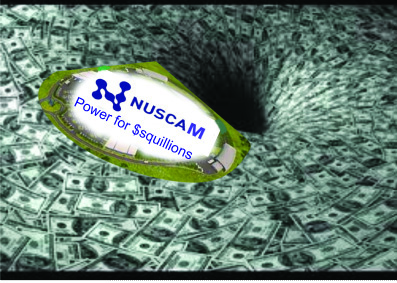
NuScale Power will not proceed to the final round of the competition’s selection process
Executives at NuScale Power were told on
Wednesday afternoon that they had been eliminated from the small modular
reactor (SMR) design competition.
The decision by officials at Great
British Nuclear (GBN), a government agency, leaves four companies battling
to secure support for their proposed technologies: Rolls-Royce,
Westinghouse, GE-Hitachi and Holtec Britain. Those businesses will now
progress to the final stage of the process, which will see them submit
“final best offers” to the Government.
GBN is then expected to announce
two winners either late this year or early in 2025, with the companies then
awarded sites and funding.
Earlier this year, a sixth company, the French
state-owned energy giant EDF, effectively dropped out of the contest when
it decided not to submit a bid by the required deadline. A spokesman for
NuScale also confirmed the decision. He said the company had been told it
did not meet the criteria for the SMR competition as it had already begun
production of its reactors and did not need support getting to market.
The decision is a fresh blow to NuScale, which suffered another setback last
November when its $1.4bn (£1bn) project to build a plant for a Utah power
provider was cancelled amid spiralling costs. The Government has not yet
confirmed where the first SMRs will be built. However, GBN purchased sites
in Wylfa, on the Welsh island of Anglesey; and Oldbury, Gloucestershire,
earlier this year.
Telegraph 25th Sept 2024
New developments at Sellafield for endless storage of ever-increasing amounts of highly radioactive spent nuclear fuel.
Sellafield to store all fuel from UK’s operational nuclear power stations, by Business Crack, September 25, 2024

I would have thought that it might be a good idea to plan for not making any more of this poisonous stuff.
But I guess that’s not in the official, expert, thinking.
A new space-saving rack at Sellafield will enable the site to store all the fuel expected from the UK’s operational nuclear sites.
The first fuel has been placed into a storage rack and the firm said it was set to save billions of pounds.
Known as the 63-can rack, the container allows the Thorp pond to store 50% more spent nuclear fuel.
Without the rack, a new storage pond would have to be built, potentially costing billions of pounds.
The rethink was required because Thorp needs to store more fuel than previously thought because the UK no longer reprocesses spent fuel, but instead stores it underwater prior to disposal.
The rack has been 16 years in the making and represents a success story for UK manufacturing.
Weighing 7 tonnes and standing 5.5 metres high, the stainless steel containers are being built by a consortium of Cumbrian manufacturers and Stoke-based Goodwin International.
Between them, they will manufacture 160 racks. Another 340 racks will be needed in the future…………………………………………………………………….
“These racks will increase fuel capacity from 4,000 tonnes to 6,000 tonnes, meaning we can accommodate all current and future arising, negating the need for a new storage facility……………………………………………………………………..
Because fuel will be stored for longer than was originally intended, the pond has required other alterations including raising the pH level to avoid corrosion and installing new cooling capacity, Sellafield Ltd said. https://businesscrack.co.uk/2024/09/25/sellafield-to-store-all-fuel-from-uks-operational-nuclear-power-stations/
Ambassadors called upon to refrain from military action involving nuclear plants
NFLA 26th Sept 2024
Following a recent safety visit by Director General Grossi of the International Atomic Energy Agency (IAEA) to the Kursk nuclear reactor in Southwest Russia, the Nuclear Free Local Authorities have written to the Russian and Ukrainian Ambassadors to the UK urging their armed forces not to take military action against nuclear power plants in the conflict zone.
Letters have also been sent to Mr Grossi and to the UN Secretary General Guterres urging them to take action to ensure that both the Russian Federation and Ukraine comply.
All nations already have existing international obligations under the 1949 Geneva Convention, Protocol 1, Article 56, not to target nuclear installations or to use military equipment based at such installations to launch offensive actions………………………………….
https://www.nuclearpolicy.info/news/ambassadors-called-upon-to-refrain-from-military-action-involving-nuclear-plants/
1 This Month


Tell the Ukrainian Government to Drop Prosecution of Peace Activist Yurii Sheliazhenko

Petition to revoke the licensing of the Near Surface Nuclear Disposal Facility (NSDF) at Chalk River. https://www.ourcommons.ca/petitions/en/Petition/Details?Petition=e-7247


of the week – STOP SMALL MODULAR REACTORS IN CANADA
To see nuclear-related stories in greater depth and intensity – go to https://nuclearinformation.wordpress.com
-
Archives
- March 2026 (204)
- February 2026 (268)
- January 2026 (308)
- December 2025 (358)
- November 2025 (359)
- October 2025 (376)
- September 2025 (258)
- August 2025 (319)
- July 2025 (230)
- June 2025 (348)
- May 2025 (261)
- April 2025 (305)
-
Categories
- 1
- 1 NUCLEAR ISSUES
- business and costs
- climate change
- culture and arts
- ENERGY
- environment
- health
- history
- indigenous issues
- Legal
- marketing of nuclear
- media
- opposition to nuclear
- PERSONAL STORIES
- politics
- politics international
- Religion and ethics
- safety
- secrets,lies and civil liberties
- spinbuster
- technology
- Uranium
- wastes
- weapons and war
- Women
- 2 WORLD
- ACTION
- AFRICA
- Atrocities
- AUSTRALIA
- Christina's notes
- Christina's themes
- culture and arts
- Events
- Fuk 2022
- Fuk 2023
- Fukushima 2017
- Fukushima 2018
- fukushima 2019
- Fukushima 2020
- Fukushima 2021
- general
- global warming
- Humour (God we need it)
- Nuclear
- RARE EARTHS
- Reference
- resources – print
- Resources -audiovicual
- Weekly Newsletter
- World
- World Nuclear
- YouTube
-
RSS
Entries RSS
Comments RSS
 nuclear-news