More nuclear reactors? Denying the risks, IAEA’s Grossi promotes unrealistic nuclear power plans
Beyond Nuclear, By M.V. Ramana and Jixiang Wang, 22 Sept 24
Rafael Grossi, the International Atomic Energy Agency’s Director General, has been busy over the last few years. The media has often reported on his efforts to highlight “the risk of a major nuclear accident” at the Zaporizhzhia nuclear plant. Grossi has also met with Russian President Vladimir Putin twice to discuss the situation at Zaporizhzhia, arguing that a “severe nuclear accident…would recognize no borders” and “we must do everything possible to prevent” such an accident.
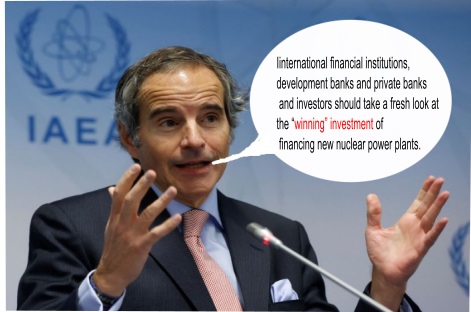
But Grossi has also simultaneously been increasing the risk of accidents, albeit inadvertently, by calling for building more nuclear reactors. This advocacy takes many forms. He has written op-eds in prominent outlets like Foreign Affairs. He has been trying to canvas countries to start nuclear power programs. For example, in March 2024. he went to Baghdad and committed to working with Iraq to help build a nuclear reactor “for peaceful purposes”. And as a way to deal with the unaffordable costs of nuclear reactors, he has pushed the World Bank and Asian Development Bank to provide funding for building nuclear plants.
None of this make sense. When viewed as investment advice to banks, Grossi’s promotion of nuclear power does not meet the laugh threshold. According to Grossi, the banks’ lack of funding for nuclear energy is “out of date, out of step with what is happening”. But it is Grossi’s advocacy that is out of step with happening to nuclear energy in the real world.
When nuclear energy is evaluated through how much it contributes to the world’s electricity production, the technology has been declining continuously for over 25 years, from 17.5 percent in 1996 down to 9.2 percent in 2022. For reasons discussed later, this trend will likely continue. In other words, the importance of nuclear energy is diminishing. Investing more money into a technology that some scholars argue is “destined for decline” makes little sense.
When analyzing Grossi’s advice to these development banks, one should remember what these institutions are supposed to do. The World Bank’s mission is “to end extreme poverty and boost prosperity on a livable planet”. And the Asian Development Bank has a similar mission, with a regional focus on Asia and the Pacific. The World Bank’s mission, in particular, mentions the multiple, intertwined crises we are confronting and emphasizes both the need for “affordable energy” and how quickly these crises should be addressed, stating “time is of the essence”. Nuclear energy fails on both counts.
Expensive and Slow
Electricity from nuclear reactors is costly and does not provide affordable energy, especially when compared to other low-carbon, renewable sources of energy. During the same period mentioned earlier, the share of all electricity generated by modern renewables has risen from just over 1 percent of in 1996 to 15.9 percent in 2023. Today, it is utility-scale solar photovoltaic power that provides the least costly option for generating electricity plants in many countries. This is why, in 2020, the International Energy Agency dubbed solar “the new king of the world’s electricity markets”. Money spent on nuclear reactors by banks would only divert funds away from investing in renewables and associated technologies and infrastructures.
Nuclear reactors have also almost never been on time. An astonishing 89 percent of all reactors that were connected to the grid between 2020 and 2022 were delayed………………………………..
That is not all. Around the world, 92 nuclear projects have been cancelled or suspended, usually after hundreds of millions, if not billions, have been spent. In the United States, the latest such cancellation was a project involving a small modular reactor from NuScale that the company advertised as “smaller, safer, and cheaper”
Necessary Conditions for Nuclear Power
It is not as though development banks have not considered nuclear energy. Back in 1959, the World Bank did invest in a nuclear project in Italy, based on a set of conditions, most importantly the unavailability of other cost-competitive alternatives. That project was not a success. More important for the present discussion is that with the reduced cost and increasing availability of solar and wind power, nuclear power no longer meets these conditions to be cost-effective.
The Asian Development Bank (ADB), too, undertook an analysis of various technologies and published an Energy Policy paper in 2009 that highlighted a number of barriers confronting nuclear power development, including “public concerns related to nuclear proliferation, waste management, safety issues, high investment costs, long lead times, and commercial acceptability of new technologies”. Thanks to these concerns, the paper declared that “ADB will maintain its current policy of non-involvement in the financing of nuclear power generation”. None of these barriers have disappeared.
………………………………………Fukushima served as a reminder that the nature of nuclear technology ensures “the inevitability of accidents”.
The Unlearned Lessons of Zaporizhzhia
A different route to a severe nuclear accident is on display at the Zaporizhzhia power plant—and Grossi has been eloquent about how such an accident will “have ripples and reverberations all over the world”. But instead of considering Zaporizhzhia as a wake-up call to reflect on whether the world should continue to build more nuclear power plants, Grossi has taken recourse to advocating for five principles of nuclear safety and security. Unfortunately for him these rules are unlikely to be widely accepted—as evidenced by the many attacks on the Zaporizhzhia plant.
…………………………………………………………………………………………………………………………………………….. Grossi’s silence about this risk should be troubling at the best of times. But it is particularly inexcusable when he is, in parallel, emphasizing the risks of suffer a major accident at the Zaporizhzhia power plant. When he went to Iraq recently, he actively downplayed the legitimate concerns in that country thanks to its nuclear reactors being bombed by Israel and the United States. Grossi’s prescription is to simply call for “turning the page on this complex past”. Can he genuinely and credibly assure Iraq that such an attack will not happen again?
The deeper problem is a conflict of interest. As the head of the International Atomic Energy, Rafael Grossi, like his predecessors, tasked with two separate objectives: “to accelerate and enlarge the contribution of atomic energy to peace, health and prosperity throughout the world” and to “ensure, so far as it is able, that assistance provided by it or at its request or under its supervision or control is not used in such a way as to further any military purpose”. The case for promoting nuclear energy was never very strong and has completely collapsed in recent years. It is past time to simply abandon the first objective and focus on the second. https://beyondnuclearinternational.org/2024/09/22/more-nuclear-reactors/
No comments yet.
1 This Month

of the week – Shut Down Drone Warfare!


Tell the Ukrainian Government to Drop Prosecution of Peace Activist Yurii Sheliazhenko

Petition to revoke the licensing of the Near Surface Nuclear Disposal Facility (NSDF) at Chalk River. https://www.ourcommons.ca/petitions/en/Petition/Details?Petition=e-7247
To see nuclear-related stories in greater depth and intensity – go to https://nuclearinformation.wordpress.com
-
Archives
- April 2026 (19)
- March 2026 (251)
- February 2026 (268)
- January 2026 (308)
- December 2025 (358)
- November 2025 (359)
- October 2025 (376)
- September 2025 (257)
- August 2025 (319)
- July 2025 (230)
- June 2025 (348)
- May 2025 (261)
-
Categories
- 1
- 1 NUCLEAR ISSUES
- business and costs
- climate change
- culture and arts
- ENERGY
- environment
- health
- history
- indigenous issues
- Legal
- marketing of nuclear
- media
- opposition to nuclear
- PERSONAL STORIES
- politics
- politics international
- Religion and ethics
- safety
- secrets,lies and civil liberties
- spinbuster
- technology
- Uranium
- wastes
- weapons and war
- Women
- 2 WORLD
- ACTION
- AFRICA
- Atrocities
- AUSTRALIA
- Christina's notes
- Christina's themes
- culture and arts
- Events
- Fuk 2022
- Fuk 2023
- Fukushima 2017
- Fukushima 2018
- fukushima 2019
- Fukushima 2020
- Fukushima 2021
- general
- global warming
- Humour (God we need it)
- Nuclear
- RARE EARTHS
- Reference
- resources – print
- Resources -audiovicual
- Weekly Newsletter
- World
- World Nuclear
- YouTube
-
RSS
Entries RSS
Comments RSS
 nuclear-news
Leave a comment