Hinkley Point C: Building Britain’s first nuclear reactor in 30 years
The government revised the strike prices for renewable generation in December 2023, the strike price for offshore wind is £73 and PV £61 so nuclear remains an expensive zero carbon option. The current price for electricity is approximately £83mWhr.
Building, By Thomas Lane, 17 September 2024
Like its Finnish and French twins, Hinkley Point C has suffered from cost overuns and delays. What are the team doing to claw back the losses and what does this mean for Sizewell C?
Nothing on the drive from Taunton to Hinkley Point C hints at the scale of the project at the destination. The journey is along picturesque minor roads, through woods and up and down steep-sided, intimate valleys before the terrain flattens out to reveal Europe’s largest construction site.
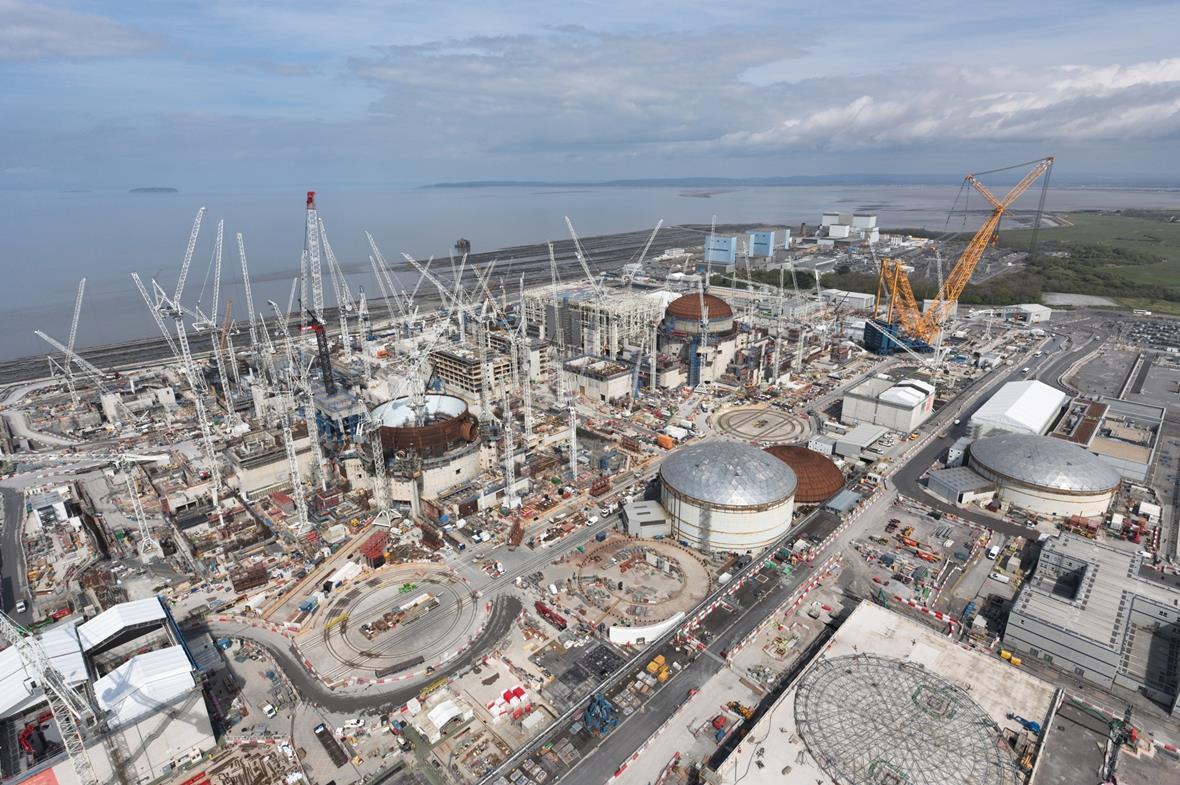
The huge location, which is deliberately situated miles away from major population centres, sprawls across a flat plain next to the Bristol Channel on the Somerset coast. Everything about this project is supersized.
There are 58 cranes on this job, one of which is Big Carl, the world’s largest land-based crane. Powered by 12 engines and rolling on 96 wheels, this monster can lift 5,000 tonnes and needs dedicated tracks to move it to the different parts of the nuclear island, where the reactors are being built.
A dedicated bus company was set up to avoid thousands of workers clogging up the lanes with traffic. It brings up to 11,000 of them from around the area and home again on a fleet of 176 buses. This includes a route to transport people around the 176-hectare site. The site even has a doctor’s surgery, a fire service and police station.
The civil engineering works are well advanced, with one of the two reactors close to fit-out and construction on the second coming along. Works elsewhere are progressing with the project about to move from the civil engineering phase to the complex mechanical, electrical and heating fit-out stage (see box).
Getting to this point has been long, slow and expensive. Hinkley Point C is the first nuclear reactor to be built since Sizewell B was completed in 1995. Called the European pressurised water reactor (EPR), Hinkley Point C is the third example to be built in Europe. The first was built at Olkiluoto in Finland and the second at Flamanville in France.
Each of these projects has gone massively over budget and taken much longer to build than envisaged (see box). The latest estimates suggest that Hinkley Point will cost as much as £34bn, nearly double the original budget of £18bn.
Originally scheduled to complete in 2025, the plant could come online as late as 2031. Why is Hinkley proving so expensive to build, despite the lessons from two earlier projects? And what are the cost and programme implications – and therefore the likelihood of it going ahead – for the proposed Sizewell C and beyond?.
There are many reasons for the cost increases and delays. These include the impact of the pandemic, which has delayed construction by 15 months, inflation and the challenge of finding people with the skills to meet the exacting standards demanded by nuclear construction. Different nuclear regulatory regimes across Europe are a big reason why the third EPR reactor is still costing more and is taking longer to build than originally envisaged.
“We had to substantially adapt the EPR design to satisfy British regulations, requiring 7,000 changes, adding 35% more steel and 25% more concrete,” explains Simon Parsons, EDF’s delivery director for the nuclear island.
According to Parsons, the French regulatory approach is very prescriptive, whereas in the UK it is up to EDF to prove that its design meets UK requirements. The UK is more focused on the consequences of failure than in Europe.
The main components inside the reactor building such as the reactor pressure vessel and steam generators are made to the same design by the same manufacturers but are subject to a UK specific safety regime. “We’ve been asked to do more FMEA (failure mode and effects analysis), material analysis and fracture toughness testing of welds over a piece of equipment,” Parsons says.
Progress at Hinkley Point…………………………………………………………………………………………………………………………………….
………………………….The digital data will be used for building operation, maintenance and – in 60 years after the plant starts operating – decommissioning. The data has a second important function: it will be used to build Sizewell C assuming funding is confirmed by the new government. Crucially for the future of UK nuclear, this will incorporate the lessons learnt from the construction of each reactor.
Will Hinkley Point and Sizewell provide value for money?
……………………….Hinkley Point and Sizewell will produce 14% of the UK’s electricity, the same as generated in 2022. This is considerably less than during nuclear’s 1990s heyday when it generated 24.5% of the UK’s electricity.
When Sizewell and Hinkley Point C start generating power, the only operational nuclear power station will be Sizewell B, which means nuclear’s total contribution to UK electricity generation will be 17%.
The argument against nuclear is the cost, with critics saying it is poor value for money compared with renewables. All three EPR nuclear power stations built in Europe have suffered from serious cost overruns and delays.
…………………Hinkley Point C got the green light in 2016 with an estimated £18bn build cost and completion by 2027. The most recent estimates put costs as high as £34bn at 2015 prices, £46bn in today’s money. The poor budgetary track record of the EPR begs the question, is new nuclear good value for money?
Hinkley Point was originally a privately financed joint venture between EDF and China General Nuclear with EDF owning two-thirds and CGN the remaining third. The station was to be financed using the Contracts for Difference mechanism which is used to support forms of electricity generation which can’t compete with gas.
This government guarantees a minimum payment for the electricity, the so-called strike price. In 2012 a strike price of £93.50mWhr was agreed for Hinkley Point C at a time when electricity cost £40mWhr, provoking criticism that nuclear was too expensive. The strike price is inflation linked meaning it is worth approximately £139 at 2023 prices.
The government revised the strike prices for renewable generation in December 2023, the strike price for offshore wind is £73 and PV £61 so nuclear remains an expensive zero carbon option. The current price for electricity is approximately £83mWhr.
As the cost of Hinkley Point has increased, the backers have had to provide more funding. The souring of relations between Britain and China saw CGN stop providing any more money, leaving EDF to fund the shortfall. EDF has called upon the UK government to help out with the escalating cost but it has refused. EDF was fully nationalised in 2023, leaving the French taxpayer to pick up the tab for the cost overruns.
Like Hinkley Point, Sizewell was a joint venture between EDF and CGN but concerns over Chinese involvement meant the UK government took over from CGN in 2022. The cost overruns on Hinkley mean EDF wanted a different funding arrangement to avoid picking up the construction risk for Sizewell.
It will be funded using the regulated asset base model, which is the same as used for Thames Tideway; a surcharge is placed on electricity bills to fund the plant. EDF’s role would be to build and operate the plant without taking the construction risk.

A development consent order for the project was granted in January 2024 and the nuclear site licence approved in May 2024. The final investment decision will be made at the end of this year.
Sizewell C may cost less to build than Hinkley Point thanks to the experience gained constructing the latter, but the British consumer could end up paying more thanks to the different funding arrangement…………………………………………………………………………………………………………………………………………………………………………………………………. https://www.building.co.uk/buildings/hinkley-point-c-building-britains-first-nuclear-reactor-in-30-years/5130997.article
No comments yet.
1 This Month

Petition to revoke the licensing of the Near Surface Nuclear Disposal Facility (NSDF) at Chalk River. https://www.ourcommons.ca/petitions/en/Petition/Details?Petition=e-7247


of the week – STOP SMALL MODULAR REACTORS IN CANADA
To see nuclear-related stories in greater depth and intensity – go to https://nuclearinformation.wordpress.com
-
Archives
- March 2026 (153)
- February 2026 (268)
- January 2026 (308)
- December 2025 (358)
- November 2025 (359)
- October 2025 (376)
- September 2025 (258)
- August 2025 (319)
- July 2025 (230)
- June 2025 (348)
- May 2025 (261)
- April 2025 (305)
-
Categories
- 1
- 1 NUCLEAR ISSUES
- business and costs
- climate change
- culture and arts
- ENERGY
- environment
- health
- history
- indigenous issues
- Legal
- marketing of nuclear
- media
- opposition to nuclear
- PERSONAL STORIES
- politics
- politics international
- Religion and ethics
- safety
- secrets,lies and civil liberties
- spinbuster
- technology
- Uranium
- wastes
- weapons and war
- Women
- 2 WORLD
- ACTION
- AFRICA
- Atrocities
- AUSTRALIA
- Christina's notes
- Christina's themes
- culture and arts
- Events
- Fuk 2022
- Fuk 2023
- Fukushima 2017
- Fukushima 2018
- fukushima 2019
- Fukushima 2020
- Fukushima 2021
- general
- global warming
- Humour (God we need it)
- Nuclear
- RARE EARTHS
- Reference
- resources – print
- Resources -audiovicual
- Weekly Newsletter
- World
- World Nuclear
- YouTube
-
RSS
Entries RSS
Comments RSS
 nuclear-news
Leave a comment