The future of new nuclear

With new nuclear stagnating and renewables soaring – the sober reality is that nuclear power is just too costly and too late amid crisis
by Dr Paul Dorfman, 10-09-2024 ,
https://bylines.scot/environment/the-future-of-new-nuclear/
Editor’s note: This article has been written by Dr Dorfman and others:
- Prof Steve Thomas (Coordinating Editor, Energy Policy; Emeritus Professor of Energy Policy, University of Greenwich, UK).
- Dr Bernard Laponche (Polytechnicien, Docteur ès Sciences en Physique des Réacteurs Nucléaires, Docteur en Economie de l’Energie, France).
- Prof MV Ramana (Professor and Simons Chair in Disarmament, Global and Human Security at the School of Public Policy and Global ANairs, University of British Columbia, Canada).
- Tetsunari Iida (Chairperson, Institute for Sustainable Energy Policies, Japan).
- Prof Amory Lovins (Civil Engineering, Stanford University, USA).
Many governments around the world are under enormous pressure to expand funding for nuclear power, usually accompanied by claims that nuclear must or will play a key role in achieving climate change targets. However, the fact is that nuclear technology is in decline, and for good reason. Nuclear energy’s share of global electricity production has decreased from 17.5% (1996) to 9.2% (2023), largely due to the high costs of, and delays to, building and operating nuclear reactors.

Governments must resist pressures from the nuclear industry to fund this declining technology. These resources should be used to fund renewables and energy storage or management options – these can and will deliver climate change objectives more abundantly, reliably, quickly, and cost-effectively.

New nuclear promotional pressure can be seen in three areas: funding for the development of Small Modular Reactors (SMRs), financing new large reactors, and paying for life extension of existing reactors as they reach the end of their design life. These pressures on governments can be seen in five of the major nuclear-generating countries: the USA, France, Canada, Japan, and the UK.
Small Modular Reactors (SMRs)
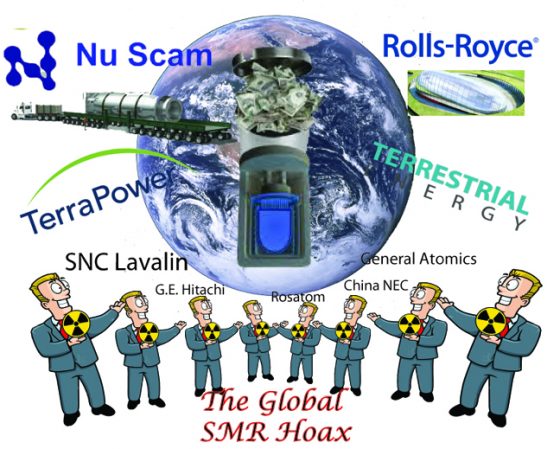
When times get tough, the nuclear industry always redirects attention to new technologies it claims will solve the problems of existing designs. The latest magic bullet is SMRs. Even though no commercial order is even close to being placed, SMRs are presented in the press as quick, cheap, safe, and under construction. Yet, in reality, SMRs are years away from commercial operation, are as expensive as large reactors, and share the same safety, security, and waste problems.
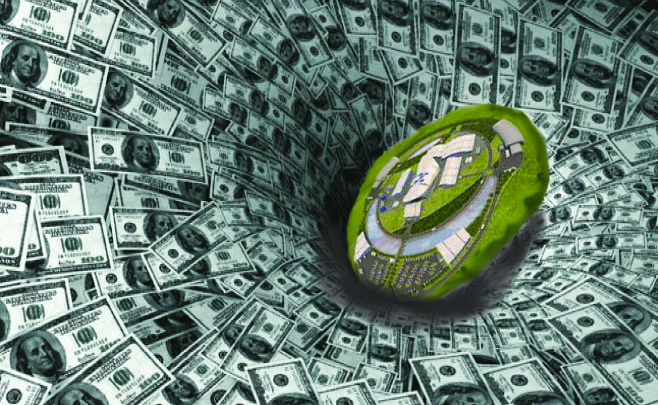
Indeed, the motivation behind SMRs appears to be financial. In recent years the nuclear industry has quietly changed its business model from making and selling products to harvesting subsidies for SMR ‘development’. In Canada, various publicly owned bodies are trying to develop new SMRs using public money, while here, the UK government is running an SMR design competition with a budget of £20bn from the public purse. Ultimately, the underlying problems become obvious – as demonstrated by last year’s collapse of NuScale USA’s SMR design and EDF France’s recent abandonment of its own SMR effort.
Large nuclear reactors
Far from improving, the record of large nuclear reactor construction is in decline with the latest designs being the worst-ever record of delays and cost escalation. The nuclear industry’s recipe is always the same; claim they are learning, claim bulk orders will reduce cost, and try to ‘streamline’ planning, safety and security regulation. These have never worked in the past and won’t work now.
Meanwhile, despite the usual cost and time overruns, the UK government is struggling to build two more reactors using the frail European Pressurised Reactor (EPR) reactor design. In France, EDF (the nationalised French nuclear utility), has plans to develop new large reactors using a modified version of the EPR design – limiting a number of safety and security features – while signalling that it will need even more public financial support.

Ageing nuclear
The world’s reactor stock is ageing. In the USA, about half the operating reactors are beyond their 40-year design life, providing expensive power even though their construction costs have been paid off. There, nuclear can survive in competitive electricity markets only thanks to large new public subsidies. In Japan, 23 reactors remain closed since the Fukushima disaster – their utilities are still trying to reopen them despite these reactors being out of service for 13 years and more. In France, EDF is facing a bill of up to €100bn for mandatory safety upgrades to its ageing nuclear fleet. Globally, these old reactors fall far short of the safety and security standards required for new reactors and should therefore be replaced as soon as possible with non-nuclear options.
Transition to renewables
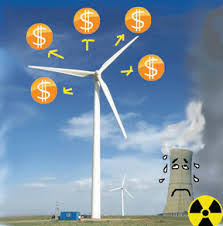
Nuclear power has never been economic, and its real costs have continued to rise throughout its history. In the past, nuclear survived because electricity was a monopoly, and electric utilities could pass on the cost, no matter how high. The introduction of competitive electricity meant this option was lost, causing the finance market to turn away from new nuclear.
After more than 60 years of commercial history, nuclear is getting further from, not nearer to, being able to survive without massive public subsidies. This is a clear indication that this quintessentially mid-20th century technology is in terminal decline and should be abandoned. Doing so would help protect the climate, not least because an hour of nuclear energy production costs several times more than renewables. In other words, nuclear delivers far less power per pound sterling than renewables.
Nuclear displaces far less fossil fuel than renewables, in terms of cost and delivery time. According to the UK Government’s Regulated Asset Base Model Impact Assessment, new nuclear takes up to 17 years for the planning, regulation and construction of just one station. The more concerned you are about climate change, the more vital it is to buy cost-effective, fast, sure, renewable options rather than expensive, slow, speculative nuclear.
The International Panel on Climate Change has reported that renewables are now ten times more efficient than nuclear at CO2 mitigation. New renewable electricity provided 507 Gigawatts (GW) in 2023, accounting for 86% of global additions of generation capacity, (reaching a total renewable capacity of 3870 GW). The renewable share of total power capacity rose to 43.2%. This extraordinary surge shows that renewables are the only technology available for a rapid transition from fossil fuels. At best, new nuclear adds only as much electricity in a year as renewables add every few days. For example, China is now installing wind and solar capacity equivalent to five new nuclear reactors every week.
New nuclear has no business case
With new nuclear stagnating and renewables soaring, the sober reality is that nuclear power is just too costly and too late for the climate and energy crises.
Far from being needed to back up variable solar and wind power, nuclear plants require even more and costlier support because their failures are larger, longer, more abrupt, and far less predictable. In 2022, half of all French reactors were online with safety faults. Not only is nuclear slow and expensive, but it is also far too inflexible to keep going up and down with the swings of electricity demand. In contrast, the variability of wind and solar technologies can be more easily integrated into evolving, flexible electricity grids capable of adjusting output to fluctuating demand and providing stable power at all times.
New nuclear has no operational need and no business case. The fact is, it’s entirely possible to sustain a reliable power system by using electricity far more efficiently and expanding diverse renewable energy supply in all sectors. This can be achieved together with the rapid growth and modernisation of the electricity grid, fuller and faster interconnection, smart energy management, and swift deployment of today’s cost-effective storage technology.
We need to secure affordable, sustainable, low-carbon energy to power our industry, transport, homes, and businesses. Since all key energy international organisations and institutes agree that renewables will do the heavy lifting to achieve net-zero, the future backbone of the world’s power supply will be clean, green, safe, and cost-effective. Nuclear is none of those.
No comments yet.
1 This Month


Tell the Ukrainian Government to Drop Prosecution of Peace Activist Yurii Sheliazhenko

Petition to revoke the licensing of the Near Surface Nuclear Disposal Facility (NSDF) at Chalk River. https://www.ourcommons.ca/petitions/en/Petition/Details?Petition=e-7247


of the week – STOP SMALL MODULAR REACTORS IN CANADA
To see nuclear-related stories in greater depth and intensity – go to https://nuclearinformation.wordpress.com
-
Archives
- March 2026 (176)
- February 2026 (268)
- January 2026 (308)
- December 2025 (358)
- November 2025 (359)
- October 2025 (376)
- September 2025 (258)
- August 2025 (319)
- July 2025 (230)
- June 2025 (348)
- May 2025 (261)
- April 2025 (305)
-
Categories
- 1
- 1 NUCLEAR ISSUES
- business and costs
- climate change
- culture and arts
- ENERGY
- environment
- health
- history
- indigenous issues
- Legal
- marketing of nuclear
- media
- opposition to nuclear
- PERSONAL STORIES
- politics
- politics international
- Religion and ethics
- safety
- secrets,lies and civil liberties
- spinbuster
- technology
- Uranium
- wastes
- weapons and war
- Women
- 2 WORLD
- ACTION
- AFRICA
- Atrocities
- AUSTRALIA
- Christina's notes
- Christina's themes
- culture and arts
- Events
- Fuk 2022
- Fuk 2023
- Fukushima 2017
- Fukushima 2018
- fukushima 2019
- Fukushima 2020
- Fukushima 2021
- general
- global warming
- Humour (God we need it)
- Nuclear
- RARE EARTHS
- Reference
- resources – print
- Resources -audiovicual
- Weekly Newsletter
- World
- World Nuclear
- YouTube
-
RSS
Entries RSS
Comments RSS
 nuclear-news
Leave a comment