The US Empire Can Exist Only In A Continuous State Of Mass Military Violence
Caitlin Johnstone, Sep 10, 2024
I shouldn’t be able to do this for a living. Criticizing the warmongering of a single power structure shouldn’t be anyone’s full-time job. No government should be murdering people so consistently and reliably that people can plan their whole lives around it.
Yet here we are. Not only are people like me able to focus on commentary about the mass military violence of the US and its satellite states as a full-time gig, but we usually find there’s too much to talk about from day to day.
Just today we’re getting reports that at least 40 people have been killed in an IDF massacre on a tented encampment in southern Gaza near Khan Younis, which Israel had previously designated as a humanitarian safe zone. There are videos of families digging frantically in the sand trying to rescue loved ones who were buried by the blast, which was reportedly so forceful that bodies are being found some thirty feet down.
Antiwar’s Dave DeCamp has taken to typing up daily updates on the documented Israeli massacres of Palestinian civilians in Gaza, often with dozens of victims added to the official death toll in a single day.
Kamala Harris has finally announced a foreign policy platform, and it contains nothing but a promise of more of the same. She promises to “ensure that the United States remains the strongest, most lethal fighting force in the world,” to “make sure that America, not China, wins the competition for the 21st century,” to “strengthen, not abdicate, our global leadership,” to “stand up for Israel’s right to defend itself,” and to “protect U.S. forces and interests from Iran and Iran-backed terrorist groups,” and boasts that she “has worked with our allies to ensure NATO is stronger than ever” in the face of “Vladimir Putin’s brutal aggression.”
In other words, more unrelenting violence and militarism to ensure that the US empire continues dominating the planet. It’s not hard to see why Harris is winning endorsements from some of the worst warmongers on the planet.
Bloodthirsty empire manager Victoria Nuland is now openly admitting that the US sabotaged a peace deal in Ukraine in the early weeks of the war, saying in an interview that Washington pushed Kyiv to reject the deal because it “included limits on the precise kinds of weapons systems that Ukraine could have” if it were agreed to.
This is something people like myself used to get called Russian propagandists for saying happened, despite all the overwhelming evidence that it had.
The horrors in Ukraine are happening because the US-centralized power alliance refused easy off-ramp after easy off-ramp. This whole war could’ve easily been avoided, and it could have easily been ended shortly after it began. But they kept pushing on, because they wanted this war………………………………………………………………………………
there are plenty of others like me. And for every person there is making a living from opposing US warmongering, there are thousands making a living from facilitating it. In the military. In the arms industry. In think tanks. In the media. In politics. In government agencies. There is much, much more money to be made from war than from peace. That’s one of the main reasons the capitalist empire we live under exists in a constant state of mass military violence. Endless violence and the threat thereof is the glue which holds the empire together.
In a healthy world, none of these jobs would exist — people working for peace or people working for war. Peace would just be the natural order of things.
But until that healthy world has emerged, we fight on. Day after day after day after day, for however long such work is necessary. https://www.caitlinjohnst.one/p/the-us-empire-can-only-exist-in-a?utm_source=post-email-title&publication_id=82124&post_id=148710143&utm_campaign=email-post-title&isFreemail=true&r=1ise1&triedRedirect=true&utm_medium=email
Which rural area will take the UK’s nuclear waste?

each community being considered for a geological disposal facility (GDF) now receives about £1m a year in investment
If a GDF is built here, Mr Moore says, there will be billions of pounds invested in the area
Victoria Gill and Kate Stephens, Science correspondent and senior science producer, BBC News, 9 Sept 24

“………………………………………………………………………..Sellafield is filling up – and experts say we have no choice but to find somewhere new to keep this material safe.
Nuclear power is also part of the government’s stated mission for ”clean power by 2030”. More nuclear power means more nuclear waste.
…………………….. Sellafield runs 24 hours a day with 11,000 staff. It costs more than £2bn per year to keep the site going, and it comprises more than 1,000 buildings, connected by 25 miles of road.
However, in recent years, doubts have been raised about the site’s security and physical integrity.
One of its oldest waste storage silos is currently leaking radioactive liquid into the ground. That is a “recurrence of a historic leak” that Sellafield Ltd, the company that operates the site, says first started in the 1970s.
Sellafield has also faced questions about its working culture and adherence to safety rules. The company is currently awaiting sentencing after it pleaded guilty, in June, to charges related to cyber-security failings.
An investigation by the Guardian revealed that the site’s systems had been hacked, although the Office for Nuclear Regulation said there was “no evidence that any vulnerabilities had been exploited” by the hackers.
All of this has cast a shadow over an operation that, as well as taking in newly created nuclear waste, also houses several decades worth of much older radioactive material.
The site no longer produces or reprocesses any nuclear material, but this is where the race began to produce plutonium for nuclear weapons at the height of the Cold War.
“It was the dawn of the nuclear age,” says Roddy Miller, Sellafield’s operations director. “But because it was a race, not a lot of thought was given to the long-term safe storage of the waste materials that were produced.”
The leaking storage silo, which was built in the 1960s, is just one of the buildings that now has to be emptied so the material inside can go into more modern silos. The building was only ever designed to be filled, and Sellafield says its plans to clear the site and demolish the building are the safest option.
The site’s head of retrievals, Alyson Armett, points out that without a “permanent solution” for the nuclear waste, the plans to decommission could be delayed.
The current plan for that permanent solution is to bury the waste deep underground.
A complicated search – both scientifically and politically – is currently on for somewhere to lock it away from humanity permanently.
“We need to isolate it from future populations or even civilisations, that’s the timescale we’re looking at,” says Prof Corkhill…………………………………………………..
The plan for permanent, underground storage is to contain that solid waste in a Russian doll-like series of barriers. The glass, encased in steel, will be shielded in concrete, then buried beneath the Earth‘s own barriers – layers of solid rock.
The question is, where will that facility be?
‘The waste is already here’
Six years ago, communities in England and Wales were asked to come forward if they were willing to consider having a disposal facility built near their town or village.
Potential sites will need the ideal geology – enough solid rock to create that permanent barrier. However, they also need something that might be more difficult – a willing community.
There are financial incentives for communities to take part in this discussion. So far, five have come forward. Two have already been ruled out. Allerdale in Cumbria was deemed unsuitable because there was not enough solid bedrock. Then, in September, councillors in South Holderness, in Yorkshire, withdrew after a series of local protests.
Government scientists are assessing the remaining three communities that are currently in the running. Geologists have been carrying out seismic testing – looking for that all-important impermeable rock.
One of the communities being considered is very close to the Sellafield site in West Cumbria, at Seascale.
It is not yet clear if Mid Copeland, the area under consideration that includes Seascale, will have the right rock. The survey and consultation here – and in the other locations being considered – are in their early stages and scheduled to last at least a decade.
In the meantime, the conversation goes on and each community being considered for a geological disposal facility (GDF) now receives about £1m a year in investment while initial scientific tests are carried out.
Mr Moore is part of a committee called a GDF partnership. It includes local residents, local government and representatives of Nuclear Waste Services, which is the government body behind this project.
These partnerships aim to keep the process transparent and ensure local people are well-informed. They also decide how the money is spent.
If a GDF is built here, Mr Moore says, there will be billions of pounds invested in the area. “If we’re going to host this on behalf of the UK, the community should benefit,” he says.
Also still on the shortlist are South Copeland, again on the Cumbrian coast, and a site on the east coast in Lincolnshire, where there have been a number of peaceful, but angry, protests.
On Halloween 2021 in Theddlethorpe, one of the local villages, several residents used their gardens to put up garish anti-nuclear dump scarecrows, inspired by an idea from pressure group the Guardians of the East Coast, which is campaigning against the disposal facility.
Ken Smith, from nearby Mablethorpe, is a member of both the campaign group and the local GDF partnership.
He thinks the government’s approach to finding a nuclear waste disposal site “stinks”.
Mr Smith is concerned that the voices of those most affected might not be heard and says it is unclear how local opinion will be measured at the end of the consultation…………………………………………………………………………………………………………………
https://www.bbc.co.uk/news/articles/czx6e2x0kdyo
Former Palisades engineering director has misgivings about the plant’s historic restart effort

Tom Henry, The Blade, 9 Sept 24,
A former nuclear industry executive has emerged as a surprise critic of the historic effort to restart the Palisades nuclear plant in southwest Michigan.
Alan Blind, 71, who lives on a 16-acre farm in Baroda, Mich., said during a 75-minute interview with The Blade last week that Palisades, in his opinion, is “not a good selection as a role model for expanding the nuclear industry.”
Holtec International, of Jupiter, Fla., which originally was hired to decommission the plant, has instead bought it from its previous owner, New Orleans-based Entergy, and has put together an unprecedented plan to restart it.
Bringing a mothballed nuclear plant back into service has never been tried before in nuclear history.
The project has received huge government support, including a $1.52 billion commitment from the U.S. Department of Energy.
The outcome is expected to have huge ramifications for the industry worldwide, given the prohibitive cost of building new plants from scratch and continued issues over less-expensive units known as small modular reactors.
Mr. Blind has special insight into Palisades because he served as its engineering director for nearly seven years under Entergy’s ownership, from May of 2006 through February of 2013.
Decades in industry
Palisades was the last stop in Mr. Blind’s career, which included time as a vice president at two other sites.
Mr. Blind began working in the nuclear industry in December of 1975 at a plant about 35 miles south of Palisades, the D.C. Cook nuclear plant near Bridgman, Mich.
That job came shortly after he graduated from Purdue University.
He he worked his way up to site vice president for D.C. Cook’s owner, American Electric Power.
After 21½ years at D.C. Cook, Mr. Blind went to New York to be vice president of nuclear power at the former Indian Point nuclear complex, which at the time was owned by Consolidated Edison Company of New York Inc.
He said he believed Palisades was operating on a thin safety margin while he was there, that he “saw a lot of red flags,” and never expected it to become the first test case of whether a mothballed plant can be put back in service.
“I put Palisades out of my mind and was comforted by the decision to shut it down and put it into decommissioning,” Mr. Blind said.
The plant was shut down and entered its decommissioning phase in May of 2022, a little more than two years ago……………………………………………………………
Palisades history……
Palisades began operating March 24, 1971, meaning that much of the engineering behind it occurred in the mid to late-1960s.
The NRC itself didn’t begin as a government agency until 1975, although it grew out of one called the Atomic Energy Commission, which had a much broader mission. The NRC is solely focused on safety. The AEC was created after World War II to promote and develop peaceful use of atomic science and technology.
The “defense in depth” concept that promotes use of multiple backup safety systems, as well as the NRC’s general design criteria, were not well-developed during the era Palisades was built, Mr. Blind said.
He said it’s akin to not having an old house brought up to modern building codes.
“Overall, I was concerned about the lack of safety systems and design in depth,” Mr. Blind said.
He said he wanted to see more done as Palisades — like many other nuclear reactors — went to longer fuel cycles and higher outputs.
“They started off with very little margin because of the age of the plant,” Mr. Blind said. “Those margins were razor thin.”
His concerns have made their way into three formal petitions he filed with the NRC last month, imploring the agency to slow down and think harder about the pros and cons of restarting Palisades.
Each are undergoing a lengthy review process the NRC uses when it receives such detailed petitions. One petition challenges the rulemaking process, citing the unprecedented nature of what Holtec is trying to do. Another claims there is a lack of quality assurance, and the third petition raises questions about the existing state of steam generators.
Mr. Blind said he expects to file a fourth petition with the NRC within the next 10 days, making a technical argument for a public hearing more extensive than what’s been held to date………………………………….. https://www.toledoblade.com/business/energy/2024/09/08/former-palisades-engineering-director-has-misgivings-about-the-plant-s-historic/stories/20240908054/?fbclid=IwY2xjawFMkQxleHRuA2FlbQIxMQABHR1G0iCbJRiP0yk2X0kR5WGv88UE6xH5Fsi9ycAnPz2Oo1TQWtlbaFI6DA_aem_-0oAmUfm0HdWnMUniKDfaA
Nuclear Fusion’s public-relations drive is obscuring the challenges that lie ahead
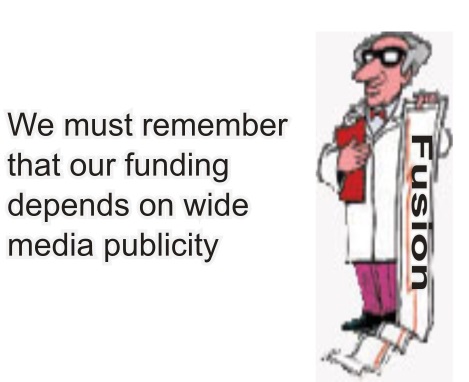
EUROfusion’s Research Roadmap, which the UK co-authored when it was still part of ITER, sees fusion as only making a significant contribution to global energy production in the course of the 22nd century. This may be politically unpalatable, but it is a realistic conclusion.
EUROfusion’s Research Roadmap, which the UK co-authored when it was still part of ITER, sees fusion as only making a significant contribution to global energy production in the course of the 22nd century. This may be politically unpalatable, but it is a realistic conclusion.
https://physicsworld.com/a/fusions-public-relations-drive-is-obscuring-the-challenges-that-lie-ahead/, 09 Sep 2024
Guy Matthews says that the focus on public relations is masking the challenges of commercializing nuclear fusion.
“For a successful technology, reality must take precedence over public relations, for nature cannot be fooled.” So stated the Nobel laureate Richard Feynman during a commission hearing into NASA’s Challenger space shuttle disaster in 1986, which killed all seven astronauts onboard.
Those famous words have since been applied to many technologies, but they are becoming especially apt to nuclear fusion where public relations currently appears to have the upper hand. Fusion has recently been successful in attracting public and private investment and, with help from the private sector, it is claimed that fusion power can be delivered in time to tackle climate change in the coming decades.
Yet this rosy picture hides the complexity of the novel nuclear technology and plasma physics involved. As John Evans – a physicist who has worked at the Atomic Energy Research Establishment in Harwell, UK – recently highlighted in Physics World, there is a lack of proven solutions for the fusion fuel cycle, which involves breeding and reprocessing unprecedented quantities of radioactive tritium with extremely low emissions.
Unfortunately, this is just the tip of the iceberg. Another stubborn roadblock lies in instabilities in the plasma itself – for example, so-called Edge Localised Modes (ELMs), which originate in the outer regions of tokamak plasmas and are akin to solar flares. If not strongly suppressed they could vaporize areas of the tokamak wall, causing fusion reactions to fizzle out. ELMs can also trigger larger plasma instabilities, known as disruptions, that can rapidly dump the entire plasma energy and apply huge electromagnetic forces that could be catastrophic for the walls of a fusion power plant.
In a fusion power plant, the total thermal energy stored in the plasma needs to be about 50 times greater than that achieved in the world’s largest machine, the Joint European Torus (JET). JET operated at the Culham Centre for Fusion Energy in Oxfordshire, UK, until it was shut down in late 2023. I was responsible for upgrading JET’s wall to tungsten/beryllium and subsequently chaired the wall protection expert group.
JET was an extremely impressive device, and just before it ceased operation it set a new world record for controlled fusion energy production of 69 MJ. While this was a scientific and technical tour de force, in absolute terms the fusion energy created and plasma duration achieved at JET were minuscule. A power plant with a sustained fusion power of 1 GW would produce 86 million MJ of fusion energy every day. Furthermore, large ELMs and disruptions were a routine feature of JET’s operation and occasionally caused local melting. Such behaviour would render a power plant inoperable, yet these instabilities remain to be reliably tamed.
Complex issues
Fusion is complex – solutions to one problem often exacerbate other problems. Furthermore, many of the physics and technology features that are essential for fusion power plants and require substantial development and testing in a fusion environment were not present in JET. One example being the technology to drive the plasma current sustainably using microwaves. The purpose of the international ITER project, which is currently being built in Cadarache, France, is to address such issues.
ITER, which is modelled on JET, is a “low duty cycle” physics and engineering experiment. Delays and cost increases are the norm for large nuclear projects and ITER is no exception. It is now expected to start scientific operation in 2034, but the first experiments using “burning” fusion fuel – a mixture of deuterium and tritium (D–T) – is only set to begin in 2039. ITER, which is equipped with many plasma diagnostics that would not be feasible in a power plant, will carry out an extensive research programme that includes testing tritium-breeding technologies on a small scale, ELM suppression using resonant magnetic perturbation coils and plasma-disruption mitigation systems.
The challenges ahead cannot be understated. For fusion to become commercially viable with an acceptably low output of nuclear waste, several generations of power-plant-sized devices could be needed
Yet the challenges ahead cannot be understated. For fusion to become commercially viable with an acceptably low output of nuclear waste, several generations of power-plant-sized devices could be needed following any successful first demonstration of substantial fusion-energy production. Indeed, EUROfusion’s Research Roadmap, which the UK co-authored when it was still part of ITER, sees fusion as only making a significant contribution to global energy production in the course of the 22nd century. This may be politically unpalatable, but it is a realistic conclusion.
The current UK strategy is to construct a fusion power plant – the Spherical Tokamak for Energy Production (STEP) – at West Burton, Nottinghamshire, by 2040 without awaiting results from intermediate experiments such as ITER. This strategy would appear to be a consequence of post-Brexit politics. However, it looks unrealistic scientifically, technically and economically. The total thermal energy of the STEP plasma needs to be about 5000 times greater than has so far been achieved in the UK’s MAST-U spherical tokamak experiment. This will entail an extreme, and unprecedented, extrapolation in physics and technology. Furthermore, the compact STEP geometry means that during plasma disruptions its walls would be exposed to far higher energy loads than ITER, where the wall protection systems are already approaching physical limits.
I expect that the complexity inherent in fusion will continue to provide its advocates, both in the public and private sphere, with ample means to obscure both the severity of the many issues that lie ahead and the timescales required. Returning to Feynman’s remarks, sooner or later reality will catch up with the public relations narrative that currently surrounds fusion. Nature cannot be fooled.
TEPCO restarts debris extraction attempt at Fukushima plant

 KYODO NEWS – https://english.kyodonews.net/news/2024/09/35e573ef1ad3-urgent-tepco-restarts-debris-extraction-attempt-at-fukushima-plant.html
The operator of the Fukushima Daiichi nuclear complex restarted Tuesday a bid to retrieve a small amount of melted fuel from one of its stricken reactors after its first attempt last month was suspended due to setup complications.
The trial extraction was put on hold on Aug. 22 due to issues discovered during preparations, according to Tokyo Electric Power Company Holdings Inc.
The resumption comes after TEPCO confirmed that five pipes set to be used to insert a retrieval device into the No. 2 reactor’s containment vessel are now installed in the correct order.
TEPCO said earlier that it and contractor Mitsubishi Heavy Industries Ltd. failed to check the order in which the pipes were set up, causing the earlier issues.
There are an estimated 880 tons of fuel debris in the Nos. 1, 2 and 3 reactors.
The task of retrieving melted fuel remains a serious challenge in the decades-long decommissioning plan for the Fukushima Daiichi complex, which was damaged following a massive earthquake and tsunami in March 2011.
Japan PM hopeful Kono calls for US assurances to deter nuclear ambitions
By Tim Kelly and Yukiko Toyoda, September 9, 2024
TOKYO, Sept 9 (Reuters) – Tokyo should seek stronger assurances from Washington about its commitment to Japan’s nuclear defence, in order to deflect concerns that could fuel domestic calls for an independent nuclear arsenal, Taro Kono, a prime ministerial contender, said.
Kono, who oversees Japan’s digital transformation and has been both foreign and defence minister, made the comment amid uncertainty over November’s U.S. presidential election fought by Vice President Kamala Harris and former President Donald Trump.
“If the U.S. government becomes unstable, some people in Japan might suggest that Japan develop an independent nuclear deterrent,” Kono told Reuters in an interview on Friday.
“However, if Japan were to declare its intention to abandon nuclear disarmament, South Korea and others might follow suit.”
The only nation to have suffered atomic bomb attacks, Japan has long renounced nuclear weapons, relying instead on the United States to deter potential nuclear-armed rivals such as China, North Korea and Russia.
In the past, however, Trump has stoked concern about that U.S. commitment by suggesting that Japan pay the United States to defend it, including with nuclear weapons.
Japan’s large plutonium stockpile and access to advanced technology, such as rockets developed for its space program, means it has many of the components to build nuclear missiles.
Doing so would hurt rather than strengthen Japan’s national security, said Kono, because apart from proliferation risks, it would probably cut off access to the nuclear fuel Japan needs for its power plants at a time of tight energy supplies………………………………… https://www.reuters.com/world/asia-pacific/japan-pm-hopeful-kono-calls-us-assurances-deter-nuclear-ambitions-2024-09-09/
North Korea’s Kim Jong Un says country to increase number of nuclear weapons, KCNA says
By Reuters, September 10, 2024,
Reporting by Joyce Lee Editing by Chris Reese, https://www.reuters.com/world/asia-pacific/north-koreas-kim-jong-un-says-country-increase-number-nuclear-weapons-kcna-says-2024-09-09/
SEOUL, – North Korean leader Kim Jong Un said the country is now implementing a nuclear force construction policy to increase the number of nuclear weapons “exponentially,” state media KCNA said on Tuesday.
Kim gave a speech on North Korea’s founding anniversary on Monday, KCNA said.
North Korea must more thoroughly prepare its “nuclear capability and its readiness to use it properly at any given time in ensuring the security rights of the state,” Kim said, according to KCNA.
A strong military presence is needed to face “the various threats posed by the United States and its followers,” Kim added.
1 This Month

of the week – Shut Down Drone Warfare!


Tell the Ukrainian Government to Drop Prosecution of Peace Activist Yurii Sheliazhenko

Petition to revoke the licensing of the Near Surface Nuclear Disposal Facility (NSDF) at Chalk River. https://www.ourcommons.ca/petitions/en/Petition/Details?Petition=e-7247
To see nuclear-related stories in greater depth and intensity – go to https://nuclearinformation.wordpress.com
-
Archives
- April 2026 (44)
- March 2026 (251)
- February 2026 (268)
- January 2026 (308)
- December 2025 (358)
- November 2025 (359)
- October 2025 (376)
- September 2025 (257)
- August 2025 (319)
- July 2025 (230)
- June 2025 (348)
- May 2025 (261)
-
Categories
- 1
- 1 NUCLEAR ISSUES
- business and costs
- climate change
- culture and arts
- ENERGY
- environment
- health
- history
- indigenous issues
- Legal
- marketing of nuclear
- media
- opposition to nuclear
- PERSONAL STORIES
- politics
- politics international
- Religion and ethics
- safety
- secrets,lies and civil liberties
- spinbuster
- technology
- Uranium
- wastes
- weapons and war
- Women
- 2 WORLD
- ACTION
- AFRICA
- Atrocities
- AUSTRALIA
- Christina's notes
- Christina's themes
- culture and arts
- Events
- Fuk 2022
- Fuk 2023
- Fukushima 2017
- Fukushima 2018
- fukushima 2019
- Fukushima 2020
- Fukushima 2021
- general
- global warming
- Humour (God we need it)
- Nuclear
- RARE EARTHS
- Reference
- resources – print
- Resources -audiovicual
- Weekly Newsletter
- World
- World Nuclear
- YouTube
-
RSS
Entries RSS
Comments RSS
 nuclear-news