A Looming Nuclear Catastrophe

Unfortunately, we’re in an election season with both candidates battling over who would create a more lethal military force and increase military spending, The campaign thus far has featured no reference to arms control and disarmament.
by Melvin Goodman, 30 Aug 24, https://www.counterpunch.org/2024/08/30/a-looming-nuclear-catastrophe-2/
“Escalation dominance defines a situation in which a nation has the military capabilities that can contain or defeat an adversary at all levels of violence with the possible exception of the highest.”
– Reagan Administration’s Commission on Integrated Long-Term Strategy, “Discriminate Deterrence,” 1988.
There is no greater strategic madness than the belief that nuclear superiority must be maintained at each rung of the nuclear ladder in order to maintain deterrence. U.S. weapons technology was a major driver of escalation dominance throughout the 1950s and 1960s along with the belief that the Soviet Union would move to a level of nuclear conflict that the United States could not counter. “Dr. Strangelove or How I Stopped Worrying and Learned to Love the Bomb” parodied these fears, and the arms control and disarmament developments of the 1970s and 1980s helped to defuse them. Sadly, the Biden administration has taken a step that suggests a return to escalation dominance, which will spiral a Pentagon budget that will soon reach $1 trillion per year.
“Dr. Strangelove” remains the greatest of movie satires for a host of reasons, not least that it hews so closely to the real-life absurdities of two saber-rattling superpowers—the United States and the Soviet Union—escalating an arms race that could only end in mutual annihilation. Now we have a third superpower—China—that is expanding its nuclear arsenal, and the Biden administration has approved a highly classified nuclear strategic plan—the Nuclear Employment Guidance—that seeks to prepare the United States for possible coordinated nuclear challenges from Russia, China, and North Korea. According to David Sanger in the New York Times, the document is so highly classified that “there are no electronic copies, only a small number of hard copies distributed to a few national security officials and Pentagon commanders.
The importance of escalation dominance in the Cold War was driven by such Cold Warriors as Paul Nitze, who argued that a Soviet nuclear attack would enable the Kremlin to hold the American population hostage and to dictate the terms of peace. Nitze added that the Soviet Union’s “effective civil defense program” would keep Soviet casualties to two to four percent of their population, a cost that Moscow would be willing to pay to achieve “dominance.” These absurd notions encouraged the Kennedy administration in the early 1960s to advise U.S. families to build bomb shelters as protection from atomic fallout in the event of a nuclear exchange with the Soviet Union. President John F. Kennedy said the government would provide such protection for every American; in the 1980s, President Ronald Reagan guaranteed protection in the form of his Star Wars missile defense.
Only the United States has spent billions of dollars in the pursuit of a missile defense shield over the entire country. I wrote about this 25 years ago in a book titled “The Phantom Defense: America’s Pursuit of the Star Wars Illusion.” Now, European leaders are talking about a “European Air Shield,” and the Heritage Foundation—Donald Trump’s think tank—favors a missile defense system that would destroy over 100 incoming missiles. Trump’s flawed reference to the success of Israel’s Iron Dome defensive system is also illusory because it intercepts small short-range rockets fired by militants in the region and not ballistic missiles.
The next president will inherit a nuclear landscape that is more threatening and volatile than any other since the dangers of the Cuban missile crisis more than 60 years ago. China is expanding its nuclear arsenal; Russia is threatening the use of nuclear weapons against Ukraine and warning about World War III; Iran’s nuclear program is expanding rapidly in size and sophistication; and North Korea reportedly has a nuclear arsenal that rivals three nuclear states that never joined the Non-Proliferation Treaty: Israel, India, and Pakistan.
The close ties between China, Russia, Iran, and North Korea are feeding Washington’s nuclear paranoia. Washington’s failure to hold substantive discussions with these four countries makes the potential for conflict more real. Our obsession with terrorists obtaining nuclear weapons adds to the exaggeration of the threat and our distorted strategic spending. The fact that Donald Trump may return to the White House, where he once boasted about the size of his nuclear button and promised to return America’s nuclear arsenal to the “top of the pack,” adds to nuclear uncertainty
Russia and China are willing to enter discussions on nuclear matters with the United States, but only as part of a larger strategic discussion on the tensions and challenges that confront Washington’s bilateral policies with both Moscow and Beijing. President Biden’s administration has refused to enter such an expanded dialogue, which is a major failure in its national security strategy. It is essential for the three major nuclear powers to discuss arms control, risk reduction, and the importance of nonproliferation; the United States is primarily responsible for the failure to begin a dialogue. Instead, Biden and his national security team have been preoccupied with ways to interfere in the broader China-Russia relationship, which has never been stronger. In fact, it has been Washington’s opposition to Sino-Russian relations that has led Moscow and Beijing to bolster their ties.
The United States has been lacking serious disarmament specialists at the highest levels of the government since the Obama administration when John Kerry was secretary of state and Rose Gottemoeller was undersecretary for arms control and international security and assistant secretary of state for verification, compliance, and implementation. Kerry and Gottemoeller were fighting an uphill battle because of President Bill Clinton’s decision in 1997 to abolish the Arms Control and Disarmament Agency, which seriously weakened the entire arms control community in the United States. ACDA’s demise as an independent voice for arms control weakened national security by narrowing arms control options for presidential decision making.
Unfortunately, we’re in an election season with both candidates battling over who would create a more lethal military force and increase military spending, The campaign thus far has featured no reference to arms control and disarmament. The United States is already responsible for half of the global spending on the military, and is the world’s only country that has power projection capabilities that involve every corner of the globe. Our nuclear inventory contains more warheads than there are strategic targets, and this is certainly true for the other nuclear powers around the world. There is no greater shared irresponsibility in the international community than the secret decisions that led to the overkill capabilities in the nuclear inventories of the nine nuclear powers. It will take a serious act of statesmanship to stop the fear-mongering delusions that could once again shape our nuclear weapons policy.
Melvin A. Goodman is a senior fellow at the Center for International Policy and a professor of government at Johns Hopkins University. A former CIA analyst, Goodman is the author of Failure of Intelligence: The Decline and Fall of the CIA and National Insecurity: The Cost of American Militarism. and A Whistleblower at the CIA. His most recent books are “American Carnage: The Wars of Donald Trump” (Opus Publishing, 2019) and “Containing the National Security State” (Opus Publishing, 2021). Goodman is the national security columnist for counterpunch.org.
“Dr Strangelove” – the 50th anniversary of this iconic nuclear film

THE HALF-CENTURY ANNIVERSARY OF “DR. STRANGELOVE” New Yorker, BY DAVID DENBY 14 May 14 “Mein Führer, I can walk!” screams Dr. Strangelove (Peter Sellers), the ex-Nazi nuclear scientist, rising from his wheelchair to salute the American President at the climax of “Dr. Strangelove or: How I Learned to Stop Worrying and Love the Bomb.” Stanley Kubrick’s satirical masterpiece is now a half century old (Film Forum will be playing a new 35-mm. print starting this Friday), and it remains as outrageously prankish, juvenile, and derisive as ever. Which, given the subject of nuclear annihilation, is exactly right. The movie is an apocalyptic sick joke: the demented general Jack Ripper (Sterling Hayden), who thinks the Commies are using fluoridation to destroy his bodily fluids (he withholds his essence from women), dispatches a group of B-52s loaded with H-bombs to destroy Soviet targets. President Merkin Muffley (Sellers again) tries to recall them; he even helps the Soviet Union to destroy some of the planes. But, after all sorts of misadventures, one B-52 gets through, setting off a Soviet-built Doomsday Machine—chained nuclear explosions assembled in a stunningly beautiful montage, accompanied by Vera-Ellen singing the tender ballad “We’ll Meet Again (Don’t Know Where, Don’t Know When).”……….
Book: Dirty Secrets of Nuclear Power in an Era of Climate Change
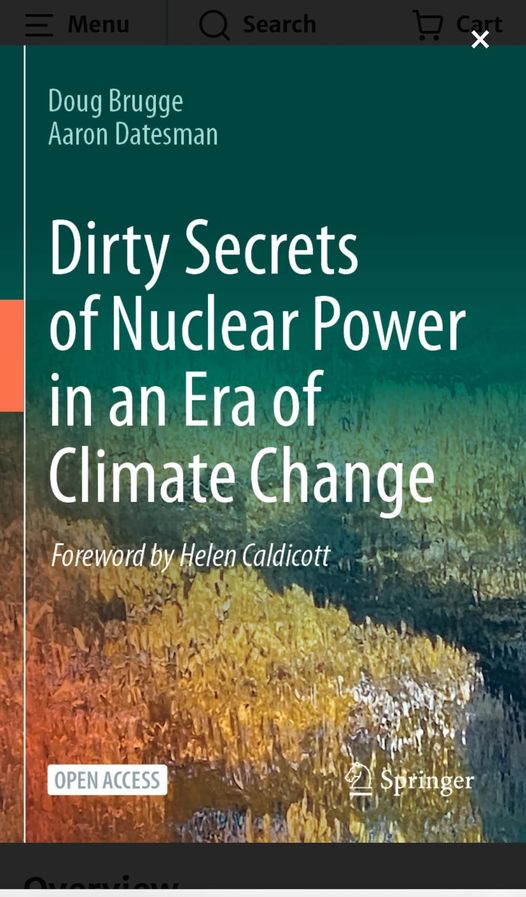
Book, Open Access
Overview
Authors: Doug Brugge , Aaron Datesman, https://link.springer.com/book/10.1007/978-3-031-59595-0
This book is open access, which means that you have free and unlimited access
Helps to understand the serious limitations and drawbacks to nuclear power
Conveys why nuclear power is a less than desirable option in terms of addressing climate change
Uses accessible and engaging language to appeal to a broad readership
About this book
This open access book provides a review of the serious limitations and drawbacks to nuclear power, and clearly conveys why nuclear power is a less than desirable option in terms of addressing climate change. It uses accessible and engaging language to help bring an understanding of the issues with nuclear power to a broader sector of the public, with the intention of appealing to non-scientists seeking knowledge on the disadvantages of nuclear power as a solution for climate change. The argument is made that while superficially appealing, nuclear power is too costly, fragile, and slow to implement, compared to alternative options such as wind and solar.
Dirty Secrets of Nuclear Power in an Era of Climate Change
Overview
Authors:
- Helps to understand the serious limitations and drawbacks to nuclear power
- Conveys why nuclear power is a less than desirable option in terms of addressing climate change
- Uses accessible and engaging language to appeal to a broad readership
- This book is open access, which means that you have free and unlimited access
- 1490 Accesses
- 23 Altmetric
About this book
This open access book provides a review of the serious limitations and drawbacks to nuclear power, and clearly conveys why nuclear power is a less than desirable option in terms of addressing climate change. It uses accessible and engaging language to help bring an understanding of the issues with nuclear power to a broader sector of the public, with the intention of appealing to non-scientists seeking knowledge on the disadvantages of nuclear power as a solution for climate change. The argument is made that while superficially appealing, nuclear power is too costly, fragile, and slow to implement, compared to alternative options such as wind and solar.
“As this book shows, to nowadays hold on to Nuclear Energy, a risky and extremely expensive method of create power, just does not make sense any longer.” — Prof. (em.) Andreas Nidecker, MD, retired academic radiologist, Basel, Switzerland
“Datesman and Brugge present evidence that nuclear power is an insecure and unsecureable technology, inherently incompatible with humanity and democracy; it fuels nuclear weapons technology and possession; choosing it would damage our chances at mitigating the climate crisis.” — Cindy Folkers, MS, Radiation & Health Specialist, Beyond Nuclear
“Although the government, industrial, and scientific nexus say it is safe.…I can only think of one word in Navajo “Ina’adlo'” meaning manipulation by the power that be to say it is safe. My Navajo people are dying from the uranium exposure on their health and environment. Great account of information on studies that have taken place around the world to say uranium is not good.” – Esther Yazzie, Navajo Interpreter and knowledge holder on Navajo issues.
“At a time when there is a call to triple the growth of nuclear power, Datesman and Brugge provide a timely and thorough examination of the dark-side of “romancing” the atom. With solid technical astuteness, they cover a wide field littered with unsolved and dangerous problems ranging from the poisoning of people and the environment to the failed economics, to the spread of nuclear weapons ….they point out how science and public trust have been corrupted by the lure of unfettered nuclear growth.” –Robert Alvarez, Associate Fellow at the Institute for Policy Studies in Washington, D.C.
An arms embargo on Israel is not a radical idea — it’s the law

In July, the International Court of Justice (ICJ), the highest global court, ruled that Israel’s occupation of the West Bank, East Jerusalem, and Gaza was illegal. The Court held that the regime of segregation that the Palestinian people live under—complete with separate roads, rationed access to water, and a separate legal system based on military law—amounts to apartheid. The Court ordered Israel to withdraw its settlers from the occupied Palestinian territory, pay reparations, and respect the Palestinian right to self-determination.
Halting military aid to Israel is the bare minimum the U.S. can do to stop the Gaza genocide. An arms embargo is not only supported by 80% of Democratic Party voters, it is demanded by international and U.S. law.
By Yoana Tchoukleva August 31, 2024, https://mondoweiss.net/2024/08/an-arms-embargo-on-israel-is-not-a-radical-idea-its-the-law/
As Israel launches its largest military assault in the West Bank in twenty years, I cannot stop thinking about the people I met in the occupied territory. I think of the mother in Jenin who was on the phone with her two sons seconds before their house was burned in an Israeli raid. I think of the wife of a man who was being held in an Israeli prison without charge or trial asking me, “Is there anything you can do? My husband is dying.” I think of the farmer who gifted me a melon even though he could barely put food on his own table and I was there only for a short period of time, traveling and volunteering with Faz3a, an international protective presence organization.
While all eyes have been on Gaza, Palestinians in the West Bank are undergoing what many call a “slow genocide”. Every day, Israeli settlers attack Palestinian families to push them off their private land. They destroy water wells, burn houses, and assault families. Palestinians who remain on their land risk arrest. In the last 10 months, 9,000 Palestinians from the West Bank have been arrested and detained without charge or trial, many experiencing torture.
In July, the International Court of Justice (ICJ), the highest global court, ruled that Israel’s occupation of the West Bank, East Jerusalem, and Gaza was illegal. The Court held that the regime of segregation that the Palestinian people live under—complete with separate roads, rationed access to water, and a separate legal system based on military law—amounts to apartheid. The Court ordered Israel to withdraw its settlers from the occupied Palestinian territory, pay reparations, and respect the Palestinian right to self-determination.
A day later, American friends of mine were violently attacked by settlers in the West Bank. They were accompanying Palestinian farmers to their olive groves when settlers from the nearby Esh Kodesh settlement descended and beat them with metal pipes. This month, another unarmed American volunteer with the international protective presence organization Faz3a was shot in the leg by the Israeli army. The U.S. State Department has remained largely silent.
As the Democratic Party vies for votes, many have demanded the U.S. impose an arms embargo on Israel as a way to signal to Prime Minister Netanyahu that he cannot continue to violate international law with impunity. What few people know is that an arms embargo is not only what 60% of Americans and nearly 80% of Democratic voters want — it is, in fact, already required by law.
U.S. federal law is clear—countries that receive U.S. military funding must meet human rights standards or risk losing their funding.
The Foreign Assistance Act holds that no assistance can be provided to a country “which engages in a consistent pattern of gross violations of internationally recognized human rights.” The Leahy Law prohibits the provision of weapons “to any unit […] of a foreign country if the Secretary of State has credible information that such unit has committed a gross violation of human rights.”
Gross violations include “torture, cruel, inhuman, or degrading treatment or punishment, prolonged detention without charges and trial, […] and another flagrant denial of the right to life or liberty”, all acts Israel is found to have committed by the ICJ, United Nations and even Israel’s own human rights experts and courts.
Our U.S. laws, therefore, demand that we pause military funding to Israel until it remedies its human rights record by agreeing to a permanent ceasefire in Gaza and complying with the ICJ order to end the occupation of Palestinian territories.
Such a pause—or an “arms embargo”—is not without precedent. In 2021, the U.S. withheld $225 million in funding from Egypt and paused the sale of offensive weapons to Saudi Arabia due to these countries’ human rights violations. So why is the U.S. enforcing its laws selectively?
On February 8, President Biden signed National Security Memorandum 20 which at least gave a nod to our federal laws. The Memorandum required the Secretary of State to obtain “credible and reliable written assurances” from foreign recipients of military aid that they are using U.S. weapons in compliance with international law. Those that fail to provide such assurances, or make claims not backed evidence, should have their aid paused.
In March, the State Department admitted there were “credible reports of alleged human rights abuses by Israeli security forces, including arbitrary or unlawful killings, enforced disappearance, torture, and serious abuses in conflict.” Still, the Department rubber-stamped Israeli government’s “assurances” and the White House continued to approve billions of dollars in weapons transfers despite recognized violations of international law.
According to a recent Israeli Defense Ministry report, the U.S. has sent over 50,000 tons of arms and military equipment to Israel since October 7, an average of 2 arms shipments per day.
All of this would crush me if it weren’t for my Palestinian friends who taught me what unwavering faith and commitment to life look like.
So I ask you, Vice President Harris—if you were elected President, will you “take care” that the laws of the United States “be faithfully executed,” as required by our Constitution? Will you consistently uphold federal laws that ban funding foreign governments that commit human rights violations, regardless of how powerful those governments or their lobbies are? Will you honor your commitment at the Democratic National Convention “to end this war such that Israel is secure, the hostages are released, the suffering in Gaza ends and the Palestinian people can realize their right to safety, dignity, freedom and self-determination?”
Doing so requires that we walk our walk, not just talk our talk. It requires that we change policy, not just express concerns. Pausing military funding to Israel is the bare minimum needed to stop the bombing of innocent people and to remind ourselves that we are, after all, a nation of laws.
Russia says it will change nuclear doctrine because of Western role in Ukraine
In short:
Russia will make changes to its doctrine on the use of nuclear weapons.
The decision is “connected with the escalation course of our Western adversaries”, Russia’s deputy foreign minister said.
What’s next?
It is not clear when the updated nuclear doctrine will be ready.
Russia will make changes to its doctrine on the use of nuclear weapons in response to what it regards as Western escalation in the war in Ukraine, state media quoted Deputy Foreign Minister Sergei Ryabkov as saying on Sunday.
The existing nuclear doctrine, set out in a decree by President Vladimir Putin in 2020, says Russia may use nuclear weapons in the event of a nuclear attack by an enemy or a conventional attack that threatens the existence of the state.
Some hawks among Russia’s military analysts have urged Mr Putin to lower the threshold for nuclear use in order to “sober up” Russia’s enemies in the West.
Mr Putin said in June that the nuclear doctrine was a “living instrument” that could change, depending on world events.
Mr Ryabkov’s comments on Sunday were the clearest statement yet that changes would indeed be made.
“The work is at an advanced stage, and there is a clear intent to make corrections,” state news agency TASS cited Mr Ryabkov as saying.
He said the decision is “connected with the escalation course of our Western adversaries” in connection with the Ukraine conflict.
Moscow accuses the West of using Ukraine as a proxy to wage war against it, with the aim of inflicting a “strategic defeat” on Russia and breaking it apart.
The United States and its allies deny that, saying they are helping Ukraine defend itself against a colonial-style war of aggression by Russia.
Putin said on day one of Russia’s full-scale invasion of Ukraine in February 2022 that anyone who tried to hinder or threaten it would suffer “consequences that you have never faced in your history”.
Since then, he has issued a series of further statements that the West regards as nuclear threats, and announced the deployment of Russian tactical nuclear weapons in Belarus.
That has not deterred the US and its allies from stepping up military aid to Ukraine in ways that were unthinkable when the war started, including by supplying tanks, long-range missiles and F-16 fighter jets.
Ukraine shocked Moscow last month by piercing its western border in an incursion by thousands of troops that Russia is still fighting to repel.
President Volodymyr Zelenskyy said the operation made a mockery of Mr Putin’s “red lines”.
He is also lobbying hard for the US to allow it to use advanced Western weapons to strike targets deep inside Russia.
Kremlin spokesman Dmitry Peskov said in an interview published on Sunday that the West was “going too far” and that Russia would do everything to protect its interests.
Mr Ryabkov did not say when the updated nuclear doctrine would be ready.
“The time for completing this work is a rather difficult question, given that we are talking about the most important aspects of ensuring our national security,” he said.
Russia has more nuclear weapons than any other country. Mr Putin said in March that Moscow was ready for the eventuality of a nuclear war “from a military-technical point of view”.
He said, however, that he saw no rush towards nuclear confrontation and that Russia had never faced a need to use nuclear weapons in Ukraine.
France still faces problems in starting up long-delayed super-expensive Flamanville nuclear reactor

https://www.ft.com/content/31bb42d9-603c-4456-a8d3-9dcaa19c7759, Sarah White in Paris, 2 Sept 24
New unit could be connected to grid by end of year but optimism over further expansion faces political hurdles
France is starting up its first newly built nuclear reactor in a quarter of a century, 12 years behind schedule and after multiple setbacks as the industry looks to a revival with plans for more new plants.
EDF, the French state-owned operator of Europe’s biggest fleet of nuclear power stations, said late on Monday that the first chain reactions — or so-called divergence operations — at the Flamanville 3 reactor on France’s Normandy coast were due to get under way overnight.
If these are successful the reactor will eventually be connected to the grid before the end of the year, once it has reached 25 per cent of its total 1.65 gigawatt capacity — enough to power a large city.
Please use the sharing tools found via the share button at the top or side of articles. Copying articles to share with others is a breach of FT.comT&Cs and Copyright Policy. Email licensing@ft.com to buy additional rights. Subscribers may share up to 10 or 20 articles per month using the gift article service. More information can be found here.
https://www.ft.com/content/31bb42d9-603c-4456-a8d3-9dcaa19c7759
The reactor, France’s 57th and a prototype of models EDF wants to develop at home and overseas, had come to epitomise the reversals the nuclear industry was suffering globally in the wake of a downturn in orders over recent decades, which prompted skilled workers to leave the sector.
Flamanville ended up costing more than four times its initial budget at €13.2bn, and took longer to finish than similar models EDF built in China and Finland that were also hit by delays.
Components for the complex design had to be retooled, some after complaints from safety regulators. EDF was also criticised by the French government for how it struggled to co-ordinate the project that involved hundreds of suppliers.
Please use the sharing tools found via the share button at the top or side of articles. Copying articles to share with others is a breach of FT.comT&Cs and Copyright Policy. Email licensing@ft.com to buy additional rights. Subscribers may share up to 10 or 20 articles per month using the gift article service. More information can be found here.
https://www.ft.com/content/31bb42d9-603c-4456-a8d3-9dcaa19c7759
“It’s a historic step in this project,” Régis Clement, co-head of EDF’s nuclear production division, said of the launch. “Our teams are on the starting blocks.”
EDF, which has contracts to build new reactors in Britain and is tendering to export its design elsewhere, said it had learned valuable lessons from Flamanville 3 that will allow it to whittle down construction times in future.
But it still faces a series of hurdles at home despite French President Emmanuel Macron launching a plan to build at least six new reactors.
The orders have yet to be formalised, and a political impasse in Paris may only delay the process further, after legislative elections this summer delivered a hung parliament.
EDF, which is spending money filling thousands of new positions to prepare for the orders, needs to agree on a funding plan for the projects, which could cost over €52bn.
Hopes of reaching a deal by the end of the year are fading, several people close to the company said. An initial ambition to deliver the new reactors by 2037 seems optimistic as a result, they added.
Other challenges include improving design updates for the future reactors while training a range of staff from engineers to welders will take time. EDF also faces competition overseas from other players, such as South Korean rivals, amid a worldwide revival of nuclear technology.
Though valued for its low carbon emissions, nuclear power has faced an atmosphere of distrust after the Chernobyl accident of 1986 and the Fukushima meltdown in Japan following a tsunami in 2011.
Campaigners against government scheme boost for Sizewell C

“Funds wasted on Sizewell C would be better spent on measures such as insulation and energy efficiency that could reduce bills now.”
By Oli Picton, 31st August, https://www.lowestoftjournal.co.uk/news/24554123.campaigners-government-scheme-boost-sizewell-c/
The government has announced billions of pounds in funding is available to Sizewell C in a proposal that has been branded “appalling” by campaigners.
Together Against Sizewell C (TASC) responded to the government’s announcement that up to £5.5 billion has been unlocked for a new nuclear power station subsidy scheme – with Sizewell C Limited set to be the main beneficiary.
Approval for the building of a third site at the coastal town was granted in 2020 under the previous Conservative government.
………………….A department spokesperson said: “Subject to all the relevant approvals we aim to reach a final investment decision before the end of the year, and we have established a new subsidy scheme of up to £5.5 billion to provide certainty and ensure the project has access to the necessary financial support to remain on track………
However, TASC argue that the project will be “slow to build”, harm nearby habitats and damage the tourism around Suffolk’s coastline.
Jenny Kirtley, chairperson for TASC, said: “We find this announcement appalling – Labour promised ‘change’ but there is no change here.
“Funds wasted on Sizewell C would be better spent on measures such as insulation and energy efficiency that could reduce bills now.”
“Labour complained about a black hole in the country’s finances yet now they are proposing to dig still further.”
In July, Chancellor Rachel Reeves warned that there was a £22 billion “black hole” left by the previous government, encouraging Labour to reduce the winter fuel allowance for millions of pensioners across the country.
1 This Month

of the week – Shut Down Drone Warfare!


Tell the Ukrainian Government to Drop Prosecution of Peace Activist Yurii Sheliazhenko

Petition to revoke the licensing of the Near Surface Nuclear Disposal Facility (NSDF) at Chalk River. https://www.ourcommons.ca/petitions/en/Petition/Details?Petition=e-7247
To see nuclear-related stories in greater depth and intensity – go to https://nuclearinformation.wordpress.com
-
Archives
- March 2026 (230)
- February 2026 (268)
- January 2026 (308)
- December 2025 (358)
- November 2025 (359)
- October 2025 (376)
- September 2025 (257)
- August 2025 (319)
- July 2025 (230)
- June 2025 (348)
- May 2025 (261)
- April 2025 (305)
-
Categories
- 1
- 1 NUCLEAR ISSUES
- business and costs
- climate change
- culture and arts
- ENERGY
- environment
- health
- history
- indigenous issues
- Legal
- marketing of nuclear
- media
- opposition to nuclear
- PERSONAL STORIES
- politics
- politics international
- Religion and ethics
- safety
- secrets,lies and civil liberties
- spinbuster
- technology
- Uranium
- wastes
- weapons and war
- Women
- 2 WORLD
- ACTION
- AFRICA
- Atrocities
- AUSTRALIA
- Christina's notes
- Christina's themes
- culture and arts
- Events
- Fuk 2022
- Fuk 2023
- Fukushima 2017
- Fukushima 2018
- fukushima 2019
- Fukushima 2020
- Fukushima 2021
- general
- global warming
- Humour (God we need it)
- Nuclear
- RARE EARTHS
- Reference
- resources – print
- Resources -audiovicual
- Weekly Newsletter
- World
- World Nuclear
- YouTube
-
RSS
Entries RSS
Comments RSS
 nuclear-news