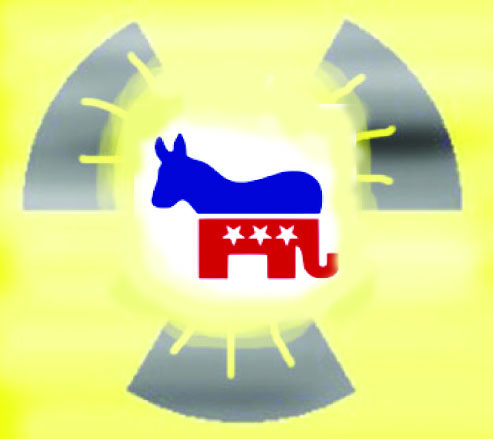
The US presidential candidates are not confronting the nuclear threat that haunts the world
Bulletin, By Robert Jay Lifton | August 29, 2024
The candidates in the coming election in the United States have said little, certainly nothing coherently, about nuclear weapons. Yet those weapons continue to haunt us, even as they move in and out of our conscious awareness.
We are reminded of this disconnect by the recent revelation of a shift in the American strategy of “nuclear deterrence” to give greater emphasis to China because of evidence of its rapid build-up of the weapons.1 That strategy change suggests China has been granted the dubious status of player in the game of bringing an end to humanity.
This “nuclear end,” as we came to call it in the antinuclear movement, was oddly treated in the recent Musk interview of Trump. Trump spoke vaguely of “nuclear warming,” though he has constantly dismissed the danger of climate change. Musk referred to the relatively rapid rebuilding of Nagasaki as a thriving city, failing to recognize that reconstruction was possible only because of the existence of an outside world to bring the necessary energy and know-how for such rebuilding. The use of contemporary nuclear weapons would allow for no such outside world. And the statement also ignores the residual pain and nuclear fear brought on by the atomic bombing of that city.2
And in her Democratic National Convention acceptance speech, Kamala Harris committed herself to a military that “always has the strongest, most lethal fighting force in the world.”3 We do not know whether she had nuclear weapons in mind.
What are the nuclear truths that are still rarely taken into account?
Nuclear weapons represent a revolution in the human capacity for destructiveness. Whether it begins with battlefield use of relatively small nuclear weapons or with larger ones, a nuclear war is likely to bring about a “nuclear winter”—the blocking of the sun’s rays by soot and other debris blown into the stratosphere—bringing about the lowering of Earth’s temperature to an extent that agriculture and human life could no longer be sustained. There is also more recent research suggesting that even a “limited” nuclear war could bring about worldwide starvation, affecting hundreds of thousands or even millions of people.
From this standpoint, Robert Oppenheimer’s brilliant success in guiding his fellow scientists at Los Alamos to the creation of nuclear weapons was his also tragedy. He could never decide whether to go along with the society’s rendering him a hero or to insist on his guilt, as he did when he told President Harry Truman, “I have blood on my hands.”
The larger US society has the same conflict. It is unable to decide whether the weapons are crucial to keeping the peace and even keeping the world going—the US addition to what I call nuclearism—or whether their very existence, not just their use but their stockpiling, is what threatens our future. The latter idea is central to the treaty put forward by the United Nations banning the “use, possession, testing, and transfer of nuclear weapons under international law.”4 Recently 150 medical journals, including The New England Journal of Medicine, Journal of the American Medical Association, Lancet, and the British Medical Journal made a joint call for the elimination of nuclear weapons with an editorial statement: “The nuclear arms states must eliminate their nuclear arsenals before they eliminate us.”5
That reasonable advocacy of nuclear abolition could not of course abolish our capacity to rebuild the weapons. But such re-creation would be highly demanding, and abolition would make the world a much safer place even if the possibility of building new nuclear weapons existed………………………………………………………………………………..more https://thebulletin.org/2024/08/the-us-presidential-candidates-are-not-confronting-the-nuclear-threat-that-haunts-the-world/?utm_source=Newsletter&utm_medium=Email&utm_campaign=ThursdayNewsletter08292024&utm_content=NuclearRisk_LiftonNuclear_082024
No comments yet.
1 This Month

of the week – Shut Down Drone Warfare!


Tell the Ukrainian Government to Drop Prosecution of Peace Activist Yurii Sheliazhenko

Petition to revoke the licensing of the Near Surface Nuclear Disposal Facility (NSDF) at Chalk River. https://www.ourcommons.ca/petitions/en/Petition/Details?Petition=e-7247
To see nuclear-related stories in greater depth and intensity – go to https://nuclearinformation.wordpress.com
-
Archives
- March 2026 (230)
- February 2026 (268)
- January 2026 (308)
- December 2025 (358)
- November 2025 (359)
- October 2025 (376)
- September 2025 (257)
- August 2025 (319)
- July 2025 (230)
- June 2025 (348)
- May 2025 (261)
- April 2025 (305)
-
Categories
- 1
- 1 NUCLEAR ISSUES
- business and costs
- climate change
- culture and arts
- ENERGY
- environment
- health
- history
- indigenous issues
- Legal
- marketing of nuclear
- media
- opposition to nuclear
- PERSONAL STORIES
- politics
- politics international
- Religion and ethics
- safety
- secrets,lies and civil liberties
- spinbuster
- technology
- Uranium
- wastes
- weapons and war
- Women
- 2 WORLD
- ACTION
- AFRICA
- Atrocities
- AUSTRALIA
- Christina's notes
- Christina's themes
- culture and arts
- Events
- Fuk 2022
- Fuk 2023
- Fukushima 2017
- Fukushima 2018
- fukushima 2019
- Fukushima 2020
- Fukushima 2021
- general
- global warming
- Humour (God we need it)
- Nuclear
- RARE EARTHS
- Reference
- resources – print
- Resources -audiovicual
- Weekly Newsletter
- World
- World Nuclear
- YouTube
-
RSS
Entries RSS
Comments RSS
 nuclear-news
Leave a comment