Fire at Zaporizhzhia elevates meltdown risk
13 Aug 24, https://cnduk.org/fire-at-zaporizhzhia-elevates-meltdown-risk/
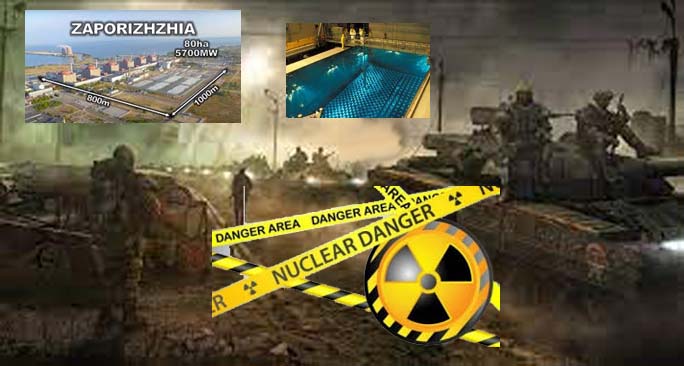
CND scientific advisor, radiation expert Dr Ian Fairlie writes about the elevated risks posed by the recent fire at the Zaporizhzhia nuclear plant.
The recent fire at the Russian-occupied Zaporizhzhia nuclear plant in Ukraine is causing much concern throughout Europe.
Ukraine’s nuclear energy company, Energoatom, which operated the site until Russian forces seized control in the early days of the war, confirmed that flames broke out at the service water supply facility, later engulfing one of the cooling towers. Both Vladimir Putin and Volodymyr Zelensky have traded blame for the fire. The six nuclear reactors at Zaporizhzhia are in cold shutdown and no nuclear activity was recorded on Sunday August 11, but the overall risk of nuclear meltdown remains elevated.
In 1986, the huge nuclear accident at the Chornobyl nuclear station in Ukraine resulted in radioactive fallout throughout Europe including all of the UK.
Ideally, the UK government should make arrangements to pre-distribute prophylactic iodide tablets (to protect against thyroid cancer) to all individuals who wish them, as occurs in many countries, but it has resisted previous calls for this. Current UK official advice on iodide tablets merely states “you will be given official advice from government or emergency services on how to get them, when to take them and how much to take”.
In the absence of timely official UK advice, readers may wish to consult official US advice or the WHO’s advice.
SMRs and nuclear renaissance: Learning from past to avoid over promising on low costs
NS Energy 26 Aug 24, Dr Charles McCombie, Independent nuclear advisor
“………………….It is yet to be shown that the economies of scale which led to nuclear power plants becoming ever larger can be outweighed by the economies of multiples which are expected from factory line production – assuming that full order books can keep these lines busy. But for how many of the over 80 SMR designs being developed will there be a large enough market to feed a factory production line?
Already 50 years ago, physicists and engineers designing large nuclear power plants were focused on the interesting challenges of proposing ever more reactor variants that looked – on paper – to be more efficient, safer or cheaper. But even the comparatively limited variety of designs proposed back then proved to be more an obstacle than an advantage. The UK, for example, dithered for years in making hard choices, while building and operating expensive first-of-a-kind units of many different types. The most successful large reactor programme was in France where an early decision was taken to narrow in to a standardised PWR design. Today, the clear lesson is that only a handful of SMR designs can hope to benefit from economics of multiples and thus reach commercial success.
A further mistake from the past which also affects the economics is the long timescales required for implementation of nuclear power plants. Many of the delays have been due to technical or project management weaknesses but a large contributor has often been the time needed by regulators to license a new design. …………………………….
But getting the economics of SMRs right and shortening licensing and construction times will not on their own solve the problem. There are other challenges which large reactor designers ignored until too late. The clearest example here is neglecting to address the issue of safe disposal of spent fuel and/or highly radioactive wastes. Even today, although safe geological disposal facilities are being implemented, for example in Finland, the “unsolved waste problem” is still put forward by many as an objection to expanding nuclear power. SMR developers should, already at the design stage be considering what wastes will be produced and at the tendering stage should be offering specific help and advice to their potential customers, most especially if these are small or new nuclear nations.
In addition to these potential impediments to wide deployment of SMRs, there are some novel issues to be addressed. One of these is related to the nuclear proliferation and security concerns which might arise in a scenario where hundreds of SMRs are distributed around the globe in many countries with no nuclear experience and, in some cases, in remote regions within these countries. In the end, because of their smaller fissile inventories and compact designs, the nuclear security concerns with widespread SMR deployment may be less than with current nuclear power plants with their much larger inventories of fissile materials. However, the issue should be discussed now by the nuclear community and not ignored until it is brought up as an impediment by nuclear opponents in potential SMR user countries.
If we want to learn from the bitter lessons of past hoped-for nuclear renaissances, then we should learn from the mistakes made back then and also anticipate any new and novel issues that will arise with widespread SMR deployment. https://www.nsenergybusiness.com/analysis/smrs-and-nuclear-renaissance-learning-from-past-to-avoid-over-promising-on-low-costs/
Donald Trump and Nuclear Weapons

we’ve overlooked the most important truth about them: they’re ludicrous weapons. They’re so big you can’t use them.
Their non-use is the result of nuclear weapons being blundering, bumbling, poison-spreading, lousy weapons.
This is not about what you think
Ward Hayes Wilson, Aug 22 2024, https://wardhayeswilson.substack.com/p/donald-trump-and-nuclear-weapons
In honor of the Republican and Democratic conventions, I thought I’d try to draw parallels between how Democrats have changed their approach to Donald Trump and how we should change our approach to nuclear weapons.
Outrage
For a long time Trump held center stage. He’s speeches were carried live on cable because — oh, my God! — you never knew what he was going to say! Each speech brought a deluge of anger and outrage in response. ……………………………….
The problem with this way of reacting to Trump is that when you emphasize the danger, when you get carried away, you only play into his hands. ………………………………….If you shout that Trump is the Devil, then you make it a foregone conclusion that people believe he possesses enormous power.
Weird
Of course, Trump’s hold on us has weakened. His crowds are smaller. His coverage is scantier. His polls are down (a little). And part of this change is simple exhaustion with Trump’s endless appetite for attention.
But part of it is also a change in the way Kamala Harris and Tim Walz deal with Trump. Rather than putting Trump at the center of their message, rather than getting into a lather about Trump’s constantly stirring the pot, Harris and Walz seem to be having fun…………………………..
No longer distracted by what he says — or perhaps no longer distracted by our reaction to what he says — it’s possible to see that Trump’s shtick has always been kind of strange. Instead of fearing him, people have now started laughing at him…………………….. ather than emphasizing that we should fear Trump, they note he’s kind of weird. They belittle him, in other words.
Respect and fear
Hannah Arendt, the German philosopher who fled the Nazis in the 1930s and eventually found a home at the University of Chicago, said an interesting thing about authority. In her slim, powerfully argued volume, On Violence, in which she analyses the differences between power, violence, force, strength, and authority, she says that the best way to undermine authority is to mock it. And that is at the heart of what I want to say about nuclear weapons…………………………………………………………………………..
We decide
I still run across people who want to fight against nuclear weapons by emphasizing the horror of attacks with nuclear weapons, by working to make people more afraid, and by exaggerating the effects of nuclear war……………………………………….
The recent book by Annie Jacobson, Nuclear War: A Scenario, promotes feelings of awe and fear and ends up, it seems to me, delivering a message of powerlessness. The processes of nuclear war are, according to Jacobson, inexorable and cannot be controlled. And after running through a chilling and somewhat illogical scenario for how a nuclear war would unfold, she offers not the slightest hope that there will ever be a solution.
………………………………..But nuclear weapons are not “the Destroyer of Worlds.” They aren’t the power of God. And they don’t give us god-like power. They are just weapons. Tools. We control them. We decide.
President John F. Kennedy, in his famous peace speech at American University, helpfully reminds us that “No problem of human destiny is beyond human beings.”…………………………….
…………………………. The truth is nuclear weapons are too big to use on battlefields.
The truth is that using nuclear weapons to fight a long-range war where you target your adversary’s homeland is simply suicidal……………………………
The truth is that nuclear deterrence is fatal over the long run because it’s run by human beings — creatures who make mistakes and are prone to folly. We’ve been lucky so far, but you can’t have these large arsenals on hair trigger alert forever without eventually ending in catastrophe.
We have been so focused on the horror and fear of nuclear weapons that we’ve overlooked the most important truth about them: they’re ludicrous weapons. They’re so big you can’t use them. The 78 years of non-use hasn’t been the result of moral compunction or restraint imposed by their awesomeness. War is a brutally pragmatic business and countries generally do whatever is necessary to win. Their non-use is the result of nuclear weapons being blundering, bumbling, poison-spreading, lousy weapons.
What we should do
I think the shift from fear to mockery is exactly what we have to do with nuclear weapons. We treat nuclear weapons with so much awe, we are so fearful and respectful of them, we are so afraid of the issue we won’t even talk about it. Or when we finally do we use such hushed tones of awe that of course the weapons seem god-like and overwhelming.
What we need to do with nuclear weapons is to exhale and then look calmly, clear-eyed, and objectively at their utility. Tools are kept or tossed based on one criteria: utility. If nuclear weapons are useful, then you have to keep them. If they’re not, then they have to go. Having studied the issue of their utility for forty years, I would welcome a debate that puts “are they useful?” at its center.
Because, believe me, nuclear weapons are virtually useless and very dangerous. And no one keeps technology that is virtually useless and very dangerous.
Blinken ‘Sentenced Ceasefire Talks to Death’ With Comments on Netanyahu

sources called Blinken’s comments a “gift” to Netanyahu
Sources told Ynet that Blinken’s comments about the negotiations indicate his ‘amateurism, naivety, and lack of understanding’
https://news.antiwar.com/2024/08/22/blinken-sentenced-ceasefire-talks-to-death-with-comments-on-netanyahu/
by Dave DeCamp August 22, 2024
Secretary of State Antony Blinken’s comments about Gaza ceasefire talks this week sentenced the negotiations to death, Middle East Eye reported Thursday, citing Israeli media.
After meeting with Israeli Prime Minister Benjamin Netanyahu on Monday, Blinken said the Israeli leader agreed to a new US proposal and that it was now up to Hamas to agree to the deal. However, the US proposal included new demands from Netanyahu that Hamas considers unacceptable. Israeli, US, and Arab sources have all said Netanyahu’s demands are too hardline and will prevent a deal.
Sources speaking to Ynet slammed Blinken for making the comments that portrayed Hamas as the obstacle to a deal. “Blinken made a very serious foul here that indicates innocence, amateurism, naivety, and lack of understanding,” a source said.
They added that Blinken’s positive spin on the ceasefire negotiations was likely an effort to prevent the situation from overshadowing the Democratic National Convention.
“He broadcast optimism from intra-American political considerations, so that the Democratic convention in Chicago would go smoothly, but senior officials of the Israeli negotiating team who listened to his press conference wanted to dispel the speculations,” the source said.
The sources called Blinken’s comments a “gift” to Netanyahu and said the Israeli leader’s continued insistence that Israel must maintain control of the Gaza-Egypt border, known as the Philadelphi Corridor, will prevent a deal.
“There is no deal and there is no summit if the Israeli insistence on deploying forces along the Philadelphi axis continues,” the source said. “What was implied in Blinken’s words is that the US is giving Netanyahu support for IDF forces to remain in Philadelphi, while both the Egyptians refuse and Hamas refuses.”
US and Israeli officials are due to meet again in Cairo this week to discuss the ceasefire, but Arab mediators have said there’s no point in holding talks unless the US puts significant pressure on Netanyahu to back down from his demands and agree to a deal.
How EDF almost plunged France into darkness
INDUSTRIAL RESURRECTIONS (3/6) – Cracks of a few millimeters, discovered by surprise in the fall of 2021, led to the preventive shutdown of nearly half of EDF’s nuclear reactors, depriving Europe of electricity in the midst of the war in Ukraine. An industrial crisis that shook EDF and radically changed the situation on the electricity markets.
By Sharon Wajsbrot August 23, 2024
It is an anniversary that is being kept discreet at EDF, busy this summer celebrating the Olympic Games and
its electric cauldron that carried the Olympic flame into the Paris sky for the first time . Three years ago, however, an industrial crisis of unprecedented magnitude began at EDF that nearly plunged France into darkness.
In August 2021, reactor number one at the Civaux nuclear power plant in Vienne was shut down for a routine ten-year inspection, a sort of health check of the facilities carried out every ten years. The technicians responsible for checking the pipes could not believe their eyes. The reactor’s safety injection circuits, those that inject borated water into the core to cool it in the event of a problem, had cracks several millimeters wide. Unimaginable for this type of circuit, this defect made any restart impossible………………………………(Subscribers only)
Les Echos 22nd Aug 2024
“Final Investment Decision (FID) ” in Sizewell C nuclear station might never happen

There are media reports that a Final Investment Decision (FID) “risks
dragging into 2025″ over negotiations with investors. See Bloomberg’s
report, also New Civil Engineer and Energy Live News. These articles do not
consider whether a FID might not in fact ever happen, but we are keeping up
the pressure. Interestingly, while Bloomberg mentions four of the known
possible investors (see list below on original), USS and Equitix are absent. It’s
unclear what, if anything, this means but we are attempting to find out. If
you have not yet written to these companies to urge them not to invest, now
would be an excellent time to do so.
Stop Sizewell C 22nd Aug 2024
Zelensky’s Misadventures in Kursk

This operation is likely to be working upside-down to what we are reading in corporate media.
Not long prior to the incursion, the Biden regime had given Kiev dispensation to use U.S.–made weapons against Russian targets so long as these were deployed in self-defense and against military targets.
the question remains. What is the point as the Kursk operation continues?
By Patrick Lawrence / Original to ScheerPost, 23 Aug 24
It has been three weeks since ground units of the Armed Forces of Ukraine crossed into the Kursk province in southwestern Russia, surprising — or maybe not surprising — the U.S. and its clients in the North Atlantic Treaty Organization. Two days later, the AFU began artillery and drone attacks in Belgorod, a province just south of Kursk. It has been a little more than a week since explosions at the Zaporozhye nuclear power plant, which lies in what is now Russian territory along the Dnipro River, ignited a fire in one of the plant’s two cooling towers. All six reactors are now in cold shutdown.
In the still-to-be-confirmed file, BelTA, the Belarusian news agency, reported last weekend that Ukraine has amassed significant forces along the Belarus–Ukraine border. Aleksandr Lukashenko, the Belarusian president, put the troop count at an improbable 120,000. Further out in speculative territory, RT International reported at the weekend that the AFU is “preparing a nuclear false flag—an explosion of a dirty atomic bomb,” targeting nuclear-waste storage sites at the Zaporozhye plant. RT cited “intelligence received by Russia” and a military correspondent and documentarian named Marat Khairullin.
Hmmm.
When I began my adventures in the great craft at the New York Daily News long years ago, two of the better shards of wisdom I picked up were, “Go with what you’ve got” and “When in doubt, leave it out.” Let us proceed accordingly as we consider Ukraine’s latest doings in the proxy war it wages. I will leave aside the BelTA and RT International reports pending further developments, but with this caveat: Amassing units along the Belarus border would be entirely in keeping with the AFU’s recent forays into Russian territory. As for the imminence of a dangerous false flag op at the Zaporozhye plant, I would not put it past a regime that has acted recklessly and irrationally on numerous occasions in the past.
Why, we are left to ask of what we know to be so, did the AFU send troops, tanks, artillery, drone units, and assorted matériel into Kursk on Tuesday, Aug. 6? And then the ancillary operation in Belgorod? Everyone wondered this at first—supposedly everyone, anyway. This is our question, and I will shortly get to the “supposedly.”
On the eve of the incursion, Kiev was losing ground steadily to a new Russian advance in eastern Ukraine. Critically short of troops, the Ukrainian forces are, indeed, about to lose a tactically significant town, Pokrovsk, on their side of the Russian border. The thought that the AFU would sustain and expand its Kursk operation to bring the war to Russian territory in any effective way is prima facie preposterous. What was the point? Where is the strategic gain?
In his speech Monday evening at the Democratic Party convention in Chicago, Joe Biden defended his proxy war in Ukraine as a just war waged in the name of democracy and liberty. Oh? setting aside the emptiness of this characterization, the question remains. What is the point as the Kursk operation continues? The AFU now holds one Russian town and six villages, according to the latest reports, which also indicate they have set about destroying bridges critical to Russian supply lines. But where to from here? I do not see a sensible answer.
There is no question the Russians were caught off guard when the AFU crossed into the border village of Sudzha and proceeded with evidently little initial resistance further into Russian territory. Hundreds of thousands of Russians have been evacuated; the governor of Belgorod quickly declared a state of emergency after the drone and artillery strikes of Aug. 14.
But we cannot count this as any kind of astute strategic move. I do not pretend to have an inside read as to Russia’s apparent intelligence failure or what looks like its flat-footed response. But I do not think we can correctly mark down events to date to the AFU’s superior strength or the Russians’ weakness or incompetence. Western correspondents are having a fine old time reporting that klutzy, clumsy Moscow is once again stumbling, but I buy none of it. In my view this is probably another case of Russian restraint: The AFU is using U.S. — and NATO — supplied weapons, and the Kremlin has all along been acutely sensitive to the risk of escalation against Kiev’s Western sponsors.
My conclusion: No one’s script has flipped. This operation is likely to be working upside-down to what we are reading in corporate media. The best explanation they have come up with so far is that Kiev’s plan was to draw Russian forces away from the front on the Ukrainian side of the border. That has plainly not happened, however much The Times indulges in denial on this point. “And now Moscow has begun withdrawing some troops from Ukraine in an effort to repel Kyiv’s offensive into western Russia, Constant Méthuet reported Aug. 14 — before adding “according to U.S. and Ukrainian officials.” Crapulous journalism. Simply crapulous. There is no evidence of this whatsoever—only of further Russian gains as noted above.
Inversely, the Kursk adventure required a lot of Ukrainian units to get going and more now to sustain. It is Kiev that is wasting resources on what is bound to end in retreat. The Russian military has not marshaled anything approaching its full force. This is likely to end when Moscow decides it should, and in the meantime the Russians appear to wage the same wearing war of attrition that has reduced the AFU to something close to a desperate force on the home front.
The initial press reports of the Kursk adventure had it that top officials in Washington were caught entirely by surprise and were as perplexed as the rest of us as to the “Why?” of the thing. I do not accept this at face value, either. The Times ran a lengthy report on the Ukrainians’ preparations, featuring residents in the towns bordering Kursk remarking for weeks about the buildup of AFU units and matériel before the operation began. Russian intelligence took note, The Times also reported. And the Pentagon, the intelligence agencies, and the administration were all taken by surprise? To quote an East European emigre I knew in the old days, “Gimme break.”
Not long prior to the incursion, the Biden regime had given Kiev dispensation to use U.S.–made weapons against Russian targets so long as these were deployed in self-defense and against military targets. And the only reason the U.S. is at all interested in Ukraine, we must remind ourselves—forget about freedom and democracy, for heaven’s sake—is for its use in prosecuting the West’s long, varied campaign to subvert “Putin’s Russia.” This remains the ultimate objective. In the matter of Washington’s hand in directing the Zelensky regime from one adventure to another, Biden’s national security people wear more fig leaves than you find on a tree in Tuscany. …………………………………………………………………………………………………………………
Maybe Zelensky wants some Russian real estate as a bargaining advantage in negotiations with Russia he has come to accept as inevitable. It is possible but does not fit with his adamant insistence that the full restoration of Ukrainian territory, including Crimea, is non negotiable — a precondition to any diplomacy. And as in Netanyahu’s case, a settlement would put his political future greatly in doubt.
In any case, Zelensky chose badly when the AFU crossed into Russian territory at Kursk. The Red Army’s defeat of the Wehrmacht at Kursk, in 1943, was the largest battle in the history of warfare and left roughly 1.7 million Russians dead, wounded, or missing. Along with Stalingrad, it marked a decisive moment in the Allied victory over the Reich. Russians do not forget this kind of thing, especially when German weapons are part of the AFU’s arsenal. The thought of Ukrainian troops and tanks holding Kursk is another of the miscalculations that litter the story of this war since it began with the U.S.–inspired coup 10 years ago. https://scheerpost.com/2024/08/22/patrick-lawrence-zelenskys-misadventures-in-kursk/
From the NPT to the UN Summit of the Future: Cut nuclear weapons budgets and investments

Aug 22, 2024, m https://nuclearweaponsmoney.org/news/from-the-npt-to-the-un-summit-of-the-future-cut-nuclear-weapons-budgets-and-investments/
Legislators and civil society organizations are using the opportunities of key international events in the latter part of 2024 to elevate calls for cuts in nuclear weapon budgets, an end to investments in the nuclear arms race, and a shift of these resources to better address planetary emergencies including an climate change, threats to biodiversity and an increase in the number and intensity of armed conflicts.
Actions utilizing these opportunities include parliamentary and civil society appeals to the two-week long meeting of States Parties to the nuclear Non-Proliferation Treaty at the United Nations in Geneva (2024 NPT Prep Com) from July 22-August 2, and the UN Summit of the Future from September 22-23.
On July 23, Baroness Miller of Chilthorne Domer presented a parliamentary appeal ‘Turn Back the Doomsday Clock’ to a plenary session of the NPT Prep Com with nine concrete proposals directed to both the NPT Prep Com and the UN Summit of the Future. One of the proposals calls on governments “cut nuclear weapons budgets and public investments in the nuclear weapons industry, and to re-purpose these resources to instead support public health, peace, climate stabilization and sustainable development.”
More than 80 parliamentarians from 35 legislatures endorsed the appeal, including members of foreign affairs and defence committees; parliamentary delegates to the Inter-Parliamentary Union, NATO Parliamentary Assembly and OSCE Parliamentary Assembly; former Ministers of Foreign Affairs, Defence and Disarmament; and others.
A similar appeal from faith-based organizations and leaders, entitled Pursuing Peace, Security and Nuclear Disarmament through our Common Humanity, was also presented at the NPT plenary session on July 23 by Ayleen Roy, a member of the Transnational working group on faith and values based perspectives. The appeal, which was endorsed by more than 80 faith-based organizations and an additional 180 faith and values based leaders and individuals, highlights principles common to all the world’s major religious and faith-based traditions that are relevant to peace, security and nuclear weapons.
On July 23, Baroness Miller of Chilthorne Domer presented a parliamentary appeal ‘Turn Back the Doomsday Clock’ to a plenary session of the NPT Prep Com with nine concrete proposals directed to both the NPT Prep Com and the UN Summit of the Future. One of the proposals calls on governments “cut nuclear weapons budgets and public investments in the nuclear weapons industry, and to re-purpose these resources to instead support public health, peace, climate stabilization and sustainable development.”
More than 80 parliamentarians from 35 legislatures endorsed the appeal, including members of foreign affairs and defence committees; parliamentary delegates to the Inter-Parliamentary Union, NATO Parliamentary Assembly and OSCE Parliamentary Assembly; former Ministers of Foreign Affairs, Defence and Disarmament; and others.
A similar appeal from faith-based organizations and leaders, entitled Pursuing Peace, Security and Nuclear Disarmament through our Common Humanity, was also presented at the NPT plenary session on July 23 by Ayleen Roy, a member of the Transnational working group on faith and values based perspectives. The appeal, which was endorsed by more than 80 faith-based organizations and an additional 180 faith and values based leaders and individuals, highlights principles common to all the world’s major religious and faith-based traditions that are relevant to peace, security and nuclear weapons.
Citing the faith-based principle of social responsibility, the appeal notes that “The €90 billion equivalent spent each year on nuclear weapons development, production and deployment is draining resources (human and financial) that are required to eliminate world poverty and achieve the SDGs” and encourages “States to acknowledge their social responsibility by ending investments in nuclear weapons and re-purposing these investments to address basic human needs.”
And in preparation for the UN Summit of the Future, civil society organizations from around the world, cooperating through the facilitation of the Coalition for the UN We Need, have released a Peoples Pact for the Future with a number of recommendations to the Summit of the Future, one of which calls for a commitment to be made at the Summit “to channel domestic and other funds currently utilized for weapons—including nuclear and other weapons of mass destruction—to peaceful use such as environmental protection, sustainable development, peacemaking, rehabilitation, restorative justice, reparations, and building a culture of peace.”
Member organizations of Move the Nuclear Weapons Money were amongst the leaders of these initiatives.
Parliamentarians are also taking actions in their own legislatures to cut nuclear weapons budgets, but these are mostly actions that have not yet received sufficient support to be adopted.
On June 24, for example, US Senator Ed Markey who serves as Co-President of Parliamentarians for Nuclear Non-proliferation and Disarmament (PNND) and as Co-chair of the bicameral Nuclear Weapons and Arms Control Working Group (NWAC), organized a joint letter from NWAC members to the Secretary of Defense, challenging the US Sentinel Inter-Continental Ballistic Missile (ICBM) replacement program on both financial and policy grounds. The legislators wrote to “remind the DoD that the American people have not granted them a blank check to pursue wasteful, unnecessary programs. As a varied group, our positions on the overall nuclear posture may vary, but we all share a common commitment to preventing government waste, avoiding dangerous nuclear escalation, and promoting peace.”
There are growing calls amongst security experts and civil society organizations for a retirement of all ICBMs in order to cut the bloated nuclear weapons budget and reduce the risks of nuclear war. See, for example, Slash the Pentagon Budget in Half & Abolish ICBMs: Dan Ellsberg on How to Avoid Nuclear Armageddon.
Senator Markey has given voice in the US Congress to these calls in a number of ways including in the Smarter Approach to Nuclear Expenditure (SANE) Act and the Invest in Cures Before Missiles (ICBM) Act that he has introduced, and in direct challenges to nuclear weapons budget items during the Defence Budget Authorization process. See Senator Markey: Shift funds from the military to climate action. And end the nuclear threat!
However, Markey and the Nuclear Weapons and Arms Control Working Group are opposed by a powerful nuclear arms industry lobby and the many legislators whom they support in congress, including members of the the bi-partisan Missile Defence Caucus. See Meet the Senate nuke caucus, busting the budget and making the world less safe. The efforts of Senator Markey and his colleagues are unlikely to succeed in deep cuts to the US nuclear weapons budget unless there is a stronger groundswell of Americans pushing their elected representatives to support their legislative initiatives.
Over in the UK, the possibilities for cutting the nuclear weapons budget do not appear to have improved with the election of a Labour government. Prime Minister Keir Starmer has affirmed that his government is committed to a triple lock for nuclear deterrence, which includes maintaining Britain’s continuous at-sea deterrent (CASD) “24 hours a day, 365 days a year”; building four new nuclear submarines; and delivering “all the needed upgrades” for existing and new submarines in the future. However, there could be dissention to this from some Labour MPs and from the increased number of Liberal Democrats in the House of Commons. (See Reality check: is Keir Starmer’s triple lock on nuclear weapons anything new?)
TODAY. A whole new way of thinking about nuclear weapons – THEY’RE SILLY!

I’m grateful to Ward Hayes Wilson for giving me this idea. He has noted that Kamala Harris and co have changed the tone of discussion about Donald Trump – from being about fear of Trump, to laughter at Trump.
Then he turns to discussion about nuclear weapons. Why haven’t they been used over almost 80 years of warfare? Because – like Trump, they’re not useful – they’re weird.
Ward Hayes Wilson does not minimise the danger of nuclear weapons. He knows his stuff, and has an impressive record as a writer on matters nuclear. It’s just that he can write clearly about this, without the jargon.
“The truth is nuclear weapons are too big to use on battlefields”
“The truth is that using nuclear weapons to fight a long-range war where you target your adversary’s homeland is simply suicidal.”
“The truth is that nuclear deterrence is fatal over the long run because it’s run by human beings — creatures who make mistakes and are prone to folly.”
“the most important truth about them: they’re ludicrous weapons………….. Their non-use is the result of nuclear weapons being blundering, bumbling, poison-spreading, lousy weapons.”
In the laborious progress towards genuine democracy (we haven’t got there yet), there has been one breakthrough – over a century ago. That is that the political leaders not only have to get voted in – they have to wear more or less “ordinary” clothes. This attire is a very visible symbol that the leader – President, Prime Minister – whoever he (even she!) is called – is not a god, not divinely inspired, but just an ordinary fallible human being.
This type of breakthrough insight has not yet hit the military. In their god-like smart uniforms , bedecked with buttons, ribbons, insignia, jazzy hats – the military, naval, airforce bigwigs look like they are special creatures – super-knowledgeable angels who know what’s best for us, and that the killing of lotsa people is OK, (even if we have to go, too).

Actually, this isn’t really fair. Often you get more sense out of the military toffs that you do out of the politicians, who are beholden to the weapons-making corporations.
Still, tax-payers spend an exorbitant amount not only on nuclear weaponry, but on the whole hierarchy of “experts” of all kinds involved in developing, managing, teaching, publicising and extolling nuclear weapons, and preparing for war.
Much less is spent on genuine diplomacy.

Genuine diplomacy is different from the smarmy hypocrisy of those “diplomats” who swan around a world preparing for nuclear war, and pretending that all will be OK, underneath the American “nuclear umbrella” – that the USA has everything under control.
We don’t need this silly trumpeting about nuclear deterrence etc. It’s time for those more down to earth methods – genuine diplomacy, negotiation, compromise …….
We can swap our fear of nuclear weapons for making fun of how silly the whole thing is .
Global disappointment with the most promising energy: ‘The dream is dead’, and we are in ‘big trouble’
by D. García, 08/23/2024 https://www.ecoticias.com/en/fusion-nuclear-energy-dream-dead/5728/?fbclid=IwY2xjawE2PiVleHRuA2FlbQIxMQABHfSEEnp1jh9NKYg3N-pZe7YOq421dNO7fCN7ZZKAeigI3n1uZOiemR-I-Q_aem_ePp32l88aWrmHEcGwyKikg
Renewable sources are expanding across the country, but there is a ‘silent enemy’ that is eating away at some of this progress, and that is nuclear energy. Experts have believed for years that they can make it clean and safe, which we simply call a pipe dream. Recently, a prestigious media outlet such as The Guardian collected the opinions of several experts under the reflection ‘The dream is dead’. What has happened so that optimism has turned into global pessimism? A discovery about reactors has left everyone in shock.
It was a promising, non-renewable energy: Now, it’s a dead dream, according to experts
Nuclear fusion, a dream of obtaining a virtually inexhaustible and pollution-free energy, has remained an appealing goal for science and politics for a long time. Still, recent problems and accumulating issues caused some analysts to announce that nuclear fusion as a near-term energy source is indeed dead.
A major dream in energy generation circles has been nuclear fusion – the process that drives the sun and stars. Fusion reactions in which hydrogen atoms are combined to form helium have no complicated, long-lived radioactive waste or greenhouse gases as a by-product. But to maintain controlled fusion on Earth, it has been identified as one of the greatest scientific feats ever.
The International Thermonuclear Experimental Reactor is the largest fusion experiment in the world, and the project has experienced the problems with time and over budget. Initially designed to start operations in 2025, the current schedule of ITER has now been delayed, and it is not expected that full fusion operations will commence until the 2050s.
Key figures to understanding why this is a global disappointment: We are losing energy at GW-scale
The dominoes began to tumble and affect the overall nuclear energy industry because of the failures of fusion research. While fusion remains experimental, traditional fission-based nuclear power has been on a downward trend in many parts of the world:
- Worldwide nuclear energy generation has been on the downtrend, with a record in 2006, and Nuclear electricity generation was reduced by 4% between 2019 and 2020.
- Nuclear power’s contribution to the world’s electricity mix has gone down from a peak of roughly 17%. It went from 5% in 1996 to slightly above 10% in the recent past.
- Nuclear power’s contribution to electricity generation in the United States has been steady at approximately 20 percent, but the operating reactors are fewer than before, with 93 as compared to 104 in 2012 and 2021.
What’s the reason why nuclear energy is declining? Beyond the fusion process
The nuclear energy sector in America is facing significant challenges:
- Aging Infrastructure: A majority of the nuclear plants in the United States are either already, or on the verge of, expiring their permits granted for 40 years of utilization.
- Economic Challenges: Nuclear power is unable to compete with relatively cheaper sources such as natural gas and renewable forms of energy. Some of the plants have been shut down before time due to unfavorable market conditions.
- Public Perception: Public opinion remains a core issue of discussion since safety, management of waste and probabilities of the occurrence of an accident cannot be fully overlooked when producing nuclear energy.
- Policy Uncertainty: It is stated that energy policy lacks a long-term vision, which resulted in no clear inspiration for the new nuclear projects.
Is America facing the same situation? Not, here is worse
Several U.S. states have experienced significant losses in nuclear energy capacity:
- California: All nuclear power will vanish in the state following the shutdown of the San Onofre Nuclear Generating Station in 2013 and the planned Diablo Canyon Nuclear Power Plant in 2025.
- Massachusetts: The last operating nuclear power plant in Massachusetts shut down operations in 2019, and the Pilgrim Nuclear Power Station has been off.
- New York: While some efforts had been made to carry forward the Indian Point Energy Center, it was extensively shut down in 2021, thus lowering New York’s nuclear power.
- Pennsylvania: The Three Mile Island plant shut down in 2019, and other plants in the state are also facing financial issues.
Who knows if nuclear fusion energy in America will become a more established source than ever (as Trump said last week) or if it will remain a memory, something like Natrium, Bill Gates’ extravagant invention to resurrect a source that many still believe will be the future. Will we ever “break the dream” and go for a 100% clean and renewable industry? Yes, but without sources with the potential to pollute entire ecosystems for millennia.
A new French fairy tale: “Cheap” nuclear electricity in France is not what it appears.

The French public are paying for their nuclear addiction — and will pay even more when the plants need decommissioning.

By Axel Mayer, 11 Sept 23, https://beyondnuclearinternational.org/2023/09/11/a-new-french-fairy-tale/—
“Bread and games”(Panem et circenses) were the enforcement strategies in the Roman Empire to maintain power. “Cheap petrol, cheap electricity and football” are popular campaign strategies under a democracy, says Axel Mayer, Vice-President of the Trinational Nuclear Protection Association (TRAS).
In France, the nuclear industry is in decline and the nuclear company EDF is heavily in debt. At the same time, President Macron is once again promising cheap nuclear power and wants to have new small nuclear power plants built. A small part of the French nuclear industry’s financial problems is to be solved with EU money.
In this context, the fairy tale of cheap French nuclear power is happily spread in France and also in Germany and the use of nuclear energy is praised as the miracle weapon in the losing war against nature and the environment. However, the price of electricity in France is only apparently cheap.
According to a report of the supreme audit court in France, the research and development, as well as the construction of the French nuclear power plants, cost a total of 188 billion euros. Since in France the “civilian” and the military use of nuclear power cannot be separated, the sum is probably much higher. Retrofitting France’s outdated reactors will cost over 55 billion euros. Liberation magazine reports retrofitting costs of nearly 100 billion euros by 2030.
People of France are paying for expensive nuclear power with their taxes
According to a report by the French Ministry of Economy, the semi-state-owned EDF had debts of about 41 billion euros at the end of 2019, an amount that is expected to be nearly 57 billion euros by 2028. To avoid domestic political problems, EDF is not allowed to raise the price of electricity for political reasons. EDF liabilities are driving up France’s national debt massively. The people of France (and especially their grandchildren) are paying for the seemingly cheap, but in reality expensive nuclear power with their taxes.
This cost does not include the dismantling of the nuclear power plants or any costs of a severe accident. A serious nuclear accident would have devastating consequences in France. A government study estimates the cost at 430 billion euros.
Demolition costs of over 100 billion euros
In France, EDF operates 56 outdated reactors that are now becoming old and decrepit almost simultaneously, but the company has built up almost no reserves for decommissioning. In Germany, the government is very optimistic about a 47 billion euros cost for decommissioning and final storage. The decommissioning of the large number of French nuclear power plants could cost well over 100 billion euros as costs rise, if no savings are made on safety. There is a distinct possibility that the nuclear industry could bankrupt the French state even without a nuclear accident that could happen at any time.
A “European Pressurized Water Reactor” (EPR) has been under construction on France’s Atlantic coast in Flamanville since 2007. The flagship project was originally scheduled for completion in 2012 at a fixed price of 3.2 billion euros. Since then, the start of operation has been postponed again and again, and the Court of Auditors now puts the cost at over 19 billion euros. Whether the EPR can go online in 2024 is questionable. The model reactor will never work economically.
In countries with a functioning market, no new nuclear power plants are building
Swiss nuclear lobbyist and Axpo CEO Christoph Brand puts the kibosh on dreams of cheap nuclear power from new, small nuclear plants. “The production costs for the electricity supplied by new nuclear power plants are currently about twice as high as those of larger wind and solar plants,” Brand said. “No matter how one assesses the risks of nuclear power, it is simply not economical to rely on new nuclear plants,” he said in the pro-nuclear NZZ on Oct. 21, 2021.
In countries with a functioning market, no new nuclear power plants are being built. When in doubt, it always helps to look at EDF’s share price, which has fallen massively over the long term, to assess the market chances of the nuclear renaissance announced by President Macron.
“Bread and games” with artificially low nuclear electricity prices can work in election campaigns. Low-cost, risk-free electricity is generated today with photovoltaics and wind energy. (AM/hcn)
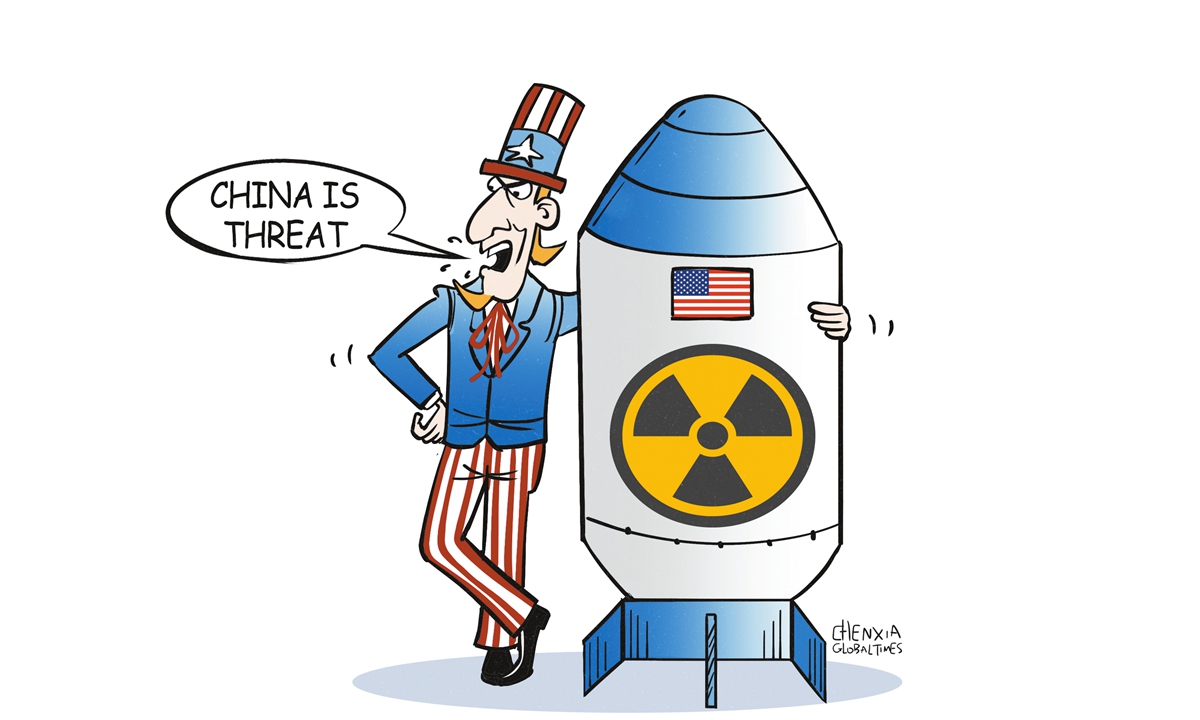
US crying wolf over China’s ‘nuclear threat’ while expanding nuclear arsenal
Aug 22, 2024 https://www.globaltimes.cn/page/202408/1318466.shtml
On Tuesday, a New York Times report caused quite a stir: US President Joe Biden has ordered US forces to prepare for “possible coordinated nuclear confrontations with Russia, China and North Korea.” It sounds like the US president was instructing the military to prepare for doomsday, observers pointed out.
The report revealed that in March, Biden approved a highly classified nuclear strategy plan called “Nuclear Employment Guidance,” which for the first time reorients the US’ deterrent strategy to focus on the so-called threat posed by China’s rapid expansion in its nuclear arsenal. The article states that this shift comes as the Pentagon believes China’s stockpiles will rival the size and diversity of the US’ and Russia’s over the next decade.
With over 5,000 nuclear warheads, the US possesses the world’s largest and most advanced nuclear arsenal. So why does it repeatedly target China in its nuclear threat rhetoric? This can be traced back to a dilemma faced by the US Department of Defense – how to justify maintaining such a massive nuclear arsenal in the post-Cold War world. To secure more defense budgets for the domestic military-industrial complex, the US chooses to constantly manufacture or exaggerate baseless “nuclear threats.” And China has become the best excuse.
What the US truly seeks is to ensure that its power far exceeds that of any other country in the world, allowing it to threaten and coerce other nations at will, without fear of retaliation. As a hegemonic state, US’ security is built on the insecurity of other countries. To maintain its hegemonic status, the US struggles to ensure its absolute superiority in power, with nuclear weapons being a crucial tool in maintaining its global dominance. Therefore, this new nuclear strategy plan is an excuse for expanding its nuclear arsenal and sustaining its military hegemony.
China and the US have fundamentally different perceptions of the strategic role of nuclear weapons. China has repeatedly emphasized that it pursues a nuclear strategy of self-defense, and is committed to the policy of no first use of nuclear weapons. China does not engage in any nuclear arms race with any other country, and keeps its nuclear capabilities at the minimum level required for national security. The notion of establishing an offensive nuclear hegemony or pursuing the so-called goal of rivaling the nuclear arsenal size of the US does not align with China’s strategic logic. As experts pointed out, China’s development of nuclear weapons is aimed at avoiding threats from other nuclear-armed states.
No matter how the US fabricates or exaggerates the so-called China threat narrative, China’s nuclear development follows its own set pace, including a measured increase in the quantity and quality of its nuclear arsenal, which will not be swayed by the US’ interference. This is a necessary measure for China in a complex international environment to safeguard its national security and territorial integrity – a legitimate act of self-defense, Shen Yi, a professor at Fudan University, told the Global Times.
The US repeatedly harps on the “China nuclear threat” narrative, yet it is, in fact, the one that poses the biggest nuclear threat to the world. In possession of the largest nuclear arsenal in the world, the US follows a nuclear policy that allows first-use of nuclear weapons. In recent years, the US has invested heavily to miniaturize nuclear weapons, lowering the threshold of their use in real-combat, and used nuclear weapons as a bait to hijack its allies and partners. Its irresponsible decisions and actions have resulted in the proliferation of nuclear risks, and its attempts to maintain hegemony and intimidate the world with nuclear power have been fully exposed.
There will be no winners in a nuclear war. We urge the US to abandon Cold War mentality, recognize that a nuclear war cannot be won and must never be fought, reduce the role of nuclear weapons in national and collective security policies, and take concrete actions to promote global strategic stability, instead of doing the opposite. Instead of smearing and hyping up China, the US should reflect on itself and consider how to rebuild mutual trust with China through dialogue and sincerity.
Putin says Ukrainian forces tried to strike Kursk nuclear plant
The Russian leader does not offer any evidence for his claim but says the UN nuclear watchdog has been alerted.
Russian President Vladimir Putin says Ukrainian forces have tried to attack the Kursk Nuclear Power Station in an overnight raid.
The Russian leader did not offer evidence for the claim but said on Thursday that Moscow has informed the United Nations nuclear watchdog, the International Atomic Energy Agency (IAEA), about the incident.
Ukraine has not responded to Russia’s allegations.
“The enemy tried to strike the nuclear power plant at night. The IAEA has been informed,” Putin said in a televised government meeting.
Putin made the claim as Ukrainian forces continued to fight inside Russia more than two weeks after launching an ambitious cross-border attack, which has become an embarrassing headache for Moscow.
While the strategic aims of Ukraine’s Kursk incursion remain uncertain, President Volodymyr Zelenskyy on Thursday said the attack is part of an effort to bring the war to an end on terms amenable to Ukraine…………………………. https://www.aljazeera.com/news/2024/8/22/putin-says-ukrainian-forces-tried-to-strike-kursk-nuclear-plant
Sizewell C seeks permit for ‘water vole displacement activities’.
Sizewell C is seeking a permit to “undertake water vole displacement activities” on two rivers near the development.
Sizewell C seeks permit for ‘water vole displacement activities’.
Sizewell C is seeking a permit to “undertake water vole displacement
activities” on two rivers near the development.
ENDS 21st Aug 2024
Climate scientist says 2/3rds of the world is under an effective ‘death sentence’ because of global warming

Dr. Deborah Brosnan, a climate and ocean scientist, predicts that Earth could eventually become uninhabitable for humans given the grave state of the planet.
She said about two thirds
of the 8.2billion people who live on this planet are under an effective
“death sentence” as natural disasters will continue to grow more deadly in
the years to come unless human behaviors change. “The point is that climate
change is happening to everyone and in every region of the world,” she
said.
Mirror 19th Aug 2024
https://www.themirror.com/news/us-news/climate-scientist-says-23rds-world-644615
1 This Month

petition to oppose the rapid increase of space-military industry threatening Jeju Island and the region.
[Petition by April 19th (KST)] Stop the joint military-Hanwha Systems-Jeju Provincial Government Sea Launch!

Chernobyl: The Lost Tapes – A good documentary on Chernobyl on SBS available On Demand for the next 3 weeks– https://www.sbs.com.au/ondemand/tv-program/chernobyl-the-lost-tapes/2352741955560

of the week–London Campaign for Nuclear Disarmament

Tell the Ukrainian Government to Drop Prosecution of Peace Activist Yurii Sheliazhenko
To see nuclear-related stories in greater depth and intensity – go to https://nuclearinformation.wordpress.com
-
Archives
- April 2026 (194)
- March 2026 (251)
- February 2026 (268)
- January 2026 (308)
- December 2025 (358)
- November 2025 (359)
- October 2025 (376)
- September 2025 (257)
- August 2025 (319)
- July 2025 (230)
- June 2025 (348)
- May 2025 (261)
-
Categories
- 1
- 1 NUCLEAR ISSUES
- business and costs
- climate change
- culture and arts
- ENERGY
- environment
- health
- history
- indigenous issues
- Legal
- marketing of nuclear
- media
- opposition to nuclear
- PERSONAL STORIES
- politics
- politics international
- Religion and ethics
- safety
- secrets,lies and civil liberties
- spinbuster
- technology
- Uranium
- wastes
- weapons and war
- Women
- 2 WORLD
- ACTION
- AFRICA
- Atrocities
- AUSTRALIA
- Christina's notes
- Christina's themes
- culture and arts
- Events
- Fuk 2022
- Fuk 2023
- Fukushima 2017
- Fukushima 2018
- fukushima 2019
- Fukushima 2020
- Fukushima 2021
- general
- global warming
- Humour (God we need it)
- Nuclear
- RARE EARTHS
- Reference
- resources – print
- Resources -audiovicual
- Weekly Newsletter
- World
- World Nuclear
- YouTube
-
RSS
Entries RSS
Comments RSS
 nuclear-news