Is Nuclear Waste Poisoning This Missouri Suburb? How 2 Moms Teamed Up for Answers, Even If They Die Trying
“I think the kindest, and meanest, thing anybody’s ever said about us is we’re lovable pains in the ass,” Dawn Chapman tells PEOPLE
People By Johnny Dodd, Eileen Finan, and Brian Brant, August 15, 2024
The first warning sign was the stench that seemed to fill the air of Dawn Chapman’s suburban St. Louis neighborhood in 2012.
“You could smell burning, but there was something different about it, like jet fuel,” she says in this week’s issue of PEOPLE. Her three children started to wake in the night with irritated eyes or bloody noses caused, she believes, by the caustic fumes.
By January 2013 Chapman, then a full-time mom, had discovered the source of the overpowering odor: a fire in an underground quarry at the Bridgeton Landfill about two miles from her home.
The blaze raised fresh alarm about a decades-old issue — how much atomic waste had been stored in the region post-World War II, with some radioactive material mixing with a local creek and, separately, 43,000-plus tons of it piling up at West Lake Landfill, which is next to Bridgeton Landfill.
Frightened for her family, Chapman went to a community event about air quality and met Karen Nickel, a fellow stay-at-home mom who was wondering whether her own health issues were connected to the nuclear waste. The two bonded immediately.
“We were in shock because of what we were learning,” says Nickel, 60.
Both landfills have the same owner, who strongly disputes claims of danger from either site, citing federal research that found there was no risk.
Still, outside analyses by the state of Missouri and news organizations suggest a pattern of unusual health problems around Bridgeton that stretches back years.
In the past decade, as Chapman’s husband and oldest son fell ill with chronic diseases that she links to the radioactive waste, she and Nickel cofounded Just Moms STL, building up 100,000 supporters to confront the landfill company and government while pushing the EPA to clean up the waste site, matching work being done with local Coldwater Creek.
Activist Lois Gibbs, who helped fix similar issues in New York’s Love Canal in the ’70s, mentored the women. “They’re extraordinarily effective,” she says.
But Chapman and Nickel don’t relish their mission. “We wanted simple lives,” says Chapman, 44. “This didn’t just rob us of our health. It robbed us of that too.”
Their suburban dream was tainted by toxic remnants of the country’s wartime past. After the bombing of Pearl Harbor in 1941, the U.S. chose St. Louis as one of the places to process the uranium used in the nation’s atomic weapons program the Manhattan Project.
In the decades that followed, the resulting radioactive waste was dumped close to the city airport, and contaminants washed into nearby Coldwater. In the ’70s the waste was moved to the West Lake Landfill, amid single-family homes in Bridgeton. In 1990 the landfill was designated a Superfund site — one of the nation’s most contaminated areas.
Many residents were none the wiser. Nickel grew up in the ’60s and ’70s playing softball in the parks beside Coldwater, where years later scientists would discover Manhattan Project-era radioactive material in the soil.
“Fifteen people on my street passed from rare cancer in their 40s and 50s,” she says.
Three of her four adult children, whom she raised with husband Todd in a house less than two miles from the landfill, live with neurodevelopmental challenges, she says. And Nickel has lupus, an autoimmune disease she blames on exposure to radioactivity.
…………………..Advocates like her and Nickel, together with some lawmakers, continue to clash with the Environmental Protection Agency and the landfills’ owner over the extent of any risk.
Experts say there’s no evidence that directly connects cancers or autoimmune diseases to a single cause like radiation, but a 2014 study by Missouri health officials found zip codes bordering the creek and landfill had rates of leukemia, breast cancer and, in one zip code, pediatric brain cancer (all often associated with radiation) that were “significantly higher” than those in the rest of the state………………
Chapman and Nickel have mobilized thousands through Just Moms to call attention to what they insist is a crisis, organizing more than 300 community meetings and making 20 trips to Washington, D.C., to lobby Congress and the EPA, including a new Radiation Exposure Compensation Act to provide money and medical support to victims………………………………………… more https://people.com/is-nuclear-waste-poisoning-this-missouri-suburb-how-2-moms-teamed-up-for-answers-even-if-they-die-trying-8695532
Radioactive waste danger at St Louis, USA – new film ‘Atomic Homefront’.

 ‘Atomic Homefront’: St. Louis Residents Fire Back at EPA Over Local Nuclear Waste http://www.hollywoodreporter.com/news/atomic-homefront-clip-nuclear-waste-st-louis-doc-watch-video-1058118 The film, which premieres at the Doc NYC festival, follows a group of moms-turned-activists as they confront government agencies and corporations over the illegal dumping of radioactive waste in their neighborhood.
A group of concerned St. Louis residents confront representatives from the Army Corps and EPA over the safety of their neighborhood, in light of nuclear waste being dumped in a nearby landfill, in an exclusive clip from the HBO documentary Atomic Homefront.
The film, which is set to premiere at the Doc NYC festival on Wednesday (Nov. 15) before opening in New York on Friday (Nov. 17) and airing on HBO early next year, follows a group of moms-turned-activists in the St. Louis area as they take on the government and corporations over the illegal dumping of nuclear waste in their community in a desperate bid to protect their families from the toxic effects of radioactive waste.
In the clip, the residents of Bridgeton, Missouri, gather at a meeting with representatives from the Army Corps of Engineers and EPA and the residents, many of whom are moms, grow frustrated at the officials’ inability to explain the risk facing their community and suggestion that their neighborhood is a safe living area. The residents are afraid that radioactive particles could become airborne once an uncontrolled, subsurface fire reaches the nuclear waste.
NATO member gives Ukraine green light to use its weapons in Russia
Rt.com 16 Aug 24,
Kiev is free to use donated Leopard tanks and other combat vehicles during its incursion into Kursk Region, Canada has said
Ukraine has been given approval to use Canadian-donated tanks and armored vehicles on Russian soil, according to a statement by Canada’s Department of National Defense on Thursday. Kiev is currently waging a large-scale incursion into Russia’s Kursk Region.
Ottawa has donated to Kiev a total of eight German-made Leopard 2A4 tanks as well several dozen armored combat vehicles, hundreds of armored patrol vehicles, and several M-777 howitzers. Last month, the Canadian government also announced an additional $367 million military aid package for Kiev.
“Ukrainians know best how to defend their homeland, and we’re committed to supporting their capacity,” Canadian Defense Department spokesperson Andree-Anne Pulin told the media on Thursday…………………………………….
Russian officials have also repeatedly condemned the West for continuing to provide military support to Kiev, arguing that the Ukraine conflict is effectively a proxy war being waged by NATO against Russia, in which Ukrainians serve as ‘cannon fodder.’………………………….. more https://www.rt.com/russia/602685-ukraine-canada-wepons-russia/
South Africa halts plans for nuclear power.
Minister of Energy and Electricity, Dr Kgosientsho Ramokgopa, has announced
that the Ministerial Determination for the procurement of 2 500MW of
nuclear energy, has been withdrawn. The Minister was speaking during a
media briefing held on Friday in Pretoria. The determination, and the
National Energy Regulator of South Africa’s (Nersa) concurrence of the
process, had come under legal pressure with groups contending that, amongst
others, public comments had not been sought and the procedure had not been
fair.
Business Tech 16th Aug 2024
https://businesstech.co.za/news/energy/787277/south-africa-halts-nuclear-plans-for-now/
US deploys missile submarine to Middle East
Rt.com 16 Aug 24
The Pentagon also ordered a carrier strike group equipped with F-35 fighter jets to the region in order to defend Israel
The US is accelerating military deployments to the Middle East as it seeks to defend Israel amid reports of a potential Iranian attack, according to a statement by the Pentagon issued on Sunday.
Iran has been vowing retaliation against the Jewish State after the killing of former Hamas political chief Ismail Haniyeh in Tehran on July 31, hours after he attended the inauguration of Iranian President Masoud Pezeshkian.
The Pentagon’s statement said that Defense Secretary Lloyd Austin has ordered a guided missile submarine and the ‘USS Abraham Lincoln’ aircraft carrier equipped with F-35 fighter jets to the region.
“Secretary Austin reiterated the United States’ commitment to take every possible step to defend Israel,” the statement, issued following a phone call Austin had with his Israeli counterpart, Yoav Gallant, reads……………………………………………… more https://www.rt.com/news/602491-us-israel-iran-tensions/
Japan: Radioactive water leaks reported at crippled Fukushima power plant
Economic Times 14 Aug 24
About 25 tons of radioactive water have leaked within the crippled Fukushima Daiichi Nuclear Power Plant, the plant’s operator has reported, a week after the latest round of ocean discharge started.
Tokyo: About 25 tons of radioactive water have leaked within the crippled Fukushima Daiichi Nuclear Power Plant, the plant’s operator has reported, a week after the latest round of ocean discharge started.
The nuclear-contaminated water, which leaked from a surge tank connected to the Unit 2 reactor building, was meant to be contained in a tank receiving overflow from the spent nuclear fuel pool, reports Xinhua news agency, quoting Tokyo Electric Power Company (TEPCO).
Accumulating on the first basement level of the reactor building, the leaked water led to a rise in the level of contaminated water already present in the area, TEPCO introduced on Tuesday, confirming that the contaminated water had not escaped outside the reactor building.
The leak was first identified last Friday when a decrease in the water level of the surge tank was detected, according to TEPCO, which, upon further investigation, discovered water flowing into a drain in a room on the third floor of the reactor building…………………………. https://energy.economictimes.indiatimes.com/amp/news/japan-radioactive-water-leaks-reported-at-crippled-fukushima-power-plant/112522815?fbclid=IwY2xjawErZw1leHRuA2FlbQIxMQABHSWwmPKOPQUA1lBz87XbNFrQ3wk0wpyhN7qtxdfQuEx-DbXmtfHad_QMGg_aem_4DBCWO0jAgCiBqQbTvKONA
The two faces of Kamala Harris on Israeli genocide in Gaza.
Kamala Harris’s seeks to have it both wars on Israeli genocide in Gaza.
Walt Zlotow, West Suburban Peace Coalition, Glen Ellyn IL 16 Aug 24
The sensible, mentally centered Harris, tells Israeli Genocide In Chief Benjamin Netanyahu to implement a ceasefire to end the destruction of sustainable life for 2,300,000 Palestinians in Gaza.
But then the pandering Harris, seeking millions in Israel Lobby money, and trying to avoid The Lobby throwing their full support to her even more pro genocide opponent, tells Netanyahu, ‘Here’s another $23.5 billion in genocide weapons to finish the job.’
Harris has yet to learn that opposing genocide is a one way street. Her moving back and forth seeking to both end and enable genocide in Gaza, may cost her millions of Biden’s 2020 voters and a 4 year lease on the White House. It’s already costing 2,300,000 Palestinians in Gaza infinitely worse.
Ukraine’s plan to buy Russian-made nuclear reactors sparks uproar

Lawmakers argue buying aging atomic energy equipment from Bulgaria won’t help keep the lights on and could fuel corruption.
Politico, August 15, 2024 , By Gabriel Gavin
Ukraine’s government is fighting off growing opposition to a multimillion-dollar scheme to buy mothballed nuclear reactors, facing accusations that officials are opening the door to corruption just as they push to clean up the country’s energy sector.
The government wants to bring two new units online at the Khmelnytskyi Nuclear Power Station in Western Ukraine, arguing they will help shore up the country’s energy grid that Russian bombs have decimated. The quickest and fastest way to do so, they argue, is to buy Russian-made reactors currently sitting in storage in Bulgaria at an estimated cost of $600 million.
But the deal needs lawmakers’ sign-off, and several parliamentarians — including at least one from President Volodymyr Zelenskyy’s own party — are alleging the deal could blow a massive hole in the country’s tattered budget for outdated technology that won’t necessarily help Ukrainians stave off looming blackouts.
………………………………………The row has created another point of contention as Ukraine tries to crack down on corruption in its energy sector. Earlier this week, Galushenko’s deputy minister, Oleksandr Kheil, was arrested over allegations he pushed for a bribe of half a million dollars in exchange for transferring coal mining equipment belonging to a state enterprise.
Zhupanyn and his colleagues claim the Russian nuclear reactor purchase will become another venue for such dodgy dealing.
“In the last 10 years, there have been many criminal cases against people using tenders to extract cash from Ukraine’s state nuclear power company,” he said in an interview. “If you allow them to spend billions of hryvnia on this, you can expect a pipeline of criminal cases in the next 10 years.”
Galuschenko denied accusations the government was withholding information…………………………………….
“There are a lot of MPs from basically all factions that are not supporting it,” Yaroslav Zheleznyak, an economist and MP from Ukraine’s liberal Holos party, told POLITICO following the meeting on Tuesday. “We are concerned about corruption in this procurement process and we have not received any explanations.”………………………………………………………………………..
Ukrainian energy and environment NGO Ekodiya has also raised concerns about the proposals for Khmelnytskyi, arguing that the project would rely on “obsolete Russian-made equipment” and that “the use of outdated technology can lead to serious safety and efficiency problems.”
Instead, the group argues, the better investment would be in smaller electricity-generating facilities, including renewables, distributed across a wider area. Volodymyr Kudrytskyi, the chief executive of state power firm Ukrenergo, told POLITICO earlier this year that building a broad green energy network would make the grid less susceptible to Russian attacks……………………………………….. https://www.politico.eu/article/ukraine-buy-russia-made-nuclear-reactor-uproar-war-corruption/
No amount of money is worth turning Wyoming into a nuclear waste dump

Wyoming needs legislators willing to protect public health and seek viable economic development.
WyoFile, by Kerry Drake, August 13, 2024
Last year Steinborn, a Democrat, led a successful effort to ban the transportation and storage of high-level nuclear waste in his home state. It would take a GOP version of the legislator to accomplish that in deep-red Wyoming.
One of Steinborn’s main arguments for the ban was economic. He didn’t buy the claims of a private company that planned to build a temporary storage facility for spent nuclear fuel rods near Carlsbad, N.M. Backers had visions of billions of dollars dancing in their heads.
It’s the same dream some Wyoming legislators have embraced — fortunately without success — since the early 1990s. Now the idea has reared its ugly head again.
Rep. Donald Burkhart Jr. (R-Rawlins) said he will bring a draft bill to October’s Joint Minerals, Business and Economic Development Committee to allow a private nuclear waste dump (my description, not his) to be built in Wyoming.
Burkhart, who co-chairs the panel, said the state could reap more than $4 billion a year from nuclear waste storage “just to let us keep it here in Wyoming.” What a sweet deal!
Except the prospect of that much annual revenue may be a tad overstated. It could be about $3.974 billion less than Burkhart suggested, which means the trial balloon he floated won’t get off the ground.
How much money Wyoming could earn for hosting a nuclear waste storage facility is debated whenever the state has a budget crunch and legislators decide it’s time to reap the windfall.
I naively thought whether to establish a temporary “Monitored Retrievable Storage,” as they used to be called, had long been settled in Wyoming
In 1992, then-Gov. Mike Sullivan rejected a proposed Fremont County project. Two years later, a University of Wyoming survey found 80% of respondents opposed a high-level nuclear waste facility……………………………………………………………..
In 2019, the Legislative Management Committee narrowly decided — in a secret vote by email — to authorize a Spent Fuel Rods Subcommittee to study the issue. The panel’s chair, Sen. Jim Anderson (R-Casper), said it could be an annual $1 billion bonanza, which certainly captured people’s attention.
The subcommittee’s enthusiasm for such a project sank, though, when it learned the feds were only going to pony up $10 million a year. That figure has since increased, but not by much.
The Department of Energy announced in 2022 that it would make $16 million available to communities interested in learning more about “consent-based siting management of spent nuclear fuel.” Last year President Joe Biden’s administration sweetened the pot to $26 million.
We’ll have to wait until October’s Joint Minerals meeting to find out more details about Burkhart’s proposal. He circulated a rough draft of his bill to members of the committee on July 31, but declined to share it with the public or the media.
………………………………..Steinborn told Source NM the nation needs a permanent solution for storing spent nuclear fuel. “But New Mexico can’t just be the convenient sacrifice zone for the country’s contamination,” he said.
And neither should Wyoming. Yes, the U.S. Department of Energy and Microsoft billionaire Bill Gates are backing a $4 billion Natrium nuclear power plant near Kemmerer, and BWXT Advanced Technologies is considering establishing a microreactor manufacturing hub. But Wyoming has no obligation to take other states’ nuclear trash.
I can see why some Wyoming legislators want to believe there are billions at the end of the nuclear dump rainbow. The federal government has collected more than $44 billion from energy customers since the 1980s, but the Nuclear Waste Fund was intended to be spent on a permanent facility. Temporary facilities, like what Burkhart proposes, don’t rake in the big bucks.
The feds have spent around $9 billion to pay interim nuke storage costs at the 80 current and former nuclear reactor sites located in 35 states, where a total of 90,000 metric tons of nuclear waste is stored. Meanwhile, the Department of Energy’s Agency Finance Report estimated it will cost more than $30 billion until a permanent waste disposal option is completed.
But it’s increasingly unlikely a permanent site will ever be built………………………………..
There is a significant legal obstacle to siting a “temporary” waste site in Wyoming or anywhere else. Congress would have to amend the Nuclear Waste Policy Act, which prohibits the Department of Energy from designating an interim storage site without a viable plan to establish a permanent deep-mined geologic repository — like the Yucca Mountain project, but one that could actually be approved and built.
…………………..Why in the world do Wyoming legislators who brag about their distrust of federal government — and in some cases even argue we shouldn’t take its money at all — see nothing wrong with a federal agency managing nuclear waste here? They’ve turned down an estimated $1.4 billion for Medicaid expansion since 2013, but they’re willing to take peanuts from the federal government to be a nuclear dumping ground?
……………………………. https://wyofile.com/no-amount-of-money-is-worth-turning-wyoming-into-a-nuclear-waste-dump/
Nuclear Free Local Authorities send message of solidarity to Canadian First Nations opposed to nuke dump

14th August 2024
Following the United Nations’ International Day of the World’s Indigenous Peoples (9 August), the UK/Ireland Nuclear Free Local Authorities have joined the Cumbrian campaign group, Lakes against Nuclear Dump (LAND) in sending a message of solidarity and support to the Canadian First Nations who have publicly declared their opposition to the development of an underground nuclear waste dump at Ignace, Ontario.
On July 15, the Anishinaabeg of Kabapikotawangag Resource Council (the “AKRC”), representing five tribal groups, published their Declaration of Opposition in which the Council states declared that the Deep Geological Repository proposed near Ignace ‘poses and unprecedented threat to the integrity, safety, and sanctity of Kabapikotawangag and its surrounding environments. It has the potential to compromise the health, welfare, and cultural heritage of our Anishinaabeg people.
As stewards of the lands and waters in our territory, we have not provided our free, prior, and informed consent. We have a duty to protect and safeguard Kabapikotawangag (also known as Lake of the Woods). We cannot let this type of project move forward.’
The Nuclear Waste Management Organisation was established by the Canadian nuclear industry to lead the effort to find a location for an underground nuclear waste repository. Its attempt to foist a nuclear waste dump on First Nation land near Ignace, in collaboration with provincial and local authorities, appears to contravene the legal obligations made originally by the British Government to the First Nations under Treaty 3 and the commitments made by the Canadian Government in signing the UN Declaration on the Rights of Indigenous People.
………………………………………………………………………………………..This represents another example of ‘nuclear colonialism’, in which militaries, the nuclear industry, and their supporters in government disproportionately locate their activities in lands traditionally occupied by Indigenous People, impacting their environment, health, culture and future. At the first and last of the nuclear cycle, from the mining of uranium to the disposal of radioactive waste, the lands of Indigenous people are seen as fair game by big business, whilst their land has also been seen as ideal for nuclear weapons testing by the major powers.
The NFLAs have participated in several online meetings with campaign groups in the UK and Canada which are opposed to nuclear waste dumps in their locality. We are delighted now to be in contact with the Canadian First Nations. https://www.nuclearpolicy.info/news/nflas-send-message-of-solidarity-to-canadian-first-nations-opposed-to-nuke-dump/
TODAY. Low dose ionising radiation as a cause of illness and death

It’s not fashionable to talk about low level radiation as causing illness. If it gets mentioned at all, well, we tentatively state low level radiation as linked with or associated with illness.
Nice and vague. We all know that you can’t respectably experiment on humans, to get absolute proof.
The nuclear lobby doesn’t mind admitting to the harmful effects of immediate high doses of ionising radiation. Those effects are so bad for the relatively few individuals that suffer them, – why it almost seems to prove that low doses are OK, (even good for you as the “hormesis” fans claim)! It’s easier to dwell on, and deplore the effects of high dose radiation on one person, which is, for some unknown reason, now the most popular topic on my nuclear-news website.

What is ignored, especially by the nuclear lobby, is the collective effect over time, of low level radiation. Nobody seems to have a figure for this. But there have been several thoroughly researched epidemiological studies, showing the harmful effects on exposed populations. The most recent was published in the British Medical Journal (BMJ Aug 16, 2023 accessible free of charge).
The thing is – people can get their head around the idea of one individual having a painful illness and death.
The less dramatic thought is – say for example – if 10 million people were exposed over time to low level radiation, and their risk of fatal cancer was increased from the normal risk of 5%, by another 8% (as the BMJ study showed) that would result in one million three hundred thousand fatal cancers.
When we pause to think about this less exciting information about slowly developing illness of great numbers of people – it’s pretty serious!
So this is the collective effect of low level radiation – that doesn’t get talked about.
One huge study recently has been based on dual research – i.e. on epidemiological research and experimentation on mice. This kind of study is similar to the work of Sir Richard Doll in the 1950s proving that cigarette-smoking causes cancer.
Now the corporate world prefers terms like “linked” and “associated with’ – terms that blur the reality of the scandals of environmental pollution and health. And there’s no bigger scandal than the pervasive lie that low level ionising radiation does not matter.
Long-run exposure to low-dose radiation reduces cognitive performance

Science Direct, Journal of Environmental Economics and Management, Benjamin Elsner , Florian Wozny Volume 118, March 2023, 102785
Abstract
This paper examines the effect of long-run exposure to low-dose radiation on cognitive performance. We focus on the fallout from the Chernobyl accident, which increased the level of ground radiation in large parts of Europe. To identify a causal effect, we exploit unexpected rainfall patterns in a critical time window after the disaster as well as the trajectory of the radioactive plume, which determine local fallout but have no plausible direct effect on test scores. Based on geo-coded survey data from Germany, we show that people exposed to higher radiation perform significantly worse in standardized cognitive tests 25 years later. An increase in initial exposure by one standard deviation reduces cognitive test scores by around 5% of a standard deviation.
1. Introduction
The last 40 years have seen a drastic increase in radiation exposure. Today, the average person in Europe and America receives about twice the annual dose of radiation compared with in 1980 (NCRP, 2009). This increase is almost entirely due to man-made sources of radiation, such as medical procedures, nuclear power and nuclear weapons. Procedures such as CT scans, X-rays, mammograms or radiotherapy expose patients to low doses of radiation, and their use has been steadily increasing over the past decades. Moreover, the fallout from nuclear disasters such as Chernobyl and Fukushima or a nuclear bomb can expose people thousands of miles from the epicenter.
Medical research shows that subclinical radiation can damage human cells, which has potential knock-on effects on health and cognition and that these effects may occur at all ages. The existing literature has mostly focused on the effect of in-utero exposure, documenting significant adverse effects of radiation exposure during pregnancy on education and labor market outcomes many years later (Almond et al., 2009, Heiervang et al., 2010, Black et al., 2019). However, there is little evidence on the long-term effects of exposure to low-dose radiation after birth. Documenting such effects is important, not least because of the number of potentially affected people: the number of people alive at any one point is substantially greater than the number of fetuses in the womb.
In this paper, we exploit plausibly exogenous variation of the Chernobyl fallout to study the impact of exposure to low-dose radiation on cognitive test scores 25 years after the disaster. We focus on Germany, which received a significant amount of fallout due to weather conditions in the aftermath of the disaster in 1986. Because of the long half-life of the radioactive matter, people who continuously lived in areas with higher initial fallout have been exposed to higher radiation levels for over 30 years. For people exposed after birth, there are two plausible biological channels through which radiation can affect cognitive test scores: a direct effect on the brain because radiation can damage brain cells, and an indirect effect through general health, which may lead to fatigue, thus reducing test performance.
Our dataset – the National Educational Panel Study (NEPS), a representative geo-coded survey – allows us to link fine-grained data on fallout levels in a person’s municipality of residence since 1986 to a battery of standardized cognitive tests done 25 years after the disaster. At the time of the disaster, over half of our sample were adolescents or adults, allowing us to estimate the long-run effect of exposure at these ages.
The central identification challenge is a potential correlation between the local amount of radiation and residential sorting. The local amount of radiation is driven by a combination of several factors, for example wind speed, rainfall, altitude or soil composition. Some of these factors may have also influenced residential sorting prior to 1986, thus potentially leading to omitted variable bias. ………………………………………………………………………
Our central finding is that people exposed to higher levels of radiation from 1986 onward performed significantly worse in cognitive tests 25 years later. A one-standard-deviation higher initial exposure in 1986 reduces test scores by around 5% of standard deviation. Over the course of 25 years, the additional radiation dose of a one-standard-deviation higher initial exposure is roughly equivalent to the dose from 6 chest X-rays or 1.65 mammograms, which indicates that the long-term effects of low-dose radiation can be non-trivial. An additional analysis shows that these effects are not driven by selective migration after the Chernobyl disaster.
This result feeds into two domains of the public debate on radiation. One is about the costs and benefits of nuclear power in many countries. While nuclear power offers the advantage of supplying vast amounts of energy at zero carbon emissions, it comes with the cost of potential disasters. In the last 35 years we have seen two major disasters. Given the proliferation of nuclear power along with the emergence of conflicts like the current war in Ukraine, it is possible that more nuclear disasters may follow. Our results, along with those in other studies, point to significant external costs of nuclear power generation and document an important effect of nuclear disasters on the population. Another public debate, more broadly, deals with exposure to man-made radiation. For example, today the average American receives twice the annual radiation dose compared to in 1980, which is mainly due to medical procedures such as X-rays, mammograms or CT scans (NCRP, 2009). Our results can inform the debate about the long-term consequences of this increase in radiation exposure. The radiation dose from medical procedures is similar to the additional radiation dose Germans in highly affected areas received after Chernobyl. And although these procedures offer high benefits for patients, our findings suggest that they come with a health cost due to a higher radiation exposure.
With this paper, we contribute to three strands of literature. First, our findings contribute to the literature on the effect of pollution on human capital. This literature has produced compelling results for two types of effects. One strand focuses on exposure during pregnancy or early childhood and documents adverse long-term effects of pollution. Another strand focuses on adults and estimates the short-run effect of fluctuations in pollution on outcomes such as productivity, test scores and well-being.1 Our study, in contrast, examines the long-run effects among people exposed after early childhood. These effects are important, not least because of the number of people affected. The cohorts in our sample represent around 24 million people, compared to 200,000 children who were in the womb at the time of Chernobyl. Even if the individual effect is smaller for people exposed after early childhood, our study shows that the environment can have adverse consequences for large parts of the population and, therefore, exposure after early childhood deserves more attention in the literature.
Second, this paper adds new evidence to the emerging literature on pollution and cognitive functioning……………………………………………………….
……………………., this paper contributes to the broader literature on the effects of low-dose radiation. Two recent reviews of the epidemiological literature by Pasqual et al. (2020) and Collett et al. (2020) conclude that there is significant evidence that exposure to low-dose radiation early in life has negative effects on health and cognitive performance.
……………………………….. our results point to even wider-reaching adverse effects of nuclear disasters. Germany is over 1200 km from Chernobyl, and our study shows that large parts of the population have been adversely affected.
2. Historical background and review of the medical literature
2.1. The Chernobyl disaster and its impact in Germany
2.1. The Chernobyl disaster and its impact in Germany
The Chernobyl nuclear disaster in 1986 is one of the two largest nuclear accidents in history. It occurred after a failed simulation of a power cut at a nuclear power plant in Chernobyl/Ukraine on April 26, 1986, which triggered an uncontrolled chain reaction and led to the explosion of the reactor. In the two weeks following the accident, several trillion Becquerel of radioactive matter were emitted from the reactor, stirred up into the atmosphere, and – through strong east winds – carried all over Europe.2 The most affected countries were Belarus, Ukraine as well as the European part of Russia, although other regions, such as Scandinavia, the Balkans, Austria and Germany also received considerable amounts of fallout. The only other accident with comparable levels of fallout was the Fukushima disaster in Japan in 2011 (Yasunari et al., 2011).
Post-Chernobyl radiation in Germany.
………………………………….From 1986 to 1989, the governments of West and East Germany rolled out a comprehensive program to measure radiation across the country. At over 3,000 temporary measuring points, gamma spectrometers measured the radiation of Cs137. Based on the decay of the isotopes, all measurements were backdated to May 1986.
………………………………………….Radiation exposure of the German population.
Humans can be exposed to radiation in three ways, namely through inhaling radioactive particles, ingesting contaminated foods, as well as external exposure, whereby radiation affects the body if a person is present in a place with a given level of radioactivity in the environment. Exposure to radiation through air and ground can be directly assigned to – and therefore be strongly correlated with – a person’s place of residence ……………………………………………………………………………………………………………………………..
Information about the nuclear disaster and reactions of the German public
……………………………………………………………………………………. 2.2. Effects of radiation on the human body
The effect of radiation on the human body is by no means limited to high-dose radiation, such as the one experienced by survivors of nuclear bombs or clean-up workers at the site of the Chernobyl reactor. The medical literature has shown that exposure to subclinical radiation – at doses most people are exposed to, for example due to background radiation, medical procedures, or the fallout from Chernobyl in large parts of Europe – can negatively affect cognition, physical health and well-being. Moreover, while the effects of subclinical radiation may be strongest during pregnancy and early childhood, radiation exposure can have adverse effects throughout a person’s life.
Plausible channels.
Radiation exposure can affect cognitive test scores through four types of channels:
- 1.A direct effect on cognition, as radiation can impair the functioning of brain cells.
- 2.An indirect effect through physical health; radiation can impair the functioning of organs and lead to greater fatigue, which in turn may negatively affect test scores.
- 3.An indirect effect through mental health; a review by Bromet et al. (2011) suggests that people’s worry about the long-term consequences of radiation for physical health may lower their well-being and lead to poor mental health.
- 4.Indirect effects through behavioral responses, such as internal migration or changes in life style. To the extent that these effects reflect avoidance behavior, they will dampen the negative biological effects.5
In the following, we summarize the evidence from two types of study: one based on observational studies with humans, the other based on experimental studies with mice and rats. While both arguably have their weaknesses – one is non-experimental, the other has limited external validity – together they show that an effect of radiation on cognitive test scores is biologically plausible.
Observational studies.
The effect of radiation on cognitive performance is an active field of research in radiobiology and medicine. Radiation affects the human body through ionization, a process that damages the DNA and can lead to the dysfunction or death of cells (Brenner et al., 2003). Until the 1970s the human brain was considered radio-resistant, that is, brain cells were assumed to be unaffected by radiation. This view changed when lasting cognitive impairments were found in cancer patients who underwent radiotherapy. Studies find cognitive impairments among 50%–90% of adult brain cancer patients who survive more than six months after radiotherapy. The cognitive impairment can manifest itself in decreased verbal and spatial memory, lower problem-solving ability and decreased attention, and is often accompanied by fatigue and changes in mood ……………………………………………….
Laboratory evidence on rats and mice.
The experimental evidence with rodents confirms the evidence found among human cancer patients. Rats who were treated with brain irradiation experience a reduction in cognitive ability, although the biological processes differ between young and old rats………………………………………
While these studies confirm that radiation can plausibly affect cognitive functioning across the life cycle, they are mostly based on once-off radiation treatments. In contrast, after Chernobyl, the German population was constantly exposed to higher ground radiation for many years. A recent experiment on mice by Kempf et al. (2016) is informative about the effect of regular exposure to low-dose radiation. Among mice who were exposed for 300 days, the researchers detected a decrease in cognitive functioning and a higher incidence of Alzheimer’s disease.
Impact on overall health……………………………………….
3. Data and descriptive statistics…………………………………………………..
3.1. The NEPS data
Our main data source is the NEPS, a rich representative dataset on educational trajectories in Germany. ………………………………………………………………………………………………….
3.2. Estimation sample
Our sample includes all survey participants who were born before Chernobyl. We exclude participants born after Chernobyl because the survey only sampled birth cohorts up to December 1986, leaving us with few participants who were born after Chernobyl. Moreover, because we are interested in the effect of post-natal exposure, excluding them ensures that our estimates are not confounded by exposure in utero, which operates through a different biological channel. ……………………………………………………………………………………………………………………………………..
3.3. Cognitive tests………………………………………………………………………………………………………
3.4. Municipality- and County-level Data
Data on ground deposition……………………………………………………………………………………………
Linkage between individual and regional data.………………………………………………………………………..
Additional data.…………..
3.5. Descriptive statistics………………………………………………………………………………………………………………………………………..
4. Empirical strategy
4.1. Empirical model………………………………………………………………………………………
4.2. Identification challenge and balancing checks……………………………………………………………………………………
4.3. Instrumental variable strategy……………………………
IV component I: local rainfall during a critical time window.………………………………………………………………………………….
IV component II: available radioactive matter in the plume……………………………………………………………
First stage and instrument relevance………………………………………………………………………………..
Instrument validity………………………………………………………………………………………………………………
5. Radiation and cognitive skills: Results
5.1. The effect of initial exposure on cognitive performance………………………………………………………………….
5.2. The effect of average exposure,1986–2010…………………………………………………
5.3. Internal migration as a potential channel………………………………………………………………
5.4. Effect magnitude and discussion…………………………………………………………………
5.5. Robustness checks………………………………………………………………………..
6. Conclusion
In this paper, we have shown that radiation – even at subclinical doses – has negative long-term effects on cognitive performance………………………………………………………………………………………..
Declaration of Competing Interest
The authors declare that they have no known competing financial interests or personal relationships that could have appeared to influence the work reported in this paper.
Appendix A. Supplementary data………………………………….. more https://www.sciencedirect.com/science/article/pii/S0095069623000037
Journalists Demand Blinken Back Israel Arms Embargo

August 16, 2024 https://scheerpost.com/2024/08/16/journalists-demand-blinken-back-israel-arms-embargo/
The following letter was delivered to the State Department on Thursday morning with a request to meet with the Secretary of State.
August 15, 2024
Dear Secretary Blinken,
Since October 7, 2023, Israel has killed more than 160 Palestinian journalists. This is the largest recorded number of journalists killed in any war. While Israel’s indiscriminate bombing of the densely populated Gaza means no civilians are safe, Israel has also been repeatedly documented deliberately targeting journalists.
Israel’s military actions are not possible without U.S. weapons, U.S. military aid, and U.S. diplomatic support. By providing the weapons being used to deliberately kill journalists, you are complicit in one of the gravest affronts to press freedom today.
On World Press Freedom Day this year, you called on “every nation to do more to protect journalists,” and reiterated your “unwavering support for free and independent media around the world.”
As journalists, publications and press freedom groups in solidarity with the courageous Palestinian journalists of Gaza, we call on you to do more to protect journalists and show unwavering support for free and independent media by supporting an arms embargo against Israel.
Israel has gone to great lengths to suppress media coverage of its war in Gaza, imposing military censorship on both its own journalists and international reporters operating in the country; and, with Egypt’s help, blocking all foreign journalists from Gaza.
Israel shut down Al Jazeera, raided its office, seized its equipment, and blocked its broadcasts and website within Israel. The world relies only on the Palestinian journalists in Gaza to report the truth about the war and Israel’s widespread violations of international law.1
Israel’s deliberate targeting of these journalists seems intended to impose a near blackout on coverage of its assault on Gaza. Investigations by United Nations bodies, NGOs, and media organizations, have all found instances of deliberate targeting of journalists.
In a joint statement, five U.N. special rapporteurs declared:
“We have received disturbing reports that, despite being clearly identifiable in jackets and helmets marked “press” or traveling in well-marked press vehicles, journalists have come under attack, which would seem to indicate that the killings, injury, and detention are a deliberate strategy by Israeli forces to obstruct the media and silence critical reporting.”3
Israel has also killed journalists during the war outside of Gaza, such as on October 13, 2023 when an Israeli tank fired across the Lebanese border at clearly identified press, killing a Reuters reporter and injuring six other journalists.4
Under international law, the intentional targeting of journalists is a war crime.5 While all governments are bound by international law protecting reporters, U.S. domestic law also prohibits the State Department from providing assistance to units of foreign security forces credibly accused of gross violations of human rights.6 Israel’s well-documented pattern of extrajudicial executions of journalists is a gross violation of human rights.
Additionally, the First Amendment of the United States Constitution protects the American people’s right to receive information and ideas.7 Israel’s deliberate targeting of journalists follows a longstanding pattern by the Israeli government to suppress truthful reporting on its treatment of Palestinians and its war in Gaza. By providing Israel with the weapons used to kill journalists, the State Department is abetting Israel’s violent suppression of journalism.
The U.S. is providing the weapons Israel continually uses to target Palestinian journalists in Gaza. This is a violation of International law and U.S. domestic law. We urge you to immediately cease the transfer of all weapons to Israel.
Signed,
113 journalists
20 news outlets
7 press freedom organizations
Journalists – a long list of names here
Press Freedom Organizations – a long list
A nuclear legacy in Los Alamos

After three cleanups, independent analysis shows 80-year-old plutonium persists in Acid Canyon and beyond
Searchlight New Mexico, by Alicia Inez Guzmán, August 15, 2024
The world’s oldest documented plutonium contamination may not lie not in the Chihuahuan Desert at the Trinity Site, where the first-ever atomic bomb ripped open the skies and melted the sand into green glass. Rather, that distinction more likely goes to Los Alamos’s Acid Canyon, according to an independent study by Michael Ketterer, professor emeritus of chemistry and biochemistry at Northern Arizona University.
Ketterer announced these findings at an online press conference held by Nuclear Watch New Mexico on Aug. 15, after collecting and analyzing soil, water and plant samples in Acid Canyon, a popular hiking area in the middle of town. Beginning in 1943, the year the Manhattan Project came to Los Alamos, workers released radioactive waste into the canyon. Three remediations would follow, but as Ketterer’s analysis found, “a super weapons-grade” plutonium persists in the soil, water and plant life in and around Los Alamos, representing some of the earliest ever made.
One thought came to his mind as he analyzed samples from the area, collected last month: “I’ve never seen anything like this in any samples anywhere,” he told Searchlight New Mexico in an interview.
Scientists in the niche community of nuclear forensics can identify the point of origin of a particular nuclear material based on its composition of isotopes, a process called fingerprinting. Ketterer believes his findings prove unequivocally that legacy plutonium from Los Alamos National Laboratory has not only remained in Acid Canyon all these years later, but also migrated beyond, even after the cleanups. “It’s just a ribbon of contamination going down to the Rio,” he said.
Using a technology called mass spectrometry, Ketterer said this scenario became apparent after he found that several samples from scattered sites in Acid Canyon — whose trailhead is tucked behind the Los Alamos County Aquatic Center — had the same fingerprint, one that dated to the earliest days of the Manhattan Project. He realized just how far that plutonium had traveled when he also collected the identical fingerprint in Los Alamos Canyon, some 12 miles southeast of Acid Canyon, near the Phillips 66 gas station in Totavi — washed downhill by monsoon rains.
The contaminants’ ultimate destination, he wrote in his brief report, is the Rio Grande, where plutonium has already been detected. His results confirm the findings of a 2024 study by Nuclear Watch New Mexico that used data culled from LANL’s online database, Intellus New Mexico, to map plutonium contamination around Los Alamos………………………………………………………………………………………………………………… more https://searchlightnm.org/a-nuclear-legacy-in-los-alamos/#:~:text=Ketterer%20believes%20his%20findings%20prove,the%20Rio%2C%E2%80%9D%20he%20said.
Rebranded SNC-Lavalin seeks as much as $75M in taxpayer dollars to build more powerful Candu nuclear reactors.
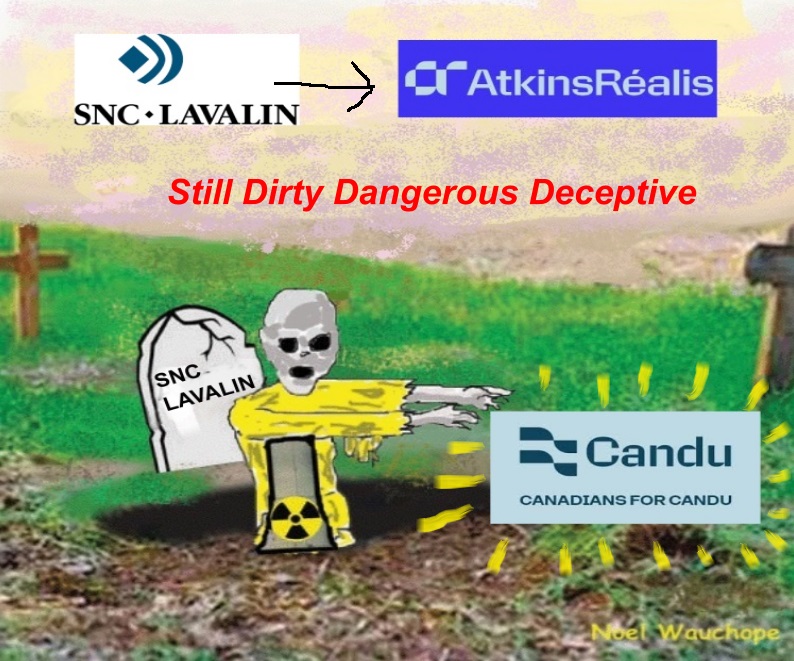
AtkinsRéalis wants to develop a new Candu reactor to sell around the world, but an industry insider says the company’s past could be a ‘big problem’ to getting funding
National Post Ryan Tumilty, Aug 15, 2024
OTTAWA – A company formerly at the centre of one of the biggest scandals of the Trudeau government is now looking for as much as $75 million in annual funding to update a nuclear reactor Canada has exported around the world.
AtkinsRéalis, formerly named SNC Lavalin, launched the Canadians for Candu campaign earlier this year. It’s a push to get both provincial governments and the federal government to back a new, more powerful Candu nuclear reactor that could be built both home and abroad.
The lobbying effort, started earlier this year, has recruited other engineering and construction firms, local unions and other groups to advocate for government support of the made in Canada reactor. The co-chairs of the campaign are former prime minister Jean Chrétien and Ontario premier Mike Harris.
Gary Rose, executive vice-president of nuclear, said the company wants Canadians to be aware of the potential.
“The campaign is really all about promoting Candu, the fact that Canada owns a world-class nuclear technology,” he said. “As provinces make decisions on which technologies that they wish to pursue, when it comes to large nuclear, we want that pursuance to be Candu technology because it’s a Canadian technology.”
AtkinsRéalis holds the license for Candu reactors which were first developed in the 1950’s by the Canadian government. All of Canada’s current nuclear reactors are Candu models ………….
In 2011, the Harper government sold the right to develop Candu reactors to what was then SNC-Lavalin for $15 million. The Crown corporation, Atomic Energy of Canada Limited, retained the intellectual property of the reactors.
With the license in place, AtkinsRéalis has worked on large refurbishment projects and last year signed a deal to build two new reactors in Romania with the help of export financing from the Canadian government.
The proposed Romanian reactors are Candu-6 models capable of producing 700 megawatts of power, but to attract more business, including here in Canada, AtkinsRéalis is working on a new reactor, the Candu Monark, which would be capable of 1,000 megawatts…..
That’s where the company is seeking federal cash. Rose said they are currently spending $50 to $75 million a year on engineering to complete the Monark design and expect to do the same over the next three years. They would like the government to match that spending, potentially adding up to a $300 million bill for taxpayers.
He said ultimately the government will win out in the end.
“We’re asking for it to be an investment. We’re not asking for a handout,” he said. “The IP that we develop as Monark will stay owned by the Canadian government.”
Minister of Natural Resources Jonathan Wilkinson’s office said only that they were aware of the Canadians for Candu campaign when the National Post reached out.
…………………………….AtkinsRéalis has at least one specific project in mind for the Monark, the proposed expansion of the Bruce Nuclear plant in southern Ontario. That project announced last year aims to add up to 4,800 megawatts of power to the Bruce plant, which is already the largest nuclear installation in the world.
Ontario’s then Minister of Energy Todd Smith, said last year, the province would need a lot more power………………….
The proposed site C project is in its infancy and the company has only just started consultations with local communities and planning for what the project would look like. It has only started to look at what reactor technology it might use, but has said it intends to conduct an open process with a “technology neutral” approach.
Rose said the Monark design work could be done in the next four years and be ready to build at the end of this decade.
“The Monark is an evolution of existing Candu technology so we are not starting from scratch,” he said. Most of the components, over 85 per cent, of a Monark reactor would come from Canadian suppliers.
Aaron Johnson, a vice president with AECON construction who worked on nuclear refurbishment projects with AtkinsRéalis and is part of the Canadians for Candu campaign, said new reactors would be a big boost to the local economy.
“That’s already an existing supply base, and that’s something that would only be furthered upon in a Candu new build application,” he said………………………………….
AtkinsRéalis’ request for more government funding comes as the company is shedding the SNC-Lavalin brand that was tarnished in a scandal.
In 2019, the company pleaded guilty to fraud and agreed to a $280 million fine for its actions in Libya between 2001 and 2011. In an agreed statement of facts at the time, the company admitted having paid nearly $48 million to the son of Libyan dictator Muammar Ghadafi to secure contracts.
Former attorney general Jody Wilson-Raybould resigned from cabinet earlier that year after she came under pressure from Prime Minister Justin Trudeau’s office to work out a deal with the company. The ethics commissioner ultimately found Trudeau had improperly pressured Wilson-Raybould.
Rose joined the company only last year and said he was assured he was making the right choice to come aboard because much more than the name of the company has changed.
“The entire management team, leadership team, programs that support it. I believe it’s a totally different company than it was,” he said.
Chris Keefer, president of the group Canadians for Nuclear Energy, acknowledges that AtkinsRéalis’ former name will be a political problem………………………..
Keefer’s group doesn’t receive funds from AtkinsRéalis and isn’t a member of Canadians for Candu, but he does believe the reactor should get government support. American company Westinghouse, which has the AP1000 reactor, received U.S. support for its design and Keefer argued it is not uncommon in the industry…………………………
At the COP 28 climate change conference last year, more than 20 countries including Canada, signed onto a pledge to triple nuclear power production by 2050.
Rose said he believes Candu reactors could easily be 10 per cent of the global market, but they need government support to do it.
“We’re building up front with the hopes of selling 25 in Canada, 75 to 100 globally, and having the federal government standing up and supporting us on that is really key.”https://nationalpost.com/news/politics/snc-lavalin-candu-nuclear-reactors?utm_source=Sailthru&utm_medium=email&utm_campaign=National%20Post%20-%20Posted%202024-08-15&utm_term=NP_HeadlineNews
1 This Month

petition to oppose the rapid increase of space-military industry threatening Jeju Island and the region.
[Petition by April 19th (KST)] Stop the joint military-Hanwha Systems-Jeju Provincial Government Sea Launch!
World Nuclear Power. Reactors 1951-2026, 75 Years of Nuclear Power.
Interactive Map– https://dv.worldnuclearreport.org/

Chernobyl: The Lost Tapes – A good documentary on Chernobyl on SBS available On Demand for the next 3 weeks– https://www.sbs.com.au/ondemand/tv-program/chernobyl-the-lost-tapes/2352741955560

of the week–London Campaign for Nuclear Disarmament


Tell the Ukrainian Government to Drop Prosecution of Peace Activist Yurii Sheliazhenko
To see nuclear-related stories in greater depth and intensity – go to https://nuclearinformation.wordpress.com
-
Archives
- April 2026 (194)
- March 2026 (251)
- February 2026 (268)
- January 2026 (308)
- December 2025 (358)
- November 2025 (359)
- October 2025 (376)
- September 2025 (257)
- August 2025 (319)
- July 2025 (230)
- June 2025 (348)
- May 2025 (261)
-
Categories
- 1
- 1 NUCLEAR ISSUES
- business and costs
- climate change
- culture and arts
- ENERGY
- environment
- health
- history
- indigenous issues
- Legal
- marketing of nuclear
- media
- opposition to nuclear
- PERSONAL STORIES
- politics
- politics international
- Religion and ethics
- safety
- secrets,lies and civil liberties
- spinbuster
- technology
- Uranium
- wastes
- weapons and war
- Women
- 2 WORLD
- ACTION
- AFRICA
- Atrocities
- AUSTRALIA
- Christina's notes
- Christina's themes
- culture and arts
- Events
- Fuk 2022
- Fuk 2023
- Fukushima 2017
- Fukushima 2018
- fukushima 2019
- Fukushima 2020
- Fukushima 2021
- general
- global warming
- Humour (God we need it)
- Nuclear
- RARE EARTHS
- Reference
- resources – print
- Resources -audiovicual
- Weekly Newsletter
- World
- World Nuclear
- YouTube
-
RSS
Entries RSS
Comments RSS
 nuclear-news