TODAY. A whole new way of thinking about nuclear weapons – THEY’RE SILLY!

I’m grateful to Ward Hayes Wilson for giving me this idea. He has noted that Kamala Harris and co have changed the tone of discussion about Donald Trump – from being about fear of Trump, to laughter at Trump.
Then he turns to discussion about nuclear weapons. Why haven’t they been used over almost 80 years of warfare? Because – like Trump, they’re not useful – they’re weird.
Ward Hayes Wilson does not minimise the danger of nuclear weapons. He knows his stuff, and has an impressive record as a writer on matters nuclear. It’s just that he can write clearly about this, without the jargon.
“The truth is nuclear weapons are too big to use on battlefields”
“The truth is that using nuclear weapons to fight a long-range war where you target your adversary’s homeland is simply suicidal.”
“The truth is that nuclear deterrence is fatal over the long run because it’s run by human beings — creatures who make mistakes and are prone to folly.”
“the most important truth about them: they’re ludicrous weapons………….. Their non-use is the result of nuclear weapons being blundering, bumbling, poison-spreading, lousy weapons.”
In the laborious progress towards genuine democracy (we haven’t got there yet), there has been one breakthrough – over a century ago. That is that the political leaders not only have to get voted in – they have to wear more or less “ordinary” clothes. This attire is a very visible symbol that the leader – President, Prime Minister – whoever he (even she!) is called – is not a god, not divinely inspired, but just an ordinary fallible human being.
This type of breakthrough insight has not yet hit the military. In their god-like smart uniforms , bedecked with buttons, ribbons, insignia, jazzy hats – the military, naval, airforce bigwigs look like they are special creatures – super-knowledgeable angels who know what’s best for us, and that the killing of lotsa people is OK, (even if we have to go, too).

Actually, this isn’t really fair. Often you get more sense out of the military toffs that you do out of the politicians, who are beholden to the weapons-making corporations.
Still, tax-payers spend an exorbitant amount not only on nuclear weaponry, but on the whole hierarchy of “experts” of all kinds involved in developing, managing, teaching, publicising and extolling nuclear weapons, and preparing for war.
Much less is spent on genuine diplomacy.

Genuine diplomacy is different from the smarmy hypocrisy of those “diplomats” who swan around a world preparing for nuclear war, and pretending that all will be OK, underneath the American “nuclear umbrella” – that the USA has everything under control.
We don’t need this silly trumpeting about nuclear deterrence etc. It’s time for those more down to earth methods – genuine diplomacy, negotiation, compromise …….
We can swap our fear of nuclear weapons for making fun of how silly the whole thing is .
Global disappointment with the most promising energy: ‘The dream is dead’, and we are in ‘big trouble’
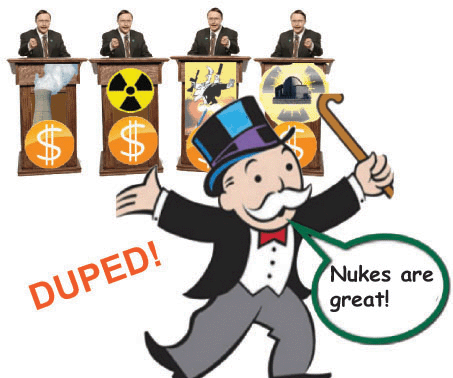
by D. García, 08/23/2024 https://www.ecoticias.com/en/fusion-nuclear-energy-dream-dead/5728/?fbclid=IwY2xjawE2PiVleHRuA2FlbQIxMQABHfSEEnp1jh9NKYg3N-pZe7YOq421dNO7fCN7ZZKAeigI3n1uZOiemR-I-Q_aem_ePp32l88aWrmHEcGwyKikg
Renewable sources are expanding across the country, but there is a ‘silent enemy’ that is eating away at some of this progress, and that is nuclear energy. Experts have believed for years that they can make it clean and safe, which we simply call a pipe dream. Recently, a prestigious media outlet such as The Guardian collected the opinions of several experts under the reflection ‘The dream is dead’. What has happened so that optimism has turned into global pessimism? A discovery about reactors has left everyone in shock.
It was a promising, non-renewable energy: Now, it’s a dead dream, according to experts
Nuclear fusion, a dream of obtaining a virtually inexhaustible and pollution-free energy, has remained an appealing goal for science and politics for a long time. Still, recent problems and accumulating issues caused some analysts to announce that nuclear fusion as a near-term energy source is indeed dead.
A major dream in energy generation circles has been nuclear fusion – the process that drives the sun and stars. Fusion reactions in which hydrogen atoms are combined to form helium have no complicated, long-lived radioactive waste or greenhouse gases as a by-product. But to maintain controlled fusion on Earth, it has been identified as one of the greatest scientific feats ever.
The International Thermonuclear Experimental Reactor is the largest fusion experiment in the world, and the project has experienced the problems with time and over budget. Initially designed to start operations in 2025, the current schedule of ITER has now been delayed, and it is not expected that full fusion operations will commence until the 2050s.
Key figures to understanding why this is a global disappointment: We are losing energy at GW-scale
The dominoes began to tumble and affect the overall nuclear energy industry because of the failures of fusion research. While fusion remains experimental, traditional fission-based nuclear power has been on a downward trend in many parts of the world:
- Worldwide nuclear energy generation has been on the downtrend, with a record in 2006, and Nuclear electricity generation was reduced by 4% between 2019 and 2020.
- Nuclear power’s contribution to the world’s electricity mix has gone down from a peak of roughly 17%. It went from 5% in 1996 to slightly above 10% in the recent past.
- Nuclear power’s contribution to electricity generation in the United States has been steady at approximately 20 percent, but the operating reactors are fewer than before, with 93 as compared to 104 in 2012 and 2021.
What’s the reason why nuclear energy is declining? Beyond the fusion process
The nuclear energy sector in America is facing significant challenges:
- Aging Infrastructure: A majority of the nuclear plants in the United States are either already, or on the verge of, expiring their permits granted for 40 years of utilization.
- Economic Challenges: Nuclear power is unable to compete with relatively cheaper sources such as natural gas and renewable forms of energy. Some of the plants have been shut down before time due to unfavorable market conditions.
- Public Perception: Public opinion remains a core issue of discussion since safety, management of waste and probabilities of the occurrence of an accident cannot be fully overlooked when producing nuclear energy.
- Policy Uncertainty: It is stated that energy policy lacks a long-term vision, which resulted in no clear inspiration for the new nuclear projects.
Is America facing the same situation? Not, here is worse
Several U.S. states have experienced significant losses in nuclear energy capacity:
- California: All nuclear power will vanish in the state following the shutdown of the San Onofre Nuclear Generating Station in 2013 and the planned Diablo Canyon Nuclear Power Plant in 2025.
- Massachusetts: The last operating nuclear power plant in Massachusetts shut down operations in 2019, and the Pilgrim Nuclear Power Station has been off.
- New York: While some efforts had been made to carry forward the Indian Point Energy Center, it was extensively shut down in 2021, thus lowering New York’s nuclear power.
- Pennsylvania: The Three Mile Island plant shut down in 2019, and other plants in the state are also facing financial issues.
Who knows if nuclear fusion energy in America will become a more established source than ever (as Trump said last week) or if it will remain a memory, something like Natrium, Bill Gates’ extravagant invention to resurrect a source that many still believe will be the future. Will we ever “break the dream” and go for a 100% clean and renewable industry? Yes, but without sources with the potential to pollute entire ecosystems for millennia.
A new French fairy tale: “Cheap” nuclear electricity in France is not what it appears.

The French public are paying for their nuclear addiction — and will pay even more when the plants need decommissioning.

By Axel Mayer, 11 Sept 23, https://beyondnuclearinternational.org/2023/09/11/a-new-french-fairy-tale/—
“Bread and games”(Panem et circenses) were the enforcement strategies in the Roman Empire to maintain power. “Cheap petrol, cheap electricity and football” are popular campaign strategies under a democracy, says Axel Mayer, Vice-President of the Trinational Nuclear Protection Association (TRAS).
In France, the nuclear industry is in decline and the nuclear company EDF is heavily in debt. At the same time, President Macron is once again promising cheap nuclear power and wants to have new small nuclear power plants built. A small part of the French nuclear industry’s financial problems is to be solved with EU money.
In this context, the fairy tale of cheap French nuclear power is happily spread in France and also in Germany and the use of nuclear energy is praised as the miracle weapon in the losing war against nature and the environment. However, the price of electricity in France is only apparently cheap.
According to a report of the supreme audit court in France, the research and development, as well as the construction of the French nuclear power plants, cost a total of 188 billion euros. Since in France the “civilian” and the military use of nuclear power cannot be separated, the sum is probably much higher. Retrofitting France’s outdated reactors will cost over 55 billion euros. Liberation magazine reports retrofitting costs of nearly 100 billion euros by 2030.
People of France are paying for expensive nuclear power with their taxes
According to a report by the French Ministry of Economy, the semi-state-owned EDF had debts of about 41 billion euros at the end of 2019, an amount that is expected to be nearly 57 billion euros by 2028. To avoid domestic political problems, EDF is not allowed to raise the price of electricity for political reasons. EDF liabilities are driving up France’s national debt massively. The people of France (and especially their grandchildren) are paying for the seemingly cheap, but in reality expensive nuclear power with their taxes.
This cost does not include the dismantling of the nuclear power plants or any costs of a severe accident. A serious nuclear accident would have devastating consequences in France. A government study estimates the cost at 430 billion euros.
Demolition costs of over 100 billion euros
In France, EDF operates 56 outdated reactors that are now becoming old and decrepit almost simultaneously, but the company has built up almost no reserves for decommissioning. In Germany, the government is very optimistic about a 47 billion euros cost for decommissioning and final storage. The decommissioning of the large number of French nuclear power plants could cost well over 100 billion euros as costs rise, if no savings are made on safety. There is a distinct possibility that the nuclear industry could bankrupt the French state even without a nuclear accident that could happen at any time.
A “European Pressurized Water Reactor” (EPR) has been under construction on France’s Atlantic coast in Flamanville since 2007. The flagship project was originally scheduled for completion in 2012 at a fixed price of 3.2 billion euros. Since then, the start of operation has been postponed again and again, and the Court of Auditors now puts the cost at over 19 billion euros. Whether the EPR can go online in 2024 is questionable. The model reactor will never work economically.
In countries with a functioning market, no new nuclear power plants are building
Swiss nuclear lobbyist and Axpo CEO Christoph Brand puts the kibosh on dreams of cheap nuclear power from new, small nuclear plants. “The production costs for the electricity supplied by new nuclear power plants are currently about twice as high as those of larger wind and solar plants,” Brand said. “No matter how one assesses the risks of nuclear power, it is simply not economical to rely on new nuclear plants,” he said in the pro-nuclear NZZ on Oct. 21, 2021.
In countries with a functioning market, no new nuclear power plants are being built. When in doubt, it always helps to look at EDF’s share price, which has fallen massively over the long term, to assess the market chances of the nuclear renaissance announced by President Macron.
“Bread and games” with artificially low nuclear electricity prices can work in election campaigns. Low-cost, risk-free electricity is generated today with photovoltaics and wind energy. (AM/hcn)
US crying wolf over China’s ‘nuclear threat’ while expanding nuclear arsenal
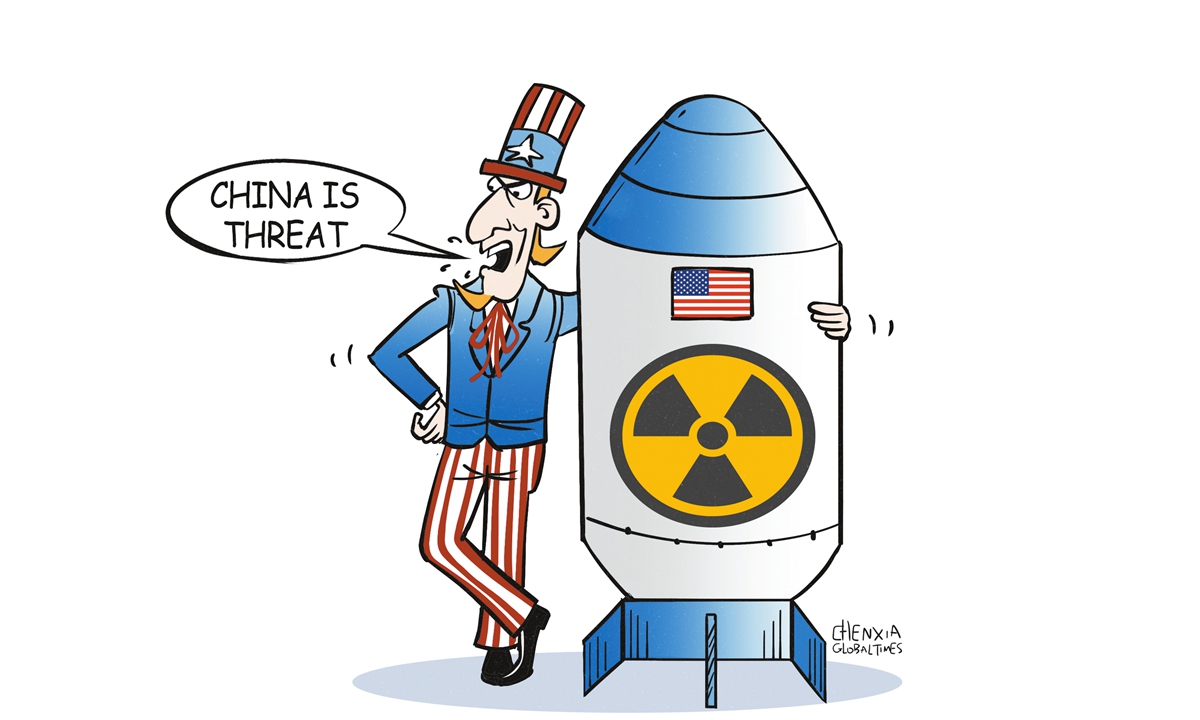
Aug 22, 2024 https://www.globaltimes.cn/page/202408/1318466.shtml
On Tuesday, a New York Times report caused quite a stir: US President Joe Biden has ordered US forces to prepare for “possible coordinated nuclear confrontations with Russia, China and North Korea.” It sounds like the US president was instructing the military to prepare for doomsday, observers pointed out.
The report revealed that in March, Biden approved a highly classified nuclear strategy plan called “Nuclear Employment Guidance,” which for the first time reorients the US’ deterrent strategy to focus on the so-called threat posed by China’s rapid expansion in its nuclear arsenal. The article states that this shift comes as the Pentagon believes China’s stockpiles will rival the size and diversity of the US’ and Russia’s over the next decade.
With over 5,000 nuclear warheads, the US possesses the world’s largest and most advanced nuclear arsenal. So why does it repeatedly target China in its nuclear threat rhetoric? This can be traced back to a dilemma faced by the US Department of Defense – how to justify maintaining such a massive nuclear arsenal in the post-Cold War world. To secure more defense budgets for the domestic military-industrial complex, the US chooses to constantly manufacture or exaggerate baseless “nuclear threats.” And China has become the best excuse.
What the US truly seeks is to ensure that its power far exceeds that of any other country in the world, allowing it to threaten and coerce other nations at will, without fear of retaliation. As a hegemonic state, US’ security is built on the insecurity of other countries. To maintain its hegemonic status, the US struggles to ensure its absolute superiority in power, with nuclear weapons being a crucial tool in maintaining its global dominance. Therefore, this new nuclear strategy plan is an excuse for expanding its nuclear arsenal and sustaining its military hegemony.
China and the US have fundamentally different perceptions of the strategic role of nuclear weapons. China has repeatedly emphasized that it pursues a nuclear strategy of self-defense, and is committed to the policy of no first use of nuclear weapons. China does not engage in any nuclear arms race with any other country, and keeps its nuclear capabilities at the minimum level required for national security. The notion of establishing an offensive nuclear hegemony or pursuing the so-called goal of rivaling the nuclear arsenal size of the US does not align with China’s strategic logic. As experts pointed out, China’s development of nuclear weapons is aimed at avoiding threats from other nuclear-armed states.
No matter how the US fabricates or exaggerates the so-called China threat narrative, China’s nuclear development follows its own set pace, including a measured increase in the quantity and quality of its nuclear arsenal, which will not be swayed by the US’ interference. This is a necessary measure for China in a complex international environment to safeguard its national security and territorial integrity – a legitimate act of self-defense, Shen Yi, a professor at Fudan University, told the Global Times.
The US repeatedly harps on the “China nuclear threat” narrative, yet it is, in fact, the one that poses the biggest nuclear threat to the world. In possession of the largest nuclear arsenal in the world, the US follows a nuclear policy that allows first-use of nuclear weapons. In recent years, the US has invested heavily to miniaturize nuclear weapons, lowering the threshold of their use in real-combat, and used nuclear weapons as a bait to hijack its allies and partners. Its irresponsible decisions and actions have resulted in the proliferation of nuclear risks, and its attempts to maintain hegemony and intimidate the world with nuclear power have been fully exposed.
There will be no winners in a nuclear war. We urge the US to abandon Cold War mentality, recognize that a nuclear war cannot be won and must never be fought, reduce the role of nuclear weapons in national and collective security policies, and take concrete actions to promote global strategic stability, instead of doing the opposite. Instead of smearing and hyping up China, the US should reflect on itself and consider how to rebuild mutual trust with China through dialogue and sincerity.
Putin says Ukrainian forces tried to strike Kursk nuclear plant
The Russian leader does not offer any evidence for his claim but says the UN nuclear watchdog has been alerted.
Russian President Vladimir Putin says Ukrainian forces have tried to attack the Kursk Nuclear Power Station in an overnight raid.
The Russian leader did not offer evidence for the claim but said on Thursday that Moscow has informed the United Nations nuclear watchdog, the International Atomic Energy Agency (IAEA), about the incident.
Ukraine has not responded to Russia’s allegations.
“The enemy tried to strike the nuclear power plant at night. The IAEA has been informed,” Putin said in a televised government meeting.
Putin made the claim as Ukrainian forces continued to fight inside Russia more than two weeks after launching an ambitious cross-border attack, which has become an embarrassing headache for Moscow.
While the strategic aims of Ukraine’s Kursk incursion remain uncertain, President Volodymyr Zelenskyy on Thursday said the attack is part of an effort to bring the war to an end on terms amenable to Ukraine…………………………. https://www.aljazeera.com/news/2024/8/22/putin-says-ukrainian-forces-tried-to-strike-kursk-nuclear-plant
Sizewell C seeks permit for ‘water vole displacement activities’.
Sizewell C is seeking a permit to “undertake water vole displacement activities” on two rivers near the development.
Sizewell C seeks permit for ‘water vole displacement activities’.
Sizewell C is seeking a permit to “undertake water vole displacement
activities” on two rivers near the development.
ENDS 21st Aug 2024
Climate scientist says 2/3rds of the world is under an effective ‘death sentence’ because of global warming

Dr. Deborah Brosnan, a climate and ocean scientist, predicts that Earth could eventually become uninhabitable for humans given the grave state of the planet.
She said about two thirds
of the 8.2billion people who live on this planet are under an effective
“death sentence” as natural disasters will continue to grow more deadly in
the years to come unless human behaviors change. “The point is that climate
change is happening to everyone and in every region of the world,” she
said.
Mirror 19th Aug 2024
https://www.themirror.com/news/us-news/climate-scientist-says-23rds-world-644615
Report on nuclear power in Wales is so secret the UK Government won’t even disclose its name

21 Aug 2024, Martin Shipton, https://nation.cymru/news/report-on-nuclear-power-in-wales-is-so-secret-the-uk-government-wont-even-disclose-its-name/
A campaigner wanting to find out how power from a possible new nuclear power plant on Anglesey would be channelled into the national grid has been refused all information, including even the name of an official report on the matter.
Dr Jonathan Dean, a trustee of the Campaign for the Protection of Rural Wales, wrote to the UK Government’s Department of Energy Security and Net Zero (DESNZ), asking: “Please could I get a copy of the evaluation report where it was concluded that Wylfa on Ynys Môn should be selected as the next large nuclear site after Sizewell C.”
His request was rejected. He wrote back stating: ”I wondered if it would be possible to obtain a redacted copy of the report you mention. I have little interest in any commercial details. Ideally the whole report suitably redacted, but at least those sections dealing with the connection to the national grid; use of waste heat as per section 4.8 of national policy statement EN-1; location and area of land considered on Ynys Môn; and means of overcoming the many reasons given by the Planning Inspectorate in their recommendation to the Secretary of State in 2019/2020 to refuse the DCO [Development Consent Order] application made by Horizon Nuclear Power.
“Would it be possible to know the title and any reference number for this report to aid future requests?”
Confidential information
He was then told: “The report has been withheld in full under regulation 12(5)(b) of the Environmental Information Regulations 2004 and no part of the report is available for disclosure … [The] report does not have a reference number and the title of the report is confidential information.”
Later the Department said it had quoted the wrong section of the regulations as the reason for turning down Dr Dean’s request . The correct section was regulation 12(5)(e), which states: “(The) confidentiality of commercial or industrial information where such confidentiality is provided by law to protect a legitimate economic interest.”
Dr Dean told Nation.Cymru: “There have been tentative ideas to connect the transmission grid in north Wales to that in the south since at least 2009 that I am aware of. Then the idea was a subsea connection from Wylfa to Pembroke And back in 2012 NGET [National Grid Electricity Transmission] wanted to build a 400 kV transmission line to Lower Frankton from Cefn Coch to service mid Wales wind farms.
“The Offshore Transmission Network Review in 2020 again suggested a subsea connection linking Lancashire to Wylfa to Pembroke, taking in the new Irish Sea wind farms.
“The Holistic Network Design (HND) of 2022 changed things. It brought power subsea from Scotland into Pentir (Bangor) and took power from Pentir to Swansea North substation. Although heavily caveated as just indicating a network need, and not indicating technology or route, it was described as a ‘double circuit’ which could be interpreted as meaning pylons.
“In the ‘Beyond 2030’ report this year the ESO [Electricity System Operator] says that the subsea link into Pentir will be double the capacity (4 GW?) of that in the HND, but interestingly show the extra capacity connecting to Bodelwyddan not Pentir.
“Meanwhile NGET have planned a substation at Gwyddelwern, supposedly for north Wales wind farms, and Llandyfaelog for mid Wales wind farms.
“Last week, the Beyond 2030 Celtic Sea report revealed Llandyfaelog will be one of the landing points for the Celtic Sea wind farms, and that Swansea North substation has no free capacity or space to expand
“Pentir is constrained ‘behind’ both Eryri and the new north east Wales national park (currently Area of Outstanding Natural Beauty). If all the capacity from Scotland came into Bodelwyddan and headed south from there, depending on the final limits of the new national park, there may be no obvious hard constraints to pylons.
“So what might be possible? The line could go down the vale of Clwyd, maybe via the new substation in Gwyddelwern, to Cefn Coch (previously desired substation site) then Newtown (132 kV link), Builth and down the Tywi to the new substation in Llandyfaelog.
“Vyrnwy Frankton wouldn’t be needed, Tywi Usk wouldn’t be needed, and with a bit of re-jigging, Teifi Tywi wouldn’t be needed. Technically it would be a far superior transmission solution (at least the correct transmission voltage!) with up to 6 GW capacity and meet the HND objectives of linking north to south Wales. It would likely be 50m pylons carrying 400 kV double circuits.
“If there wasn’t the desire to extract wind power from mid Wales, the alternative could be a HVDC [High Voltage Direct Current] ‘bootstrap’ from Pentir to Pembroke (as per 2009). The two double circuit lines out of Pembroke can carry 12 GW so can easily accept 6 GW from north Wales (4 GW of it from Scotland) and 3 GW from the Celtic Sea, while still having space for the 2 GW Pembroke power station which will, apparently, be converted to hydrogen and/or carbon capture.
“But this is just my feverish imagination. We will have to wait and see.”
Grid connection
Responding to the UK Government’s secrecy over the transmission link from Wylfa, Dr Dean said: “I have always had an interest in Wylfa as I brought my family to Ynys Môn in the 1960s. I remember going to one of the first public meetings about Wylfa B in 1976 to hear my father talk.
“When Hitachi were developing the last iteration of Wylfa B I was involved with the campaign to have the grid connection put underground or subsea. This campaign was supported by Albert Owen, Rhun ap Iorwerth and then Virginia Crosbie. However Hitachi refused to consider a subsea connection and National Grid refused to consider a buried connection
“The Hitachi proposal was ultimately recommended for refusal by the Planning Inspectorate for multiple reasons. Knowing the north Wales grid will be so constrained by 2030, due to the growth of renewables, so much so that pylons are required from Bangor to Swansea, I was shocked at the announcement of a GW scale station. I had expected a series of SMRs [Small Modular Reactors]. There will be no spare grid capacity in the whole of north Wales for nuclear.
“As trustee of CPRW I was concerned that a new line of pylons would be put through Eryri, against UK planning policy, as there is no way around the national park other than under the sea. The UK. planning policy for nuclear has never considered grid connections, so I assumed that the DESNZ report must have addressed this. A power station without a grid connection would just be an enormous white elephant
“I still don’t understand why such technical details should be withheld from the public, given there was a very clear announcement the power station would happen. The fact the report has a ‘secret’ title, and no reference number, makes me think it doesn’t actually exist! But I cannot believe governments announce new power stations based on no analysis or consideration. Surely not?
“All I want to know is, will it be a subsea cable or more pylons all the way to Connah’s Quay? I really don’t see the need for such secrecy.
Inside the ‘suitably opaque’ response to a toxic sewage spill at Chalk River nuclear lab
Internal communications raise questions about transparency at nuclear organizations amid pollution incident
Brett Forester · CBC News ·Aug 20, 2024
When a nuclear research facility was directed to stop polluting the Ottawa River with toxic sewage earlier this year, at least one official seemed pleased with the non-transparency of the facility’s public messaging.
“This is suitably opaque,” wrote Jennifer Fry in an April 24 email to Jeremy Latta, director of communications and government reporting at Atomic Energy of Canada Ltd. (AECL), a Crown corporation.
The two AECL officials were discussing a planned public communiqué from Canadian Nuclear Laboratories (CNL) to be released that day. AECL owns the Chalk River nuclear research campus near Deep River, Ont., about 150 kilometres upstream from Ottawa, but outsources site management to private sector corporate consortium CNL.
Chalk River’s sewage plant began failing toxicity tests on Feb. 21, meaning the treated wastewater, or effluent, was confirmed toxic to fish. (One hundred per cent of the rainbow trout directly subjected to the effluent died over a four-day period, records show. A death rate over 50 per cent fails the test.)
And so on April 23, after two months of this toxic water going into the Ottawa River, Environment Canada stepped in, prompting both CNL’s communiqué and AECL’s assessment of it.
“Reads fine to me, not major risks,” Latta had written, “and who knows if it gets traction.”
Those emails are among more than 100 pages of internal communications released by AECL under access-to-information law, which are raising questions about transparency around the pollution incident.
CBC News requested an interview with an AECL spokesperson to discuss the corporation’s handling of the incident based on a review of the records, and Latta agreed to speak last week.
Latta defended the response, maintaining there was no deliberate effort to hide information. He brushed off Fry’s comment as one person’s opinion………………………………………………………………………
“We have absolutely no confidence in the fact that, if there is a major incident, they will disclose it to us,” said Haymond, a vocal opponent of CNL’s plan to build a radioactive waste dump at Chalk River.
“It just really speaks to the challenge in the relationship where they profess to want to have better communications, and said they would make the effort. Time and time again, there’s incidents which demonstrate that that’s not happening.”…………………………………….
CNL ultimately didn’t answer many of CBC’s questions directly at the time, including one explicitly asking whether the effluent was going into the Ottawa River……………………….. https://www.cbc.ca/news/indigenous/chalk-river-sewage-foi-documents-1.7299822
1 This Month

of the week – Shut Down Drone Warfare!


Tell the Ukrainian Government to Drop Prosecution of Peace Activist Yurii Sheliazhenko

Petition to revoke the licensing of the Near Surface Nuclear Disposal Facility (NSDF) at Chalk River. https://www.ourcommons.ca/petitions/en/Petition/Details?Petition=e-7247
To see nuclear-related stories in greater depth and intensity – go to https://nuclearinformation.wordpress.com
-
Archives
- April 2026 (34)
- March 2026 (251)
- February 2026 (268)
- January 2026 (308)
- December 2025 (358)
- November 2025 (359)
- October 2025 (376)
- September 2025 (257)
- August 2025 (319)
- July 2025 (230)
- June 2025 (348)
- May 2025 (261)
-
Categories
- 1
- 1 NUCLEAR ISSUES
- business and costs
- climate change
- culture and arts
- ENERGY
- environment
- health
- history
- indigenous issues
- Legal
- marketing of nuclear
- media
- opposition to nuclear
- PERSONAL STORIES
- politics
- politics international
- Religion and ethics
- safety
- secrets,lies and civil liberties
- spinbuster
- technology
- Uranium
- wastes
- weapons and war
- Women
- 2 WORLD
- ACTION
- AFRICA
- Atrocities
- AUSTRALIA
- Christina's notes
- Christina's themes
- culture and arts
- Events
- Fuk 2022
- Fuk 2023
- Fukushima 2017
- Fukushima 2018
- fukushima 2019
- Fukushima 2020
- Fukushima 2021
- general
- global warming
- Humour (God we need it)
- Nuclear
- RARE EARTHS
- Reference
- resources – print
- Resources -audiovicual
- Weekly Newsletter
- World
- World Nuclear
- YouTube
-
RSS
Entries RSS
Comments RSS
 nuclear-news