‘Very serious’ nuclear situation could happen ‘at any moment’ in Ukraine, says IAEA chief
Cathy Newman, Presenter 4 News 20 Aug 24
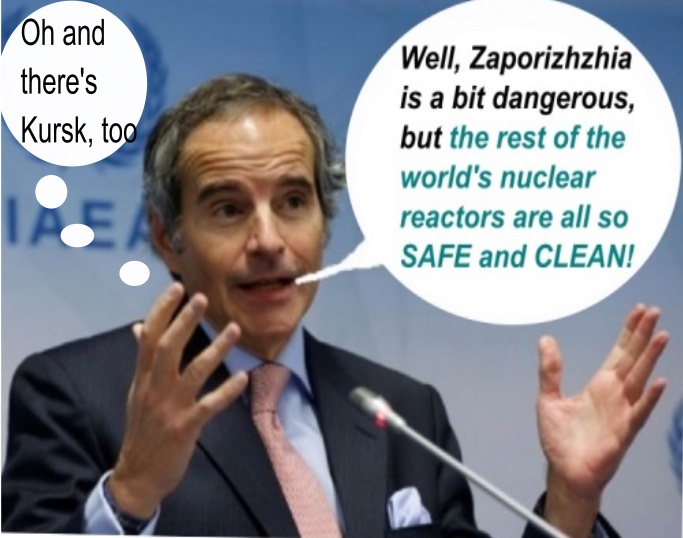
We spoke to Rafael Grossi, Director General of the International Atomic Energy Agency.
Cathy Newman: Let’s start with Zaporizhzhia, because earlier you said that safety was deteriorating there after this drone strike. How critical would you say it is?
Rafael Grossi: Well, we could have a very serious situation any moment. Because when you see the amount of military activity surrounding the plant………………………….The physical integrity of the facility is being challenged. So, this is why we say that what we see is a deterioration. The condition of the plant, I should say, is that it’s not producing energy at the moment, is in jargon what we call shut down. But there’s a lot of material there, a lot of nuclear material there. There’s a lot of spent fuel there. Fresh fuel. So, things that if impact could trigger the release of radioactivity.
Cathy Newman: So the risk has been minimised, but it hasn’t been removed, clearly. I mean, in theory, another Chernobyl is possible?
Rafael Grossi: ………………………………………… I would say, as I was just mentioning, you have all of this material around and you could have a situation theoretically where because of the loss of external power, which has occurred, we had nine episodes of complete blackouts of the plant. So no cooling function. So if you lose all that, you could eventually have a meltdown.
Cathy Newman: So it’s perilous, clearly. I wonder whether you think the risk of the Kursk plant, ……………. Russia is now fortifying around that plant. I mean, is that potentially more risky because it’s a much more volatile situation.
Rafael Grossi: It is certainly serious and we should take it very, very seriously. We are taking it, the agency at the IAEA, very, very seriously. This nuclear power plant is, I would say, within artillery range already. You have just informed that the incursion of the Ukrainian troops, is a few miles, a couple dozen kilometres into Russian territory and just a few miles, in kilometres is about between 20 and 30 km from the plant itself. And there is a technical aspect here. You were just mentioning Chernobyl. The reactors here, you have six reactors in Kursk. You have two reactors that are being decommissioned. You have two reactors that are operating. No shutdown, operating when you have hot reactors. Anything that could happen there could be maximised in this sense.
And then two other units being built. The two reactors that are operating are of a type called RBMK, which is exactly the type of reactors, an old model type of reactor was the one, like the ones that were in Chernobyl. These reactors have a particularity. Normally when you look at a nuclear reactor is a dome. There is a concrete and metal protection. These two reactors don’t have that, don’t have any of that. The core of these reactors is open. Is like, as if you were here and you could see the fuel elements there. So, God forbid, was there an impact on the plant, we could have a very serious situation…………………………………………………………………………………. https://www.channel4.com/news/very-serious-nuclear-situation-could-happen-at-any-moment-in-ukraine-says-iaea-chief
Defence Correspondents: The Journalistic Wing of the Military?
There are stenographers – and then there are UK defence correspondents.
DECLASSIFIED UK, DES FREEDMAN, 19 August 2024
An analysis of broadcasters’ online coverage of defence spending and strategy since Keir Starmer won the election shows that reporting is virtually 100% in line with the government’s own priorities.
Critical voices, where they are included, are entirely from the right.
All 20 articles posted under ‘defence’ since 4 July – 14 from Sky, 5 from the BBC and 1 from ITV – faithfully reproduce the government’s agenda.
These include its proposals for a defence review, its promise to increase military spending to 2.5% of GDP, its commitment to Ukraine and NATO (described on the BBC by foreign secretary David Lammy as ‘part of Britain’s DNA’).
Its notion that there is a need to restore confidence in the military in order to face up to “rapidly increasing global threats” (as Sky quoted defence secretary John Healey) also features.
The only critical voices that appear are Conservative shadow ministers, hawkish think tank spokespeople and military ‘experts’, all speaking about how vital it is to boost defence spending, which currently stands at £64.6bn a year (2.32% of GDP).
Such spending is apparently necessary to confront what the army’s chief Sir Roland Walker has described as an “axis of upheaval” composed of Russia, China, Iran and North Korea.
Sky quoted Walker without comment on 23 July as saying that “there was an ‘urgent need’ for the British Army to rebuild its ability to deter future wars with credible fighting power”.
Churnalism
Much of the coverage feels like a press release from the Ministry of Defence, which is hardly surprising given that MoD statements are liberally incorporated – without challenge – into news reports.
For example, ITV News’ report of 16 July on Labour’s “root and branch” review of defence draws heavily on the MoD’s release earlier that day
Its only deviation from government spin is that it also quotes the shadow armed forces minister Andrew Bowie saying that “the country didn’t need another review, and instead ‘we just need to get on and spend more money on defence’.”
Both the BBC and Sky ran lengthy, gushing reports on the speeches given by the defence secretary and General Walker at the Royal United Services Institute’s ‘Land Warfare’ conference on 22/23 July, unambiguously pushing the line that increasing defence spending was crucial to securing peace.
None of these pieces featured comments about the huge political and economic risks of increasing defence spending and a possible acceleration, not reduction, of instability.
Guns not butter
This isn’t just a matter of excluding voices from the left arguing for a completely different set of priorities. There isn’t even room for mainstream economists like Paul Johnson from the Institute for Fiscal Studies, criticising the way recent governments have presented the proposed hike and making the obvious, if important, point that “[m]ore money for defence means less for everything else”…………………………………………………………………………………………..
‘Pre-war world’
The tone of recent coverage is, however, entirely in line with what has gone on before where news broadcasters have acted more as cheerleaders of the UK government’s strategic defence priorities than impartial journalists.
For example, following a widely reported speech in January by then defence secretary Grant Shapps, committing the UK to spending 2.5% of GDP on defence, Sky News launched a series called “Prepared for War?” in April.
This examined whether the UK was ready for the “possibility of armed conflict” and was based on interviews with defence specialists, former military officers and academics, all of whom were singing to the same pro-war hymn sheet.
It reported on the emergence of a “national defence plan” to deal with “mounting concerns about Russia, China and Iran” and uncritically embraced the idea that we are now in a “pre-war world”.
This has all the trappings of a drive to war.
Seduced
Broadcasters’ favourite defence-related stories appear to be ones where they can show dazzling images of the latest military hardware.
As Richard Norton-Taylor, former defence correspondent for the Guardian and now contributor to Declassified UK, has noted: “The MoD knows how to seduce journalists, especially those writing for specialist defence publications – often used as primary sources by mainstream journalists – by showing off new weapons.”
So in January, Sky News ran a puff piece on a new laser system, DragonFire, developed by the MoD to the tune of around £100m, that spoke of its “pinpoint accuracy” taken straight from the MoD’s own press release. ……………………………………………………………………………………………………………..
As always, an uncritical embrace of the UK’s strategic geopolitical interests comes before any commitment to transparency and even to exploring the claim that increasing military spending might not be the best way of de-escalating rising tensions across the globe.
How do we account for this deference on the part of defence correspondents?
Declassified UK has run several stories examining this question and revealing the preferential treatment of favoured journalists, sanctions against those who ask tough questions, the close contacts between correspondents and defence and security-related officials and indeed the existence of a revolving door between journalism and military PR.
When it comes to reporting on defence and security, ‘[d]eference, as much as secrecy, remains the English disease’, notes Norton-Taylor.
Indeed, all too often, it’s not a specific strategy so much as ideological congruence between the defence establishment and defence journalists about what is understood to be protecting the “national interest”.
That means that while the UK ramps up its support for Ukraine and continues to stand by Israel in defending it from possible attacks from Iran, British broadcast journalists are operating effectively as part of a coordinated effort to boost defence spending.
Their silence on stories such as the training of Israeli troops inside the UK or the number of UK military flights from Cyprus to Israel is just as troubling as their more visible and uncritical amplification of successive UK governments’ defence priorities.
This isn’t journalism but public relations https://www.declassifieduk.org/defence-correspondents-the-journalistic-wing-of-the-military/
Ukraine could trigger ‘another Chernobyl’ – ex-US Army officer.

A meltdown at the Kursk Nuclear Power Plant would make the region uninhabitable, Stanislav Krapivnik has warned
https://www.rt.com/russia/602744-ukraine-may-trigger-another-chernobyl/ 21 Aug 24
Ukraine’s armed forces could cause a nuclear disaster that would affect most of Europe if they strike the Kursk Nuclear Power Plant, former US Army officer Stanislav Krapivnik has warned.
In an interview with RT on Saturday, Krapivnik discussed the difference between a dirty bomb and a nuclear bomb, explaining that while a dirty bomb does not have the critical mass or enriched material, it could cause large scale contamination if it hits nuclear waste.
If the coolant system in an active plant is targeted, it would cause a “nuclear meltdown” which could lead to an incident similar to Fukushima or Chernobyl, he added. Such an event would impact most of Europe, especially at this time of the year “when the wind blows northwest.”
Krapivnik predicted that “if there is enough evidence” of the threat, it would “force a very large reaction” from the Russian government, as a meltdown at the Kursk plant would make the region uninhabitable.
“And the fallout is going to go straight to the northwest into Europe,” he said, adding: “It’s going to hit the Poles, the Germans, the Danes, the Scandinavian countries,” right into the UK. “But apparently the leadership of those nations really doesn’t give a damn.”
On Friday, Russian military journalist Marat Khairullin reported, citing sources, that Kiev is preparing to detonate a dirty atomic bomb targeting nuclear waste at either Russia’s Zaporozhye NPP or the Kursk NPP.
While the nuclear plant in Zaporozhye, the largest such facility in Europe, has been shut down, the plant in Kursk Region is operational.
The Russian Defense Ministry responded to the reports by saying that any attempts to create a “man-made disaster in the European part of the continent” would be met with “tough military and military-technical countermeasures.” Foreign Ministry spokeswoman Maria Zakharova called on the international community “to immediately condemn the provocative actions prepared by the Kiev regime.”
Kiev has denied the allegations. Neither the UN nor the International Atomic Energy Agency have addressed the threat.
Biden approved nuclear strategy focusing on China: Report
President directed US forces to prepare for ‘possible coordinated nuclear confrontations with Russia, China and North Korea,’ New York Times reports
Rabia Iclal Turan |21.08.2024 https://www.aa.com.tr/en/americas/biden-approved-nuclear-strategy-focusing-on-china-report/3308990
WASHINGTON
President Joe Biden approved a classified document in March directing US forces to get ready for potential “coordinated nuclear confrontations involving Russia, China and North Korea,” the New York Times reported Tuesday.
The document, which is revised approximately every four years, is classified to such a degree that there are no electronic versions available. Only a limited number of hard copies have been distributed to select national security officials and Pentagon leaders, the newspaper reported.
The newspaper added, however, that in recent speeches, two senior administration officials were allowed to allude to the change prior to a more comprehensive and unclassified update to Congress that is anticipated before Biden’s term concludes.
The Pentagon believes that China’s nuclear arsenal will rival the size and diversity of US and Russian stockpiles over the next decade, the Times reported.
“The president recently released updated guidance for nuclear weapons employment to address the presence of multiple nuclear-armed adversaries,” the newspaper cited Vipin Narang, a nuclear strategist from the Massachusetts Institute of Technology (MIT) who previously worked at the Pentagon, as saying earlier this month before returning to academia.
He further noted that this guidance specifically considers “the significant increase in the size and diversity” of China’s nuclear arsenal, it added.
In June, the National Security Council’s senior director for arms control and nonproliferation, Pranay Vaddi, said Biden “recently issued updated nuclear weapons employment guidance, which takes into account the realities of a new nuclear era.”
“It emphasizes the need to account for the growth and diversity of the PRC’s nuclear arsenal—and the need to deter Russia, the PRC and North Korea simultaneously,” he added, referring to the People’s Republic of China, China’s official name.
White House National Security Council spokesperson Sean Savett told Anadolu that the US nuclear policy is updated regularly as part of their efforts to “reduce nuclear risks and maintain stable deterrence.”
“This administration—like the four administrations before it—issued a Nuclear Posture Review and Nuclear Weapons Employment Planning Guidance. While the specific text of the Guidance is classified, its existence is in no way secret. The Guidance issued earlier this year is not a response to any single entity, country, or threat,” he added.
Democrats Release Insanely Hawkish Middle East Policy Platform
“President Biden and Vice President Harris believe a strong, secure, and democratic Israel is vital to the interests of the United States,” the platform reads. “Their commitment to Israel’s security, its qualitative military edge, its right to defend itself, and the 2016 Memorandum of Understanding is ironclad.”
The 2016 Memorandum of Understanding is the agreement by which the United States agrees to continue sending Israel $3.8 billion a year to spend on weapons.
Caitlin Johnstone, Aug 21, 2024
Celebrity progressive Alexandria Ocasio-Cortez falsely claimed that Vice President Kamala Harris “is working tirelessly to secure a ceasefire in Gaza” at the Democratic National Convention on Monday night. There is literally no evidentiary basis anywhere for this assertion. She made it up.
Kamala Harris is not “working tirelessly” to do anything at this time besides become the next president. Her own staff are saying she is opposed to an arms embargo on Israel and won’t consider cutting or conditioning military aid, which is the only way the Israeli government can be effectively forced to stop sabotaging a peace deal so that the US-backed genocide can finally end. Saying you’ll continue pouring military explosives into a regime that is using those military explosives to conduct regular massacres of civilians is the exact opposite of working tirelessly to secure a ceasefire.
“This is false, it’s propaganda, and it’s making people misunderstand the issue,” Current Affairs’ Nathan Robinson said of AOC’s statement. “The Biden administration could have imposed a ceasefire anytime it wanted to. The only reason there isn’t one is that Biden has made sure Israel has no incentive to agree to one.”
As we deal with this crap, the DNC has approved a 2024 party platform whose section on the middle east is so surprisingly hawkish that it largely reads like it could have been written by some of Washington’s most war-horny Republicans. It repeatedly calls its support for Israel and the continuation of arms shipments thereto “ironclad”. It criticizes Trump as having been too soft on Iran, for god’s sake.
After boasting about the Biden administration’s bombing campaign against the “Iranian-linked Houthi forces” in Yemen, its “precision airstrikes on key Iranian-linked targets,” and its success in neutralizing Iran’s retaliatory strikes on Israel after Israel assassinated multiple Iranian military officials in Syria, the platform says that this “stands in sharp contrast to Trump’s fecklessness and weakness in the face of Iranian aggression during his presidency.”
Then they literally attack Trump for not going to war with Iran:
“In 2018, when Iranian-backed militias repeatedly attacked the U.S. consulate in Basra, Iraq Trump’s only response was to close our diplomatic facility. In June 2019, when Iran shot down a U.S. surveillance aircraft operating in international airspace above the Straits of Hormuz, Trump responded by tweet and then abruptly called off any actual retaliation, causing confusion and concern among his own national security team. In September 2019, when Iranian-backed groups threatened global energy markets by attacking Saudi oil infrastructure, Trump failed to respond against Iran or its proxies. In January 2020, when Iran, for the first and only time in its history, directly launched ballistic missiles against U.S. troops in western Iraq, Trump mocked the resulting Traumatic Brain Injuries suffered by dozens of American servicemembers as mere ‘headaches’ — and again, took no action.”
The “national security team” who suffered “confusion and concern” when Trump opted not to wade into a middle eastern war of unfathomable horror includes psychopathic war criminal John Bolton, who was reportedly “devastated” when Trump called off a deadly military assault on Iran in retaliation for its shooting down the aforementioned (unmanned) surveillance aircraft.
When you’re siding with John Bolton on whether to bomb Iran, you’re as insanely hawkish as it gets.
“President Biden and Vice President Harris believe a strong, secure, and democratic Israel is vital to the interests of the United States,” the platform reads. “Their commitment to Israel’s security, its qualitative military edge, its right to defend itself, and the 2016 Memorandum of Understanding is ironclad.”
The 2016 Memorandum of Understanding is the agreement by which the United States agrees to continue sending Israel $3.8 billion a year to spend on weapons.
This comes as Kamala Harris’ current and former staff members report that not only will the vice president refuse to cut or condition military support to Israel, she will also refuse to re-enter the Iran deal to ease tensions in the region. The Times of Israel cites congressman Brad Schneider saying he was told by the Harris campaign’s Jewish outreach chief that “the Democratic Party’s presidential nominee would oppose a return to the Iran nuclear deal.”
The Iran nuclear deal, formally known as the Joint Comprehensive Plan of Action, was one of the only decent foreign policy moves made by the Obama administration, and killing it was one of the nastiest things Trump did as president — along with his other recklessly hawkish actions against Iran like implementing starvation sanctions and assassinating Soleimani. But rather than pledging to re-enter the Obama era of de-escalation and detente with Iran, the Democrats are attacking Trump for not fighting a war with Iran while pledging ironclad support for the nation that’s doing everything it can to get that war started.
So yeah, that’s the Democratic Party for you. Vote for them and you get a nicer-looking mask on the blood-spattered face of the US war machine. It’ll kill just as many middle eastern kids as the Republicans will, but it will kill them under the presidency of a woman of color with “she/her” in her Twitter bio.
Nuclear unicorn Newcleo to move holding company from UK to France to tap EU funds
The move comes as the startup targets a €1bn equity round
Sifted Kai Nicol-Schwarz, 21 Aug 24
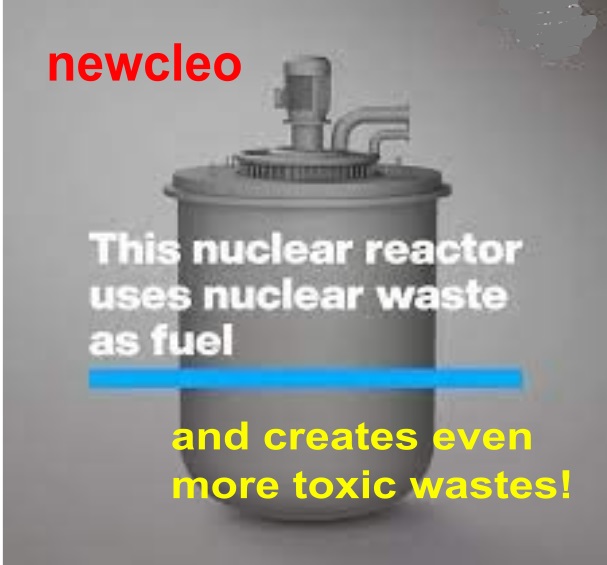
Nuclear power startup Newcleo is moving its holding company from the UK to France, as the company looks to tap EU funding pools in its bid to raise a €1bn equity round.
Newcleo said in its annual accounts, released yesterday, that it had announced to shareholders and employees in January that it was making the move to increase the potential of attracting “significant funding from EU financial institutions”.
“While we are moving the location of our holding company, our plans for the UK are unchanged and we remain committed to investing and building next-generation SMRs to generate electricity for the UK grid and industry,” a Newcleo spokesperson told Sifted. Sifted understands that the move would not involve employees relocating.
…………………………………………………………. founder and CEO Stefano Buono told Sifted in May that the company would need to raise billions more if it’s to realise its ambitions of building a revenue-making commercial reactor by the early 2030s.
Newcleo is hoping French and EU institutional funding can help it get there. “The rationale for the restructure is partly to improve the potential to attract funding from French and other EU financial institutions in the future,” the company said in its accounts.
French government-funded investment bank Bpifrance has “strict” requirements on holding companies being based in the country, explains Tommy Stadlen, cofounder and partner at Giant Ventures.
………………………………..Newcleo’s average monthly cash burn is €13m for the first half of 2024 and it made a loss of €57.5m in 2023 — up from €18.1m in 2022 — according to its accounts. The company had €221m of cash in the bank on 30 June 2024.
https://sifted.eu/articles/nuclear-newcleo-raise-startup-france
Final investment decision on new nuclear plant Sizewell C is delayed
The crucial final investment decision (Fid) for the new nuclear power
plant Sizewell C is unlikely to be agreed until 2025, according to recent
reports. Financial sector publication Bloomberg reported that anonymous
sources close to the project said negotiations between potential private
investors were moving more slowly than had been expected.
The Fid had already been delayed by the general election, but new energy secretary Ed
Miliband indicated his support for Sizewell in an early speech to
parliament before the 2024 summer recess. Bloomberg reported negotiations
with Centrica, Emirates Nuclear Energy Corporation, Amber Infrastructure
Group and Schroders Greencoat are ongoing.
Earlier in July, Centrica chiefnexecutive officer Chris O’Shea said: “An investment decision this year would be dependent upon how the government and the Sizewell company want to
move. “We are able to move as quickly as the other parties, but I think
we should be realistic that the government have been in office less than
three weeks and they need to figure out what they want to do.”
New Civil Engineer 20th Aug 2024
Meeting 1.5C warming limit hinges on governments more than technology, study says

The ability of governments to implement climate policies effectively is the “most important” factor in the feasibility of limiting global warming to 1.5C, a new study says.
The future warming pathways used by the Intergovernmental Panel on Climate Change (IPCC) suggest that holding warming to 1.5C is unlikely, but still possible, when considering the technological feasibility and project-level economic costs of reaching net-zero emissions.
However, the new study, published in Nature Climate Change, warns that adding in political and institutional constraints on mitigation make limiting warming to 1.5C even more challenging.
They find that the most ambitious climate mitigation trajectories give the world a 50% chance of limiting peak global warming to below 1.6C above pre-industrial temperatures. However, adding ”feasibility constraints” – particularly those involving the effectiveness of governments – reduces this likelihood to 5-45%.
The study shows that, thanks to advances such as solar, wind or electric vehicles, “the technological feasibility of climate-neutrality is no longer the most crucial issue”, according to an author on the study.
Instead, he says, “it is much more about how fast climate policy ambition can be ramped up by governments”.
Emissions scenarios
In 2015, almost every country in the world signed the Paris Agreement – with the aim to limit global warming to “well below” 2C above pre-industrial levels, with a preference for keeping warming below 1.5C.
Since then, most countries have set net-zero targets and many are making progress towards achieving them. However, as the planet continues to warm, some scientists are questioning whether it is still possible to limit warming to 1.5C, the new study says.
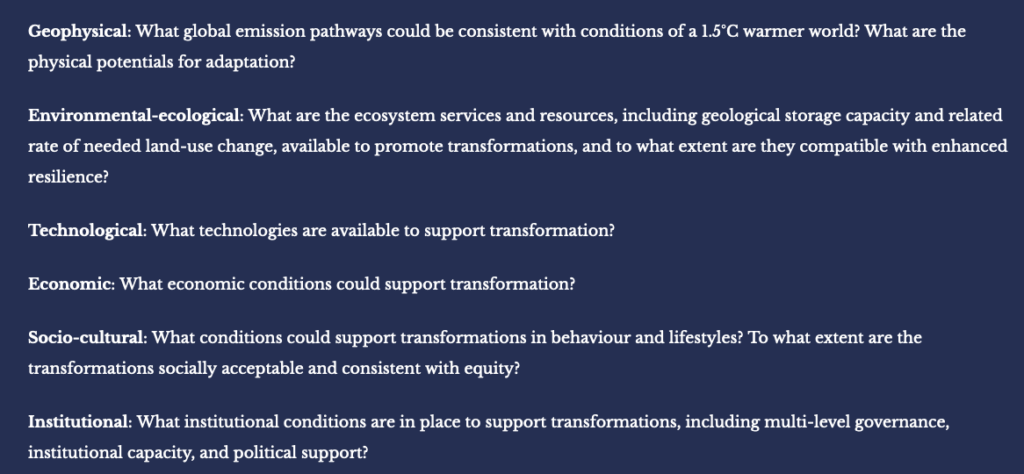
The IPCC’s special report on 1.5C, published in 2018, included a cross chapter box on the “feasibility” of this temperature limit. The report says there are six components of feasibility that could inhibit the world’s ability to limit warming to 1.5C, as shown in the image below.
The IPCC’s working group three report from its sixth assessment cycle explores thousands of different future warming scenarios. These scenarios are mainly generated by integrated assessment models (IAMs) that examine the energy technologies, energy use choices, land-use changes and societal trends that cause – or prevent – greenhouse gas emissions.
Fewer than 100 of these scenarios result in warming of below 1.5C with limited or no overshoot, defined as more than a 50% chance of seeing a peak temperature below 1.6C. These are known as the “C1 scenarios”. However, these scenarios do not consider all of the feasibility constraints outlined by the IPCC.
(Furthermore, these scenarios – which run from 2019 – assume that rapid decarbonisation began almost immediately. However, in reality, emissions have continued to rise since 2020, eating into the remaining “carbon budget” for warming to be limited to 1.5C more quickly than the models assume.)
The new study investigates five constraints. The first two – geophysical and technological – focus on the constraints presented by technologies, such as the growth of carbon capture and storage, nuclear power and solar generation, and the Earth’s total geological carbon storage capacity.
For sociocultural constraints, the study explores behavioural changes that can accelerate decarbonisation, such as reduced energy demand. The authors refer to these as “enablers”. And the “economic constraint” focuses on carbon prices.
However, the authors say the “key innovation” of their study is the inclusion of “institutional constraints”, which measure a government’s ability to “effectively implement climate mitigation policies”.
Policy constraints
All countries have different “institutional capabilities” to enforce policies. Some countries are able to quickly and successfully implement policies, such as taxation changes or environmental regulation. Other countries – which are often less wealthy – have lower levels of governance, making it harder to implement these measures.
Dr Christoph Bertram – an associate research professor at the University of Maryland and guest researcher at the Potsdam Institute for Climate Impact Research (PIK) – is the lead author of the study. He tells Carbon Brief that the paper uses a metric called the “governance indicator” to show how fast countries are expected to decarbonise.
The indicator is based on the speed and success with which they have achieved their past “environmental goals” – for example, reductions in the sulphur emissions of power plants – he explains. Countries that were successful in achieving these targets in the past are given higher governance scores.
Dr Marina Andrijevic, a researcher at the International Institute for Applied Systems Analysis (IIASA), led the study introducing these governance indicators, but was not involved in the new paper.
She tells Carbon Brief that the indicator is originally from the Worldwide Governance Indicators published by the World Bank. (See more on the indicators in the guest post Andrijevic and her co-authors wrote for Carbon Brief.)
The graph below [0n original] , taken from the new study, shows how governance is expected to improve over the 21st century for countries with a population of more than 25 million in 2020, according to this indicator. Each colour indicates a different world region. The grey lines indicate a “pessimistic” scenario in which governance remains frozen at 2020 levels.
The authors use global average carbon prices as a “proxy” for the overall strength of a country’s climate policy, assuming that countries with higher levels of governance will implement higher carbon prices.
They develop a range of scenarios. In their optimistic scenario, carbon prices vary, but this does not explicitly constrain emissions reductions. In the “default” scenario, both carbon prices and emissions reductions are constrained.
In the pessimistic scenario, governance indicator values are “frozen” at their 2020 levels, meaning that governments’ ability to implement new climate mitigation policies does not improve over the 21st century.
Bertram tells Carbon Brief that the measure is “not perfect”, but says that it gives a good approximation of “how fast decarbonisation can happen in different countries”.
Is 1.5C ‘feasible’?
The authors used existing literature to quantify how much each of the five constraints might affect the world’s ability to limit global warming. They then produced a set of different “feasibility scenarios” and assessed their future CO2 emissions using eight IAMs.
The plot below shows the minimum total global CO2 emissions that could be produced between 2023 and the date that net-zero CO2 is reached for these scenarios. In the panel “a”, on the left, each dot indicates a model result.
The column on the far left is a “pessimistic” institutional feasibility scenario, in which governance indicators do not improve beyond 2020 levels. Cumulative global CO2 emissions before net-zero here are the highest of any scenario explored.
The next column is the “default” assumption of carbon prices and emissions-reduction quantities, under four different combinations of constraints.
From left to right within this column, the combinations cover technological and institutional constraints, only institutional constraints, technological and institutional constraints with enablers and then institutional constraints with enablers.
The enablers include measures such as reduced energy demand in high income countries and increased electrification. This helps to “create more flexibility on the supply side and thus further improve the feasibility of implementation”, according to the paper.
The final column shows “optimistic” scenarios, divided between a scenario with technological constraints (left) and a “cost-effective” scenario, as used in the IPCC (right).
Panel “b” shows the likelihood, based on the 14 feasibility scenarios in panel a, of staying below 1.5C, 1.6C, 1.8C and 2.0C peak temperatures. Each bar indicates a different peak temperature. Red indicates a high likelihood of meeting the temperature target, given the level of emissions, and purple indicates a low likelihood.
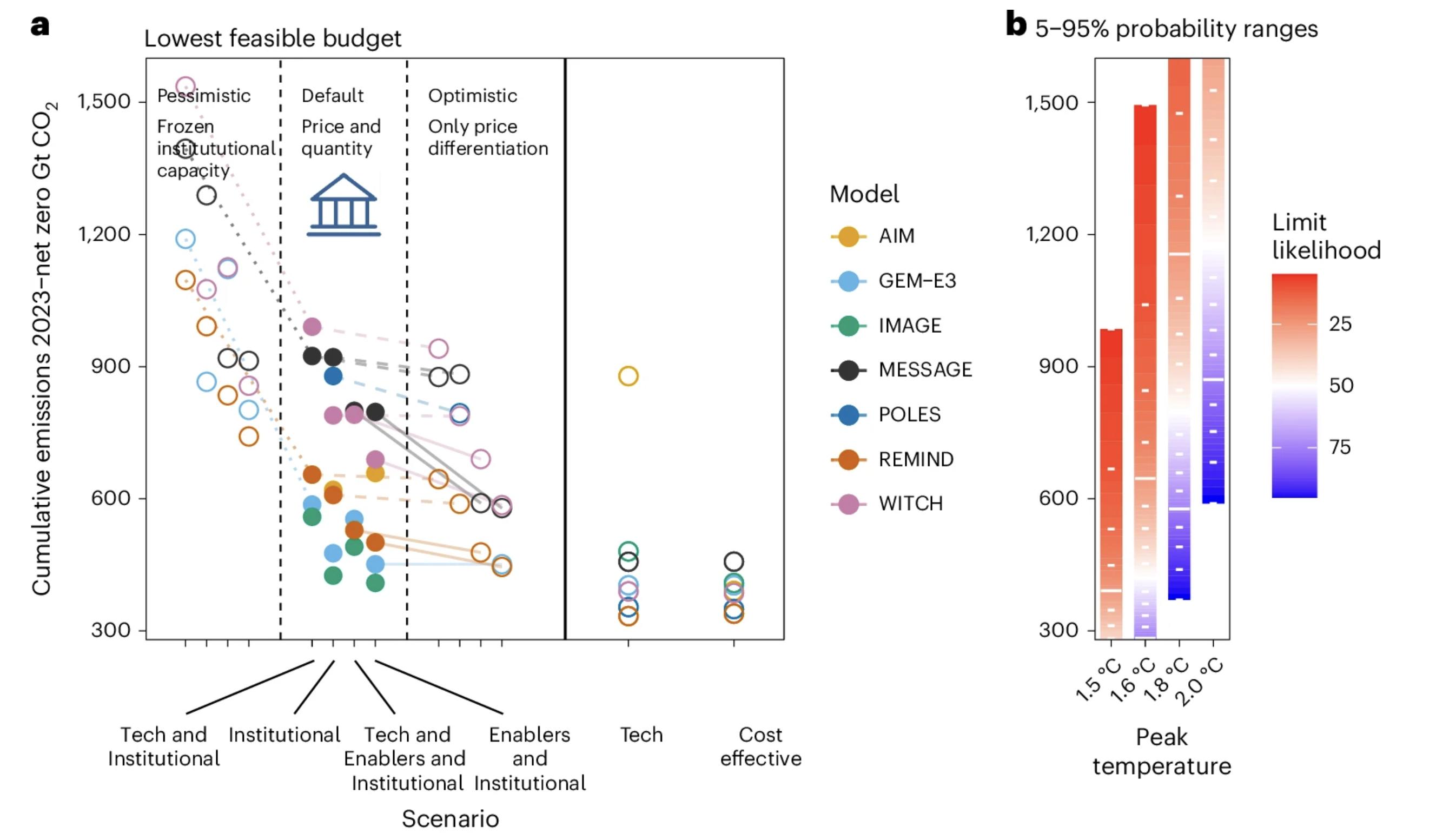
In scenarios without any institutional constraints, nearly all models are able to produce scenarios which line up with the IPCC’s C1 scenarios, which have more than a 50% chance of seeing a peak temperature below 1.6C.
However, adding institutional constraints reduces this likelihood to 5-45%.
(A peak temperature of 1.6C would not necessarily breach the long-term goal of the Paris agreement, as long as temperatures were brought back down below the 1.5C threshold by the end of the century. However, there are risks associated with overshoot – such as crossing tipping points – and it relies more heavily on large-scale implementation of negative emissions technologies.)
Under the “pessimistic” institutional constraints, the ability of countries to cut emissions is “sharply curtailed”, the authors say, resulting in only a 30-50% chance of limiting warming even to 2C above pre-industrial levels.
The study shows that “technological constraints are not a crucial impediment to a fast transition to net-zero anymore,” Bertran tells Carbon Brief.
“Thanks to the latest advances in low-carbon technology deployment, such as solar, wind or electric vehicles, the technological feasibility of climate-neutrality is no longer the most crucial issue,” Prof Gunnar Luderer – a study author and lead of the energy systems group at the PIK – added in a press release.
Instead, he said, “it is much more about how fast climate policy ambition can be ramped up by governments”.
Future warming
The findings of this study have implications for meeting the Paris Agreement 1.5C limit. “Our study does not imply that the 1.5C target needs to be abandoned,” the study says. However, it adds:
“The world needs to be prepared for the possibility of an overshoot of the 1.5C limit by at least one and probably multiple tenths of a degree even under the highest possible ambition.”
“The 1.5C target was always something that, while theoretically possible, was very unlikely given the real-world technical, institutional, economic and political setting that determines climate policy,” says Prof Frances Moore from the department of environmental science and policy at UC Davis, who was not involved in the study.
However, she tells Carbon Brief, the finding that humanity could still limit warming to 2C is “a signal of the progress countries have made in committing to climate action”.
Dr Carl-Friedrich Schleussner – a science advisor to Climate Analytics and honorary professor at Humboldt University Berlin – tells Carbon Brief that the paper is “an important contribution to the literature”.
However, he says the results “need to be interpreted very cautiously”. For example, he notes that the study only considers CO2 emissions and not other greenhouse gases, such as methane.
In addition, he notes that “institutional capacities affect climate action in a myriad of different ways that are not easily representable in the modelling world”. As a result, the study authors had to “settle” on an approach that “may only be partly representative of ‘real world’ dynamics and is very sensitive to modelling assumptions”.
Moore says this is a “valuable initial study”, but makes a similar point, noting that the “implementation of institutional constraints and demand-side effects is somewhat arbitrary and ad-hoc”, such as using carbon prices as a governance indicator.
Dr William Lamb is a researcher at the Mercator Research Institute and was also not involved in the study. He tells Carbon Brief that the study results are “sobering” and says that “we need to start focusing research, policy and advocacy on the underlying institutions and politics that shape climate action”.
He adds that there are other aspects of feasibility that could be considered:
“We know that incumbent fossil fuel interests are politically powerful in many countries and are able to obstruct the implementation of climate policies, or even reverse those that are already in place. In other words, some governments may be capable, but do not want to implement ambitious climate action.”
Flight attendant turned author reveals terrible security vulnerability she fears could trigger nuclear apocalypse.
A former flight attendant who became a successful thriller author has
revealed a terrifying security weakness that she fears could cause a
nuclear apocalypse.
New York Times bestselling author T.J. Newman, 41, got
the idea for her most recent book ‘Worst Case Scenario’ after asking pilots
to share their scariest fears. One pilot told her that he often worried
that a plane could crash into a nuclear power plant, which ‘planted the
seed’ for her third novel, Newman said.
She soon started to research his
fear to see if there ‘was any validity to his fears,’ and soon figured out
that even though reactors – the heart of nuclear power plants – are
hardened, the material stored outside of them could cause a major disaster.
‘The research terrified me, and it became very quickly apparent that what
became the premise of the book is completely plausible,’ she said.
Daily Mail 21st Aug 2024
White House downplays Chinese concerns over possible US nuclear strategy change
VOA, August 21, 2024 By William Gallo, Seoul, South Korea —
White House officials on Wednesday appeared to downplay Beijing’s sentiment that it is “seriously concerned” after a report alleged the United States recently approved a secret plan to shift some of the focus of its nuclear strategy away from Russia to deal with Beijing’s nuclear weapons buildup…………………………….
Late Tuesday, The New York Times reported that U.S. President Joe Biden in March approved a new “nuclear employment guidance,” a highly classified document outlining how the U.S. would use nuclear weapons in a potential conflict.
Asked about the report during a press briefing Wednesday, a Chinese foreign ministry spokesperson accused the United States of “peddling the China nuclear threat narrative” and “finding excuses to seek strategic advantage.”
“China is seriously concerned about the relevant report, and the facts have fully proven that the United States has constantly stirred up the so-called China nuclear threat theory in recent years,” said Chinese foreign ministry spokesperson Mao Ning.
Russia has not responded to the report…………………………………………………………………………. https://www.voanews.com/a/china-concerned-after-report-alleging-us-nuclear-strategy-change-/7750939.html
1 This Month
Chernobyl: The Lost Tapes – A good documentary on Chernobyl on SBS available On Demand for the next 3 weeks– https://www.sbs.com.au/ondemand/tv-program/chernobyl-the-lost-tapes/2352741955560

of the week–London Campaign for Nuclear Disarmament

Tell the Ukrainian Government to Drop Prosecution of Peace Activist Yurii Sheliazhenko
To see nuclear-related stories in greater depth and intensity – go to https://nuclearinformation.wordpress.com
-
Archives
- April 2026 (126)
- March 2026 (251)
- February 2026 (268)
- January 2026 (308)
- December 2025 (358)
- November 2025 (359)
- October 2025 (376)
- September 2025 (257)
- August 2025 (319)
- July 2025 (230)
- June 2025 (348)
- May 2025 (261)
-
Categories
- 1
- 1 NUCLEAR ISSUES
- business and costs
- climate change
- culture and arts
- ENERGY
- environment
- health
- history
- indigenous issues
- Legal
- marketing of nuclear
- media
- opposition to nuclear
- PERSONAL STORIES
- politics
- politics international
- Religion and ethics
- safety
- secrets,lies and civil liberties
- spinbuster
- technology
- Uranium
- wastes
- weapons and war
- Women
- 2 WORLD
- ACTION
- AFRICA
- Atrocities
- AUSTRALIA
- Christina's notes
- Christina's themes
- culture and arts
- Events
- Fuk 2022
- Fuk 2023
- Fukushima 2017
- Fukushima 2018
- fukushima 2019
- Fukushima 2020
- Fukushima 2021
- general
- global warming
- Humour (God we need it)
- Nuclear
- RARE EARTHS
- Reference
- resources – print
- Resources -audiovicual
- Weekly Newsletter
- World
- World Nuclear
- YouTube
-
RSS
Entries RSS
Comments RSS
 nuclear-news