TODAY “Churnalism” – that is a timely word that we all need to consider;

The days of independent investigative journalism as a well-paid job – are pretty much over .
We get our “mainstream” news from journalists who are toeing the line of the corporate media owners, and of government.
I’m grateful to DES FREEDMAN, who today introduced me to that lovely word “churnalism”. How beautifully it expresses all the joyous news that bombards us, about the wonderful world of militarism, and its exciting new devices for killing! Such a glorious use of our taxes!
However, I’m not all that thrilled to learn of the horrible deaths to be inflicted upon Russian and Chinese human beings, as some kind of compensation for my own horrible death in World War 3. Indeed, I’m quite puzzled at the prevailing patriotic view that belligerence and confrontation are the way to go , with these other countries, whom we are somehow obliged to hate.
Of course, the really hard tasks are apparently just too hard to contemplate – those difficult things like negotiation, diplomacy, compromise……….. Especially if it’s dealing with people whose native language is not English. We barely tolerate the Europeans, (but of course, we make an exception for the Ukrainians as they are willingly sacrificing themselves in the cause of American hegemony).
A few brave souls are still doing objective journalism, either openly, or sort of “between the lines” as they write about political tensions, about international conflicts, – and they hope to hang on to their jobs in the “respectable” media.
Meanwhile – where the real journalism is now happening, where questions are really being asked, is in the “alternative ” media – that depends on the generosity of volunteers, giving their time, some voluntary subscribers – but no funding from government and corporate advertising .
I’m not sure that these alternative voices are going to cut through the miitaristic handouts that are regurgitated in the prevailing churnalism, as well as in the jungle of “social” media.
The questions that need to be asked and answered are so simple and obvious – that somehow by some magical veil thrown over our eyes – they are just never allowed to be seen:
- is it a good idea to provoke Putin?
- is it a good idea to attack China About Taiwan?
- why is our tax-payer money going into ever more terrible weapons?
- why is it not going into healthcare?
- why is it not going into education? to helping the homeless? to preserving the environment?
So – the military juggernaut rolls on. Facebook, Instagram, Mastodon etc now censor links to the irregular media, where such questions are asked. So I don’t know whether sensible thinking will ever rise to the surface above the churnalism.
If it doesn’t – we are all doomed.
IAEA chief to visit Kursk nuclear plant due to Ukraine incursion
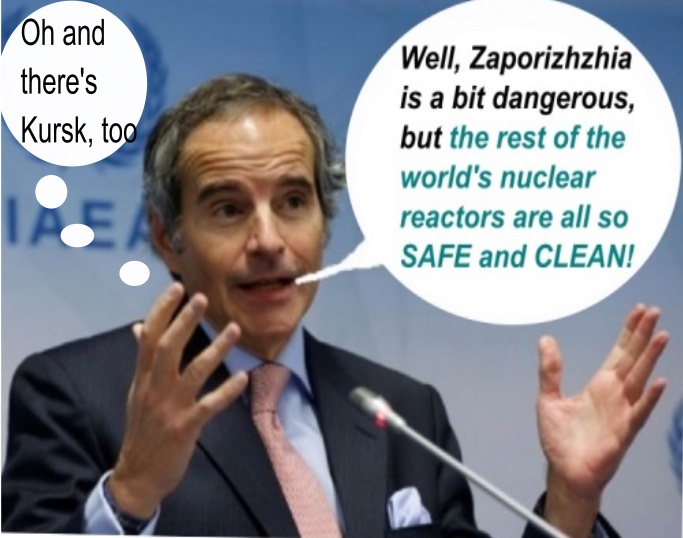
Rafael Grossi says Russian power station is within artillery range of Ukrainian positions
Ben Hall, Malcolm Moore and Andrew England in London, 21 Aug 24, https://www.ft.com/content/c9fab532-44f1-412c-aa96-2fcd55057f27
The head of the UN’s nuclear watchdog is to visit an atomic power station in Kursk, south-west Russia, saying he is taking “very seriously” the risk that the facility could be damaged during Ukraine’s incursion into the region.
Rafael Grossi, director-general of the International Atomic Energy Agency, told the Financial Times in an interview that the Kursk plant was “technically within artillery range” of Ukrainian positions. “And since there is combat, I’m very concerned.”
Grossi said he would visit Kursk next week to talk to its managers and gather any evidence of whether it had already been targeted. He also wanted to assess the state of external power supply and access routes to the plant, noting the recent Ukrainian destruction of bridges across the Seym river in the west of the region.
Ukrainian forces have advanced to positions some 30km from the station, according to military analysts and open source intelligence, putting it within range of their rocket artillery and western-supplied howitzers.
Kyiv has said little about its objectives for the audacious incursion, beyond establishing a buffer zone to protect its border regions and strengthening its position for possible future peace negotiations.
Moscow has accused Ukraine of preparing to attack the plant. Ukrainian officials and commanders have given no indication that the facility is a target or that its seizure is an aim of their offensive.
The nuclear station is situated about 40km west of Kursk, a city of 500,000 people. It has two active reactors, two decommissioned older units and two partly built ones.
The two operating reactors are of a so-called RMBK design, such as the one involved in the Chernobyl disaster, and have no protective dome.
“It’s a Chernobyl-type plant,” Grossi said, with the reactor core “totally exposed”. “I’ve visited a few of these. You can walk around and see the fuel elements that go down, as if it was a sports hall or something,” Grossi said.
The proximity of the site to the fighting between Russian and Ukrainian troops was of “special concern”, he added, because of the two fully functioning reactors.
The Zaporizhzhia nuclear power station in south-eastern Ukraine captured by Russian forces soon after their full-scale invasion was also operating at the time of its seizure, causing widespread concern about safety, but has since been placed in “cold shutdown” mode.
Moscow seized the Zaporizhzhia plant despite agreeing to UN principles that nuclear stations should never be attacked or occupied militarily. The station was taken over with help of Rosatom, Russia’s atomic energy operator and reactor builder, and has been occupied for two and a half years.
Since its seizure, Russia and Ukraine have each accused the other side of striking parts of the site with artillery and drones, most recently on August 18. Asked whether his visit to Kursk was at Moscow’s request, Grossi replied: “I suggested if they want me to take a position, the agency would have to have access to the plant. And they invited me.”
UK’s nuclear facilities ‘at high risk of atomic blackmail’ from Putin

the British sites can be seen in the same way as those in Ukraine in being susceptible to sabotage and infiltration.
The full-scale invasion of Ukraine has brought with it high-level warnings that the UK is headed for a direct military confrontation with Russia.
Josh Layton https://metro.co.uk/2024/08/19/uks-nuclear-facilities-at-high-risk-atomic-blackmail-putin-21449130/
The UK’s nuclear facilities are at high risk from hostile states who are tipping the world into war, according to an expert in risk management.
Dr Simon Bennett warned that World War Three is only a matter of years away, with Russia already pursuing a strategy of ‘atomic blackmail’.
Dr Bennett revived author Bennett Ramberg’s Cold War-era theory of how nuclear power facilities can be weaponised for political ends in calling on the UK government to ramp up defence spending.
He also believes the potential exists for a cornered Vladimir Putin to escalate from psyops to a deliberate use of the Zaporizhzhia nuclear power plant as a dirty bomb, which would have devastating consequences for Ukraine and neighbouring countries.
The risk management expert, of the University of Leicester, warned that the UK government has ‘lost sight’ of its primary duty to protect its citizens amid a slide to global conflict.
‘The full-scale invasion of Ukraine by Russia is the first large-scale conflict where there are potentially numerous nuclear power plants at risk,’ he said.
‘Not only at Zaporizhzhia, which is Europe’s largest power plant, but in Russia, where the current incursion could see the Ukrainians reach the Kursk nuclear power station if they drive hard to the east.
In the 80s, Bennett Ramberg came up with the hypothesis of atomic blackmail, which is based on the premise that as the number of nuclear power stations grows, so does the potential for an aggressor to use them to gain leverage over the owners
‘The potential for a facility like Zaporizhzhia to be used very crudely against an opponent is clear to see.
‘If the plant, which has six reactors, was rigged with powerful demolition mines, and they were detonated, the radiation would be off the scale.
‘It’s possible the Russians have already placed explosives there.’
Dr Bennett, director of the university’s Civil Safety and Security Unit, told Metro.co.uk that Putin — who is under pressure after Ukraine’s invasion of Russia’s Kursk region — is capable of the unthinkable.
He a drew a comparison with one of the darkest days of history.
‘Using Zaporizhzhia for atomic blackmail gives Putin leverage over not just Ukraine but the entire world,’ Dr Bennett said.
One of the latest safety incidents at Zaporizhzhia came last week when smoke was filmed rising from one of the cooling towers at the Russian-held facility in eastern Ukraine.
Experts doubted there was any risk of an explosion, with Ukraine saying that the fire was started deliberately by setting light to tyres.
However the use of the plant in this way, which follows continued reports of incidents involving drones and shelling, fits with Ramberg’s theory — and has implications for the UK’s own security, according to Dr Bennett.
On Saturday, the safety situation at Zaporizhzhia was ‘deteriorating’ after a nearby drone strike, the International Atomic Energy Agency said.
The party behind the explosion, just outside the site’s protected area, has not been identified. Under Rishi Sunak, the British government announced the biggest expansion in nuclear power for 70 years, and the new prime minister is also committed to building new facilities.
Through Ramberg’s thesis, the British sites can be seen in the same way as those in Ukraine in being susceptible to sabotage and infiltration.
‘If we think more laterally, the number of power stations in the UK is growing, and through the optics of Ramberg’s theory, we are offering our enemies more targets and potentially more leverage over us in a conflict,’ Dr Bennett said.
The Russian FSB security agency and GRU military intelligence are very good at hybrid warfare, so what they could be doing at the moment is recruiting and running individuals as “sleepers” within the British state and potentially within the nuclear industry, ready to be activated at any moment. Three civil servants have recently been charged under the National Security Act and my understanding is that they are alleged to have been spying for China.’
The full-scale invasion of Ukraine has brought with it high-level warnings that the UK is headed for a direct military confrontation with Russia.
British sites, including a shipyard housing nuclear submarines in Barrow-in-Furness, were last week reported by the Financial Times to be on the Kremlin’s list of targets.
Tobias Ellwood, former chair of the Commons Select Committee, responded by saying: ‘We must wake up — storm clouds are gathering.’
Dr Bennett said: ‘The British state needs to take these nuclear threats far more seriously not just within the optics of the Ukraine-Russia war but because, in my opinion, there will be a world war in the next five to 10 years. It will start in the Asia-Pacific, where China will invade Taiwan and, because of the Aukus pact, we will be directly involved in defending Taiwan.
‘Russia will be involved because of its ties with China, leading to a multi-hemisphere conflict.’

Dr Bennett, whose book ‘Atomic Blackmail?’ examines the weaponisation of nuclear facilities in the Russia-Ukraine war, has raised the issues in letters and emails to various governments, including that of Rishi Sunak, but to date has not received any acknowledgement.
‘In my opinion, the government obsession with net zero and climate change agreements distracts from a far greater threat to safety, namely atomic blackmail,’ he said.
‘The primary purpose of the state is national security and in my view we have lost sight of that purpose. The Labour government is carrying out a defence review when what we really need is to raise the 2% of GDP we spend on defence to a minimum 4% of GDP.’
The prospect of an apocalyptic conflict in a matter of years has gained traction during the Ukraine-Russia war and China’s continued pressure on Taiwan, which it views as its own territory.
The author intends to continue trying to raise the alarm.
The U.S. and China Can Lead the Way on Nuclear Threat Reduction

Policies of “no first use” are a model for nuclear states.
Foreign Policy, By Zhou Bo, a senior fellow at the Center for International Security and Strategy at Tsinghua University and a retired senior colonel in the Chinese People’s Liberation Army. August 20, 2024,
Since the end of the Cold War, the role of nuclear weapons has only grown. Nuclear arsenals are being strengthened around the world, with many nuclear states continuing to modernize their arsenals. In June, outgoing NATO Secretary-General Jens Stoltenberg said that the alliance was in talks to deploy more nuclear weapons, taking them out of storage and placing them on standby. Robert C. O’Brien, a former national security advisor to former U.S. President Donald Trump, has urged him to conduct nuclear tests if he wins a new term, arguing that it would help the United States “maintain technical and numerical superiority to the combined Chinese and Russian nuclear stockpiles.”
There are two bleak conclusions about nuclear diplomacy in this age. First, it will be impossible to ban such weapons anytime soon. Since its passage in 2017, no nuclear-armed states have signed the United Nations Treaty on the Prohibition of Nuclear Weapons, some of them instead contending that it will distract attention from other disarmament and nonproliferation initiatives.
It is also very hard, if not impossible, to convince these states to reduce their nuclear stockpiles amid ever-intensifying geopolitical and military competition. On the contrary, in February 2023, Russia announced that it was suspending its participation in the 2010 Treaty on Measures for the Further Reduction and Limitation of Strategic Offensive Arms (New START)—the last remaining nuclear arms control treaty limiting Russian and U.S. strategic nuclear forces.
In response, the United States has also suspended the sharing and publication of treaty data. In November, Russia went a step further and withdrew its ratification of the Comprehensive Nuclear Test Ban Treaty (CTBT), citing “an imbalance” with the United States, which has failed to ratify the treaty since it opened for signature in 1996.
Amid such a situation, it is impossible for Beijing to stand by idly. The Stockholm International Peace Research Institute estimates that the size of China’s nuclear arsenal has increased from 410 warheads in January 2023 to 500 in January 2024, and it is expected to continue to grow. For the first time, China may also now be deploying a small number of warheads on missiles during peacetime. According to the U.S. Defense Department, China is likely to increase its nuclear warheads to 1,500 by 2035.
Given this reality, perhaps the most promising near-term way to guard against nuclear risks is not by limiting the number of nuclear weapons but by controlling the policies that govern their use. In this regard, a pledge by nuclear-armed states of “no first use” of nuclear weapons looks to be the most realistic approach in reducing the escalation of nuclear threats.
In theory, no first use refers to a policy by which a nuclear-armed power formally refrains from the use of nuclear weapons or other weapons of mass destruction in warfare, except in the case of doing so as a second strike in retaliation to an attack by an enemy power using weapon of mass destruction.
Of the five nuclear states that have signed onto the Treaty on the Nonproliferation of Nuclear Weapons (NPT)—China, France, Russia, the United Kingdom, and the United States—only China has ever declared a no-first-use policy. On Oct. 16, 1964, when China successfully detonated its first atomic bomb, the country immediately declared that it would not be the first to use nuclear weapons at any time and under any circumstances, and unconditionally committed itself not to use or threaten to use nuclear weapons against nonnuclear states or in nuclear-weapon-free zones…………………………………………..
All nuclear powers could afford to adopt a formal no-first-use policy—taking the moral high ground without reducing their capabilities for retaliation.
Though it has never adopted a no-first-use policy itself, the United States’ nuclear posture is actually more similar to China’s than it seems. In its 2022 Nuclear Posture Review, the Biden administration declared that it would only consider the use of nuclear weapons “in extreme circumstances to defend the vital interests of the United States or its allies and partners.” But it is hard to imagine which interests are so vital that they might require Washington to use nuclear weapons as a first measure to defend them.
To be sure, it is important for the United States to assure its allies that it will follow through on its deterrent promises. It is equally hard to imagine who would venture to launch a nuclear strike on a U.S. ally, knowing the dire potential consequences.
The United Kingdom’s nuclear deterrent, meanwhile, is operationally independent. But in terms of its nuclear policy, the British government has made it clear that “we would consider using our nuclear weapons only in extreme circumstances of self-defence, including the defence of our NATO allies.” France, meanwhile adheres to a principle of “strict sufficiency.”
The real challenge, then, is getting Russia to commit to a no-first-use policy. The Soviet Union adopted a formal policy of no first use in 1982. But after its dissolution, the Russian Federation reversed this approach in 1993, likely to mitigate the comparative weakness of the Russian Armed Forces in the post-Soviet era………………………………………………….
A dual-track approach may be the best bet for the adoption of a formal no-first-use policy.
In Europe, NATO can start with a unilateral no-first-use pledge against Russia as a gesture of goodwill. Even if such an offer isn’t immediately reciprocated by Russia, it might begin to thaw tensions.
As a second—and crucial—step, NATO could pledge to halt any further expansion of its alliance in exchange for Moscow adopting a no-first-use policy This would be a difficult pill for the alliance to swallow. But after Sweden’s and Finland’s entry earlier this year, there are only three aspiring countries on the waiting list: the barely significant Bosnia and Herzegovina as well as Georgia and Ukraine, which have deeply problematic ongoing conflicts with Russia that NATO is sensitive about.
The path forward would likely be smoother if it went through Asia. Both Russia and China have already agreed to no first use against each other. China and the United States could reach a similar agreement, thus de-escalating potential conflicts involving U.S. allies—such as the Philippines and Japan—as well as the dangers that could be provoked through accidental collisions in the sea or air. A U.S.-led example might then make it easier to bring the Europeans on board.
This may seem far-fetched in the current geopolitical climate, but there is precedent for it. When India and Pakistan tested nuclear devices in May 1998, they incurred swift condemnation from the U.N. Security Council, which called for both countries to sign both the NPT and the Comprehensive Nuclear Test Ban Treaty. In a rare show of solidarity, China and the United States made a joint declaration in June 1998 agreeing to de-target their nuclear weapons against each other.
This was largely a symbolic and unverifiable step. But it was not only a defusing of tensions, but also good to see nuclear states at least partially honoring the vision of nuclear disarmament laid out in Article VI of the NPT. And this China-U.S. joint statement eventually led to another joint statement among the five nuclear-armed permanent Security Council states in May 2000, which affirmed that their nuclear weapons are not targeted at each other or at any other states.
No first use is a big step forward from nontargeting. It’s not out of bounds to imagine that, with enough diplomatic capital, a similar but more important pledge of no first use could be made today. In fact, in January 2022—only a month before Russia’s invasion of Ukraine—these five nuclear powers agreed in a joint statement that “a nuclear war cannot be won and must never be fought.”
What is more significant is that during Chinese President Xi Jinping’s visit to Moscow last year, China and Russia reiterated this commitment, even amid Russia’s ongoing war.
If, indeed, a nuclear war cannot be won, then what is stopping these nuclear powers from taking a no-first-use pledge? Nuclear weapons didn’t help the United States in its wars in Vietnam, Iraq, and Afghanistan—or the Russians in Ukraine. A commitment of no first use by the nuclear-armed states would give people hope that a nuclear-free world, however distant, is still possible one day.
This essay is published in cooperation with the Asian Peace Programme at the National University of Singapore’s Asia Research Institute. https://foreignpolicy.com/2024/08/20/nuclear-weapons-war-no-first-use-policy/—
‘US the primary source of nuclear threat in world’
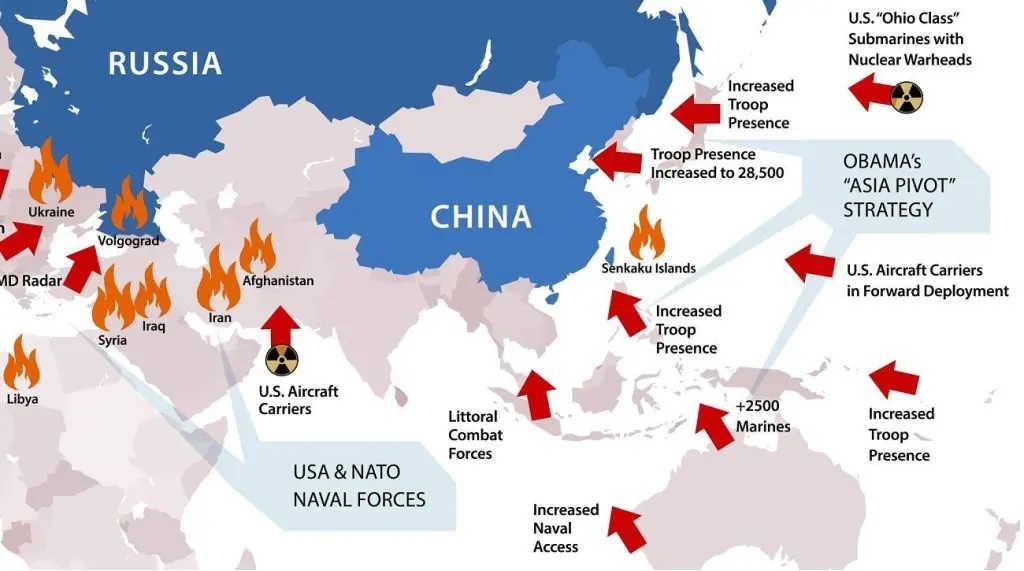
“The size of China’s nuclear arsenal is not on the same level with the US. China follows a policy of ‘no first use’ of nuclear weapons and always keeps its nuclear capabilities at the minimum level required by national security. We have no intention to engage in any form of arms race with others,” Mao said.
Nuclear strategy of US slammed for using China as pretext to expand nuke arsenal
By Zhao Yusha, Aug 21, 2024 , https://www.globaltimes.cn/page/202408/1318453.shtml
The US’ constant hyping of the “China nuclear threat” theory is a convenient pretext for the US to shirk its obligation of nuclear disarmament, expand its own nuclear arsenal and seek absolute strategic predominance, a spokesperson from China’s Ministry of Foreign Affairs said on Wednesday, after US media reported President Joe Biden has approved a highly classified nuclear strategic plan that, for the first time, reorients the US’ deterrent strategy to focus on China’s purported expansion of its nuclear arsenal.
The New York Times reported on Tuesday that Biden approved the document in March after the Pentagon said it believes China’s nuclear arsenal stockpiles will rival the size and diversity of the US’ and Russia’s over the next decade.
The White House never announced that Biden had approved the revised strategy, called the “Nuclear Employment Guidance,” which seeks to prepare the US for possible coordinated nuclear challenges from China, Russia and North Korea. The document, updated every four years or so, is so highly classified that there are no electronic copies, with only a small number of hard copies distributed to a few national security officials and Pentagon commanders.
The US has called China a “nuclear threat” and used it as a convenient pretext for the US to shirk its obligation of nuclear disarmament, expand its own nuclear arsenal and seek absolute strategic predominance, Mao Ning, spokesperson of China’s Ministry of Foreign Affairs said at a Wednesday briefing, while stressing China is gravely concerned over the report.
“The size of China’s nuclear arsenal is not on the same level with the US. China follows a policy of ‘no first use’ of nuclear weapons and always keeps its nuclear capabilities at the minimum level required by national security. We have no intention to engage in any form of arms race with others,” Mao said.
“In contrast, the US sits on the largest and most advanced nuclear arsenal in the world. Even so, it clings to a first-use nuclear deterrence policy, and has invested heavily to upgrade its nuclear triad and blatantly devised nuclear deterrence strategies against others. It is the US who is the primary source of nuclear threat and strategic risks in the world,” Mao stated.
The document reflects that the US has reached a level of hysteria when it comes to competition with countries like China. It has even reached a point where it is prepared for a nuclear conflict, which is extremely dangerous, said Li Haidong, a professor at the China Foreign Affairs University.
He said the US’ hype over China’s nuclear arsenal is a tactic to justify and bolster its own nuclear weapons program for political maneuvering and policy objectives.
Biden’s Convention Speech Made Absurd Claims About His Gaza Policy

August 21, 2024 By Norman Solomon, https://scheerpost.com/2024/08/21/bidens-convention-speech-made-absurd-claims-about-his-gaza-policy/
An observation from George Orwell — “those who control the present, control the past and those who control the past control the future” — is acutely relevant to how President Biden talked about Gaza during his speech at the Democratic convention Monday night. His words fit into a messaging template now in its eleventh month, depicting the U.S. government as tirelessly seeking peace, while supplying the weapons and bombs that have enabled Israel’s continual slaughter of civilians.
“We’ll keep working, to bring hostages home, and end the war in Gaza, and bring peace and security to the Middle East,” Biden told the cheering delegates. “As you know, I wrote a peace treaty for Gaza. A few days ago I put forward a proposal that brought us closer to doing that than we’ve done since October 7th.”
It was a journey into an alternative universe of political guile from a president who just six days earlier had approved sending $20 billion worth of more weapons to Israel. Yet the Biden delegates in the convention hall responded with a crescendo of roaring admiration.
Applause swelled as Biden continued: “We’re working around-the-clock, my secretary of state, to prevent a wider war and reunite hostages with their families, and surge humanitarian health and food assistance into Gaza now, to end the civilian suffering of the Palestinian people and finally, finally, finally deliver a ceasefire and end this war.”
In Chicago’s United Center, the president basked in adulation while claiming to be a peacemaker despite a record of literally making possible the methodical massacres of tens of thousands of Palestinian civilians.
Orwell would have understood. A political reflex has been in motion from top U.S. leaders, claiming to be peace seekers while aiding and abetting the slaughter. Normalizing deception about the past sets a pattern for perpetrating such deception in the future.
And so, working inside the paradigm that Orwell described, Biden exerts control over the present, strives to control narratives about the past, and seeks to make it all seem normal, prefiguring the future.
The eagerness of delegates to cheer for Biden’s mendaciously absurd narrative about his administration’s policies toward Gaza was in a broader context — the convention’s lovefest for the lame-duck president.
Hours before the convention opened, Peter Beinart released a short video essay anticipating the fervent adulation. “I just don’t think when you’re analyzing a presidency or a person, you sequester what’s happened in Gaza,” he said. “I mean, if you’re a liberal-minded person, you believe that genocide is just about the worst thing that a country can do, and it’s just about the worst thing that your country can do if your country is arming a genocide.”
Beinart continued: “And it’s really not that controversial anymore that this qualifies as a genocide. I read the academic writing on this. I don’t see any genuine scholars of human rights international law who are saying it’s not indeed there. . . . If you’re gonna say something about Joe Biden, the president, Joe Biden, the man, you have to factor in what Joe Biden, the president, Joe Biden, the man, has done, vis-a-vis Gaza. It’s central to his legacy. It’s central to his character. And if you don’t, then you’re saying that Palestinian lives just don’t matter, or at least they don’t matter this particular day, and I think that’s inhumane. I don’t think we can ever say that some group of people’s lives simply don’t matter because it’s inconvenient for us to talk about them at a particular moment.”
Underscoring the grotesque moral obtuseness from the convention stage was the joyful display of generations as the president praised and embraced his offspring. Joe Biden walked off stage holding the hand of his cute little grandson, a precious child no more precious than any one of the many thousands of children the president has helped Israel to kill.
Too big to fail? Who cares if there’s no accountability – the Nuclear Lie

How is it that political parties can get away promising huge projects that won’t eventuate for 10 to 20 years; that’s four to eight election cycles in the future.
Even if the current opposition leader, Peter Dutton, manages to sell the nuclear dream at the next election, he won’t be around to see his promises are kept. He simply isn’t accountable for the claims he’s making today.
by David Salt | Aug 21, 2024 https://sustainabilitybites.com/too-big-to-fail-who-cares-if-theres-no-accountability/
Building big on big promises of endless clean energy ignores the limits of our institutions. It’s something rarely considered in the febrile, volatile environment of contemporary politics. We pull our leaders up on the smallest of inconsistencies but let them get away with the biggest of lies. When you next cast your vote, keep in mind that extraordinary promises require extraordinary accountability.
The nuclear lie

Australia is currently contesting a future based on nuclear energy vs renewables.
The conservative opposition Coalition has put forward a ‘plan’ to build seven government-owned nuclear plants across Australia that will come online around 2035. The promise is that these plants will provide cheap, reliable carbon free electricity and help our nation achieve ‘net zero’ by 2050. It’s a strange policy requiring massive government investment and control from a party the stands for smaller government. But that’s just the beginning of strangeness around this thinking.
To call it a ‘plan’ is drawing a long bow because the proposal comes with no costings or modelling attached; existing legislation prevents the construction of nuclear power plants; and Australia currently lacks the necessary capacity to develop a nuclear power network (something the nuclear loving coalition did nothing about while in government for most of the last decade). Experts from across Australia don’t believe it would be possible to build the plants by 2035, or that they can produce electricity at anything close to what can be produced by renewables.
However, if the electorate was to buy the proposal and vote in the conservatives, it would result in the extension of coal power (to fill the gap till nuclear comes online), the expansion of gas energy and a redirection of investment away from renewables, which don’t really complement nuclear anyway.
While questions are being asked about all of these uncertainties, I think a more fundamental issue relates to governance and scales of time.
How is it that political parties can get away promising huge projects that won’t eventuate for 10 to 20 years; that’s four to eight election cycles in the future. Even if the current opposition leader, Peter Dutton, manages to sell the nuclear dream at the next election, he won’t be around to see his promises are kept. He simply isn’t accountable for the claims he’s making today.
Flawed accountability
Clearly this is a weakness of our democratic system of governance. We vote someone in to represent us for a number of years, three to six years in most electorates around the world, and we hold these representatives to account for the how they perform in delivering what they promised at election time. This tends to have voters actively reflecting on day-to-day business (taxes, health care delivery, education etc), while simply ignoring the hundreds of billions of dollars of commitments made for promises that sit well over the electoral horizon (promises like nuclear submarine fleets and nuclear power plants).
This weakness in accountability appears to be increasingly exploited by all sides of politics. Voters are collapsing under the ‘cost of living’, holding their breaths with every quarterly inflation announcement, and quick to pull down any politician who seems insensitive to the needs of ‘working families’.
Yet, at the same time, voters seem oblivious to the consequences of political leaders making a $100 billion dollar pledge to be delivered in 3-4 election’s time (though I note critics say this plan could easily end up costing as much as $600 billion). Consequently, we’re seeing more of these big announcements because the pollies know the electorate is not going to hold them to account. They simply don’t have the capacity to take it in, they are too absorbed by the day-to-day stuff.
Extraordinary accountability
The late, great astronomer Carl Sagan once said that “extraordinary claims require extraordinary evidence”. He was referring to the possibility of UFOs and extra-terrestrial life, but the same principle should apply to extraordinary political promises. If a political leader makes an extraordinary promise that can’t be delivered in one to two electoral cycles and commits vast quantities of (scarce) resources, then they need to put up a corresponding level of ‘extraordinary accountability’ before their case should be considered seriously by the broader electorate.
It’s not just the money involved and skills needed, it’s also how such a goal might be met over several electoral cycles. Bipartisan support, you would think, would have to be a basic first step.
A couple of decades ago Prime Minister John Howard passed the Charter of Budget Honesty Act in an effort to make political parties more accountable for the spending they promised. Many claim it has achieved little however, at the very least, it was an effort to show the electorate that politicians were aware that they needed to demonstrate greater accountability for the promises they make.
In the case of Dutton’s nuclear plan, this accountability is completely missing. However, rather than acknowledging this and attempting to build a stronger case, the Coalition has instead been attacking the institutions that have been examining the proposal (like CSIRO and the Australian Academy of Technological Sciences and Engineering). The conservatives have simply written them off when they question the validity of the proposal. (“I’m not interested in the fanatics,” says Dutton.) This doubling down is doubly dumb because it involves both extraordinary promises with no proof and the politicisation of independent experts.
Beyond nuclear
But this tendency to aim extraordinarily big without extraordinary accountability goes way beyond Australia’s future nuclear energy ambitions. Consider the quest for fusion energy.

Europe is chasing the holy grail of clean energy by investing in fusion power. The multi-country International Thermonuclear Experimental Reactor (ITER) project was dreamt up in the 1980s and took over 25 years to come together as a formal collaboration between China, the European Union, India, Japan, South Korea, Russia, and the United States. Construction began in 2010 with operations expected to start about a decade later. But manufacturing faults, the COVID-19 pandemic, and the complexity of a first-of-a-kind machine (one of the most complex machines in the world) have all slowed progress and now ITER will not turn on until 2034, 9 years later than currently scheduled. Energy producing fusion reactions—the goal of the project—won’t come online until 2039!
ITER is a doughnut-shaped reactor, called a tokamak, in which magnetic fields contain a plasma of hydrogen nuclei hot enough to fuse and release energy. The technocrats running the project will gleefully explain that particle beams and microwaves heat the plasma to 150 million degrees Celsius—10 times the temperature of the Sun’s core—while a few meters away the superconducting magnets must be cooled to minus 269°C, a few degrees above absolute zero. Amazing as that sounds, it’s possibly less challenging than coordinating the actions and investment choices of the world’s superpowers decades into the future; Russia, China and the US are not exactly buddies at the moment. How strong do the ‘particle beams’ have to be to hold this agreement together for 20-30 years.
And even if ITER never eventuates, the possibility of ‘unlimited, clean energy’ over the horizon impacts investment decisions today. We’re seeing this even with the nuclear fission debate today in Australia as investors become wary of putting their money into renewables with the opposition promising nuclear powerplants just down the road.
And then there’s growing talk about implementing geoengineering solutions to fix humanity’s existential overheating problem (‘global boiling’). We’re talking pumping sulphates into the stratosphere, giant mirrors in space and fertilising the ocean to draw down carbon in the atmosphere. Playing God by ‘controlling’ the Earth system is going to be as big a governance issue as it is a technical challenge. And, given we’re doing so poorly on energy solutions using technology that’s relatively well understood, we’d be wise to demand extraordinary accountability before swallowing any promises in this domain.
Going thermonuclear
Which is not to say that ‘thermonuclear’ is not potentially a big part of a possible energy solution, just not the man-made kind. That big ball of energy in the sky called the Sun is driven by thermonuclear fusion, and this energy is there for the harvesting via photovoltaic cells (and indirectly by wind turbines).
And the accountability on these renewable sources of power doesn’t need the same level of extraordinary accountability that nuclear and thermonuclear demands because it can be delivered now, in the same electoral cycle as the promise to deliver it.
Renewables are not without their own set of issues but in terms of cost, feasibility AND accountability, it’s a solution that Australia (and the world) should be implementing now. Renewables are not ‘too big to fail’ but waiting twenty years before switching to them is simply too little too late.
Labour MP under fire for accepting £2,000 donation from Sizewell C developer.

Opposition to the proposed power plant accuse Jack Abbott of being in ‘EDF’s pocket’
Luke Barr, 19 August 2024
A Labour MP whose constituency borders the proposed Sizewell C nuclear power station has been criticised for accepting a £2,000 donation from the developer behind the project.
Jack Abbott, the newly appointed MP for Ipswich, is facing scrutiny over the decision to
take cash from the French energy giant EDF earlier this month. EDF is the
main private investor behind the proposed nuclear project, which is
expected to cost £20bn and will be part-funded by the taxpayer.
New filings show that Mr Abbott registered the EDF donation on Aug 2, just weeks after
he was elected in Ipswich. His constituency neighbours Sizewell C, which
once completed will serve as a 3.2 gigawatt power station providing energy
to around 6m homes.
However, the project has faced opposition from
campaigners who claim that it risks large cost overruns that will fall on
household bills and that it will spoil local nature.
Alison Downes, executive director of the Stop Sizewell C campaign group, claimed the EDF
donation suggested Mr Abbott was “in EDF’s pocket”. She said: “A huge
project like this has money and will likely use it to persuade people to
lend their support. It is telling that an organisation like ours doesn’t
have lots of money but still has plenty of support.”
A final investment decision on Sizewell C has yet to be made despite around £2.5bn already
being spent on the project. The Government had expected to secure backing
from private investors by the end of the year, although negotiations are at
risk of running into 2025.
Telegraph 19th Aug 2024
A robot’s attempt to get a sample of the melted nuclear fuel at Japan’s damaged reactor is suspended
An attempt to use an extendable robot to remove a fragment of melted fuel from a wrecked reactor at Japan’s tsunami-hit nuclear plant has been suspended due to a technical issue
abc news, By MARI YAMAGUCHI Associated Press, August 22, 2024,
TOKYO — An attempt to use an extendable robot to remove a fragment of melted fuel from a wrecked reactor at Japan’s tsunami-hit Fukushima Daiichi nuclear power plant was suspended Thursday due to a technical issue.
The collection of a tiny sample of the debris inside the Unit 2 reactor’s primary containment vessel would start the fuel debris removal phase, the most challenging part of the decadeslong decommissioning of the plant where three reactors were destroyed in the March 11, 2011, magnitude 9.0 earthquake and tsunami disaster.
The work was stopped when workers noticed that five 1.5-meter (5-foot) pipes used to maneuver the robot were placed in the wrong order and could not be corrected within the time limit for their radiation exposure, the plant operator Tokyo Electric Power Company Holdings said.
The pipes were to be used to push the robot inside and pull it back out when it finished. Once inside the vessel, the robot is operated remotely from a safer location.
The robot can extend up to about 22 meters (72 feet) to reach its target area to collect a fragment from the surface of the melted fuel mound using a device equipped with tongs that hang from the tip of the robot.
The mission to obtain the fragment and return with it is to last two weeks. TEPCO said a new start date is undecided…………………………………………………………….
The government and TEPCO are sticking to a 30-40-year cleanup target set soon after the meltdown, despite criticism it is unrealistic. No specific plans for the full removal of the melted fuel debris or its storage have been decided. https://abcnews.go.com/Technology/wireStory/robots-attempt-sample-melted-nuclear-fuel-japans-damaged-113049701
‘We don’t want your garbage’: Northern township in shock after hearing Ontario is sending it radioactive waste

Communities asking the province to halt its transport plan while it holds consultations
Aya Dufour · CBC News Aug 20, 2024
Residents of a small northern Ontario township 40 minutes west of Sudbury say they were blindsided by Ontario’s decision to transport radioactive waste from an abandoned mill 200 kilometres away to the tailing facilities in their community in the coming weeks.
Nairn and Hyman, with a total of about 300 residents, became aware of the province’s plan when work began on the back roads leading to the Agnew Lake Mine last month, after there hadn’t been much action on that property since the Ministry of Mines took over in the 1990s.
“This project has been in the works for years. Why are we only finding out about it now?” asked Nairn chief administrative officer Belinda Ketchabaw said during an emergency joint council meeting Monday.
The province’s plan involves using the tailings on the property to store 40 tonnes of naturally occurring radioactive materials from the abandoned niobium ore processing mill near Nipissing First Nation.
The mill operated for barely a few months before shutting down in the 1950s and its tailings contaminated soil in the First Nation in the decades that followed.
Remediation work there has been a long time coming, with the process of identifying and excavating the contaminated soil beginning in 2019.
The Ministry of Transportation (MTO) and the Ministry of Mines are now moving on to the next step, which involves hauling the radioactive materials elsewhere.
The tailings facility in Nairn was chosen as it is already designed to receive radioactive materials. It’s been holding radioactive waste and byproducts of the inactive Agnew Lake Mine for decades without incident. The tailings themselves are some 20 kilometers away from the centre of the township.
Townships ask province to halt transport, consult with them……………………..
…………………….A town hall is set to take place in Nairn and Hyman in the coming weeks. https://www.cbc.ca/news/canada/sudbury/nairn-hyman-nipissing-first-nation-remediation-ontario-1.7299108 ]
The Nuclear Decommissioning Authority (NDA)NDA’s £30 million investment into nuclear research & innovation
The Nuclear Decommissioning Authority (NDA) has awarded contracts totalling
£30million to drive innovation and research into new techniques to deliver
safe, sustainable and cost-effective decommissioning.
The NDA is cleaning up the UK’s oldest nuclear sites which were designed without
decommissioning in mind, posing challenges which require first-of-a-kind
engineering and technological solutions. Research is an essential part of
the decommissioning programme and each year the NDA group invest
£100million in Research & Development (R&D). The aim is to solve
challenging technical problems more effectively, more efficiently, and,
where possible, for less cost.
The NDA Research Portfolio (NRP) competition
forms a key part of the NDA’s strategic research programme and provides
direct funding for research that supports strategic objectives including
growing and maintaining diverse skills within the supply chain and
promoting innovation across multiple sites.
Electronic Specifier 19th Aug 2024
The lost world of Chornobyl: inside a nuclear disaster zone – in pictures
https://www.theguardian.com/artanddesign/gallery/2024/aug/20/the-lost-world-of-chornobyl-inside-a-nuclear-disaster-zone-in-pictures – [Great pictures!]
For six years photographer Pierpaolo Mittica documented the communities who inhabited and passed through the exclusion zone of the nuclear reactor disaster of 1986. The Russia-Ukraine war has since seen almost everyone evacuated and the site’s perimeter defensively mined – so these pictures are of a vanished life
Rocket Test on Remote Scottish Island Ends in Flames
New York Times, By Lynsey Chutel, Reporting from London, Aug. 20, 2024
Aug. 20, 2024, As European countries push to develop more independent space capabilities, a test at one new site produced an explosion.
The test was spectacular, but not in the way those involved had hoped.
A rocket engine firing at a planned spaceport on a remote Scottish island ended in a tower of fire on Monday, with an explosion that engulfed the launch platform in flames.
The site, a former radar station on Unst, in the north of the Shetland Islands, is intended to become a base for launching small satellites. That ambition reflects a wider push in Western Europe to develop more independent space capabilities after relations with Russia broke down over the war in Ukraine, freezing European access to Russian Soyuz rockets.
But this time at least, the result was a fiery display of the trial and error that characterizes the space business.
The rocket manufacturers involved, the German company Rocket Factory Augsburg, said that an “anomaly” had occurred, and that no one was injured.
“We will take our time to analyze and assess the situation,” the company said in a statement.
“This was a test, and test campaigns are designed to identify issues prior to the next stage,” SaxaVord, the spaceport, said in a statement.
Rocket Factory Augsburg is SaxaVord’s first client, with others including HyImpulse, a German company that specializes in launching small satellites, and a subsidiary of the U.S. aeronautics firm Lockheed Martin.
Setbacks like these were anticipated, Britain’s Civil Aviation Authority said on Tuesday, adding that it was in contact with the companies involved to ensure safety standards. The aviation authority granted SaxaVord a spaceport license last year.
“Advancing space technology is complex and at the cutting edge of aerospace and tests like the one at SaxaVord are essential to achieve future success,” the Civil Aviation Authority said in a statement.
SaxaVord and Rocket Factory Augsburg had planned “extensively for this potential outcome,” the U.K. Space Agency said, and tests like these will become more common as the country develops its satellite launching capabilities. Britain’s space industry was worth an estimated 17.5 billion pounds (nearly $23 billion) in 2021, according to a report published last month by Britain’s National Audit Office.
“The benefits that space brings — to our society, economy and communities across the country — are more than worth it,” the agency said in a statement.
Rocket Factory Augsburg is part of the European Space Agency’s Boost program, an initiative aimed at developing the region’s commercial space capabilities. This test, and its failures, were part of the development process, the agency said in an email.
“It is in Europe’s best interest to have a competitive space transportation industry, with multiple options of launch vehicles at its disposal,” said Thilo Kranz, manager of the agency’s Commercial Space Transportation Program.
Rocket Factory Augsburg’s shareholders said the explosion did not worry them. The company’s approach to testing had prepared its backers, said OHB, a German aeronautics company and one of the factory’s main shareholders.–………………….(Subscribers only)https://www.nytimes.com/2024/08/20/world/europe/rocket-test-on-remote-scottish-island-ends-in-flames.html
1 This Month


18 March Webinar @ 1 PM EST: An Assessment of SMR Projects: The Case of Canada
register for the zoom:
https://us02web.zoom.us/webinar/register/WN_o8BIIOUvQ2ONJR1nta65DQ#/registration


of the week – STOP SMALL MODULAR REACTORS IN CANADA
To see nuclear-related stories in greater depth and intensity – go to https://nuclearinformation.wordpress.com
-
Archives
- March 2026 (138)
- February 2026 (268)
- January 2026 (308)
- December 2025 (358)
- November 2025 (359)
- October 2025 (376)
- September 2025 (258)
- August 2025 (319)
- July 2025 (230)
- June 2025 (348)
- May 2025 (261)
- April 2025 (305)
-
Categories
- 1
- 1 NUCLEAR ISSUES
- business and costs
- climate change
- culture and arts
- ENERGY
- environment
- health
- history
- indigenous issues
- Legal
- marketing of nuclear
- media
- opposition to nuclear
- PERSONAL STORIES
- politics
- politics international
- Religion and ethics
- safety
- secrets,lies and civil liberties
- spinbuster
- technology
- Uranium
- wastes
- weapons and war
- Women
- 2 WORLD
- ACTION
- AFRICA
- Atrocities
- AUSTRALIA
- Christina's notes
- Christina's themes
- culture and arts
- Events
- Fuk 2022
- Fuk 2023
- Fukushima 2017
- Fukushima 2018
- fukushima 2019
- Fukushima 2020
- Fukushima 2021
- general
- global warming
- Humour (God we need it)
- Nuclear
- RARE EARTHS
- Reference
- resources – print
- Resources -audiovicual
- Weekly Newsletter
- World
- World Nuclear
- YouTube
-
RSS
Entries RSS
Comments RSS
 nuclear-news