Think we don’t have a choice when it comes to saving the planet? Think again.

As temperatures around the world increase, Lord Deben explains why it is still within our collective power to mitigate the effects of climate change – before it’s too late
Climate change is increasingly causing global disruption. Human beings naturally seek certainty and modern societies have long taken for granted the relative certainties of the weather. That assumption underpins everything, from insurance, to food security, to global trade, to mass tourism.
We travel and we trade as if that certainty is a given, and we insure against the once-in-a-hundred-years occasion that it isn’t. Indeed, our whole free enterprise system depends on businesses being able to restrict their risks and limit the call on their capital. Insurance and the limited liability company are the necessary facilitators of capitalism.
However, as each year is hotter than the last; as wildfires rip through whole nations and are followed by floods and hurricanes of unparalleled force and extent; and as no part of the world is spared extreme weather events, the insurance model is fundamentally threatened and the ability to limit risk undermined.
From individual homeowners, no longer able to insure against flooding, to great international businesses that can’t protect their global supply chains, a warming world is disrupting the very system that has brought us unparalleled prosperity and opportunity. And every year it gets worse and more extensive.
2023 was the hottest year on record. Canada experienced its worst fire season and there were catastrophic blazes in Hawaii, the Mediterranean, central Amazonia, and Chile. The ferocity and the spread grows apace – and with it, the indirect effects.
People who have no water for their children invade their neighbours who have. Unparalleled levels of heat drive men and women to move – not for a better life, but just to be able to live. The migration that is already a toxic issue throughout Europe and North America is eclipsed when heat becomes intolerable, state structures collapse, and whole nations like Bangladesh are awash with rising sea levels.
The numbers on the move will be of a different order in a world where the rich nations have already shown themselves unable to deal with immigration. They’ve seen nothing yet!
However, this is not just a human disaster. We are sustained by what may well be a unique environment. Centuries of astronomy have not revealed another world capable of maintaining life as we know it. It seems that planet Earth is a rare phenomenon which may well depend on some delicate balances.
It was once too hot to support life, and it was the emergence of trees and bushes that gradually took carbon out of the atmosphere and enabled the emergence of fish and reptiles, insects and mammals, and finally human beings. Those decaying trees laid that carbon down to become, over millennia, coal, oil, and gas. For 200 years we have been putting that carbon back into the atmosphere, so it isn’t surprising that we’ve reversed the cooling and turned up the heat.
And, if the process continues, we don’t know what that will produce. Already, global warming has shifted the earth’s energy balance with unprecedented flows of heat into the oceans; ice caps; soils; and atmosphere. The rate has doubled in less than 50 years, and, as the melting ice caps move more water towards the centre of the globe, it slows the planet’s rotation and lengthens our days.
Almost imperceptible at the moment but, if we allow the effect to increase, it could begin to counter the moon’s attraction on which we depend for the relative stability of our climate. The sheer scale of what is happening means that the ocean currents, like the Gulf Stream, could change entirely and with them the weather patterns that they control.
This is why scientists have sought to convince the world to keep warming below a 1.5-degree increase. Anything more and we really cannot tell what cataclysmic changes would occur. Although we can go back more than a million years and trace temperatures and the air’s carbon content by analysing the layers of ice, we can find no comparable warming.
The ebb and flow of warm and cold periods continues as it has always done, but nothing like the global heating that has grown persistently since the beginning of the industrial revolution. That is entirely unprecedented, man-made, and already very close to levels that are likely to be catastrophic.
So, as American cities black out because of wildfires; China wrestles with persistent drought; Greece battles to protect its monuments from the flames; Niger swelters with temperatures of more than 40 degrees; and even the East of England is officially designated a semi-arid region – the world has a choice.
If this is what we get with 1.5 degrees warming, do we still cling to business as usual until 3 degrees warming produces results we hardly dare contemplate? Or does humankind rise to the occasion and meet the global threat with a global response, creating a new industrial revolution in which renewable energy powers a society that doesn’t cost the Earth, but builds a cleaner, greener, and fairer world?
It is the fundamental challenge of the human condition. We can rise to the heights or disappear in the depths. We have the choice.
Nuclear power is a dead end as a climate solution


Many Climate ‘Solutions’ Are Dead Ends Or Niches & Should Be Ignored
Michael Barnard, Climate futurist advising multi-billion dollar funds and firms.
Money, power and influence. The low-carbon transformation that we have started is the path to immense amounts of money, power and influence. Non-solutions and even major problems are being pitched hard as climate wins. Nuclear energy, carbon capture, hydrogen for energy and synthetic fuels should be ignored by most policy makers and serious investors.
Let’s start with nuclear power. Up front, there are a lot of things to like about the technology. It’s low-carbon, low-pollution and safe. Personally, I’m pleased with every nuclear reactor that actually gets attached to the grid. If there weren’t alternatives and serious downsides, I would be all in on the power generation technology.
But there are serious problems for nuclear in the vast majority of countries in the world, and we have to power every country. Wind, solar, transmission and storage are viable in every country, hence their dominance in the short list of climate actions that will work.
Countries have to have some very specific conditions for success for nuclear generation build out, and almost none do in the 21st Century. They have to be at heightened risk of major conflict. They have to have a nuclear weapons strategic requirement, whether a program to build them as with the USA and France historically, or the ability to build them quickly should they become needed as with South Korea. They have to be a big, rich country.
Commercial nuclear generation has to be a national strategy. Federal purse strings have to open wide, and federal governments must have the ability to override local opposition and regulatory hurdles. The federal government has to satisfy 28 major requirements with the International Atomic Energy Agency and establish overlapping circles of physical and cyber defense on the full length of the nuclear fuel supply, use and waste chain.
A single technology and design has to be selected and required for every reactor to enable regulatory, technical and human processes to gain learning experience and more quickly deploy the technology. The nuclear design has to be large, typically gigawatt scale. And the deployment must run its course in 20 to 30 years so that the experienced teams don’t retire, losing their hard-won knowledge.
Every successful deployment of nuclear generation historically has had those characteristics. Without them, nuclear cost and schedule overruns are massive, and the time to approve and build a nuclear power plant is a decade or longer. As global megaproject expert Bent Flyvbjerg’s data set of over 16,000 projects greater than a billion dollars in cost shows, nuclear energy is close to the worst type for cost and schedule overruns, 23rd of 25 categories, with only the Olympics and nuclear waste repositories being worse.
Even then, nuclear power plants are inflexible and so only suitable for 40% or less of annual demand without running into significant challenges. France’s fleet is actually 13% of Europe’s electrical generation and the country trades terawatt hours in all directions annually. Without massive transmission in and out of the country, their cost of electricity and challenges with operations would multiply.
Jurisdictions that can’t commit to dozens of nuclear reactors at the national level and can’t enforce a single reactor design should ignore nuclear entirely.
China is a good natural experiment to consider regarding scaling of nuclear energy versus renewables. It’s had a national strategic nuclear generation program since the 1990s, and wind and solar programs since the mid-2000s. Despite its more centralized planning and authority, renewables have scaled vastly more quickly and are increasing exponentially, while the nuclear program peaked in 2018 and has been slower since.
If China can’t scale nuclear energy as rapidly as wind, solar, transmission and storage, no country can. Equivalent wind and solar generation can be built in a fifth the time for a third the cost with much greater budget and schedule certainty.
Small modular reactors are even worse. They lose the economies of physical size and won’t be able to build enough to achieve economies of manufacturing scale. They are unproven, and first of a kind projects are the highest risk. They require all of the same conditions for success as large scale nuclear. There is no reason to believe claims related to them.
Mechanical carbon capture and sequestration is mostly another subsidy for the fossil fuel industry. Globally, only oil and gas heavy countries are considering it as a reasonable carbon drawdown strategy, and that’s not because it is one. Looking around the world, the majority of countries are sensibly leaning into nature-based drawdown strategies because they scale and work……………………………………………………………….
Hydrogen for energy is another dead end. At present we manufacture about 120 million tons of it, and the process creates as much greenhouse gasses as the entire aviation industry globally. That must be cleaned up. ……………………………… any process which manufactures hydrogen requires a lot of energy
………………………………………. There are powerful and well-funded organizations and individuals attempting to bend our decarbonization journey to their ineffective technologies. They are slowing progress. They are working to create profits for themself at the expense of the planet. Many individuals are well meaning, but simply deluded about the benefits of their favored technology.
Ignore them. The climate crisis and the opportunity are both too great to waste time on clearly poor solutions.
As a reminder, here’s the short list of climate actions that will work:
- Electrify everything
- Overbuild renewable generation
- Build continent-scale electrical grids and markets
- Build pumped hydro and other storage
- Plant a lot of trees
- Change agricultural practices
- Fix concrete, steel and industrial processes
- Price carbon aggressively
- Shut down coal and gas generation aggressively
- Stop financing and subsidies for fossil fuel
- Eliminate HFCs in refrigeration
- Ignore distractions
- Pay attention to motivations
Michael Barnard spends his time projecting scenarios for decarbonization 80 years into the future, and assisting his clients — executives, Boards and investors on several continents — to pick wisely today. ………… mohttps://www.forbes.com/sites/michaelbarnard/2023/10/16/many-climate-solutions-are-dead-ends-or-niches–should-be-ignored/?sh=3eb5ba803987 #nuclear #antinuclear #nuclearfree #NoNukes
Why Nuclear Energy Is Not the Solution to the Climate Crisis

In this Q&A, Dr. M.V. Ramana discusses key insights from his new book and why nuclear power does not help mitigate climate change.
The Good Men Project, August 19, 2024 by Beyond British Columbia, By Sachi Wickramasinghe
Despite about 20 countries declaring plans to triple nuclear energy by 2050 and the backing of billionaires like Bill Gates, we should not support expanding nuclear power.
That’s according to a new book, Nuclear is Not the Solution: The Folly of Atomic Power in the Age of Climate Change, by Dr. M.V. Ramana, the Simons Chair in Global Disarmament and Human Security at the school of public policy and global affairs at UBC.
We spoke to Dr. Ramana about key insights from the book and why nuclear power does not help mitigate climate change.
What motivated you to write this book?
Just 20 or 30 years ago, talking about nuclear energy as an environmentally friendly source of electricity would probably get you laughed out of the room.
But in the last decade, advocates of nuclear energy – from energy companies to governments and tech billionaires – have advertised the technology as a clean source of electricity that is vital to solving climate change.
Their arguments make no sense given what we know about the history and the technical characteristics of nuclear energy, so one motivation for this book is to lay out those arguments yet again, because they seem to have been forgotten.
How do you respond to claims that nuclear energy is necessary for meeting our carbon reduction goals?
Many technologies have low carbon footprints but we need to consider two other important factors: cost and deployment time.
Nuclear energy is one of the most expensive ways to generate electricity. Investing in cheaper low-carbon sources of energy will provide more emission reductions per dollar. Second, it takes about a decade to build a nuclear plant. If you add the time needed for environmental clearances, community consent and raising the huge amounts of funding necessary, you’re looking at 15-20 years before a nuclear project can even start producing electricity. This timeline is incompatible with the urgent demands of climate science.
Thus, nuclear power fails on two key metrics for evaluating any technology claiming to deal with climate change.
What risks associated with nuclear energy are most overlooked by its proponents?
First, nuclear reactors by their very nature are susceptible to catastrophic releases of energy and radioactivity – we’ve seen that happen with Fukushima and Chernobyl. It’s impossible to guarantee severe accidents won’t happen again.
Second, all activities linked to the nuclear fuel chain, from mining uranium to dealing with the radioactive wastes produced, have significant public and environmental impacts. Some radioactive materials remain hazardous for hundreds of thousands of years. There is no demonstrated solution to managing these wastes.
Third, the technology to generate nuclear power is closely tied to the one to make nuclear weapons. Expanding nuclear energy will increase the potential for nuclear weapons proliferation.
Proponents downplay all these problems. But as I explain in my book, they will afflict new nuclear reactors too.
What renewable energy sources are most promising, and how can we accelerate their adoption?
Solar energy has become the cheapest power source in the past decade, with solar and wind now leading new-electricity generation.
We have learned how to manage grids with high proportions of renewable sources. To balance this variability, we must invest in a mix of renewable energy technologies across various regions, and in battery and other storage technologies to store excess energy. In addition, we need to shape electricity demand to more closely match supply.
These renewables are not a panacea, but they seem to be the best option. Addressing climate change isn’t just about technology; it’s also about making appropriate social and political changes. For reasons discussed in my book, nuclear power is incompatible with the kind of social and political transformations needed to address climate change.
Featured Researcher
M.V. Ramana, PhD, Professor, School of Public Policy and Global Affairs https://goodmenproject.com/featured-content/why-nuclear-energy-is-not-the-solution-to-the-climate-crisis/
What Happens if Ukraine Seizes the Kursk Nuclear Power Plant?

Moscow Times, By Dmitry Gorchakov, Aug. 16, 2024
From the very beginning of Ukraine’s offensive into Russia’s Kursk region on Aug. 6, there has been much discussion about the possible objectives of this operation. Simply glancing at the map begs the question of whether one objective of the Ukrainian incursion might be the seizure of the Kursk nuclear plant, located just 60 kilometers from the border.
It is a scenario the Russian side is taking seriously. Already Rosatom, Russia’s state nuclear corporation, had begun withdrawing staff from the plant and Russian troops are hastily digging trenches around it.
The mere possibility of a nuclear plant being seized during a war is a nightmare scenario for any nuclear and radiation safety specialist. But after the almost two-and-a-half-year-long Russian occupation of the Zaporizhzhia nuclear plant and the seizures (again, by Russia) of the Chernobyl exclusion zone and the research reactor in Sevastopol during the occupation of Crimea in 2014, such scenarios have become more possible. The longer Russia’s aggression against Ukraine continues, the more common the threat of an accident will become.
While we do not know how events will unfold, our analysis at Bellona and recommendations from the IAEA make clear that should nuclear plants be enveloped by war, every effort should be made to avoid a direct assault on them with heavy weapons. The defending side should not deploy troops at nuclear plants, which would turn them into military targets. Should a nuclear plant be surrounded, it is better to surrender it through negotiations rather than have the facility be attacked or used as a staging ground for attacks.
Having considered these principles, there are a few hypothetical plans that Ukraine could have for the Kursk nuclear plant as its incursion into Russia continues. These scenarios have repeatedly surfaced in the media, and it makes sense to address them in detail.
One theory is that Ukraine may connect the Kursk nuclear plant to its own energy system. I think this is the least likely objective. Should the plant be seized, the safest course of action for its operators would be to put all of its reactors into cold shutdown mode, which stops electricity generation……………………………………………………………..
Some have also speculated that Ukraine is trying to deprive Russia of a vital energy source — hopefully by shutting it down safely rather than a nuclear accident. But the numbers do not support this.
One would like to believe that if such a plan exists, it does not involve the loss of the facility due to a nuclear accident, but rather involves its shutdown through standard procedures…………………………………………….
The most rational objective for seizing the Kursk nuclear plant would be to use it in exchange for the Zaporizhzhia nuclear plant in any upcoming negotiations.
When we consider that Ukraine’s army is not only advancing in the Kursk region, but is also fortifying its position by bringing in reserves and other defenses, it appears that Kyiv intends to hold its gains — possibly until the end of the war and the start of negotiations. The presence of a nuclear power plant within the captured territory would significantly increase its leverage and would confirm the strategic nature of this operation.
Nevertheless, as a representative of an environmental organization, I sincerely hope that we do not see any attack or attempt to seize the Kursk nuclear plant. There is simply no safe way to do it. Any attempt to do so carries risks of a nuclear or radiation accident, to say nothing of damaging the political support Ukraine enjoys from its Western allies. ………………….
if ending this war on terms acceptable to Ukraine involves fighting around nuclear plants on both sides of the front, such a process must proceed with minimal risk of a nuclear disaster. https://www.themoscowtimes.com/2024/08/16/what-happens-if-ukraine-seizes-the-kursk-nuclear-power-plant-a86045
Blinken Heads to Israel for Gaza Cease-Fire Push as IDF Slaughter Continues

“We are not facing a deal or real negotiations, but rather the imposing of American diktats,”
“to say that we are getting close to a deal is an illusion.”
“We are not facing a deal or real negotiations, but rather the imposing of American diktats,”
“to say that we are getting close to a deal is an illusion.”
Israeli airstrikes wiped out an entire family in al-Zawayda and killed 10 Syrian refugees in Lebanon as Hamas poured cold water on President Joe Biden’s claim that a cease-fire is “closer than we’ve ever been.”
Brett Wilkins, 18 Aug 24, https://www.commondreams.org/news/blinken-in-israel
U.S. Secretary of State Antony Blinken departed for Israel on Sunday in an effort to secure a cease-fire in Gaza, even as Israeli forces continued to massacre Palestinians in the embattled strip and Hamas dismissed hopeful assertions by optimists including President Joe Biden that an agreement on a cessation of hostilities is within sight.
Blinken’s trip to Israel comes days after Israeli negotiators met with senior U.S. officials, as well as Qataris and Egyptians mediating between Hamas and Israel, in Doha, Qatar. Although those talks ended without any major progress toward a cease-fire deal, Biden said Friday that “we are closer than we’ve ever been” to an agreement, “but we’re not there yet.”
In a separate statement, Biden said that a U.S. negotiating team presented a “comprehensive bridging proposal” offering “the basis for coming to a final agreement on a cease-fire and hostage release deal.”
“I am sending Secretary Blinken to Israel to reaffirm my iron-clad support for Israel’s security, continue our intensive efforts to conclude this agreement, and to underscore that with the comprehensive cease-fire and hostage release deal now in sight, no one in the region should take actions to undermine this process,” the president added.
Israeli negotiators expressed “cautious optimism” over the prospects of a deal, Agence France-Presse reported.
During the weekly meeting of his far-right Cabinet, Israeli Prime Minister Benjamin Netanyahu said that “there are areas where we can show flexibility, and there are areas where we can’t show flexibility—and we are standing firm on them.”
Concistent with what observers say is a pattern of Israeli escalations when cease-fire deals seem within reach, Israeli forces on Saturday bombed a home and adjacent warehouse in the central Gaza Strip town of al-Zawayda, killing at least 15 to 18 members of the al-Ejlah family, according to local and international media.
Victims include Sami Jawad al-Ejlah—a wholesaler who cooperated with the Israeli military to distribute food in Gaza—who was killed along with two of his wives, 11 of their children, and the children’s grandmother, according to officials at al-Aqsa Martyrs Hospital in nearby Deir al-Balah.
“A massive fire broke out, burning everything in the warehouse as children were torn to pieces,” Al Jazeera correspondent Tareq Abu Azzoum reported from the scene. “Rescue efforts are still continuing to try to recover more bodies.”
According to the Lebanese satellite news channel Al Mayadeen, the al-Ejlah family “was wiped off the civil registry,” a fate shared by at least scores—and perhaps hundreds—of Palestinian families during the 317-day assault by Israel, which is on trial for genocide at the World Court.
Al Mayadeen‘s Gaza correspondent said that “there were still individuals trapped under the rubble, with rescue teams working at the site of the massacre,” and that most of the recovered victims “arrived dismembered” at al-Aqsa Martyrs Hospital.
A spokesperson for the Israel Defense Forces (IDF) said the attack targeted unspecified “terrorist infrastructure.”
Meanwhile in southern Lebanon, where resistance to Israel’s Gaza onslaught by Hezbollah has prompted fierce retaliation, an Israeli airstrike in the Wadi al-Kafur area of Nabatieh killed 10 Syrian refugees who fled that country’s civil war, including a mother and her two children, according to the Lebanese Ministry of Public Health.
An IDF spokesperson said the strike targeted a Hezbollah weapons storage site.
In response to reports of U.S. and Israeli guarded optimism over a possible cease-fire deal, Hamas Political Bureau member Sami Abu Zuhri told Agence France-Presse that “to say that we are getting close to a deal is an illusion.”
“We are not facing a deal or real negotiations, but rather the imposing of American diktats,” Zuhri added.
Blinken’s trip to Israel comes as the Palestinian death toll of the IDF’s assault on Gaza topped 40,000 this week, with more than 92,000 people wounded and at least 11,000 others missing and presumed dead and buried beneath the rubble of hundreds of thousands of bombed-out homes and other buildings. Pale
The Biden administration has been accused of complicity in genocide for sending Israel tens of billions of dollars worth of arms and providing diplomatic cover, including by vetoing multiple United Nations cease-fire resolutions supported by the overwhelming majority of the world’s nations.stinian and international officials say most of those killed have been women and children.
Capitalism is killing the planet – but curtailing it is the discussion nobody wants to have

Pádraic Fogarty, Thu Aug 08 2024 https://www.irishtimes.com/environment/2024/08/08/capitalism-is-killing-the-planet-but-curtailing-it-is-the-discussion-nobody-wants-to-have/
If life on our one and only planet is to be pulled back from the brink, the time for voluntary ecological measures from businesses has surely passed
The sheer magnitude of the biodiversity crisis is laid bare in the biannual Living Planet Index compiled by the World Wildlife Fund and the Zoological Society of London. Their latest report from 2022 showed there was a 69 per cent collapse in monitored wildlife populations since 1970.
In 2018, when the decline was “only” 60 per cent, their report lambasted “exploding human consumption” as “the driving force behind the unprecedented planetary change we are witnessing, through the increased demand for energy, land and water”.
However, these reports do not delve into why consumption of land and resources has exploded in this time. In an article for the Conversation website, Anna Pigott, who is a lecturer in human geography at Swansea University in Wales, criticised WWF/ZSL for failing to identify capitalism as the “crucial (and often causal) link” between the destruction of nature and galloping levels of consumption.
“By naming capitalism as a root cause,” wrote Pigott, “we identify a particular set of practices and ideas that are by no means permanent nor inherent to the condition of being human” and that “if we don’t name it, we can’t tackle it”.
Capitalism, according to Jason Hickel, academic and author of Less Is More: How Degrowth Will Save the World (Penguin, 2020), has three main defining characteristics: enclosure and artificial scarcity, perpetual expansion, and a lack of democracy, insisting “democratic principles are rarely allowed to operate in the sphere of production, where decisions are made overwhelmingly by those who control capital”. The result is that capital is directed not towards meeting the needs of people and nature, but into promoting consumption.
In an interview available on YouTube, Hickel expands on his ideas, noting that “the overriding objective of all production is to maximise and accumulate profit … not to meet human needs, or to achieve ecological goals or to advance social progress”. The conclusion is that “we are hostage to this insane logic”: while we have the technological capacity to reduce emissions of greenhouse gases and protect ecosystems, “capital chooses to invest in fossil fuels and high-emitting activities” such as production of SUVs, cruise ships and private jets.
If capitalism is the overriding driver of runaway consumption of resources, and so the collapse of biological systems, it is remarkable how it has been nearly absent in debates around the ecological crisis.
Our current economic doctrine, what many refer to as “neoliberal” capitalism (as it dates from the Reagan-Thatcher period of deregulation in the 1980s) has delivered immense wealth, not only to the 1 per cent but to a burgeoning global middle class (including here in Ireland) who are drawn by the allure of owning cars, taking foreign holidays and shopping at the weekend.
The World Economic Forum (WEF) remarks that “without sufficient consumption, which creates more demands for production, the production cycle would be paralysed”. It adds that “mass consumption – or consumerism – is not merely a cultural phenomenon. It is embedded in the core tenets of capitalism as an economic system”. However, the lure of endless growth in production and consumption is now butting up against the very finite limits of our one and only planet.
That it has come to this was foretold, most notably in 1972 with the publication of the Limits to Growth, which was scorned at the time but whose model scenarios for societal collapse are worryingly on track.
While the unleashing of the profit motive has brought wealth, comfort and luxury to many, it has also led to widening inequality in the rich world, while two billion people, a quarter of humanity, remain mired in poverty. All the while, accelerating deterioration of ecosystems, climate and water bodies may render the capitalist experiment little more than a blip in the human story. The WEF points out that there is no mechanism in the capitalist system to control its excesses, so do we need to “smash capitalism”, as some demonstrators call for, or can it be reined in, and if so, how?
Patrick Bresnihan, associate professor in geography at Maynooth University, says “there is a conflation of capitalism with reality, that this is the only way things operate. There are other ways of organising our relationships with nature and each other.” He says that today there is hardly anywhere on Earth that is not touched by the “voracious need to reduce costs, to find more resources, to exploit more labour in order to increase profits”.
Resources such as forests, fish or minerals mined from the Earth, as well as the waste products of production – pollution of air and water, loss of habitats for species – are made to be artificially cheap, if they are paid for at all. “So that commodity that is produced and is generating profit has all sorts of invisible costs that are not in the price [that is paid]”.
One response to making those costs visible is the production of so-called “natural capital accounts”, effectively a mechanism of confronting economic sectors with the true costs of their services or products. Ireland’s fourth National Biodiversity Action Plan, published earlier this year, makes natural capital accounting official government policy, and by 2027 it is expected that the first assessment of ecosystem accounts will be published and that the concept will be “mainstreamed” across all sectors.
Bresnihan was on the steering committee of Natural Capital Ireland when it was first established, but he feels that there is an inherent naivety to the approach. The impact to nature, he contends, “has not been discounted or undervalued due to a lack of knowledge”, but “because it is a necessary element to capitalism”. The idea that you can challenge the forces behind capitalism by putting figures on its impact to nature “misunderstands how capital and power work”, he says.
While there is a clear need to draw private finance into nature restoration, Bresnihan contends natural capital frameworks, despite being around since the early 1990s, simply have not worked. Instead, he wants to channel the “spirit and political will” of the early days of the Irish State when there was planned investment in social projects so that certain aspects of the economy (he mentions housing, nature conservation and renewable energy) are “decommodified”.
So where does that leave the role of private companies? Lucy Gaffney is the director of the Business for Biodiversity platform, an initiative funded by the National Parks & Wildlife Service and Department of Agriculture, which aims to get every Irish business to incorporate nature into their decision-making. “For a lot of organisations, their impact will be in their value chain, and you now have a responsibility to know where that impact is and where it’s happening,” she says, referring to the new Corporate Sustainability Reporting Directive (CSRD) introduced last year (although she notes this affects only a very small number of companies in Ireland).
“Being nature positive is about eliminating, or reducing as much as possible, the negative impacts to nature. We want to get into a place where we’re operating within planetary boundaries and we’re giving the natural world an opportunity to regenerate,” says Gaffney. This goes far beyond tree-planting and bee hotels, she says. Gaffney believes natural capital is a useful tool but remains in its infancy, and “we still have a way to go before it becomes mainstream”
Nevertheless, she adds “businesses won’t act unless they have to. Things like CSRD will trigger businesses into action because they have to and because there are penalties if they don’t comply”.
The time for voluntary measures from businesses has passed, in her estimation. “We are extracting and harvesting all our natural capital assets through our primary sectors. It’s being transformed into this stuff that we consume, then it goes into finance, where it sits in banks. How do we get that wealth back into nature restoration, so we can operate in a circular way? The only way to do that is through taxation. Imagine if we added half a per cent on to corporation tax, for nature? Taxation is the way to go.”
Curtailing consumption is the conversation nobody wants to have. Talk of how we can transition to a post-capitalist society has not yet made it into mainstream debate. Yet, there is no escaping these issues if there is to be a safe and equitable future for everyone on this planet
Moscow Says Ukraine Destroyed Russian Bridge With Western-Provided Missiles
The Russian Foreign Ministry says the bridge was likely destroyed by US-provided HIMARS
by Dave DeCamp August 18, 2024 , https://news.antiwar.com/2024/08/18/moscow-says-ukraine-destroyed-russian-bridge-with-western-provided-missiles/
The Russian Foreign Ministry said Friday that Ukrainian forces used Western-provided missiles to destroy a bridge in the Glushkovsky district of Russia’s Kursk Oblast.
Russian Foreign Ministry spokeswoman Maria Zakharova said the missiles were likely launched using the US-provided HIMARS rocket systems, which the US has been supplying to Ukraine since 2022.
“For the first time, the Kursk region was hit by Western-made rocket launchers, probably American HIMARS,” Zakharova wrote on Telegram. “As a result of the attack on the bridge … it was completely destroyed, and volunteers who were assisting the evacuated civilian population were killed.”
Another bridge in Kursk was reported to be hit by Ukrainian forces on Sunday. According to the Russian news site Mash, both bridges were targeted with US-provided HIMARS.
The ground incursion into Kursk came a few months after the Biden administration gave Ukraine the greenlight to use US-provided missiles in strikes inside Russia in border regions. The US says it won’t support “long-range” strikes in Russia but hasn’t defined what the limit is.
The Times reported on Friday that the US is effectively blocking Ukraine from using British-provided Storm Shadow missiles inside Russia, which have a range of about 155 miles. Ukrainian forces are using other types of British weapons in Kursk, including Challenger 2 tanks.
The US and its NATO allies insist they were unaware of Ukraine’s plans to invade Kursk, but Russian officials are pinning the blame for the incursion on Kyiv’s Western backers.
“The operation in the Kursk region was also planned with the participation of NATO and Western special services,” Nikolai Patrushev, an aide to Russian President Vladimir Putin, said on Friday. “Without their participation and direct support, Kyiv would not have ventured into Russian territory.”
Tech Companies Are Racing to Harness Nuclear Power
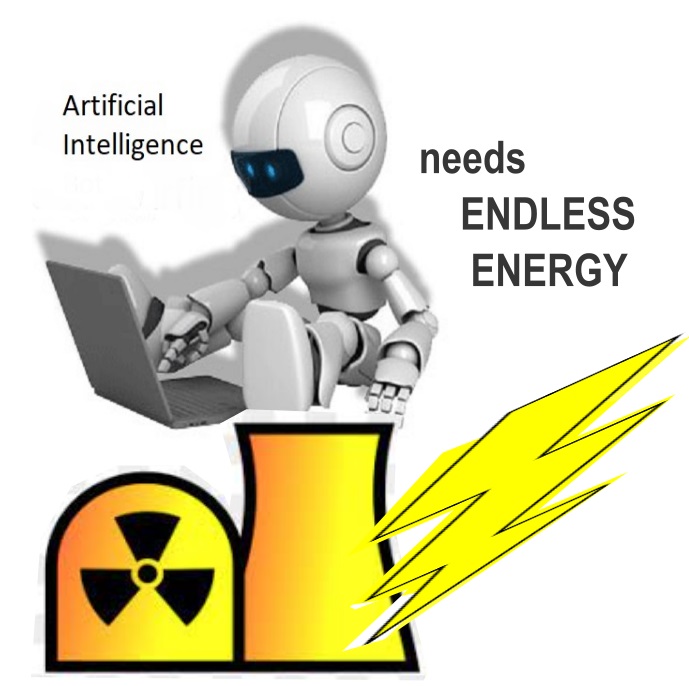
Oil Price, By Felicity Bradstock – Aug 18, 2024
- Tech companies are investing heavily in nuclear energy to power their AI operations.
- Regulatory challenges and utility opposition are hindering the development of new nuclear projects.
With the demand for power increasing rapidly, tech companies are looking for innovative solutions to meet the demand created by artificial intelligence (AI) and other new technologies. In addition to solar and wind power, several tech companies are investing in nuclear energy projects to power operations. The clear shift in the public perception of nuclear power has once again put the abundant clean [!] energy source on the table as an option, with the U.S. nuclear energy capacity expected to rise significantly over the coming decades. ……………………………
Tech companies have invested heavily in wind and solar energy to power their data centers and are now looking for alternative clean power supplies. In 2021, Sam Altman, the CEO of OpenAI, invested $375 in the nuclear fusion startup Helion Energy. Last year, Microsoft signed a deal to purchase power from Helion beginning in 2028. Altman also chairs the nuclear fission company Oklo. Oklo is planning to build a massive network of small-scale nuclear reactors in rural southeastern Idaho to provide power to data centers as the electricity demand grows. It is also planning to build two commercial plants in southern Ohio.
However, getting some of these nuclear projects off the ground is no easy feat. Oklo has found it difficult to get the backing of nuclear regulators. In 2022, the Federal Nuclear Regulatory Commission (FERC), which oversees commercial nuclear power plants, rejected the firm’s application for the design of its Idaho “Aurora” project, for not providing enough safety information. …………………………………………
In addition to the red tape from regulators, many utilities are opposing new nuclear projects due to their anticipated impact on the grid. Some data centers require 1 GW or more of power, which is around the total capacity of a nuclear reactor in the U.S. PJM Interconnection, the biggest grid operator in the U.S., recently warned that power supply and demand is tightening as the development of new generation is falling behind demand. However, some tech companies are proposing to connect data centers directly to nuclear plants, also known as co-location, to reduce the burden on the grid.
However, several U.S. utilities oppose co-location plans……………………………………………………… more https://oilprice.com/Alternative-Energy/Nuclear-Power/Tech-Companies-Are-Racing-to-Harness-Nuclear-Power.html
IAEA warns of heightened security dangers facing Ukraine’s Zaporizhzhia Nuclear Power Plant

ABC News, Sun 18 Aug
In short:
A drone strike on the perimeter of Ukraine’s Russian-controlled Zaporizhzhia Nuclear Power Plant has sparked fresh concerns for nuclear safety.
The International Atomic Energy Agency has warned of security dangers escalating and urged both countries to steer clear of attacks on energy facilities.
What’s next?
Zaporizhzhia’s power plant, the largest in Europe, is now reliant on just one power line, which if cut off, could set off cumulative explosions.
The International Atomic Energy Agency (IAEA) has called on Kyiv and Moscow to exercise “maximum restraint” amid fears of a deteriorating safety situation around the Zaporizhzhia Nuclear Power Plant in south-eastern Ukraine.
The facility came under Russian military and operational control in 2022, and has since been a target of repeated shelling with each side blaming the other.
Director-general of the IAEA, Rafael Mariano Grossi, on Saturday said a drone strike carrying an explosive payload had hit a perimeter access road, causing damage just outside of the plant’s protected area.
“Yet again we see an escalation of the nuclear safety and security dangers facing the Zaporizhzhia Nuclear Power Plant power plant,” he said.
“I remain extremely concerned and reiterate my call for maximum restraint from all sides and for strict observance of the five concrete principles established for the protection of the plant.”
Russia has accused Ukraine of detonating the explosive, according to reports from the TASS news agency.
The IAEA said the impact site was close to the essential cooling water sprinkler ponds and about 100 metres from the Dniprovska power line, the only remaining 750 kilovolt line providing a power supply to the plant.
There were no casualties or impact on equipment, however, there was damage between two main gates of the plant.
The attack comes as Ukraine continues an incursion into Russia, claiming to have taken control of 82 settlements over an area of 1,150 square kilometres in the Kursk region since August 6.
Moscow wants to discuss the drone strike with the IAEA, Russia’s RIA news agency reported, citing Roman Ustinov, the acting Russian representative in Vienna.
Why it matters
The Zaporizhzhia site is the largest nuclear power plant in Europe, holding six reactors containing Uranium 235.
All six reactors are now in cold shutdown and the plant is no longer producing electricity, as Ukraine and Russia repeatedly level allegations of sabotage against each other.
But despite the plant being dormant, electrical pumps moving water through the reactor core must still keep working to cool the nuclear fuel.
If the region’s final remaining power line is damaged, this cooling system will stop working, and result in a fuel meltdown which could begin a fire or explosion and induce a major nuclear disaster………………….. more https://www.abc.net.au/news/2024-08-18/ukraine-zaporizhzhia-nuclear-power-plant-hit-by-drone-srike/104238964
’Balance of terror’: South Korea’s unthinkable ‘shift’
Amid worrying times, South Korea is considering building nuclear weapons of its own in what could create a “balance of terror”.
news.com.au Jamie Seidel, August 19, 2024
North Korean dictator Kim Jong-un now has 50 nuclear warheads under his thumb.
US presidential candidate Donald Trump wants to pull out of the troubled peninsula altogether. That’s left South Korea thinking the unthinkable – building nuclear weapons of its own.
“Proponents argue that this approach would create a ‘balance of terror’ similar to that which maintained peace during the Cold War, ensuring that neither side could risk initiating a conflict without facing catastrophic consequences,” argues Seol-based Asia Institute geostrategist Dr Lakhvinder Singh.
A national campaign was launched Thursday to gather 10 million signatures in support of establishing a South Korean nuclear weapons program.
“This represents a profound shift, driven by doubts about the reliability of relying solely on the United States for extended deterrence,” says Singh……………………..
Now, many South Koreans doubt the 70-year-old “nuclear umbrella” of protection offered by the United States remains a reliable deterrent……………………………………………………………………………more https://www.news.com.au/technology/innovation/military/balance-of-terror-south-koreas-unthinkable-shift/news-story/2459122e37191a7b7e5644932ca85b62
Concerns raised for health professionals exposed to radiation at work
https://www.skynews.com.au/lifestyle/health/concerns-raised-for-health-professionals-exposed-to-radiation-at-work/video/6216ed317c9b0392811b3e850b8c5f23 18 Aug 24
The rise of x-ray-guided operations has raised concerns for health professionals who are now being exposed to more radiation at work.
The game-changing procedures have reduced the need for serious surgeries, improving health outcomes for many Australians with heart problems and other diseases.
“There are multiple steps that the hospitals take to reduce the exposure, however, a certain degree of exposure is inevitable,” said Interventional and Instructional Cardiologist Dr Samer Noaman.
1 This Month


Tell the Ukrainian Government to Drop Prosecution of Peace Activist Yurii Sheliazhenko

Petition to revoke the licensing of the Near Surface Nuclear Disposal Facility (NSDF) at Chalk River. https://www.ourcommons.ca/petitions/en/Petition/Details?Petition=e-7247


of the week – STOP SMALL MODULAR REACTORS IN CANADA
To see nuclear-related stories in greater depth and intensity – go to https://nuclearinformation.wordpress.com
-
Archives
- March 2026 (175)
- February 2026 (268)
- January 2026 (308)
- December 2025 (358)
- November 2025 (359)
- October 2025 (376)
- September 2025 (258)
- August 2025 (319)
- July 2025 (230)
- June 2025 (348)
- May 2025 (261)
- April 2025 (305)
-
Categories
- 1
- 1 NUCLEAR ISSUES
- business and costs
- climate change
- culture and arts
- ENERGY
- environment
- health
- history
- indigenous issues
- Legal
- marketing of nuclear
- media
- opposition to nuclear
- PERSONAL STORIES
- politics
- politics international
- Religion and ethics
- safety
- secrets,lies and civil liberties
- spinbuster
- technology
- Uranium
- wastes
- weapons and war
- Women
- 2 WORLD
- ACTION
- AFRICA
- Atrocities
- AUSTRALIA
- Christina's notes
- Christina's themes
- culture and arts
- Events
- Fuk 2022
- Fuk 2023
- Fukushima 2017
- Fukushima 2018
- fukushima 2019
- Fukushima 2020
- Fukushima 2021
- general
- global warming
- Humour (God we need it)
- Nuclear
- RARE EARTHS
- Reference
- resources – print
- Resources -audiovicual
- Weekly Newsletter
- World
- World Nuclear
- YouTube
-
RSS
Entries RSS
Comments RSS
 nuclear-news