Amazon Vies for Nuclear-Powered Data Center
The deal has become a flash point over energy fairness
1EEE Spectrum, Andrew Moseman, 12 Aug 2024
When Amazon Web Services paid US $650 million in March for another data center to add to its armada, the tech giant thought it was buying a steady supply of nuclear energy to power it, too. The Susquehanna Steam Electric Station outside of Berick, Pennsylvania, which generates 2.5 gigawatts of nuclear power, sits adjacent to the humming data center and had been directly powering it since the center opened in 2023.
After striking the deal, Amazon wanted to change the terms of its original agreement to buy 180 megawatts of additional power directly from the nuclear plant. Susquehanna agreed to sell it. But third parties weren’t happy about that, and their deal has become bogged down in a regulatory battle that will likely set a precedent for data centers, cryptocurrency mining operations, and other computing facilities with voracious appetites for clean electricity.
Putting a data center right next to a power plant so that it can draw electricity from it directly, rather than from the grid, is becoming more common as data centers seek out cheap, steady, carbon-free power. Proposals for co-locating data centers next to nuclear power have popped up in New Jersey, Texas, Ohio, and elsewhere. Sweden is considering using small modular reactors to power future data centers.
However, co-location raises questions about equity and energy security, because directly-connected data centers can avoid paying fees that would otherwise help maintain grids. They also hog hundreds of megawatts that could be going elsewhere.
When Amazon Web Services paid US $650 million in March for another data center to add to its armada, the tech giant thought it was buying a steady supply of nuclear energy to power it, too. The Susquehanna Steam Electric Station outside of Berick, Pennsylvania, which generates 2.5 gigawatts of nuclear power, sits adjacent to the humming data center and had been directly powering it since the center opened in 2023.
After striking the deal, Amazon wanted to change the terms of its original agreement to buy 180 megawatts of additional power directly from the nuclear plant. Susquehanna agreed to sell it. But third parties weren’t happy about that, and their deal has become bogged down in a regulatory battle that will likely set a precedent for data centers, cryptocurrency mining operations, and other computing facilities with voracious appetites for clean electricity.
Putting a data center right next to a power plant so that it can draw electricity from it directly, rather than from the grid, is becoming more common as data centers seek out cheap, steady, carbon-free power. Proposals for co-locating data centers next to nuclear power have popped up in New Jersey, Texas, Ohio, and elsewhere. Sweden is considering using small modular reactors to power future data centers.
However, co-location raises questions about equity and energy security, because directly-connected data centers can avoid paying fees that would otherwise help maintain grids. They also hog hundreds of megawatts that could be going elsewhere.
“They’re effectively going behind the meter and taking that capacity off of the grid that would otherwise serve all customers,” says Tony Clark, a senior advisor at the law firm Wilkinson Barker Knauer and a former commissioner at the Federal Energy Regulatory Commission (FERC), who has testified to a U.S. House subcommittee on the subject.
Amazon’s nuclear power deal meets hurdles
The dust-up over the Amazon-Susquehanna agreement started in June, after Amazon subsidiary Amazon Web Services filed a notice to change its interconnection service agreement (ISA) in order to buy more nuclear power from Susquehanna’s parent company, Talen Energy. Amazon wanted to increase the amount of behind-the-meter power it buys from the plant from 300 MW to 480 MW. Shortly after it requested the change, utility giants Exelon and American Electric Power (AEP), filed a protest against the agreement and asked FERC to hold a hearing on the matter…………………………………………………………………………………………………………….
Costs of data centers seeking nuclear energy
Yet such arrangements could have major consequences for other energy customers, Clark argues. For one, directing all the energy from a nuclear plant to a data center is, fundamentally, no different than retiring that plant and taking it offline. “It’s just a huge chunk of capacity leaving the system,” he says, resulting in higher prices and less energy supply for everyone else.
Another issue is the “behind-the-meter” aspect of these kinds of deals. A data center could just connect to the grid and draw from the same supply as everyone else, Clark says. But by connecting directly to the power plant, the center’s owner avoids paying the administrative fees that are used to maintain the grid and grow its infrastructure. Those costs could then get passed on to businesses and residents who have to buy power from the grid. “There’s just a whole list of charges that get assessed through the network service that if you don’t connect through the network, you don’t have to pay,” Clark says. “And those charges are the part of the bill that will go up” for everyone else.
Even the “carbon-free” public relations talking points that come with co-location may be suspect in some cases. In Washington State, where Schneider works, new data centers are being planted next to the region’s abundant hydropower stations, and they’re using so much of that energy that parts of the state are considering adding more fossil fuel capacity to make ends meet. This results in a “zero-emissions shell game,” Clark wrote in a white paper on the subject.
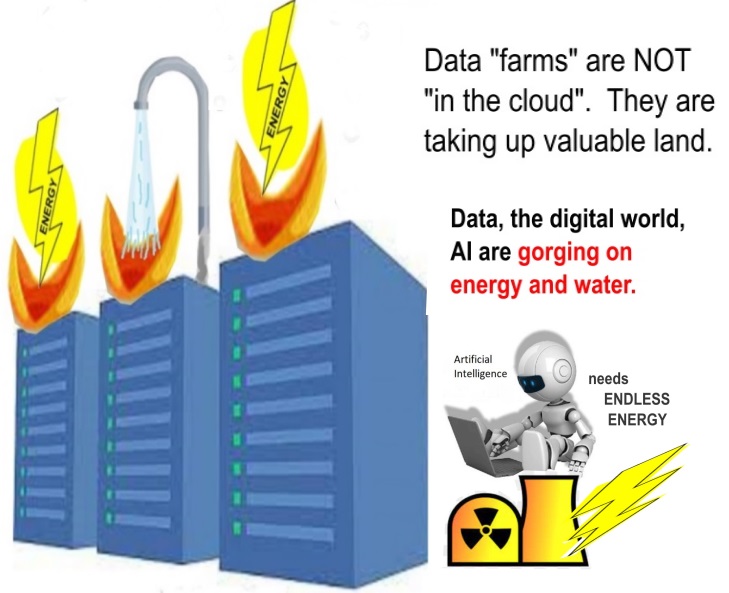
These early cases are likely only the beginning. A report posted in May from the Electric Power Research Institute predicts energy demand from data centers will double by 2030, a leap driven by the fact that AI queries need ten times more energy than traditional internet searches. The International Energy Agency puts the timeline for doubling sooner–in 2026. Data centers, AI, and the cryptocurrency sector consumed an estimated 460 terawatt-hours (TWh) in 2022, and could reach more than 1000 TWh in 2026, the agency predicts.
Data centers face energy supply challenges
New data centers can be built in a matter of months, but it takes years to build utility-scale power projects, says Poorvi Patel, manager of strategic insights at Electric Power Research Institute and contributor to the report. The potential for unsustainable growth in electricity needs has put grid operators on alert, and in some cases has sent them sounding the alarm. Eirgrid, a state-owned transmission operator in Ireland, last week warned of a “mass exodus” of data centers in Ireland if it can’t connect new sources of energy. ……………………………………………………………………………………..more https://spectrum.ieee.org/amazon-data-center-nuclear-power—
No comments yet.
1 This Month
Chernobyl: The Lost Tapes – A good documentary on Chernobyl on SBS available On Demand for the next 3 weeks– https://www.sbs.com.au/ondemand/tv-program/chernobyl-the-lost-tapes/2352741955560

of the week–London Campaign for Nuclear Disarmament

Tell the Ukrainian Government to Drop Prosecution of Peace Activist Yurii Sheliazhenko
To see nuclear-related stories in greater depth and intensity – go to https://nuclearinformation.wordpress.com
-
Archives
- April 2026 (139)
- March 2026 (251)
- February 2026 (268)
- January 2026 (308)
- December 2025 (358)
- November 2025 (359)
- October 2025 (376)
- September 2025 (257)
- August 2025 (319)
- July 2025 (230)
- June 2025 (348)
- May 2025 (261)
-
Categories
- 1
- 1 NUCLEAR ISSUES
- business and costs
- climate change
- culture and arts
- ENERGY
- environment
- health
- history
- indigenous issues
- Legal
- marketing of nuclear
- media
- opposition to nuclear
- PERSONAL STORIES
- politics
- politics international
- Religion and ethics
- safety
- secrets,lies and civil liberties
- spinbuster
- technology
- Uranium
- wastes
- weapons and war
- Women
- 2 WORLD
- ACTION
- AFRICA
- Atrocities
- AUSTRALIA
- Christina's notes
- Christina's themes
- culture and arts
- Events
- Fuk 2022
- Fuk 2023
- Fukushima 2017
- Fukushima 2018
- fukushima 2019
- Fukushima 2020
- Fukushima 2021
- general
- global warming
- Humour (God we need it)
- Nuclear
- RARE EARTHS
- Reference
- resources – print
- Resources -audiovicual
- Weekly Newsletter
- World
- World Nuclear
- YouTube
-
RSS
Entries RSS
Comments RSS
 nuclear-news
Leave a comment