Nuclear news -the other side of the stories this week.

Some bits of good news. UNICEF for every child – what we do.Baby beavers born in urban London for the first time in over 400 years. UK riots spark ‘love’ campaign for refugees
TOP STORIES.
Humanity on a knife’s edge.
The Price of the Sentinel Nuclear Weapons Program Keeps Going Up—But the True Costs Are Even Higher.
Amazon Vies for Nuclear-Powered Data Center .
From the archives. Radioactive waste danger at St Louis, USA – new film ‘Atomic Homefront’
Climate. How Close Are the Planet’s Climate Tipping Points? How climate change has pushed our oceans to the brink of catastrophe. When glaciers calve: Huge underwater tsunamis found at edge of Antarctica, likely affecting ice melt.
Mature trees offer hope in world of rising emissions.
Heat aggravated by carbon pollution killed 50,000 in Europe last year – study. Half a billion children live in areas with twice as many very hot days as in 1960s.
Noel’s notes. Low dose ionising radiation as a cause of illness and death.
AUSTRALIA. Resisting AUKUS: The Paul Keating Formula.
Australia blasted for new Aukus deal over nuclear waste fears – ‘blow to sovereignty’ . Albo’s Trojan Horse. Nuclear waste dump debate heating up over AUKUS, Coalition plans The West Report – https://www.youtube.com/watch?v=0JVfESp-A3Q Forced Posture: has Australia already ceded military control to the US? A whole lot more Australian nuclear news at https://antinuclear.net/2024/08/14/australian-nuclear-news-headlines-13-20-august/
NUCLEAR NEWS
ARTS and CULTURE. NFLA’s send ‘very best of luck’ to Peace Museum on reopening in historic Salts Mill.
ATROCITIES. The Fajr massacre: Every 70 kg bag of human remains is considered a martyr .
CLIMATE. EDF cuts nuclear production in reaction to soaring temperatures.
ECONOMICS. Sweden Considers Borrowing $28.5 Billion to Finance Nuclear. Sizewell C funding decision may not be made this year. The Nuclear Regulatory Commission’s Antiques Roadshow. German ministers told there’s no more money for Ukraine – media.
ENERGY. Data centers want to tap existing nuclear power. Is that good or bad? Tech Companies Are Racing to Harness Nuclear Power.
| ENVIRONMENT. Black bears to be evicted for nuclear waste site. | ETHICS and RELIGION. Thou Shalt Not Commit Genocide. Bloody Eschatology: Israel and the next Big War. Fans of peace call for nuclear-free Northeast Asia. | HEALTH. Radiation. Long-run exposure to low-dose radiation reduces cognitive performance.Concerns raised for health professionals exposed to radiation at work. |
| HISTORY. How NATO Went Rogue. | LEGAL. Nuclear site apologises after pleading guilty to cybersecurity failings | MEDIA. ‘The dumbest climate conversation of all time’: experts on the Musk-Trump interview. |
| OPPOSITION to NUCLEAR . Nuclear Free Local Authorities send message of solidarity to Canadian First Nations opposed to nuke dump. | PERSONAL STORIES Israel Is Holding Thousands of Palestinians Captive — Including Children. British Nuclear Test Medal. |
POLITICS.
- The two faces of Kamala Harris on Israeli genocide in Gaza. Gantz warns of a civil war in “Israel”.
- Ukraine’s plan to buy Russian-made nuclear reactors sparks uproar.
- Rebranded SNC-Lavalin seeks as much as $75M in taxpayer dollars to build more powerful Candu nuclear reactors.
- Revealed: UK ministers’ doubts over nuclear plant at Torness. Nuclear Free Local Authorities (NFLA) welcome developments to move forward to an early poll in Theddlethorpe.
- Peace Is Not On The Ballot In November https://www.youtube.com/watch?v=KqaPrRP5rZk Congressman Garamendi Asks “Why does America need nuclear weapons?” California legislators break with Gov. Newsom over loan to keep state’s last nuclear plant running.
- South Africa halts plans for nuclear power
POLITICS INTERNATIONAL and DIPLOMACY.
- Iran to Israel: Ceasefire in Gaza war, or retaliation for Haniyh murder will proceed. Iran’s future FM says nuclear deal broken, favors military-diplomatic path .
- China urges US, UK and Australia not to advance nuclear submarine cooperation.
- South Korea’s Yoon seeks dialogue with North, path to unification.
SAFETY.
- Map reveals nuclear fallout that would happen if Europe’s biggest plant explodes. IAEA warns of heightened security dangers facing Ukraine’s Zaporizhzhia Nuclear Power Plant. IAEA says safety at Ukraine’s Zaporizhzhia nuclear plant deteriorates.
- What Happens if Ukraine Seizes the Kursk Nuclear Power Plant?
- Incidents. Safety at Ukraine nuclear power plant deteriorating after blast, watchdog warns.
- Fukushima nuclear plant detects 25 tonnes of radioactive water leak. Latest leak accident in Fukushima ‘once again exposes management chaos of TEPCO’.
- Fire sparks Georgia nuclear plant alert, but officials say no safety threat as reactors unaffected
| SECRETS and LIES. 6 Billionaire Fortunes Bankrolling Project 2025. Top US Military Officials Won’t Say Whether the US had Advance Knowledge of Ukraine’s Invasion of Russia. | TECHNOLOGY. The end of Oppenheimer’s energy dream – modular reactors are supported by ideology alone. |
| WAR and CONFLICT. Israel Suddenly Has A Problem With Attacks On Population Centers. Should Ukraine capture a Russian nuclear power plant? NATO Countries Think Ukraine Won’t Be Able To Hold Territory in Russia’s Kursk. Nato fighter jets intercept Russian nuclear bombers. US deploys missile submarine to Middle East. China calls US ‘biggest nuclear threat to the world’. | WEAPONS AND WEAPONS SALES Journalists Demand Blinken Back Israel Arms Embargo. US approves new $20bn weapons sale to Israel A game plan for dealing with the costly Sentinel missile and future nuclear challenges. America prepares for a new nuclear-arms race. Iran planning to resume testing nuclear bomb detonators. Canada gives Ukraine green light to use its weapons in Russia. ’Balance of terror’: South Korea’s unthinkable ‘shift’. CNMI (Commonwealth of the Northern Marianas) group raises concern on Guam governor’s nuclear weapons storage stance. |
Humanity on a knife’s edge
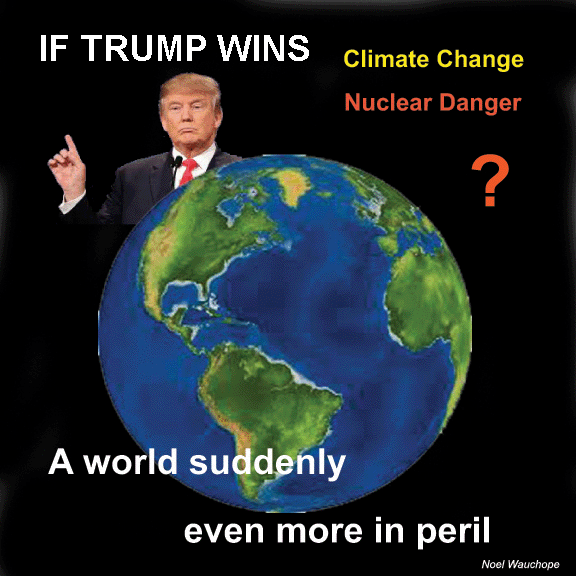
Trump took us to the nuclear brink. What happens if he’s back?
By Lawrence S. Wittner https://beyondnuclearinternational.org/2024/08/18/humanity-on-a-knifes-edge/
Over the past decade and more, nuclear war has grown increasingly likely. Most nuclear arms control and disarmament agreements of the past have been discarded by the nuclear powers or will expire soon. Moreover, there are no nuclear arms control negotiations underway. Instead, all nine nuclear nations (Russia, the United States, China, Britain, France, India, Pakistan, Israel, and North Korea) have begun a new nuclear arms race, qualitatively improving the 12,121 nuclear weapons in existence or building new, much faster, and deadlier ones.
Furthermore, the cautious, diplomatic statements about international relations that characterized an earlier era have given way to public threats of nuclear war, issued by top officials in Russia, the United States, and North Korea.
This June, UN Secretary-General António Guterres warned that, given the heightened risk of nuclear annihilation, “humanity is on a knife’s edge.”
This menacing situation owes a great deal to Donald Trump.
As President of the United States, Trump sabotaged key nuclear arms control agreements of the past and the future. He single-handedly destroyed the INF Treaty, the Iran nuclear agreement, and the Open Skies Treaty by withdrawing the United States from them. In addition, as the expiration date for the New START Treaty approached in February 2021, he refused to accept a simple extension of the agreement—action quickly countermanded by the incoming Biden administration.
Not surprisingly, Trump was horrified by the Treaty on the Prohibition of Nuclear Weapons―a UN-negotiated agreement that banned nuclear weapons, thereby providing the framework for a nuclear-free world. In 2017, when this vanguard nuclear disarmament treaty was passed by an overwhelming majority of the world’s nations, the Trump administration proclaimed that the United States would never sign it.
In fact, Trump was far less interested in arms control and disarmament than in entering―and winning―a new nuclear arms race with other nations. “Let it be an arms race,” he declared in December 2016, shortly after his election victory. “We will outmatch them at every pass.”
In February 2018, he boasted that his administration was “creating a brand-new nuclear force. We’re gonna be so far ahead of everybody else in nuclear like you’ve never seen before.” And, indeed, Trump’s U.S. nuclear “modernization” program―involving the replacement of every Cold War era submarine, bomber, missile, and warhead with an entirely new generation of the deadliest weapons ever invented―acquired enormous momentum during his presidency, with cost estimates running as high as $2 trillion.
Eager to facilitate this nuclear buildup, the Trump administration began to explore a return to U.S. nuclear weapons testing. Consequently, it announced in 2018 that, although the U.S. government had ended its nuclear tests in 1992 and President Bill Clinton had negotiated and signed the Comprehensive Test Ban Treaty in 1996, Trump would oppose U.S. Senate ratification of the treaty.
The administration also dramatically reduced the time necessary to prepare for nuclear weapons test explosions. In 2020, senior Trump administration officials reportedly conducted a serious discussion of U.S. government resumption of nuclear testing, leading the House of Representatives, then under Democratic control, to block funding for it.
Though many Americans assumed that a powerful U.S. nuclear arsenal would prevent an outbreak of nuclear war, Trump undermined this wishful thinking by revealing himself perfectly ready to launch a nuclear attack. During his 2016 presidential campaign, the Republican nominee reportedly asked a foreign policy advisor three times why, if the U.S. government possessed nuclear weapons, it should be reluctant to use them. The following year, Trump told the governor of Puerto Rico that, “if nuclear war happens, we won’t be second in line pressing the button.
Indeed, Trump came remarkably close to lunching a nuclear war against North Korea. In August 2017, responding to provocative comments by Kim Jong Un, Trump warned that further North Korean threats would “be met with fire, fury and frankly power the likes of which this world has never seen before.”
Trump’s threat of a nuclear attack triggered a rapid escalation of tensions between the two nations. In a speech before the UN General Assembly that September, Trump vowed to “totally destroy North Korea” if Kim, whom he derisively labeled “Little Rocket Man,” continued his provocative rhetoric.
Meanwhile, the White House chief of staff, General John Kelly, was appalled by indications that Trump really wanted war and, especially, by the president’s suggestion of using a nuclear weapon against North Korea and, then, blaming the action on someone else. According to Kelly, the military’s objection that the war would―in the words of Secretary of Defense Jim Mattis “incinerate a couple million people”―had no impact on Trump. In early 2018, the U.S. president merely upped the ante by publicly boasting that he had a “Nuclear Button” that was “much bigger & more powerful” than Kim’s.
What finally headed off a nuclear war, Kelly recalled, was his appeal to Trump’s “narcissism.” If Trump could forge a friendly diplomatic relationship with North Korea, the general suggested, the U.S. president would emerge as the “greatest salesman in the world.” And, indeed, Trump did reverse course and embark on a flamboyant campaign to pacify and denuclearize North Korea, remarking that May that “everyone” thought he deserved the Nobel Peace Prize.
Eventually, however, the U.S.-North Korean negotiations, including a much-heralded “summit” between Trump and Kim, resulted in little more than handshakes, North Korea’s continued development of nuclear weapons, and Trump’s return to public threats of nuclear war―this time against Iran.
Given this record, as well as Trump’s all-too-evident mental instability, we have been fortunate that, in a world bristling with nuclear weapons, the world survived his four years in office.
But our good fortune might not last much longer, for Trump’s return to power in 2025 or the recklessness of some other leader of a nuclear-armed nation could unleash unprecedented catastrophe upon the world.
Ultimately, the only long-term security for humanity lies in the global abolition of nuclear weapons and the development of a united world community.
Lawrence S. Wittner is Professor of History Emeritus at SUNY/Albany and the author of Confronting the Bomb (Stanford University Press).
Amazon Vies for Nuclear-Powered Data Center
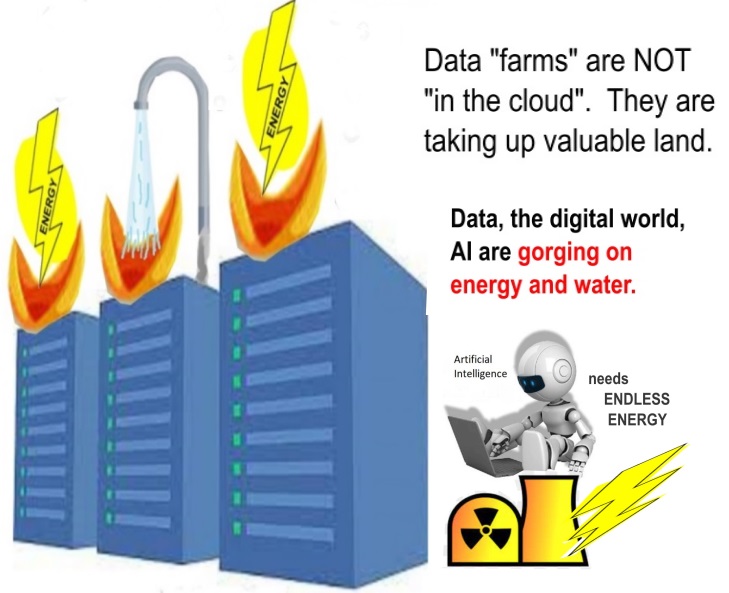
The deal has become a flash point over energy fairness
1EEE Spectrum, Andrew Moseman, 12 Aug 2024
When Amazon Web Services paid US $650 million in March for another data center to add to its armada, the tech giant thought it was buying a steady supply of nuclear energy to power it, too. The Susquehanna Steam Electric Station outside of Berick, Pennsylvania, which generates 2.5 gigawatts of nuclear power, sits adjacent to the humming data center and had been directly powering it since the center opened in 2023.
After striking the deal, Amazon wanted to change the terms of its original agreement to buy 180 megawatts of additional power directly from the nuclear plant. Susquehanna agreed to sell it. But third parties weren’t happy about that, and their deal has become bogged down in a regulatory battle that will likely set a precedent for data centers, cryptocurrency mining operations, and other computing facilities with voracious appetites for clean electricity.
Putting a data center right next to a power plant so that it can draw electricity from it directly, rather than from the grid, is becoming more common as data centers seek out cheap, steady, carbon-free power. Proposals for co-locating data centers next to nuclear power have popped up in New Jersey, Texas, Ohio, and elsewhere. Sweden is considering using small modular reactors to power future data centers.
However, co-location raises questions about equity and energy security, because directly-connected data centers can avoid paying fees that would otherwise help maintain grids. They also hog hundreds of megawatts that could be going elsewhere.
When Amazon Web Services paid US $650 million in March for another data center to add to its armada, the tech giant thought it was buying a steady supply of nuclear energy to power it, too. The Susquehanna Steam Electric Station outside of Berick, Pennsylvania, which generates 2.5 gigawatts of nuclear power, sits adjacent to the humming data center and had been directly powering it since the center opened in 2023.
After striking the deal, Amazon wanted to change the terms of its original agreement to buy 180 megawatts of additional power directly from the nuclear plant. Susquehanna agreed to sell it. But third parties weren’t happy about that, and their deal has become bogged down in a regulatory battle that will likely set a precedent for data centers, cryptocurrency mining operations, and other computing facilities with voracious appetites for clean electricity.
Putting a data center right next to a power plant so that it can draw electricity from it directly, rather than from the grid, is becoming more common as data centers seek out cheap, steady, carbon-free power. Proposals for co-locating data centers next to nuclear power have popped up in New Jersey, Texas, Ohio, and elsewhere. Sweden is considering using small modular reactors to power future data centers.
However, co-location raises questions about equity and energy security, because directly-connected data centers can avoid paying fees that would otherwise help maintain grids. They also hog hundreds of megawatts that could be going elsewhere.
“They’re effectively going behind the meter and taking that capacity off of the grid that would otherwise serve all customers,” says Tony Clark, a senior advisor at the law firm Wilkinson Barker Knauer and a former commissioner at the Federal Energy Regulatory Commission (FERC), who has testified to a U.S. House subcommittee on the subject.
Amazon’s nuclear power deal meets hurdles
The dust-up over the Amazon-Susquehanna agreement started in June, after Amazon subsidiary Amazon Web Services filed a notice to change its interconnection service agreement (ISA) in order to buy more nuclear power from Susquehanna’s parent company, Talen Energy. Amazon wanted to increase the amount of behind-the-meter power it buys from the plant from 300 MW to 480 MW. Shortly after it requested the change, utility giants Exelon and American Electric Power (AEP), filed a protest against the agreement and asked FERC to hold a hearing on the matter…………………………………………………………………………………………………………….
Costs of data centers seeking nuclear energy
Yet such arrangements could have major consequences for other energy customers, Clark argues. For one, directing all the energy from a nuclear plant to a data center is, fundamentally, no different than retiring that plant and taking it offline. “It’s just a huge chunk of capacity leaving the system,” he says, resulting in higher prices and less energy supply for everyone else.
Another issue is the “behind-the-meter” aspect of these kinds of deals. A data center could just connect to the grid and draw from the same supply as everyone else, Clark says. But by connecting directly to the power plant, the center’s owner avoids paying the administrative fees that are used to maintain the grid and grow its infrastructure. Those costs could then get passed on to businesses and residents who have to buy power from the grid. “There’s just a whole list of charges that get assessed through the network service that if you don’t connect through the network, you don’t have to pay,” Clark says. “And those charges are the part of the bill that will go up” for everyone else.
Even the “carbon-free” public relations talking points that come with co-location may be suspect in some cases. In Washington State, where Schneider works, new data centers are being planted next to the region’s abundant hydropower stations, and they’re using so much of that energy that parts of the state are considering adding more fossil fuel capacity to make ends meet. This results in a “zero-emissions shell game,” Clark wrote in a white paper on the subject.
These early cases are likely only the beginning. A report posted in May from the Electric Power Research Institute predicts energy demand from data centers will double by 2030, a leap driven by the fact that AI queries need ten times more energy than traditional internet searches. The International Energy Agency puts the timeline for doubling sooner–in 2026. Data centers, AI, and the cryptocurrency sector consumed an estimated 460 terawatt-hours (TWh) in 2022, and could reach more than 1000 TWh in 2026, the agency predicts.
Data centers face energy supply challenges
New data centers can be built in a matter of months, but it takes years to build utility-scale power projects, says Poorvi Patel, manager of strategic insights at Electric Power Research Institute and contributor to the report. The potential for unsustainable growth in electricity needs has put grid operators on alert, and in some cases has sent them sounding the alarm. Eirgrid, a state-owned transmission operator in Ireland, last week warned of a “mass exodus” of data centers in Ireland if it can’t connect new sources of energy. ……………………………………………………………………………………..more https://spectrum.ieee.org/amazon-data-center-nuclear-power—
Safety at Ukraine nuclear power plant deteriorating after blast, watchdog warns

The International Atomic Energy Agency said the blast was close to Zaporizhzhia nuclear power plant’s cooling water sprinkler ponds and its only remaining power line
By Brendan McFadden, iNews 17th Aug 2024
Safety at Ukraine’s Zaporizhzhia nuclear power plant is deteriorating following a drone strike that hit an access road on its perimeter, according to an atomic energy watchdog,
Russia has been in control of the Zaporizhzhia site, the largest nuclear power plant in Europe, since soon after it launched a full-scale invasion of Ukraine in February 2022.
The International Atomic Energy Agency (IAEA) said the impact site was close to the essential cooling water sprinkler ponds and about 100 m from the Dniprovska power line, the only remaining 750 kilovolt line providing a power supply to the plant.
It comes after Russia earlier claimed a Ukrainian drone dropped an explosive charge on a road used by staff.
The plant is dormant as Moscow and Kyiv have repeatedly accused each other of trying to sabotage its operations and of endangering safety around it.
The IAEA director general Rafael Mariano Grossi, said “Yet again we see an escalation of the nuclear safety and security dangers facing the power plant.
“I remain extremely concerned and reiterate my call for maximum restraint from all sides and for strict observance of the five concrete principles established for the protection of the plant.”
An IAEA team visited the area on Saturday and reported that the damage seemed to have been caused by a drone equipped with an explosive payload.
The report said there were no casualties and no impact on any nuclear power plant equipment. However, the road between the two main gates of the plant was impacted.
Moscow wants to discuss the attack on the Zaporizhzhia plant with the IAEA, Russia’s RIA news agency reported, citing Roman Ustinov, the acting Russian representative in Vienna.
The attack comes as Ukraine continues an incursion into the Kursk region of Russia.
Kyiv claims to have taken control of 82 settlements over an area of 1,150 square kilometres (444 square miles) in the region since 6 August when its advance began.
Today Ukrainian President Volodymyr Zelensky said his troops are “strengthening” positions in the captured territory in Russia and expanding further.
Russian troops also hit the Ukrainian city of Sumy with an Iskander-K cruise missile, causing extensive damage to buildings.
It was claimed Germany, Ukraine’s second biggest donor, has frozen its military aid to Kyiv because it cannot afford to any longer supply equipment due to a national budget crisis.
Meanwhile, Ukraine denied claims by Russia that it is planning to attack a nuclear plant in Kursk and use ‘dirty bombs’ to attack Russian territory,
Moscow’s defence ministry made the claim and warned there would be a harsh response to any attack on the Kursk power plant, which remains under its control, according to Russian news agency Interfax.
The ministry gave no evidence for its claim, but said the surrounding area could be contaminated by an attack on the plant………………….. https://inews.co.uk/news/world/safety-at-ukraine-nuclear-power-plant-deteriorating-after-blast-watchdog-warns-3232978
Thou Shalt Not Commit Genocide

Opposing genocide is a moral not a political choice.
The Chris Hedges Report, Substack, Chris Hedges, Aug 16, 2024
There is only one way to end the ongoing genocide in Gaza. It is not through bilateral negotiations. Israel has amply demonstrated, including with the assassination of the lead Hamas negotiator, Ismail Haniyeh, that it has no interest in a permanent ceasefire. The only way for Israel’s genocide of the Palestinians to be halted is for the U.S. to end all weapons shipments to Israel. And the only way this will take place is if enough Americans make clear they have no intention of supporting any presidential ticket or any political party that fuels this genocide.
The arguments against a boycott of the two ruling parties are familiar: It will ensure the election of Donald Trump. Kamala Harris has rhetorically shown more compassion than Joe Biden. There are not enough of us to have an impact. We can work within the Democratic Party. The Israel lobby, especially the American Israel Public Affairs Committee (AIPAC), which owns most members of Congress, is too powerful. Negotiations will eventually achieve a cessation of the slaughter.
In short, we are impotent and must surrender our agency to sustain a project of mass killing. We must accept as normal governance the shipment of hundreds of millions of dollars in military aid to an apartheid state, the use of vetoes at the U.N. Security Council to protect Israel and the active obstruction of international efforts to end mass murder. We have no choice.
Genocide, the internationally recognized crime of crimes, is not a policy issue. It cannot be equated with trade deals, infrastructure bills, charter schools or immigration. It is a moral issue. It is about the eradication of a people. Any surrender to genocide condemns us as a nation and as a species. It plunges the global society one step closer to barbarity. It eviscerates the rule of law and mocks every fundamental value we claim to honor. It is in a category by itself. And to not, with every fiber of our being, combat genocide is to be complicit in what Hannah Arendt defines as “radical evil,” the evil where human beings, as human beings, are rendered superfluous.
The plethora of Holocaust studies should have made this indelible point. But Holocaust studies were hijacked by Zionists. They insist that the Holocaust is unique, that it is somehow set apart from human nature and human history. Jews are deified as eternal victims of anti-Semitism. Nazis are endowed with a special kind of inhumanity. Israel, as the U.S. Holocaust Memorial Museum in Washington concludes, is the solution. The Holocaust was one of several genocides carried out in the 19th and 20th centuries. But historical context is ignored and with it our understanding of the dynamics of mass extermination.
The fundamental lesson of the Holocaust, which writers such as Primo Levi stress, is that we can all become willing executioners. It takes very little. We can all become complicit, if only through indifference and apathy, in evil.
“Monsters exist,” Levi, who survived Auschwitz, writes, “but they are too few in number to be truly dangerous. More dangerous are the common men, the functionaries ready to believe and to act without asking questions.” …………………………………………………………………………………………………………………….. more https://chrishedges.substack.com/p/thou-shalt-not-commit-genocide?utm_source=post-email-title&publication_id=778851&post_id=147780732&utm_campaign=email-post-title&isFreemail=true&r=ln98x&triedRedirect=true&utm_medium=email
Top US Military Officials Won’t Say Whether the US had Advance Knowledge of Ukraine’s Invasion of Russia
All the rage these days among “strategic thinkers” is how to “deter” both China and Russia by preparing to wage simultaneous nuclear war against them.
Michael Tracey, Aug 18, 2024
So… there’s a US-backed invasion of Russia currently underway. You’d think this would rise to the level of urgent national political concern, such that every American elected official with some purview in US foreign policy would be expected — and demanded — to articulate a position on what’s transpiring. After all, as everyone should be well aware, Ukraine only exists as a state right now due to the largesse of the US, and thus anything Ukraine does on the battlefield necessarily implicates the US — whatever the precise foreknowledge or involvement the US might have had in this particular operation.
Two years ago, if you had suggested that Ukraine and the US might be conducting a literal invasion of Russia, you would’ve been ferociously denounced as a bed-wetting alarmist who’s probably just trying to cynically boost Russia’s side of the propaganda wars by irrationally fretting about extreme escalatory outcomes, so as to discourage US or European “aid” for Ukraine. And yet here we are, with the escalation ladder having been steadily climbed, step by step, but generating less and less intense of a political reaction as time goes on and the acute psychological impact of the war wears off. To a degree, this is only natural; you can’t expect everyone to be on constant hair-trigger alert about something that’s been going on continuously for two and a half years. But that’s exactly how these escalatory leaps get smuggled in without much notice or debate.
Hence, we’re now in a political climate where the fact of an ongoing US-backed invasion of Russia is treated as little more than an ancillary concern, maybe something warranting semi-interested speculation and commentary, but certainly nothing that should occasion any large-scale political controversy — at least in the US. Neither major party presidential candidate has directly commented on it, as far as I know, and neither has there been any kind of appreciable clamor within the media for the candidates to do their public duty and set out some sort of articulable position on what, by any objective measure, is a massive escalation in the conduct of the war — which had initially been sold to the public as only necessitating US “support” that would be carefully circumscribed.
So while it’s just a drop in the bucket, I’ve attempted to at least provide a minor corrective. This past week was the annual symposium of STRATCOM, or the US Strategic Command, which is the branch of the military that controls the nuclear arsenal. If you weren’t aware, the word “strategic” is a euphemism for “nuclear” in military parlance — a long-running triumph of jargonistic obfuscation. You also gotta love that the slogan for the US nuclear arsenal is “Peace is Our Profession”…
All the rage these days among “strategic thinkers” is how to “deter” both China and Russia by preparing to wage simultaneous nuclear war against them. Another triumph of euphemistic jargon is the word “deterrence” itself — nominally the whole impetus for the Symposium, with “deterrence” really just being synonymous with “projection of American military, economic, and political power,” but presented as gravely necessary in order to “deter” the scary foreign adversaries who are always allegedly threatening that power.
The Symposium is a strange affair in that it’s tucked into a nondescript venue in Omaha, Nebraska, near where the STRATCOM headquarters is located. I overheard one fellow talking about how back in the Cold War days, Air Force members who had to go guard the nuclear silos in the vast expanses of the American Interior were told that if South Dakota ever seceded from the Union, it would automatically be the world’s third largest nuclear state. Today, the Cold War era is looked back on with nostalgic fondness by attendees of these Symposiums, with calls for action routinely issued that the US nuclear arsenal needs to be aggressively reinvigorated, and even the half-hearted efforts to scale it down after the collapse of the Soviet Union were a terrible mistake.
So it was fortuitous that this year’s Symposium should have fallen on a week in which an ongoing US-backed invasion of Russia would have been underway, not to mention another cataclysm being forecast to break out in the Middle East at any moment, with Iran and Hezbollah suggesting for weeks that a large-scale strike on Israel could be imminent.
I therefore asked Gen. Anthony Cotton, the STRATCOM commander, about the Russia/Ukraine developments, which are being touted as the most serious foreign attack on Russian territory since World War II, as if that’s supposed to inspire optimism for a happy outcome. You can find the audio here, which I played on an episode of “System Update” Friday — I guest-hosted again for the absent Glenn Greenwald. Here’s a transcript of the exchange:…………………………………………………………………..
German ministers told there’s no more money for Ukraine – media

https://www.rt.com/news/602719-germany-no-money-ukraine-aid/ 17 Aug 24
Berlin could halve its military assistance to Kiev in 2025, the newspaper claims
German Finance Minister Christian Lindner has issued a request to the country’s defense ministry calling for a limit to military assistance to Ukraine, Frankfurter Allgemeine Zeitung (FAZ) reported on Saturday. According to Lindner, the country’s current budget plan is not capable of allocating funds to Kiev.
The request was made in a letter addressed to German Defense Minister Boris Pistorius and Foreign Minister Annalena Baerbock, and specified that only military aid that has already been approved can be delivered to Kiev. Additional applications from the defense ministry will no longer be accepted, even if issued at the behest of Chancellor Olaf Scholz.
FAZ noted that the block on newly approvals is already in effect and that Berlin would halve its military aid to Ukraine next year. In 2027, the assistance is expected to decline to less than one tenth of its current volume.
Up to €8 billion in aid to Ukraine has been scheduled for 2024, and the planned maximum of €4 billion for 2025 already exceeds available funds, the media outlet noted, adding that only €3 billion is planned for 2026, and €500 million each for 2027 and 2028.
“End of the event. The pot is empty,” an unnamed source in the federal government told FAZ, stressing that Berlin has “reached a point where Germany can no longer make any promises to Ukraine.”
The newspaper noted that the urge comes amid Lindner’s push for harsh austerity measures; these have already been imposed on all German ministries except defense. The finance minister has been resisting intense pressure from Scholz and Economy Minister Robert Habeck to suspend the country’s constitutional limit on debt to allow for the cost of providing military aid to Kiev amid the Ukrainian conflict.
Germany is the second biggest backer of Ukraine after the US. Berlin has provided and committed military aid of at least €28 billion ($30.3 billion) to Kiev in current and future pledges. This includes advanced military equipment such as Leopard 2 tanks, Marder infantry fighting vehicles, and US-made Patriot air-defense systems.
Lindner reportedly doesn’t expect the country’s assistance to Ukraine to drop, as the minister hopes to cover the expenses not with federal budget funds, but through the use of Russian central bank assets that were frozen by Kiev’s Western allies shortly after the conflict escalated.
Nearly $300 billion belonging to Russia’s central bank has been immobilized by the EU and G7 nations as part of Ukraine-related sanctions. In May, Brussels approved a plan to use the interest earned on the frozen assets to support Ukraine’s recovery and defense. Under the agreement, 90% of the proceeds are expected to go into an EU-run fund for Ukrainian military aid, with the other 10% allocated to supporting Kiev in other ways.
IAEA says safety at Ukraine’s Zaporizhzhia nuclear plant deteriorates

By Reuters, August 18, 2024 https://www.reuters.com/world/europe/iaea-says-safety-ukraines-zaporizhzhia-nuclear-plant-deteriorates-2024-08-17/
Aug 17 (Reuters) – Safety at Ukraine’s Zaporizhzhia nuclear power plant is deteriorating following a drone strike that hit the road around the perimeter on Saturday, according to International Atomic Energy Agency (IAEA) director general Rafael Grossi.
The Russian management of the plant said a Ukrainian drone dropped an explosive charge on a road outside, endangering its staff who use the highway, the TASS state news agency reported.
Sizewell C funding decision may not be made this year

19 July 2024, Ben Parker & Alice Cunningham, https://www.bbc.com/news/articles/c2x0k87z400o
An investment decision into Sizewell C in Suffolk may not be made this year by the new Labour government.
The previous Conservative-led government said it would secure funding this year for the power plant and £2.5bn has already been spent on the project.
Alison Downes of Stop Sizewell C said she hoped ministers were taking the time to “reconsider their support”.
A spokesperson for Sizewell said the project was progressing while the Department for Energy Security and Net Zero said the government was committed to the project but did not comment on when a decision on the funding would be made when asked by the BBC.
………………………………….The official cost of Sizewell C has been put at £20bn and the project will be partly funded by French energy company EDF.
Ms Downes said she felt by the time Sizewell C was built, it would be too late to tackle the climate emergency.
“Given that Sizewell C cannot in any way help the new government achieve its target of a net zero grid by 2030, we very much hope Ministers are taking the time to seriously reconsider their support,” she said.
“Not only would it be too late to help our climate emergency, this project would increase household bills throughout construction and beyond, and suck billions of pounds of taxpayers’ money away from other urgent priorities.
“Doubling down on the £2.5 billion already spent would be just throwing good money after bad.”
Building permission for the project has already been granted and if funding is secured, construction could take about 12 years.
Black bears to be evicted for nuclear waste site

Matteo Cimellaro, Urban Indigenous Communities in Ottawa, August 13th 2024 https://www.nationalobserver.com/2024/08/13/news/black-bear-habitat-nuclear-waste-Canadian-Nuclear-Laboratories?utm_source=National+Observer&utm_campaign=13ad847627-EMAIL_CAMPAIGN_2024_08_16_11_38&utm_medium=email&utm_term=0_-13ad847627-%5BLIST_EMAIL_ID%5D#:~:text=As%20many%20as%20eight%20black,facility%20near%20the%20Ottawa%20River.
As many as eight black bears are facing eviction from their homes by Canadian Nuclear Laboratories, the company building a nuclear waste facility near the Ottawa River.
A letter sent to the Kebaowek First Nation and obtained by Canada’s National Observer says the company is taking action to block the bears from their dens. The letter was sent after representatives from the First Nation found evidence of at least three active bear dens during a tour of the area three weeks ago, Lance Haymond, chief of Kebaowek First Nation, said.
Evidence of those bear dens traces back to data collected for the Algonquin-led environmental assessment of the waste facility published in 2023.
The timing of CNL’s decision to evict the bears, with only a week’s notice, has left Kebaowek representatives wondering if the action over the bear dens is “retaliatory” after it challenged the decision to approve the site last month. It is also leaving Kebaowek “no choice” but to look towards a court injunction over the bear dens, Haymond said.
Canada’s National Observer contacted CNL to confirm the number of active dens in the region within and surrounding the waste facility’s pre-construction area, but did not hear back by time of publication.
The company plans to deter the bears from their dens using sensor-based noise emitting devices, as well as weighted plywood and tarps, the letter to Kebaowek states.
Land guardians from the Algonquins of Pikwakanagan, the only Algonquin First Nation within Ontario, will be present to monitor and observe the installation of the deterrents, according to the letter. Pikwakanagan and CNL have a long-term relationship agreement that provides funding for a guardian program to provide monitoring for the nuclear organization.
In an interview, Haymond criticized CNL for using Pikwakanagan to “justify” the construction of the waste facility and the environmental harms it poses. In particular, Haymond is concerned about black bear habitat and the precedent this poses for the eastern wolf. Last month, the wolf species, also known as the Algonquin wolf, was upgraded from a status of special concern to threatened species.
We should have been fully involved from the beginning,” Haymond said. Negotiations around Kebaowek involvement in monitoring is ongoing, but right now CNL is “just pushing us aside,” he added.
In the letter, CNL maintains the activities will not result in any irreparable harm to black bears. But Haymond is not buying it. The location of the forested slope is ideal for the dens given its natural protection from climate change events, according to the Algonquin-led assessment.
“If that’s the way they’re treating the black bear, can you imagine what they’re going to do or want to be doing with the eastern wolf?” Haymond asks.
It’s still unclear what regulations apply to the pre-construction activities. In Ontario, it is illegal to interfere with, damage or destroy black bear dens, but nuclear regulations fall under federal jurisdiction. Canada’s National Observer contacted Ontario and federal officials about jurisdiction, but did not hear back by time of publication.
Even before Kebaowek had heard about the bears, the First Nation filed a judicial review over the construction of the nuclear waste facility, citing it did not do enough to consult and consider Kebaowek’s inherent rights as Indigenous peoples.
“It’s just very presumptuous and ignorant of them to go ahead,” Haymond said. “They’re operating like they’re already going to win [the judicial review].”
Kebaowek has been actively campaigning against the Near Surface Disposal Facility, a nuclear waste site that was approved and licensed by Canada’s nuclear regulator last January. That led to the legal challenge, which brought the consortium before a judge last month.
The court action centres around the United Nations Declaration Act (UNDA), which enshrined the United Nations Declaration on the Rights of Indigenous Peoples (UNDRIP) into Canadian law. The declaration specifically references the need for free, prior and informed consent when hazardous waste will be stored in a nation’s territory.
The judge’s decision is not expected for another few months, Haymond told Canada’s National Observer.
— with files from Natasha Bulowski
Matteo Cimellaro / Canada’s National Observer / Local Journalism Initiative
California legislators break with Gov. Newsom over loan to keep state’s last nuclear plant running

greenwich time, By MICHAEL R. BLOOD, Associated Press, Aug 15, 2024
LOS ANGELES (AP) — The California Legislature signaled its intent on Thursday to cancel a $400 million loan payment to help finance a longer lifespan for the state’s last nuclear power plant, exposing a rift with Gov. Gavin Newsom who says that the power is critical to safeguarding energy supplies amid a warming climate.
The votes in the state Senate and Assembly on funding for the twin-domed Diablo Canyon plant represented an interim step as Newsom and legislative leaders, all Democrats, continue to negotiate a new budget. But it sets up a public friction point involving one of the governor’s signature proposals, which he has championed alongside the state’s rapid push toward solar, wind and other renewable sources.
The dispute unfolded in Sacramento as environmentalists and antinuclear activists warned that the estimated price tag for keeping the seaside reactors running beyond a planned closing by 2025 had ballooned to nearly $12 billion, roughly doubling earlier projections. That also has raised the prospect of higher fees for ratepayers……………………..
The votes in the Legislature mark the latest development in a decades-long fight over the operation and safety of the plant, which sits on a bluff above the Pacific Ocean midway between Los Angeles and San Francisco…………………….
In 2016, PG&E, environmental groups and plant worker unions reached an agreement to close Diablo Canyon by 2025. But the Legislature voided the deal in 2022 at the urging of Newsom, who said the power is needed to ward off blackouts as a changing climate stresses the energy system. That agreement for a longer run included a $1.4 billion forgivable state loan for PG&E, to be paid in several installments.
California energy regulators voted in December to extend the plant’s operating run for five years, to 2030.
The legislators’ concerns were laid out in an exchange of letters with the Newsom administration, at a time when the state is trying to close an estimated $45 billion deficit. Among other concerns, they questioned if, and when, the state would be repaid by PG&E, and whether taxpayers could be out hundreds of millions of dollars if the proposed extension for Diablo Canyon falls through.
…………………………………………..The questions raised by environmentalists about the potential for soaring costs stemmed from a review of state regulatory filings submitted by PG&E, they said. Initial estimates of about $5 billion to extend the life of the plant later rose to over $8 billion, then nearly $12 billion, they said.
“It’s really quite shocking,” said attorney John Geesman, a former California Energy Commission member who represents the Alliance for Nuclear Responsibility, an advocacy group that opposes federal license renewals in California. The alliance told the state Public Utilities Commission in May that the cost would represent “by far the largest financial commitment to a single energy project the commission has ever been asked to endorse.”……….. https://www.greenwichtime.com/business/article/correction-california-s-last-nuclear-plant-story-19658633.php?fbclid=IwY2xjawEuMDlleHRuA2FlbQIxMQABHVvxRKXYzA1jZri4TZdyt4rL1rA9cxRHZHKTVFATkmwDmExIrs3feHydxA_aem_8Q7on7q9UlKUH6RZYqNx5w
6 Billionaire Fortunes Bankrolling Project 2025

More than $120 million from a few ultra-wealthy families has powered the Heritage Foundation and other groups that created the plan to remake American government.
DeSmog, ByJoe Fassler, Aug 14, 2024
Since 2020, donor networks linked to just six family fortunes have funneled more than $120 million into Project 2025 advisory groups, a DeSmog analysis has found.
More than 100 nonprofits led by the Heritage Foundation, a right-wing think tank that has engaged in climate change denial and obstruction for decades, have signed on as advisors to the Project 2025’s 900-page “Mandate for Leadership” document — a plan to rapidly “reform,” or radically alter, the U.S. government by shuttering bureaus and offices, overturning regulations, and replacing thousands of public sector employees with hand-picked political allies.
In its official Project 2025 materials, Heritage Foundation leadership repeatedly draws attention to the size and diversity of its advisory board, suggesting that its numerous “coalition partners” are part of a broad, “movement-wide effort” representing a variety of independent viewpoints.
“Project 2025 is unparalleled in the history of the conservative movement—both in its size and scope but also for organizing [so many] different groups under a single banner,” the organization wrote in an October 2023 press release.
But an analysis of financial disclosure forms shows the same small group of donors supporting Project 2025’s advisors again and again — hardly a sign of ideological diversity. Of the 110 nonprofits formally supporting Project 2025, almost 50 received major donations from the same six sources of wealth since 2020.
Many of the organizations the six families funded also have close ties to Donald Trump and his running mate, Ohio Senator JD Vance, DeSmog found. Trump has repeatedly denied involvement in or knowledge of Project 2025, though that position conflicts with a growing number of news reports — a disavowal made more awkward by the fact that Vance wrote the forward to Dawn’s Early Light, a forthcoming book by Heritage Foundation president Kevin D. Roberts that describes his Project 2025 vision. DeSmog’s review of Project 2025’s financial backers found additional links to Trump, Vance, and key figures in their orbit that had not been previously known.
These six donor networks, linked to the family fortunes of a handful of wealthy industrialists, have spent years working to loosen environmental regulations and promote climate change denial. Though Heritage describes Project 2025 as a mainstream effort to “return government to the people,” its funding sources suggest something far less populist: a vehicle for the obsessions of ultra-rich donors on the far-right fringe, pushing an agenda to reshape American democracy and overturn regulations needed to maintain a livable climate.
Representatives from the six donor networks did not respond to DeSmog’s outreach on this story. The Heritage Foundation did not reply to a request for comment.
The Coors Family
At least $2.7 million to Project 2025 groups since 2020 …………………………………………………………..
Charles G. Koch
At least $9.6 million to Project 2025 groups since 2020 ……………………………………………
Richard and Elizabeth Uihlein
At least $13 million to Project 2025 groups since 2020
The Uihleins are co-founders of Uline, a company that sells shipping and packing supplies — including its ubiquitous brand of cardboard boxes — and other bulk business goods. ……………………………………………………………..
The Scaife Family
At least $21.5 million to Project 2025 groups since 2020
Richard Mellon Scaife died in 2014, but his contribution to conservative causes is still felt today. ……………………………………………………………..
Barre Seid
At least $22.4 million to Project 2025 groups since 2020
The enigmatic industrialist Barre Seid primarily built his fortune through his company Tripp Lite, an electronics manufacturer specializing in surge protectors…………………………………………………………….
The Bradley Family
At least $52.9 million to Project 2025 groups since 2020
The Lynde and Harry Bradley Foundation was originally established in 1942 by brothers Lynde and Harry Bradley, founders of the Allen-Bradley company, which made its fortune manufacturing a wide range of electronic products. Their descendants have continued to financially support the foundation for years to come, including with a reported $200 million gift in 2015.
But it was Michael W. Grebe, who served as CEO of the foundation between 2002 and 2016, who cemented its reputation as a conservative powerhouse, steering donations to a network of activist organizations like The Heritage Foundation, the Mackinac Center for Public Policy, and the Heartland Institute (all Project 2025 coalition partners). The current chairman is James Arthur “Art” Pope, CEO of the North Carolina grocery chain Variety Wholesalers, a longtime Koch ally. …………………………………………more https://www.desmog.com/2024/08/14/project-2025-billionaire-donor-heritage-foundation-donald-trump-jd-vance-charles-koch-peter-coors/
Should Ukraine capture a Russian nuclear power plant?
Russia’s attacks and occupation of Ukraine’s nuclear power plants have shocked observers, bringing a new and dangerous dimension to warfare. What should Ukraine do as it gains the chance to turn the tables?
New Scientist, By Matthew Sparkes 16 August 2024
All four of Ukraine’s operational nuclear power plants have suffered occupation or attack by Russian forces since the start of the invasion in 2022. Now, as Ukrainian troops on the counteroffensive push deeper into Russian territory, roles could be reversed if Ukraine decides to take control of a Russian plant.
According to the Ukrainian government, its troops are now in control of the Russian town of Sudzha, almost 10 kilometres inside the border. This brings………..(Subscribers only) https://www.newscientist.com/article/2444100-should-ukraine-capture-a-russian-nuclear-power-plant/
The end of Oppenheimer’s energy dream – modular reactors are supported by ideology alone

Allison Macfarlane
Allison Macfarlane is the director of the School of Public Policy and Global Affairs at the University of British Columbia and former chairman of the US Nuclear Regulatory Commission. 21st July 2023
Nuclear energy is both lauded as a baseload renewable power and decried as risky, expensive and outdated technology. Small modular reactors have received billions in venture capital and unprecedented media attention, but are they a red herring, with philosophy, rather than science, driving our fixation? Professor Allison Macfarlane explores the current sombre state of the technology, where it is falling short, and what philosophy is driving the interest in this unpromising tech.
From the inception of Oppenheimer’s harnessing of the power of the atom, first as a device for war, and later, as a means of peaceful energy production, nuclear energy has possessed both promise and peril. With large nuclear power plants struggling to compete in a deregulated marketplace against renewables and natural gas, small modular reactors (SMRs) offer the promise to save the nuclear energy option. In the past few years, investors, national governments, and the media have paid significant attention to small modular nuclear reactors as the solution to traditional nuclear energy’s cost and long build times and renewable’s space and aesthetic drawbacks, but behind the hype there is very little concrete technology to justify it. By exploring the challenges facing small modular reactor technology, I will demonstrate that this resurgence in nuclear energy speaks to the popular imagination, rather than materializing as actual technological innovation………………………….. (Subscribers only) more https://iai.tv/articles/the-end-of-oppenheimers-energy-dream-auid-2549
1 This Month
Chernobyl: The Lost Tapes – A good documentary on Chernobyl on SBS available On Demand for the next 3 weeks– https://www.sbs.com.au/ondemand/tv-program/chernobyl-the-lost-tapes/2352741955560

of the week–London Campaign for Nuclear Disarmament

Tell the Ukrainian Government to Drop Prosecution of Peace Activist Yurii Sheliazhenko
To see nuclear-related stories in greater depth and intensity – go to https://nuclearinformation.wordpress.com
-
Archives
- April 2026 (139)
- March 2026 (251)
- February 2026 (268)
- January 2026 (308)
- December 2025 (358)
- November 2025 (359)
- October 2025 (376)
- September 2025 (257)
- August 2025 (319)
- July 2025 (230)
- June 2025 (348)
- May 2025 (261)
-
Categories
- 1
- 1 NUCLEAR ISSUES
- business and costs
- climate change
- culture and arts
- ENERGY
- environment
- health
- history
- indigenous issues
- Legal
- marketing of nuclear
- media
- opposition to nuclear
- PERSONAL STORIES
- politics
- politics international
- Religion and ethics
- safety
- secrets,lies and civil liberties
- spinbuster
- technology
- Uranium
- wastes
- weapons and war
- Women
- 2 WORLD
- ACTION
- AFRICA
- Atrocities
- AUSTRALIA
- Christina's notes
- Christina's themes
- culture and arts
- Events
- Fuk 2022
- Fuk 2023
- Fukushima 2017
- Fukushima 2018
- fukushima 2019
- Fukushima 2020
- Fukushima 2021
- general
- global warming
- Humour (God we need it)
- Nuclear
- RARE EARTHS
- Reference
- resources – print
- Resources -audiovicual
- Weekly Newsletter
- World
- World Nuclear
- YouTube
-
RSS
Entries RSS
Comments RSS
 nuclear-news