Analysis of Canadian Nuclear Association (CNA) recommendations for Budget 2025
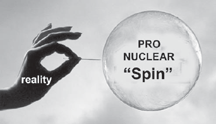
The lack of new nuclear projects in Canada reflects investor decisions, not excess regulation. No nuclear project has been assessed since the Act came into force nearly five years ago.
Ole Hendrickson , 10 August 24
The House of Commons Standing Committee on Finance announced its annual pre-budget consultations process on June 24, 2024. It invited the submission of written briefs no later than August 2, 2024. The committee will table a report on these consultations in the House of Commons, with recommendations to be considered by the Deputy Prime Minister and Minister of Finance in their development of Budget 2025. On July 30, 2024, the Canadian Nuclear Association (CNA) submitted its recommendations.
Part 1 – “Clean Economy” Investment Tax Credit (ITC) Programs
The CNA brief refers to four “Clean Economy” investment tax creditprograms from Budget 2024. Three were passed into law in June 2024.
Nuclear projects should not be eligible for investment tax credits. Nuclear power is not clean. It produces vast amounts of pollutants and waste, ranging from toxic mine tailings to irradiated fuel rods. Providing tax credits for nuclear power represents poor economic and environmental policy.
The only apparent reason for providing investment tax credits for nuclear power is that the Minister of Natural Resources Canada, whose department provides “engineering and scientific guidance” for the ITC programs, has a mandate to promote nuclear power under the Nuclear Energy Act.
1. Clean Technology ITC
Small modular nuclear reactors (SMRs) are the only nuclear power projects eligible for the 15% refundable tax credit under this program. The accepted definition of an SMR is a reactor that has a power capacity of up to 300 megawatts electrical per unit, or roughly 900 megawatts thermal.
The CNA wants to expand the definition of an SMR to include reactors up to 1400 megawatts thermal, or roughly 470 megawatts electrical.
There is considerable evidence that SMRs would produce far more expensive electricity than other generating facilities, including larger nuclear reactors. Does the CNA anticipate that the 300-megawatt BWRX-300 reactors that Ontario Power Generation plans to build at the Darlington nuclear site will not be cost-competitive without additional subsidies?
2. Clean Hydrogen ITC
This ITC program provides refundable tax credits ranging from 15-40% depending on the carbon intensity of the hydrogen produced. Widespread use of hydrogen as an energy source would require expensive new infrastructure investments. Using expensive nuclear power to produce hydrogen would further increase costs. The CNA wants hydrogen produced by using nuclear power to hydrolyze water to be considered as a qualified clean hydrogen project. The Government of Canada has not provided details on eligible projects under this ITC program.
3. Clean Technology Manufacturing ITC
This ITC program provides refundable tax credits for “clean technology manufacturing and processing.” The CNA wants to see explicit mention of the extraction and processing of uranium as a “critical mineral”, of the manufacturing of nuclear energy equipment and nuclear fuels, and of the manufacturing of “equipment for lifecycle handling of uranium fuel,” as being eligible for tax credits.
All the activities in the nuclear fuel “lifecycle” generate waste that is hazardous to human health and difficult to manage. The use of robotic equipment to handle the highly radioactive spent nuclear fuel waste is one of the most expensive parts of this “lifecycle”. A “clean economy” program should not subsidize waste management for a particular industry, particularly when that industry has delayed its decommissioning and waste management activities for decades.
4. Clean Electricity ITC
Under this ITC program, which has not yet passed into law, the CNA wants to “include all components enabling clean electricity assets to continue operating in refurbishment expenditures.”
Ontario Power Generation and Bruce Power have active reactor refurbishment programs. The Ontario provincial government already provides a $7.3 billion taxpayer subsidy to hold down electricity rates and shield industrial and household ratepayers from reactor refurbishment costs. A new federal subsidy for refurbishment of Ontario’s reactors would further hide nuclear costs, and would provide no apparent benefit to Canadian taxpayers in other provinces.
Part 2 – Policies that “enhance the regulatory framework to expedite project approvals”
The CNA is seeking to restrict the public’s ability to participate in assessments of nuclear projects. This builds on proposals from a Ministerial Working Group on Regulatory Efficiency for Clean Growth Projects, and a review of the Physical Activities Regulations (the “Project List”) by the Impact Assessment Agency of Canada. Policy matters that go beyond the Committee’s request for views on 2025 Budget priorities should be debated by appropriate Parliamentary committees.
1. Exempting nuclear projects from impact assessment
Based on a plan (Building Canada’s Clean Future) created by a Ministerial Working Group on Regulatory Efficiency for Clean Growth Projects, the Impact Assessment Agency of Canada wishes to reduce the possibility that future nuclear projects will be assessed under the Impact Assessment Act. On July 30, 2024, the Agency released a Discussion paper on the review of the Physical Activities Regulations – the so-called “Project List” – with comments due September 27, 2024.
Proposals in the Agency’s discussion paper mirror those in the CNA’s submission to the Finance Committee, suggesting that the two may have been working together. The CNA wants to exempt nuclear reactors of any size that are built on “brownfield” sites (e.g., sites where coal- or gas-fired generating stations have been shut down), or on licensed nuclear sites, from assessment. At present, only reactors of up to 200 megawatts thermal on brownfield sites, or 900 megawatts thermal on licensed sites, are exempt. The CNA proposal would also limit technical assessments to “First of a Kind” reactors, with only site considerations for future reactors of a similar design.
The CNA also wants to exempt construction, expansion and decommissioning of uranium mines with an ore production capacity of up to 5,000 tons per day. This would double the current 2,500 tons/day exemption. And it wants to allow provincial assessments to replace federal assessments.
These are not constructive proposals. They would increase the likelihood that nuclear projects will generate conflicts and fail to gain social license. The Act improves the chances that a project will proceed by encouraging public participation in project planning stages, The ability of independent experts to examine technical details brings rigor to the assessment process.
The lack of new nuclear projects in Canada reflects investor decisions, not excess regulation. No nuclear project has been assessed since the Act came into force nearly five years ago.
2. Putting the Canadian Nuclear Safety Commission (CNSC) in charge of impact assessment
If a nuclear project is captured by the Physical Activities Regulations under the Impact Assessment Act, under Section 44 of the Act the Minister of the Environment must create a review panel, set the panel’s terms of reference, appoint the chairperson and at least two other members of the panel, and ensure that they are unbiased and free from any conflict of interest relative to the project.
The Minister also has the power to designate a project for assessment, even if it is not captured by the Project List. The CNA wants to remove the Minister’s powers and give them to the CNSC.
An expert panel report, Building Common Ground: A New Vision for Impact Assessment in Canada, noted the long-standing perception of a lack of independence and neutrality of the CNSC because of its close relationship with the industry it regulates, and its promotion of projects it is tasked with regulating. The panel found that the CNSC has eroded confidence in the assessment process, leading to widespread use of the term “regulatory capture” to describe this body.
Taking away the Ministers’ powers and reassigning them to the CNSC would be a regressive step, leading to further loss of social license for nuclear projects, as has been the case with the proposed Near Surface Disposal Facility at the federally owned Chalk River Laboratories.
3. Amending the Species at Risk Act
Under section 79 of the Species at Risk Act, the proponent of a project must “notify the competent minister or ministers in writing of the project if it is likely to affect a listed wildlife species or its critical habitat.”
The CNA recommends that section 79 be modified “to align with the Supreme Court of Canada opinion, focusing on federal jurisdiction.” The Court, in its reference decision on the Impact Assessment Act, considered the Species at Risk Act and found that the protection of migratory birds, fish, fish habitat, and aquatic species should be included in the definition of adverse federal effect in the Impact Assessment Act. The Court did not discuss amending the Species at Risk Act.
The Species at Risk Act applies to all wild species found in Canada and has provisions to promote cooperation with other governments and jurisdictions. The CNA recommendation to amend the Act in the context of Budget 2025 would represent an inappropriate use of budget legislation.
No comments yet.
1 This Month
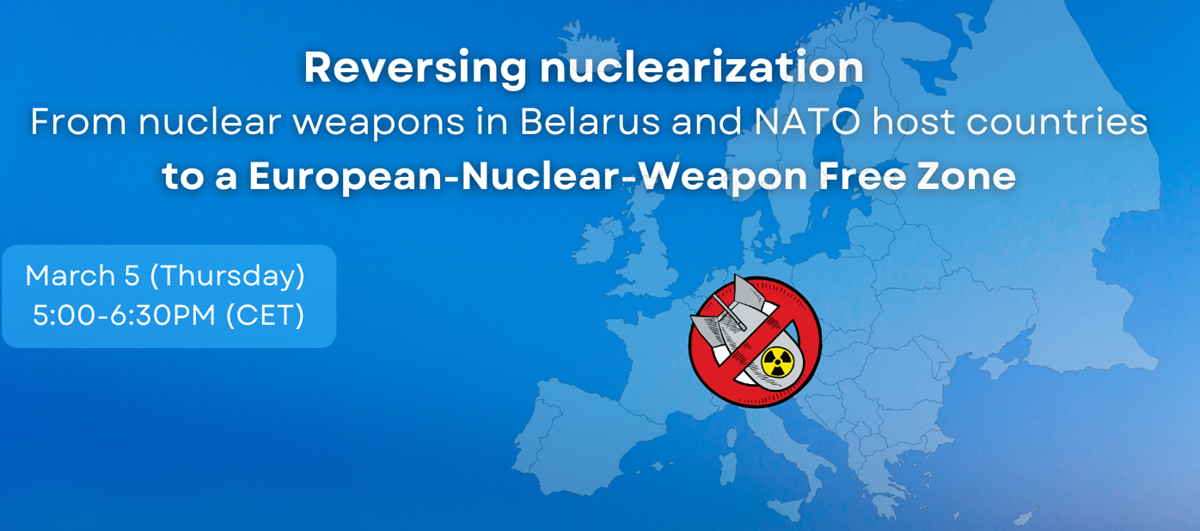
5 March -Online – Reversing nuclearization:
From nuclear weapons in Belarus and NATO host countries to a European-Nuclear-Weapon Free Zone
11am-12:30pm Eastern Time USA / 5pm-6:30pm CET

of the week – Advocating for a
nuclear free beach – https://www.samuellawrencefoundation.org/
The Samuel Lawrence Foundation advocates for a Nuclear Waste Free Beach at San Onofre, join us and take action!

10 March A LIVE WEBINAR THE REAL EFFECTS OF NUCLEAR POWER
What the Industry Isn’t Telling Us
1:00 PM Mountain, 2 pm Central, 3 pm Eastern. Live on the Keepers of the Water Facebook page

18 March Webinar @ 1 PM EST: An Assessment of SMR Projects: The Case of Canada
register for the zoom:
https://us02web.zoom.us/webinar/register/WN_o8BIIOUvQ2ONJR1nta65DQ#/registration

of the week – STOP SMALL MODULAR REACTORS IN CANADA
To see nuclear-related stories in greater depth and intensity – go to https://nuclearinformation.wordpress.com
-
Archives
- March 2026 (38)
- February 2026 (268)
- January 2026 (308)
- December 2025 (358)
- November 2025 (359)
- October 2025 (376)
- September 2025 (258)
- August 2025 (319)
- July 2025 (230)
- June 2025 (348)
- May 2025 (261)
- April 2025 (305)
-
Categories
- 1
- 1 NUCLEAR ISSUES
- business and costs
- climate change
- culture and arts
- ENERGY
- environment
- health
- history
- indigenous issues
- Legal
- marketing of nuclear
- media
- opposition to nuclear
- PERSONAL STORIES
- politics
- politics international
- Religion and ethics
- safety
- secrets,lies and civil liberties
- spinbuster
- technology
- Uranium
- wastes
- weapons and war
- Women
- 2 WORLD
- ACTION
- AFRICA
- Atrocities
- AUSTRALIA
- Christina's notes
- Christina's themes
- culture and arts
- Events
- Fuk 2022
- Fuk 2023
- Fukushima 2017
- Fukushima 2018
- fukushima 2019
- Fukushima 2020
- Fukushima 2021
- general
- global warming
- Humour (God we need it)
- Nuclear
- RARE EARTHS
- Reference
- resources – print
- Resources -audiovicual
- Weekly Newsletter
- World
- World Nuclear
- YouTube
-
RSS
Entries RSS
Comments RSS
 nuclear-news
Leave a comment