TODAY. 6th August – a day of respectful remembrance, and a day of absurd nuclear hypocrisy
https://www.youtube.com/watch?v=gVunlJOyfB0

Respectful remembrance of the atomic bombing of Hiroshima is happening – in places world-wide, and especially in Hiroshima.
But at the same time, the reality is that the nuclear nations, led by the USA, are all busy spending the taxpayers’ money on nuclear weapons. And the tax-payers don’t seem to care much – Nuclear-weapons -making provides jobs – doesn’t it?, and shares in it provide financial security don’t they? And nuclear weapons provide security and safety from the evil other people, don’t they?
And people continue to believe the spin. The spin that has gone on ever since that evil decision to atomic bomb Hiroshima, and that next evil decision, to atomic bomb Nagasaki.
Now – while pious statements about Hiroshima abound – the world’s leaders are gearing up for the next bombing. There’s a load of nonsense about “tactical nuclear weapons”, and a “limited nuclear war” – as if, somehow it would be OK to annihilate just a few billion civilians, rather than the whole 8 billion.
The hypocrisy about it being OK to bomb civilians is equalled by the hypocrisy that believing in increasing nuclear weaponry will deter wars. It sure has not prevented them over the past 79 years.
The “Western” World leaders seem fine with the idea of gearing up for a war against China and Russia. And now gearing up for a war against Iran? And Israel, led by a fanatic Zionist clique, looks ready to get that started.
It is hard to believe that Mutually Assured Destruction is still an accepted policy. ( I always thought it was a strange idea – that knowing of the deaths of billions of the “others” would be any consolation to us as we were ourselves annihilated.)
So – the whole nuclear weapon thing is a load of hypocrisy spun by imbecilic macho men.
But the next load of hypocrisy is the pretense that the “civil” nuclear industry has any real purpose beyond supporting the nuclear weapons industry. (Yes, nuclear medicine has a role, but it’s a two-edged sword, being itself a contributor to cancer)
Which brings me to that ultimate lie – that “nuclear power will solve climate change”
Amongst the many global threats to human and animal life, the big one is global heating.
Nuclear energy’s role in dealing with global heating has just one purpose- to stop the development of renewable energy and energy conservation.
The breath-taking hypocrisy of it all
79 years since the unthinkable
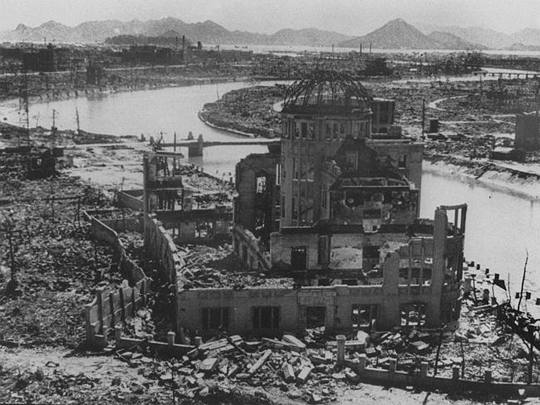
But are we closer than ever to nuclear war?
By Kate Hudson, August 4 2024 https://beyondnuclearinternational.org/2024/08/04/79-years-since-the-unthinkable/
As we mourn the loss of all those killed at Hiroshima and Nagasaki by US atomic bombs, in August 1945, we cannot avoid the fact that we are closer than ever to nuclear war. The war on Ukraine is greatly increasing the risk. So too is NATO’s location of upgraded nuclear weapons across Europe — including Britain — and Russia’s siting of similar weapons in Belarus. Irresponsible talk suggesting that “tactical” nuclear weapons could be deployed on the battlefield — as if radiation can be constrained in a small area — makes nuclear use more likely.
And our own government is leading the charge on greater militarisation and is in denial about the dangers it is unleashing. This is a bad time for humanity — and for all forms of life on Earth. It’s time for us to stand up and say No: we refuse to be taken into nuclear Armageddon.
Help in raising awareness of the existential peril of nuclear weapons is coming from an unusual quarter — Hollywood. Many of us have seen the blockbuster, Oppenheimer. Many in the movement have their criticisms but my own feeling is that you cannot leave the film without being aware of the terror of nuclear weapons, and their world-destroying capacity.
I attended a screening hosted by London Region CND; it was sold out within hours, and followed by a dynamic audience discussion that lasted till 11pm. I recognised only two people in the audience. That’s the crowd we need to engage with — none of us just want to preach to the converted. But there is a particular flaw in the film I must raise, as we remember Hiroshima Day.
It was repeatedly suggested that dropping the bomb was necessary to end the second world war. Although there was eventually a quick aside that countered this, it could easily have been missed. So for the record, this is the reality of what happened.
Conventional wisdom, especially in the US, is that it was necessary to drop the bomb to bring about a speedy conclusion to the war and save lives. Even today many people believe that the bomb was necessary to bring about a Japanese surrender and to avoid the need for an invasion of Japan by the US, which might have cost hundreds of thousands of lives.
But extensive scholarly research in the US, using primary sources from the time, shows that this just wasn’t true. By the time the bomb was ready for use, Japan was ready to surrender. As General Dwight Eisenhower said, Japan was at that very moment seeking some way to surrender with minimum loss of face, and “it wasn’t necessary to hit them with that awful thing.”
Here’s what was said at the time by some of the key players:
It is my opinion that the use of this barbarous weapon at Hiroshima and Nagasaki was of no material assistance in our war against Japan. The Japanese were already defeated and ready to surrender because of the effective blockade and successful bombing with conventional weapons … In being the first to use it we had adopted an ethical standard common to the barbarians of the Dark Ages. I was not taught to make war in that fashion and wars cannot be won by destroying women and children. – Admiral William Leahy, President Truman’s chief of staff
Nor were the atomic bombs decisive. It has long been held in justification that they made unnecessary an invasion of the Japanese mainland and thus saved the resultant fighting and thousands and possibly hundreds of thousands of casualties on both sides. On few matters is the adverse evidence so strong. The bombs fell after the decision had been taken by the Japanese government to surrender. That the war had to be ended was agreed at a meeting of key members of the supreme war direction council with the emperor on 20 June 1945, a full six weeks before the devastation of Hiroshima. – Professor JK Galbraith, official US investigator, Japan 1945
It would be a mistake to suppose that the fate of Japan was settled by the atomic bomb. Her defeat was certain before the first bomb fell and was brought about by overwhelming maritime power. – Winston S Churchill, British wartime leader
So if Japan was ready to surrender, why were atomic bombs dropped on Hiroshima and Nagasaki? A significant factor in the decision to bomb was the US’s desire to establish its dominance in the region after the war. Those planning for the post-war situation believed that this required US occupation of Japan, enabling it to establish a permanent military presence, shape its political and economic system and dominate the Pacific region. But the US’s key strategic concern, above all, was the position of the Soviet Union in the post-war world.
Evidence suggests that the US wanted to demonstrate its unique military power — its possession of the atomic bomb — in order to gain political and diplomatic advantage over the Soviet Union in the post-war settlement in both Asia and Europe. So nothing to do with ending the war with Japan.
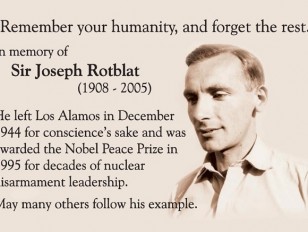
I leave the final word to Joseph Rotblat — the true hero of the Manhattan Project. Whatever qualms Oppenheimer may have felt after the event, as shown in the film, the fact is he pursued the bomb to the bitter end. Rotblat was a nuclear physicist from a Polish-Jewish family. He had seen the development of the atomic bomb as a necessary evil in the arms race to defeat Hitler, and went to work on the Manhattan Project. At the end of 1944, it was clear that Germany was not going to succeed in making an atom bomb. In these circumstances, Rotblat left the Manhattan Project. Others tried to alert politicians to the dangers ahead. But top politicians pressed for the rapid completion of the bomb.
As Rotblat himself later pointed out: “There is good reason to believe that the destruction of Hiroshima and Nagasaki was not so much the end of the second world war as the beginning of the cold war, the first step in a fateful chain of events, the start of an insane arms race that brought us very close to a nuclear holocaust and the destruction of civilisation.”
In memory of all those who died at Hiroshima and Nagasaki, and those who have suffered the consequences since, let us do our utmost to prevent the same catastrophe happening again; let us take action to prevent our politicians catapulting us into nuclear war — and the destruction of all life on this planet.
Kate Hudson has been General Secretary of Campaign for Nuclear Disarmament (CND) since September 2010. Prior to this she served as the organisation’s Chair from 2003. She is a leading anti-nuclear and anti-war campaigner nationally and internationally. This article was originally published by CND in August 2023.
The pictures worth a thousand words

Canada and the Atom Bomb Exhibition
Canada’s little-known role in atomic bombings on display
By Anton Wagner, 4 Aug 24, https://beyondnuclearinternational.org/2024/08/04/the-pictures-worth-a-thousand-words/
The Hiroshima Nagasaki Day Coalition launched a “Canada and the Atom Bomb” photo exhibition inside Toronto City Hall on August 2. The exhibition of 100 photographs reveals the Canadian government’s participation in the American Manhattan Project that developed the atom bombs that destroyed Hiroshima and Nagasaki in August 1945.
The exhibition can be viewed in its entirety online at the Toronto Metropolitan University website.
It documents how the Eldorado Mining and Refining Company extracted uranium ore at Great Bear Lake in the Northwest Territories in the late 1930s and shipped the ore to its refinery in Port Hope, Ontario, for sale to the Americans.
Images by the Montreal photographer Robert Del Tredici focus on the Dene hunters and trappers at Great Bear Lake who were hired by Eldorado to carry the sacks of radioactive ore on their backs for loading onto barges that transported the ore to Port Hope. Many of them subsequently died of cancer.
Before his death in 1940, the Dene spiritual leader Louis Ayah had prophesied that such an illness would befall the Dene because of white men mining on Dene territory. Ayah also prophesied a nuclear holocaust that would end human civilization.
Prime Minister Mackenzie King hosted President Roosevelt and Prime Minister Winston Churchill in Quebec City in 1943 where they agreed to have Canada participate in the production of the atom bomb.
The exhibition highlights this participation by the Canadian government, scientists, industry, and nuclear research laboratories. Posters from the Hiroshima Peace Museum show the death and destruction in the two bombed cities. The exhibition includes five images by Yoshito Matsushige, the only photographer who took pictures in Hiroshima the day the atom bomb exploded overhead.
“Canada and the Atom Bomb” concludes with photographs showing the efforts by peace activists to persuade Toronto City Council to participate in the world-wide movement to abolish nuclear weapons. In 2017, City Council reaffirmed Toronto as a Nuclear Weapons-Free Zone and called on Prime Minister Justin Trudeau to have Canada ratify the UN Treaty on the Prohibition of Nuclear Weapons.
Setsuko Thurlow accepted the Nobel Peace Prize on behalf of the International Campaign to Abolish Nuclear Weapons in Oslo, Norway, in December 2017. A Hiroshima survivor, Thurlow, now 92, attended the opening of the “Canada and the Atom Bomb” exhibition on August 2. She will also speak at the annual August 6 commemoration at the Toronto City Hall Peace Garden to urge that Canada sign the Treaty on the Prohibition of Nuclear Weapons.
Anton Wagner is with the Hiroshima Nagasaki Day Coalition.
Hiroshima inviting Israel to attend nuclear bombing anniversary ‘very unfortunate,’ says scholar
Hope Nagasaki’s refusal to invite Israel to its peace event to mark US bombing of Japan ‘makes some kind of impact on the world,’ Richard Falk tells Anadolu
Riyaz ul Khaliq |05.08.2024, https://www.aa.com.tr/en/asia-pacific/hiroshima-inviting-israel-to-attend-nuclear-bombing-anniversary-very-unfortunate-says-scholar/3296156
An invitation for Israel to attend an annual peace event in Hiroshima to mark the US nuclear bombing of the Japanese city was “very unfortunate,” a leading legal scholar told Anadolu.
“It is very unfortunate that Hiroshima does not grasp the fact it was victimized in a way Palestinian people have been victimized by Israel,” said Richard Falk, an American professor emeritus of international law at Princeton University.
Falk’s comments to Anadolu come as the cities of Hiroshima and Nagasaki will be commemorating 79th anniversary of 1945 atomic bombing by the US this week.
While Nagasaki has refused to invite Tel Aviv, Hiroshima will be hosting Israeli officials on Tuesday.
Nagasaki will be holding a similar event on Friday.
The US dropped nuclear bombs on Hiroshima, the site of the world’s first atomic bombing, on Aug. 6, 1945, and then Nagasaki, resulting in the deaths of at least 140,000 people by the end of that year.
“And what Nagasaki is doing by not inviting Israel to its observance of the bombing in World War II is to make a statement that it does not want to be identified with a government that behaves that way,” Falk said, referring to Israel’s treatment of Palestinians, including its ongoing brutal offensive on the Gaza Strip.
“That is a very important lesson for the world and is a very interesting way of highlighting two ways of relating to Israel” amid the war on Gaza, said Falk, who in past served as UN special rapporteur on occupied Palestinian territory. “I hope it makes some kind of impact on the world.”
Japan has refused to invite Russia and Belarus to similar events as Moscow has been waging war on Ukraine since February 2022.
Hiroshima’s local administration has invited Tel Aviv despite accusations of double standards and activists pressing authorities to backtrack on the move.
Local authorities in Hiroshima have called for an “immediate cease-fire in the Palestinian territory.”
Several demonstrations have been held against Israel’s participation in the program on Tuesday.
Israeli war on Gaza ‘changed discourse in Japan’
Saul Takahashi, professor of human rights and peace studies at Osaka Jogakuin University, told Anadolu that there has been “lot of protests and lots of discussions” in Japan about Hiroshima’s decision to invite Israel.
This event is where all the countries in the world come together and pray for peace.
So “how can it be that a country that has been found by International Court of Justice to plausibly be committing genocide … how can it be we invite them (Israel). This is outrageous,” Takahashi told Anadolu.
He said the genocide in Gaza has “changed discourse in Japan for sure.”
“People are much more mindful, they are much more paying attention to the Palestine question … in particular young people and that is big, really big,” said the academic.
Recalling his pre-Oct. 7 lectures on Palestine, which were mostly attended by older individuals, Takahashi said: “I was concerned about the future of the movement (regarding Palestine in Japan).”
“But it is completely different. You have young people in the streets, every week and not just in Tokyo but also in smaller cities and that is very big.”
Last week, both Iran and Hamas accused Israel of assassinating Ismail Haniyeh, the head of Hamas’ political bureau, in Iran’s capital Tehran, an accusation that Israel has neither confirmed nor denied. However, Israeli Prime Minister Benjamin Netanyahu hinted at Israel’s involvement.
Israel, flouting a UN Security Council resolution demanding an immediate cease-fire, has faced international condemnation amid its continued brutal offensive on Gazasince an attack last October by the Palestinian resistance group Hamas.
Nearly 39,600 Palestinians have since been killed, mostly women and children, and nearly 91,400 injured, according to local health authorities.
Almost 10 months into the Israeli war, vast tracts of Gazalie in ruins amid a crippling blockade of food, clean water and medicine.
Israel stands accused of genocide at the International Court of Justice, which ordered it to immediately halt its military operation in the southern city of Rafah, where more than 1 million Palestinians had sought refuge from the war before it was invaded on May 6.
The Hidden Ties Between Google and Amazon’s Project Nimbus and Israel’s Military

By Caroline Haskins, Jul 15, 2024 https://www.wired.com/story/amazon-google-project-nimbus-israel-idf/?utm_brand=wired&utm_source=twitter&utm_social-type=owned&mbid=social_twitter&utm_medium=social
A WIRED investigation found public statements from officials detail a much closer link between Project Nimbus and Israel Defense Forces than previously reported.
On April 16, police entered Google offices in New York and California to detain several employees protesting a $1.2 billion cloud contract with Israel’s government called Project Nimbus. The deal, shared with Amazon, has met pushback from some employees at both companies since 2021, but the protests have grown louder since Israel’s renewed conflict with Hamas after the attacks of October 7, 2023.

Current and former Google and Amazon workers protesting Project Nimbus say it makes the companies complicit in Israel’s armed conflicts and its government’s illegal and inhumane treatment of civilian Palestinians. Google has insisted that it is not aimed at military work and is not “relevant to weapons or intelligence services,” while Amazon, seemingly, has not publicly discussed the scope of the contract.
But a WIRED review of public documents and statements by Israeli officials and Google and Amazon employees shows that the Israel Defense Forces have been central to Project Nimbus since its inception, shaping the project’s design and serving as some of its most important users. Top Israeli officials appear to think the Google and Amazon contract provides important infrastructure for the country’s military.
In February, at a conference dedicated to Project Nimbus, the head of Israel’s National Cyber Directorate, Gaby Portnoy, was quoted by Israeli media as crediting the contract with helping the country’s military retaliation against Hamas.
“Phenomenal things are happening in battle because of the Nimbus public cloud, things that are impactful for victory,” Portnoy said, according to an article published in People & Computers, which coorganized the conference. “And I will not share details.” Portnoy and the Cyber Directorate did not respond for comment.
Portnoy’s statement contradicts Google’s statements to media, which have sought to downplay the military connections of Project Nimbus. “This work is not directed at highly sensitive, classified, or military workloads relevant to weapons or intelligence services,” Google spokesperson Anna Kowalczyk said in an emailed statement. “The Nimbus contract is for workloads running on our commercial cloud by Israeli government ministries, who agree to comply with our Terms of Service and Acceptable Use Policy.”
Google’s terms forbid customers from “high risk activities,” defined to include situations where “use or failure of the Services would reasonably be expected to lead to death, personal injury, or environmental or property damage (such as the creation or operation of nuclear facilities, air traffic control, life support systems, or weaponry).” It is unclear how supporting IDF combat operations would fit within those rules.
Portnoy’s claim and other documents and statements reviewed by WIRED add to recent reporting that appears to confirm the Nimbus contract’s long-established military connections. Time quoted an internal Google document that said the Israeli Ministry of Defense has its own “landing zone” into the company’s Project Nimbus infrastructure. The Intercept reported that two state-owned Israeli arms companies are required to use Google and Amazon cloud services through Project Nimbus.
In response to a detailed list of questions from WIRED, Google spokesperson Anna Kowalczyk repeated the company’s boilerplate statement.
Likewise, Amazon spokesperson Duncan Neasham repeated boilerplate language Amazon has used in the past to talk about Project Nimbus, which says the company provides its technology to customers “wherever they are located” and that employees have the “right to express themselves.”
“We are committed to ensuring our employees are safe, supporting our colleagues affected by these terrible events, and working with our humanitarian relief partners to help those impacted by the war,” Neasham added. (Sasha Trufanov, a Russian-Israeli Amazon employee, is currently being held hostage by Hamas in Gaza. He was last seen alive in a hostage video released on May 28.)
Making Project Nimbus
Project Nimbus began in 2019 as a major upgrade to Israeli government technology. The multi-year project, led by the Ministry of Finance, had no specific end-date and called for the government to pick preferred cloud providers that would build new data centers to store data securely inside Israel. Like other Cloud customers, the Israeli government could use Google for data storage, and use its built-in tools for machine learning, analyzing data, and developing apps.
An early trace alluding to the Israeli military’s involvement in Project Nimbus came in a June 2020 LinkedIn post from Shahar Bracha, former chief executive officer of Israel’s National Digital Agency, then called the ICT Authority. “I am happy to update that the Ministry of Defense (in the name of the IDF) decided to join with the Cloud Center and in doing so changed the center to be greater and more attractive,” he wrote, suggesting the military would be a major user of services under the project.
Over the three-year bidding process, many other documents and public statements were explicit about the IDF’s intimate involvement in Nimbus and its expected role as a user. “Project Nimbus is a project to supply public cloud services to the government, the defense department and the IDF,” a statement provided by Israel’s Ministry of Finance in 2022 to Israeli online news outlet Mako said. . It added that “the relevant security bodies were partners of this project from its first day, and are full partners still.”
The IDF’s involvement included having a say in which companies would win the Nimbus contract. An Israel State Comptroller audit report from 2021 that says the IDF joined “to enable the transfer of declassified systems to the public cloud” and notes that “the Ministry of Defense and the IDF are crucial parts of the team working on the tender, both in creating the requirements and in assessing the outcomes.”
Ultimately, Google and Amazon won the Project Nimbus contracts, beating out Microsoft and Oracle. A May 2021 press release in English that congratulated the companies and announced “The Israeli Government is Moving to the Cloud” said that Project Nimbus is intended to serve “the Government, the Security Services and other entities.”
The Times of Israel reported the same day that Google and Amazon could not pick and choose which agencies they worked with, quoting an attorney for the Israeli Finance Ministry saying that the contract bars the companies “from denying services to particular government entities.”
That appears to still include the IDF. WIRED identified several Israeli government statements and documents published since 2022 that confirm the IDF’s continued involvement with Project Nimbus, although they do not provide details of the tools and capabilities it uses.
For instance, a government document published on June 15, 2022, that outlines the scope of the project, says “The Ministry of Defense and the IDF” will get a dedicated “digital marketplace” of services they can access under Project Nimbus.
In July 2022, The Intercept also reported on training documents and videos provided to Nimbus users in the Israeli government that revealed some of the specific Google technologies the contract provided access to. They included AI capabilities such as face detection, object tracking, sentiment analysis, and other complex tasks.
Official government pages old and new, both in Hebrew and English, feature the same boilerplate description of Project Nimbus. It calls the contract “a multiyear and wide-ranging flagship project, led by the Government Procurement Administration in the Accountant General’s Division in the Ministry of Treasury together with the National Digital Unit, the Legal Bureau in the Ministry of Finance, the National Cyber Unit, the Budget Division, the Ministry of Defense and the IDF.” The statement appears on one of the main government pages about Project Nimbus, an undated news release, a 2022 cloud strategy document, and a press release from January 2023.
A version of the statement has also been posted in an Amazon guidance document about Nimbus from January 2023, and on the event page for the 2024 “Nimbus Summit,” a privately run event that brings together tech workers from Amazon, Google, and the dozens of other companies that have played some hand in modernizing Israel’s tech infrastructure in recent years.
Close Ties
Social media posts by Israeli officials, Amazon employees, and Google employees suggest the country’s military remains closely involved with Project Nimbus—and the two US cloud companies working on it.
In June 2023, Omri Nezer, the head of the technology infrastructure unit at the Israeli Government Procurement Administration, posted a recap of a cloud conference held by the Israeli government to LinkedIn. He wrote that it was meant to bring together people from “different government offices within ‘Project Nimbus.’”
Nezer’s post mentions a panel at the conference that featured “an IDF representative” and the head of engineering IT for Rafael Advanced Defense Systems, a defense company originally created as a research and development company for the Israeli military. The Intercept reported last month that Rafael and Israel Aerospace Industries, both Israeli government-backed weapons manufacturers, are “obligatory customers” of Google and Amazon through Project Nimbus. Amazon spokesperson Duncan Neasham tells WIRED that Rafael is “not required to use AWS or Google only for cloud services” and can “also use other cloud providers’ services.”
National security agencies remain an important part of Project Nimbus. In a 2023 LinkedIn post tagged #nimbus, Omri Holzman, defense team lead at Amazon Web Services, summarized a recent event AWS put on for defense customers. “We had attendees from each security organization in Israel,” Holzman wrote, without specifying which agencies. “AWS puts a lot of focus on the National Security (NatSec) community which has its unique needs and requirements.”
Google has recently been pitching Israeli policing and national security officials on its Gemini AI model, the centerpiece of the search company’s attempts to compete with OpenAI’s ChatGPT. Shay Mor, director and head of public sector and defense for Google Cloud Israel, said in a March Linkedin post that he recently presented information about its “groundbreaking Nimbus projects” with agencies that include the Israeli Police, the Israel National Digital Agency, and the Israel National Cyber Directorate.
“It was an honor and a pleasure to present our Gemini technology and some of our groundbreaking Nimbus projects with the Israeli Police, Israel National Digital Agency, Ministry of Education, and the Israel National Cyber Directorate today at the Nimbus event,” Mor posted, referring to the same event where Portnoy the Cyber Directorate leader said Nimbus helped the battle with Hamas. Mor didn’t specify how the IDF or security agencies could use Google’s AI, but the company has said Gemini could help its cloud customers write code, analyze data, or identify security challenges.
In his own reported comments at the event, Portnoy suggested that the Nimbus project is set to deepen Amazon’s and Google’s ties with Israel’s national security apparatus. He said that the companies have been “working partners” on a new project creating “a framework for national defense” with cloud-based security tools. Portnoy likened it to Israel’s missile defense system, calling it the “Iron Dome of Cyber.”
Growing Outcry
The recent protests against Project Nimbus do not mark the first time that a cloud deal with military connections has prompted protests—in particular, protests inside Google. A former Google employee who was fired along with dozens of others after protesting Project Nimbus in April says years of trying to steer the company in a more ethical direction had left them exhausted. “I became convinced that basically, you cannot trust anything they say,” says the former employee. They protested in 2018 against Project Maven, a now-lapsed Pentagon contract that saw Google algorithms analyze drone surveillance imagery, Google’s work with US Customs and Border Protection in 2019, and Project Nimbus starting in 2021 with the group No Tech for Apartheid. “I have zero trust in these people.”
The first major action against Project Nimbus took place in October 2021, when a coalition of Google and Amazon employees published an open letter in The Guardian decrying the contract. No Tech for Apartheid also formed explicitly in response to Project Nimbus at around this time. Many of the same people who joined these early organizing efforts were also involved in No Tech for ICE, a tech worker-led movement formed in 2019 to oppose their companies working for Immigration and Customs Enforcement.
Ariel Koren, at the time a project manager at Google who helped draft the open letter, says that her manager told her in early November 2021 that she had to agree to move to São Paulo, Brazil, within 17 business days “or lose her position,” according to the Los Angeles Times. Koren announced that she had resigned in March 2022. A few weeks later, a group of tech workers and activists led protests outside Google and Amazon offices in New York, Seattle, and Durham, North Carolina, to express solidarity with Koren and her demand to wind up Project Nimbus.
Protests have escalated from there. Emaan Haseem, a former engineer for Google Cloud, was fired in April alongside 48 others after she traveled from Seattle to San Francisco to participate in a group sit-in inside the office of Google Cloud CEO Thomas Kurian. She says that No Tech for Apartheid is part of a wider movement known as Boycott Divest Sanction, using economic pressure to encourage Israel to end occupation of Palestinian territories.
Opposition to Israel’s military actions in Gaza and the West Bank, Haseem said, is a central pillar of No Tech for Apartheid. Poject Nimbus “is a contract that stands out the most for anyone who has their eyes on the genocide in Gaza currently.”
A DUBIOUS PROSPECT? Rolls-Royce looks to sell stake in small nuclear reactor business.

I will be following this U.K. story. Similar to here in Canada, the SMR proponents in Europe (in the U.K. the frontrunner is Rolls-Royce) are struggling to find private capital to develop their designs. The big nuclear industry extravaganza in Brussels in March (organized by the IAEA nuclear-boosters) was a flop, with investment bankers telling the SMR companies they lack a business case and need to look for government (taxpayer) dollars.
In Canada, the only SMR design to receive significant government funding is the BWRX-300 project at Darlington, which received $970 million in a “low-interest loan” from the Canada Investment Bank (CIB) shortly after the CIB had its operating scope changed which then allowed it to give money to nuclear companies. Politics. Scam. Anyway, the two designs planned for here in New Brunswick (ARC-100 and Moltex SSR + WATSS) last year said they will each need $500 million to develop their designs, and after six years of looking for it, they have come up with only a fraction of that. To be continued…
By: Guy Taylor, CITY AM, https://www.cityam.com/rolls-royce-looks-to-sell-stake-in-small-nuclear-reactor-business/ 5 Aug 24
Rolls-Royce is preparing to sell off a stake in its mini-nuclear power business as it looks to raise fresh funding.
Chief executive Tufan Erginbilgic said the firm was in discussion with possible investors, with cash set to run out by early next year, The Sunday Telegraph reported.
One source familiar with discussions told the paper that the FTSE 100 giant was looking to raise hundreds of millions pounds.
Some £280m has already been pumped into the operation by its current backers, which include the Qatar Investment Authority and BNF Resources. A further £210m government grant was also announced by the former Conservative government in November 2021.
The company is being advised by bankers at BNP Paribas and is understood to have received approaches from “across the board,” including infrastructure investors, clean energy funds, hedge funds and other nuclear power companies, the report said.
It comes as Rolls-Royce closes in on winning a government tender, led by Great British Nuclear (GBN), to develop so-called Small Modular Reactors, which are essentially scaled-down versions of nuclear power plants. GBN will pick two designs from a host of competitors including Rolls, GE Hitachi, Holtec Britain, Nuscale and Westinghouse.
Asked about the funding situation, Erginbilgic told The Sunday Telegraph he was “very comfortable”.
“I won’t go into specific deals. But obviously our SMR is an attractive proposition and it’s got a great future and some investors potentially recognise that,” he said.
A spokesman for Rolls-Royce SMR added: “Our first mover advantage, combined with the significant growth in demand for small modular reactors, puts Rolls-Royce SMR in a leading position to capitalise on this global decarbonisation opportunity.
“Naturally, this is attracting investor interest and we continue to consider a range of options to support our future growth.”
Alliance Takes Nuclear Waste Opposition Message to Communities Throughout Northwestern Ontario

We the Nuclear Free North, 5 August 24, Dryden
– A northern Ontario alliance opposed to plans to transport and bury nuclear waste in northwestern Ontario is taking its message to more than a dozen communities across northern Ontario this month, doing one-day stops with an information table, displays and children’s activities.
The all-volunteer effort organized by We the Nuclear Free North began an eight-day tour on August 1st, with visits in Fort Frances, Sioux Lookout, Kenora and Vermilion Bay. Locations were organized with the respective municipalities, and selected for high visibility and pedestrian traffic.
“The public response has been very positive”, commented Brennain Lloyd, project coordinator with Northwatch and tour organizer.
“People are approaching the table looking for a petition to sign and ideas about how they can express their opposition to this project. Many are commenting on how they can’t believe that it has gone this far, and they feel an urgency to see it brought to a stop”.
On July 10th the Township of Ignace delivered their “willingness decision” to the Nuclear Waste Management Organization, which locked the Township into an agreement signed on March 18th, committing the current and future Township councils to supporting the project.
“We’re spending time in communities that are downstream of the NWMO’s candidate site (between Ignace and Dryden) and along the transportation route”, explained Wendy O’Connor, a member of Nuclear Free Thunder Bay.
“Outside of Ignace, there is real frustration with the NWMO having positioned Ignace as their proxy decision-maker, while shutting out all of the other communities that will be impacted if this project were ever to go through.”
There is broad opposition to the NWMO project from individuals, community and citizens’ groups, municipalities, and First Nations. In addition to criticism of the project itself due to the negative impacts on the environment and human health during transportation and operation and after radioactive waste abandonment, the NWMO siting process and the Township of Ignace’s approach have also been soundly criticized for being secretive, undemocratic, and lacking scientific and technical rigour.
The tour is being supported by local volunteers in each of the stops, which continues today in Sioux Lookout, followed by stops in Dryden, Wabigoon and Atikokan. A second leg of the tour will take place in late August, with stops in Wawa, White River, Marathon, Schreiber, Nipigon and Longlac. https://wethenuclearfreenorth.ca/
Understanding China’s Approach to Nuclear Deterrence
China has also always adhered to a “no first use” (NFU) doctrine regarding its nuclear forces, precluding it from adopting an asymmetric escalation posture. That it is entirely reliant on its own strategic nuclear capabilities for deterrence also precludes it from adopting a catalytic posture, as it does not need to, nor can it rely on, a nuclear patron to intervene in crises on its behalf.
Alex Alfirraz Scheers, https://thediplomat.com/2024/08/understanding-chinas-approach-to-nuclear-deterrence/
It has never been more crucial to understand China’s approach to deterrence, in order to bring a much-needed sense of perspective to Sino-American nuclear dynamics
The case for U.S. nuclear superiority made by several high-profile nuclear policy experts in the United States has tacitly increased tensions between Washington and Beijing. Any decision to pursue the recommendations outlined in the U.S. Strategic Posture Review to respond to China’s alleged efforts to achieve nuclear parity with the United States will only create a more uncertain and dangerous international threat environment. Hence, it has never been more crucial to understand China’s approach to deterrence, in order to bring a much-needed sense of perspective to Sino-American nuclear dynamics. More importantly, cultivating a sense of understanding is critical to attaining and maintaining peace.
This article seeks to contextualize China’s nuclear journey, and to serve as a reminder to policymakers and the general public alike that while China’s nuclear journey has been far from straightforward, China’s nuclear intentions have historically been to prevent and not to provoke nuclear conflict.
China has been a nuclear power since 1964. Up until the 1990s, China only had roughly 20 strategic nuclear capable delivery systems. Its approach to deterrence in that period, according to Nicola Leveringhaus, was not strategic, but rather can be understood by analyzing technological constraints, domestic politics, and its leadership decision-making considerations on nuclear and national security issues.
During the Cold War, China’s main strategic threats were posed by the USSR and the United States. Then, nuclear weapons served as a deterrent against any acts of aggression by the superpowers. In the 21st century, China has undertaken massive nuclear modernization and expansion. Today, China’s nuclear forces are numbered at roughly 440 warheads, and according to Pentagon estimates will number 1,500 warheads by 2035.
With the end of the Cold War and the dissolution of the USSR, and the emergence of regional nuclear powers such as India and Pakistan as well as a continued U.S. threat perception, China’s nuclear deterrent is positioned to prevent acts of aggression regionally and against the United States.
Indeed, according to Caitlin Talmadge and Joshua Rovner, “The specific nature of China’s improvements do seem oriented toward bolstering the country’s assured retaliation posture in response to growing threats from ever more capable U.S. counterforce and missile defense systems.”
Yet, throughout China’s nuclear history, it has consistently adopted a deterrence by punishment posture, and has stressed the importance of maintaining an effective second-strike retaliatory capability.
A deterrence by punishment posture enables China to threaten nuclear retaliation against a nuclear strike on its vital interest, and a secure second-strike capability refers to China’s ability to absorb a nuclear strike and to retaliate with a nuclear response. Both require highly survivable nuclear capabilities, and a resilient national security infrastructure, which China appears to have continually pursued.
Since Xi Jinping came to power in 2012, China has invested heavily in developing a triad of land, air and sea-based nuclear capabilities. While the proliferation of nuclear silos from which to launch its DF-5 intercontinental ballistic missiles (ICBM) constitutes the largest land-based nuclear build-up in China’s history, they bolster China’s strategic deterrence capability by signaling to the United States that it is investing in long-range delivery systems that can reach targets in the continental United States.
Nevertheless, as Vipin Narang observed, “The types of capabilities that China developed are consistent with a retaliatory posture aimed at deterring nuclear coercion and nuclear use.” China has also always adhered to a “no first use” (NFU) doctrine regarding its nuclear forces, precluding it from adopting an asymmetric escalation posture. That it is entirely reliant on its own strategic nuclear capabilities for deterrence also precludes it from adopting a catalytic posture, as it does not need to, nor can it rely on, a nuclear patron to intervene in crises on its behalf.
As Brandon Babin stated, “China has defined its active defense national military strategy as ‘striking only after the enemy has struck.’” Nevertheless, recent Chinese efforts to develop more nuclear options, such as theater nuclear weapons and longer-range ballistic missiles, indicate that China is potentially reviewing its deterrence posture.
Current estimates of their nuclear forces suggest that China appears to adopt a posture that includes countervalue targets, holding at risk their adversaries’ densely populated centers. The size of China’s nuclear forces logically orients it toward adopting countervalue targeting, as a counterforce posture would require a nuclear force size capable of successfully hitting an adversary’s nuclear forces.
A damage limitation approach, therefore, would simply not be feasible with their force size. As it stands, counterforce would prove ineffective for China if ever it is engaged in a nuclear conflagration with the United States. Again, Narang here is salient: “Chinese posture features…strong centralized controls, survivability through dispersed and concealed stewardship procedures and numerical ambiguity, and punitive retaliatory strikes against key countervalue targets.”
Adopting countervalue targeting enables China to effectively deter adversaries without requiring it to possess robust nuclear forces with sophisticated delivery systems. Changes in force size, however, will surely increase China’s nuclear options and will afford China with a breadth of maneuverability previously unattainable.
China’s targets also align with its deterrence by punishment posture. Its primary targets, as illustrated by its DF-1 to D-5 ICBMs, are strategic in character. These targets illustrate that China’s approach is also shaped by the fact that since the end of the Cold War, it does not face any direct existential security threats on its borders. Recent skirmishes with India have not escalated to levels of war-fighting sufficient to warrant genuine concern and are unlikely to result in the kind of direct military engagement seen in the 1969 conflict with the Soviet Union.
There is precedent – however obscure – for China to trade blows with a nuclear power: The Sino-Soviet border clashes in 1969 are the only time in history that a nuclear China clashed militarily with another nuclear power. However, given that the likelihood for a recurrence of such clashes remains low, never mind the likelihood of regional nuclear escalation involving China, policymakers in the United States should not seek to pursue superiority simply to fuel a sense of insecurity in China.
Having said that, China’s main strategic concern revolves around Taiwan, and its nuclear deterrence strategy is ultimately oriented toward preventing what it refers to as a “high-intensity war” with the United States. How the next president of the United States will affect China’s calculus remains to be seen, but recent reports regarding China’s decision not to pursue arms control talks with the United States surely do not bode well for Sino-American cooperation on nuclear matters.
Whether a President Trump or a President Harris can lead to a course reversal for the better remains to be seen. Nevertheless, China’s approach to nuclear deterrence looks likely to continue to be informed by its efforts to protect its vital interests and to deter conflict with the United States, through threatening a retaliatory nuclear strike and by preserving assured second-strike capabilities.
While concerns mount over the prospect of a future nuclear conflict between the United States and China, a concerted U.S. pursuit of nuclear superiority will do little to decrease tensions with China and preserve the peace, however fragile it may currently appear to be.
US Congressmen Say ‘No War With Iran!’
“Israel’s dramatic escalation is completely compatible with its past efforts to drag the U.S. into another war,” one expert said of the Israeli assassination of a Hamas leader in Iran.
Jessica Corbett, Aug 04, 2024
Amid mounting fears of a regional war in the Middle East, a pair of Democratic congressmen joined the growing chorus warning against the U.S. engaging in an armed conflict with Iran.
In response to U.S. Sen. Lindsey Graham (R-S.C.) introducing a resolution to authorize the use of U.S. armed forces against Iran, Congressman Ro Khanna (D-Calif.) said on social media Saturday that “the U.S. must not be dragged into a war with Iran.”
“The Iraq War was the biggest American blunder of the 21st century,” Khanna added. “Every candidate running this cycle must be clear on where they stand on this.”
U.S. Rep. Mark Pocan (D-Wis.) said early Sunday: “I agree with Ro Khanna. No war with Iran! Let’s all get on record with this.”
Hassan El-Tayyab, legislative director for Middle East policy at the Friends Committee on National Legislation, urged Khanna to introduce a related war powers resolution, arguing that “we really could use a clear vehicle like this to increase the pressure for no U.S. military intervention in a disastrous war with Iran.”
“We’re a miscalculation or a miscue away from an event that could draw the U.S. and Iran into a direct military conflict.”………………………………………………………………………………………………………. more https://www.commondreams.org/news/us-iran-war
1 This Month

of the week – Shut Down Drone Warfare!


Tell the Ukrainian Government to Drop Prosecution of Peace Activist Yurii Sheliazhenko

Petition to revoke the licensing of the Near Surface Nuclear Disposal Facility (NSDF) at Chalk River. https://www.ourcommons.ca/petitions/en/Petition/Details?Petition=e-7247
To see nuclear-related stories in greater depth and intensity – go to https://nuclearinformation.wordpress.com
-
Archives
- April 2026 (44)
- March 2026 (251)
- February 2026 (268)
- January 2026 (308)
- December 2025 (358)
- November 2025 (359)
- October 2025 (376)
- September 2025 (257)
- August 2025 (319)
- July 2025 (230)
- June 2025 (348)
- May 2025 (261)
-
Categories
- 1
- 1 NUCLEAR ISSUES
- business and costs
- climate change
- culture and arts
- ENERGY
- environment
- health
- history
- indigenous issues
- Legal
- marketing of nuclear
- media
- opposition to nuclear
- PERSONAL STORIES
- politics
- politics international
- Religion and ethics
- safety
- secrets,lies and civil liberties
- spinbuster
- technology
- Uranium
- wastes
- weapons and war
- Women
- 2 WORLD
- ACTION
- AFRICA
- Atrocities
- AUSTRALIA
- Christina's notes
- Christina's themes
- culture and arts
- Events
- Fuk 2022
- Fuk 2023
- Fukushima 2017
- Fukushima 2018
- fukushima 2019
- Fukushima 2020
- Fukushima 2021
- general
- global warming
- Humour (God we need it)
- Nuclear
- RARE EARTHS
- Reference
- resources – print
- Resources -audiovicual
- Weekly Newsletter
- World
- World Nuclear
- YouTube
-
RSS
Entries RSS
Comments RSS
 nuclear-news