Is the dream of nuclear fusion dead? Why the international experimental reactor is in ‘big trouble’
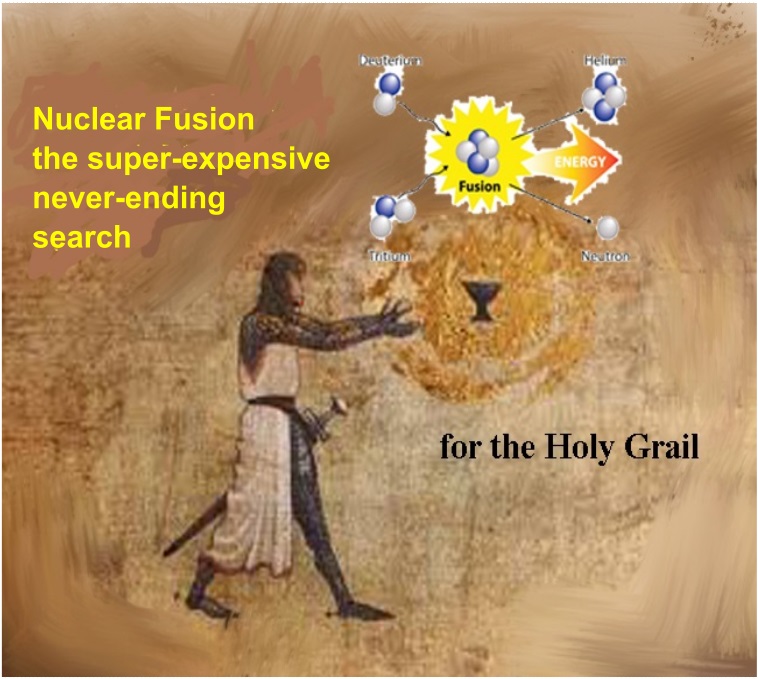
The 35-nation Iter project has a groundbreaking aim to create clean and limitless energy but it is turning into the ‘most delayed and cost-inflated science project in history’
Guardian, Robin McKie Science Editor, 4 Aug 24
It was a project that promised the sun. Researchers would use the world’s most advanced technology to design a machine that could generate atomic fusion, the process that drives the stars – and so create a source of cheap, non-polluting power.
That was initially the aim of the International Thermonuclear Experimental Reactor (Iter) which 35 countries – including European states, China, Russia and the US – agreed to build at Saint-Paul-lez-Durance in southern France at a starting cost of $6bn. Work began in 2010, with a commitment that there would be energy-producing reactions by 2020.
Then reality set in. Cost overruns, Covid, corrosion of key parts, last-minute redesigns and confrontations with nuclear safety officials triggered delays that mean Iter is not going to be ready for another decade, it has just been announced. Worse, energy-producing fusion reactions will not be generated until 2039, while Iter’s budget – which has already soared to $20bn – will increase by a further $5bn.
Other estimates suggest the final price tag could rise well above this figure and make Iter “the most delayed and most cost-inflated science project in history”, the journal Scientific American has warned. For its part, the journal Science has stated simply that Iter is now in “big trouble”, while Nature has noted that the project has been “plagued by a string of hold-ups, cost overruns and management issues”.
Dozens of private companies now threaten to create fusion reactors on a shorter timescale, warn scientists. These include Tokamak Energy in Oxford and Commonwealth Fusion Systems in the US.
“The trouble is that Iter has been going on for such a long time, and suffered so many delays, that the rest of the world has moved on,” said fusion expert Robbie Scott of the UK Science and Technology Facilities Council. “A host of new technologies have emerged since Iter was planned. That has left the project with real problems.”
A question mark now hangs over one of the world’s most ambitious technological projects in its global bid to harness the process that drives the stars. It involves the nuclei of two light atoms being forced to combine to form a single heavier nucleus, while releasing massive amounts of energy. This is nuclear fusion, and it only occurs at colossally high temperatures.
To create such heat, a doughnut-shaped reactor, called a tokamak, will use magnetic fields to contain a plasma of hydrogen nuclei that will then be bombarded by particle beams and microwaves. When temperatures reach millions of degrees Celsius, the mix of two hydrogen isotopes – deuterium and tritium – will fuse to form helium, neutrons and a great deal of excess energy.
Containing plasma at such high temperatures is exceptionally difficult. “It was originally planned to line the tokamak reactor with protective beryllium but that turned out to be very tricky. It is toxic and eventually it was decided to replace it with tungsten,” said David Armstrong, professor of materials science and engineering at Oxford University. “That was a major design change taken very late in the day.”
Then huge sections of tokamak made in Korea were found not to fit together properly, while threats that there could be leaks of radioactive materials led the French nuclear regulators to call a halt on the plant’s construction. More delays in construction were announced as problems piled up………………………………………………………….
For its part, Iter denies that it is “in big trouble” and rejects the idea that it is a record-breaking science project for cost overruns and delays. Just look at the International Space Station or for that matter the UK’s HS2 rail link, said a spokesman.
Others point out that fusion power’s limited carbon emissions would boost the battle against climate change. “However, fusion will arrive too late to help us cut carbon emissions in the short term,” said Aneeqa Khan, a research fellow in nuclear fusion at the University of Manchester. “Only if fusion power plants produce significant amounts of electricity later in the century will they help keep our carbon emissions down – and that will become crucial in the fight against climate change.” https://www.theguardian.com/technology/article/2024/aug/03/is-the-dream-of-nuclear-fusion-dead-why-the-international-experimental-reactor-is-in-big-trouble
No comments yet.
1 This Month


18 March Webinar @ 1 PM EST: An Assessment of SMR Projects: The Case of Canada
register for the zoom:
https://us02web.zoom.us/webinar/register/WN_o8BIIOUvQ2ONJR1nta65DQ#/registration


of the week – STOP SMALL MODULAR REACTORS IN CANADA
To see nuclear-related stories in greater depth and intensity – go to https://nuclearinformation.wordpress.com
-
Archives
- March 2026 (139)
- February 2026 (268)
- January 2026 (308)
- December 2025 (358)
- November 2025 (359)
- October 2025 (376)
- September 2025 (258)
- August 2025 (319)
- July 2025 (230)
- June 2025 (348)
- May 2025 (261)
- April 2025 (305)
-
Categories
- 1
- 1 NUCLEAR ISSUES
- business and costs
- climate change
- culture and arts
- ENERGY
- environment
- health
- history
- indigenous issues
- Legal
- marketing of nuclear
- media
- opposition to nuclear
- PERSONAL STORIES
- politics
- politics international
- Religion and ethics
- safety
- secrets,lies and civil liberties
- spinbuster
- technology
- Uranium
- wastes
- weapons and war
- Women
- 2 WORLD
- ACTION
- AFRICA
- Atrocities
- AUSTRALIA
- Christina's notes
- Christina's themes
- culture and arts
- Events
- Fuk 2022
- Fuk 2023
- Fukushima 2017
- Fukushima 2018
- fukushima 2019
- Fukushima 2020
- Fukushima 2021
- general
- global warming
- Humour (God we need it)
- Nuclear
- RARE EARTHS
- Reference
- resources – print
- Resources -audiovicual
- Weekly Newsletter
- World
- World Nuclear
- YouTube
-
RSS
Entries RSS
Comments RSS
 nuclear-news
Leave a comment