‘True horror’: Japan’s Hiroshima atomic bomb survivor campaigns for a nuclear-free world
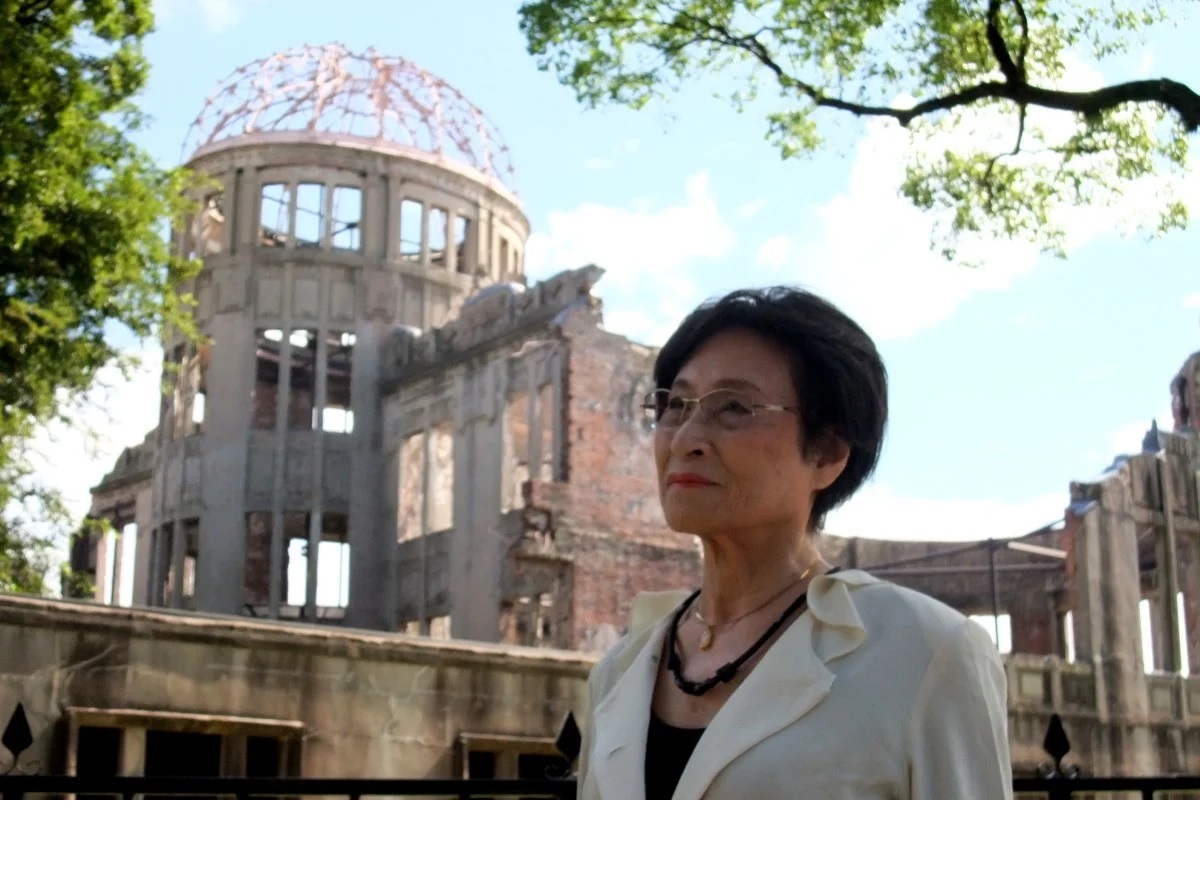
Bun Hashizume, 93, who has written poems about her descent into ‘hell’ after the bombing, has travelled the world to spread her message
Norman Aisbett, SCMP, 3 Aug 24,
What I feel the most about these days is human stupidity,” says 93-year-old Bun Hashizume, from her home in the Japanese temple city of Kamakura.
“I was a victim of the first atomic bomb in human history and I have advocated throughout my life for the abolition of nuclear weapons, but the world leaders still do not understand their true horror.
“Even my poems cannot describe it.”
Rewind to 8.15am on August 6, 1945 in the final throes of World War II.
A US atomic bomb named “Little Boy” was dropped from a B-29 aircraft and exploded at low altitude over the city of Hiroshima. With a blast force equal to 16 kilotons of TNT, it destroyed most buildings and caused mass death and injury.
Then aged 14, Hashizume was a war-mobilised school student working in the four-storey reinforced-concrete Savings Bureau building about 1.5km from the hypocentre of the blast.
Looking back, she recalls a third-floor window being filled “with a sudden flash of light that was so bright I thought the sun had fallen at my feet. A thousand rainbows all at once seemed to explode before my eyes”. And how, after being briefly unconscious and bleeding heavily from a head wound, she staggered downstairs among other workers looking “like a parade of ghosts with wildly dishevelled hair and sooty bodies”.
Once outside the building, it was a regular employee, Tomoyanagi, who “half-carried” her to a nearby Red Cross Hospital, where more shocking scenes and high drama followed.
Hashizume is today the author of The Day the Sun Fell – Memoirs of a Survivor of the Atomic Bomb – translated by Susan Bouterey – which closely details her and her family’s horrific experiences and also explains her present-day opposition to “dangerous” nuclear power plants, which she emphasises during this Australian writer’s long-distance interview with her, via a Japanese interpreter-admirer.
Her drive was such that, at age 70, she began her solo pilgrimages to many countries over 15 years to “become a citizen of the world” and share her anti-nuclear views. With only her aged pension to buy airline tickets and stay in youth hostels, she spoke to anyone or group willing to listen, including schoolchildren. Everywhere, people were also touched by her genuine personal warmth and quiet charm. A small booklet she handed out was entitled, “Fellow Humans! Let Us Foster Love and Wisdom.”
Right now, though, she is homebound due to A-Bomb-related health issues that have plagued her life. She tells of having endured “lifelong” rheumatism, chronic kidney disease, thyroid cancer and more. The past 20 years have also brought numerous breaks of radiation-weakened ribs, collarbones and three compressed fractures of her spine after a fall in Norway in 2003.
She is unable to go outside alone. There are twice-weekly visits to a hospital and three transports per week to a rehabilitation clinic. “Otherwise I’m on my bed reading the newspapers, with care from my eldest son and his family, who live with me.”
Her activist spirit nevertheless endures. She cites recent-times threats of nuclear strikes by North Korea if threatened; by Russia amid the Ukraine war; and an Israeli cabinet minister’s suggestion to nuke Hamas in Gaza The minister was promptly sacked by his embarrassed government which has never admitted that it has nuclear weapons – and subsequent high tensions and conflict between arch-enemies Israel and Iran.
{I believe that nuclear weapons should never be used, stockpiles should be completely abolished, and the Japanese government should join and ratify the Treaty on the Prohibition of Nuclear Weapons as soon as possible,” she says. “It’s no wonder they are being been used as a threat.” She further notes that nine nations have nuclear weapons, but the warheads of only two nations – Russia (5,890) and the US (5,224) – “are enough to destroy all life on Earth several times over”.
A major disappointment for her was the 28th United Nations Climate Change Conference (Cop28) in Dubai when 23 nations including the US and Japan declared they would triple the generation of their nuclear power plants to achieve zero greenhouse gas emissions by 2050.
“It is shocking that Japan joined this dangerous proposal despite the fact that the world’s pervasive emphasis on economic growth, baseless absolute trust in science and technology, and limitless pursuit of energy collapsed in Fukushima in 2011,” she says…………………………………………
After Tomoyanagi left to find her own family, a 16-year-old boy Yoshiaki Iida, who was unknown to Hashizume, helped her outside just before flames engulfed the whole building.
However, she later heard that her brother, Hideo, seven, had died after his back caught fire in an instant when hit from behind by the scorching A-Bomb blast in a school playground. Her other family members survived but with bad injuries and other health problems. Younger sister Shizuko, nine, had been evacuated to a temple when she was struck by the blast wave. Years of radiation sickness caused her suicide at age 19. Older sister Mitsuko, 19, suffered “ghastly” facial wounds at her grandmother’s house.
What does Hashizume remember most after the explosion? She replies: “The complete silence and the smell of burnt corpses that filled the air.”………………………………………………………………………………………………
The Day the Sun Fell – Memoirs of a Survivor of the Atomic Bomb by Bun Hashizume (translated by Susan Bouterey) is published by Austin Macauley Publishers Ltd and also available on Kindle. https://www.scmp.com/week-asia/people/article/3273031/true-horror-japans-hiroshima-atomic-bomb-survivor-campaigns-nuclear-free-world
No comments yet.
1 This Month

18 March Webinar @ 1 PM EST: An Assessment of SMR Projects: The Case of Canada
register for the zoom:
https://us02web.zoom.us/webinar/register/WN_o8BIIOUvQ2ONJR1nta65DQ#/registration

of the week – STOP SMALL MODULAR REACTORS IN CANADA
To see nuclear-related stories in greater depth and intensity – go to https://nuclearinformation.wordpress.com
-
Archives
- February 2026 (256)
- January 2026 (308)
- December 2025 (358)
- November 2025 (359)
- October 2025 (376)
- September 2025 (258)
- August 2025 (319)
- July 2025 (230)
- June 2025 (348)
- May 2025 (261)
- April 2025 (305)
- March 2025 (319)
-
Categories
- 1
- 1 NUCLEAR ISSUES
- business and costs
- climate change
- culture and arts
- ENERGY
- environment
- health
- history
- indigenous issues
- Legal
- marketing of nuclear
- media
- opposition to nuclear
- PERSONAL STORIES
- politics
- politics international
- Religion and ethics
- safety
- secrets,lies and civil liberties
- spinbuster
- technology
- Uranium
- wastes
- weapons and war
- Women
- 2 WORLD
- ACTION
- AFRICA
- Atrocities
- AUSTRALIA
- Christina's notes
- Christina's themes
- culture and arts
- Events
- Fuk 2022
- Fuk 2023
- Fukushima 2017
- Fukushima 2018
- fukushima 2019
- Fukushima 2020
- Fukushima 2021
- general
- global warming
- Humour (God we need it)
- Nuclear
- RARE EARTHS
- Reference
- resources – print
- Resources -audiovicual
- Weekly Newsletter
- World
- World Nuclear
- YouTube
-
RSS
Entries RSS
Comments RSS
 nuclear-news
Leave a comment