This nuclear waste site could soon host a massive solar installation
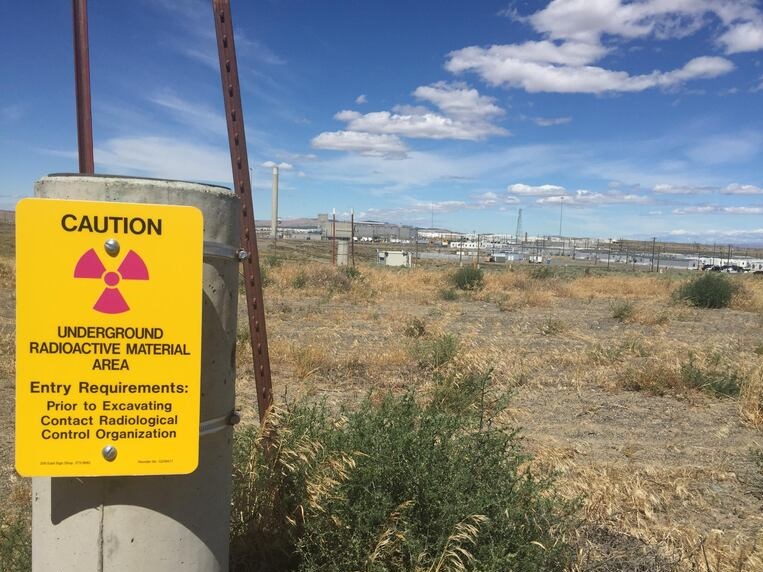
The Hanford Site in Washington state, a radioactive relic of the Manhattan Project and Cold War, was selected by DOE to be outfitted with up to 1GW of solar.
By Carrie Klein, 30 July 2024, https://www.canarymedia.com/articles/solar/this-nuclear-waste-site-could-soon-host-a-massive-solar-installation—
The U.S. Department of Energy announced plans last week to transform a contaminated former nuclear weapons production site into what could be the largest solar project in the country. The installation would stretch across up to 8,000 acres in south-central Washington state and boast up to 1 gigawatt of energy capacity — enough to power 750,000 homes.
One of the core challenges of building large solar installations is deciding where to put them. Local residents and farmers sometimes protest the use of agricultural land, while environmentalists urge caution in disturbing ecosystems. But this project location, known as the Hanford Site, is heavily contaminated from decades of atomic weapons production — first as part of the Manhattan Project and later during the Cold War.
Weapons production at Hanford created around 56 million gallons of radioactive and chemical waste, plus millions of cubic feet of solid waste and billions of gallons of less contaminated liquids. During production and upon Hanford’s decommissioning in the early 1990s, much of this waste was disposed of in concrete-lined pits, trenches, and ponds, and has since leached into the Columbia River basin, contaminating groundwater and causing health issues for locals.
Building solar at this location is “a great way to reuse land that has limited potential for other uses,” said Nels Johnson, senior advisor for renewable energy at The Nature Conservancy, who notes that “it means we’re not converting” prime farmland.
The project is part of the DOE’s new program Cleanup to Clean Energy, launched last year to help attain the climate goals in President Joe Biden’s 2021 executive order directing federal agencies to develop clean energy generation on their properties, with the goal of those agencies achieving 100 percent clean electricity by 2030.
The department announced the program’s first two projects — also solar installations — in June and July. One project will be located on 890 square miles of Idaho National Laboratory land and will feature 400 megawatts of solar capacity. The other will take up 2,400 acres of the Nevada National Security Site and has a capacity of 200 megawatts.
The Hanford project aims to generate the most energy by far — and, in addition to potentially becoming the largest solar project in the country, Johnson said that it would certainly be the largest on mine land, brownfield, or other degraded land.
Real estate negotiations are currently underway between the DOE and renewable energy developer Hecate Energy. Once an agreement is reached, Hecate will lead environmental reviews, including cultural resource surveys and consultations with local tribal nations, a DOE spokesperson told Canary Media. Hecate will also assess the impact of the proposed power generation on the grid to determine if any transmission upgrades are needed. These environmental and grid assessments could impact the ultimate size of the installation, according to the DOE.
The department declined to share a target timeline for the project.
In Benton County, where the Hanford Site sits, the Tri-City Development Council (TRIDEC) sees the solar installation as part of a larger transformation of the economy. The council, originally created to help diversify employment so the county was less dependent on federal funding, is planning several other renewable energy projects, along with “decarbonized manufacturing and industrial” projects, said Sean O’Brien, executive director at TRIDEC. “We very much envision that there will be a strong appetite for the electrons that this project will produce.”
Cleanup of the Hanford Site will be ongoing while the solar project moves forward into construction and operation in the coming years. “We can be doing both,” O’Brien said. The project itself will mostly be located on land that doesn’t require environmental remediation work, he said.
The Hanford Site is 560 square miles — about half the size of the state of Rhode Island. Since the late 1990s, workers have “cocooned,” or covered, seven nuclear reactors, removed 600 tons of contaminants from groundwater, and treated 32 billion gallons more. But decades of work still remain to fully remediate the site, O’Brien said. Adding solar to the site doesn’t change that, though it does at least put the land to productive use in the meantime.
No comments yet.
1 This Month
Chernobyl: The Lost Tapes – A good documentary on Chernobyl on SBS available On Demand for the next 3 weeks– https://www.sbs.com.au/ondemand/tv-program/chernobyl-the-lost-tapes/2352741955560

of the week–London Campaign for Nuclear Disarmament

Tell the Ukrainian Government to Drop Prosecution of Peace Activist Yurii Sheliazhenko
To see nuclear-related stories in greater depth and intensity – go to https://nuclearinformation.wordpress.com
-
Archives
- April 2026 (126)
- March 2026 (251)
- February 2026 (268)
- January 2026 (308)
- December 2025 (358)
- November 2025 (359)
- October 2025 (376)
- September 2025 (257)
- August 2025 (319)
- July 2025 (230)
- June 2025 (348)
- May 2025 (261)
-
Categories
- 1
- 1 NUCLEAR ISSUES
- business and costs
- climate change
- culture and arts
- ENERGY
- environment
- health
- history
- indigenous issues
- Legal
- marketing of nuclear
- media
- opposition to nuclear
- PERSONAL STORIES
- politics
- politics international
- Religion and ethics
- safety
- secrets,lies and civil liberties
- spinbuster
- technology
- Uranium
- wastes
- weapons and war
- Women
- 2 WORLD
- ACTION
- AFRICA
- Atrocities
- AUSTRALIA
- Christina's notes
- Christina's themes
- culture and arts
- Events
- Fuk 2022
- Fuk 2023
- Fukushima 2017
- Fukushima 2018
- fukushima 2019
- Fukushima 2020
- Fukushima 2021
- general
- global warming
- Humour (God we need it)
- Nuclear
- RARE EARTHS
- Reference
- resources – print
- Resources -audiovicual
- Weekly Newsletter
- World
- World Nuclear
- YouTube
-
RSS
Entries RSS
Comments RSS
 nuclear-news
Leave a comment