2-3 August, and 6-8 August Hiroshima Seen: Survivors and Witnesses Picture the Nuclear Age –
Learn more by exploring the galleries:
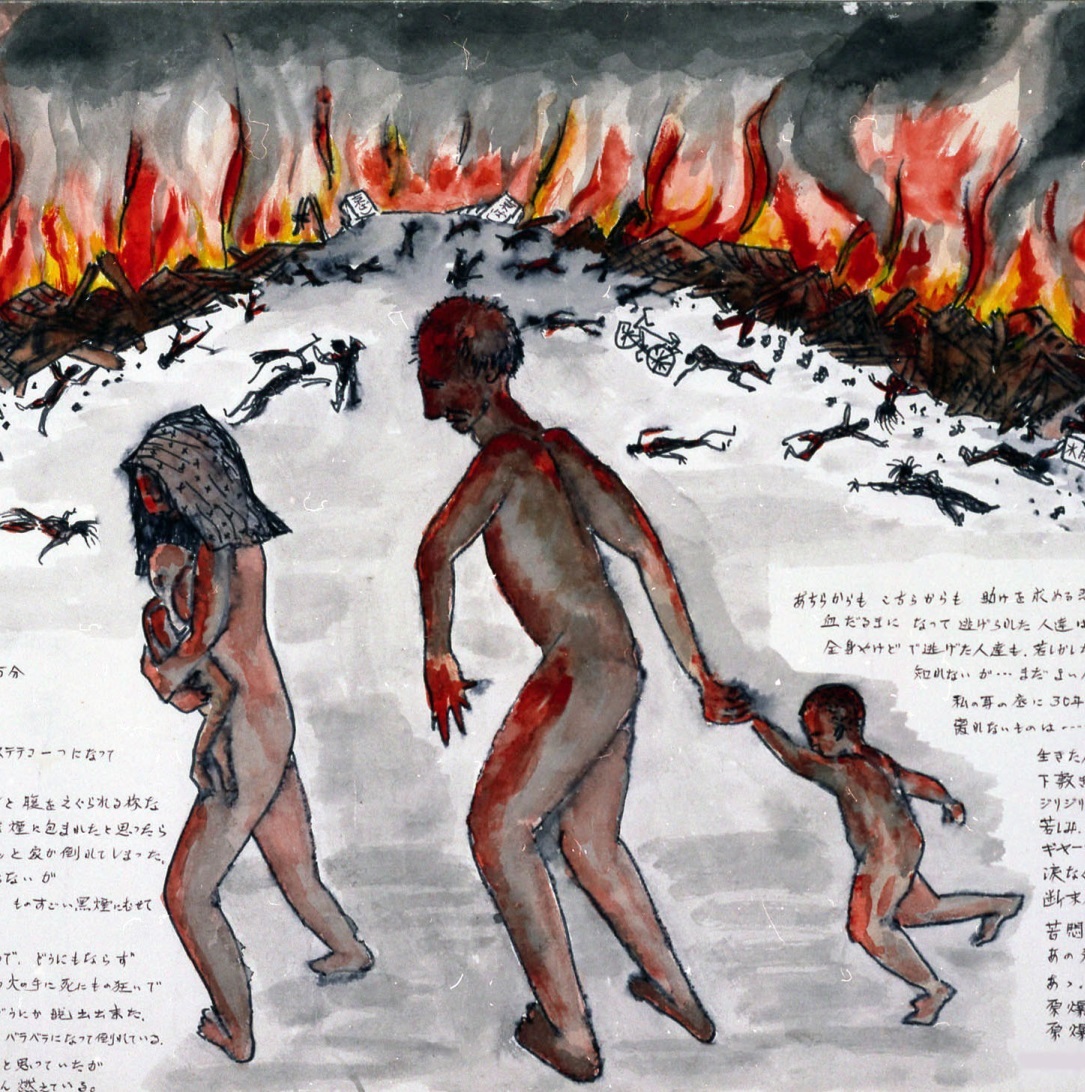
On August 6th, 1945, one U.S. B29 bomber dropped one bomb, code-named Little Boy, on the city of Hiroshima at 8:15 a.m. without warning. The destruction it loosened upon the city’s 300,000 inhabitants was unimaginable. Never had such a fierce weapon existed: its flash released heat up to one million degrees centigrade, the shock wave toppled some 60,000 buildings, a firestorm erupted that burned four square miles. Radioactive oily black rain fell—and many gasping for water opened their mouths to drink it.
Some 70,000 people perished instantly or within days, due to radiation poisoning and other grave injuries; 70,000 more died before the end of the year. Those exposed to radioactivity faced punishing illnesses, cancers, and disorders such as bone crushing fatigue and recurring bleeding. Due to the censorship imposed over the seven-year U.S. Occupation, personal stories were repressed, but not forgotten. More than 25 years after the bombing, survivors were asked to make drawings of what they remembered of that day, reflecting their harrowing memories. These images were donated to the Hiroshima Peace Memorial Museum, whose mission is to witness and educate about the devastating effects of nuclear warfare—and to prevent its ever happening again.
This exhibition is co-sponsored by Hiroshima Nagasaki Day Coalition (HNDC) and Artspace Gallery. Images are courtesy of the Hiroshima Peace Memorial Museum. Curated by Katy McCormick.
No comments yet.
1 This Month
Chernobyl: The Lost Tapes – A good documentary on Chernobyl on SBS available On Demand for the next 3 weeks– https://www.sbs.com.au/ondemand/tv-program/chernobyl-the-lost-tapes/2352741955560

of the week–London Campaign for Nuclear Disarmament

Tell the Ukrainian Government to Drop Prosecution of Peace Activist Yurii Sheliazhenko
To see nuclear-related stories in greater depth and intensity – go to https://nuclearinformation.wordpress.com
-
Archives
- April 2026 (126)
- March 2026 (251)
- February 2026 (268)
- January 2026 (308)
- December 2025 (358)
- November 2025 (359)
- October 2025 (376)
- September 2025 (257)
- August 2025 (319)
- July 2025 (230)
- June 2025 (348)
- May 2025 (261)
-
Categories
- 1
- 1 NUCLEAR ISSUES
- business and costs
- climate change
- culture and arts
- ENERGY
- environment
- health
- history
- indigenous issues
- Legal
- marketing of nuclear
- media
- opposition to nuclear
- PERSONAL STORIES
- politics
- politics international
- Religion and ethics
- safety
- secrets,lies and civil liberties
- spinbuster
- technology
- Uranium
- wastes
- weapons and war
- Women
- 2 WORLD
- ACTION
- AFRICA
- Atrocities
- AUSTRALIA
- Christina's notes
- Christina's themes
- culture and arts
- Events
- Fuk 2022
- Fuk 2023
- Fukushima 2017
- Fukushima 2018
- fukushima 2019
- Fukushima 2020
- Fukushima 2021
- general
- global warming
- Humour (God we need it)
- Nuclear
- RARE EARTHS
- Reference
- resources – print
- Resources -audiovicual
- Weekly Newsletter
- World
- World Nuclear
- YouTube
-
RSS
Entries RSS
Comments RSS
 nuclear-news
Leave a comment