Landmark Swedish Court Judgment against Nuclear Waste Repository.

Landmark Swedish Court Judgment against Nuclear Waste Repository: Read the English Translation http://www.dianuke.org/landmark-swedish-court-judgment-nuclear-waste-repository-read-english-translation/
MKG, the Swedish NGO Office for Nuclear Waste Review has made an unofficial translation into English of the Swedish Environmental Court opinion on the power industry’s Nuclear Waste Company SKB’s license application for a final repository for spent nuclear fuel in Forsmark, Sweden.
The court said no to the application because it considered that there were problems with the copper canister that had to be resolved now and not later. The translation shows the courts judicial argumentation and why it decided not to accept the regulator SSM’s opinion that the problems with the integrity of the copper canister were not serious and could likely be solved at a later stage in the decision-making process.
The main difference between the court’s and the regulator’s decision-making was that the court decided to rely on a multitude of scientific sources and information and not only on the material provided by SKB. It had also been uncovered that the main corrosion expert at SSM did not want to say yes to the application at this time that may have influenced the court’s decision-making. In fact there appear to have been many dissenting voices in the regulator despite the regulator’s claim in the court that a united SSM stood behind its opinion.
The court underlines in its opinion that the Environmental Code requires that the repository should be shown to be safe at this stage in the decision-making process, i.e. before the government has its say. The court says that some uncertainties will always remain but it sees the possible copper canister problems as so serious that it is not clear that the regulator’s limits for release of radioactivity can be met. This is a reason to say no to the project unless it can be shown that the copper canister will work as intended. The copper canister has to provide isolation from the radioactivity in the spent nuclear fuel to humans and the environment for very long time-scales.
It is still unclear how the process will proceed. The community of Östhammar has cancelled the referendum on the repository, as there will be no question from the government in the near future. The government has set up a working group of civil servants to manage the government’s handling of the opinions delivered by the court and SSM. SSM has told the government that it is ok to say yes to the license application.
The court has stated that there are copper canister issues that need to be considered further. The nuclear waste company SKB has said that it is preparing documentation for the government to show that there are no problems with the canister. Whether the government thinks that this will be enough remains to be seen. This is likely not what the court had in mind. The government would be wise to make a much broader review of the issue. There is a need for a thorough judicial review on the governmental level in order to override the court’s opinion. Otherwise the government’ decision may not survive an appeal to the Supreme Administrative Court.
 There are eminent corrosion experts that are of the opinion that copper is a bad choice as a canister material. There is also increasing experimental evidence that this is the case. One problem for the court was likely that SKB has hesitant to do the required corrosion studies that show that copper does not corrode in an anoxic repository environment. The 18-year FEBEX field test shows that copper corrodes relatively rapidly with pitting corrosion. SKB says that all corrosion is due to in-leaking oxygen but it is now clear that experimental systems containing copper and clay become anoxic within weeks or months so this explanation is not valid.
MKG has for long wanted SKB to retrieve the next experimental package in the LOT field test in the Äspö Hard Rock Laboratory. SKB had refused. The remaining packages have now been heated for 18 years. When a 5-year package was retrieved in 2006 it was discovered that there was “unexpectedly high corrosion”. There is clearly a need for more lab and field test results to decide whether copper is a good and safe choice for a canister material.
The court’s decision-making shows the importance of a democratic and open governance in environmental decision-making. It is important that the continued decision-making regarding the Swedish repository for spent nuclear is transparent and multi-faceted.
Climate hazards impact more than four-fifths of cities worldwide, study finds

New research has revealed that 83% of cities worldwide are dealing with
significant climate hazards, up from 80% in 2022, with flooding and extreme
heat being the most widespread challenges facing urban areas globally. As
global temperature records continue to be broken for the 12th consecutive
month, new data from CDP – the non-profit organisation managing voluntary
environmental disclosures from cities and businesses – indicates that
flooding and extreme heat are the most pervasive impacts of climate change
affecting cities worldwide. In 2023, 1,131 cities reported their
environmental data through CDP-ICLEI Track. More than 83% of these cities
reported significant climate hazards, an increase from 80% in 2022. More
than half (56%) are already experiencing substantial impacts from these
hazards. Looking ahead, around two-thirds of the cities expect these
hazards to become more intense (67%) and more frequent (64%). Flooding was
the most reported hazard, with 58% of cities identifying it as a concern,
followed by extreme heat (54%), drought (38%), heavy rain (35%) and the
risk of wildfires (22%).
Edie 3rd July 2024
https://www.edie.net/climate-hazards-impact-more-than-four-fifths-of-cities-worldwide-study-finds/
Ukrainian drones injure Zaporizhzhia nuclear power plant workers, say Russian-backed officials
By Reuters, July 4, 2024, https://www.reuters.com/world/europe/ukrainian-drones-injure-zaporizhzhia-nuclear-power-plant-workers-say-russian-2024-07-03/—
MOSCOW, July 3 (Reuters) – A Ukrainian drone attack injured eight workers from the Russian-controlled Zaporizhzhia nuclear power plant and left a nearby town largely without power and water, Russian-backed officials said on Wednesday.
In a statement on Telegram, the plant’s management said that eight staff had been injured during an attack by three Ukrainian kamikaze drones on an electricity substation near the plant in south-eastern Ukraine.
It said all of the injured workers were receiving medical treatment.
Reuters was not able to independently confirm what had happened and there was no immediate comment from Ukraine.
Eduard Senovoz, the Russian-installed mayor of the nearby city of Enerhodar where the plant’s workers live, said in a statement that the attack had left most of the city without power and water.
The attack was the third of its kind within two weeks, he said, adding that work was underway to repair the damage to the substation.
Alexei Likhachev, director general of Rosatom, Russia’s state nuclear corporation, said the attack was the first time that the power plant’s workers had been deliberately put in danger.
In comments to Russian state TV channels, Likhachev called on the Vienna-based U.N. nuclear watchdog, the International Atomic Energy Agency (IAEA), to assess what had happened.
“IAEA head Rafael Grossi has repeatedly said that the activities of nuclear cities, the lives of people, and especially the lives of nuclear power plant workers are ‘sacred’ elements of nuclear safety. Today they have been defiantly violated,” Likhachev said.
The IAEA last month called for a halt to attacks on Enerhodar after earlier attacks on electricity substations in the area.
The nuclear and renewable myths that mainstream media can’t be bothered challenging

Mark Diesendorf, Jul 4, 2024, https://reneweconomy.com.au/the-nuclear-and-renewable-myths-that-mainstream-media-cant-be-bothered-challenging/
Nuclear energy proponents are attempting to discredit renewable energy and promote nuclear energy and fossil gas in its place. This article refutes several myths they are disseminating that are receiving little or no challenge in the mainstream media.
Myth: Renewables cannot supply 100% electricity
Denmark, South Australia and Scotland already obtain 88, 74 and 62 per cent of their respective annual electricity generations from renewables, mostly wind. Scotland actually supplies 113 per cent of its electricity consumption from renewables; the difference between its generation and consumption is exported by transmission line.
All three jurisdictions have achieved this with relatively small amounts of hydroelectricity, zero in South Australia. Given the political will, all three could reach 100% net renewables generation by 2030, as indeed two northern states of Germany have already done. The ‘net’ means that they trade some electricity with neighbours but on average will be at 100% renewables.
Computer simulations by several research groups – using real hourly wind, solar and demand data spanning several years – show that the Australian electricity system could be run entirely on renewable energy, with the main contributions coming from solar and wind. System reliability for 100% renewables will be maintained by a combination of storage, building excess generating capacity for wind and solar (which is cheap), key transmission links, and demand management encouraged by transparent pricing.
Storage to fill infrequent troughs in generation from the variable renewable sources will comprise existing hydro, pumped hydro (mostly small-scale and off-river), and batteries. Geographic dispersion of renewables will also assist managing the variability of wind and solar. For the possibility of rare, extended periods of Dunkelflaute (literally ‘dark doldrums’), gas turbines with stores of biofuels or green hydrogen could be kept in reserve as insurance.
Myth: Gas can fill the gap until nuclear is constructed
As a fuel for electricity generation, fossil gas in eastern Australia is many times more expensive per kilowatt-hour than coal. It is only used for fuelling gas turbines for meeting the peaks in demand and helping to fill troughs. For this purpose, it contributes about 5% of Australia’s annual electricity generation. But, as storage expands, fossil gas will become redundant in the electricity system.
The fact that baseload gas-fired electricity continues temporarily in Western Australia and South Australia is the result of peculiar histories that will not be repeated. Unlike the eastern states, WA has a Domestic Gas Reservation Policy that insulates customers from the high export prices of gas.
However, most new gas supplies would have to come from high-cost unconventional sources. South Australia’s ancient, struggling, baseload, gas-fired power station, Torrens Island, produces expensive electricity. It will be closed in 2026 and replaced with renewables and batteries.
Myth: Nuclear energy can co-exist with large contributions from renewables
This myth has two refutations:
- Nuclear is too inflexible in operation to be a good partner for variable wind and solar. Its very high capital cost necessitates running it constantly, not just during periods of low sun or wind. Its output can only be ramped up and down slowly, and it’s expensive to do that.
- On current growth trends of renewables, there will be no room for nuclear energy in South Australia, Victoria or NSW. The 2022 shares of renewables in total electricity generation in each of these states were 74%, 37% and 33% respectively.
Rapid growth from these levels is likely. It’s already too late for nuclear in SA. Provided the growth of renewables is not deliberately suppressed in NSW and Victoria, these states too could reach 100% renewables before the first nuclear power station comes online.
As transportation and combustion heating will be electrified, demand for electricity could double by 2050. This might offer generating space for nuclear in the 2040s in Queensland (23% renewables in 2022) and Western Australia (20% renewables in 2022). However, the cost barrier would remain.
Myth: There is insufficient land for wind and solar
The claim by nuclear proponents that wind and solar have “vast land footprints” is misleading. Although a wind farm can span a large area, its turbines, access road and substation occupy a tiny fraction of that area, typically about 2%.
Most wind farms are built on land that was previously cleared for agriculture and are compatible with all forms of agriculture. Off-shore wind occupies no land.

Solar farms are increasingly being built sufficiently high off the ground to allow sheep to graze beneath them, providing welcome shade. This practice, known as agrivoltaics, provides additional farm revenue, which is especially valuable during droughts. Rooftop solar occupies no land.
Myth: The longer lifetime of nuclear reactors hasn’t been taken into account
The levelised cost of energy method – used by CSIRO, AEMO, Lazard and others – is the standard way of comparing electricity generation technologies that perform similar functions.
It permits the comparison of coal, nuclear and firmed renewables. It takes account automatically of the different lifetimes of different technologies.
Myth: We need baseload power stations
The recent claim that nuclear energy is not very expensive “when we consider value” is just a variant of the old, discredited claim that we need baseload power stations, i.e. those that operate 24/7 at maximum power output for most of the time.
The renewable system, including storage, delivers the same reliability, and hence the same value, as the traditional system based on a mix of baseload and peak-load power stations.
When a nuclear power reactor breaks down, it can be useless for weeks or months. For a conventional large reactor rated at 1000 to 1600 megawatts, the impact of breakdown on electricity supply can be disastrous.
Big nuclear needs big back-up, which is expensive. Small modular reactors do not exist––not one is commercially available or likely to be in the foreseeable future.
Concluding remarks
We do not need expensive, dangerous nuclear power, or expensive, polluting fossil gas. A nuclear scenario would inevitably involve the irrational suppression of renewables.
The ban on nuclear power should be maintained because nuclear never competes in a so-called ‘free market’. Renewables – solar, wind and existing hydro – together with energy efficiency, can supply all Australia’s electricity.
Mark Diesendorf is Honorary Associate Professor at the Environment & Society Group in the School of Humanities & Languages and Faculty of Arts, Design & Architecture at UNSW. First published in Pearls and Irritations. Republished with permission of the author.
US announces more than $2 billion package for Ukraine

BY BRAD DRESS – 07/02/24, https://thehill.com/policy/defense/4752120-biden-administration-lloyd-austin-2-million-ukraine-aid-package/
Defense Secretary Lloyd Austin announced a $2.3 billion security assistance package for Ukraine ahead of a meeting with his Ukrainian counterpart Tuesday.
The package will include critical air defense interceptors and other weapons. A spokesperson for the Pentagon said more details on the package would be made available soon.
Austin met with Ukrainian Defense Minister Rustem Umerov at the Pentagon on Tuesday and underscored the U.S. commitment to defending the country against a Russian invasion.
“Ukraine is in a tough fight,” Austin said in remarks ahead of the meeting, adding “make no mistake, Ukraine is not alone.”
The Pentagon chief also noted that the U.S. has signed a 10-year bilateral security agreement with Ukraine, providing Kyiv with defense cooperation guarantees over a decade. He added that he would discuss with Umerov additional ways to strengthen the partnership.
The U.S. has announced billions of dollars of assistance to Ukraine since the last congressional package of some $60 billion was approved in April. That legislation came after months of delays, giving Russia the advantage on the battlefield before more U.S. aid began arriving on the battlefield.
Ukrainian troops are fighting across the 600-mile front against Russian forces, including in the northeastern Kharkiv region, where Moscow opened a new front in May.
Israel Has Forcibly Displaced 1.9 Million Palestinians in Gaza
Israel’s assault has displaced over 1 million people just since May, a UN human rights official said.
SCHEERPOST, By Sharon Zhang , TRUTHOUT, July 2, 2024
srael’s ongoing assault in Gaza has now forcibly displaced 1.9 million Palestinians, a UN humanitarian official reported on Tuesday as Israel forced another round of evacuations for hundreds of thousands of people across southern and central Gaza.
Israel’s brutal assault and humanitarian blockade has turned Gaza into an “abyss of suffering” and a “maelstrom of human misery,” said Sigrid Kaag, UN Senior Humanitarian and Reconstruction Coordinator for Gaza, in an address to the UN Security Council.
“Following the Israeli offenses against Rafah, since the sixth of May, over 1 million people have been displaced once again, desperately seeking shelter and safety,” said Kaag. “One point nine million people are now displaced across Gaza.”
This amounts to over 86 percent of the 2.2 million person population of Gaza displaced — though the proportion may be larger when the number of Palestinians who have been killed, are missing under the rubble or have died in ways that officials aren’t recording are subtracted from the population estimates. The number of displaced people is up from 1.7 million Palestinians who UN officials said had been forced out of their homes in earlier estimates……………………………………………………………………………………………………………………………
Meanwhile, Israeli forces are also fiercely attacking Gaza City in the north. This has sparked an “exodus” from the eastern part of the city, the UN reported, after days of intense bombardments and tanks entering the region.
According to the UN, about 84,000 Palestinians have been displaced by this massacre, with most families having already fled areas multiple times, their supplies and energy dwindling amid Israel’s intensified famine campaign.
UNRWA’s communications head Louise Wateridge reported from a recent trip to Gaza that the region is “apocalyptic — most people have lost their homes, either completely or partially, and have to flee with very few belongings; essentially what they can carry in their hands.” https://scheerpost.com/2024/07/03/israel-has-forcibly-displaced-1-9-million-palestinians-in-gaza/
Tory accused of exaggerating chances of new nuclear plant
Martin Shipton, Net Zero Investor 2nd July 2024
The Conservative candidate for the three-way marginal seat of Ynys Môn has been accused of exaggerating the possibility of a new nuclear power station being developed on the island.
Dr Jonathan Dean, a trustee of the Campaign for the Protection of Rural Wales, submitted a freedom of information request to the UK Government’s Department for Energy Security and Net Zero (DESNZ), seeking a copy of the evaluation report that Wylfa, on Ynys Môn, should be selected as the next large nuclear site after Sizewell C.
He says he was surprised to be told that Wylfa had not been confirmed as the next big nuclear site.
Instead, he was told by DESNZ: “To date, while Wylfa has been announced as the preferred location for a further large nuclear reactor, final decisions on sites and technologies have not been made.”……………………………………………………….
‘Firm commitment’
A leaflet distributed as part of Ms Crosbie’s campaign states: “I am delighted that after much hard work on May 22 2024 the UK Government gave a firm commitment to a gigawatt new nuclear plant at Wylfa………………..
Dr Dean said: “Maybe the announcement was just to boost Virginia Crosbie’s election chances after all?”………………………………
Net Zero Investor 2nd July 2024
https://www.netzeroinvestor.net/news-and-views/nuclear-energy-appetite-growing-but-challenges-remain
Huge ITER fusion nuclear reactor is finally completed. But it won’t run for another 15 years.
By Ben Turner , Live Science 3 July 24
ITER, a $28 billion fusion reactor in France, has finally had its last magnetic coil installed. But the reactor itself won’t fire up fully until 2039 at the earliest.
The world’s largest fusion reactor has finally been completed, but it won’t run for another 15 years, project scientists have announced.
The International Fusion Energy Project (ITER) fusion reactor, consisting of 19 massive coils looped into multiple toroidal magnets, was originally slated to begin its first full test in 2020. Now scientists say it will fire in 2039 at the earliest.
This means that fusion power, of which ITER’s tokamak is at the forefront, is very unlikely to arrive in time to be a solution for the climate crisis.
“Certainly, the delay of ITER is not going in the right direction,” Pietro Barabaschi, ITER’s director general, said at a news conference on Wednesday (July 3). “In terms of the impact of nuclear fusion on the problems humanity faces now, we should not wait for nuclear fusion to resolve them. This is not prudent.”
The world’s largest nuclear reactor and the product of collaboration between 35 countries — including every state in the European Union, the U.K., China, India and the U.S. — ITER contains the world’s most powerful magnet, making it capable of producing a magnetic field 280,000 times as strong as the one shielding Earth.
The reactor’s impressive design comes with an equally hefty price-tag. Originally slated to cost around $5 billion and fire up in 2020, it has now suffered multiple delays and its budget swelled beyond $22 billion, with an additional $5 billionproposed to cover additional costs. These unforeseen expenses and delays are behind the most recent, 15-year delay……………………………………………………………… https://www.livescience.com/physics-mathematics/worlds-largest-nuclear-reactor-is-finally-completed-but-it-wont-run-for-another-15-years
The world must stop creating nuclear garbage.

At last a journalist has tackled the issue of nuclear waste. Yet, even Austyn Gaffney , writing in Grist, , did not dare to suggest the obvious first move to control this monstrous problem. –
Stop making nuclear waste
The nuclear lobby boasts that Finland has solved this problem.:
Great copper and cast iron casks up to two stories tall will be lowered deep into a bedrock tomb, to bury toxic nuclear wastes that will remain toxic for many thousands of years.
And Finland got that essential precious jewel – community consent. But did they, really?
Finland’s KBS-3 nuclear waste disposal system was designed by Swedish Nuclear Fuel and Waste Management Company, SKB., but rejected by Swedish Environmental Court. “The foremost reason is that as the project was being discussed with the public, SKB’s research was found to be incomplete and, in certain cases, inaccurate.
When, in 2011, Sweden’s SKB first applied for a license to build the Forsmark repository, the KBS-3 project documentation was published, which made it possible to give the project a review that would be independent from the nuclear industry’s own evaluation.
In February 2016, a special expert group appointed by the government, called the Swedish National Council for Nuclear Waste (Kärnavfallsrådet), published a 167-page report entitled “Nuclear Waste State-of-the-Art Report 2016: Risks, uncertainties and future challenges.” Among other things, it identifies the repository project’s risks and uncertainties having to do with earthquake impacts, with the long-term prospects of financing and monitoring the site’s condition, and with the health effects of low doses of radiation.
Finland has no such expert body. The concept of the repository, under construction in Euroajoki municipality, is criticized by many Finnish scientists, but the government is not taking notice and is likewise ignoring the scientific objections coming from its neighbor Sweden.“
With the proliferation of all kinds of nuclear facilities, big and small, – what about RADIOACTIVITY AND HUMAN HEALTH, , SAFETY, ENVIRONMENT, WEAPONS PROLIFERATION, TERRORISM RISKS ?
– NAH – they don’t matter. WHAT MATTERS IS COMMUNITY CONSENT.
And, I commend Austyn Gaffney, for quietly shedding light on the salient facts here:
In the USA the Federal Government (not the nuclear companies) has the legal responsibility for the nuclear waste. And it is sort of committed to “consent-based” siting of waste dumps, since it was forced by community opposition do dump its old Nevada nuclear dump plan.
Even in Finland, a campaign to get community consent took many years, and the community got inadequate information, and Finland had a string tradition of trust in the government.
In Canada – it’s been a worse story. The government, (helped by subservient media) has had to resort to all sorts of bribery. And those pesky First Nations, who love the land, the environment, have not been all that willing to accept waste dumps, even with the bribery.
The thing is – people can be more easily conned into having a toxic nuclear waste dump nearby, if they already have nuclear facilities, and if they get the various government bribes, and of course – the perpetual promise of jobs jobs jobs.
But there would be plenty of jobs in shutting down nuclear facilities too.
Why does nobody, – not even that excellent writer, Austyn Gaffney – ever suggest that logical first step?
French nuclear giant scraps SMR plans due to soaring costs, will start over.
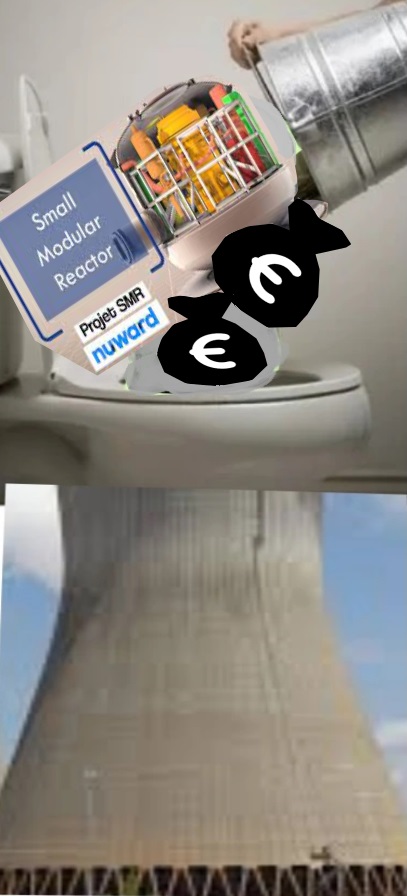
Another Small Modular Nuclear Reactor project goes down the toilet
This time it’s that great nuclear poster boy France that is facing the humiliation and embarrassment of wasting billions on “New Nuclear”
Last time it was the USA with the NuScale fiasco
Giles Parkinson Jul 2, 2024, https://reneweconomy.com.au/french-nuclear-giant-scraps-smr-plans-due-to-soaring-costs-will-start-over/
The French nuclear giant EdF, the government owned company that manages the country’s vast fleet of nuclear power stations, has reportedly scrapped its plans to develop a new design for small nuclear reactors because of fears of soaring costs.
EdF, which is now fully government owned after facing potential bankruptcy due to delays and massive cost over-runs at its latest generation large scale nuclear plants, had reportedly been working on a new design for SMRs for the last four years.
The French investigative outlet L’Informé reported on Monday that EdF had scrapped its new internal SMR design – dubbed Nuward – because of engineering problems and cost overruns. It cited company sources as saying EdF would now partner with other companies to use “simpler” technologies in an attempt to avoid delays and budget overruns.
Reuters confirmed the development, citing an email from a company spokesman that confirmed the program had been abandoned after the basic design had been completed.
“The reorientation consists of developing a design built exclusively from proven technological bricks. It will offer better conditions for success by facilitating technical feasibility,” an EDF spokesperson told Reuters via email.
Continue readingWhy Julian Assange couldn’t outrun the Espionage Act

the grave threat the Espionage Act poses to journalism and the First Amendment
SOTT, Jordan Howell The FIRE, Wed, 26 Jun 2024
Julian Assange spent seven years in self-exile in London’s Ecuadorian Embassy avoiding arrest, and five more in prison, for publishing classified documents on WikiLeaks.
Julian Assange is a free man, and one of the most contentious press freedom controversies in living memory may finally be coming to a close.
The WikiLeaks founder reached a plea deal with the Department of Justice on Monday after spending five years in an English prison fighting extradition to the United States. Federal officials sought to charge Assange with conspiracy to obtain and disclose national security information under the Espionage Act of 1917.
Assange and WikiLeaks shocked the world in 2010 by publishing hundreds of thousands of secret military documents and diplomatic cables related to the wars in Iraq and Afghanistan that were leaked by Army intelligence analyst Chelsea Manning. Months later, Assange was on the run and Manning was in jail.
Assange claimed that by receiving and publishing confidential information, what he did was no different than the type of routine news reporting that journalists around the world engage in every day. As the Supreme Court ruled in New York Times Co. v. United States (1971), better known as “The Pentagon Papers” case, publishing leaked documents is protected under the First Amendment.
FIRE has long opposed use of the Espionage Act to curtail the rights of journalists to source information. And in December 2022, FIRE signed an open letter organized by the Committee to Protect Journalists along with 20 other civil liberties groups calling on the federal government to drop its charges against Assange.
“We are united . . . in our view that the criminal case against him poses a grave threat to press freedom both in the United States and abroad,” we argued. “[J]ournalists routinely engage in much of the conduct described in the indictment: speaking with sources, asking for clarification or more documentation, and receiving and publishing official secrets. News organizations frequently and necessarily publish classified information in order to inform the public of matters of profound public significance.”
Assange’s 12 year ordeal, including seven years in self-exile in the Ecuadorian Embassy in London before his arrest and imprisonment, underscores the continued threat that the century-old Espionage Act still poses to civil liberties today — and not just in the United States. Assange is not a U.S. citizen, nor was he ever a resident. But because of modern extradition treaties, there were few places in the world where he could travel to escape the Act’s reach,
Under the terms of Monday’s deal, Assange pleaded guilty to the charges and was sentenced to 62 months incarceration, but with credit for time served, according to documents filed with the U.S. District Court for the Northern Mariana Islands.
Ultimately, freedom of the press is what was at stake with the government’s case against Assange. It was never only about him. The precedent that would have been set by his extradition and trial would have sent a chilling message to journalists across the country and the world: You can run, but you can’t hide from the Espionage Act.
What is the Espionage Act?……………………………………………………………………………………….Based on the Defense Secrets Act of 1911, the Espionage Act of 1917 included much stiffer penalties — including the death penalty — for sharing secret or confidential information or otherwise interfering with the operations of the U.S. military.
The Espionage Act made it a crime to obtain information regarding national defense “with intent or reason to believe” that doing so would hurt the U.S. or to advantage another country. While subsequent amendments and court decisions have refined its language and scope, its core purpose remains the same.
Espionage Act and the Supreme Court
The law was immediately controversial because its use was not limited to actual acts of espionage. Rather, the Espionage Act allowed the government to clamp down on anyone who opposed the war effort.
In Schenck v. United States, in 1919, the Supreme Court upheld the conspiracy conviction against socialist Charles Schenck under the Espionage Act for distributing anti-war leaflets that urged people to boycott the draft.
The problem with the Court’s ruling in Schenck, as subsequent decisions would affirm, is that Schenk’s speech was not calling for violence or even civil disobedience. Rather, his speech was precisely the kind of political expression that decades of subsequent Supreme Court decisions would ultimately uphold. Numerous convictions under the Espionage Act would make their way to the Court, including that of socialist presidential candidate Eugene Debs, who was arrested for giving a speech opposing the war.
Since then, one of the most nefarious uses of the Espionage Act has been to silence journalists. At least insofar as publishing the leaked documents on the Wikileaks website, what Assange did was little different than what The New York Times and The Washington Post did in 1971 when they published and reported on thousands of pages from a classified report about the war in Vietnam.
……………………………………….As the Supreme Court has ruled, freedom of the press is a foundational principle, enshrined in the Bill of Rights. And though Julian Assange is finally free, FIRE continues to have serious concerns about the grave threat the Espionage Act poses to journalism and the First Amendment. https://www.sott.net/article/492768-Why-Julian-Assange-couldnt-outrun-the-Espionage-Act
You Don’t Want to Live in America’s ‘Nuclear Sponge’

military planners often describe ICBMs as a “nuclear sponge” that would soak up hundreds of Russian warheads as they tried to destroy the missiles before they could launch.
People living in Montana, North Dakota, Wyoming and Colorado may not think of their homes as “nuclear sponges” but that is one of the primary justifications for ICBMs today………. . ICBMs are sitting ducks
By Joseph Cirincione, National Security Analyst, 3 July 24, https://www.newsweek.com/you-dont-want-live-americas-nuclear-sponge-opinion-1919646
ou have to be a real optimist to think that we can keep thousands of nuclear weapons in fallible human hands indefinitely and nothing terrible will happen. Something terrible will happen—and it could mean the end of human civilization.
The risks are growing. Today, nine nations hold over 12,000 nuclear weapons, each many times more powerful than those used on Japan. The United States and Russia have most of them—about 90 percent of the global total—but China may be trying to catch up.
The fear that China might increase its nuclear arsenal from some 500 to 1,000 weapons has fueled calls for America to abandon all arms control limits and vastly increase its stockpile of some 5,000 weapons. In fact, massive new programs to build a new generation of nuclear-armed bombers, submarines and missiles were well under way before China began its build up—and may well have triggered China’s move.
The cost of this new nuclear arms race is high. A new report shows that global spending on nuclear weapons jumped last year—and that the United States accounted for 80 percent of that increase.
The global costs and the U.S. share will grow. This year, U.S. spending climbed again to more than $70 billion. The Congressional Budget Office estimates that the government will spend over $750 billion on nuclear weapons over the next 10 years. The total modernization cost will likely be over $2 trillion. Add in the $30 billion a year spent on programs to try to intercept ballistic missiles and the cost goes from unimaginable to unaffordable.
It gets worse. The Air Force just disclosed that the price of its new intercontinental ballistic missile (ICBM) has jumped 37 percent. Originally, the Air Force claimed that replacing the existing force of 400 Minuteman III missiles would cost only $62 billion. That rose to $95 billion, then to more than $125 billion (plus tens of billions more for the nuclear warheads). In a new report, the watchdog group, Taxpayers for Common Sense, warns that the price tag could hit $315 billion.
For a family, a cost increase of 37 percent on a house or car they want to buy would certainly change their minds. Even for the Pentagon, this hike was “a critical breach” of cost projections, triggering a rare report to Congress.
This is likely why defense contractors are working furiously with their Congressional supporters to defend the program, supplying members with talking points and briefings, in addition to the generous contributions that flow into their campaign coffers. Members in the few states that have nuclear bases also do not want to lose the considerable economic benefits they provide.
Thus, Sen. Deb Fischer, a Republican from Nebraska, home to the Strategic Command, pleads in her recent piece for Newsweek, to continue the programs no matter what the cost. She argues that “Our ground-based intercontinental ballistic missiles (ICBMs) are indispensable. …by virtue of their location in our heartland, [they] are also unlikely to be targeted by enemy attacks.”
That would be a surprise to military planners who often describe ICBMs as a “nuclear sponge” that would soak up hundreds of Russian warheads as they tried to destroy the missiles before they could launch. This would complicate an adversary’s planning so severely that it would discourage any attack, the theory goes.
People living in Montana, North Dakota, Wyoming and Colorado may not think of their homes as “nuclear sponges” but that is one of the primary justifications for ICBMs today. Formerly valued as being more accurate and faster to launch than missiles from submarines, that is no longer the case. As the Taxpayers report notes. “Both ballistic missile submarines and nuclear-armed aircraft carry more accurate and powerful nuclear weapons than they used to,” allowing them to destroy even the most hardened target. Meanwhile, “the survivability of U.S. ICBMs has steadily declined as U.S. adversaries have developed more powerful and accurate nuclear weapons.”
Submarines are undetectable and bombers can be scrambled. ICBMs are sitting ducks that must be launched on warning of an enemy attack, stressing their human controllers to decide within minutes whether to launch Armageddon. Former Secretary of Defense William Perry says we must eliminate these relics of the Cold War, calling them, “some of the most dangerous weapons in the world. They could even trigger an accidental nuclear war.”
There have been dozens of close calls in the nuclear age, most caused by the need to launch these hulking missiles so quickly. Rep. John Garamendi (D-CA), Don Beyer (D-VA) and Sen. Ed Markey (D-MA) will hold a public hearing July 24 to examine the troubled missile program and “raise the alarm about our unsustainable, reckless nuclear posture.”
“We must confront the challenges before us, not by building ever more dangerous weapons,” says Garamendi, “but by placing the same priority on effective arms control and risk reduction measures that we currently place on modernization.”
This hearing may be our last, best chance to evaluate the risks of putting more nuclear weapons on hair-trigger alert before it is too late.
Joe Cirincione is the author or editor of seven books and over a thousand articles on nuclear policy and national security.
Russia might restart the Zaporizhzhia Ukrainian nuclear plant it seized, our new report shows
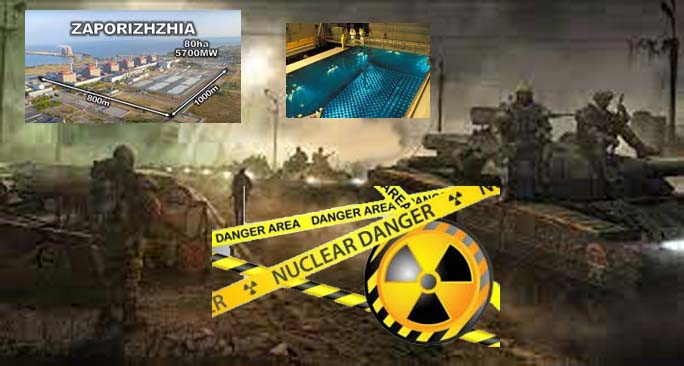
Charles Digges, Bellona, 2 July 24
“……………………………………………….. Russia has taken over the plant with its own technicians while coercing the Ukrainian workers who remain to sign contracts with Rosenergoatom, the branch of Rosatom, responsible for day-to-day operations at the 11 nuclear plants within Russia. The Kremlin has also spun off another commercial tendril from Rosatom to oversee the management of the captive plant.
But should a potential restart continue to unfold, the principal nuclear threat of Putin’s war on Ukraine could soon be an atomic energy station operating on the front lines of a protracted war.
Since early in the invasion, all of the Zaporizhzhia nuclear plant’s reactors have been placed in various states of shutdown. This was a critical safety measure, urged by the IAEA and agreed to by both Moscow and Kyiv, which would dampen the impact of a radiological disaster should any of the reactors suffer a catastrophic strike.
In this setting, the content of short-lived and highly dangerous radionuclides like iodine-131 in uranium fuel is much lower than if the plant was active because they have partially, or even completely decayed since September 2022. But once the reactors are restarted, these radionuclides will once again begin to form — making their spread into the environment a possibility should reactor containments be ruptured.
Despite the obvious risks, recent statements from Russian officials and, more concretely, the activities of Russia’s technical oversight agency within Ukraine, indicate that the plant’s Russian occupiers could move to restart at least one of the reactor units sometime this year — thus removing this important assurance against disaster.
To restart a reactor, Russian technicians would first have to guarantee an ample and stable supply of cooling water. This task was made more difficult by the destruction of the nearby Khakovka Dam in June 2023, which compromised several reservoirs used for precisely that purpose.
But over the past year, the Russian side has announced plans to replenish the plant’s damaged cooling ponds, which would then be capable of supplying up to three reactors.
Further, Russian technicians have begun to rewire the power grid to divert the electricity produced by the Zaporizhzhia nuclear plant toward Russia and the occupied territories of Ukraine. Satellite images of the Rosatom-controlled Zaporizhzhia Terminal Power Plant, which connects the nuclear plant to the Ukrainian grid, show evidence of efforts to shift powerlines away from Ukraine and into the occupied regions.
The plant has also recently played host to high-profile guests from Moscow. In April, Alexander Trembitsky, the head of Russia’s Federal Service for Environmental, Technological and Nuclear Supervision, Rostekhnadzor) visited the plant to review personnel certifications and work toward extending the lifespan of the reactors. Rostekhnadzor officials have also been codifying licensing requirements for the plant to operate under Russian purview and reviewing various plant systems since the start of the year.
That same month Sergei Kiriyenko, a former CEO of Rosatom and one of Putin’s first deputies, visited Enerhodar, where many plant workers live.
This flurry of activity followed a March meeting in Sochi between Putin, current Rosatom CEO Alexei Likhachev, and IAEA director general Rafael Grossi, during which, according to media reports, Putin stated his intentions to restart Zaporizhzhia’s reactors. This remains diplomatically unconfirmed by other sources, but recent events seem to bear those intentions out.
Kyiv vociferously protested Russia’s efforts to disconnect a nuclear plant that once supplied 5700 megawatts, or about 10%, of Ukraine’s entire electricity needs. There is little doubt that the military could fight back against any efforts to redirect this energy.
Still, efforts to relaunch the reactors may prove to be more effort than they are worth.
Fresh nuclear fuel and spare parts would have to be transported across war zones. The pump station enhancing cooling water supplies is being constructed under conditions of military conflict. Powerlines will have to be rerouted under fire. All of this will cost billions of rubles, which, in our analysis, will hardly be recouped by tariffs on the power one or two Zaporizhzhia reactors would produce. ………. https://bellona.org/news/nuclear-issues/2024-07-russia-might-restart-the-ukrainian-nuclear-plant-it-seized
Talent Shortage Threatens Europe’s Nuclear Renaissance
As many countries in Europe look to boost their nuclear power capacities
and build more reactors, companies face a workforce challenge as many of
the skilled force are retiring while younger generations choose energy jobs
in solar and wind. European countries and companies planning major
expansion in nuclear fleets are struggling to fill in thousands of skilled
engineering jobs that would support the construction of nuclear reactors,
which take years to complete. Companies in France are hiring back retirees
and are collaborating with colleges and universities to promote jobs in the
nuclear power sector.
Oil Price 3rd July 2024
Congressional group on nuclear arms sets July hearing for embattled missile program

The program, which is being led by defense contractor Northrop Grumman, is now expected to cost around $130 billion, up from initial projected costs of around $60 billion in 2015. It is also expected to be delayed by at least two years.
BY BRAD DRESS – 06/04/24, https://thehill.com/policy/defense/4703104-congressional-group-on-nuclear-arms-sets-july-hearing-for-embattled-missile-program/
The chairs of a congressional working group on nuclear arms announced Tuesday a late July hearing on the controversial Sentinel missile program, which has blown past its budget and triggered concerns among more progressive lawmakers on Capitol Hill.
Members of the Nuclear Weapons and Arms Control Working Group, co-chaired by Democrats Sen. Ed Markey (Mass.) and Reps. John Garamendi (Calif.) and Don Beyer (Va.), said the July 24 hearing would focus on testimony from experts in the nuclear arms world.
Garamendi said at a press conference that the goal of the hearing is to try to “engage Congress in its constitutional responsibility.”
Beyer added that he wants to “raise the alarm about our unsustainable, reckless nuclear posture.”
“We all understand the need for adequate nuclear deterrence,” said Beyer. “But our spending process and nuclear posture are becoming increasingly divorced from reality — a reality of scarce resources and a variety of competing national security priorities.”
The Tuesday press conference was also attended by former Rep. John Tierney (D-Mass.) and Daryl Kimball, executive director of the Arms Control Association.
“In the United States, there seems to be a sense of inevitability around the need to build up our own stockpile,” Tierney said, adding he was “demanding answers to questions about the programs that cost taxpayers hundreds of billions of dollars without making us one iota safer.”
Tierney said it was the duty of Congress to conduct oversight, but that many of his former colleagues were “eager to simply rubber stamp multibillion dollar programs without asking even the most basic questions.”
In January, Sentinel overshot its projected budget by 37 percent, forcing the Pentagon to step in and review the program.
The program, which is being led by defense contractor Northrop Grumman, is now expected to cost around $130 billion, up from initial projected costs of around $60 billion in 2015. It is also expected to be delayed by at least two years.
Most of Congress supports modernizing the nuclear arsenal and views land-based intercontinental ballistic missiles (ICBMs) as a vital part of nuclear deterrence, along with the other legs of the so-called triad: bomber planes and submarines.
Proponents argue the Sentinel program is a national security priority, especially with China and Russia modernizing or increasing their nuclear arms. Still, progressive Democrats have raised alarm about the ballooning costs and feasibility of the program.
The congressional working group on Tuesday called for the Pentagon to conduct a candid review of Sentinel, which Garamendi and Sen. Elizabeth Warren (D-Mass.) have previously pushed for.
And Markey called for the Pentagon to declassify the 2014 Analysis of Alternatives report that found it would be cheaper to create new Sentinel missiles than to life-extend the more than 50-year-old Minuteman III ICBMs. The Air Force has kept the report, which would detail how they arrived at that conclusion, classified.
Markey also pushed for a review of the costs for modernizing the entire nuclear triad and stressed his concerns about the “insanity” of spending hundreds of billions of dollars on updating nuclear weapons under the “guise” of protecting against national security risks.
“That is simply not an excuse to open up the federal government’s bank account to write a blank check made out to nuclear bombmakers with no transparency,” he said. “We have a responsibility to ensure we put the Sentinel program on the chopping block.”
Sentinel will replace the 400 Minuteman III ICBMs scattered across the rural Western U.S. in missile silos and deploy them through 2075. The program is a huge overhaul and involves a major real estate effort across several states that is driving up costs.
Garamendi tried to pass several amendments to rein in the Sentinel program in the annual defense bill that the House Armed Services Committee passed last month, but they were ultimately blocked aside from one requiring the Government Accountability Office to audit the Pentagon’s review of the program.
Garamendi has raised concerns about the difficulty to get Congress to conduct more oversight of the program.
“We want Congress to do its job,” Garamendi said.
1 This Month.
5 January -Webinar-What is Trump’s Golden Dome?
REGISTER AT Massachusetts Peace Action Education


New book – https://www.amazon.com/dp/1923372157?utm_source=substack&utm_medium=email
Now until to February 10, 2026 Radioactive waste storage in France: the debate is finally open! How to participate?
-
Archives
- December 2025 (293)
- November 2025 (359)
- October 2025 (377)
- September 2025 (258)
- August 2025 (319)
- July 2025 (230)
- June 2025 (348)
- May 2025 (261)
- April 2025 (305)
- March 2025 (319)
- February 2025 (234)
- January 2025 (250)
-
Categories
- 1
- 1 NUCLEAR ISSUES
- business and costs
- climate change
- culture and arts
- ENERGY
- environment
- health
- history
- indigenous issues
- Legal
- marketing of nuclear
- media
- opposition to nuclear
- PERSONAL STORIES
- politics
- politics international
- Religion and ethics
- safety
- secrets,lies and civil liberties
- spinbuster
- technology
- Uranium
- wastes
- weapons and war
- Women
- 2 WORLD
- ACTION
- AFRICA
- Atrocities
- AUSTRALIA
- Christina's notes
- Christina's themes
- culture and arts
- Events
- Fuk 2022
- Fuk 2023
- Fukushima 2017
- Fukushima 2018
- fukushima 2019
- Fukushima 2020
- Fukushima 2021
- general
- global warming
- Humour (God we need it)
- Nuclear
- RARE EARTHS
- Reference
- resources – print
- Resources -audiovicual
- Weekly Newsletter
- World
- World Nuclear
- YouTube
-
RSS
Entries RSS
Comments RSS
 nuclear-news