Inside the NATO Summit in Washington, D.C.
Neal Resnikoff, 10 July 24
This morning I went through the huge security perimeter around the NATO Summit meeting place, without any problem, to get to a “conversation” with Defense Ministers from Estonia, Latvia, and Lithuania organized by the POLITICO organization.
The entire time was focused on emphasizing the importance of opposing Russia, including bombing Russia, with nonstop demonization of the Russian government and Putin. There was no mention that the NATO expansionism and other threats and attacks on Russia risks a World War IIII, a possibly nuclear war.
There was maybe a minute of expression of support for Israel and the actions they are taking.
The ministers said their governments would work with whoever is elected in the U.S. One emphasized that the U.S. goveernment is an indispensible partner.
No questions were allowed.
The NATO delegates are obviously worried about opposition. The ministers had body guards, including one in military uniform.
After the program, on my way back down the street, past the entrance for delegates and the convention center, I was interviewed by Channel 4 of Washington. They seemed surprised that I came from Chicago to oppose the NATO Summit, and wanted to know why. I explained that NATO is a war mongering organization using our tax money to risk a possible World War III.
Now to cool off a bit after doing a good amount of walking from and to the Metro station in the 95 degree heat. All the counter NATO protests in the heat we have had on the weekend have been worth it to put the heat on NATO. As one person remarked to me, without our emphasis on NATO, she would not have been aware of it and what it does. Onward with the struggle against the capitalist U.S. ruling class and its NATO seeking to ensure power and profits for their banks and big corporations
The dirty history of ‘Nukey Poo’, the reactor that soiled the Antarctic
By Nick O’Malley, July 10, 2024 , https://www.theage.com.au/environment/conservation/the-dirty-history-of-nukey-poo-the-reactor-that-soiled-the-antarctic-20240708-p5jrzd.html
The rekindled nuclear debate in Australia has stirred old memories in some of a little-known chapter of our region’s history, when the US Navy quietly installed what today we might call a small modular reactor at the US Antarctic base on Ross Island.
The machine, nicknamed “Nukey Poo” by the technicians who looked after it, was installed at McMurdo base in 1961, when Antarctic exploration was expanding and nuclear energy had developed a bright futuristic sheen.
Things did not end well.
Back then, as now, Antarctic missions relied upon lifelines with distant homes. Supplies had to be carried long and sometimes dangerous distances. The US kept its Antarctic sites supplied via an ongoing supply mission called Operation Deep Freeze, which was based at the McMurdo Naval Air Facility.
According to an article on the Nukey Poo incident published in 1978 by the Bulletin of the Atomic Scientists – a journal concerned with the potential danger of nuclear technology, founded by Albert Einstein and veterans of the Manhattan Project – while a gallon of diesel cost the US Navy US12¢ back then, by the time the Americans shipped supplies to McMurdo, diesel cost 40¢ a gallon. At South Pole station, diesel was worth $12 a gallon.
But the then US Atomic Energy Commission had a solution to save costs on transporting supplies. What if McMurdo, and other distant US bases, were supplied by small transportable nuclear reactors? Congress agreed and soon the Martin Marietta Corporation won a contract to build them.
In an advertisement in Scientific American, the company boasted in language reminiscent of today’s debate over modular reactors that “because nuclear energy packs great power in little space, it’s extremely useful when you need electricity in remotes spots. It’s portable and gives you power that last for years …” Soon, the company said, nuclear power might be carrying us to outer space and frying our eggs.
A reactor named PM-3A (PM stood for “portable, medium powered”) was shipped out in sea crates and installed at McMurdo – which is within New Zealand-claimed Antarctic territory – over the summer of 1961 and became known on the base as Nukey Poo. Because cement would not cure in the frigid climate, the reactor was not encased in concrete, rather its four major components sat in steel tanks embedded in gravel and wrapped in a lead shield.
Admiral George Dufek described the moment as “a dramatic new era in man’s conquest of the remotest continent”. The US administration was certain the reactor did not violate the Antarctic Treaty’s declaration that “any nuclear explosions in Antarctica and the disposal there of radioactive waste material shall be prohibited”.
Within a year, Nukey Poo caused its first fuss, a hydrogen fire in a containment tank that led to a shutdown and energy shortages. Icebreakers fought to break through and fuel for generators was delivered by helicopter, which burned as much as they delivered over the course of a flight. Over the following years, Nukey Poo proved so unreliable and expensive to maintain that the military gave up hopes of using the technology to displace diesel at other remote locations.
In 1972, the navy began the three-year task of decommissioning the reactor and decontaminating the site. During that process, they discovered corrosion that technicians feared may have caused leaks of irradiated material. No detailed investigation was done. The secretary of the US National Academy of Sciences said the program was ended due to a series of malfunctions and the possibility of leaks, the Bulletin of the Atomic Scientists reported. The New Zealand government declared the decision was economic.
Either way, it was decided not only to remove the reactor, but half the hillside it was built into. Eventually 12,000 tonnes of irradiated gravel and soil was removed on supply ships to be buried in concrete lined pits in the United States.
The young Australian scientist, Dr Howard Dengate, who had run one of the NZ bases, hitched a lift on one those ships, the Schuyler Otis Bland, in 1977. Dengate recalls a grumpy captain who once swore at him for inviting bad luck on the ship by whistling on deck. The captain, Dengate recalled this week, blamed him for “whistling up” the storm that struck the vessel before the Australian disembarked in New Zealand and the ship sailed on to the US.
Though the reactor was little discussed in the wider world, no secret was made on the base of the reactor or its impact. Indeed, Dengate recalled finding an operating manual for the reactor in the American rubbish pits that New Zealanders had developed the habit of fossicking in.
But the story did not end there.
In 2011, an investigation by journalists of News 5 Cleveland found evidence that McMurdo personnel were exposed to long-term radiation, and in 2017 compensation was paid to some American veterans of the base. A year later, New Zealand officials announced that it was possible that New Zealand staff were also affected.
It has since been reported that four New Zealanders had raised claims about their ill health since their time in the Antarctic.
In 2020, the Waitangi Tribunal, a permanent commission in New Zealand to investigate cases against the Crown, launched inquiries. They are not yet complete.
Asked if he was concerned about travelling with the irradiated material, Dengate said he was not. “We were young and dumb and adventurous,” he told this masthead of his time in the Antarctic.
Biden signs a big nuclear bill. Can it remake the industry?

EE News, By Zach Bright | 07/10/2024
President Joe Biden signed legislation Tuesday that aims to deploy advanced nuclear reactors more quickly, placing wind at the backs of companies feverishly striving to carve out a bigger niche for nuclear technology as a zero-carbon source of electricity.
The ADVANCE Act, aims to further streamline permitting for new reactor designs, give the Nuclear Regulatory Commission more resources, and promote deployment across the globe.
For the NRC, it’s a chance at redemption. The pace of permitting projects is regarded by nuclear advocates as a major impediment to any future nuclear renaissance. The latest injection of support from Congress builds on the agency’s ongoing effort to sift through applications and put easier safety assessments on faster tracks.
……. close observers of the industry cautioned that it comes down to implementation. A vacant seat on the five-member NRC means the pace of licensing the next generation of reactors could hinge on who occupies the White House in 2025.
Both Biden and former President Donald Trump — with much of the Republican Party in tow — tout a return to nuclear energy as a potential solution to U.S. energy and climate challenges. Biden’s Department of Energy has helped shore up existing reactors and cast a $1.5 billion lifeline to a shuttered nuclear plant in Michigan that aims to restart in 2025. At the global climate summit in Dubai, United Arab Emirates, last December, the United States pledged with more than 20 other countries to triple the world’s nuclear energy capacity by 2050.
The Trump administration also took actions aimed at developing and exporting U.S. nuclear technology.
Yet given the huge financial commitment required to build out the nuclear industry, Trump’s strategy is less clear today. During his previous four years in office, he wanted to eliminate the Department of Energy’s Loan Programs Office. And through political surrogates such as the Heritage Foundation, Trump’s backers have indicated they’d significantly pare DOE spending on nonfossil energy.
The DOE loan program provided support to the $30 billion Vogtle nuclear expansion in Georgia that slogged its way to completion earlier this year.
Changing its mission
The ADVANCE Act passed with bipartisan support. But it’s also the first significant nuclear legislation in almost two decades.
Since 2005, the last time Congress put its foot on the scale hoping to spur more nuclear projects, the energy mix has changed significantly. Natural gas is the largest source of electricity. Solar power is dominating new generation. Battery technology and more transmission are enabling remote wind power to travel longer distances. And investment in technology to pull more carbon pollution out of the air is advancing.
Westinghouse is no longer the only company developing nuclear technology at scale. And the leading companies developing smaller-scale nuclear reactors are rooted in the West Coast tech industry — not Pittsburgh.
The other tough reality is that building a new nuclear reactor from scratch has proven extremely expensive.
Under the ADVANCE Act, Congress directed the NRC to revise its mission statement to ensure it uses its oversight authority “in a manner that is efficient and does not unnecessarily limit” the use of nuclear energy.
……… the tweak to the commission’s mission statement marks a big change for nuclear scientists and public health advocates who say it makes advancing civilian nuclear energy a top priority of the agency.
“It essentially compromises the independence of the NRC’s regulatory authority by forcing the agency to have to consider the health of the nuclear industry in everything it does,” said Edwin Lyman, nuclear power safety director for the Union of Concerned Scientists.
“It essentially compromises the independence of the NRC’s regulatory authority by forcing the agency to have to consider the health of the nuclear industry in everything it does,” said Edwin Lyman, nuclear power safety director for the Union of Concerned Scientists.
“If this mythology that nuclear power is completely safe — that it doesn’t need to be heavily regulated — takes hold, we could see a whole generation of really dangerous experimental nuclear facilities being licensed and built around the world,” Lyman continued. “And the first time that there’s a catastrophe, it’s going to set back the industry for decades.”……………………………… https://www.eenews.net/articles/biden-signs-a-big-nuclear-bill-can-it-remake-the-industry/
Texas Nuclear Power Plant Hit By Hurricane Beryl
Jul 08, 2024 , By Anna Skinner, https://www.newsweek.com/texas-nuclear-power-plant-hit-hurricane-beryl-1922433?fbclid=IwZXh0bgNhZW0CMTEAAR29mvidVj1SSXxwkVTE1ZlgUDnniN1ns2WYungAgepziqraWPcHYqrf1Ng_aem_n7E5P5-vOaqLLjIkP0kOkg
Hurricane Beryl made landfall in Matagorda, Texas, on Monday morning as a Category 1 hurricane, prompting concern and preparations at a nuclear power plant just miles away.
Beryl strengthened into a hurricane last Saturday, becoming June’s easternmost major hurricane in the Atlantic. The storm underwent rapid intensification and, at one point, was categorized as a Category 5 hurricane. It has killed at least 11 people in the Caribbean and two people in Texas, according to The Associated Press.
The system has since weakened to a tropical storm with maximum sustained wind speeds of 70 miles per hour. Despite the weakening, the storm still had the potential for life-threatening impacts, prompting a slew of weather-related warnings for much of southeastern Texas on Monday, including a tropical storm warning, flash flood warning and a storm surge warning, among others.
The South Texas Project Nuclear Operating Company (STPNOC), which is “one of the newest and largest nuclear power facilities in the nation” according to its website, has two nuclear units that provide energy to 2 million Texas homes. It is located in Bay City, which is near Matagorda. Storm-related warnings remain in place for Matagorda and Bay City as of Monday afternoon.
According to a satellite image from AccuWeather, STPNOC was directly in the path of the storm. It’s unclear what measures were taken at the facility to prepare for the severe weather, given that the company hasn’t provided an update to its website or social media pages. Newsweek reached out to STPNOC by email for comment.
Hurricane Harvey made landfall on the Texas coast on August 25, 2017, as a Category 4 hurricane.
“STP’s performance during 2017’s Hurricane Harvey helps make the case for nuclear power – thanks to a resilient Storm Crew, a robust design and solid severe weather plan,” the webpage said.
As of Monday afternoon, more than 2.7 million Texans were without power.
Beryl is the first hurricane of the 2024 Atlantic hurricane season and the second named storm. Tropical Storm Alberto made landfall in Mexico on the morning of June 20. Shortly after Beryl formed, the third named storm of the season—Tropical Storm Chris—formed quickly on June 30. Chris made landfall in Mexico that night, with wind speeds around 40 mph.
Multiple agencies, including the National Oceanic and Atmospheric Administration (NOAA), have issued forecasts warning that 2024 will be an exceptionally strong year for hurricanes.
“The Sun has won”: exponentially growing solar destroys nuclear, fossil fuels on price

Given Dutton’s claims about solar power costing more than nuclear are made ridiculous by the fact that solar’s break-even price has fallen by a factor of more than 1000 and the trend is continuing.
Meanwhile cost overruns in nuclear are endemic and SMR’s only exist in Dutton’s imagination.
By Noel Turnbull, Jul 11, 2024, https://johnmenadue.com/the-sun-has-won-exponentially-growing-solar-destroys-nuclear-fossil-fuels-on-price/—
It’s not known if Peter Dutton [ Australia’s pro-nuclear Opposition leader] reads The Economist but if he does, he must probably think from time to time that it is sometimes dangerously left wing.
In the 22 June issue, it had a special essay on solar power – headlined ‘The Sun Machine’. The sub-head was “An energy source which gets cheaper the more you use it marks a turning-point in industrial history’.
The essay is a total contradiction of almost everything Dutton is claiming about nuclear and renewable energy.
“What makes solar energy revolutionary is the rate of growth which brought it to this just-beyond the marginal state”, the essay says.
They cite a veteran energy analyst, Michael Liebreich, who shows that in 2004 it took a year to install a gigawatt of solar power capacity; in 2010 it took a month; in 2016 a week; and in single days in 2023 there were a gigawatt of installation worldwide.
Current projections are that solar will generate more electricity than all the world’s nuclear plants in 2026; than wind turbines in 2027; dams in 2028; gas-fired plants in 2026; and coal-fired ones in 2032.
All that well before Dutton’s nuclear plants – if at all – start generating power. Moreover, unlike nuclear power which notoriously always takes longer to build than predicted, predictions about the rate of solar power roll-out are consistently under-estimates.
The Economist points out that in in 2009 The International Energy Agency (IEA) predicted solar would increase from 23GW to 244GW by 2030. It hit that milestone in 2016 – less than a third of the predicted time. The world capacity was 1419GW by 2023.
Ironically, one of the few organisations which got their predictions roughly right was Greenpeace – yet even their prediction was an under-estimate.
Given Dutton’s claims about solar power costing more than nuclear are made ridiculous by the fact that solar’s break-even price has fallen by a factor of more than 1000 and the trend is continuing. Meanwhile cost overruns in nuclear are endemic and SMR’s only exist in Dutton’s imagination.
Dutton is stronger on ideology and outrageous claims than economics, but the manufacture of photovoltaics is a classic example of the benefits of mass production – benefits which have always eluded the nuclear power industry.
As The Economist points out solar cells are standardised products all made in basically the same way and “they have no moving parts at all, let alone the fiendish complexity of a modern turbine.”
“Manufacturers compete on cost, by either making cells that make fractionally more electricity, by either making cells that make fractionally out of a given amount of sunshine or which cost less.”
Economics 101 teaches us that a commoditised product does not lead to more and more aggressive competition on the supply side – simply in this case by getting more electricity out of any given amount of sunshine or by costing less.
Rob Carlson, a technology investor, told The Economist: “There is no other energy-generation tech where you can install one million or one of the same thing depending on your application.”
“The Sun has won” he says.
The Economist said: “From the mid-1970 to the early 2020s cumulative shipments of photovoltaics increased by a factor of a million which is 20 doublings. At the same time prices dropped by a factor of 500. That is a 27% decrease in cost of doubling of installed capacity, which means a halving of costs every time installed capacity increases by 360%.
Adair Turner, an eminent economist and financial services executive, was Chair of Britian’s Climate Change Committee which was set up to help transition to zero emissions.
He told The Economist: “We totally failed to see that solar would come down so much.”
BloombergNEF estimated, in 2015, that the cost for solar on a global basis was $122 per MWH – higher than on shore wind and coal. Today both solar and onshore wind are almost half the cost of coal.
Meanwhile, Dutton has welcomed Keir Starmer’s election win by pointing to his support for nuclear power. Which, given that the UK has already installed nuclear power, the cautious Starmer is unlikely to announce that he is closing it down.
Moreover, Starmer’s major problem with nuclear is managing the spiralling delays in, and cost of, nuclear plants being constructed following typical Tory blunders.
The question which Dutton needs to answer is why he knows more about nuclear and solar power than The Economist reporters, Bloomberg, Adair Turner, Rob Carlson, many major investment funds and the overwhelming majority of Australian scientists?
He might ponder all that while the Murdoch media is becoming a tad critical of him – criticising his policy on supermarket divestment and speculating on who might be the Liberal Party leader if Dutton loses the next election.
Meanwhile, notwithstanding their doubts about Dutton’s chances and policies (other than nuclear) The Australian never totally loses its manic opposition to anything progressive. The inimitable Greg Sheridan opined on The Australian front page (6/7) that Labour had not won but the Tories had lost. Partly true obviously, but his piece was enough to prompt the subs to headline the piece with “Self-described socialist is set to drag Britain far to the left”.
Sheridan also rehearsed his regular hates and speculated how it would all come undone.
Jeremy Corbyn would love that to be the case but Starmer not so.
Perhaps the funniest lines in Sheridan’s’ piece were: “Starmer is brainy and works hard. Too deep immersion in the law has rendered it impossible for Starmer to write felicitous prose or create memorable images.”
From a journalist who year after year simply reproduces the same old opinions on the same old subjects that is, to say the least, a bit much.
‘Horrific Massacre’: Israel Bombs Gaza School Used as Refugee Camp, Killing Dozens.
“Schools have gone from safe places of education and hope for children to overcrowded shelters and often ending up a place of death and misery,” said UNRWA’s commissioner-general.
JAKE JOHNSON, Jul 10, 2024 https://scheerpost.com/2024/07/10/horrific-massacre-israel-bombs-gaza-school-used-as-refugee-camp-killing-dozens/
Israeli forces killed dozens of people Tuesday in an airstrike on a school-turned-refugee camp in the southern Gaza Strip, the fourth school Israel’s military has bombed in as many days as the country continues its massive assault on the enclave’s starving population.
At least 29 people were killed and dozens more were wounded in Tuesday’s attack, including women and children—who have made up roughly two-thirds of those killed in Israel’s latest assault on Gaza, which began following a Hamas-led attack in October. The death toll from Tuesday’s attack is expected to rise, as many of those injured were reportedly in critical condition and taken to the under-resourced and overwhelmed Nasser Hospital.
The Israel Defense Forces (IDF) acknowledged carrying out the airstrike—which hit the entrance of the school—but claimed to be targeting a Hamas militant “adjacent” to the complex. The IDF, whose internal investigations rarely result in accountability for atrocities, said the “incident is under review.”
Video footage posted to social media shows displaced Palestinians playing in the schoolyard when the airstrike hit, sparking panic and chaos. [Video on original –Warning: The footage is graphic]
Citing witnesses, the BBC reported that “the area was teeming with displaced people at the time” of the airstrike, which “resulted in widespread destruction and the deaths of women and children.”
“Body parts were scattered across the site and many people staying in tents outside the school were also injured,” the British outlet reported. “Ayman Al-Dahma, 21, told the BBC there had been as many as 3,000 people packed into the area at the time, which he said housed a market and residential buildings. Describing the number of casualties as ‘unimaginable,’ he said he had seen people whose limbs had been severed by the blast.”
Tuesday’s attack marked the fourth time in four days that the IDF has attacked a school in the Gaza Strip, according to Agence France-Presse. Over the weekend, Israeli forces killed more than a dozen Palestinians in an attack on a United Nations-run school in central Gaza.
Most of Gaza’s education infrastructure has been damaged or completely destroyed by Israeli forces, and the schools still standing are being used to shelter those displaced by the IDF assault, which is now in its 10th month. The United Nations estimates that 90% of Gaza’s population has been internally displaced since October, with some displaced up to 10 times.
Canadians for Justice and Peace in the Middle East called the IDF’s latest attack “a horrific massacre,” adding, “Annihilation is the point.”
“Nothing can justify Canada’s failure to act,” the group wrote on social media.
Canada is one of a number of major countries that have supplied weaponry to the Israeli government as it has carried out its utter devastation of the Gaza Strip, nearly all of which is now uninhabitable.
The United States and Germany together provided 99% of the arms Israel imported last year, according to the Stockholm International Peace Research Institute. Germany’s Foreign Office called Wednesday’s attack “unacceptable” and demanded a swift investigation.
“People seeking shelter in schools getting killed is unacceptable. Civilians, especially children, must not get caught in the crossfire,” the foreign office said. “The repeated attacks on schools by the Israeli army must stop.”
Philippe Lazzarini, commissioner-general of the U.N. Relief and Works Agency for Palestine Refugees in the Near East (UNRWA), said Wednesday that “schools have gone from safe places of education and hope for children to overcrowded shelters and often ending up a place of death and misery.”
“Nine months in, under our watch, the relentless, endless killings, destruction, and despair continue. Gaza is no place for children,” he added. “The blatant disregard of international humanitarian law cannot become the new normal… Cease-fire now before we lose what is left of our common humanity.”
NATO member to fight ‘pro-war propaganda’ – official
https://www.rt.com/news/600664-hungary-fight-war-propaganda/ 10 July 24
Budapest wants media financing. to be “transparent” as part of its “anti-war action plan,” said Gergely Gulyas
Hungary is set to introduce a new “anti-war action plan” which will include measures aimed at countering “war propaganda,” Gergely Gulyas, the head of the Hungarian Prime Minister’s Office, announced at a press conference on Monday.
Under the plan, any political forces or media outlets accused of promoting belligerent policies would be required to reveal their funding sources. The goal is “full transparency,” Gulyas said. The measure is primarily aimed at the media, the nation’s news outlets reported, noting that political parties in Hungary are already legally barred from receiving funds from abroad.
The government would also reserve the right to block any foreign funding and send the money back to whoever provided it, if it is used to bankroll “war propaganda,” Gulyas said.
The official provided few details as to how the government would decide what exactly constitutes “war propaganda.” He said that the Justice Ministry would develop a mechanism to determine whether a media outlet is involved in the practice.
When asked if “foreign funding” included money coming from within the EU, Gulyas said that the measure would be focused on financing coming from outside the bloc. He argued, however, that the EU itself is dominated by “war propaganda” focused on the ongoing conflict between Kiev and Moscow.
Gulyas said Budapest is facing “political, legal and financial blackmail” which aims to force it to join the ranks of Kiev’s Western war backers, but that it has so far resisted the pressure. “There is no blackmail that [can force] Hungary to change its conviction that every political step must serve the end of war,” he said.
His words came as Hungarian Prime Minister Viktor Orban embarked on what he called a peace mission that included visits to Kiev and Moscow within the span of several days. In the Ukrainian capital, he called for a ceasefire, describing it as a first step towards conflict resolution. The idea was rejected by Ukraine’s Vladimir Zelensky.
Orban called his Moscow trip the first step to restoring dialogue. The move drew criticism from the EU, which said the Hungarian prime minister, whose nation currently holds the bloc’s rotating presidency, had no mandate to speak on behalf of Brussels.
On Monday, Gulyas addressed the issue by saying that peace cannot be achieved without direct dialogue with all the warring parties. “Hungary would like to be in contact with any country that can contribute to peace,” he added.
COMMENT. From outside the bloc could be countries like the US, and the UK.
The move from Hungary comes after the visits of Victor Orban.
Ignace, Ontario, betrayed by Council, on nuclear waste decision

Ignace has voted in favour of continuing in the Nuclear Waste Management Organization’s siting process, which brings Northwestern Ontario one step closer to being put on the receiving end of all of Canada’s high-level nuclear waste.
The NWMO has said it will select a single site by the end of 2024 for a deep geological repository for Canada’s existing stockpiles and future inventory of high-level nuclear fuel waste. The project will include transportation of the waste in 2-3 trucks per day for over 50 years, then processing at the site in a still-to-be-designed waste transfer facility, and finally placement deep underground in a series of tunnels and vaults so radioactive no workers can be present during the emplacement process.
An “ad hoc willingness committee”, appointed by the Township in February, delivered its recommendation in a special meeting of Council this afternoon. Immediately after the presentation by Committee co-chair Roger Dufault, Council voted to continue in the Nuclear Waste Management Organization’s site selection process.
The NWMO has been studying the Revell Site, between Ignace and Dryden, since 2010. In 2020 the NWMO narrowed its list of candidate sites to just two: the Revell Site in Northwestern Ontario and the Teeswater site in the Municipality of South Bruce in Southwestern Ontario. The Revell Site is 45 kilometres outside the Township of Ignace and is in a different watershed.
“We feel betrayed”, said Ignace resident Sheila Krahn.
“For the last ten years we’ve been bombarded with promotional messages from the NWMO, and when it was finally time for a decision, we didn’t even get a vote. I don’t believe that the majority of people in Ignace support this project, but so many people didn’t trust the so-called “willingness process” and didn’t participate.”
Instead of a referendum such as the one scheduled for South Bruce on October 28th, Ignace hired a consultant to conduct interviews and run an online poll. The online registration required scans of government ID and asked residents if they supported continuing in the NWMO siting process, rather than asking a more direct question about whether they agreed with the NWMO’s project.
“The NWMO siting process is all about getting to “yes”, so they can claim some semblance of public support”, explained Northwatch spokesperson Brennain Lloyd.
“They missed the mark with this one. They’ve spent an estimated $10 million of electricity ratepayers’ money trying to convince Ignace to support their nuclear waste project, but at the end of the day what they bought was a questionable outcome from a largely unelected council of a community that has no authority and is not even in the same watershed as the NWMO’s candidate site.
The NWMO has deemed Ignace to be the “host community”, despite Ignace’s distance from the site, lack of jurisdiction, and the presence of other communities closer to the site and downstream. In 2020 the Township of Ignace passed a resolution that the Township itself would make the decision on behalf of the people of Ignace, rather than holding a referendum, as the Municipality of South Bruce will carry out on October 28, 2024. In 2023 the Township hired the consulting firm With Chela Inc., which conducted a number of interviews and held an online poll. The consultant’s report was presented in-camera to Ignace’s “Ad Hoc Willingness Committee”, which had been selected and appointed by the Council in February. This “ad hoc” committee recommendation to Council, presented today, is to stay in the NWMO siting process. Minutes later Council voted to accept the recommendation, committing the current and future councils to adhering to the terms and conditions of a “hosting agreement” signed by the Township of Ignace and the NWMO in March 2024.
“At minimum this should be a regional decision, not the decision of one small upstream council”, added Wendy O’Connor, a volunteer with the northern Ontario alliance We the Nuclear Free North.
“There is a growing list of municipalities and First Nations passing resolutions against the NWMO using northern Ontario as the dumping ground for high-level nuclear waste. It will be astounding to see the NWMO select the Revell site, despite the poor decision made by the Ignace Township Council today”.
There is broad opposition to the NWMO project from individuals, community and citizens’ groups, municipalities, and First Nations. In addition to criticism of the project itself due to the negative impacts on the environment and human health during transportation and operation and after radioactive waste abandonment, the NWMO siting process and the Township of Ignace’s approach have also been soundly criticized for being secretive, undemocratic, and lacking scientific and technical rigour.
How Netanyahu Has Systematically Foiled Talks to Release Hostages From Hamas Captivity
Michael Hauser Tov, 10 July 24,
The past six months, during which Israel negotiated a framework for the release of Israeli hostages being held captive by Hamas in the Gaza Strip – were riddled with hopeful moments that shattered one after the other. While Hamas impeded the talks, Prime Minister Benjamin Netanyahu repeatedly torpedoed their progress – particularly when it came to decisive moments…………………..(Subscribers only) https://www.haaretz.com/israel-news/2024-07-10/ty-article-timeline/.premium/how-netanyahu-has-systematically-foiled-talks-to-release-hostages-from-hamas-captivity/00000190-9b91-d591-a7ff-fff341120000
Newly Signed Bill Will Boost Nuclear Reactor Deployment in the United States
ENERGyYGOV JULY 10, 2024
President Biden signed the Fire Grants and Safety Act into law chalking up a BIG win for our nuclear power industry.
Included in the bill is bipartisan legislation known as the ADVANCE Act that will help us build new reactors at a clip that we haven’t seen since the 1970s. …………………………………
Incentivizing Competition
The ADVANCE Act builds on the successes of previous legislation to develop a modernized approach to licensing new reactor technologies. ……………………………..
The ADVANCE Act directs the U.S. Nuclear Regulatory Commission (NRC) to reduce certain licensing application fees and authorizes increased staffing for NRC reviews to expedite the process.
It also introduces prize competitions that the U.S. Department of Energy (DOE) can award to incentivize deployment.
These awards are subject to Congressional appropriations but will cover the total costs assessed by the NRC for first movers in a variety of areas, including the first advanced reactor to receive an operating or combined license. …………………………………………………………………………………………………………… https://www.energy.gov/ne/articles/newly-signed-bill-will-boost-nuclear-reactor-deployment-united-states
The Atlas Network’s transnational revolution.
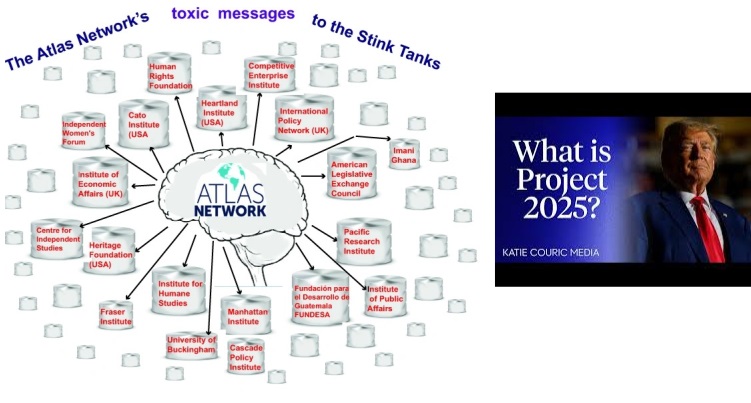
By Lucy HamiltonJul 8, 2024 https://johnmenadue.com/the-atlas-networks-transnational-revolution/
Twice in a fortnight, the president of the Heritage Foundation has declared that America is experiencing its second revolution. The revolution would remain bloodless (because their side is “winning”) “if the left allows it to be.” The two bodies whose acts provoked the announcements are leading Atlas Network partners. They are also spending millions of dollars in Europe to roll back rights for women and LGBTQIA people.
Both president Kevin Roberts’ announcements were made on Steve Bannon’s War Room broadcast, central to the Trumpist movement and its efforts to remake America from every school board and electoral precinct upwards.
The first announcement of revolution was made on the 22nd June. It functioned as an advertisement for the MAGA(Make America Great Again) audience to take part. Becoming a revolutionary involves undertaking Project 2025’s recruitment and training of loyalists to staff the incoming Trump administration, but also at state and local government levels. Roberts declared they were building not just for 2025, but for the next century in the United States.
Project 2025 is the most recent iteration of Heritage’s Mandate for Leadership. The first was written for Ronald Reagan, spelling out his massive reforms. He implemented two thirds in his first term. The last iteration for Donald Trump’s first term was similarly “business Republican” in tone, and Trump too implemented two thirds in his first year. The newest iteration is, as Roberts describes, revolutionary. It dictates the process for the dismantling most of the federal government as well as setting America on track to eliminate reproductive and Queer rights.
It also sets out the intention to dismantle the vital energy transition work underway as a result of the Inflation Reduction Act, with plans to boost fossil fuel production instead. This is fitting as much of Heritage’s funding comes from fossil fuel sources.
Project 2025 is a joint Atlas Network and Council for National Policy project.
The second announcement of revolution was made after the Supreme Court’s dramatic week of judgements. In particular, the one that granted the President of the United States immunity for the vaguely worded field of “official acts.” Naturally the partisan court will make the determination which acts are “official.”
The week also compounded the Trumpist Supreme Court’s norm-violating series of decisions that have rolled back reproductive healthcare access for women across Republican states, further damaged voters’ representation, and frozen programs that aim to address entrenched disadvantage.
In one week, the Court placed itself above the experts in government agencies who define, for example, how much mercury is unsafe to consume. While the relevant judge confused nitrous oxide and nitrogen oxide, he dared to claim that judges were better placed than government experts to determine the minutiae of America’s functioning. This attack on the administrative state’s ability to protect the public from corporate recklessness and malfeasance was a triumph for capital. The court also damaged the SEC’s ability to deal with White Collar crime.
Such gifts to the wealthy were balanced with another judgement that decided a gratuity given after a favour was received would not be determined an illegal bribe. For a court riddled with scandal over oligarch largesse, this was a particularly cynical decision.
As a footnote, the same week revealed a decision that said regions could make it illegal to be homeless. This can provide numbers for private prison operator profits. There prisoners are hired out to businesses for near slave-labour wages.
All these decisions have resulted from the years of work by the Federalist Society which handed Trump his literal list from which to choose judges. Republicans had stalled appointments to federal benches over the Obama era, granting Trump the gift of hundreds of appointments; some appointees were considered scandalous.
The years of surreptitious work by the Federalist Society and its leader Leonard Leo have been documented by Pro Publica. The body made headlines when it was gifted $1.6 billion by a single donor.
Both Heritage and the Federalist Society are Atlas Network partners. They are also Council for National Policy (CNP) members: that’s the interlinked body that has been driving the Christian Nationalist takeover of America.
Dr Jeremy Walker explained the process by which the Atlas Network architecture of influence operates in the lead-up to the Voice referendum in 2023.
Investigative journalist Jane Mayer revealed its American operations in Dark Money, using the label “Kochtopus” after Charles and David Koch, preeminent funders of the network. Historian Nancy MacLean documented its longer history in Democracy in Chains.
With around 500 partner organisations in roughly 100 countries its global operations remain less obvious because the system is intentionally covert.
The central “think” tanks foster the replication of more such bodies, providing seed funding if necessary and training in fundraising and public relations strategies to help the local offshoots become independent. They network. The primary function is to sell the donors’ messages by advertising them constantly: in 1985, Heritage founder Ed Feulner told Australian operatives to treat campaigns as if they were for a toothpaste brand that needed constant reinforcing. The messages: low tax, minimal regulation, small government, dismantling of social safety nets. Together the junktanks, as journalist George Monbiot has labelled them, create a chorus of voices from university centres and civil society bodies reinforcing the wishlist.
While the focus has primarily been on these “business Republican goals,” junktanks have their own remit. Conservative social messaging about the family has been partly used to conceal the lack of ethics in the libertarian mission. It has partly functioned to encourage family and church networks to mitigate the damage done to communities and individuals by the slashing of safety nets. There has also remained a more socially conservative and religious array of junktanks within the network.
The more toxic “family values” groups tend to be interconnected with Atlas rather than Atlas partners themselves. Trump appointee Betsy DeVos, for example, links the two. She has been chair and on the board of two Atlas partners: the American Federation for Children that aims to replace the public school system with privatised charter schools and the Acton Institute for the study of Religion and Liberty which educates business leaders and academics in “the connection that can exist between virtue and economic thinking.” Both Prince and DeVos families are substantial donors to the anti-LGBTQIA group Focus on Family. Focus is part of the CNP, a Christian Nationalist network that includes the Charles Koch and the Prince and DeVos families as donors, not to mention Mike Pence and Steve Bannon as key figures.
Both the extremist Christians and the libertarians are close to achieving their goals in America. Apart from the impact the implosion of the United States government and civil rights framework will have on the rest of the world, this is relevant because the very global nature of Atlas means that its outposts are trying to replicate its work outside the American homeland.
The European Parliament conducted a study affirming reporting that $280 million dollars have been funnelled into the EU over the last decade by Atlas and CNP partners as well as by Evangelical mission programs. Heritage and Federalist stand alongside the Cato Institute, the Leadership Institute and Acton as having donated roughly $20 million towards European groups fighting to repeal reproductive healthcare rights and LGBTQIA rights. Another American body, the American Society for the Defense of Tradition, Family and Property (TFP) has also been training European groups in strategy in cooperation with Bruce Eberle a “visiting professor” at the Leadership Institute. The Koch, DeVos and Prince families are named as major sources of the money.
(These donations are overshadowed in scale by those from European and Russian sources.)
Australia’s Centre for Independent Studies (CIS) mostly leaves the culture war battles on gender and religious virtues to the Institute of Public Affairs (IPA) and their media ally, News Corp. This year’s CIS Consilium event where the Atlas pipeliners intermingle with local and international talking heads is running adjacent to the inaugural conference of the Australian Chapter of the Alliance for Responsible Citizenship. The London original was a religio-ethnonationalist event. The consecutive timing is convenient for international guests to attend both.
The rest of us must remain focused on the fact that these networks operate transnationally. They share talking points, strategies, individuals and sometimes money. The revolution that Kevin Roberts has declared they are winning in the US is to be reenacted, piecemeal, for all of us.
US says not ready to resume nuclear talks with Iran under Pezeshkian
Iran International 8 July 24
The Biden administration is not ready to resume nuclear talks with Iran under the new president, the White House national security council spokesman said Monday.
In his presidential campaign, Iran’s president-elect Masoud Pezeshkian advocated engagement in constructive talks with Western powers to revive the 2015 nuclear deal (JCPOA) and to lift the sanctions that he says have crippled the Iranian economy since the withdrawal of the US from the agreement in 2018.
Asked whether Pezeshkian’s election will change the US negotiating position, the White House’s John Kirby offered a blunt “no”…………………………………………….more https://www.iranintl.com/en/202407084339
US Mayors for Peace Call for Dialogue in a Time of Nuclear Danger
“If you don’t think nuclear weapons are a local issue, just ask the mayors of Hiroshima and Nagasaki.”
QUENTIN HART. 5 July 24 https://www.thenation.com/article/world/hiroshima-nagasaki-nuclear-threats-rising-urgent-diplomacy-needed/
he 79th anniversaries of the US atomic bombings of Hiroshima and Nagasaki are coming up in August. Rather than commemorating those somber anniversaries as a grim reminder of the past, this year they serve as a foreboding warning of what may be to come.
The Russian war on Ukraine, with its attendant nuclear threats, and an intensifying array of antagonisms among nuclear-armed governments in Northeast Asia, the South China Sea, South Asia, and the Middle East have brought into sharp focus the increasing risks of nuclear war by accident, miscalculation, or crisis escalation, making new efforts to restart disarmament diplomacy an imperative.
Instead, we are seeing progress toward nuclear disarmament slide into reverse. The last remaining US-Russia arms control treaty is set to expire in 2026. The United States is planning to spend $2 trillion over the next 30 years to maintain and modernize its nuclear warheads and delivery systems, and a new multipolar arms race is underway, as all nuclear-armed states are qualitatively and, in some cases, quantitatively upgrading their nuclear arsenals.
Reflecting the urgency of this moment, at the close of its 92nd annual meeting in Kansas City, Missouri, on June 23, the United States Conference of Mayors (USCM) adopted a new resolution, titled,“The Imperative of Dialogue in a Time of Acute Nuclear Dangers.” This is the 19th consecutive year that the USCM has adopted a resolution submitted on behalf of US members of Mayors for Peace.
By adopting this resolution, the USCM, the official nonpartisan association of more than 1,400 American cities with populations over 30,000, has once again charted a responsible path. It “condemns Russia’s illegal war of aggression on Ukraine and its repeated nuclear threats and calls on the Russian government to withdraw all forces from Ukraine.” Importantly, it also calls on the President and Congress “to maximize diplomatic efforts to end the war in Ukraine as soon as possible.”
The resolution welcomes national security advisor Jake Sullivan’s June 2023 invitation to Russia to manage nuclear risks and develop a post-2026 arms control framework, and his signal of US readiness to engage China to ensure that competition does not veer into conflict. It further “encourages our government to pursue any offer made in good faith to negotiate a treaty among nuclear powers barring any country from being the first to use nuclear weapons against one another.”
In an important provision, the resolution “calls on the government of the United States to make good faith efforts to reduce tensions with the government of the People’s Republic of China, seeking opportunities for cooperation on such global issues as the environment, public health, and equitable development, and new approaches for the control of nuclear arms.”
And the resolution welcomes the September 10, 2023, Declaration of the G20 Leaders meeting in Delhi—including leaders or foreign ministers of China, France, India, Russia, the United Kingdom, and the United States—that the “threat of use or use of nuclear weapons is inadmissible.”
Looking to the future, the USCM “calls on the Administration and Congress to reconsider further investments in nuclear weapons and find ways that our finite federal resources can better meet human needs, support safe and resilient cities, and increase investment in international diplomacy, humanitarian assistance and development, and international cooperation to address the climate crisis.”
As an elected official and original sponsor of this resolution, I understand just how precious human life is. It is our responsibility as leaders to ensure we leave this earth in a better place than we inherited it. It’s imperative that we look at the ways we utilize nuclear weapons and the threat thereof, and that we promote meaningful global dialogue to avoid nuclear war and create a culture of peace. I am proud to stand shoulder to shoulder with mayors across the globe as a member of the Mayors for Peace initiative that has led the way.
Mayors for Peace was founded in 1982 and is headed by the mayors of Hiroshima and Nagasaki. Its 8,397 members cities in 166 countries and territories are working for a world without nuclear weapons, safe and resilient cities, and a culture of peace.
Our resolution calls on USCM member cities to take action at the municipal level, to raise public awareness of the growing dangers of wars among nuclear-armed states, the humanitarian and financial impacts of nuclear weapons, and the urgent need for good faith US leadership in negotiating the global elimination of nuclear weapons. Mayors for Peace has a wide range of resources available for mayors: for example, planting seedlings of A-bombed trees, hosting A-bomb poster exhibitions, and the annual Mayors for Peace Children’s Art Competition, “Peaceful Towns.”
Mayors are the elected representatives who are closest to the people. As my good friend, Frank Cownie, the former mayor of Des Moines, has remarked, “If you don’t think nuclear weapons are a local issue, just ask the Mayors of Hiroshima and Nagasaki.” It’s past time for the federal government to heed the advice of the nation’s mayors.
“The Imperative of Dialogue in a Time of Acute Nuclear Dangers” was sponsored by Mayor Quentin Hart of Waterloo, Iowa, and cosponsored by Mayor Jesse Arreguin of Berkeley, California; Mayor Lacey Beaty of Beaverton, Oregon; Mayor Brad Cavanagh of Dubuque, Iowa; Mayor Martha Guerrero of West Sacramento, California; Mayor Chris Hoy of Salem, Oregon; Mayor Elizabeth Kautz of Burnsville, Minnesota; Mayor Daniel Laudick of Cedar Falls, Iowa; Mayor Satya Rhodes-Conway of Madison, Wisconsin; Mayor Andy Schor of Lansing, Michigan; Mayor Matt Tuerk of Allentown, Pennsylvania; and Mayor Victoria Woodards of Tacoma, Washington.
Pentagon keeps commitment to Sentinel nuclear missile as costs balloon

Defense news, By Stephen Losey 8 July 24
The military will continue developing its new LGM-35A Sentinel intercontinental ballistic missile but has told the U.S. Air Force to restructure the program to get its ballooning costs under control.
Even a “reasonably modified” version of the Northrop Grumman-made Sentinel will likely cost $140.9 billion, 81% more than the program’s original cost estimate of $77.7 billion, the Pentagon said in a statement. If Sentinel continues on its current path without being modified, the likely cost will be about $160 billion, it said.
And the military expects restructuring the program will delay it by several years.
“There are reasons for this cost growth, but there are also no excuses,” William LaPlante, undersecretary of defense for acquisition and sustainment, said in a conference call with reporters on Monday. “We fully appreciate the magnitude of the costs, but we also understand the risks of not modernizing our nuclear forces and not addressing the very real threats we confront.”
The Sentinel is intended to replace the Air Force’s half-decade old Minuteman III nuclear missile, which is nearing the end of its life. In January, the Air Force announced Sentinel’s future costs were projected to run over budget severely enough to trigger a review process known as a critical Nunn-McCurdy breach.
Such a review can sometimes lead to a program being canceled. LaPlante said Monday he decided to proceed with Sentinel after concluding it met several criteria, including that it is essential to national security and there were no cheaper alternatives that would meet the military’s operational requirements.
Big changes are coming for Sentinel, however. LaPlante rescinded the program’s Milestone B approval, which in September 2020 authorized the program to move into its engineering and manufacturing development phase. He also ordered the Air Force to restructure the program to address the root causes of the cost overruns and make sure it has the right management structure to keep its future price down.
The per-unit total cost for Sentinel was originally $118 million in 2020, when its cost, schedule and performance goals were set. When the Nunn-McCurdy breach was announced in January, those per-unit costs had grown at least 37% to about $162 million.
Hunter said the per-unit cost for the revised Sentinel program — which include components in addition to its missiles — is estimated to be about $214 million……………………………. more https://www.defensenews.com/air/2024/07/08/pentagon-keeps-commitment-to-sentinel-nuclear-missile-as-costs-balloon/—
Julian Assange And The Criminalization of Journalism: A Story Of Moral Injury And Moral Courage
New Matilda, By Kari James on July 8, 2024
‘The truth will out’, or so the saying goes. The question is, at least in a modern context, is how much injury – moral and otherwise – is suffered by the courageous men and women trying to expose it? Psychologist and researcher Kari James explores that answer.
12th July 2007: Two US Apache helicopters unleash 30mm cannon fire on a group of Iraqi civilians. Two of them are Reuters journalists – Namir Noor-Eldeen and Saeed Chmagh.
Twelve are killed, including both journalists and a passing van driver who stops to help the wounded. The van driver’s two young children, passengers at the time, are severely wounded.
The journalists’ cameras were later retrieved from the soldiers who had seized them. They indicated no evidence of the firefight the US military claimed had prompted the strike.
5th April 2010: WikiLeaks releases a video titled Collateral Murder, confirmed as authentic by the US military. The grainy footage taken from one of the Apaches documents the casual slaughter of noncombatants. You can hear the crew laughing at some of the casualties.
Is this just part and parcel of war? Is it sanctioned by the brass, or just the actions of a few bad apples, like the 2005 Abu Ghraib prisoner abuse scandal that had previously embarrassed the US military?
The troops involved in the Collateral Murder atrocity were well aware of the rules of engagement, and that they were in violation. Yet a US military investigation cleared them of any wrongdoing, though they were unable to locate their own copy of the footage.
Stories that make or break
In service of public interest reporting, journalists worldwide may routinely witness traumatic events like the Collateral Murder atrocity.
While that’s no picnic, it’s the outcome of a story that makes or breaks the journalist.
In some cases, the story never sees the light of day, spiked by an editor who doesn’t see the value in it.
In other cases, the story is published, people read it and think ‘oh, how awful’, and then nothing changes. The same atrocities continue.
And in other cases, the story is published, the public react to it, and the world comes perilously close to making much-needed changes. Vested interests may then come into play, seeking to make scapegoats and examples of those who dare to incite change.
That’s how people like Jamal Khashoggi, Shireen Abu Akleh, and the Balibo Five wind up on the cutting room floor. And that’s how WikiLeaks founder Julian Assange wound up behind maximum security bars in Belmarsh.
A timeline of persecution
25th June 2024: Julian Assange is released from prison, a guilty plea of espionage extorted from him in exchange for his freedom.
It’s an interesting conclusion to a saga that began with Swedish sexual assault charges in 2010, just a few months after the release of Collateral Murder……………………………………………………………………………………………………………………………………….
Moral betrayal and moral injury
…………………………….Upon visiting Assange in prison, Nils Melzer, UN special rapporteur on Torture and Other Cruel, Inhuman or Degrading Treatment or Punishment, concluded that he presented with symptoms typical of prolonged exposure to psychological torture.
…………………The treatment of Assange has a label: moral betrayal.
Moral betrayal involves witnessing or experiencing persecution, gross injustice, or systemic failure; or being let down by legitimate authorities, colleagues, or the public when it really counts.
……………….Occupational hazard?
Like first responders, journalists are frequently, and often repeatedly, exposed to trauma and moral challenge, whether reporting on natural disasters, violent crime, war, or human rights abuses………………………………………………………………..
………………..A chilling effect?
It’s now widely speculated that Assange’s plea bargain will have a chilling effect on future reporting on the moral and ethical transgressions of the world’s governing authorities and their enforcers.
It seems prior chilling events may have tumbled down the memory hole.
Yes, while the plea bargain sets a precedent for the criminalization of public interest journalism, extrajudicial guarantees against public interest journalism have long been in place…………………………………………………………………………
1 This Month.
5 January -Webinar-What is Trump’s Golden Dome?
REGISTER AT Massachusetts Peace Action Education


New book – https://www.amazon.com/dp/1923372157?utm_source=substack&utm_medium=email
Now until to February 10, 2026 Radioactive waste storage in France: the debate is finally open! How to participate?
-
Archives
- December 2025 (293)
- November 2025 (359)
- October 2025 (377)
- September 2025 (258)
- August 2025 (319)
- July 2025 (230)
- June 2025 (348)
- May 2025 (261)
- April 2025 (305)
- March 2025 (319)
- February 2025 (234)
- January 2025 (250)
-
Categories
- 1
- 1 NUCLEAR ISSUES
- business and costs
- climate change
- culture and arts
- ENERGY
- environment
- health
- history
- indigenous issues
- Legal
- marketing of nuclear
- media
- opposition to nuclear
- PERSONAL STORIES
- politics
- politics international
- Religion and ethics
- safety
- secrets,lies and civil liberties
- spinbuster
- technology
- Uranium
- wastes
- weapons and war
- Women
- 2 WORLD
- ACTION
- AFRICA
- Atrocities
- AUSTRALIA
- Christina's notes
- Christina's themes
- culture and arts
- Events
- Fuk 2022
- Fuk 2023
- Fukushima 2017
- Fukushima 2018
- fukushima 2019
- Fukushima 2020
- Fukushima 2021
- general
- global warming
- Humour (God we need it)
- Nuclear
- RARE EARTHS
- Reference
- resources – print
- Resources -audiovicual
- Weekly Newsletter
- World
- World Nuclear
- YouTube
-
RSS
Entries RSS
Comments RSS
 nuclear-news