Testimonies from the Mawasi massacre: 90 people buried in the sand

“I saw before my eyes one missile after another descending next to the tents. Missiles I have never seen in my life in all of Gaza’s wars. Isn’t this internationally forbidden? Shouldn’t the civilian population be protected and not face genocide and mass killing? Isn’t this forbidden?”
The Israeli army committed another massacre against displaced Palestinians in tent encampments, this time in the coastal Mawasi area, which Israel had designated as a “safe zone.”
BY TAREQ S. HAJJAJ , https://mondoweiss.net/2024/07/testimonies-from-the-mawasi-massacre-90-people-buried-in-the-sand/
In a crater in the ground almost larger than a schoolyard, a group of young men dig through the sand and pull out the bodies.
“His head is there! His head is there!” someone yells. A man emerges from the hole, carrying a child.
“Who knows who this child is? Who knows his family? Where are his parents?” he calls out.
Behind him are dead bodies and severed limbs scattered across the ground. Some poke out from beneath the sand, half-buried.
When the Israeli army struck the coastal displacement camp in al-Mawasi, west of Khan Younis, there was no rubble. The Israeli-designated “safe zone” was little more than a sea of tents on the beach, so people were buried in the sand instead.
At 10 a.m. on Saturday, while people were starting their day, the Israeli military targeted the area with successive airstrikes, leading to a massacre that, according to the Ministry of Health in Gaza, has, as of the time of writing, killed 90 people and injured over 300 others. Half of them are women and children, the health ministry says.
Shaima Farwaneh, 16, was near the site of the massacre when it happened. She was preparing to make breakfast for her family when the bombs fell.
People and sand scattered everywhere, limbs that were once attached to bodies flying over their heads.
“A leg hit me, and I saw dismembered bodies a few meters away,” Shaima told Mondoweiss. “I saw a young child screaming. He lost his lower limbs and was crawling on his hands and screaming. The bombs didn’t stop, and suddenly the boy disappeared. I saw how he vanished before me while we ran and lowered our eyes to the ground, unable to do anything but run.”
Shaima describes hearing seven explosions in short succession before it was over. “What a life we live in these tents that we have to see the dismembered bodies of our siblings and families fly over our heads.”
When the ambulance and Civil Defense crews arrived near a well-known crowded market for residents of the area, their vehicles were targeted as well, according to the director of the Civil Defense in Khan Younis, Yamen Abu Suleiman. Two Civil Defense workers were killed in the strike.
Abu Suleiman said that the occupation targeted Al-Mawasi with a large barrage of missiles, which led to many casualties. “The occupation targeted the area more than once to prevent us from any rescue operation,” he tells Mondoweiss, denouncing the silence of the International Committee of the Red Cross over Israel’s prevention of rescue teams from doing their work.
Israel claims that the airstrikes were an attempt to assassinate Muhammad al-Deif, the head of the armed wing of Hamas, the al-Qassam Brigades, as well as the commander of al-Qassam’s Khan Younis District Brigade, Rafi Salama. The Gaza government media office denies the Israeli claims, emphasizing that they are nothing but a way of diverting the world’s attention from the reality of the massacre the Israeli army committed as part of the genocide of Gaza’s people.
According to local sources, over 80,000 displaced people currently reside in tents in that area.
‘No state does this’
Fawzia Sheikh Youssef, 82, was buried in the sand from the bombing but survived. She describes what she experienced during the massacre as something she had never seen in her entire life. She tells Mondoweiss that she was already displaced during the Nakba of 1948 when she was only 6 years old, coming to the Khan Younis area and staying with her family for two years in a tent. 76 years later, she found herself back where she started, but this time witnessing massacres the likes of which she had never seen even during the Nakba.
“There is no country in all the world that does this to children, women, and civilians,” she says. “This isn’t how wars are.”
Fawzia was eating her breakfast when the bomb ripped through her encampment, demolishing her tent and trapping her underneath it. She found herself covered in sand and trapped inside but was not critically injured. She began crawling on the ground and extricated herself from beneath the tent, eventually escaping to a place far away from the shrapnel and missiles, closer to the main road.
“I saw before my eyes one missile after another descending next to the tents. Missiles I have never seen in my life in all of Gaza’s wars. Isn’t this internationally forbidden? Shouldn’t the civilian population be protected and not face genocide and mass killing? Isn’t this forbidden?”
“They killed young people and old women. They do not respect humans. Aren’t we human?” she continues. “There is nothing to protect us from these missiles. The tents fell on our heads, and I was hit with two pieces of shrapnel in my leg. I may get poisoned, and I did not harm anyone.”
“These are not humanitarian actions,” Fawzia says. “A normal state would know that children have value, and women have value. Their lives are respected. Killing them is forbidden. There are wars. Some countries fight in the world, but not like this. Not like what happens with us.”
‘I left my son and fled from the horror of the bombing’
Samah al-Farra, a survivor of the massacre, says she fled from the horror of the missiles, leaving her son behind without knowing what she was doing. She describes what she saw after the incident as witnessing the horrors of the Day of Resurrection. The sound of the explosions, the panic of the people around her, the stampede in the attempt to escape, women leaving their tents without even wearing their clothes — Samah has to live with witnessing all these brutal scenes.
“People were running. There was sand in our eyes and fire over our heads. I left my son behind me and started running. I found the world turned upside down. The bodies of the martyrs were next to us, cut into pieces. It was a massacre. The fragments, sand, and bodies flew over our heads as we ran,” Samah describes.
She says that if this density of missiles had fallen on fortified buildings, it would have destroyed them. “But what about when they fall on tents whose owners are protected only by a piece of cloth?”
She describes the scene as a shower of missiles falling four times in a row, with more than one explosion occurring during each shower. “We saved ourselves. If we had stayed where we were, we would have been cut up and buried under the sand.”
Media reports have said that the bombs used in the al-Mawasi attack were JDAMs made in the U.S., which turn highly destructive unguided bombs into more precise missiles.
‘The entire area was overturned‘
Aziza Abu Tahir sits in front of the devastation after the bombing. Scattered bags of flour, gallons of water, vegetables, pillowcases, and utensils litter the area. She owns an oven and sits beside it every day. The women of the camp send their dough to her to bake for a small fee.
“When they dropped the bombs above our heads, all the people were running and screaming and saying that these were incendiary bombs, and this is the first time we have heard a sound like this,” Aziza tells Mondoweiss. “We ran away, and no one knew where to run. Some people went from one direction and were bombed, and some of them went from another direction and survived. But no one knew where they were going.”
As she speaks, a small child is hugging her, the son of her neighbor. Aziza says his mother takes care of orphans, and explains that when the attack started, his mother was bringing some dough for Aziza to bake in order to then resell to get an income for her family. “She was just here, and I baked what she wanted, and she went to sell it. As soon as she walked away, the bombing started. I don’t know where she is now, and I don’t know if she will return. The entire area she was walking in was overturned, and everything was buried.”
Hassan Suleih conducted interviews and provided photography for this report.
Yongbyon Nuclear Complex: New evidence of increased activity
Night-time lights visible at the Yongbyon radiochemical laboratory suggest that North Korea is covertly importing spent fuel rods for plutonium extraction reprocessing
DAILY NK By Bruce Songhak Chung, 16 July 24
Evidence suggests that North Korea is ramping up production of plutonium and uranium nuclear materials at the radiochemical laboratory and uranium enrichment facility in the Yongbyon nuclear complex, as it has begun full-scale operation of the experimental light water reactor this summer. Recently, major foreign media outlets covering North Korea have debated and verified the reliability of the thermal infrared analysis of the Yongbyon facility presented in a Daily NK column I published in May. This article summarizes thoughts and opinions on this matter, and also examines what is behind the intermittent night lights observed in Yongbyon through night-time luminosity images.
Recent conditions at the Yongbyon reactor and light water reactor area were examined using Maxar’s GeoEye-1 satellite imagery (40 centimeter resolution). In the June 19 satellite photo, heated cooling water from the reactor and light water reactor operation is clearly identified being discharged into the Kuryong River through two pump stations, accompanied by white foam. This marks the 16th cooling water discharge detected this year. As it continues to appear in satellite images since late April, the experimental light water reactor appears to have entered full-scale operation. The South Korean Ministry of National Defense had previously predicted that the Yongbyon light water reactor would enter normal operation in or around the summer months.
Below the second pump station, a yellow substance spread out in a rectangular shape can be seen on the ground. This could be wheat or barley being dried after harvest. In North Korea, mid-June is the peak harvest time for wheat and barley in the fields, followed typically by planting corn as the year’s second crop. Soldiers and workers guarding the Yongbyon nuclear facility appear to be engaging in farming activities in empty spaces within the complex as food rations are insufficient.
Analysis of Yongbyon thermal infrared satellite imagery………………………………………………………………………………………..
Repairs of the boiler room in the Yongbyon thermal power plant ………………………………………………………
Mysterious late night lights at the radiochemical laboratory………………………………………………………….
influential foreign media outlets recently released an assessment about thermal infrared analysis, which is used to determine the operational status of the Yongbyon nuclear facilities. The prominent U.S. North Korea-focused website Beyond Parallel has provided an in-depth analysis of the reliability of thermal infrared data. I read the three articles with great interest. The conclusion of the series of articles evaluated the results of the thermal infrared analysis of North Korea’s Yongbyon nuclear facilities as generally reliable. The outlet explained that after obtaining and comparing Yongbyon facility operation records for over two years held by the U.N., the results largely matched those of the thermal infrared analysis. When high heat was detected in the thermal infrared data, it corresponded with the operation of the Yongbyon facilities. However, the caveat was that facilities operating at low intensity might not be detected due to weak heat emissions. They also recommended drawing comprehensive conclusions by combining thermal infrared analysis with various other data, as there are still imperfections in the analysis. This is valuable advice worth noting.
Please send any comments or questions about this article to dailynkenglish@uni-media.net. https://www.dailynk.com/english/yongbyon-nuclear-complex-new-evidence-of-increased-activity/
–
July 16, 2024
Saudi Arabia wants to fully recognize Israel in exchange for arms, nuclear facility — Biden
By JACOB MAGID, https://www.timesofisrael.com/liveblog_entry/saudi-arabia-wants-to-fully-recognize-israel-in-exchange-for-arms-nuclear-facility-biden/ 16 July 24
US President Joe Biden says Saudi Arabia wants to normalize relations with Israel in exchange for security guarantees from the United States.
“I got a call from the Saudis — they want to fully recognize Israel,” Biden says in an interview on “360 with Speedy.”
Riyadh has not publicly gone this far, and its officials have reiterated that their country will not normalize relations with Israel unless Jerusalem agrees to establish a pathway to a future Palestinian state — a condition Prime Minister Benjamin Netanyahu has flatly rejected.
Biden doesn’t mention the Palestinian condition, and instead asserts that what Saudi Arabia wants in exchange for normalizing relations with Israel is a guarantee that the US will provide them weapons “if they’re attacked by other Arab nations — one just around the corner.” He appears to be referring to Riyadh’s Mideast rival Iran, which is not an Arab country.
The US president says Washington would also establish a civilian nuclear facility in Saudi Arabia, which the US army would operate “so they can move away from fossil fuels.”
This appears to be the most detail any US official has publicly given regarding the terms of the defense guarantees sought by Saudi Arabia, particularly the nuclear component.
“That’s a big game changer in the whole region,” Biden says.
A Democratic lawmaker and a senior Republican Senate aide told The Times of Israel last week, though, that the window has closed for the Biden administration to broker a normalization deal before the November presidential election, because there is not enough time left for the Senate to hold the hearings necessary to approve the defense guarantees for Saudi Arabia.
US Ally South Korea Threatens Nuclear-Armed North Korea With Regime Destruction
https://www.newsweek.com/south-north-korea-nuclear-weapons-regime-destruction-1925096, Jul 15, 2024
South Korea said Kim Jong Un‘s regime in the North faces a certain end if it uses nuclear weapons, a strongly worded statement that came after Pyongyang blasted Seoul and Washington for opening the door to further nuclear force deployments to the peninsula.
“If North Korea attempts to use nuclear weapons, the overwhelming response of the South Korea-U.S. alliance will bring about the end of the North Korean regime,” the Defense Ministry in Seoul said on Sunday.
“There is no scenario in which the North Korean regime will survive after using nuclear weapons,” the ministry added.
Kim’s government has stepped up its ballistic missile tests despite existing prohibitions backed by the U.N. Security Council. Amid spiraling tensions on the Korean Peninsula, Pyongyang has threatened to launch a preemptive nuclear strike to defend its territory from what it claims is an impending invasion.
In Washington, D.C., last week, President Joe Biden met South Korean counterpart Yoon Suk Yeol and recommitted “the full range of U.S. capabilities, including nuclear,” to the defense of the longtime U.S. treaty ally.
In a joint statement issued later the same day, the U.S. Defense Department and South Korean Defense Ministry announced the signing of “Guidelines for Nuclear Deterrence and Nuclear Operations on the Korean Peninsula.” This is a move to further integrate U.S. nuclear assets with South Korea’s conventional forces in defense of the alliance.
On Saturday, the North Korean Defense Ministry warned the United States and the South—”hostile states“—that they would “pay an unimaginably harsh price” for increased nuclear cooperation.
The allies were “betraying their sinister intention to step up their preparations for a nuclear war against the DPRK,” read the statement carried by the official Korean Central News Agency. DPRK stands for the Democratic People’s Republic of Korea, North Korea’s official name.
“We come to the conclusion that there is only one option for us to take against such confrontational fanatics,” the ministry said, noting the urgent requirement “to further improve its nuclear deterrent readiness and add important elements to the composition of the deterrent.”
South Korea’s Defense Ministry described the new guidelines as “a legitimate measure,” justified by North Korea’s continued development of nuclear-capable missiles.
The forceful language against Kim was first used by Biden last year during a state visit by Yoon.
“A nuclear attack by North Korea against the United States or its allies or partners is unacceptable and will result in the end of whatever regime, were it to take such an action,” Biden said.
North Korea’s embassy in Beijing did not immediately respond to a written request for comment.
The new guidelines governing when and how American nuclear forces might be deployed and used on the Korean Peninsula were crafted by the U.S.-ROK Nuclear Consultative Group, established after Yoon’s visit to the White House. ROK stands for the Republic of Korea, South Korea’s official name.
South Korea, which has no nuclear weapons, says the contents of the guidelines are confidential.
Analysts say Washington aims to boost the credibility of what it calls “extended deterrence,” the ability of the U.S. military to deter adversaries and reassure allies, particularly with its nuclear arms.
North Korea conducted its first nuclear test in 2006 and is estimated to have around 50 nuclear warheads in its stockpile, according to the Stockholm International Peace Research Institute.
In SIPRI’s annual yearbook released last month, the think tank’s experts described North Korea’s nuclear weapons program as “active but highly opaque.”
“Based on statements by the North Korean leader, Kim Jong Un, and North Korea’s expanding force posture, it seems likely that North Korea intends to increase its nuclear warhead inventory significantly,” the experts said.
North Korean nuclear weapons, 2024
Bulletin By Hans M. Kristensen, Matt Korda, Eliana Johns, Mackenzie Knight | July 15, 2024
North Korea continues to modernize and grow its nuclear weapons arsenal. In this Nuclear Notebook, the authors cautiously estimate that North Korea may have produced enough fissile material to hypothetically build up to 90 nuclear warheads, but has likely assembled fewer than that—potentially around 50. To deliver the warheads, North Korea is enhancing and diversifying its missile force, most recently with new solid-fuel long-range strategic missiles, short-range tactical missiles, and sea-based missiles. The Nuclear Notebook is researched and written by the staff of the Federation of American Scientists’ Nuclear Information Project: director Hans M. Kristensen, associate director Matt Korda, research associate Eliana Johns, and program associate Mackenzie Knight.
This article is freely available in PDF format in the Bulletin of the Atomic Scientists’ digital magazine (published by Taylor & Francis) at this link.
North Korea—also known as the Democratic People’s Republic of Korea, or DPRK—has made significant advances over the past two decades in developing its nuclear weapons arsenal. Since 2006, North Korea has detonated six nuclear devices, updated its nuclear doctrine to reflect the irreversible role of nuclear weapons for its national security, and continued to introduce a variety of new missiles test-flown from new launch platforms.
It is widely assumed that North Korea has operational nuclear warheads for its short- and medium-range missiles as well as possibly for its longer-range missiles, although the latter capability has not yet been publicly demonstrated. There is considerable uncertainty about which of North Korea’s missiles have been fielded with an active operational nuclear capability. However, it seems clearer from North Korea’s public statements and systems-testing that the country intends to field an operational nuclear arsenal capable of holding targets at risk in East Asia, the United States, and Europe.
In 2021, Kim Jong-un announced several key strategic goals for North Korea’s nuclear weapons program, proposed as a five-year plan. According to Kim’s statement, these goals included: 1) producing “super-sized nuclear warheads,” 2) producing smaller and lighter nuclear weapons for tactical uses, 3) improving precision strike and range capabilities, 4) introducing “hypersonic gliding flight warheads,” 5) developing “solid-fuel engine propelled intercontinental, underwater, and ground ballistic rockets,” and 6) introducing a “nuclear-powered submarine and underwater-launch nuclear strategic weapon” (KCNA 2021). North Korea appears to have made significant progress on these goals, and has since introduced more demands including the dramatic increase of missile production and “cutting edge strategic weapon engines” (Kim 2023).
Due to the lack of clarity surrounding North Korea’s nuclear program, agencies and officials of the US intelligence community, as well as military commanders and independent experts, struggle to assess the program’s characteristics and capabilities………………………………………………………………………………………………………………………….
North Korea’s nuclear policy
For decades, North Korea has made numerous statements and signals about its nuclear weapons policy, laying out its nuclear doctrine if deterrence fails. Such statements have more recently been codified in official declaratory policy. In 2013, for example, North Korea’s “Law on Consolidating the Position of Nuclear Weapons State” suggested a no-first-use policy, noting that North Korea’s nuclear arsenal would only be used “to repel invasion or attack from a hostile nuclear weapons state and make retaliatory strikes” (KCNA 2013). Kim Jong-un officially declared a no-first-use policy in 2016 following North Korea’s fourth nuclear test.
Since 2016, however, North Korean statements and force posture changes have indicated a shift away from this no-first-use policy. Just two months after the policy was declared, the North Korean government issued a statement that North Korea would not be the first to use nuclear weapons “as long as the hostile forces for aggression do not encroach upon its sovereignty” (KCNA 2016b). In 2020, Kim Jong-un stated that North Korea’s nuclear deterrent “will never be used preemptively. But if […] any forces infringe upon the security of our state and attempt to have recourse to military force against us, I will enlist all our most powerful offensive strength in advance to punish them” (38 North 2020). Such caveats culminated in September 2022 when North Korea’s parliament codified in law North Korea’s right to launch nuclear weapons preemptively (Kim 2022). One year later, the North Korean government codified under the country’s constitution its right to “deter war and protect regional and global peace by rapidly developing nuclear weapons to a higher level” (Soo-Yeon 2023).
The abandonment of North Korea’s no-first-use policy coincides with the country’s recent efforts to develop tactical nuclear weapons. Following development and demonstration of new long-range strategic nuclear-capable missiles, the pursuit of tactical nuclear weapons appears intended to provide options for nuclear use below the strategic level and strengthen its regional deterrence posture (KCNA 2022; National Committee on North Korea 2021). According to two analysts, Pyongyang now sees its nuclear weapons as useful not only for retaliation against an attack but also for potentially winning a limited conflict………………
………………….. Occasionally, North Korea has explicitly mentioned or signaled which targets it would hit with its nuclear weapons. These include US military bases in South Korea, the Asia-Pacific region, Guam, Hawaii, and the continental United States.
………………………………………………………………….. despite occasional inflammatory statements, it appears highly likely that North Korea—as with other nuclear-armed states—would use its nuclear weapons only under extreme circumstances, particularly if the continued existence of the North Korean state and its political leadership were threatened.
North Korea’s nuclear weapons program
Plutonium production operations
The Yongbyon Nuclear Scientific Research Center, located in North Pyongan province, has been called the “beating heart” of North Korea’s nuclear weapons program. At Yongbyon, North Korea produces plutonium at its five megawatt-electric (MWe) graphite-moderated nuclear reactor, which has been operating intermittently since 1986………………………………………………………………………………………………………
Uranium enrichment operations
Assessing the state of North Korea’s uranium enrichment operations is more difficult because the operational history and locations of several associated uranium enrichment facilities are unknown………………………………………………………………
Fissile material and warhead inventory estimates
Because of the prior access to the facilities at Yongbyon, analysts have a reasonable understanding of North Korea’s plutonium production capabilities. However, given the uncertainties about the operations at Yongbyon’s uranium enrichment facility and the possible existence of a second centrifuge facility, it is unclear how much highly-enriched uranium (HEU) North Korea has produced and how much uranium it might divert to military purposes, including for plutonium production. Still, this amount is known to be growing and it is clear North Korea is investing in the improvement of its fissile material production capabilities………………………………………………………………………………………………………………………………………………………….
The size of North Korea’s nuclear stockpile also depends on the weapon design and the number and types of launchers that can deliver them. Many experts also estimate that North Korea may have built a smaller number of nuclear weapons than what its stockpile of fissile material may suggest………………………………………………………………………………………………………………….
Nuclear testing and weaponization
After six nuclear tests—including two with moderate yields and one with a high yield—there is no longer any doubt that North Korea can build powerful nuclear explosive devices designed for different yields. North Korea’s latest nuclear test, conducted on September 3, 2017, had a yield of well over 100 kilotons and demonstrated that North Korea had managed to design a thermonuclear device or at least one that used a mixed-fuel (composite) design………………………………………………………………………………………………………………………………………
Potential land-based nuclear-capable missiles
Over the past decade, North Korea has developed a highly diverse ballistic missile force, including missiles in all major range categories…………………………………………………………………………………………
Short-range missiles…………………………………………………………………………………
Medium- and intermediate-range missiles North Korea is developing a new generation of medium- and intermediate-range missiles with improved accuracy, readiness, and maneuverability…………………………………………………………………
Intercontinental ballistic missiles
The most dramatic of North Korea’s recent developments has been the display and test launch of large intercontinental ballistic missiles (ICBMs),…………………………………………………
Sea-based nuclear-capable missiles
Over the past decade, North Korea has worked to develop an increasingly sophisticated sea-based nuclear deterrent. ……………………………………………………………………..
Submarine-launched ballistic missiles……………………………………………
Submarine-launched cruise missiles North Korea is developing a new submarine-launched cruise missile, known as Pulhwasal-3-31. The system has been labeled a “strategic cruise missile”—implying a nuclear-capable status……………………………………………………
Other sea-based weapons North Korea appears to be developing an underwater weapon system………………………………………..
Land-attack cruise missiles North Korea appears to be developing a series of land-attack cruise missiles (LACMs)—………………………………………………… more https://thebulletin.org/premium/2024-07/north-korean-nuclear-weapons-2024/
China is installing the wind and solar equivalent of five large nuclear power stations per week

Instead of nuclear, solar is now intended to be the foundation of China’s new electricity generation system.
ABC Science / By technology reporter James Purtill, 16 July 24, https://www.abc.net.au/news/science/2024-07-16/chinas-renewable-energy-boom-breaks-records/104086640
In short:
China is installing record amounts of solar and wind, while scaling back once-ambitious plans for nuclear.
While Australia is falling behind its renewables installation targets, China may meet its end-of-2030 target by the end of this month, according to a report.
What’s next?
Energy experts are looking to China, the world’s largest emitter and once a climate villain, for lessons on how to rapidly decarbonise.
While Australia debates the merits of going nuclear and frustration grows over the slower-than-needed rollout of solar and wind power, China is going all in on renewables.
New figures show the pace of its clean energy transition is roughly the equivalent of installing five large-scale nuclear power plants worth of renewables every week.
A report by Sydney-based think tank Climate Energy Finance (CEF) said China was installing renewables so rapidly it would meet its end-of-2030 target by the end of this month — or 6.5 years early.
It’s installing at least 10 gigawatts of wind and solar generation capacity every fortnight.
By comparison, experts have said the Coalition’s plan to build seven nuclear power plants would add fewer than 10GW of generation capacity to the grid some time after 2035.
Energy experts are looking to China, the world’s largest emitter, once seen as a climate villain, for lessons on how to go green, fast.
“We’ve seen America under President Biden throw a trillion dollars on the table [for clean energy],” CEF director Tim Buckley said.
“China’s response to that has been to double down and go twice as fast.”
Smart Energy Council CEO John Grimes, who recently returned from a Shanghai energy conference, said China has decarbonised its grid almost as quickly as Australia, despite having a much harder task due to the scale of its energy demand.
“They have clear targets and every part of their government is harnessed to deliver the plan,” he said.
China accounts for about a third of the world’s greenhouse gas emissions. A recent drop in emissions (the first since relaxing COVID-19 restrictions), combined with the decarbonisation of the power grid, may mean the country’s emissions have peaked.
“With the power sector going green, emissions are set to plateau and then progressively fall towards 2030 and beyond,” CEF China energy policy analyst Xuyang Dong said.
So how is China building and connecting panels so fast, and what’s the role of nuclear in its transition?
Like building solar farms near Perth to power Sydney
Because its large cities of the eastern seaboard are dominated by apartment buildings, China hasn’t seen an uptake of rooftop solar like in Australia.
To find space for all the solar panels and wind turbines required for the nation’s energy needs, the planners of China’s energy transition have looked west, to areas like the Gobi Desert.
The world’s largest solar and wind farms are being built on the western edge of the country and connected to the east via the world’s longest high-voltage transmission lines.
These lines are so long they could span the length of our continent.
In Australian terms, it’s the equivalent of using solar panels near Perth to power homes in Sydney.
Mr Buckley said China’s approach was similar to the Australian one of developing regional “renewable energy zones” for large-scale electricity generation.
“They’re doing what Australia is doing with renewable energy zones but they’re doing it on steroids,” he said.
What about ‘firming’ the grid?
One of the issues with switching a grid to intermittent renewables is ensuring a steady supply of power.
In technical terms, this is the difference between generation capacity (measured in gigawatts) and actual energy output (measured in gigawatt-hours, or generation over time).
Renewables have a “capacity factor” (the ratio of actual output to maximum potential generation) of about 25 per cent, whereas nuclear’s is as high as 90 per cent.
So although China is installing solar and wind generation equivalent to five large nuclear power plants per week, their output is closer to one nuclear plant per week.
Renewables account for more than half of installed capacity in China, but only amount to about one-fifth of actual energy output over a year, the CEF’s Tim Buckley said.
To “firm” or stabilise the supply of power from its renewable energy zones, China is using a mix of pumped hydro and battery storage, similar to Australia.
“They’re installing 1GW per month of pumped hydro storage,” Mr Buckley said.
“We’re struggling to build the 2GW Snowy 2.0 in 10 years.”
There are some major differences between Australia and China’s approaches, though. Somewhat counterintuitively, China has built dozens of coal-fired power stations alongside its renewable energy zones, to maintain the pace of its clean energy transition.
China was responsible for 95 per cent of the world’s new coal power construction activity last year.
The new plants are partly needed to meet demand for electricity, which has gone up as more energy-hungry sectors of the economy, like transport, are electrified.
The coal-fired plants are also being used, like the batteries and pumped hydro, to provide a stable supply of power down the transmission lines from renewable energy zones, balancing out the intermittent solar and wind.
Despite these new coal plants, coal’s share of total electricity generation in the country is falling.
The China Energy Council estimated renewables generation would overtake coal by the end of this year.
The CEF’s Xuyang Dong said despite the country’s reliance on coal, “having China go green at this speed and scale provides the world with a textbook to do the same”.
“China is installing every week the equivalent of what we’re doing every year.”
Despite this speed, China wasn’t installing renewables fast enough to meet its 2060 carbon neutrality target, she added.
“According to our analysis, [the current rate of installation] is not ambitious enough for China.”
What about nuclear?
China is building new nuclear plants, although nowhere near as fast as it once intended.
In 2011, Chinese authorities announced fission reactors would become the foundation of the country’s electricity generation system in the next “10 to 20 years”.
But Japan’s 2011 Fukushima disaster prompted a moratorium on inland nuclear plants, which have to use river water for cooling and are more vulnerable to frequent flooding.
Meanwhile, over the following decade, solar became the cheapest electricity in the world.
From 2010 to 2020, the installed cost of utility-scale solar PV declined by 81 per cent on a global average basis.
As well as cheap, it was safe, which made solar farms quicker to build than nuclear reactors.
Instead of nuclear, solar is now intended to be the foundation of China’s new electricity generation system.
Authorities have steadily downgraded plans for nuclear to dominate China’s energy generation. At present, the goal is 18 per cent of generation by 2060.
China installed 1GW of nuclear last year, compared to 300GW of solar and wind, Mr Buckley said.
“That says they’re all in on renewables.
“They had grand plans for nuclear to be massive but they’re behind on nuclear by a decade and five years ahead of schedule on solar and wind.”
How is China transitioning so fast?
In June of this year, on the eve of the Coalition’s nuclear policy announcement, former Queensland Premier Annastacia Palaszczuk, who’s now a Smart Energy Council “international ambassador”, led a delegation of Australians to the world’s largest clean energy conference in Shanghai.
The annual Smart Energy Conference hosts more than 600,000 delegates across three days.
Its scale underlines China’s increasing dominance of the global clean energy economy and, for some attendees, prompted unenviable comparisons with Australia’s progress.
Mr Buckley, who was part of the delegation, said he was “blown away”.
“China is winning this race.”
John Grimes, the Smart Energy Council CEO who also attended, said Australia could learn from the Chinese government’s ability to execute a long-term, difficult and costly transition plan, rather than relying on market forces to find a solution.
“Australia’s transition is going too slow, there was a lost decade of action,” he said.
“The world today spends about $7 trillion a year on coal, gas and oil and that money is going to find a new home.
Who is going to be the economic winner in that global economic transition? It’s going to be China.”
He and other energy experts are frustrated with the progress of Australia’s transition, including the discussion of nuclear power and the “weaponisation of dissent” from community groups over new wind farms and transmission lines.
Stephanie Bashir, CEO of the Nexa energy advisory, said Australia’s transition was tangled in red tape.
“The key hold-up for a lot of projects is the slow planning approvals,” Ms Bashir, who also attended the conference, said.
“In China they decide they’re going to do something and then they go and do it.”
The Australian Energy Market Operator’s (AEMO) plan to decarbonise the grid and ensure the lights stay on when the coal-fired power stations close requires thousands of kilometres of new transmission lines and large-scale solar and wind farms.
Australia is installing about half the amount of renewables per year required under the plan.
Due to this shortfall, many experts say its unlikely to meet its 2030 target of 82 per cent renewables in the grid and 43 per cent emissions reduction.
“We need to build 6GW each year from now until each power station closes, and so far we’re only bringing online 3GW,” Ms Bashir said.
“If we identify some projects are nation-building … and we need them for transition, we just have to get on with it.”
Mr Buckley predicted China would accelerate its deployment of renewables.
“My forecast is it will lift 20 per cent per annum on current levels.”
Democrats to Keep Unconditional Military Aid to Israel in Party Platform

by Kyle Anzalone | Jul 10, 2024, https://libertarianinstitute.org/news/dems-to-keep-unconditional-military-aid-to-israel-in-party-platform/
A senior Joe Biden administration official explained that the Democratic party has no plans to alter its policy of unconditional arms support for Israel. President Biden has provided Israel with billions of dollars in weapons since October 7, including over ten thousand heavy bombs.
After an internal DNC debate over the party’s plank on arms shipments to Israel, an official explained that President Biden has no plans to change the policy that allows weapons to flow to Tel Aviv with no conditions on how they are used. “The platform will reflect the views of the president of the United States, and cutting aid to Israel is not President Biden’s policy,” the official said.
Over the past nine months, the White House has sent Israel over $6.5 billion in arms, including tens of thousands of bombs. Fourteen thousand of those munitions are massive one-tonne bombs. American-made bombs have contributed to the enormous death toll that has surpassed 38,000.
While American weapons have been documented to have been used in Israeli attacks on civilian targets in Gaza, the White House has maintained that Tel Aviv has not violated US laws. President Biden has no plans to curtail arms shipments except for one shipment of heavy bombs.
A growing number of Democratic voters have broken with the president over his unfettered support for the Israeli onslaught in Gaza. An April poll found about 40% of Democrats believe Biden has given Israel too much support.
Biden is a self-proclaimed Zionist and has been a vocal supporter of Israel for decades. Over his career, the president has frequently claimed that Israel is so vital to American security that if it did not exist, the US would have to create Israel.
However, the argument that Israel contributes to American security is rebuked by the head of the State Department Intelligence agency, Brett Holmgren. The Assistant Secretary of State explained that the Israeli war on Gaza is driving recruitment into jihadist organizations and inspiring lone-wolf terrorists.
North Korea tests new nuclear-capable underwater drone
Canberra Times, By Soo-Hyang Choi and Ju-Min Park, March 24 2023
North Korea has tested a new nuclear-capable underwater attack drone, as leader Kim Jong-un warned joint military drills by South Korea and the United States should stop.
The drone cruised underwater at a depth of 80 to 150 metres for more than 59 hours and detonated a non-nuclear payload in waters off its east coast on Thursday, North Korean state news agency KCNA said on Friday.
Analysts say North Korea is showing off its increasingly diverse nuclear threats to Washington and Seoul, though they are sceptical whether the underwater vehicle is ready for deployment.
North Korea intends to signal “to the United States and South Korea that in a war, the potential vectors of nuclear weapons delivery that the allies would have to worry about and target would be vast,” said Ankit Panda, senior fellow at the US-based Carnegie Endowment for International Peace.
“There would be silos, railcars, submarines and road mobile missile launchers and now they’re adding this underwater torpedo to the mix,” he said………………………………………………………… more https://www.canberratimes.com.au/story/8134654/north-korea-tests-new-nuclear-capable-underwater-drone/—
Nuclear War Is Imminent
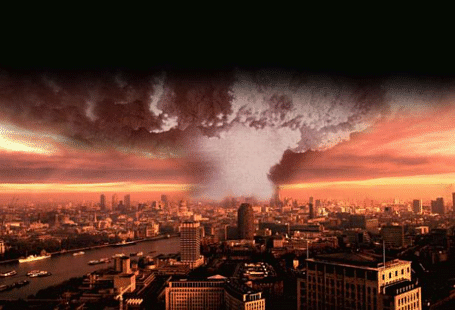
Unless the U.S. Embraces Peace – and Soon!
by Gerry Condon, , https://original.antiwar.com/Gerry_Condon/2024/07/14/nuclear-war-is-imminent/
The world is headed toward nuclear war. The horrific nightmare of global destruction that has haunted humanity ever since Hiroshima and Nagasaki is nearly upon us. For decades, peace activists and nuclear experts have warned about the “growing danger of nuclear war.” The Bulletin of Atomic Scientists has moved the hands of their Doomsday Clock all the way to 90 seconds! How much closer can we get? Are these dire warnings being dismissed like the man with the sign shouting “The End Is Near?”
The original nuclear powers, the U.S., Russia, China, France and the UK – the five permanent members of the UN Security Council – never followed the commitment they made when they signed and ratified the 1970 Nuclear Nonproliferation Treaty (NPT), which required them to “begin good-faith negotiations for the total elimination of nuclear weapons.” Instead they have poured billions of dollars into “modernizing” nuclear weapons. In the meantime, four more countries have joined the nuclear club – India, Pakistan, North Korea and Israel.
After the dissolution of the Warsaw Pact military alliance of the Soviet Union, there was an opportunity for a broad peace in Europe. NATO, an anti-Soviet military alliance led by the U.S., should have disbanded at that point. Instead, it pursued an aggressive policy against a weakened Russia, surrounding it with hostile military forces, including nuclear weapons.
In 2002, President George W. Bush unilaterally removed the U.S. from the Anti-Ballistic Missile (ABM) Treaty, while placing a U.S. missile base in Romania. In 2019, President Donald Trump unilaterally withdrew the U.S. from the Intermediate-range Nuclear Forces (INF) Treaty that had lowered nuclear tensions in Europe, while placing another U.S. missile base in Poland. What were the Russians to think? The U.S. is clearly seeking a dominant nuclear position.
Neoconservative war hawks – or “Neocons” – have captured the foreign policy machinery of Democratic and Republican administrations. Given the declining economic power of the U.S. vis-à-vis a rising China, the Neocons believe the U.S. must aggressively employ its military superiority to maintain global dominance. The U.S. maintains 850 foreign military bases in over 80 countries (compared to a handful each for Russia and China).
Western politicians and pundits frequently accuse Russian president Vladimir Putin of making “nuclear threats.” Indeed, Putin keeps reminding the world of Russia’s nuclear rules of engagement. Russia reserves the right to use nuclear weapons first if it is attacked by the superior conventional forces of NATO. The U.S. has a similar nuclear posture – it will use nuclear weapons first, even against non-nuclear threats such as a cyber-attack. As Daniel Ellsberg reminded us, to possess nuclear weapons is to use them every day, like a gun pointed at someone’s head.
Apparently oblivious to the imminent threat of nuclear war, President Biden continues to pour billions of dollars of weapons into its proxy war against Russia in Ukraine, while blocking peace negotiations. The Biden administration is simultaneously sending billions in weapons to Israel as it commits a horrific and ongoing genocide in Gaza. Israel threatens other Middle Eastern countries with its U.S.-backed military, including nuclear weapons. Can anybody now doubt that they would use them?
The Neocons are also actively preparing for a war against China. The U.S. is encouraging Taiwan’s independence from China, conducting provocative “freedom of navigation” operations in the Taiwan Straits and South China Sea, and building anti-China military alliances throughout the Pacific. One of the few foreign policy debates in Congress is which war should take precedence – the war against Russia or the war against China. Both are nuclear powers. Then there is the joint US/South Korean military exercises aimed at the “decapitation” of the government of North Korea, another nuclear power. What could possibly go wrong?
The threat of nuclear war does not exist in a vacuum. It is directly related to aggressive military competition, much of it being driven by the U.S. Nuclear annihilation will come from a specific war, whether by miscalculation, accident or otherwise.
If we are serious about avoiding a nuclear war, we must demand that the U.S. stops sending weapons to Ukraine and Israel, and instead supports ceasefires and negotiations to stop the killing. We must call for an end to the reckless U.S. confrontation with China and North Korea. It is critically important that these conflicts are ended as soon as possible and replaced with negotiations for peaceful co-existence.
In the longer run, as detailed in the Veterans For Peace Nuclear Posture Review, the U.S. must make a sea change in its foreign policy. We must stop intervening in other countries. We must stop playing “nuclear chicken.” We must demand a peaceful U.S. foreign policy that respects the sovereignty of all nations and the human rights of all people.
The U.S. should sign the UN Treaty on the Prohibition of Nuclear Weapons, and reach out to the other nuclear powers, saying “let’s all get rid of our nuclear weapons together.” Let’s pursue the interests of all humanity by replacing competition with cooperation. Let’s stop spending precious resources on the military and take care of our peoples’ needs instead. Let’s work together to stop global warming, the other imminent existential threat. In order to avoid nuclear annihilation – and climate catastrophe too – we must abolish war once and for all.
Gerry Condon is a Vietnam-era veteran and war resister who serves on the Board of Directors of Veterans For Peace and coordinates its Nuclear Abolition Working Group.
FacebookTwitterWhatsAppRedditLinkedInTumblrEmailPrint
https://www.facebook.com/v17.0/plugins/like.php?app_id=0&channel=https%3A%2F%2Fstaticxx.facebook.com%2Fx%2Fconnect%2Fxd_arbiter%2F%3Fversion%3D46%23cb%3Df7d6bd41d37b090cc%26domain%3Doriginal.antiwar.com%26is_canvas%3Dfalse%26origin%3Dhttps%253A%252F%252Foriginal.antiwar.com%252Ff746d070f98ff7b99%26relation%3Dparent.parent&container_width=0&href=https%3A%2F%2Foriginal.antiwar.com%2Fgerry_condon%2F2024%2F07%2F14%2Fnuclear-war-is-imminent%2F&layout=button&locale=en_US&ref=addtoany&sdk=joey&width=90https://platform.twitter.com/widgets/tweet_button.2f70fb173b9000da126c79afe2098f02.en.html#dnt=false&id=twitter-widget-0&lang=en&original_referer=https%3A%2F%2Foriginal.antiwar.com%2FGerry_Condon%2F2024%2F07%2F14%2Fnuclear-war-is-imminent%2F&related=AddToAny%2Cmicropat&size=m&text=Nuclear%20War%20Is%20Imminent&time=1721084674990&type=share&url=https%3A%2F%2Foriginal.antiwar.com%2Fgerry_condon%2F2024%2F07%2F14%2Fnuclear-war-is-imminent%2FShare
Hundreds of Scientists Urge Biden to Cancel $100 Billion Nuclear Weapons Boondoggle
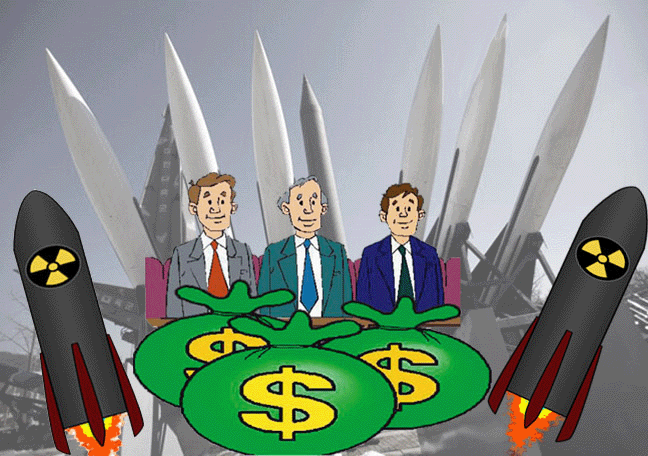
“There is no sound technical or strategic rationale for spending tens of billions of dollars building new nuclear weapons,” an expert said.
Edward Carver, Common Dreams. JULY 11, 2024 https://www.commondreams.org/news/scientists-end-land-based-nuclear-weapons
More than 700 scientists on Monday called for an end to the United States’ land-based nuclear weapons program that’s set to be replaced, following a Pentagon decision to approve the program despite soaring costs.
In an open letter to President Joe Biden and Congress, the Union of Concerned Scientists (UCS) argued that the new intercontinental-range ballistic missile system, known as Sentinel, was “expensive, dangerous, and unnecessary.”
The Department of Defense on Monday certified the continuation of the project, releasing the results of a review that was legally required when the cost estimate ballooned to “at least” $131 billion earlier this year, which drew the scrutiny of some Democrats in Congress, according toThe Hill.
The Defense review found that Sentinel was “essential to national security,” but the scientists disagreed with the assessment.
“There is no sound technical or strategic rationale for spending tens of billions of dollars building new nuclear weapons,” Tara Drozdenko, director of UCS’ global security program, said in a statement.
Nobel Prize-winning physicist Barry Barish, a signatory to the letter, was also harshly critical of the Pentagon’s approach.
“It is unconscionable to continue to develop nuclear weapons, like the Sentinel program,” he said.
The soaring costs of Sentinel, which is overseen by the defense contractor Northrup Grumman, have been the subject of media attention. The program will cost an estimated $214 million per missile, far more than originally expected, Bloombergreported on Friday.

However, the cost is hardly the only reason to cancel the program, UCS scientists argue. The silos that house the nuclear missiles, which are found in North Dakota, Montana, Wyoming, Colorado, and Nebraska, are vulnerable to attack—in fact, they are designed to draw enemy weapons away other U.S. targets, according toScientific American. Such an attack would expose huge swaths of the American population to radioactive fallout.
Because they are a likely target, the siloed missiles are kept on “hair-trigger” alert so the U.S. president can launch them within minutes. This “increases the risk of nuclear war” that could start from false alarms, miscalculations, or misunderstandings, the UCS letter states.
The scientists further argue that there’s no need for a land-based nuclear weapons system given the effectiveness of nuclear-armed submarines—one of the other parts of the nuclear triad, along with bomber jets. Such submarines are “hidden at sea” and “essentially invulnerable to attack,” according to the letter. Moreover, the submarine missiles are just as accurate as land-based missiles, and already have “destructive capability than could ever be employed effectively,” it states.
The submarine system is also being overhauled, as is the ‘air’ component of the nuclear triad. In total, the U.S. military plans to spend more than $1 trillion over 30 years on renewing the nuclear arsenal, according to the Arms Control Association.
The U.S. leads the way in a surge of global spending on nuclear arms, according to two studies published last month, one of which found that nearly $3,000 per second was spent in 2023.
Biden signs ADVANCE Act. Now what?

By Dave Kraft/NEIS, Dave Kraft is the founder and director of Nuclear Energy Information Service. https://beyondnuclearinternational.org/2024/07/14/biden-signs-advance-act-now-what/
Congress wants to “accelerate” new reactor build, putting public safety in jeopardy
By Dave Kraft/NEIS
On Wednesday July 10th President Joe Biden signed the “ADVANCE Act,” which stands for “Accelerating Deployment of Versatile, Advanced Nuclear for Clean Energy.”
The controversial bill aggressively promotes the narrow, short-term interests of the U.S. nuclear industry in ways that threaten the long-term national environmental, climate and national/international security interests.
Further, it functionally rewrites the mandate of the federal Nuclear Regulatory Commission (NRC) in ways that potentially cast it into the role of promoter instead of federal regulator of the controversial and moribund nuclear power industry.
To summarize, The ADVANCE Act:
- promotes development of currently experimental, commercially non-existent “small modular nuclear reactors” (SMNRs) and allegedly “advanced” reactors, using tax dollars;
- provides less regulatory oversight by ordering the NRC to “streamline” licensing of currently experimental SMNRs, putting the NRC in a position of becoming a quasi-promoter instead of regulator, in contradiction to its 1975 founding mandate;
- requires development of the infrastructure needed to produce more intensely enriched radioactive fuel called “HALEU” – high-assay, low-enriched uranium — required for the SMNRs to run on. Enrichment would be just below weapons-usable; currently the only source of HALEU is Russia;
- ignores the potential increased risk and harm from having more nuclear reactors large and small;
- produces more high-level radioactive waste without first having a disposal method in place for either current or future reactors;
- permits and encourages export of nuclear technology and materials internationally; and
- for the first time, allows foreign control/ownership of nuclear facilities within the U.S.
Congress cannot be absolved from its role in uncritically swallowing the gaslit promises of nuclear power. The House previously passed its version of the legislation by a margin of 393-13 before sending it to the Senate. There, it stalled, but was procedurally resurrected by attaching the 93-page nuclear Christmas-wish list to a three-page, must pass fire safety bill – S.870, the Fire Grants and Safety Act. It passed in the Senate 88-2, with only Senators Ed Markey (MA) and Bernie Sanders (VT) recognizing the imminent threat it posed to energy, environmental, and international security interests.
Critics of nuclear power and opponents of the ADVANCE Act fail to see:
- how the Act fights climate disruption, when SMNRs are only experimental, may not work at all, and if they work will not be available in sufficient quantities for commercialization before the mid-2030s, according the nuclear industry itself. It is the carbon we remove and keep out of the atmosphere between NOW and the mid-2030s that will determine if we can meet climate goals;
- how SMNRs will enhance currently threatened system reliability and power availability, when they will not be available – assuming they even work – before the mid-2030s;
- how exporting SMNR technology and ~19+% enriched (just below weapons useable) HALEU reactor fuel worldwide improves international security in a world dominated by wars in Ukraine, the Middle East, and potentially in southeast Asia; poorly controlled non-state actors; and well-known corrupt business entities. Equally baffling is how allowing foreign ownership of nuclear facilities in the U.S. proper makes our energy systems safer, more secure, and insulated from economic instability or foreign interference;
- how mandating the NRC to “expedite” SMNR licensing – potentially at the expense of its original and official mandate to “adequately” protect public health and safety and the environment – makes nuclear power and the nation safer. This regulatory approach has demonstrably failed with Boeing; failed with Norfolk Southern in East Palestine; failed with PIMSA in Sartortia; and doubly-failed at Fukushima. NRC is supposed to oversee and regulate an industry that in the past five years has repeatedly displayed corporate and legislative corruption at the highest levels resulting in FBI indictments, convictions and guilty pleas, millions of dollars in fines, and enormous cost overruns born by ratepayers; and
- why viable alternatives to nuclear expansion like renewable energy, energy efficiency, energy storage, and transmission improvements are not prioritized over nuclear expansion, since ALL are cheaper, quicker to implement, reduce carbon emissions, produce no radioactive wastes, have no meltdown potential, create no nuclear proliferation issues, and, most importantly – ALREADY EXIST. Nothing more needs to be invented; just implemented.
For example, the Federal Energy Regulatory Commission (FERC) stated in December, 2023 that roughly 2,600 giga-watts (GW) of electric power projects await grid connection – over twice the entire current electrical output of the US, and roughly 27 times the entire output of all current US reactors combined. The large majority of this backlog are renewable energy projects awaiting connection access to the aging transmission grid.
New EXISTING transmission technologies like reconductoring and improved grid resiliency solutions could double the capacity of the grid in much shorter time and with far greater certainty than chasing speculative nuclear promises, creating greater ease of access for renewables and storage.
By signing the ADVANCE Act, the President and an accomplice Congress have placed the nation’s energy future, climate goals, and even international security at grave risk. Clearly, placing short term, ego-invested interests over the long-term best interests of the nation seem to be a problem extending beyond re-election. As Napoleon once observed, never ascribe anything to malice when there is the least suspicion of incompetence. Perhaps, but in the end, the results are the same.
Dave Kraft is the founder and director of Nuclear Energy Information Service.
Campaigners against Sizewell C hopeful new MPs will take their concerns to parliament

The campaign group Stop Sizewell C says it’s heard from several MPs already
Jasmine Oak, 10th Jul 2024, https://hellorayo.co.uk/greatest-hits/west-norfolk/news/stop-sizewell-c-campaigners-new-mp-hopes/
Campaigners are calling on the new Government to consider scrapping plans to build a nuclear power plant on the Suffolk Coast
Once up and running, it’s thought Sizewell C will power up to six million homes, but activists say it’s going to devastate our countryside
Alison Downes is from ‘Stop Sizewell C’ group – and says Sir Kier Starmer needs to listen to their concerns: “The priority needs to be preventing there being any more unnecessary damage to the local environment.
“We have already seen a fair amount of damage, but that’s nothing compared with what’s to come…
“The government needs to resist any pressure from the nuclear industry for a hasty decision, especially as Sizewell C is going to take a long time, and a lot of money, to build.”
Alison’s hoping the local area’s new MPs will voice their concerns in Parliament: “Our new MP has publicly said that Stop Sizewell C was the first group she met with when she was elected.
“We also have the co-leader of the Green Party, Adrian Ramsay, in Waveney Valley. He’s been very vocal against Sizewell C.”
A spokesperson for EDF Energy has previously told us: “Our proposals for Sizewell C will see the creation of a 3.2 gigawatt power station that will create low-carbon electricity that will supply 6 million homes.
“This will be delivering clean, reliable, and affordable power for generations.”
Exposing the Myth of the ‘Good War’
BY NICKY REID, CounterPunch 12 July 24
America has a problem but don’t worry, because we can stop anytime we want. I speak of course of America’s bottomless appetite for warfare, the fact that we can’t seem to go fifteen minutes without lighting up a third world country like a fucking spliff. But this doesn’t make us addicts, we just like to fuck around and blow shit up once in a while to let off some steam after a long day. I mean, we quit Afghanistan after like twenty years and we kind of quit Iraq. We could totally go cold turkey and put America first if we wanted too.
But let’s just send a few more bombs to Ukraine first. And maybe just one more drone strike in Somalia, you know, for old times’ sake. And then maybe just a quick invasion of Haiti and another freedom of navigation drill in the South China Sea and a few more sanctions on North Korea and a couple more NATO members and another base in Okinawa and a quick quagmire in Yemen and a few more child soldiers in Rojava and just one goddamn holocaust in the Holy Land, maybe two, or three, or five, or fuck it, give us World War Three!
OK, so maybe America has a tiny little addiction. Oh, let’s just face it, we’re fucking war junkies, Sid and Nancy grade shit, sucking off Raytheon behind the missile silo for just one last fix. But as long as we’re having this moment of clarity here, why don’t we just put it all on the table right now. We may be an empire of fiends who crave war crimes like a baby craves tits, but this is far from a new condition, and we are all infected. Even your average marching pacifist in this country seems to view America’s appetite for destruction as little more than an aberration in an otherwise stoic national history and every so-called non-interventionist seems to carry room in their heart for at least one exception that proves the rule. That one good war, you know, the one where we played the good guys for real and saved the day for just one bright shining moment.
But this is all bullshit. Every single American war has been bullshit. They all come with different excuses and some of them are pretty goddamn convincing but every major conflict that this country has ever engaged in has been motivated by greed and power, and every single war we’ve fought has ended the exact same way, with piles of bodies, fewer civil rights, and a growing thirst for more.
Even our so-called Revolution, which so many otherwise peaceful libertarians hold in such high regard, was little more than another blood thirsty power grab. Let me be frank here, even I can get behind a good old-fashioned grass roots revolution as an act of societal self-defense, but the idea that you can have any kind of real revolution on illegally occupied territory is absurd. The American Revolution was really more of a colonial mutiny. A bunch of slave-trading Indian killers got tired of kicking up to the Crown and after catching wind that the British were making moves to curtail some of their slave trading and Indian killing, they went all Colonel Kurtz on their ass and declared their encampment to be a sovereign nation…………………………………………………………………………………………….
And then of course we have our sainted World Wars, where America the indispensable saved humanity from fascism in the name of world peace and global democracy. Yeah, sorry progressives, but that’s just more imperial bullshit. The First World War was a senseless imperial clusterfuck with a bunch of antiquated empires like France, Germany, Russia, and the UK clawing each other’s eyes out over their dwindling spheres of influence. After about three years of this shit, everybody involved was pretty much ready to call it quits and negotiate a settlement. Then Woodrow Wilson jumped into the mosh pit to keep the bloodbath running so he could achieve his dream of establishing America as a progressive global superpower and use his massive new war powers to reorganize the economy beneath a cartel of massive corporations while simultaneously reorganizing the Constitution beneath an engorged police state.
That white devil also set the stage for the next World War by putting all the debt from the first one on Germany with the Treaty of Versailles. But wasn’t America attacked at Pearl Harbor? Technically, yes, but FDR and his thugs went out of their way to make this attack inevitable, goading the Japanese with a crippling oil embargo, shaming their Diet when they visited Washington to negotiate, and placing the US Pacific Fleet on their doorstep by relocating it to the recently colonized territory of Hawaii. Germany never would have declared war on the US if it wasn’t for Pearl Harbor. Hitler had already basically lost the war in Stalingrad and was actually pretty committed to avoiding stretching himself any thinner in the Atlantic.
But the US wanted to finish what Wilson started. So, once again, we jumped into another imperial bloodbath between dueling monsters at the last minute to cravenly poach the spoils of war and we did so with a campaign of shocking terrorist attacks designed to send a message to the world that we were the Nazis now. Entire cities were torched to the ground in massive napalm attacks. 100,000 people in Tokyo, another 600,000 in Hamburg, Dresden, and Cologne. By 1945, Japan was begging for a peace deal, but we dropped two nuclear bombs on them anyway just to make sure that Stalin got the message.
Sound like a pretty good fucking war to you?
Over the decades, the battlefields and the boogeymen kept changing but the results were always the same. Another 4 million people burnt alive in Korea, another 5 million in Vietnam, dictators and death squads and mujahadeen armed to the teeth and trained in butchery, all in the name of fighting the evils of communism. But then communism falls, and we start more wars with those same dictators and death squads and mujahadeen. The so-called War on Terror creates another killing field for another 4.7 million bodies and America gets bigger, our corporations get richer, and our police state becomes more severe.
Enough! Enough bullshit wars already. America needs to end this demented addiction before it ends us all in a nuclear overdose. The first step isn’t just admitting that we have a problem. The first step is ripping up the toxic mythology of the good war and admitting that we’ve always had a fucking problem, that war itself is the problem. The only good excuse for violence is self-defense and you can’t defend yourself when you are constantly crashing someone else’s property. It’s time for a different kind of intervention. It’s time for dope-sick Americans to join the rest of the world in defending ourselves from the disease of American imperialism. And it all starts with us finally admitting that every American war is bullshit. https://www.counterpunch.org/2024/07/12/exposing-the-myth-of-the-good-war/
Anti-nuclear weapons activists to camp outside RAF base for ten days

“We call on the Labour government to explicitly refuse any US request to station their weapons of mass destruction here.”
PEACE activists will camp outside RAF Lakenheath for 10 days as the Suffolk air base prepares for an “upcoming nuclear mission.”
Up to 50 members of Lakenheath Alliance for Peace set out on a three-day walk from Norwich to the United States Air Force base on Saturday and will set up camp there tomorrow until July 25 in their protest against nuclear weapons.
CND general secretary Kate Hudson said: “CND is a proud part of the Lakenheath Alliance for Peace and calls on everyone across Britain to get involved with this campaign.
“The return of US nuclear weapons to Lakenheath greatly increases the nuclear risk already faced by this country as it puts the whole of Britain on the nuclear front line.
“We call on the Labour government to explicitly refuse any US request to station their weapons of mass destruction here.”
The group aims to arrive at nearby Brandon and head to RAF Lakenheath at 1pm to pitch camp, with vigils, protests and workshops planned. The group will hand-deliver a letter to the base commander tomorrow.
Their action comes after a document came to light stating that work was under way in preparation for Lakenheath’s “upcoming nuclear mission.”
RAF Lakenheath is the largest US Air Force operated base in England.
Neither the US Air Force nor the Ministry of Defence have commented on plans for stationing nuclear weapons there.
The ministry said it would neither confirm nor deny the presence of nuclear weapons at any given location, per long-standing British and Nato policy.
An RAF Lakenheath spokesman said the base was aware of the planned event and respected the right to protest peacefully.
Suffolk Police said the force has prepared a “proportionate lawful and effective policing response.”
Kiev missile attack. What happened? [i]
Cruise missile or stray air defense missile
Black Mountain Analysis MIKE MIHAJLOVIC, JUL 14, 2024
Coincidence or not, every time NATO has a high-level meeting, something terrible happens in Ukraine. After that, there is a frenzy of accusations about war crimes, indiscriminate targeting of civilians, and insults in both mainstream media and social media. There are “experts” that pop up like mushrooms after rain and an uncontrollable flood of speculations. What is missing is someone who puts a brake on emotional comments and starts to look at the issue from different angles: what may be evident from one side may be completely different when looked at from the other side.
This article is not an attempt to investigate the recent explosion that damaged the children’s hospital in Kiev, nor to finger point at anyone, but rather to establish the facts that may point to some conclusion if one expends the effort.
FACTS
The warhead
On July 8, Russia unleashed a barrage of cruise missiles at strategically important locations such as the Artyom Plant, which is a well-known manufacturer of equipment for the Ukrainian military. This target was carefully selected, and selection was based on careful and long surveillance, meaning that drones, satellites, field operatives, etc., were involved. The target for the specific day was not chosen randomly but after careful analysis, and the decision to strike was made after many pieces of the intelligence puzzle were acquired and placed to reveal a clear picture.
The target was very important, so the targeteers decided to engage it with multiple cruise missiles. Mathematically, it is clear that the probability of destruction is much higher with multiple missiles. The weapon chosen was not by chance: a cruise missile with a 450 kg warhead (the optimal choice for this type of target) guarantees destruction on a large scale, even if it is not a pinpoint hit. Several warheads of this size will obliterate the designated target(s).
Ukrainians are not naïve; more often than not, valuable equipment is relocated to predetermined places. Because of the machinery and other equipment, moving the manufacturing facilities is harder but not entirely impossible. Moving the VIPs is much easier, but one precise hit can virtually destroy the command structure or decision-makers.
In this case, as seen in several videos, the target mentioned was the Artyom Plant—a series of sequential hits by Kh-101 missiles achieved desirable results. What happened with the hospital is highly debatable
Firstly, there is a video clip showing a flying object, a missile, in a steep dive hitting the area. What is very important to say is that the missile didn’t hit the hospital directly, and the damage on the facade, which is evident in some photos, is caused by secondary effects such as blasts and shrapnel.
[excellent photos on original]
……………………………………………………………………………………………… Let’s do a brief investigation backward, starting from the position of the hit and working toward the missile. In almost every analysis flooding the media, everyone talks about the missile, and there are two streams: those who categorically say that the missile is indeed a Russian cruise missile and the other that argues for the stray Ukrainian AD missile. More on the hierarchy line in the political world, more acquisitions and this is especially on the pro-Ukrainian side.
The first step is to determine the level of damage and the impact point and compare it with the equivalent damage that can be produced with a high explosive charge.
The damaged building, a Soviet-built brick structure, has one corner collapsed, while the substation also shows damage from blasts and shrapnel. The hospital is not damaged except for shrapnel (that may be from the flying debris, not from the warhead fragments), broken windows, and other minor consequences of the blast…………………………………………………………………………………………………………………………………………………………………………………………………………………………………….. [many photos]……………….
What is the next?
Based on what was previously said, all factors must be involved in the investigation: the estimated size of the warhead, two “best” candidates for the perpetrator based on the video evidence, and something that both sides, including the whole pact for one side, are not willing to share—radar records and surveillance satellite records………………………………………………………………………………………………
Conclusion
The hospital was not the intended target. The damaged building is likely not the intended target as well.
The explosive was not heavy and is likely not from the typical cruise missile charge, even with the activation of unburned motor propellant. This does not exclude cruise missiles because they may be decoys or have some modified charge, another stream that may be explored.
The visual records are of low quality and prone to heavy editing, so the validity of the comparison is questionable, and the investigation can’t be judged solely on that.
AD units in the area were active. It is not publicly known how many missiles were launched and from where.
Hypotheses like that there was a secret meeting in the building or that the target was actually a Ministry of Infrastructure meeting may be considered. Still, there is no evidence to support this.
Sabotage and some heavily modified third types of missiles are in the domain of conspiracy theories and should stay there.
As usual, the blame game will continue until something else happens, and everything starts from the beginning.
In any case, the reader should conduct further research and, if possible, try to stay unbiased if that is possible.
I. Balagansky: Damaging Effects of Weapons and Ammunition, 3.5 Evaluation of the Damaging Effect of Shock Waves on Various Objects.
Ibid
High Explosive-Fragmentation
[i] Edited by Piquet (editPiquet@gmail.com) https://bmanalysis.substack.com/p/kiev-missile-attack-what-happened?utm_source=post-email-title&publication_id=1105422&post_id=146522183&utm_campaign=email-post-title&isFreemail=true&r=1ise1&triedRedirect=true&utm_medium=email—
1 This Month.
5 January -Webinar-What is Trump’s Golden Dome?
REGISTER AT Massachusetts Peace Action Education


New book – https://www.amazon.com/dp/1923372157?utm_source=substack&utm_medium=email
Now until to February 10, 2026 Radioactive waste storage in France: the debate is finally open! How to participate?
-
Archives
- December 2025 (286)
- November 2025 (359)
- October 2025 (377)
- September 2025 (258)
- August 2025 (319)
- July 2025 (230)
- June 2025 (348)
- May 2025 (261)
- April 2025 (305)
- March 2025 (319)
- February 2025 (234)
- January 2025 (250)
-
Categories
- 1
- 1 NUCLEAR ISSUES
- business and costs
- climate change
- culture and arts
- ENERGY
- environment
- health
- history
- indigenous issues
- Legal
- marketing of nuclear
- media
- opposition to nuclear
- PERSONAL STORIES
- politics
- politics international
- Religion and ethics
- safety
- secrets,lies and civil liberties
- spinbuster
- technology
- Uranium
- wastes
- weapons and war
- Women
- 2 WORLD
- ACTION
- AFRICA
- Atrocities
- AUSTRALIA
- Christina's notes
- Christina's themes
- culture and arts
- Events
- Fuk 2022
- Fuk 2023
- Fukushima 2017
- Fukushima 2018
- fukushima 2019
- Fukushima 2020
- Fukushima 2021
- general
- global warming
- Humour (God we need it)
- Nuclear
- RARE EARTHS
- Reference
- resources – print
- Resources -audiovicual
- Weekly Newsletter
- World
- World Nuclear
- YouTube
-
RSS
Entries RSS
Comments RSS
 nuclear-news