TODAY. Who will honestly face up to the problem of nuclear wastes? Rolling Stewardship as a practical option.
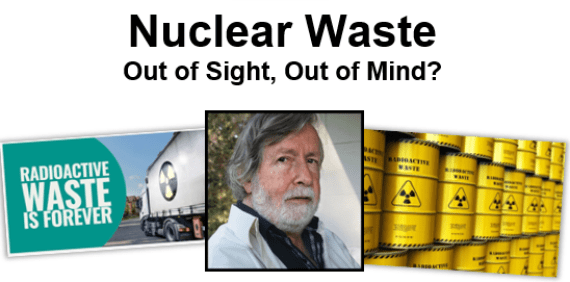
Dr Edwards is the first I’ve come across to simply acknowledge that there really is no definitive solution for disposing of nuclear wastes. But he moves on to a practical method of managing the wastes that now exist, (along with the aim of not creating any more). He suggests adapting a plan by the National Academy of Sciences for dealing with long-lived toxic substances – Rolling Stewardship.
Do not trust the authorities on this problem. Get real.
The International Atomic Energy Agency (IAEA) was set up in order to promote the nuclear industry, (and to blur and assuage the guilt from the bombing of Hiroshima and Nagasaki).
So – don’t expect the IAEA, and all the other worthy bodies set up to manage the industry, to genuinely face up to the problem. If it means adding costs to today’s industry – they’re not interested. (Just let’s pass it on to our grandchildren)
Do not trust the “respectable” media to genuinely address, let alone even understand, this problem. They can’t – (A) because they want to keep their jobs, and (B) they are intimidated by their feeling of not really understanding such technical matters – best leave it to the experts!
Trouble is – the experts all have a vested interest in the nuclear/ nuclear-weapons and associated industries.
Having said that, I do acknowledge that there are a courageous few – experts who see the bad stuff about nuclear. (These are soon dismissed and labelled as cranks etc) .
There are a few courageous journalists who manage to speak the truth, and still hold down their jobs in the “mainstream” media. (I will not name these, for their own employment safety.)
So – now we come to talking about nuclear wastes.
I am grateful to Gordon Edwards for coming up with a genuine examination of the question of nuclear wastes. Gordon Edwards is a mathematician, physicist, nuclear consultant, and president of the Canadian Coalition for Nuclear Responsibility (www.ccnr.org). No doubt he will soon be trashed by the “experts” as a foolish and dangerous crank.
Dr Edwards is the first I’ve come across to simply acknowledge that there really is no definitive solution for disposing of nuclear wastes. But he moves on to a practical method of managing the wastes that now exist, (along with the aim of not creating any more). He suggests adapting a plan by the National Academy of Sciences for dealing with long-lived toxic substances – Rolling Stewardship.
Dr Edwards’ concept is outlined here – Rolling stewardship of nuclear wastes. In brief, it means that we should take responsibility now for nuclear waste – store it safely and strongly above ground, away from large water bodies, and monitor it, repair and repackage containers. This is an alternative to the present plan for bury it and forget about it – leave it to future generations to cope with any issues.
This stewardship plan is expensive – the costs of making the containers really strong, and kept in repair, and the ongoing work of monitoring and repair. Indeed it will add to the already well-known diseconomics of the industry.
So the authorities and experts will not like it. But perhaps – some will. Some will join the ranks of the discredited critics of the nuclear industry. It would be something to be proud of – to join with Gordon Edwards and others who look towards a positive plan – as we exit from the nuclear age.
“Unspeakable”: Doctors Back from Gaza Say Death Toll “Much Higher,” Push Harris, Biden for Ceasefire
Democracy Now, AMY GOODMAN, 26 Jul 24
We speak to two doctors who are part of a group of 45 U.S. doctors, surgeons and nurses who have volunteered in Gaza since October 7 and wrote an open letter to President Biden and Vice President Harris, the Democratic presidential candidate, demanding an immediate ceasefire and an international arms embargo of Israel. The group includes evidence of a much higher death toll than is usually cited: more than 92,000 people, which represents over 4% of Gaza’s population. The doctors write, “With only marginal exceptions, everyone in Gaza is sick, injured, or both. Israel’s continued, repeated displacement of the malnourished and sick population of Gaza, half of whom are children, to areas with no running water or even toilets available is absolutely shocking.” The conditions in Gaza are “unacceptable,” and “people know this is wrong but no one is speaking up,” says Dr. Thalia Pachiyannakis, an obstetrician and gynecologist who volunteered at the Nasser Medical Complex. “We all saw evidence of a death toll that is certainly much higher than what is reported by the Gaza Ministry of Health,” adds Dr. Feroze Sidhwa, a trauma surgeon who volunteered at the European Hospital.
Transcript
AMY GOODMAN: As Israel carries out new airstrikes on the Gaza Strip, the United Nations Palestinian refugee agency, known as UNRWA, is reporting nine in every 10 Palestinians in Gaza have been forcibly displaced. Meanwhile, the World Food Programme is warning Israel continues to block delivery of aid, and says it’s been forced to reduce food rations, quote, “to ensure broader coverage for newly displaced people,” unquote. U.N. experts are blaming Israel for the onset of famine in Gaza, accusing it of carrying out a targeted starvation campaign.
Here in the United States, days after launching her White House presidential campaign and skipping Israeli Prime Minister Benjamin Netanyahu’s joint address to Congress, vice president and Democratic presidential candidate Kamala Harris met privately Thursday afternoon with Netanyahu, who also met with President Biden. Harris spoke afterwards.
VICE PRESIDENT KAMALA HARRIS: What has happened in Gaza over the past nine months is devastating. The images of dead children and desperate, hungry people fleeing for safety, sometimes displaced for the second, third or fourth time, we cannot look away in the face of these tragedies. We cannot allow ourselves to become numb
to the suffering. And I will not be silent.
AMY GOODMAN: Harris described her private meeting with Netanyahu as “frank and constructive.” She said nothing about cutting U.S. military assistance for Israel, even as she reiterated calls to finalize a ceasefire deal.
This comes as a group of 45 U.S. doctors, surgeons, nurses who have volunteered in Gaza since October 7th have written an open letter to President Biden and Vice President Harris, demanding an immediate ceasefire and an international arms embargo against Israel. The group of health workers include evidence of a much higher — they say there’s evidence of a much higher death toll than is usually cited: more than 92,000 people, which represents over 4% of Gaza’s population.
Two of the doctors join us now. In South Bend, Indiana, we’re joined by Thalia Pachiyannakis. She’s an obstetrician-gynecologist who returned from Gaza earlier this month after having worked at Nasser Medical Complex in Khan Younis. And joining us from Stockton, California, is Dr. Feroze Sidhwa, a trauma surgeon who volunteered at European Hospital in Khan Younis in the early spring. He worked with the Palestinian American Medical Association in collaboration with the World Health Organization. He recently co-wrote the recent Politico article, “We Volunteered at a Gaza Hospital. What We Saw Was Unspeakable.”………………………………………………………………………………………………………………………………………….more https://www.democracynow.org/2024/7/26/feroze_sidhwa_thalia_pachiyannakis_gaza_war
As record heat risks bleaching 73% of the world’s coral reefs, scientists ask ‘what do we do now?’

A vast array of solutions are being worked on but experts urge a ‘fundamental rethink’ as temperatures are forecast to climb even higher in coming decades
Graham Readfearn Climate and environment reporter, Tue 30 Jul 2024 https://www.theguardian.com/environment/article/2024/jul/30/as-record-heat-risks-bleaching-73-of-the-worlds-coral-reefs-scientists-ask-what-do-we-do-now
After 18 months of record-breaking ocean temperatures, the planet’s reefs are in the middle of the most widespread heat-stress event on record.
Across the Pacific, Atlantic and Indian oceans, latest figures from the US government’s Coral Reef Watch, shared with the Guardian, show 73% of the world’s corals have been hit with enough heat for them to begin bleaching.
Beginning in February 2023, this is the fourth global mass bleaching event – the second in 10 years, and the most widespread on record.
After seeing their beloved reefs struggling to survive, some coral scientists are calling for a major rethink on how to protect reefs as temperatures climb even higher in the coming decades.
“We’re coming out of a couple of decades where we made predictions,” said Prof Tracy Ainsworth, the vice-president of the International Coral Reef Society.
“Now we are at a point where we hoped we would not be. Now we’re asking, what do we do now?”
In the scientific journal Nature Climate Change, three articles were published on Monday calling on the coral conservation and science community to have a collective rethink.
“I would call it soul searching,” said Prof Tiffany Morrison, a co-author of one of the articles which is sharply critical of widespread programs, many with corporate backers, to grow corals in nurseries and then plant them out on reefs.
“When everyone realised the scale of the climate impacts on coral reefs, the first instinct was to just do something and intervene because people were so distressed.”
In Florida and the Caribbean last year, many replanted corals died as record-breaking heat stress swept across the region
“We need a fundamental rethink,” said Prof David Bellwood, a colleague of Morrison’s at James Cook University in Australia.
“Too much is at stake. At the moment, coral restoration is at best psychological relief and cosmetic conservation, and at worst a dangerous distraction from climate action.”
Critical coral
Coral reefs provide food for millions of people around the world. They also provide the raw material that eventually becomes much of the sand on beaches and protect coastlines from wave damage.
When corals sit in water that is too hot, they expel algae in their tissues that provide colour and much of their nutrients.
Dr Derek Manzello, director of Coral Reef Watch, said the number of reefs affected by heat stress from the current global event was still rising and had “definitely led to most everyone involved with reef science and restoration having a hard think about future activities and best practices”.
The current global event has affected reefs in 70 countries and the full impact may never be fully understood.
The world’s biggest coral reef system – the Great Barrier Reef – has also likely been through its worst coral bleaching event, but government scientists may not know until next year how many corals died.
Whether an individual coral survives bleaching depends on each species and the extremes and duration of heat.
In another scientific article, Prof Michael Webster of New York University suggested a radical idea which, he said, would have been far too controversial for a scientific paper only 10 years ago.
Coral reefs exist across tropical waters around the world but are adapted to local conditions. Conservationists should consider introducing corals that have evolved in very hot regions to reefs where the current mix of corals are struggling to survive, Webster said.
“It’s incredibly controversial and we might not ever go there, but we’re in a situation where we’re questioning if we will have reefs in many places. Is it now worth asking that question?”
Webster said coral reefs would have a better chance of surviving through the coming decades if they had a diversity of coral species.
“Getting CO2 down has to be our end game, but we have centuries where coral systems like reefs will be in trouble.”
Cautious interventions
It’s interventions like that mooted by Webster that Morrison is cautious about.
There’s a vast array of scientific solutions for coral reefs currently being worked on around the world, from whitening clouds to shade reefs to selective breeding of corals for increased heat tolerance.
“We are vesting too much money and hope into these speculative coral bioengineering and genetic engineering solutions,” Morrison said. “We don’t know if they’re scalable and, if they are, whether we can afford to scale them.”
Many interventions come up against a philosophical question. Who decides which species to save or modify, or which steps to take? Those decisions could dictate what reefs look like in the future – decisions made by humans, not by nature.
“There are very few people looking at unintended consequences and there’s no governance systems in place to manage that,” Morrison said.
“But number one – we have to be mitigating fossil fuels.”
Freaking out
Members of the International Coral Reef Society wrote in May that scientists needed to “reconsider this challenge” of protecting reefs.
Because efforts to cut global greenhouse gas emissions were too slow, governments and communities needed to redouble efforts to reduce other stressors on corals, such as overfishing and local water pollution, the society said.
Tim McClanahan, a reef ecologist and director of marine science at the US-based Wildlife Conservation Society, admitted “people are freaking out” from the current bleaching.
He said there was little evidence coral restoration projects had restored reefs at scale, and in places like Florida, coral nurseries had been destroyed by heat.
“I think they are ignoring past experiences and not recognising the science,” he said.
“I’m concerned that a problem we have with NGOs is we’re not very good at admitting to our failures. I find there’s a tendency to act without consulting the literature.”
McClanahan, in a third article in Nature Climate Change, said predicting the future for coral reefs needed to be more sophisticated.
Rather than just including heat, modelling should account for how reefs react differently to heat stress depending on local conditions like the mix of coral species or how well protected they are. The prognosis for some reefs may not be quite so dire, he argued.
McClanahan has been working on reefs for 40 years and said he has seen them go from undisturbed wonders to shadows of their former selves.
“Yes, the reefs are screwed – in deep trouble. We’re experiencing very austere conditions for corals already,” he said.
“In the 90s I was in grief, but now I want to know how we deal with the situation that we’re in. We are not dealing with it very well and we have this fatalistic view.
“We should be freaking out. That’s not an unreasonable response, but we need to sit back and be a bit more intelligent.”
Californians defy evacuation orders as wildfire threatens homes
Residents of a small California town are refusing to evacuate as one of the
largest wildfires in the state’s history threatens their homes. More than
4,000 firefighters and emergency personnel are battling the Park fire in
northern California, which by Monday had burned more than 350,000 acres
across four counties. The fire broke out on Wednesday, when authorities say
a man pushed a burning car into a ravine near the city of Chico, about 160
miles north of San Francisco.
Times 29th July 2024
U.S. company HOLTEC approaches South Yorkshire with £1.3bn offer to start Small Nuclear Reactor production

Representatives from an American nuclear energy company have visited South
Yorkshire as it explores options for a new Small Modular Reactor (SMR)
facility. Earlier this year, Holtec – which has been working at Sizewell B
for more than15 years – shortlisted South Yorkshire as a potential location
for its new SMR factory in the UK. The factory would present a major £1.3bn
investment and job creation opportunity. Representatives from Holtec and
senior officers from the South Yorkshire Mayoral Combined Authority visited
three potential factory sites in the region. The mayor and the Holtec
delegation also met with senior business representative in the region to
gain an insight into the region’s industrial heritage, strengths and
potential for future growth.
Insider Media 29th July 2024
https://www.insidermedia.com/news/yorkshire/nuclear-power-specialist-visits-south-yorkshire
Japan nuclear watchdog panel decides against restarting Tsuruga reactor

difficult to determine the safety of the reactor, noting the proximity of a seismic faultline.
The government in Japan, one of the world’s most seismically active countries, does not allow nuclear plants to be situated over active faultlines.
July 27 2024, TOKYO, https://japantoday.com/category/national/japan-nuclear-watchdog-panel-decides-against-restarting-tsuruga-reactor1
A panel of Japan’s nuclear watchdog decided on Friday against restarting a reactor at the Tsuruga nuclear power plant citing seismic risks, paving the way for the regulator to keep the Japan Atomic Power plant shut.
The panel said it was difficult to determine the safety of the reactor, noting the proximity of a seismic faultline. Consequently, it said, the reactor was not deemed compliant with criteria for installation licensing.
“We will conduct an additional investigation. We are not considering decommissioning the plant,” Mamoru Muramatsu, president of Japan Atomic Power, said after the panel meeting, according to Kyodo News Agency.
The government in Japan, one of the world’s most seismically active countries, does not allow nuclear plants to be situated over active faultlines.
The panel is set to report its decision to the Nuclear Regulation Authority (NRA) soon.
If approved, this would be the first case of non-compliance under the stricter safety standards imposed after the 2011 Fukushima nuclear disaster.
The move could hinder the government’s efforts to restart more nuclear power plants to ensure a stable energy supply.
Japan, which had 54 operational reactors before the 2011 disaster, has restarted only 12 of the 33 nuclear reactors it has been considering restarting.
Along with most reactors in Japan, operations at the Tsuruga’s No.2 reactor have been halted since 2011 following triple meltdowns at Tokyo Electric Power’s Fukushima Daiichi nuclear power plant.
On March 11, 2011, Japan’s northeast coast was struck by a magnitude 9 earthquake, the strongest quake in Japan on record, and a massive tsunami, triggering the worst nuclear crisis since Chernobyl a quarter of a century earlier.
Atomic Fallacy: Why Nuclear Power Won’t Solve the Climate Crisis

Although climate change scares me, I am even more scared of a future with more nuclear plants.
My bottom line is that nuclear energy, whether with old reactor designs or new faux alternatives, will simply not resolve the climate crisis. The threat from climate change is urgent. The world has neither the financial resources nor the luxury of time to expand nuclear power.
LIT HUB, By M.V. Ramana, July 29, 2024
M.V. Ramana Debunks Some Common Arguments About Energy In an Era of Ecological Emergency
I am scared about how fast climate change is disrupting our world. At a theoretical level, I have known for decades about growing carbon dioxide emissions and resultant changes to global and local temperatures, sea-level rise, severe storms, wildfires, and so on…………………………..
I can go on for much longer in this vein. But there isn’t any need. Just about anyone alive today has been impacted in some way by climate change.
As someone trained in physics, and as an academic paid to research, I have been drawn to studying one essential contributor to these crises: how energy and electricity are produced, especially those methods proposed to mitigate climate change. Prominent among these proposals is nuclear energy.
Although climate change scares me, I am even more scared of a future with more nuclear plants. Increasing how much energy is produced with nuclear reactors would greatly exacerbate the risk of severe accidents like the one at Chernobyl, expand how much of our environment is contaminated with radioactive wastes that remain hazardous for millennia, and last but not least, make catastrophic nuclear war more likely.
Some might argue that these risks are the price we must pay to counter the threat of climate change. I disagree, but even if one were to adopt this position, my research shows that nuclear energy is just not a feasible solution to climate change. A nuclear power plant is a really expensive way to produce electricity. And nuclear energy simply cannot be scaled fast enough to match the rate at which the world needs to lower carbon emissions to stay under 1.5 degrees Celsius, or even 2 degrees.
Cost and the slow rate of deployment largely explain why the share of global electricity produced by nuclear reactors has been steadily declining, from around 16.9 percent in 1997, when the Kyoto Protocol was signed, to 9.2 percent in 2022. In contrast, as the costs of wind and solar energy declined dramatically, and modern renewables (which do not include large dams) went from supplying 1.2 percent of the world’s electricity in 1997 to 14.4 percent in 2022……………………………………………
We were not the only people coming up with reasons for not believing in the claim that new reactor designs would solve all these problems. Other scientists and analysts also highlighted the dangers and false promises of SMRs.
Nuclear advocates are not deterred by such arguments. They insist that this time it will be different. Nuclear plants would be cheap, would be quick to build, would be safe, would never have to be shut down in unplanned ways, and would not be affected by climate-related extreme weather events. The evidence from the real world, which I elaborate on later, suggests otherwise. Nuclear reactors are unlikely to possess any of these characteristics, let alone all of them. Thus, what is actually being advocated might be termed faux nuclear plants, existing only in the imagination of some, not in the real world.
My bottom line is that nuclear energy, whether with old reactor designs or new faux alternatives, will simply not resolve the climate crisis. The threat from climate change is urgent. The world has neither the financial resources nor the luxury of time to expand nuclear power. Meanwhile, even a limited expansion would aggravate a range of environmental and ecological risks. Further, nuclear energy is deeply imbricated in creating the conditions for nuclear annihilation. Expanding nuclear power would leave us in the worst of both worlds……………………………………………………………………………………………………………………..
The classic American entrepreneurial hero searches out unmet desires in the everyday world and then, with a certain flexible flair, invents the answers, products for the masses to use. Von Braun’s genius lay elsewhere. He was brilliant at inventing new and different uses for the only product he ever desired to make, the space rocket. He was a master at selling his one product to the only customers who could ever afford it, a nation’s rulers.
Much like von Braun, vendors and advocates of nuclear power are really interested only in selling nuclear reactors, and they try to invent different uses for their favored product. Delivering clean water, heating houses or industries, and propelling rockets and ships are all only vehicles for selling nuclear reactors. However, the appeal to other uses for nuclear reactors is also, simultaneously, an expression of the inability of the technology to economically deliver on its primary product: electricity. It is the weakness of the nuclear industry that forces it to seek alliances with other constituencies.
From Nuclear Is Not the Solution: The Folly of Atomic Power in the Age of Climate Change by M.V. Ramana. Available from Verso Books.
Extreme heat poses ‘real risk’ to Spain’s mass tourism industry

Public health adviser says higher temperatures caused by climate crisis pose danger for visitors not used to them.
Guardian, Sam Jones in Madrid, Sat 27 Jul 2024
The climate emergency poses a “real risk” to Spain’s traditional mass tourist model as rising temperatures and more frequent heatwaves hit the country’s most popular coastal destinations, a senior public health adviser has warned.
Héctor Tejero, the head of health and climate change at Spain’s health ministry, said the increasingly apparent physical impacts of the climate emergency had already led the ministry to begin talks with the British embassy on how best to educate “vulnerable” tourists about coping with the heat……………………………………………………………………………………………
The risks have been made clear in other parts of southern Europe grappling with extreme heat. In June, several foreign tourists, including the British television presenter Michael Mosley, died during a period of unseasonably high temperatures in Greece.
Tejero noted that recent epidemiological studies had shown that approximately 3,000 deaths are attributable to the heat each year in Spain, and that hot spells cause a 10% rise in urgent hospital admissions. He also said higher temperatures would also lead to an increase in vector-borne diseases, pointing out that a man was admitted to hospital in Madrid this week with Crimean-Congo hemorrhagic fever, an emerging disease spread by ticks. https://www.theguardian.com/world/article/2024/jul/27/extreme-heat-poses-real-risk-to-spains-mass-tourism-industry
Radioactive Wastes from Nuclear Reactors

Questions and Answers, Gordon Edwards 28 July 24
“Why Are We Worried? – about decommissioning The San Onofre nuclear power plant ?
Dr. EDWARDS RESPONSE
Good question. If nuclear power were just generating electricity and nothing else, it would be safe. But it also mass-produces deadly radioactive poisons that were never found in nature before the nuclear age began, just 85 years ago.
For instance, nuclear fuel can be safely handled before it goes into the reactor, but after it comes out, it is millions of times more radioactive — and it will kill any nearby human being in a matter of seconds by means of an enormous blast of gamma radiation.
What makes the used fuel suddenly so dangerous? Well, inside the fuel, there are literally hundreds of brand new varieties of radioactive elements that are created by the splitting of uranium atoms – for example, iodine-131, cesium-137, strontium-90. These are radioactive varieties of non-radioactive elements that exist in nature all around us. They are human made radioactive poisons They’re like evil twins.
For example, ordinary table salt has a little bit of iodine added to it. It’s not radioactive. The iodine goes to the thyroid gland and helps to prevent a terrible disfiguring disease called goiter. Well, nuclear plants produce radioactive iodine. It also goes to the thyroid gland and causes cancer. 6000 children in Belarus had to have their thyroid glands surgically removed because of radioactive iodine from the Chernobyl nuclear accident of 1986, in Ukraine.
Meanwhile, in northern England and Wales, for 30 years after the Chernobyl disaster, sheep farmers could not sell their meat for human consumption when it was contaminated with radioactive cesium. To this day, hunters in Germany and Austria who kill a wild boar cannot eat the meat because of radioactive cesium contamination from Chernobyl. It’s in the soil.
You know, everything is made up of atoms. The only difference is that a radioactive atom will explode. It’s called an “atomic disintegration”. Radioactive atoms are like little time bombs. If they explode inside you, they damage living cells, especially DNA molecules. When DNA is damaged, it may make things grow in an unnatural way. Radiation-damaged cells can and do develop into cancers of all kinds.
Meanwhile, in northern England and Wales, for 30 years after the Chernobyl disaster, sheep farmers could not sell their meat for human consumption when it was contaminated with radioactive cesium. To this day, hunters in Germany and Austria who kill a wild boar cannot eat the meat because of radioactive cesium contamination from Chernobyl. It’s in the soil.
You know, everything is made up of atoms. The only difference is that a radioactive atom will explode. It’s called an “atomic disintegration”. Radioactive atoms are like little time bombs. If they explode inside you, they damage living cells, especially DNA molecules. When DNA is damaged, it may make things grow in an unnatural way. Radiation-damaged cells can and do develop into cancers of all kinds.
So radioactive wastes remain dangerous for millions of years. They are the most toxic wastes ever produced by any industry, ever. These poisons are essentially indestructible. Countless billions of dollars are planned to be spent to keep these materials out of the food we eat, the water we drink, and the air we breathe. At Hanford, in Washington State, the radioactive clean-up is estimated to cost more than $300 billion according to the US General Accounting Office. By building more reactors, we are just adding to the burden.
In reality, the ultimate products of a nuclear reactor are radioactive wastes and plutonium which remain dangerous for millions of year. The electricity is just a little blip on the screen, a short-term benefit for just a few decades. The radioactive legacy lasts forever………………………………………………………………………………. ———–
US Forces Japan to be upgraded to warfighting command

The shift will move operational control of Japan-based forces east from Hawaii and, officials say, deepen cooperation with the Japanese military.
TOKYO—The Pentagon will upgrade and expand its three-star command in Japan to handle operational control of U.S. forces based there, part of an effort to deepen ties between the U.S. and Japanese militaries and to streamline command and control of joint operations, senior defense officials told reporters traveling with Defense Secretary Lloyd Austin on Friday.
“Secretary Austin plans to announce that the United States intends to reconstitute U.S. Forces Japan as a Joint Force Headquarters, reporting to the commander of U.S. INDOPACOM,” said the senior official. The shift will give USFJ, which is “currently, primarily, an administrative command” more warfighting responsibilities. “They do day-to-day management of the alliance, but not operational command of forces. So it’ll be a significant difference for them.”
The announcement comes as part of the Joint Statement of the Security Consultative Committee (“2+2”) committee meeting taking place in Tokyo between Austin, Secretary of State Anthony Blinken, and their Japanese counterparts.
The command will grow as it adds missions and responsibilities to its current alliance-management functions, the official said, “including some of the planning exercises and commanding of operations, and we’ll be doing those, as I mentioned, side-by-side with Japanese forces like never before.”
Many details of the new headquarters aren’t yet known and officials said that the approach will be phased, with many more discussions about how to implement yet to come. Among the decisions to be made is whether the expanded USFJ will have a command structure that integrates Japanese forces, the way U.S. Joint Forces Korea does for South Korean forces.
“A major part of that phased approach will involve bilateral working groups with the U.S. side, led by INDOPACOM, to work through important implementation factors, including potential resourcing needs, infrastructure, personnel, authorities and ranks,” the official said.
The new Joint Force Headquarters will allow INDOPACOM officers and operators to have daily interactions with Japanese counterparts about how to plan exercises, operations, and how to act on shared intelligence and information, the official said. ……………………..more https://www.defenseone.com/policy/2024/07/us-forces-japan-be-upgraded-warfighting-command/398386/
Huge wildfire rips into California

Thousands of firefighters battling a huge wildfire in northern California
received some help from the weather hours after it exploded in size,
scorching an area greater than the size of Los Angeles. The blaze was one
of several tearing through the western United States and Canada, powered by
wind and heat.
Telegraph 28th July 2024
Greasing Palms: The Thales Blueprint for Corruption
July 30, 2024, by: Dr Binoy Kampmark, https://theaimn.com/greasing-palms-the-thales-blueprint-for-corruption/
It is a point verging on the trite: an arms corporation suspected of engaging in corrupt practices, spoiling dignitaries and officials and undermining the body politic. But one such corporation is France’s Thales defence group, which saw raids on their offices in France, the Netherlands and Spain on June 26 and June 28. The prosecutors are keen to pursue charges ranging from standard corruption and attempts to influence foreign officials to instances of criminal association and money laundering.
It is clear in this that even the French republic, despite having a narcotics grade addiction to the international arms industry, thought that Thales might have gone just that bit far. Some 65 investigators from the Nanterre-based office responsible for battling corruption, financial and fiscal offences have been thrown into the operation. A further twelve magistrates from the National Financial Prosecutor’s Office (PNF), with the assistance of the European agency Eurojust, aided by Dutch and Spanish officials, have all been involved in this sprawling enterprise.
The police raids arise from two separate investigations. The first, starting at the end of 2016, involved suspicions of corruption pertaining to a foreign official, criminal association and money laundering. The topics of interest: the sale of submarines to Brazil, along with the construction of a naval base.
The second commenced in June 2023, with claims of suspected corruption and influence peddling, criminal conspiracy and money laundering connected with the supply of military and civilian equipment to overseas clients.
Giving little by way of details, a spokesperson for Thales insisted that the corporation “strictly complies with national and international regulations.” It had “developed and implemented a global compliance program that meets with the highest industry standards.” That, it may well turn out, is precisely the problem.
The company propaganda on such compliance with national and international regulations is plentiful and fabulously cynical. After a time perusing such material, one forgets that this is a defence outfit much dedicated to sowing the seeds of death, a far from benign purpose. Group Secretary and General Counsel Isabelle Simon, for instance, is quoted as saying that the company, over the course of two decades “has developed a robust policy on ethics, integrity and compliance, which are the foundations of our social responsibility and the key to building a world we can all trust.”
The anti-corruption policy, so it is claimed, is also “regularly reviewed and updated to reflect increasingly strict international rules and requirements on corruption and influence peddling,” a point “further strengthened by Thales’s progress towards ISO 37001 certification.”
Typical of the guff surrounding modern organisational behaviour, the company wonks assume that workshops and training sessions are the way to go when inspiring a spirit of compliance. The more sessions you run, and the more do you do, the more enlightened you become. In boasting about its “zero tolerance on corruption,” we are told that 11,270 “training sessions on corruption and influence peddling were delivered in 2019-2020.”
Other features are also mentioned to ward off any suspicions, among them a code of conduct intended to stomp on any corrupt practices, a “corruption and influence peddling risk map,” a disciplinary system, an anti-bribery management system and an internal whistleblowing program.
Thales also got what it wanted, effectively bypassing, with the blessing of the defence department, a competitive tender process. This took place despite a 2017 offer from the global munitions company, NIOA, and the ANAO’s own recommendation to pursue an appropriate tender option. All in all, the audit found that “Defence’s management of probity was not effective and there was evidence of unethical conduct.”
This is putting it mildly, given that Thales had not only been involved in drafting the criteria for the request for tender (RTF) documents (some 28 workshops were held for that purpose between October 2018 and August 2019), but did so deficiently. In October 2019, this very point was made by the Defence Department, which noted no fewer than 199 “non-compliances” by the company against the RTF.
Apart from giving officialdom their time in the sun of oversight and regulation, chastening investigations into corruption do little to alter the spoliation that arises from the defence industry. Defence contractors are regularly feted by government authorities, often with the connivance of the revolving door. Yesterday’s officials are today’s arms sales consultants. The defence sector, notably for such countries as France, is simply too lucrative and important to be cleansed of its unscrupulousness. Even as these investigations are taking place to ruffle Thales, the Brazilian military establishment, by way of example, has happily continued doing business with the French weapons giant.
In February last year, the defence group trumpeted securing a contract with the Brazilian Airspace Control Department (DECEA) for the supply and installation of ADS-B ground surveillance stations to improve the safety of commercial civil aviation. The effort is not negligible: 66 stations to be installed in over 20 Brazilian states.
On June 17, the company announced the acquisition by the Brazilian Air Force of the Ground Master 200 Multi-mission All-in-one (GM 200 MM/A) tactical air surveillance radars. With much bluster, the announcement goes on to describe such radars as giving the user “superior situational awareness for air surveillance, as well as ground-based air defence (GBAD) operations up to Mid-Range Air-Defence (MRAD).” Some gloating follows: “The contract signed with the FAB consolidates Thales’ position as a leader in the radar market in Brazil.” One can only wonder how many palms were greased, and local regulations breached, for that to happen.
1 This Month


Tell the Ukrainian Government to Drop Prosecution of Peace Activist Yurii Sheliazhenko

Petition to revoke the licensing of the Near Surface Nuclear Disposal Facility (NSDF) at Chalk River. https://www.ourcommons.ca/petitions/en/Petition/Details?Petition=e-7247


of the week – STOP SMALL MODULAR REACTORS IN CANADA
To see nuclear-related stories in greater depth and intensity – go to https://nuclearinformation.wordpress.com
-
Archives
- March 2026 (193)
- February 2026 (268)
- January 2026 (308)
- December 2025 (358)
- November 2025 (359)
- October 2025 (376)
- September 2025 (258)
- August 2025 (319)
- July 2025 (230)
- June 2025 (348)
- May 2025 (261)
- April 2025 (305)
-
Categories
- 1
- 1 NUCLEAR ISSUES
- business and costs
- climate change
- culture and arts
- ENERGY
- environment
- health
- history
- indigenous issues
- Legal
- marketing of nuclear
- media
- opposition to nuclear
- PERSONAL STORIES
- politics
- politics international
- Religion and ethics
- safety
- secrets,lies and civil liberties
- spinbuster
- technology
- Uranium
- wastes
- weapons and war
- Women
- 2 WORLD
- ACTION
- AFRICA
- Atrocities
- AUSTRALIA
- Christina's notes
- Christina's themes
- culture and arts
- Events
- Fuk 2022
- Fuk 2023
- Fukushima 2017
- Fukushima 2018
- fukushima 2019
- Fukushima 2020
- Fukushima 2021
- general
- global warming
- Humour (God we need it)
- Nuclear
- RARE EARTHS
- Reference
- resources – print
- Resources -audiovicual
- Weekly Newsletter
- World
- World Nuclear
- YouTube
-
RSS
Entries RSS
Comments RSS
 nuclear-news